The “New Monasticism” and God’s “Back Up” Plan Purity 933
M.t. Clark explores John Eldredge's "new monasticism," a practice of starting with God and letting life flow outward rather than squeezing prayer into a crowded schedule. Clark shares twelve years of living God-centered, including his divorce and eventual partnership with someone who shares that commitment, and outlines spiritual disciplines like prayer, fasting, and solitude alongside everyday work and family.
Chapters
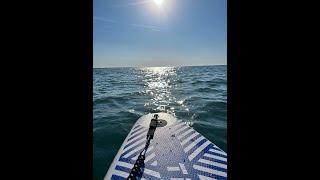
To see today's photo, go to mt4christ.org or follow me, M.t. Clark, on Facebook or Twitter. Good morning. Uh, today's photo of a paddleboard following a sunshine pathway reflected on the waters of Portsmouth Harbor in the United Kingdom comes to us from a pastor friend who incorporates exercise, nature appreciation, and prayer as an immersive spiritual practice that that involves body, mind, and spirit, and who shared this photo back in August of 2022. Well, it's Thursday, and as is my habit, I share this water and sunshine pathway as a visual representation of the pathway of Christian discipleship and invite all who read or hear this message to take the true path less traveled by putting your faith in Jesus Christ and making the daily decision to follow him. And to make your life an all-encompassing, immersive expression of your faith. I took 10 hours of Tuesday to do a retreat in my home, fasting, praying, and absorbing John Eldredge's book Resilient, and I'm currently on day 2 of his One Minute Pause app's program, 30 Days of Resilience. And I am enjoying the process of renewing my intention to follow the Lord in all things, as I unwittingly took a break from my morning prayer routine during my recent holiday staycation. One of the nuggets of wisdom that Eldredge shared in Resilient was the mistake that many people are making is trying to figure out how to fit a little more God into their crowded lives. And he suggests that we do the opposite. We should start with God. We should center our lives on him and work outward from there. He suggests that we, that we call this new reorientation the new monastic Catholicism. As someone who has had the intention to surrender to God's will and has increasingly done so for over 12— done so over the last 12 years, I can relate to this idea. After my divorce, I thought of and only half-jokingly referred to my place down by the river as Monk House because I decided that since my faith and decision to follow the Lord was a major factor in the dissolution of my marriage, I wasn't going to waver in my commitment to, to follow the Lord, and I was prepared to live the rest of my life alone. I never dreamed that the Lord would bring a Christian woman into my life who would accept me and the way of life that I have chosen by following the Christian Disciples' Path. So what Eldredge calls the new monasticism, I— is what I call the path of Christian discipleship. In Resilient, Eldredge encourages his readers to write a prescription for their new God-centered life, to imagine what your life would be like if, if you reoriented your life to follow your spiritual aspirations and to actually implement them. But Eldredge also recognizes the reality of life on Earth and the necessity to deal with our responsibilities, and suggests that whatever plan we decide to make to make our lives of faith an immersive experience, that we make them realistic, a plan that we could implement that would not disrupt the needs to meet our responsibilities, but that would change our default responses from worldly to godly. So is this path all praying, fasting, and Bible study? No. Although I believe I would be leading you astray um, uh, if I didn't say that traditional spiritual practices such as prayer, Bible study, worship, praise, thanksgiving, fasting, solitude, silence, meditation, service, and mission are not important. These practices are proven, uh, to be used by the Lord to transform our hearts and minds and cause us to know and love him more. Um, but there are the normal activities of life and the meeting of our physical needs and responsibilities that also need to be met. One day away from my 10-hour retreat, I was excited to consider the possibilities of what I could do with my evening hours as part of this new intention to use that time as part of this new monastic lifestyle. But while certainly not perfectly spiritual, most of my evenings over the past year have already been dedicated to the things of God, as I have had my schedule filled with different activities surrounding my overall ministry of encouragement, activities at my local church, and the volunteer work I do for Freedom in Christ Ministries. My dance card was pretty much full in 2022, and I already see that the calendar is filling up for this year. The only shift that I will need to make is to make the wise decision to use the few days that are not full to find my rest and comfort in doing just that. Resting. And when I feel the need for entertainment, to remind myself of how the things of God renew the mind and feed the soul, um, where secular entertainment will either cause you to long for the things of this world or prove to be unsatisfying. But we have to keep our prescription to this new monastic life realistic. We also have to take care of our responsibilities around work, family, and make and the maintenance of our home, which really encompasses the spiritual practice of good stewardship. So even though I imagined absorbing more Christian teaching or entertainment last night, I felt the pressing need to clean house in terms of the data on my laptop, producing 394 blog posts and the audio and video files from— for— for MT4Christ 247 podcast and YouTube channel creates quite an archive of media. And with the new year begun, I decided to back up these data files to a hard drive to keep them, but to free them from my laptop's memory. So after dinner, I sat down to clean house, and it took well beyond my normal bedtime to get her done. So much, so much for rest, but it but it is finished, and I am glad I completed what I thought of as a responsibility to attempt to keep things running smoothly for another year of encouragement and to protect last year's work from any unforeseen data disasters. But as I was doing it, I had to wonder why I was doing it. My exposure to Eastern mysticism, Buddhism, and my past impressed upon me the idea of imper— Impermanence, as that philosophy of suffering looked unblinkingly at the harsh reality that this world is passing away every moment. If we look at history, we see entire civilizations have passed away and only a few relics exist to tell us that they were even here. As much as, as much as large temples and ruins can tell us of the society's existence, and the artifacts can tell us who was ruling, what of the common people and their stories? Very little evidence exists to tell us about them. So I, so I know this: it is doubtful that even our descendants, our great-great-grandchildren, will remember us. And what if you don't have kids? Is our keeping photos, mementos, family heirlooms, or data files all just pointless? In the natural world, it very well may be pointless. My hard drive will probably become obsolete or fail over time, or just get tossed out in the trash at some future date. When we think of that and the impermanent nature of the world, it's depressing, tragic. But God, right? Haha! Because of Christ, I'm gonna live forever. Gonna live forever. Yes, my keeping my files on a hard drive might be might prove to be a silly waste of time in the grand scheme of things. But even those that— even those that backup— even though that backup might fail me, God never will. Even though, not those, pardon me. The work of God indicates that Christians will live with the Eternal One forever. And as our memories and files— and as for our memories and files, God is omniscient. He knows everything. And while he won't hold our sins against us, he remembers everything. So if we even get a small piece of God's wisdom and omniscient nature in eternity, we could not only be blessed with total recall, being able to remember all of the moments of our lives with a photographic memory, We will also be blessed with the ability to know what was worth remembering. The things that we think are worthwhile or important now about our worldly lives and our past may prove to be something that is best forgotten. Uh, and that's why we should embrace Eldredge's suggestion to live a God-centered life. God is the one that matters. His wisdom, his knowledge, his ways and His love are the things that will carry on forever. And so keep walking and talking with God and try to let go of the things that will not last and pursue the one who will cause us to prosper and thrive for all eternity. Well, my time is short this morning, and so we will not be sharing a Bible verse from the New Living Translation Bible Promise Book for Men, but we will share one— we will try to share one tomorrow, um, from 2 Timothy. I knew what they were going to be, but I, I couldn't comment, uh, in the time allotted here. So we're going to share tomorrow, maybe. But we are going to share from A.W. Pink's Sovereignty of God, uh, as we are continuing in chapter 1, um, basically where he is speaking on that, uh, God's sovereignty in the exercise of his grace. And so that will conclude chapter 1 of his book, The Sovereignty of God. And if you want to read that, that'll be on the end of today's blog post. Well, time is short, so I'm just going to pray and encourage everyone to check out the MT for Christ 24/7 podcast and YouTube channel for all our discipleship teachings and all our encouraging messages, um, and whatever else is out there. Bible studies and studying Dietrich Bonhoeffer's discipleship are all available. But let's pray. Lord God, Heavenly Father, thank you for another day in your kingdom. Lord, we thank you for for you. We thank you for the life you've given us and the, the fact that we will go on forever and that in your kingdom nothing is lost. Um, when we come to you through faith in Jesus Christ, we go on forever, and our family and friends who've gone before you and followed you will be there waiting for us. And, you know, nothing will be lost. Nothing of value will ever be lost in your kingdom. So we look forward to that, Lord, and we let go of the things that won't last. But we know we have to meet our responsibilities today, even though our secular jobs might not amount to much, um, in the eternal scheme. We have to meet our responsibilities and do it in the fashion of a Christian. So we're going to do our best today. But Lord, we need you. And that's why we're praying. Lord, we just pray for you to go before us today, and we pray for you to bless the people who might be listening or reading this message, that they would be blessed, that you'd come alongside their prayer request and help them in their walk. My prayers go out to Bob Griffin, who just posted dealing with pain and his encouragement to go to the Lord in prayer to— in times Bob's going through cancer treatments, and I thought it was absolutely spectacular that Bob was, um, you know, back in the swing of things in terms of sharing an encouraging message via his Instagram account or whatever he uses. But, um, it just shows me that, you know, our faith is the most important thing about us. You know, Bob doesn't know what his future holds, but he knows what's important— the Lord God Almighty. So we pray for Bob today. And we pray for all, all of anyone who might be listening. And Lord, of course, we pray for you to go before us, uh, in our daily walk, that you would guide us and protect us and lead us in the way we should go. Open our eyes to the things we need to see and help us to best represent you here on the earth. Lord, you're the thing that matters the most, and we want to just be with you in every way we can. So we pray for that. And we, we must tell you that we, we praise you, we love you, and we thank you, Lord. And we pray all these things in the mighty name of Jesus. Amen.
More from M.t.




Making Too Many Mistakes and The Mercy of God’s Grace and Favor - Purity 1811






