FDE Epi : 11 | AI Crossed Multiple Red Lines | Weekly Intelligence Roundup
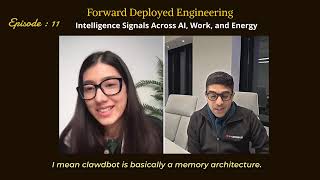
Muhammad Umar and the host examine recent AI breakthroughs crossing critical lines: autonomous agents deployed as full-time digital employees, AI proving new mathematical theorems, and billions of AI-generated images flooding the web. Energy has become the new bottleneck, with Microsoft and governments racing to power AI infrastructure, while geopolitical tensions over chip access intensify between the US and China.
Chapters
Hi everyone. Welcome to the code ninja spaces. It's our 11th episode today. So let's start with the news. So the signal one of the day is that math is crossing the human frontier. We have seen AI write code generating images, but now it's contributing to the pure math. What happened basically this week even surprised mathematicians as well. David Vikil is the leading researcher and the president of American Math Society. He recently shared that he experiment in AI system that helped him prove a new pure mathematical proof. And he was, even though sharing that he's unsure that even he could do that alone ever. So what's your take on it, Umar?
I think we've been talking this a lot in terms of AI for scientific research or AI for math. In the last two weeks. What we have seen is AI have discovered new Bellman function. AI is solving GPT 5.2 is solving ERDO's problems. So clearly math is now a promptable commodity. I would say it's not that complex function anymore. And by the way, I tell you, the math that we know, Rafa, I mean these symbols and all that and this formation, this compression, these equations, they are not very old. Like, I mean 400 years back, the natural way to express thoughts, even in the digits and forms was not. Well, was a natural language. It's like if we go back 500 years, the math was different than it is now. And Robert Penrose was saying about math, like what's so special about math? He's a Nobel Prize in maths and he was saying this, that you can explain extraordinary hard problems in a very simple way, right? So for example, if you think about what is, I mean, what is this tissue box? And you say okay, it's something, it's, it's made of a plastic or paper. And they say okay, what is paper? You say okay, in the paper there are like, as you deep down, as you move further, you would say okay. Then it's, it's made of electrons and protons and okay, what are electrons? And then there are quarks at this level, at the level of electron. You can't explain this further than what does it mean? Even you say okay, something that satisfied Drac equations or something like that, right? So math is not something out of this world. Math is basically just a way to explain an extraordinarily complex behavior of the word. Down to the very, down to the extreme precision. That's what math is about. So I've just said, for example, you can't explain what is electron, right? You, you would say something like okay, that satisfied Dirac equations, right? Now this form of thing, when you see math from this lens then you say okay, why if air solved language, right? Math is just another language. Why it wants solved math. So yes, I mean if you. And then there's so much money that is going into it. Harmonic Labs have invested close to $300 million I guess to solve millennium price problems like Hodge conjecture or Rayman hypothesis. So it's not just that some, I mean there's so much money that's going into it. So yeah, I mean it's, it's fun to be, to see how it's fun to see what are the things that we don't know and which probably now math would reveal to us. This is very important. Take, I just want to take a segment. It's very important. So they are math savants. Maths events are basically people. Savants are people who are basically mentally challenged in some other form in other ways. Like people who can't talk, who can't listen, who can't walk. But there are certain neural circuits in their brains that are extremely active when it comes to maths. Right. So go study math savants as well. So what we have discovered with AI is this mathematical function of how human brain works. And now I think it's a matter of time will bombard it with certain data. We would innovate around it and you would see that we would solve some extraordinary things.
But do you think AI is expanding beyond the human knowledge?
So there is one experiment with a GPD style thing that a guy basically took all the data up to 9001900 and the 1900 was a cutoff. And then it asked the GPT to see if it can predict the theory of relativity. So it didn't. So yeah, from that standpoint, if you see. So it didn't predict the theory of relativity. I think it can because I generally think even the consciousness is a mathematical function, right? It's a function of math. It's just, I mean there's a company called Logical Intelligence. So one way of, I mean this whole breakthrough where AI saw language was when Ashish Vaswani and a group of people solved attention is all you need. There was a very famous paper, very simple paper in Google. They wrote that paper and then the birth of Transformers. So that was one way of doing it. But there is another company called Logical Intelligence. That's basically how measuring AI with energy based functions. Right. So there's another approach as well. So a lot of things are going on around AI. So I think you would see, especially this year, it would be bumpy, but it would be very exciting. See what has, what's happening to cloudbot. Cloudbot is basically a memory architecture. It never misses the contact. But this kind of tool use, when you connect with even an existing opus 4.5 and you see things that were not possible before. So I think you probably don't need that much of a research innovation. You just need better engineering and plumbing to make all this work.
Exactly. Claude is getting in crazy. I'm just waiting for the cursor updates as well. So moving on to the second news of the day is that the workforce is becoming synthetic. So what happened this week is that a startup like Atom are launching fully autonomous AI agent as an employees. These are not only copilots or tools, but they are specifically AI agents that will build and scale businesses end to end. At the same time, even those platforms like Salesforce are positioning AI agent as an out of the box digital employees. And I personally believe as well that sooner we're going to have AI colleagues sitting next to us as well. So as in founder and business, what's your take on it? AI as an employee, it's going to happen.
But I'm not sure if a new startup would be able to survive this because what cloud cowork is, what cloud bot is, these are the AI agents. I mean, why do I need a separate team to make it work? I think the real thing that that's, that's required is, I mean it's great that all these startups are spinning up, but I think what we need to solve for is data sets, national level data sets, breakthroughs in science, those kind of things are required. More tool use, setting up AI agents who can be treated as full time employees and digital agents or whatever, I think that would be an easy. That's already happening if you are using cloud Cowork, if you're using cloudbot, you know, I mean I don't think that's something so interesting.
Got it. So the third news of the day is related to the privacy. Privacy is becoming a premium feature. Before recording this podcast I have seen a long tweet as well. He's saying like WhatsApp is not holding the privacy even signal as well. But this week what happened? The founder of the Signals Moxie Marlinspy has launched an AI system that is designed specifically AI system that is designed to be cryptographically unreadable even by its own creator. In simple terms you can say that AI, it's an AI that that is not Even readable by its own creators. So I think who can read that.
When it comes to security there are two, three things that we need to think about. One is straightforward. So for example, if you let loose cloudbot do everything for you and expect you expect something extremely scary can happen to you. So for example I posted earlier today that don't give Cloudboard your checking account. Everything else, everything else is fine. So that's one kind of security. You need to be very careful when you club thoughtboard with models like this and let them lose on everything that you have on your machine. Then of course they will do things that probably won't happen and there's no security for that. So that's one thing. That's one kind of security. The other kind of security is. So for example, if someone is thinking about if an enterprise, if a bank is thinking about cloudbot and by the way there's a huge opportunity here. If a bank is thinking about deploying cloudbot they won't deploy it. But a company like Code Ninja other companies, right? There's a huge opportunity and we're already doing it by the way. Huge opportunity for people like us to harden cardboard for the enterprise reliability and security. Right? So that's the second thing when you think about how to make these things and that is crypto graphic about you said yes, even today's security levels cannot be. I mean most of the, most of the things around security are the lapses, right? It's not like that someone had there. There's always a flaw in your design where someone just sneak into your system. But when it comes to quantum all of a sudden most of your cryptographic techniques they just become obsolete. So but we haven't seen any recent quantum innovations that are of this scale that we. Because if quantum innovation happens to. If what's happening to AI if that starts happening to quantum most of your banks won't exist today.
That's fair enough. So our fourth news is related to the creation is scaling vertically. There are three news that is betting this news over the past few months Google revealed that one of its initiation model has generated more than 1 billion images in just 53 days. So the second thing that backed creation is scaling vertically is that new images models are maintaining consistent characters across multiple scenes. Something that was nearly impossible recently and before third backed is that creation scale vertical is the Meta glasses that you are wearing right now as well. Meta is scaling smart glasses production to tens of millions of units per year. That's huge. So what there's interesting question to ask from you as well that what happened when machines can generate more content than humans can consume even.
It's a challenge. It's a challenge. I mean we are just, we were just recovering from social media and now this AI is happening. So when you combine AI with social and then there's another element with technologies like blockchain, it, it just, it just becomes. I don't know what to make of it. So yeah, I mean think about it. Like with content creation is. So let me give you an example. So we create this content. We every week we talk a lot. We do this unscripted podcast. And you know, I was talking to Merhan and he was saying like he wants to work on these shorts and wants to really make sure that the shots gets better and all that. I said like in Streamyard, we use Streamyard. In Streamyard, if you. For every podcast, they are AI generated shots. And then Steamyard makes, if you are doing, let's say 50 minute podcast, Steam Yard makes eight, nine or maybe 10 shots that Steam Yard thinks are good enough. And then Steve yard tags it, right, that these four shots have the probability to go viral. It just selects the certain titles for those and you just need to take them and upload. So if you. So what we found was like the shots that AI generated for us had far more views than the shots that our dedicated team used to create. So I think this is a dashboard. This mind is a dashboard. Don't think that you are very special. Right. AI is insanely great in tool use, in editing, and in doing everything you think you do. Our job now is in terms of content creation, whatever is to come up with truly original ideas and holding on to a certain level of mission or vision. Otherwise there's a lot of chances we go off the track. So yeah, I mean, I think how to think originally would be an extraordinary skill down the line.
Exactly. So fifth news is related to the compute. We really discussed it. Just like math. Energy is the new AI bottleneck. Bottleneck. AI companies are now investing a lot in the infrastructure. What happened basically is that Microsoft has hired hundreds of energy specialists and is committed to paying for a full power infrastructure. Governments are planning nuclear reactors for the moons. At the same time, there are some startup ones. Startup is giving energy through near infrared lasers. So it's not all of a sudden, but AI companies are getting obsessed with the power grid infrastructures and Reuters.
So what do you think AI is Energy. I mean we've been talking about this like AI is the innermost loop of AI is energy. And it's not very hard to understand. So lots of data centers powered by these very straightforward things. Not that hard to understand those things like connecting with, connected on the network. But what really you need is energy. One of the things in US that's driving this push is a competition with China. China somehow in the last 10 years has done an incredible job in bringing solar into the grid. So they have, their home users have deployed lots of solar, so their national grid is free now and they're deploying all that into powering their AI systems and then they are far ahead as compared to America when it comes to nuclear. So yes, I mean, in us our speed is a bit slower than China. And by the way, it's a challenge, it is the biggest challenge for us in the US now to how to come up with this level of energies. I mean, and when you see, I mean if you, if you use cloud or if you use cursor or any, I mean, I mean we normally use coding platforms for, to build lots of code. But yeah, I mean, if you're using, let's say cloud, cowork or if you're using chat. For me, my limit hits even at the max package. I just end up my limits in days, right? I mean, people who have lots of ideas, who are doing lots of work, no amount of tokens are enough for them. And what are tokens? Tokens are the manifestation of energy in the data centers. So yeah, I mean, I think when I use these tools, I think I need a lot of them. But then, I mean, and by the way, people who are using, let's say Claude for $200 max offering, Claude is getting a lot of hit out of it because Claude is, it's a bad deal for Claude. But yeah, I mean, that's what it is. Bad deal is because energy is so expensive.
So our sixth news is related to something we'll discuss right now. Silicon sovereignty is the new geopolitics. Despite being banned, US putting on Nvidia and other sellers, that Nvidia is selling advanced tips to China. Meanwhile, on the other hand, China is imposing its companies by law to use domestic alternates. But as we are seeing the race of AI. So why is every country suddenly being obsessed with the AI race and getting advanced on chips as well?
So first of all, I just want to explain chips and code and knowledge work, how they are connected. So if I was reading Amir Sen's book, right, and it was Cybernetic Society and it starts from a very profound few lines, I mean, very profound mental model, it's Just like code can root in any physical machine, that it runs on any code. Right. And he says like anything that mutates physical matter, it generates on top of it, generates code on top of it. And that code also represents the internal organization of the matter it works on. Right. So we need to think of knowledge, work and system not as a software and hardware, but as a computing machines. Right. So think of it like neural neuron firings in your brain are very much physical phenomena. Your thoughts are very abstract. Right. But can you think of thoughts without neurons firing? No, I mean, they're not. They're not. You've got separate them. They're one. Right. Your thoughts represent how your neurons are being fired and arranged. And your, the way your neurons are being arranged, your thoughts are made out of it. So we need to think of these as one computational machine. Now hardware is part of it, chips are part of it. Chips is basically the phenomena where you mutate physical matter. So we need to think of all this AI, all this software is part of that computational machine. So that's one thing. I just wanted to establish that and I recommend everyone to read that book for me, Roushan. And it starts with this code consciousness and control. And it says it's basically a spectrum and it's the same thing. Right, so that's one thing. Now coming back to the chips. Yes. I mean, this war is heating up. What China figured out was like, I mean, they can make lots of chips, probably not at a level that what Nvidia does, but then what they can do is they can come up with a design where maybe 20 chips of Huawei would be one chip of, let's say, Nvidia. Right. So, and it would perform at the same level. So that's what they are thinking of. Like they were short of chips previously, but now they're not. And Jensen talked this, said this like if you think. And he said like chips are pretty much a manufacturing business. Building chip is a manufacturing phenomenon. And if you think China is not good in manufacturing, I think you're absolutely wrong. Right. So, yeah, I mean, I think this is what Chinese governments are thinking. I guess.
Hyper is a composable wipe coding platform, or as we like to call it, CVC platform to help knowledge workers build internal tools faster and better. So rather than scaffolding the entire solution with AI, Hyper helps build blocks of code through automation and then use agent AI orchestration to help stitch all those blocks of code to give more deterministic internal AI tooling you can trust. So essentially it's a better way to build custom tooling or custom software. The idea is to web developers use the AI tools maximally in a one unified workflow. We built agents like business analysts to help developers room the requirements and then we build data modeling and to transfer those requirements into a concrete data model. Then you bring all those things into hyper AI studio where you build tables, hook the databases, build MCP tools to hook with a bot code and build custom workflows all using hyper AI.
The idea of Hyper A AI should.
Land up at a point where helping organizations self build their internal software systems rather than outsourcing to services vendors and coming up with a platform where the entire solution can fit into a mind of one developer. Both seemingly different ideas come together as one holistic outcome. So it has a dual use and I think it's much better way to build software where you're not outsourcing everything to the vibes and we're not only using hard code to generate all the things, it's basically a spectrum between vibing and architecting software. It's a new plot of work that we call composable white code.
Exactly. So previously we used to heard about SaaS software service. Now we have intelligence as in service intelligence is becoming a subscription. What happened? Basically Tesla has tweeted their one time purchase of self driving full self driving services. From now on, on every update of intelligence they're going to have the customer going to pay monthly. And similar pricing models are operating in different industries like logistic robotics and automation as well. So why is intelligent turning into a subscription instead of something you can own?
So I mean clearly. So on this topic, I mean this year in CES it was all about intelligence as a service or physical AI as a service or atoms as a service. So I'm not sure about why Tesla is. I mean of course I'm not part of the strategy, but one thing I'm sure of is like Nvidia for example are building these vertical capabilities where they're offering these full self driving systems and capabilities to the OEMs. So they've launched new physical AI systems, new models, language models, they're trying to plug it with Nvidia Cosmos and they've brought their CPU and GPU in a stack in a way that any OEM can build their FSC systems or on top of Nvidia stack. So the competition in this part will be tough. In terms of when it comes to physical AI, we talk about physical AI, fsd, full self driving. This is one example of physical AI. So I was in Riyadh last year in front of my hotel there was like Riyadh Rail there was a project and when I went in Riyadh in January, the train was doing these mileage because it had to complete certain miles before they make it to make it available to the general public. In January it was doing this. Last year, January it was doing this. And in December it's been two, three years it kept on completing those miles. Think about like what can we do? What kind of physical simulation systems we can build that we don't need to do all this in production actually and waste three years. Okay, Saudi maybe have funds to spend. But think about time, three years time like what we could have done. So these are all physically limitations and opportunities that businesses can build. And they don't need to work with companies like Tesla. They can just spin up all these capabilities on top of Nvidia stack.
Interesting. So our news is next related to the medical health in US as well. That medicine is becoming a software. It's not something new, but it's getting very efficiently day by day. US are preparing the pathways for AI system that don't just assist Dr. But also make legal decisions, including prescription as well. So at the same time the medical AI models for the image, diagnostic and coding are getting clear through the regulations of the medical as well. So are we very close to AI doctors prescribing medicines?
I think, I think, I mean it's AI doctors. I mean of course at some point we'll see a doctor, but currently what's happening is these things, these regulatory industries are dependent a lot on the data. So there's a company called Open Evidence in America. I think 2/3 of American practitioners are using open evidence. It looks like ChatGPT. It is ChatGPT. It's interspaces ChatGPT. But it works for the practitioners because it's trained on that very specific evidences. It's called open evidence, right? So think about like a chat open evidence with that's a 3.5 capability is equivalent to ChatGPT 10.10. The reason for it's very specific, right? So currently when we think about healthcare and by the way in a matter we talked in one of our podcast previously was like in US rather than building first AI doctors really think about how can we build capabilities like open evidence, right? That's one thing. And second thing to think about, if America spends $14,000 in terms of its spent per person, right? Europe spends around 4,000 USD's and if you really see that 40% of that $40,000 that America spends is Netman cost. Right. That's the cost that can be replaced immediately with AI right. Rather than you start building AI doctors right. Go for adopters but currently use like open Evidence. These are the areas we need to think about. Right. How can and that's basically how we can create data sets in ways that power these models like Open Evidence and create value for the doctor. For example, think about what kind of admin work that we can automate with cloudbot and plugging it with language models or open source models, whatever. There's lot of engineering and plumbing that goes into make AI work and by the way coding I mean we built. We're building a product with multiple products but one of the coding that I'm passionate about is passionate about make AI work for the customers. Everything it's not about services or product it's about. It's so much plumbing that goes into making AI work. I mean we've hooked Claude into automate most of our sales workflows right now but there's the kind of linking engineering that's required for example even just to make cloudbot hard enough that we can secure and reliability and security. It takes a lot of effort and lots of engineering and lots of plumbing. So when you think about that thing like how to make this work right. Rather than thinking about how AI doctors will come in. Lots of hype by the way at some point it would happen but I don't think it's.
It's maybe next six some another way ChatGPT is doing that a little bit. A little bit but it's doing that from.
At a moderate level.
Yeah, at a moderate level we can say that. So last news of the day is related to the human capitals being real. This is something not very great as well in 2025 alone nearly a quarter million take workers were laid off global at the same time governments and institutes are moving more towards building smaller AI specialized team as well. So what was your take on it but two may take laugh at least single Is it something being collapsing or.
Disrupting I would say find a government job because the only job that's there is a job in government. No, I think yes we are going to end in unprecedented times right. This year would be extremely bumpy at this stage today if no further improvements happen with just to make our work just to make sure that tools are cloud bought and others they can take lots lots of the workload in the organizations. Right. It's an adoption thing. It's not a think about like what you are doing, you're editing your content like you're using card co work, integrating cls, integrating level apps into it, integrating remotion and then just using your chat to edit a a professional grade video, right? You're not using Read IO, you're not using these other tools, right? This can happen with every, everything from every knowledge work. Every knowledge work. This, this would happen. This is a very interesting take. Like it's very very important. US spends US software spend is 1% of the total GDP of the US right currently US knowledge white collar knowledge work spend is 20% of the US GDP. What do you think? What would what is going to happen to that 19 extra percent? Software is going to take that 90% and how many jobs can't even imagine 19% of the GDP is being replaced with the software. So that I mean. So I think one thing that I talk about with everyone is work. I mean become roomy because I think the pure thing currently everyone needs to do is come up with truly original thoughts, truly original ideas. And that's not going to happen if you keep on thinking outwards. You have to think entirely what kind of new ideas you can bring to the table. And every, every idea execution is one short of it. Right?
So that's it for you today. Thank you.
More from Muhammad






FDE Epi : 16 | AI Agents, Billion-Dollar Infrastructure & the Future of Intelligence




