The GCC Pod Ep 1: C++, Self Driving Cars, Global Capability Centers, and Perception
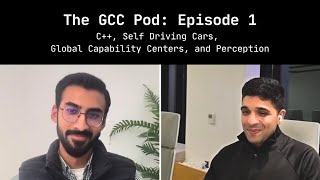
Muhammad Umar argues that self-driving cars are won through a "systems race" and a "data race," not a single AI breakthrough. He explains how Global Capability Centers in Pakistan can build simulation environments and safety software for Western automakers, giving them an edge over Chinese competitors in autonomous vehicle development.
Chapters
Before, before I jump into this next question, I wanted to level set something right when, when most people hear self driving, right. They picture, you know, flashy AI breakthrough. But I think what I find interesting is, you know, reading up to this conversation is how different the reality actually is. So when people hear self driving cars, for example, they think sensors and AI models. But McKinsey frames this as like, as, as a, as a systems problem. So I want to ask why is that distinction so important?
Okay, so I think self driving cars, often I talk to a lot of data teams who are actually working on autonomous fleets and one thing that I get from them is like it's not as a single AI breakthrough problem. So in reality there are continuous systems engineering challenge. So you're dealing with perception, prediction, planning, edge compute, cloud, orchestration, safety, validations, compliance, all running together. That's important because system problems scale through people and process, not just algorithms. And when you set the autonomy this way, then you realize this is exactly the kind of work that perhaps can be distributed across continents, across the teams. So I mean if one team is working, let's say on edge compute, another team is working on planning, another team is working on perception. So that's for example, the whole idea. When for example, some reports suggest it's a system problem and it can be solved through processes and people. And that's probably we were discussing the other day like why GCCs or global capability Centers, an ideal use case for achieving autonomy and self driving systems for America and for the companies who are trying to achieve that in Europe.
Yeah, no, and I like that because what I'm basically hearing is that it's less about like a single moment of intelligence and more about keeping a very complex system, keeping it behaving correctly over time. Right. And if we accept that framing that you just walked us through, what I understand is then this is a systems race, not a model race. Right. And it immediately pulls me into thinking about and asking if autonomous driving is then a systems race, how does this connect to for example America's competition with China?
Just to add on, of course it's a system race. But just one thing on top of it, it's a system race and it's also a data race. So we also need to, I mean, Andrej Karpathi had this incredible talk where he explained how software 2.0 is eating software 3.0 and he gave the example of FSD, Tesla FSD. Like how I think millions of lines of code got replaced with few hundred thousand lines of code. The reason is that Is like that hardcore business, that hardcore logic is now being replaced by pattern recognition. So how this is possible is it's also a data race now. You have so much data coming in now, your neural nets and all those algorithms just perform better. So it's a system race, but it's also a database. I always think of, I mean it's been 10 years Venmo has been hovering around San Francisco trying to get all the data, get their perception prediction right. And I think is there another way to do it? Let's say what does it take for us to do the same thing that for example Vemo has done for, for a decade, if we have to do it in a year is the other way. And often think, I also think like, I mean in if because of the laws in US some lots of drug discovery companies are not going outside America, South America, South Asia, because the laws are not strict there. They do their all testing there and then bring back the final product which can be approved by FDA in the US And I always think that probably the same thing perhaps can be achieved through, I mean by adjusting the neural nets of the model offshore somewhere else, maybe Chile or somewhere else, India, Pakistan, and then bring it back to us and then achieve the driving. I think that's something we need to think about like why somebody's not doing it.
And I also think like, you know, it's kind of like moving from looking at it just from a tech lens to also like a geopolitical geographical sort of lens. Right. And I think that, interesting points you raised because at a macro it becomes then more about speed through centralization instead of like, you know, creating this resilient system through just focusing on collaboration. So I think that's, that's, that's an important point to raise and that then you know, thinking about this from a, from a geographical and a geopolitical standpoint, by default, you know, most GCC conversations they tend to default to India. Right. So you mentioned Pakistan. I'd love to hear your perspective on this. Like where does Pakistan realistically fit into this entire picture?
India is great, I think, but I think the kind of transformation the world needs, especially the what America needs, especially, I mean if you're going to compete with China, India alone, I doubt India alone can serve that much demand. And I think, I mean we've built coding out of Pakistan now of course we've grown to other parts of the world in America and Chile and all that. But I think when I see Pakistan's systems engineers, mathematical and simulation talent culture working under constraints. I mean, I think this is a huge opportunity and that which we are trying to achieve and what we're trying to do is like how can we help some of the most important businesses in America to have this unfair advantage of bringing Pakistan into the picture. Setting up the GCCs in Pakistan for Frontier Tech and we have already set up global community centers in Pakistan where we're serving both, where the same business has its GCC in Bangalore, they have another GCC in Lahore, then another GCC in Romania. So I think the kind of software, the kind of software people we need in the next five to seven years to transform our workplace in factory floors, to transform to integrate AI systems into American workplaces and factory floors and the kind of problem we're trying to solve is absolute and especially to compete with China. Absolutely. I think Pakistan can play an incredibly important role and that's what we are trying to do and what we are doing already. So yeah, I mean I think it's an incredible time to be alive and to be a software engineer in Pakistan.
Yeah, yeah. No, I think that the distinction that you're making here is very important. It's more about, you know, you talked about businesses having GCC in India and then as well as in Pakistan. Right. So the distinction I think that's important to highlight across that is that it's almost like approaching it from the point of view of like it's complementing each other as opposed to replacing. Right. And I think that that feels very important across the conversations that you're having. But I'd love to sort of, I'd love to also sort of make this a little bit more real. Right. So for example, like give me a concrete example, right? What would for example a self driving GCC in Pakistan today actually do like day to day, like what would that look like?
So I am part of some work where it's incredible that that kind of work is happening in Pakistan. So and most of that work is around three things. Building large scale simulation environments. That's one, then maintaining what should I say, word models and digital twins and then H2 cloud orchestration software. These are the continuous safety and failure testing is just whatever coming in my mind. So I've seen, I'm part of some of the work that is currently happening in certain parts in Lahore, in Karachi for businesses in Germany and America. So I mean these are some, this is some actual work that's happening here and I think we should just tap, we should tap this opportunity because I've seen also I mean of Course we have more bias towards, I mean bias what like, I mean we want to make sure that America wins this AI race. And I've seen a lot of Chinese companies have started to tap into this opportunity and I think, think we should. What I talk to my team is like we need to scale faster. We need to make sure that we help important business in America to get advantage of this as soon as we can. And then as I said like building all those systems and teams, achieving all these, this, this level of performance, you need to set up your global capability centers, captive centers that just own certain parts of the technology and then deliver. Right. And it's very important. One thing that I think is very important is like most of the people think of when we talk about global capability center think of like probably it's that we need these engineers, let's say C engineers, a lot of C. I mean the people I work with, they mostly are C engineers. They're still writing C. Right. And I asked them like just on a side note I asked them like do you think AI taking away your job? So like I don't know how rapid is going to do what I do with C. I'm not sure. But anyways, come back to the point. It's not about that you need 100 C or C engines, of course that's important but it's also about owning that outcome. Like you can't just deploy the team and let the. I mean GCC needs to own the entire outcome of that thing. Right. And it should be outcome driven rather than it should be just talent driven. So that's, that's the most important thing. And especially if you are working on frontier tech like self driving systems or if you're working at, let's say some, lots of blockchain work is now starting to happen here in kli. So you need to make sure that you need the outcome. And what I've seen is more and more that now engineers, teams, product managers, project managers, they're incredibly good in the last. They've gained so much experience and now the talent landscape is just ready to solve these frontier tech problems.
I love that you kind of positioned it as owning the outcome. So that kind of makes me think of how to frame.
When I talk to CTOs and sales every time they say, I mean when we started off working, trying to solve this GCC problem, that was very clear from the day one that we need to own the outcome rather than just own the talent.
Yeah. So it's thinking about it from that perspective. Right. It's a different lens to look at it like framing them as problem centric GCCs essentially that are problem focused.
I mean everything has to be problem centric I mean from last I think I don't know and by the way I just want to add on this like if you think I mean there are lots of software jobs that are not required anymore let's be clear, right. I mean if you still think that you would be just deploying some team and talent and that's not going to happen anymore those jobs won't exist at the first place. Right so and that's good that the talent landscape at least in this part of the world and they're aware of it because what I've seen is like most of the work that historically was being outsourced to these locations I mean even in case of gccs is now I mean I can tell you they can be achieved if people doesn't they can be achieved incredibly well by codecs if you are if you want to write some level of code codecs or Clark but even doesn't want any code then use Replay Hyper. So yeah I mean this is a new kind of work. I mean that work we are talking about it's a very different kind of work where you need to own the outcome. We should be good hands on engineer and you need to know how to for example use lots of tools. You need to be aware of how to use the tools maximally and probably what historically being done by 10 engineers and a team probably you are the only one who's going to do all that. So the question that whether you're a full stack engineer or not is now you are engineer or not because if you're not full stack you're not an engineer. So now that's given that's given in JCC but I think there's so much work so much that that's now we can solve that previously was not possible and that's why I think there will be lot and lots of more jobs but those jobs will be different, very different than the kind of software engineering job that we have probably now or maybe six months back. So yeah so just to answer your question.
More from Muhammad






FDE Epi : 16 | AI Agents, Billion-Dollar Infrastructure & the Future of Intelligence




