The GCC Pod Ep 10: Sovereign AI: Compute, Energy, and Infrastructure
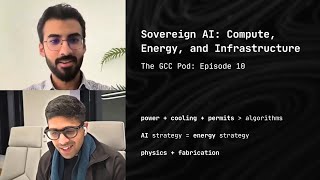
Muhammad Umar and host SPEAKER A discuss how AI is transforming global capability centers from cost-cutting back offices into research engines that own proprietary data and custom models. Energy and compute are now the bottleneck: massive AI models demand unprecedented power, making control over data centers and electricity the ultimate strategic asset. Companies still treat GCCs as ticket factories instead of outcome-driven engines, a costly mistake as venture funds pour billions into AI infrastructure and deep-tech corridors.
Chapters
Every week, my colleagues and I unpack what's really happening in the world of global capability centers. We're living in unprecedented times and most businesses aren't ready for what's coming. Many mistake using AI for simply adopting tools like ChatGPT without actually thinking about how their organizations operate. For example, how Ashish Vaswani has built R and J model, their first open source model, described as a world class 8 billion base plus instruct pair. Or for example, how companies are setting up their entire data value chain to acquire highly specialized expert data sets by setting up global capability centers in South Asia and South America. The real shift is happening elsewhere. Some companies are building their own models, others are embedding AI deeply into custom workflows. But many are securing long term advantages around computer energy, data and most importantly, access to global talent. At the heart of it all is this. The future belongs to companies that can tap into the world's most capable, ambitious and underutilized talent pools and turn them into a strategic advantage. In the GCC podcast, I sit down with operators, founders and leaders to explore how the world's most important businesses are building global capabilities centers not just to cut costs, but to acquire proprietary data, develop custom AI systems and transform their products, services and workplaces into truly AI native organizations. This is a podcast about how global businesses are being rebuilt from the inside out. So Meta platforms has announced 115 to $135 billion in 2026 CAPEX. Okay. And it's going to be focused on AI data centers, custom silicone and power infrastructure. And this is essentially you know, transforming Meta functionally from a social company into really a sovereign scale compute operator.
Meta was, I mean, I think Meta, I mean was, I mean, I don't know if you're, if you know, Meta already always had its own infrastructure. It was not on aws, it was not on Oracle or Azure. So from the day one it was, it had its own data centers, it had its own infrastructure. But yeah, I mean I think if you see after Jean Le Cou had departed Meta and now I think Meta have some direction because if you see like how the hell Grok started much after Meta and Llama and they are now, I mean today I was looking at their Grok. Imagine it was the number to vision AI model after, I think the first one was, I don't know, Runway or something. So but imagine where is, where is Llama or Facebook models. Have you seen any? No. So now I think they really want to move fast. So. And there are a couple of things Here one thing is like they know that what's going to happen in the next five, 10 years. The first thing is if you take world's total labor market, the GDP, world labor GDP is $50 trillion. If you take the extreme low amount, right, let's say 5%, just think about what does it mean 5 to 7 trillion dollars of value is going to be captured by AI anyways. If you take, and I'm taking extremely low bound and the people know in the Valley and Meta knows that. So this whole infrastructure setup is to capture that application layer actually because you're not going to sit on, you're not going to go and ask your data centers to do the work. Jensen Hong talked about on vef. The word has so much context and because to capture so much context, so you've been using Claude cowork to do lots of your sales motions and stuff like that. So think about what, how you make cloud coverage work for you. You give them a context, your personal context, organizational context. Think about how much the context we have in on Earth, all that context needs to be processed and for that we need a very large compute infrastructure. So Meta is just trying to build that sort of infrastructure where they can at least bring all this context of their own platforms so people can become more social and stuff like that. So I think it's a, I won't say it's a bet, I think they're starting much later. But yeah, that's what it is.
I think this also matters because the biggest buyers of talent then as an outcome of this are no longer tech companies, so to speak. They're more like infrastructure states generally. And I think that it's not really about who builds the biggest model anymore. OpenAI has partnered with Oracle and SoftBank on Stargate, which is a $500 billion backed US based, excuse me, hyperscale AI infrastructure initiative. And reportedly it is backed politically by US leadership as well.
Yeah, it's been six months back. I mean the news is old, it's been six months from the yard. But yes, I mean OpenAI is building this infrastructure by partnering with Oracle. And yes, Target is a government project. Yes, but so by government.
Yeah, yeah, but, but so what does Target tell us then about where AI capability centers will.
So first of all we need, it's less of an AI capability center. So why government is backing, why US government is backing this project and why US government is focusing this much on AI And I think they're doing it right. The reason is if you think about China, China in China, first of all China is eligible said in the WAF. I guess like China is maximum 6 to 12 months behind us. Right. And in China they have done an incredible job in, at the application layer. And so if you have done a good job at the application there, it means people are interacting with AI and they are, they have a good, they feel good about AI in China. And this is David Sachs in the website that in China, 83% of the people think positively about AI. Right. In U.S. only 39% of the people think good about AI. Right. Just think about it like the U.S. is the inventor of AI. How does this, how, how did we come here so we can't be bitten by China.
Right.
We are the inventors. So, so that's the reason government wants to push hard on, on AI. And honestly I think this is, I mean if you take last 20, 25,000 years of earth history, probably is one of the world's, one of the most important technology. And I think that's the reason why government and it has become a political endeavor as well. And then all that's target and all that stuff.
Yeah. And I also think like, I mean China has also announced plans for orbital AI data centers and they're going to be leveraging low earth orbit for latency and energy advantages. How does something like this also reshape global competition?
Generally speaking, there are only two countries who are competing with AI. American China. And this orbital thing is started by SpaceX. So currently if you see there are more than 9,000 satellites up there in total and they are. So SpaceX is in this incredible position which means US is an incredible position to launch Orbital Compute. But China because of its sheer manufacturing capability would be launching and competing us to why is why Orbital Compute. We've spoken in one of our podcasts already like Orbital Compute is like there's no night, like it's a 24 hour solar energy second is. If you, if you think about data centers, what's the most expensive thing in the data center? The data centers are extraordinarily heat production infrastructure. So there are tons of supercomputers connected to, to this high bandwidth and racks and racks and racks. And to make sure to make sure that it works well, you need that liquid cooled infrastructure that makes sure that temperature remains down. But on space there's no liquid cooling required as such. Right. And then here, I mean how to secure bandwidth in data center is like you need some extraordinary capabilities optical fiber to connect all those supercomputers in the data centers. And what do you think what is better than optical fiber. It's a vacuum. So space gives you that too. So in every context, space is an incredible place to set up the orbital compute. However, it's not about whether it's good or not. It's about to bring the payload from the Earth to the LEO low Earth orbit. It's not in. It's not a small feat. It requires lots of infrastructure challenges. SpaceX, even SpaceX would it space. It would take few years to actually make this happen. But yeah, eventually it would happen maybe 28 by the end of 2028. I think that's what the plan of SpaceX is. And there's another thing also. There's an important thing in terms of if you see, I mean, we don't have enough energy on Earth. Why? Because on Earth we need to manufacture steel, we need to manufacture cement. So CEO Funnywell recently said, like not every energy. So you can't manufacture cement with renewable or soil because it's not just a mixture of energy, but it's about energy density, kilojoules and that's basic physics. So a cement manufacturing plant cannot be powered by solar panels, Right? Right. So it means Earth has its own requirements. There are things on Earth that can only be done through for example, gas or other forms, but not renewal energy. So clearly if we don't have that much of an access of energy to power these very large data centers, then there's no other way to bring those to the orbit and then power them from there until we have some breakthroughs in nuclear fusion, which in my, I think what I think is like what my information or sources say they get at least 10 to 15 years or we are behind 10 to 15 years until the nuclear fusion breakthrough would happen and then probably Earth would be energy sufficient to power these large cities and large AI data centers and AI cities.
I also think that regardless of whether you're talking about governments or enterprises, it's really about physics and fabrication. Now the conversation keeps moving closer and closer to the physical layer of things. And you know, I think this shows up very clearly also in what IonQ is doing, which is they've acquired Skywater technology for 1.8 billion to vertically integrate quantum chip manufacturing and they're targeting 200,000 qubits by 2028. What does this mean? If we bring the conversation a little.
Bit towards, I think it's IonQ. So first of all, IonQ is a quantum computing company. And I think it's so much latent potential currently in the models and then in the existing chip Infrastructure we don't, I don't think, I mean nemesis, have you said the linear compute? Currently what you use, I use and what these data centers use is called linear compute. I mean we can solve cancer with a linear compute. If you see AlphaFold is built on top of linear compute.
Why?
Because we need tons of data. And then we had these scientific breakthroughs right with AlphaFold. So I think first we need to understand like we don't need new quantum computing infrastructure currently to solve most of the problems that we have as of now. But yes, if you see okay for next 20, 25, 30 years, then I think quantum computing matters. I don't see any real world quantum computing breakthrough application in next three, four, five years. I don't think so. If you are invested in one of the companies, don't do, don't do that, don't invest. Because I think currently there's so much latent potential available. Even if you take the current linear compute chip infrastructure, there's not much. I mean Nvidia is taking more. Most of that is capturing most of that value. The real value I think is in the, in the model breakthroughs. Like how much more latent value that we haven't captured but still exists in the models. That's where I think. And then also of course on the application layer. There's so much value on the application layer. Even if today, if we stop improving models and we don't have any other infrastructure, physical infrastructure, I think most of the knowledge work that we currently do, most of the boring, repetitive work in our workplaces, in our factory floors, it can be modernized. So we don't need, even if we start, if we, if we stop doing work, if we stop model improvements. Today was a cut off. Still this, with existing, what we have developed so far, we can just reimagine our workplaces and our factory floor. See what Claude Coburg does for you. Umar, isn't it magic? I mean said this about it like anything significantly advanced in technology is indistinguishable from magic. So that's, I mean when you see Claude Cowork works for you. When you see Claude Bot works for you, you say what the hell.
Yeah. No, literally I used it for the first time, I think day before yesterday. And yeah, it's insane. And even generally like if AI infrastructure is becoming this geopolitical discussion at the top end, I think the next question is how states are actually operationalizing it. Right? And New Zealand, I was reading this bit of news. New Zealand is an interesting example because they're not starting with defense or intelligence, which is also something that we've seen. The New Zealand government has launched a public sector AI marketplace. It's kind of like an AI hub or an accelerator lab really and a sandbox environment for ethical experimentation. So does this change how governments are sourcing systems and infra and talent around this?
That's the biggest opportunity and that's where everyone need to focus on sovereign AI. We've been talking about this a lot. That's the area we need to focus on. You can't let other models, it's not compute, it's intelligence. Right. So when you talk about intelligence it means your kids are going to interact with these models and what kind of culture you want that your kids adopt. It's very important. Then also there's so many problems that you want to solve which are basically intelligence problems, tool user already solved. So the whole, these bulky government infrastructure, there's hundreds and thousands of people who don't need those people anymore. So it's important to understand and if you see one of the most of these governments, at least in South Asia they are every, every year they, they have a budget deficits. Why do they have the budget deficits? So sovereign AI can solve most of these problems. Your education is going to be solved, your healthcare is going to be solved, your and then think about red taping and bureaucracy that's out there. So most of these things would be solved if we bring sovereign AI. And what is sovereign AI? It means build your own data infrastructure and build your national data sets and then build your own models. Building your own model is the easiest thing. Then coming up with a national level data set, that is hard. Think about Lahore has its own national, its own civic data set. At the provincial level there are different provincial data sets and once you have those data sets then if you have the model, you can just harden those models for the solid infrastructure. Just on Imad, he sat down with Bilal bin Saqib I think a couple of months back and he, Bilal asked him a lot of these questions, very specific to Pakistan by the way. I think in terms of sovereign AI, if you want to see where is the most cutting edge work that's happening, it's intelligent Internet and Imad, they are doing it. So that's the space to see. And if someone can help us connect with Imad, I'm trying to reach him out. If someone can connect us with Himad, probably we can build a great joint venture to bring Imad and intelligent Internet to Pakistan.
Right.
Coding can work with Intelligent Internet and let's roll out that sovereign AI infrastructure. That would be pretty cool.
Yeah, yeah, I've seen him talk a lot about the work that he's doing with Intelligent Internet. Been seeing a few of his podcasts as well and he's a fantastic speaker too. But yeah, that would be pretty cool. So let's come back, let's talk about crypto because I think different technology but same constraint, right? Former Bitcoin mining operators have or are rather pivoting their data centers in a way that will help them serve Meta and Microsoft AI workloads. Do you think that because, and I'm bringing this up because obviously what matters at the end of the day is the stuff you said, right? Power, cooling permits, these things matter more than algorithms. So is this like a one off pivot or is this more of a permanent shift?
I think it's permanent. Compute is becoming a fungible industrial resource and I think we must factor energy geography. Geography and not just labor arbitrage. So yeah, I mean, and when you talk about crypto, I just want to talk about another important point, right? 2026, 2027 and 2028, this would be the years of crypto, but not like Bitcoin. I mean if you are following Stablecoin, any currency that is tied to fiat currency, it would have a lot of value. So when you talk about for example Stablecoin, of course it is tethered to fiat like US dollar, but on the other hand, because it's built on another parallel infrastructure, not that legacy banking infrastructure, it is very programmable. So if someone wants to send you money, let's say from Canada to let's Japan, it takes 3, 4, 5, 6 days and so much bullshit KYC and all that and whatnot. With, with this kind of infrastructure, I think in 2026, 2027 it would be like within the same second. So the programmability of this money, that is a huge upside. Not just like, I mean people think of like if we, if we are still tethering this to fiat, like then what's the advantage of it? The advantage is money is the last thing that is left that is not programmable. So now you can program the money that comes with now what I've just said, to program the money and to program, to bring that programmability infrastructure to power this whole thing, the whole enterprise, you need a lot of engineering capabilities, a lot of, and, and those engineering capabilities are currently not available in the West. So most of these companies are raising their GCCs to support these kind of initiatives to raising their GCCs in India, let's say in Vietnam, in Pakistan. So that's what's all about.
And yeah, you're right, you know, because I think capital in that sense then if we talk about gccs, I think it's reorganizing itself around intelligence that is constrained by hardware. Right. And I think that once power and fabrication become constraints, which they are now, capital sort of starts to reorganize around them. Deep33 Ventures, for example, has launched a $150 million fund which is focused on US, Israel, deep tech, quantum energy, robotics and AI infra. How does this affect where GCCs are being placed?
I think GCC will cluster around research capital corridors, not just low cost regions. So most of the new gcc, if you see that are being popped up now, is basically around deep tech where you're not just looking for talent and bringing, you are looking for some very deep research, you're looking for energy infrastructure and you're also looking for lots of real estate.
Right.
So when you combine all this then you. For example, we spoke on AI proving grounds as part of gcc. You need, you need a lot of data and then you need a test bed to check your GCC capability, your technology capabilities. So gcc, the new kind of GCC, is basically primarily around research and deep tech. And that's true. I mean I've seen at least 43 GCCs have been popped up in last four years where their core focus was bringing research capabilities into the, into the mix. Pure research capabilities around deep tech, around hardware.
And you can also already sort of see that reorganization around research around deep tech. Western Union and HCL Tech have opened an AI driven GCC in Hyderabad which is obviously focused on payments engineering, but from an AI lens, digital experience. And so now that GCC at the end of the day is not a support center anymore. Right. It's a product engine. So what is different about this GCC or similar ones versus the circa 2010 capability centers back then?
I mean clearly the GCCs like these, they own the outcomes, not tickets. It builds ships, it builds every, every kind of things. It optimizes AI systems tied directly to the revenue. So the new gccs, the whole idea of GCC is basically owning the revenue. You can't just say like okay, you, you can build the teams and you build those teams because they are low cost. GCC is basically part of your research center, your own company. And the whole idea of GCC is where you can outsource not just some work at the low cost where you can outsource the entire outcome.
And I think, yeah, I mean I was reading this the other day, I was reading this blog the other day, one of the ones that I follow around gccs and I read this sentence and it said that the common thread, if you had to put it very, very simply, is basically about control. Right. Enterprises want custom clouds, enterprises want custom work, they want ownership, they want owning the outcome and all of those things. And I was reading earlier as well, Pale Blue Dot AI has raised 150 million in Series B funding to build bespoke enterprise AI cloud across the US and Asia. What does this mean for enterprise GCCs?
I mean that's true. GCCs will run private AI stacks. They will do industry specific workloads, security latency and control. Now I mean all these things just trump scale.
And I mentioned defense earlier as well. I think it's probably the most extreme test case in that sense. I think it's probably where it gets very real very fast. Zenatech has developed this sovereign quantum AI hardware that is integrated with real time surveillance systems for, specifically for US government deployment. Can these commercial GCCs.
No, no, it's not possible. No. Defense would never be outsourced and it should never be. It should never be.
Yeah, people argue that, you know, it can be done with like trusted supply chains and you know, it's a crap, crap, crap.
No, it won't happen.
Yeah, so coming out of that, this other thing I was reading around OpenAI and what's interesting is that even they're now talking about manufacturing and I think that this tells you how far we've sort of moved from the purely digital phase of AI. They've issued RFPs for US based manufacturing specifically around cabling, robotics, cooling and AI assembly infrastructure. So what does this imply for service firms that are out there?
So service firms must evolve, they must evolve into industrial AI industrial partners. They need to combine engineering, they need to bring automation and physical systems knowledge. If they don't do that, you just keep on just building software and that kind of crap. So no one is going to, I mean no one is going to come to them. So they must evolve themselves as a physical AI industrial partners, which means computational engineering, which means automation, industrial AI, automation and physical systems, and physical systems AI.
And then obviously because of that evolution, then power becomes the final boss. Right. I was reading this and GW Ranch in Texas has actually emerged as the largest permitted AI power campus. In the middle of forecasts of 75% electricity demand growth by 2050. And I was thinking, and it sort of hit me that AI strategy now is pretty much the same thing as having a good energy strategy. So what would you say is the single biggest mistake that reading stuff like this? What is the single biggest mistake that companies make with GCCs today?
So I think they optimize for talent cost. They think probably GCC is all about talent, but they ignore power, data, gravity and regulation. And that winning GCCs will be energy aware, they are sovereign aligned and deeply integrated into AI infrastructure stacks. Again, I would say the winning GCCs will be energy aware, they will be sovereign aligned and they will be deeply integrated into AI infrastructure stacks.
More from Muhammad






FDE Epi : 16 | AI Agents, Billion-Dollar Infrastructure & the Future of Intelligence




