The GCC Pod Ep 11: AI Infrastructure Diplomacy and Global Capability Centers
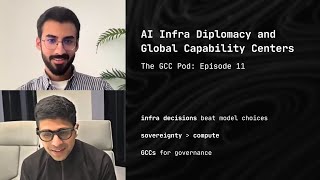
In this episode of the Global Capability Centers (GCC) podcast, host Speaker A and guest Muhammad Umar discuss the rapidly evolving landscape of AI infrastructure and its geopolitical, economic, and strategic implications. They begin by highlighting sovereign compute investments in the Middle East, notably the UAE’s $30 billion, 5‑GW AI campus and Saudi Arabia’s competing initiatives, framing the region as an emerging AI R&D hub. The conversation shifts to the private sector, examining OpenAI’s $38 billion partnership with AWS and how such massive cloud‑compute deals influence GCC planning for compute strategy and application development. Umar then introduces the UAE’s open‑source K2 model, positioning it as a sovereign alternative that could decentralize AI research and grant the UAE commercial dominance through widespread adoption. The dialogue moves to trans‑Atlantic compute cooperation, using the UK‑Canada agreement as an example of “computational diplomacy” where aligned nations share infrastructure and research priorities. The guests explore the concept of a global AI research institution modeled after CERN, arguing that shared, democratised compute could break the current oligopoly of tech giants. They cite thought leaders such as Imad (founder of Stable Diffusion) who blend AI, economics, and blockchain insights, underscoring the importance of open‑source ecosystems. Canada’s national AI strategy is examined for lessons on balancing sovereign compute capacity with international collaboration. The episode then addresses AI governance frameworks—AI Action Summit, the Framework Convention on AI, and the Global Partnership on AI—suggesting that governance, shared values, and ethical standards must be embedded in GCC design. Finally, Umar stresses that compute power alone is insufficient; resilient supply‑chain logistics for data‑center hardware are critical, and corporate capital (e.g., Nvidia, OpenAI, major cloud providers) is reshaping the GCC landscape by driving distributed compute investments and influencing where and how capability centers are established.
Chapters
Every week, my colleagues and I unpack what's really happening in the world of global capability centers. We're living in unprecedented times and most businesses aren't ready for what's coming. Many mistake using AI for simply adopting tools like ChatGPT without actually thinking about how their organizations operate. For example, how Ashish Vaswani has built RNJ model, their first open source model, described as a world class 8 billion base plus instruct pair. Or for example, how companies are setting up their entire data value chain to acquire highly specialized expert data sets. By setting up global capability centers in South Asia and South America. The real shift is happening elsewhere. Some companies are building their own models, others are embedding AI deeply into custom workflows. But many are securing long term advantages around computer energy, data and most importantly, access to global talent. At the heart of it all is this. The future belongs to companies that can tap into the world's most capable, ambitious and underutilized talent pools and turn them into a strategic advantage. In the GCC podcast, I sit down with operators, founders and leaders to explore how the world's most important businesses are building global capabilities centers not just to cut costs, but to acquire proprietary data, develop custom AI systems and transform their products, services and workplaces into truly AI native organizations. This is a podcast about how global businesses are being rebuilt from the inside out. So recently Abu Dhabi has unveiled a 5 gigawatt AI campus partnership and they've got like major tech partners in there including OpenAI, there's Oracle, Nvidia, Cisco and SoftBank. And it's going to be with a 1 gigawatt Stargate UAE compute cluster which is planned to go live this year. And that's aiming to be the largest AI infrastructure outside the US. So why is the UAE's AI campus? Talk a little bit about the significance of IT for global R and D capability centers. And how would you say this might influence the geography of overall innovation that's happening around AI?
So basically UAE is investing more than $30 billion in building this sovereign compute infrastructure. And the way they want to position UAE is the next R and D center for the world. Right? And I think there's a, and I think it's good. There's some strange competition is going on in the, in the Middle east. It's between UAE and Riyadh, Saudi Arabia. And in a good way, I would say it's good they're both trying to compete for, to take a lead in building the AI hub. So Riyadh is investing a lot in coming up with this sovereign compute infrastructure and now UAE is also investing a lot. So I think that this, I mean we talk a lot about competing with China or something. I mean it's not like that. I mean there are some regional competition, there's some regional competition there because we've been doing lots of work in Riyadh. Saudi Arabia coding has a big presence in Riyadh and I can tell you that Riyadh is investing a lot and it's just. And I think that's very good for the region especially if you see what Riyadh is doing, what Saudi is doing in building that sovereign compute. It's incredibly valuable for the entire knowledge workers in this part of the world.
And I also think what's interesting is that this was about sovereign scale investment. But I think the same logic is also playing out inside the private sector. And so OpenAI has actually signed $38 billion deal with AWS and that's going to give it access to hundreds of thousands of advanced Nvidia processors across the Amazon cloud infrastructure. Right. So what does such a massive infrastructure deal mean for how global GCCS should plan their compute strategy?
I think, I mean of course, I mean given that like this is massive, like $38 billion deal with AWS investor. But I think if you see every idea of 90s that was failed, right? I mean it's now going to be successful with AI, right? So I think, I mean the infrastructure is great, but then there is a huge economy in terms of application. There's a huge application infrastructure is now going to be built and of course these are the model providers, they know that there's a lot of value in application infrastructure. I use cloud code work a lot, I use Codex a lot and I know at times that this is superhuman. So there's so much value in deploying these AI capabilities into application layer. For example, think about hyper, we're doing hyper, we're building this incredible applications but all are dependent on tokens on this AI token on this compute. So I think there's a lot of value. So I don't think even $38 billion deal or going or spending this much on infrastructure is basically a hype or something. I think there's a. You were going to see that this would unlock. I mean I was just discussing with one of the team members like think about, I mean for me when I got cloudbot and Claude Cowork and when I started using there's so many latent ideas that I had but never executed because I just hate coordination. I mean it's hard to coordinate among the team. I mean of course I have coordinate, I have hyper, I have global sales. So hard. But now think about how many ideas that were latent and now would be can be brought live. Even in last 7 days I brought more than 100 ideas they always wanted to execute. Now I know whether how many of them were actually had any value or how many of them hadn't had any value. So I think there's so much upside of building the compute infrastructure and then giving that to the application layer businesses that all these companies, all these base models, they are investing a lot in doing these kind of deals and I think that's good. I don't think there's a this is.
Hype and I was also like that kind of, I think sets up. So I have, you know, obviously a set of items that I wanted to discuss today and I think that sets us up nicely for this next one. So in, in late January last month, the UAE has also launched a transparent OpenAI model which is called K2 think. And what that's doing is it's, if you think about it, positioning itself as a competitor to the US and the Chinese models, but also prioritizing openness in data and algorithms as well. So how does Sovereign OpenAI then contribute to the decentralization of AI R&D broader ecosystems?
So two major ecosystems in the world that are happening, one is closed source. I won't say it's closed source, but I think it was the closest. The US incredibly good models, at least two to three years ahead of the Chinese AI ecosystem. That's one thing. And with insanely great platform engineering. So think about if you're using Deep SEQ and If you're using OpenAI, maybe at the benchmarks, probably both won't be feel much different. But when you use those models, the platform of American labs is so ahead. I mean Deepseak couldn't figure out how to make their voice AI work at least two days back. So I think so coming back to the point, one is closed source US and that's one of Code Ninja's passion is like how to make OpenAI more sovereign AI and open source AI more available for the American businesses. Right. And the second, and by the way, and the second is Chinese, Chinese they know they, I mean Eric Shimmer. They know they can't win with us on frontier models. So what they figured out is like if they can build a little bit less than frontier models and then they make it open source, then it means people in Nigeria and People in India and people in every part of the world they can use, I mean 90% of the American startups are using Chinese and open source, right? So, so they figured it out, right? So that, that is the open source. So there are two different, two different ways when it comes to AI and both are good. So now Abu Dhabi is probably trying, and UA is trying to plan around that they can also be launching open source AI projects. It's good, but it has a deeper connotation. AI is much more than sovereignty. It's much more how you want to bring global dominance. If UAE model is being used for, let's say 40, by 40 different countries, you can have this implicit dominance over those countries. Right. Let's think about ChatGPT is fourth largest, I mean Pakistan is the fourth largest application, had the fourth largest user base of ChatGPT. So clearly, I mean charity is dominating this part. Right? So think about it, it's not just about. And think about if all the builders in, in this part in Pakistan are using open source AI. That's being done by Abu Dhabi. What does it mean for Abu Dhabi? I mean it means like they have a certain level of dominance. It's a certain level of. You talk about commercial dominance. You talked about, you were talking to Sanjay yesterday about commercial. This is commercial dominance. Like by opening open sourcing your AI you get to have a huge user base and that user base is not of the general purpose user but they are basically system thinkers because you are using open source AI and then they are building their application layers on top of it. Think about it and it's a good move. And by the way, I'm very passionate about open source AI. So we've been doing a lot of work on open source AI.
Yeah, yeah. And I think generally like that openness is also becoming part of the strategy. Right. Also towards shared infrastructure, even between states. For instance, the UK and Canada have signed agreements to pool AI compute resources and collaborate on shared research priorities including sustainability and advanced R and D. So what is this transatlantic AI compute cooperation sort of thing that's happening?
Yeah, I mean so I think it points to computational diplomacy. So nations with aligned ethics and values are sharing their infrastructure, the research priorities for GCCs. This signals that partnership should include cross border compute sharing agreements. That's why I brought GCCs like GC. Global capability centers are not just about talent arbitrages and talent. It's about if you're building, if you want to build a very large data center then probably the model should be global Capability centers. You need a lot of real estate. That's what general purpose GCC is required. Then you need lots of knowledge workers. In this case, you need a lot of vocational people with vocational skills like electrical engineers, plumbers. I was with Rafa and we discussed about why 178,000 fiber optics electric workers are required in America. So I think that's what's happening. So coming back to the point.
Yes.
I mean I think nations are sharing their computer infrastructure and that make me think, Umar, you've been in Saudi a lot. You have actually helped build that corridor between Saudi and Pakistan. Why can't we have a Saudi and Pakistan shared compute infrastructure? I think you should talk about this with people in Saudi. That would be very fascinating.
Yeah, because I, I also think like, generally if you think about like policymakers and scientific groups in general. I was reading this and I wanted to share this with you as well. They're, they're really pushing on ideas for a stern for AI. Right. Which is essentially like a shared international R and D institution that scientific communities could then use to democratize compute access and you know, expertise and really coordinate evals and safety and all of those things. So to your question, I throw this back to you. Is generally in the larger realm of things, is a global AI institution really something that's achievable?
And of course it is achievable. I mean, similar to cern. I mean the best. CERN democratized particle physics research. Global AI institute could break down the compute oligarchy where a few tech giants. I think this is important, the best work.
But I.
The best of the best work around this area is done by Mad Mishtak. He's a Bangladeshi British mathematician and I think he has some. I don't know what's so special about Bangladesh. I mean every day Bangladeshi entrepreneurs or people are very good in economy. So he's a great, he's an entrepreneur and engineer. He's the founder of Stable Diffusion. But he's an incredible economist. How to, I mean to think about AI, I mean why I follow him a lot is like he, he, he is a guy who thinks about AI. I mean deep technical AI and economy in one sentence. What does it mean, his work? I mean I was listening to Moonshot podcast. Is it. Peter diamond is like. His work on AI and compute is worthy of Nobel Prize. Nobel Prize in economy. And they already have one Nobel Prize in Economy, I think. So he's. And he has here he talks a lot about city sovereignty, national data sets, how different nations can come Together to solve cancer. So I think we just, and he's, and he's done a lot of work on intelligent Internet. It's. Intelligent Internet is a book he has written. No, not intelligent. It's his company. The book name is the Last Economy. I would recommend everyone to read Last Economy. It's the number one bestseller in Amazon. And the best part, you know what? It's free. It's free. He made it free. Think about it. Like, I mean, just need to, it would give you that mental toolkit, how to think about AI when it comes to economy. I loved it. So I'm a huge fan of him. So what I would say is like everyone who are trying to solve certain problems around, around AI, around compute, which requires for example, lots of compute, I think that mental model is, can create a lot of value. And he has, he has actually done a lot of scaffolding around it. If you want to build a sovereign compute infrastructure, if you want to build that, that sovereign AI, there's a lot of. You can build it on top of intelligent Internet. And also, so if you. So if someone wants to study about economy, learn about, not study economy from a real builder. It's not like he's not a content creator. Let me. He's not, he's not, he's a real, real guy who builds stable fuel. So if someone wants to learn about AI, economy and blockchain also. Right. Imad is the guy. Imad is your guy. I am trying to meet him also. I mean, you know, we met with Pakistani Prime Minister Bilal. Yeah, he did a podcast with him. So probably I'll ask maybe Bilal to.
Check with him, make some introductions there.
Yeah, I'm trying to reach him out because I want, I want to partner with him. Konija wants to partner with him to bring sovereign AI compute to Pakistan. Sovereign AI to Pakistan.
And you. And yeah, I mean you talk about sovereign AI and this next story that.
I wanted to share, most of my learning is from his podcast, his book, his papers.
Yeah. So we talked a little bit about sovereignty just now. And so this next bit I wanted to share with you for today. Canada has also launched a national strategy which is focused on growing sovereign AI capacity, compute capacity, and very much focused on ensuring that researchers and innovators can actually access large scale compute in a domestic setting. So what lessons would you say should GCC planners all over the world draw from this approach?
So one on Canada is like, you know, Canada is one of the founding nations of the CIA wave and now no one talks about it, Geoffrey Hinton and all, I mean this was, all the work was entirely done on University of Toronto.
Right.
So Canada is now, I think is being overshadowed by other nations anyways. So can our model show that compute sovereignty can coexist with open collaboration and we can prioritize ethical development and then we can also boost domestic innovation? In terms of GCC planners, I think we need to somehow balance sovereign capacity with global partnerships to maximize impact. I mean in the previous question you talked about how Canada and UK are partnering with computer infrastructure. I think yes. I think if you are trying to set up a global capability center, let's say in South Asia, you, I mean in setting up that gcc you can, you can think of in terms of building your own sovereign stack for that nation and also how that sovereign stack would be serving global demand. Both can be done in one. I mean you can do both things and frame it in a way that you can achieve a single holistic outcome where you are powering your own domestic sovereign compute, but you are also selling that compute, partnering with that compute with international businesses so they can leverage on top of them too.
I also think like as capacity grows in general, then it's not really about access anymore, it's about rules at the end of the day. Right. And so I was looking at this earlier international frameworks, if we talk about them, the ones like the AI Action Summit, the AI Action Summit and Framework Convention on AI reflect this sort of institutional momentum for cooperation around AI ethics and safety and governance. How should this theory of governance shape the design of GCCS? If we bring the conversation towards GCC.
Great question. Governance is foundational. GCs are not only compute hubs, they're not data centers but actors in. They should act in global policy ecosystems, for example embedded ethical standards, international treaties and safety frameworks. If we embed all of them to attract international talent and partnerships and then ensure R and D with shared human values, this all needs to come together. So when it comes to gcc, think about all these models require massive data infrastructures. Most of these models are being trained in African nations. There are more than 100 plus nations who are actually contributing, creating those data sets that these big models are acquiring. It's from the form of general purpose data annotation to expert data sets too. So now think about your model. The global models are being trained in nations which for example, which are not building those models. And also you are deploying those models in nations who haven't built those models. Right. So how to come up with a Shared ecosystem, shared values. Can world can come up with a shared value system where every everyone knows, okay, lying is a bad thing, right? Let's say so if lying is a bad thing in Nigeria, it's bad thing in America too. Can we come up these macro global set of values to train AIs and that is very important for GCC, especially those GCCs that are being set up just to acquire data infrastructure. And by the way, lots of GCs are now being formed either as AI proving grounds or as acquiring those data sets. Because if you want to harden your model for a very specific use case, let's say open evidence. It's one of the America's largest and most used AI model for practitioners and physicians. Now if you want to build a version of open evidence for any different use case, let's just use an example. You need a lot of data, you need a lot of expert data. If a bank wants to build a model to train certain things, you need expert bankers to train that. So now if you are setting up global capability centers on this part, so now on emerging markets, let's say so there should be some shared set of values, right? So that's why this GCC governance is very important. Why I'm talking a lot about data infrastructure. We've been working a lot on data data side when talking about gcc. But generally governance is important for gcc. I know that, but for if you are setting up GCC just for data, it's, it's, it's not one of the things, it's the only thing.
And there's also a lot of work happening around this, right? Like global initiatives like the Global Partnership on AI, the GP AI. It's, its aim is to sort of guide responsible use and international, you know, build international norms for AI. But the entirety of it is really just to advocate wider cooperation internationally. So how important is active engagement with these international bodies for GCC success?
I mean it brings, if you are partnering with them like GPI or. It brings, it signals legitimacy first of all and it also signals the shared research networks for any business who is trying to build global community centers. It positions them within the global AI governance and R and D community. And that's a good thing. That's a good thing for the top line. That's a good thing for their narrative from the narrative standpoint. It's also a good thing that they are actually contributing in policymaking. So yeah, I mean it's good.
So let's also touch on the physical supply chain that sort of makes this infrastructure possible. Reports suggest that geopolitical computations now extend beyond compute to include secure supply chains for data centers and hardware. And this is pushing Gulf states and their partners to redefine data center supply line strategies. What should GCCS consider about supply chain versus compute power?
Okay, so I think compute power is necessity, but not sufficient. I would say supply chain resilience determines whether that power is scalable and secure. So GCCS must plan logistics, secure equipment access and anticipate geopolitical shifts on inputs. I think it's not just raw compute power. There's so much thing that goes under the hood.
And also like major tech companies, right, we're seeing this all over. They're pouring billions into AI infrastructure. If you look at OpenAI's multi year AWS deal or the investments that Nvidia is committing to, I think this is signaling a broader scramble for distributed compute capacity. At the end of the day, how does corporate capital then reshape the landscape for gccs?
Oh, the corporate investments redefine what is possible actually. So GCCS can't reach R and D without meaningful capital strategies. This is important. So including CO investments, strategic corporate anchors and frameworks that protect sovereignty while enabling global integration. So yeah, I mean, I think. What's important is you can't just pitch RnDS and stuff without thinking about the overall picture of what is your capital deployment plan for setting up the GCCs.
More from Muhammad






FDE Epi : 16 | AI Agents, Billion-Dollar Infrastructure & the Future of Intelligence




