The GCC Pod Ep 12: The Great Convergence: AI and the Global Economy
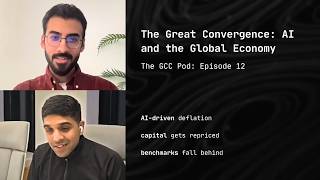
Muhammad Umar and a guest explore Ark Invest's forecast that AI, robotics, and other technologies could push global GDP growth from 3% to 7% or higher by 2030. They discuss AI's deflationary effect on white-collar work, Tesla versus Waymo in autonomous vehicles, China's open-source AI challenge, and why traditional economic measures may no longer work.
Chapters
Every week, my colleagues and I unpack what's really happening in the world of global capability centers. We're living in unprecedented times and most businesses aren't ready for what's coming. Many mistake using AI for simply adopting tools like ChatGPT without actually thinking about how their organizations operate. For example, how Ashish Vaswani has built RNJ model, their first open source model, described as a world class 8 billion base plus instruct pair. Or for example, how companies are setting up their entire data value chain to acquire highly specialized expert data sets by setting up global capability centers in South Asia and South America. The real shift is happening elsewhere. Some companies are building their own models, others are embedding AI deeply into custom workflows. But many are securing long term advantages around computer energy data and most importantly, access to global talent. At the heart of it all is this. The future belongs to companies that can tap into the world's most capable, ambitious and underutilized talent pools and turn them into a strategic advantage. In the GCC podcast, I sit down with operators, founders and leaders to explore how the world's most important businesses are building global capabilities centers not just to cut costs, but to acquire proprietary data, develop custom AI systems and transform their products, services and workplaces into truly AI native organizations. This is a podcast about how global businesses are being rebuilt from the inside out. So much for today's episode. I wanted us to dig into Ark Invest's Big Ideas 2026 report and we've been talking about a lot of different things on the GCC pod. So I thought, you know, maybe it's not a bad idea to get into what this report says about technology and infrastructure and execution and how they're all sort of converging right now, or the Great convergence as they call it. So, so let's start with the core claim that the report actually makes about growth. Historical data shows that every major technological revolution you've got your steam engine, electricity, telephones, they triggered a step function increase in economic growth. Ark Invest now forecasts global real GDP growth to accelerate to more than 7%, which is more than double the historic norm. Now, given that global GDP growth has been stuck at roughly 3ish percent for over a century now, what do you think about that prediction is 7%?
I think it's still conservative. I still think it's conservative. Historically, what we've seen is all these technologies that were happening steam engine, telephone, they were basically happening at different points in time. So what we're seeing now is as the report suggests, that these four Five forces are happening at the same time. So robotics, manufacturing, energy, AI, blockchain, all these five, six different forces are happening at the same time. And that's the reason why there's a step change like three, four steps change from 3% to 7% growth. I still think it's probably, it's more than 7% even. And I'm not saying it's too optimistic. I think we would see probably by the end of 2030, maybe we would be crossing somewhere around 10% growth rate. The reason for that is that all these forces are happening at the same point in time. Sometimes it looks very scary because every time when this sort of growth has happened, there has been an extraordinary amount of centralization and extreme inequality in the society. And when, every time when these forces have happened and these kind of growth rates have happened, we've seen massive unrest in the societies. I don't know where it's going. But yeah, in terms of growth, this is this, I still think it's conservative.
And also like this overall, like this growth story obviously has big implications on things like inflation. And so the report says true inflation metrics indicate real time inflation is already down to roughly 1.2%. But yet central banks are maintaining very restrictive policies to obviously fight that inflation. So with the Federal Reserve focused on this 2 to 3% inflation, how does your thesis reconcile with this fear that exists of sticky inflation?
I think we are in deflation. It's not even inflation. It's just like inflation. The benchmarks and the numbers we are using are from the past. So if Federal bank is aiming at 2 to 3% inflation, that's because they haven't factored in. When these four, five forces would come into play, where would the cost of things? It would be near zero.
Right.
So just imagine currently software is 1% of the total US GDP.
Yeah.
White collar work is close to 22, 23% of US GDP. This entire white collar work is going to be replaced with software. And AI would be the new software. Now imagine how, I mean, what would be the cost of those things? Because what I am saying is that labor would be replaced and the labor would be. And it's not like that. People would, of course there would be lots of job displacement, people find new kind of jobs. But the cost of existing things would be down to near zero. That's what even exactly what report suggests too.
And so I was reading through it and the report also talks a little bit about crypto. Right. And so it says Bitcoin's bull case target is set at 1.5 million by 2030, which is, and that's despite the rise of stablecoins and a lot of the volatility that's been happening recently. So what would you say about like has the proliferation of stablecoins which obviously offer protection against the devaluation of currency, has that sort of altered the long term thesis for Bitcoin?
First let's discuss Stablecoin or use the sd, let's say. So the difference between Stablecoin and Bitcoin, let's say, is like stablecoin is tethered to US dollars. And then people say, for example, if it's, if it's linked with fiat, then I mean, what's the catch here? What we need to think about is like the catch is the money programmability. When someone sends you money, for example, if you are in Dubai and somebody is sending you money from us, it takes some time, right? There's so much bureaucracy, barriers, and you can't program the money like you program your software, your workflows, you can't program, you can't do it with money. When you say stable coins, so that even though it's tied with fiat, but that programmability comes in with the money. So that's a huge upside. But then think about Bitcoin. Stablecoin is digital cash, Bitcoin is digital gold. And you have to think both things in perspective like this. So I don't think that the rise of US Stablecoin would somehow impact gold. Similarly, the rise of cash didn't impact gold.
And even like if we bring the conversation a little bit towards AI now, inference costs for LLMs, the report says, are collapsing at a rate of nearly 99% annually. Which is quite cool and crazy at the same time. But if the cost of intelligence is tending towards zero, how would you say AI companies will maintain revenue and cover this massive infrastructure build out?
So think about it. First of all, I would add a little bit further to it. So Moore's law says about compute, it doubles every 24 months and it was 18 months. AI capabilities are being doubled every five months. It's super fast. It's four times the speed of compute doubling. Now I think just imagine we were just trying to set up our infrastructure and we're doing this conversation and we had to rely on this third party tool and we thought probably we should have write our own tool because it was so crappy. There's so much to be done. The people who are using AI are spending four to five more hours on the workplace Doing stuff. There's so much latent idea they never were able to execute, but they're not executing. So you will see a lot more software, a lot more tools, lot more AI to help us build things, execute our ideas. And I think that and currently we've seen robotics as part of our core workplaces. So imagine two years from now or a year from now we have robots too. Now we have to program them to like software. Right. So for example, so when you see all of this, I think at the end of the day it would be win win for all of us. But one of the challenges would be the ride would be very bumpy, there would be massive job loss along the way, at least for some time.
Yeah, yeah. And I also think like that same thinking applies and shows up in how they look at autonomy as well. The report says that Waymo has successfully deployed driverless cars in major cities. I mean we all know this, but Tesla still relies a lot on driver supervision systems. Way more currently I think has the optics of and focuses optics of a winner with actually having cars on the road. Why does the report bet so much on Tesla then dominating this robotaxi market?
First of all, at the end of the day we think the report suggests with Tesla's vertical integration that allows Tesla to aim a cost of 20 cents per mile, roughly 50% lower than memo. That's the major thing why Tesla, what the report suggests. Of course Kathy has some inclination towards Tesla too. If you know historically her reports and all of it. It's true. I feel it's true as well because Tesla is all vertically integrated business. It's not a FSV stack only they have their own cars, they have their own infrastructure that build cars and then on top of they have their own FSD systems that allows them to bring that imagine 20 cents a mile. Right. So that's the reason why Tesla is still in terms of, in terms it's more optimistic. The court is more optimistic. To a Tesla, VEMO is great, but the supply chain of Vemo is not that. I mean the lidars and all that stuff and then their car manufacturer somewhere else. So that's the reason. But still I think both would be the winners. Tesla would be great for certain use cases, Vemo would be great for certain use cases. But yeah, that's what deport suggests that they're more optimistic to a Tesla. And the reason for that is the cost of mile is way more cheaper for Tesla because of its vertical integrated stack.
And so the report also talks a little bit about like or hints towards, you know, the geopolitics of it all. It says China has released high performing open source AI models like Deep Seq. We know this despite the bans on U.S. semiconductor exports. Would you say the United States is at risk genuinely of losing this AI race to China given their aggressive embrace of open source development?
I mean China is big on open source. If you see most of the world is now using Chinese open source models. Even in a 16z published a report that 90% of the startups are using Chinese open source models to build application stacks. So yes, I think when it comes to us and I don't think the restricting chips gave it actually pushed China to build their own stack. And Jensen Huang talked about it, chip manufacturing is primarily a manufacturing job. And if you think China is not good in manufacturing, they're probably wrong. But at the end of the day, I think with two major advantages that US have, number one is they have a lead on big AI systems like the way ahead at least six months to a year. And the second major thing is the incredible capability of US labs of building the great platforms. So if you use Deep Seq it doesn't feel as good as you're using anthropic like cloud or let's say if you're using OpenAI.
Right?
Yeah, most of the labs, I mean Chinese labs couldn't figure out how to make Voice AI work with their models. And OpenAI Voice AI is better than 11 labs. Right. So I think that application engineering both of the at the platform level and also the application stack other than this like for example, think about oh, open evidence. Open evidence is a platform that's Basically, I think 2/3 of the, we've talked about it. 2/3 and a third of American practitioners use open evidence for referring to different evidences. So the application layer stack is very strong when it comes to us. But yeah, at the end of the day it's probably six months max of a year kind of a difference and that's it. So that's what reports is.
Yeah, yeah. And then, and then all of this sort of runs into a very real physical constraint as well right around this, which is energy. Of course the report also says that environmental concerns regarding the massive energy consumption of data centers are growing, but energy production has been stagnant. How can we support the exponential energy demand that's out there right now of AI?
We've already, I mean, haven't you seen, I mean orbital data centers already moving lots of energy. There's. Yeah, yeah. So orbital data centers are I Mean, Elon said like probably 36 months given a timeline and then also nuclear.
So.
So that's why earlier the report suggests 4, 5 parallel forces are at play. It's not just that AI is happening. Energy infrastructure is being revamped entirely. So I think maybe in the shorter term there will be some bumps when the longer run I think we're good with energy and climate friendly energy. See space have no clouds, space, there's no night and day, there's no vacuum. So space has all the things. And Elon said like probably currently even the atmosphere is just, just, we just lose 30% of the energy just to the atmosphere.
It's crazy. Think about it, that's crazy. And I think that also kind of brings us then to how capital gets allocated in this environment. The signal from the report is that The S&P 500 continues to hit all time highs driven by a few mega cap tech stocks leading many to passive indexing. Now why should investors look beyond passive indexing when the S and P seems to be like the safest bet?
Benchmarks are backward looking. We already said that they make companies based on the past success. I think in the kind of disruption we are in the traditional word order no longer applies anyways. So I think the report suggests that innovation strategies will compound I think at 35% annually and the traditional benchmark will struggle as legacy incumbents. So like traditional auto and finance are disrupted by robotics. So yeah, I think benchmarks are not. Technology is moving far more faster than benchmarks and all that stuff.
We talked a little bit about. Sorry, say that again.
It's explosive. I mean how would you factor in? We've been using all these models, we've been building different platforms on top of these. You see what's happening. I mean there's a massive. I was using for my own coding work, I was using Claude 4.5 and then we just moved to 4.6 and you can, you can feel it how there's a, there's a massive change and someone says like probably they've underbranded it was Sonnet 5, but they just underbranded it to 4.6. But so good, I'm telling you, so good.
I did use it yesterday with Claude cowork as well. And yeah, you, you can actually genuinely feel the difference. Yeah, so, so, so we, we, we touched on like Tesla and you know, EVs and automakers. So let's talk about that a little bit more. The report also goes into how legacy automakers are pulling back on their EV targets and are very much focusing on hybrids. And the main reason the report says for that is cooling demand. So does this retreat of companies like Ford and General Motors from previously having aggressive EV goals suggest that, like, what does it say about the EV revolution?
So, I mean, EV revolution is well on its way. The report suggests it's harder for these companies to compete. If you're thinking about Tesla as a car company. Wrong. No one would remember Tesla as a car company. People would remember it for Optimus.
Right.
So it's a robotics company. So to build cars, if you're not a robotic company, you can't compete. So Elon talked about this a lot, says like just find a guy. He says this about robotics and also about AI tooling as well. Imagine you time travel to the past, but this time you have your MacBook and you have Claude or Grok.
Right. Video.
Right. The kind of work you can do in an hour. And you would see people in skyscrapers filled with people. They won't be able to do the same amount of work you would be doing just with Excel and your MacBook and Cloud. So there's no comparison, right? There's absolutely no comparison. And he said this. There are companies that, I mean, that are entirely AI native. It's not like there are some. Some of the work is done by humans and some of the work will be done by. The companies are entirely AI native. And when I talk about AI, it's not just about using Claude or these tools. It's about robotics too.
Yeah.
Then there's no way you can compete with them. I mean, just think about it like someone is using Google Search and Google for their main source of information and engineering and they're still subscribing to Substack and all that. And another guy is using cloud. Is there a comparison? There's no comparison. So that's what's happening to the report suggests to legacy automakers they're not able to compete. But I think it's not like that they would be able to compete. If you see already Tesla is not. Maybe you can talk about Ford is not. But if you see byd, Tesla is, I mean, I mean BYD is way ahead in terms of engineering and manufacturing. Yeah. Within us, maybe Tesla is a lead.
But you also mentioned, I remember, like maybe it was last week. You also told me that Tesla is actually cutting back their like manufacturing.
Yes, Model Y and model. The Model Y and the model. Yes. They are replacing those with Optimus. Assembly lines are being replaced with Optimus. By the way, car is just a Robot. Yeah, if you have FSD and all that.
So I think, yeah, that's true. Because then I think it becomes more about like having this DNA. Right. That then is almost like helping you transition to being a robotics company before you're a mobility company. So yeah, that's very interesting things happening and I think so. The report also questions whether our core economic metrics still work. Right. And it says like as technology demonetizes services, for example, like AI curing diseases and you know, you have free digital entertainment and all of those things, traditional GDP measurements could like shrink or stagnate. So if AI and robotics drive the cost of goods and services to zero, what will happen to gdp? Won't it shrink? Won't it like sort of make it look like a recession?
So GDP is a broken metric. So I mean if you think about gdp, if you today cure cancer, GDP would represent this negatively. Yeah, because people won't be spending that much on chemotherapy. Right. So that's what GDP is all about. I think in the longer run we would have far more free time and we have far more things to do, better things to do. I wasn't disrupting and Vinod Khosla said this to me. Like he said like jobs should not be servitude to survival. How many people in our workplaces like doing their jobs? They don't. I know they don't. They hate doing the kind of work there, especially if it's repetitive and boring. So AI would be doing all that work and then humans would be taking that thing forward from there.
Right.
So I think we should remain optimistic largely and probably we need to look at, as the reports suggest, a gross national income or a new metrics that measures real wealth and productivity rather than the velocity of the money. We are moving from a financial economy to a information economy and we need to upgrade our benchmarks according to that.
More from Muhammad






FDE Epi : 16 | AI Agents, Billion-Dollar Infrastructure & the Future of Intelligence




