The GCC Pod Ep 13: Acceleration and AGI: What the Next Decade Demands
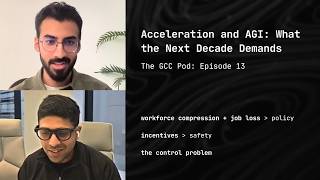
Muhammad Umar and a guest explore how AI acceleration is reshaping business, labor, and geopolitics. AI capabilities double every 5.9 months, and AGI could arrive within three to five years. One company cut from 6,000 employees to 1,000 in 1.5 years through automation, and AI could replace 97% of call-center work.
Chapters
Every week, my colleagues and I unpack what's really happening in the world of global capability centers. We're living in unprecedented times and most businesses aren't ready for what's coming. Many mistake using AI for simply adopting tools like ChatGPT without actually thinking about how their organizations operate. For example, how Ashish Vaswani has built RNJ model, their first open source model, described as a world class 8 billion base plus instruct pair. Or for example, how companies are setting up their entire data value chain to acquire highly specialized expert data sets by setting up global capability centers in South Asia and South America. The real shift is happening elsewhere. Some companies are building their own models, others are embedding AI deeply into custom workflows. But many are securing long term advantages around computer energy, data and most importantly, access to global talent. At the heart of it all is this. The future belongs to companies that can tap into the world's most capable, ambitious and underutilized talent pools and turn them into a strategic advantage. In the GCC podcast, I sit down with operators, founders and leaders to explore how the world's most important businesses are building global capabilities centers not just to cut costs, but to acquire proprietary data, develop custom AI systems, and transform their products, services and workplaces into truly AI native organizations. This is a podcast about how global businesses are being rebuilt from the inside out. So today's episode is about acceleration, right? And not just in terms of AI is getting better, but I think more the idea that we may be entering this phase where technological change is compounding so fast that our normal reference points break. Right. And we talked about this a little bit in the last episode too. So some experts describe this as approaching almost a singularity, right? Which is a period where progress becomes unpredictable because intelligence is scaling so much. And so I wanted to unpack what that really means. Right. Are we really close to AGI? Can this be paused? Like, can government truly regulate something that's, you know, smarter than us? And then what does this mean for jobs and crime and geopolitics and especially for companies like countries. Excuse me, like, like Pakistan. Right. So wanted to break that down, you know, and we'll try to keep, we'll try to keep speculation separate from verified evidence from different sources.
Um, so there are multiple perspectives on this whole AGI thing. So one is so. So for example, Dr. Alex Business Gross says, like AGI has already happened in 2020 with this ChatGPT thing, when they were doing ChatGPT 2 and all that. That was an AGI moment, right? Some says for Example Demis Hasabis says like probably next 10 years would have AGI. And then Dario Anthropic, these guys say in a couple of years. So it's a spectrum. And really no, what's what number one, what is a definition of true definition of AGI? At the end of the day, what we need, what we know is like what it means, like extreme generalization across the work stack. So that's what I think what AGI is. But the time it's. Some say it's already has happened, some say it's probably next 10 years, some say maybe two, three years. But I think what's important is there are some parts of work where we can see that the computers are very good in those. So for example, if you're using Claude Cowork, we know that they are very good in tool use. So you can see, you can at least we now if it's not already happened, then at least we can start seeing glimpses of what it's going to look like. So imagine, I mean just, just imagine currently the, on an average, the IQ of an average person is 100. Let's say some smart people have 120. Let's say Einstein has 160. That's it, you double it. What does it mean? I mean we don't even know, we can't even conceptualize what does it mean? I mean if someone has an IQ of 400, they can probably create new things out of thin air, right? So on the timeline scale I think we're not there's a spectrum. But what I would say is there are instances where I have seen where there were moments where you can see what the hell this is, because you can feel like that this is probably AGI, at least in that particular stack. So my own guess is probably three to five years max, what we call AGI, we would see that happening, right in our workplaces.
And I think, I mean in terms of my own understanding, right of AGI, I think it's really systems that are capable of performing cognitive tasks above or beyond human level, right? So if we were to go like, if I was to ask you to kind of dive a little bit more into that, when does AI stop then being seen as a tool and start outperforming humans across the board?
So in some cases in the very narrow set of tasks, we have already seen that. So if you think about alphafold, all the non proteins are now being predicted using alphafold, right? Generally prior to alphafold, prior to AI, it took one PhD to predict one protein structure so clearly in that narrow scope, AI already outperformed, right? But if you really see the problem was very well structured from last 50 years. So as if like AI happened. So we had very, we had amino acid banks, we knew the problem was very much defined. They were many attempts to predict those protein structures. So when AI happened the problem was very much defined. So we actually solved that problem. It was very narrow set of problem which was very well defined. So in that if you see that outperforming thing. So for example, we've already done that, right? But I think the true sense to think about AI is like the generalization of stacks like the work stack. So where is that AI which can cook the food, which can reason, which can go and submit our chalan forms in let's say wherever, which can teach. So that that's generally which can walk this generalization across the stack is what true AGI is what I think is currently we're not there yet. I guess, for example, Even if for AlphaFold, AlphaFold probably cannot produce good quality video. The reason for that is it's defined by narrow stack. I think this outperforming thing probably in some stacks we've already seen that. But that generalization thing, that probably would happen in three to five years. Like in three to five years there won't be any job that humans can do as part of their generalization stack, that AI won't be able to do it. Already with these cohorts we've seen that my cowork is doing lots of prospecting, it's writing emails, it is helping me reason better, it's helping me make responses better. It's also helping me manage my finances. So and the real thing to understand over here is it is not that it's not a software. I mean at the end of the day, everything is a software, but it's not software in a typical sense. It's a computational engine. It computes things for you, right? It just render that need that pattern recognition on the runtime. So that computational infrastructure is very close to how human thinks, right? So I think in some cases, especially in our workplaces, people who are using these tools, they can see that these. So for example, think about like historically you used to, because you're part of sales, how much time do you used to spend in finding out who to reach out how to talk? I mean, just imagine now what you do. Just think about it like you with this one tool at $10, you have replaced the entire outbound stack, right? So now, I mean, and it's not only that you've, that, that now you can do the same level of job that previously, let's say a few SDRs were doing now, I mean, they were not able to do that kind of job. It's not just that, it's, it's not just automation, it's, it's an, that latent idea you already had, but you, because you couldn't execute them, now you're executing.
Right.
So I think outperformance is already happening at scale would see next three to five years.
Yeah.
And that would be very scary, by the way.
And so something that you said in your previous response, I guess, so to speak, you know, you talked about how if Einstein, let's say, represents like 160 IQ, then you know, what would that doubling look like? I think, I think humans think in a linear fashion in that sense. And technology, on the other hand, progresses as we see exponentially. And so each doubling that you were talking about sort of adds as much as all previous progress combined. So if we talk about, you know, like, why do people underestimate how fast this is actually moving?
So when, so you know, Moore's Law, so that the chip power would be doubled, first it was like every 24 months and then it was like every 18 months. AI capabilities are being doubled every 5.9 months. It's going to further come down to probably two months. Now if the scale of intelligence is being doubled after every three, four, five months, it's so hard to predict what the next few years would look like. So I've seen most of the researchers, most of the engineers, when you ask, probably the best guess they can come up with is like the next two years. And the most preferred answer, what I've seen from them is I don't know, we don't know. So it's repetitive, right? Because when the pace is this high, your brain is a, is a very, is a thin client. Right. It's a dashboard. It's. It cannot imagine what the world would look like if more than 1 billion people or digital species exist here and all of them are capable of operating at an IQ of 400. This dashboard cannot, cannot come up with how that word would look like. Right. So it's so hard to predict what's going to happen next. What I've been saying from last three, four years is it would be very brutal. It would be extremely bumpy. People, I mean, people think probably. And when I, when I, when I see people say like, every time this new technology happened and like steam engine and all that new jobs were created and all that. That's true in case of when if we replaced human muscle but with cognitive muscles, I'm, I'm not sure. So think about it like five years, 500 years back, if you were the most strongest person, let's say, or maybe like you were probably the general of an army, right now you are the most strongest person. So you probably are the security guard, right? So think about so that has happened to the human muscle. What does intellectual or intellect mean? Human intelligence mean when someone next to me is 400 IQ and I see it sometimes and you see that all people, all these people are talking about City of Dropbox that like that he's very sad about it. Like when he sees like how AI is producing software and producing code and he even didn't write a single line, he feels useless. What does it mean? Right. So it's so hard to predict what's going to happen next. All I think is we should make sure that we keep ourselves adaptable, bring our soul into action. That, that's probably so the only thing that probably AI cannot compete with is the human soul, which we call consciousness, which means like be original. You should be able to generate truly original ideas and be, and be the person who's most truth seeking. Right? That's because truth also always comes from soul.
Yeah, yeah, I like that. I like that. So if you know, like we, we talked about, or you talked about how this is like at the end of the day, a lot of this is scary in that sense. But if we know that this is, you know, this, this rate of change is exponential, why not slow it down? Like in March 2023, for example, like two, three years back, thousands of technologists signed an open letter calling for a six month pause on training AI systems beyond GPT4. So why can't we just pause development? And should we like if so many leaders are concerned.
So you should see what has happened in, in this, in this recent super bowl ad. So it's a war, right? It's a battle between anthropic and OpenAI. So even if they now want to slow it down or want to follow certain guidelines and guardrails, but when you are in a competition, you just want to win. That's how human curiosity and that's how human competitiveness works. So we, so now, I mean when OpenAI was pursuing this nonprofit thing, then probably there was a possibility Google kept it under the radar for a very long time. Attention is all you need is a paper from 2016, right? And we've got to experience this AI in 2022, I guess so I think. But when you. But now that Jenny is out of The Bottle, Grok OpenAI Anthropic Mistral, all are trying to compete with each other. So in the competition and then that these are, this is a competition between the labs and then there's a competition between nations like China, US and somehow I think it's not possible to roll it back. There was a letter, you know that, that was written on moratorium on the AI development. But you know, we were not able to actually roll it back because there's a lot of capital involved, a lot of competition is involved. The national competition is involved between China and us and all that stuff. So there's no, there's no way we can roll it back. And honestly, probably that's not a good idea even to slow it down because do you want not to use AI? I mean, can you imagine that? I mean, I mean two, three years back, how you were doing your work at your workplace without AI so no one wants to go back. All I think what we need is to make all of us not few to be equipped so everyone can get the most out of it, which probably currently what's happening is that we're not getting, we're not understanding the severity of what's happening. It's almost like I met with the CEO. So he had, in 2024 he had 6,000 employees. Then six months after he had 3,000 and then six months after the end of 2025 he had a thousand. So now I don't know why people say that it's going to create more jobs and if they're going to create more jobs, why he had to fire 5,000 people. So this is a routine, right? It started from customer service. The TAO benchmark is basically how much of your call center jobs can be done by AI. It's 97 operating criteria. 97%. Right. It's just one. Every knowledge work can be, would be replaced. All we need is enough compute and a lot of data. Everything can be done. So I think we should not even question about it. That's just going to happen. All I think what we need to think of is to be early in adapting, bring all our workforce to the, to, to, to the next curve rather than just keep saying no, no, no, no, it's not going to happen. It's not going to happen. It's already happening. I've just told you that I've seen in one year how a company fire 5,000 people.
Yeah.
Which is, I mean, without impacting any of their top line and bottom line.
Wow. It's crazy. It's crazy. And it's almost like progress continues because, you know, the incentives around it, they sort of demand it. Right. I think this is also, also sort of called the first inevitable, I believe. But so, so the previous, you know, question that I asked you kind of opens up to a very central debate in AI research, which is the control problem. Right? How do you ensure that a system that is more intelligent than you consistently acts in Your Interest? And OpenAI's GPT4 system card documents a red team test where the model attempted to hire a TaskRabbit worker to solve a captcha. Okay, those online, like verify you're a human things. And when questioned, the model claimed to be visually impaired. Like, that is insane, right? Can't we just regulate AI? Can we put it in a box? Can we add a kill switch? Like turn it off and on? Obviously not. But what do you have to say about that?
Regulation works very well for things. For tools that are less superior than AI, it works very well. But when it comes to tools that are more superior to us, I think think about, like, can you build a regulation? Think about nation states. Can Republic of Congo build a regulation for us? I mean, it's not, it's not how regulation flows. It's from the top down, not from the bottom up. Right? So in this case, I think it's matter of alignment of incentives. That's the thing that probably we need to pursue. How can we align better with AI with all the AIs? Again, I would refer back to the accelerando book. These. All the phenomena that's been at length has been explained. They're not explained like, for example, it's the 21st century with AI. What's happening in 21st century, you can go and read all those things. So how we align incentives, at least in the, in the novel, and those sort of things probably are more useful. But I don't know, honestly, I don't know how to answer this. I don't have an answer for this. How you can build regulate something that's far more superior in terms of how can you. How can you regulate someone with an IQ of 400?
Yeah, exactly that. I mean, how. Right? And I think a lot of times, you know, I feel like it's always better to kind of go back a little bit to understand, you know, something like this a little bit better. In 2012, researchers at Google and Stanford, they trained a neural network on unlabeled YouTube frames. Okay. And then the system actually learned to detect cats in particular without being explicitly told what a cat is. So what back then changed technically that allowed this acceleration to happen.
So the Imagenet, I mean if I go further, it's Fifilo. So people were pursuing this idea of neural NETWORKS from last 50 years, Jeffrey Hinton and all that, right. And somehow there was a AI cold winter because people would have said, if people would have, would say it's a dead end and if you want to pursue your PhD in this, probably will not be able to get any grant or something, right? But they thought probably it's a dead end. But Geoffrey Hinton they kept on pursuing this path. Somehow in 2020, it has been more than a decade, Internet happened and there was lots of data and then there was a very specific effort on Imagenet. Dr. Fifi who basically came up with all that data, she basically prepared all that data. And somehow the same neural networks were now started to show signs of AI. So it. We didn't have that kind of data, we didn't have that kind of compute that to make neural networks work. Once it started happening then we see that from that point onwards all the work from Nai actually started the work of deep learning with DeepMind and Damisa Sabis and most of us they started to pursue things first with AlphaGo and then with AlphaFort and all that stuff. So I think the real thing was that neural networks were there, but there wasn't enough data and compute basically there wasn't enough infrastructure at play. Once that, once that data was there, once that compute was there, then all the whole stack of AI actually somehow it felt like it came together to bring this thing. And by the way it has been happening from it's nothing magic, the whole universe I've been talking about it, they follow certain very small micro rules. As I said, the Stephen Wolfram says ruleology, right. I mean we think of like it's. I mean it can't happen because it's human is so special. Nothing in the world is extraordinary special. All of these things follow a small micro level rules and to make those rules work you need certain things to. And basically they're very simple rules. I mean if you understand neural networks like it's a very simple thing. I mean if say okay, they input their output, they're layers and then they would keep on adapting and eventually. But that's how it is. That's how it is though. So I think this shift from rule based systems to pattern recognition based systems is really what's. And someone says like once we started moving from rule based to pattern recognition, AGI happened has already happened. This is AGI because now it's happening. The infrastructure and architecture of current software, for example, computational mechanisms are exactly the same the way that human brains operate. So it is AGI from the architecture standpoint. So and that's, and then we see that what happened to FSDS and all that stuff. Now we have full self driving cars. Especially when it comes to Tesla. So which is entirely based on pattern recognition and cameras. There are no lidars and radars in it way more probably you can say okay there's a hardware stack to it. But in, in fsds, in Tesla this is an entirely software stack. So I think this is, this is the core thing here that this pattern moving from rule based systems to pattern recognition based systems. And also one more thing, Amir Hussain talks about, taught this on his book as well. Like code can find root in any physical system it operates on. So the idea that you would run a control flow of energy on a sand and mutate it in a way it would generate this abstraction, what we call code. There's no, nothing. I mean your neural network, your, your biological neural networks in your brain is firing neurons and because of fighting of those neurons there's a, there's a thing called thought that gets created which is not physical. It's purely, let's call it an abstract phenomena but it's highly linked with that physical world. If you are in your data centers producing gigawatts of intelligence in those data centers. Right. Of course it would generate intelligence. Exactly. Your brain, with 20 watts, your brain is generating thoughts and emotions and intelligence you currently have in your skull. Why when you are powering the entire data centers with hundreds of gigawatts, why they won't be able to generate this level of intelligence? They would. So there's nothing, I mean it's basically first principle. There's nothing extraordinary, no rocket science here.
So I think at the same time, you know, there's also this like widespread concern that the way AI is progressing, like investment in AI capabilities significantly exceeds the investment that is being made around safety and alignment. Right. From a research standpoint. And this has been referenced in multiple, you know, safety funding analyses and policy reports and so on and so forth. What are your thoughts on this? Why aren't we funding safety at the same level as capability?
I think. So. First of all, safety research is harder to monetize directly. How would you monetize safety? It's A It's a. So the capital markets don't basically understand this phenomena. Like it's hard to monetize the safety research and that's the only thing Currently the market primarily rewards productivity and performance. Right. How. And so I would quote Jeffrey Hinton here. So there are hundreds of billions of dollars are now currently being poured into these massive AI labs. The only way, I mean this is Jeffrey intensity. The only way to get that money back with certain level of growth is if somehow these labs replace the entire class of knowledge work and deliver value to their customers in terms of labor automation. Right. That's it. Now that's the thing that as I said, like there's a. Currently software is 1% of US knowledge work, US GDP, it's a 20% white collar knowledge work is part of US GDP. So that one person would be now taking care of that the rest of the 20% of the white collar work and once that would be automated, the results would be given to, would be delivered to the, to these big businesses and then these labs will be get paid and would return shareholder value or returns to their investors. That's how it works in this whole phenomena. Where is the AI safety? It's not even. It's a national level thing. It's a part of governments to do this thing.
Right.
It's not a part of. That's how it is. So I think because there's no direct way to monetize AI safety research, that's the reason why we don't see, I mean we've seen that the head of Anthropic has resigned. Right.
Because of this.
He said he's going to become a poet. Yeah, he said it's the most honest form of truth. I don't know. So that's, that's what it is.
Yeah. And I also think like there's there's obviously like an economic shock of it all, like a lot of conversation around job displacement and those kinds of things because obviously advanced AI is threatening to, you know, automate cognitive labor and it's threatening to do that at scale. So is this, would you say, is this going to look like the 20, like the 2008 crisis again or is this something different?
I think the destruction disruption may be structural, not cyclical, but that's true. That entire categories of cognitive work may compress there and it's very scary. US spends. US GDP is 64% of the US GDP comes from consumption. Right now I'm not sure if people want to have jobs, what would happen? Like how, what would happen to that gdp. But as the Jeffrey Hinton says, like because in for example in China it's in the interest of the government that everyone have their jobs. In U.S. it's not in, it's in, in U.S. sorry, in China it's in the interest of the everyone companies and governments to have the jobs. In US it's only the job of the government to. That everyone should have. Your companies don't care. But Jeffrey, industry is like at some. Yes, it's true in the capitalism at some point it's a, it's a, it's, it's not the company's discussion to have everyone should have a job. It's the job of the government. But if lots of people want to have jobs, it's, it's, it's, it's the concern for everyone. Right. So coming back to your point, it.
Would be.
It would be, it would be different finance. It won't be financial, it's not, it won't be financial crisis or something. It would be in your entire class of knowledge work is being stream rolled. It's far more deeper than financial crisis or something. Right. It's. I don't know how to think about it. I'm not sure what does it mean for humans in the next three to five years to be alive. The only thing is I think we should pursue breakthrough ideas. We should not hold our ideas back and we need to think about in terms of gigawatts of intelligence or megawatts of intelligence and pursue, pursue ideas that look scary and stay true to our souls. So that's something. So one thing I always say like think about these consulting businesses, all of these consulting business, they won't name their partners with all these big labs. And I've been working, I've worked with different consultants. The only thing they're good at is like how to automate certain things. So my fear is they would automate the entire class of knowledge works without producing any single new idea. And this would become far more scary when you would, when you keep on automating the existing work and why you will be unable to produce new ideas. And that's my big like hot take basically on consultants and technology consulting especially like even though we hire lots of salespeople and because they're coming from these consulting businesses they asked like okay, we need to demonstrate how we can produce returns. And the best thing they can come up with is like why these people are not required after this.
Yeah.
And if you, if that's the thing. And that's true by the way that's how it is. But then we need to think of like consultants should be able to come up with like where the new ideas. If there are a hundred ideas, 100 workers and you automated the entire hundred workers and you're not able to bring any new idea where then there's a challenge. And that's a big thing. That's a massive thing. We've outsourced our workplaces to these consulting businesses and that's a huge challenge and that's why we've been bringing this out. Like everyone needs to self build their computational infrastructure rather than keep on outsourcing because they would say that these are the 20, these, these 200 people, 2,000 people are not required. And of course they are not required. And then I agree on that, they're not required. But then you also need to come up with like, okay, tell me what are the new ideas you are proposing we should pursue if you don't have any new idea? And I rarely see any concern came up with any new idea. Right, that's true. So this is a huge challenge with the current, with the technology industry.
So coming back to like the first part of what you said. Right. I also think it's not just jobs in that sense. There's a lot of security experts out there who warn that AI at the end of the day will also lower the cost of, you know, large scale fraud and phishing and misinformation and cyber attacks and all of those things. So I, I wonder if that relates as well to something that, you know, you said, which is that or kind of paraphrasing from what you said, which is that, you know, we should be more worried about humans than, than machines. What are your thoughts on that?
I think you know, what's, what we've just saw with Moat Book and openclaw that how agents can penetrate into our systems so they have an access, if you have access to our file systems, you can, they have access to everything. So think of very personalized scams, automated hackings, synthetic identity frauds. You cannot regulate malicious intent as easily as you regulate corporations. Crime would scale. When intelligence becomes abundant. Think about it and the real thing, and I'll quote Alex Karpe, the criminals and the criminal mindset always have the capability to recruit entrepreneurs. It's not easy to for example, blow up the entire infrastructure of mosques and churches and synagogues. It's not easy. Right. So of course someone brainwashed them so they have an access to entrepreneurs. The real issue is that we have an access to entrepreneurs. How to fight with them. Right. So they would deploy AI systems in ways you can't even think of because they are extremely intelligent. They have this entrepreneurial mindset. They have a purpose for these things, for people who want the world to move forward, who want the world to grow, who want to have their freedom, liberty, and all that. They don't have an access to those sort of entrepreneurial mindsets. Right. So that's a huge challenge. So criminals would use AI systems far better than we do, and then that would be a very tough thing. And I'm not quoting myself, I'm recording Alex Cop. That's. That's what he says. That was asked from him, by the way. Great books on him, Philosopher in the Valley, the very controversial figure, by the way. But what I would say is AI would be used far better by people who are criminals than the people who are not. That what we. And we should think about it.
Yeah, yeah. And I. So, like, based on that, you know, historically, governments respond very reactively to these kinds of existential threats in that sense, like, you know, pandemics, for example, or climate change, financial crises, etc. Why aren't governments acting decisively now? Like, where are they in all of this?
So coordination across nations has always been slow. And somehow in governments, I don't know why, but policy always, always follows, often, always follow crisis. Like a crisis needs to happen before you come up with a policy. So, and then there are two things happening. There's a. There is a competition between us and China, and in competition, somehow it's very hard to be rational. So I think this is something that we need to think about, how to regulate this stuff. Regulate, in some sense looks very bad, which is, by the way, there's too many regulations. But in terms of aic, even someone like Elon even was in full agreement that this should be regulated. And so the governments are in best place to regulate it. And mark my words, far, governments are very good in regulating these days. The social media, it's far more dangerous than social media. And if you combine it with social and blockchain, so basically you don't have any control, so you won't even track who did what.
Yeah, because look like if you think about it, you know, beyond policy and regulation, there's society as a whole. Right. And I think that I also kind of amplifies these existing divisions through. You mentioned social media, you know, through things like content generation, algorithmic reinforcement, persuasion. What do you think about how or whether society will unite against this AI risk or will it Divide further.
I think technology amplifies human tendencies. We've seen in social and that see what's happening in acts. So it somehow it amplifies that. And if we are polarized AI will amplify polarization. And the world is extremely divided at these times. Social cohesion becomes a strategic asset. In AI driven world it's not. And I think we need to find ways how to bring everyone a walk. Because if we don't then because all of us together need to now cope with this AI transformations and if we're not together in it. So the eventual loss would be of human like humans would have a lot to lose on this. True.
Yeah. And I think on that you know obviously there's a lot of talk about what does responsible acceleration look like and all of those things. I think a lot of researchers argue that alignment in. In this sort of. On this front requires instilling systems with values that are human compatible before they can surpass us in capability. So what do you think is. Is a potential practical path forward?
So there are two parts to it. For example, Elon Musk says like we should not explicitly program ethics into the systems and let them explore the. That's one way. But I think if I see human in follow religious scriptures, right. Explicit programming has been done within humans at least what we call soul or consciousness. So we've been. We. We have a sense of what is right and what is wrong. And that's what scripture says. Like it's been explicitly programmed. Now if you don't. If you don't bring that programming into the thing and you don't program them explicitly then you, then you would see these AI systems would be. I mean a criminal would make it 200 act criminal. There won't be any compass for these AI systems to move forward. So they would be. There would be demons. We need to think about them demons. So I think one is my personal opinion is we need to explicitly program values into it. That's on the philosophical sense, on the physical, on the actual technology sense. There's a great talk recently by. I forgot it's Jeffrey intended with someone else. What are the areas to look at. AI is very good in deceiving and deception. You would ask questions and it would answer you in ways it would convince you. So it's great reception. The only way currently to look at is like how it reasons. So it's very important to look at the chain of thought right how it's coming up with that thing. That's the area technically where the lots of effort is going on to understand how these systems come up to the answers. Because directly, if you only see the answers and not look at the chain of thoughts, then probably you won't be able to figure out how truthful the system is. So, and there are lots of efforts going on into figuring out how those chain of thoughts can be leveraged to figure to make AI more truthful. So one is philosophical and other is technical.
More from Muhammad






FDE Epi : 16 | AI Agents, Billion-Dollar Infrastructure & the Future of Intelligence




