The GCC Pod Ep 4: Global Capability Centers, and Autonomy in America
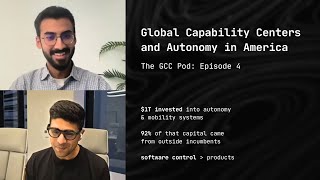
Muhammad Umar and host SPEAKER A break down the $1 trillion mobility boom, where 92% comes from venture capital and big tech, not car makers. Autonomous robo-taxis could drop from $8 per mile to $1-2 by 2035, while only 6% of U.S. factories are truly automated. OEMs risk losing software ownership unless they build in-house AI research and integrate mechanical-software cultures.
Chapters
So with today's conversation, I wanted to make it a little bit more about numbers as opposed to narratives, which is what we usually do and I enjoy very much. So before I jump into this next question, I'll start with this. Over the last decade, nearly like $1 trillion has been invested into the future of mobility overall. And when you break that down, like who invested, where the money went, what systems are actually being built, you start to realize that the future of cars isn't actually being shaped by car companies at all. Which is very interesting when you look at the numbers when for example 92%, as research shows, 92% of the capital is coming from outside an industry. At some point that stops being diversification and it starts becoming displacement. So what exactly are these outsiders, outsiders buying with this money that you know, OEMs historically didn't. Let's start there.
So when you say 92% money is coming from the outside, I mean, I think in the last two decades two things which are very significant when it, when it comes to mobility. One is autonomy, self driving systems and the second is ride hailing. So if you see most of the money that has been flown into this mobility sector, it is around these two areas where businesses, it's basically, it's more of a software play than a hardware play. Building a car is less of a technology problem than a supply chain issue. I mean there's so many parts of the car, so many parts of the car that you can't even imagine, like how to organize all that. I mean, I remember we've been working with some, with oem and then I got the opportunity to learn something from them and it was, I mean, just to get the seats right. There were 11 suppliers. So it's not an easy thing first of all. Right, but then, so in the last, but in the last 20 years what happened is one with, when it comes to full self driving systems, when it comes to electric cars. So the parts have been dramatically reduced, for example, Indian parts have been dramatically reduced. So now it has become far more easier for the outsiders to come into a carplay. I won't say like, I mean, still, I see, I mean of course there are three, four companies that are dominating outside what you call like for example Tesla byd. These are the businesses that are probably are dominating some market share. But other than that, I mean Daimler is still there at the top, BMW is there. So it's not like they're not, I mean, and by the way, they're investing a lot in software too. I mean, I'VE been in talks with some of those people as well. I mean, they're spending a lot in their AI infrastructure, they're spending a lot in data infrastructure and software. So it's not like that. But yeah, I mean now there are 43 startups in mobility in Y Combinator in one batch. So clearly, I mean, it's a far as it has become an electric play or software play. Far more people are now trying to think how they can build something around mobility. And previously, traditionally it was very, very hard to break into that space. But now, I mean, this is this. So that's the reason. And now most of these new, if you really see that 92% capital you're talking about, apart from FAANG, like big tech businesses, lots of that money is VC money that is funding startups. So that's the complete picture, I think. But still, I mean, I know, I mean lots of people talk about the OEMs are now, I mean they're lagging. I mean they're not. I mean, I can tell you that I follow them, I meet with lots of CIOs and CTOs in these OEMs. They are way, way ahead. It's not like they're behind or something, but it's just, it's not cooler if for example, Daimler is doing something. It makes a lot more cooler if a Y Combinator startup is challenging dialogue. So that's what makes the news. But yeah, what's interesting is car manufacturing. Overall mobility is a very much software play now. Previously it was the only hardware, it was more hardware than software. Now it's probably, it's balanced, it's equal.
Yeah, and I also like that you mentioned like autonomy and then ride hailing. Right. Because. And that makes me kind of view this entire sphere as a, as a very like arithmetic debate in that sense. So for example, if we look at like, let's take a case study, like if we look at Washington D.C. for instance, right. Ride hailing is already cheaper than owning a car for those people who are doing below, like, I think it's around 2,000 miles a year. And if you remove the drivers or if you go towards autonomy, the brake even jumps to like 7,500 miles a year. Right. So 50% of the drivers interestingly actually fall below that threshold. So if half a city, like 50% is already sort of economically, I guess, irrational as car owners, what do you think feels first, Right? Is it consumer behavior? Is it urban and city planning? Or is it just from the OEM's perspective? Is it like demand forecasting and those kinds of things.
So it's very interesting. I think you're referring to that McKenzie research, I think. Yeah, I mean it's very interesting. Like if you are in Washington D.C. and if you're driving less than 2,000 miles a year, then probably ride hailing is a far better thing for you than owning a car. And for example, currently the major portion of ride hailing, that major cost of riding, he's a driver. But if the full mobility comes in, full autonomy comes in, then probably if someone is driving 7,000 miles a year, even then ride hailing is cheaper. So that's a very interesting problem. But I have a different take on this. I mean, what I see is like, I mean, if you want to drive, if you want to take your girlfriend out, it's not just moving from 1.1 to B. I mean, it's a lot more prestige for you. I mean, you just want to have some me moments. I mean, you, I mean, think about it like you can have a best coffee in, at your home, right? Think about it like you can have. I mean, there's so many machines. I mean you. Even Nescafe now gives you a coffee, instant coffee and I mean, but still you go to Starbucks. And in the last 20 years, the rise of coffee bars have increased 100% in America. So why. I mean, it's not just coffee, it's just an environment. So car is not just, I mean, we need to think about, it's not just moving from point A to point B. That's, that's, that's a very important point. But it's far more than that too. So I think, yes, it's not about rationality, it's about owning something and then associating yourself with that thing is very much here that we need to account for. But yeah, I won't say that that's the only thing that we need to look for. That's what we are talking about that most of the money coming in into the car industry is, for example, coming up with these new business models where you don't need to build your car, you don't need to have that, a large infrastructure plant to build cars. All you need to come with is a very cool idea to basically connect different cars, which basically is a software play, then use AI on top of it, things like that. So ride heading, basically, if you essentially see it's a marketplace, it's an inventory. Right. Uber is an inventory of the cars. Right. So yeah, I mean, that's a challenge. That's a challenge for OEMs. But at a macro, I'm very, very excited about mobility, autonomy. And I not see it from that much irrational lens that you are looking at. Like, if you're driving less than 2000, you probably don't need to own a car. I mean, I think if I would be driving, if I would be in the SE and I would be driving less than 2000, I still would own a car.
Yeah, yeah, fair enough, fair enough.
And I think, you know, I wrote an article in 2016 or 17 on Medium, the title was. And it got it. It was an immediate hit. It was like owning a car. Need economy or prestige Economy. So it was on medium. So they were just brought in that what I say, autonomy, electric car manufacturing and all those things into one thing. And then where that I looked into this thing that how it's going to impact OEMs and impact. Even then I deduced, I mean, of course, moving from point A to point B is probably. Yes, but that's one thing. But I still want.
Yeah, right. As opposed to like a holistic kind of thing. But I think, I mean, even so, I did also want to touch on like safety in this context. Right. And the data that you were referring to, that I actually read up on before our conversation today.
There'S some early.
Autonomy data in there, and it actually suggests that there's an 80% injury reduction potential if we talk about autonomy. And so it makes me think if a system is genuinely statistically safer, even if it's not perfect, at what point does allowing human driving become indefensible? If we continue to look at it from, you know, getting you from point A to point B, that kind of perspective.
Because just in the back, I got it just in America, just in America, there were 2.3 million emergencies just because of the car accidents. And 90.5% of those car accidents were human error.
Yeah, exactly.
2.3 million car accidents in emergencies, in the hospitals. Right. So just think about it. Like, I don't know why people. I mean, there's why people talk. I mean, I was doing this part with Rafa and she was asking me, like Vemo had. I mean, la. Oh, no, la. San Francisco had this power shortage. And then all of a sudden Veo was not responding and all that. And there was a big news in WSJ and all those media chances. I mean, so like, people don't understand the upside of autonomy. I mean, cars doesn't drink. They can do lots of multiple tasks at once. But think about it. Just ask yourself like 2.3 million accidents for example. If we have a shot to move this number to near zero, is it a good idea? Is autonomy a good idea? Of course it's a good idea, why not? I think in terms of safety that's the biggest thing we need to look at. Even in all parts of the emerging works. Think about how many accidents do we have? And if you really, I mean a couple of months back we had this. I had my, two of my cousins, they were driving from Islamabad to Lahore I guess and what happened was like they just slept while driving and somehow they just stuck with a bus next to them and both of them died at the spot. So think about it. They felt, so think about it. Like I mean even Forget about full L5 or L4 driving, even they have L3 level driving, L2, I mean they could have been easily changed the lanes. They were driving on motorway. So what I am saying is like these are the areas we need to, so we need to continuously push for autonomy.
Yeah, yeah, yeah. No, I'm first off like obviously I'm sorry to hear that. But I think, you know, in the context of shifting towards autonomy, it also makes room for a lot of conversation around like the economics of all of it. Right. So, and I'll throw some more numbers at you here. So again, I was looking at some data and a current autonomous mile is, correct me If I'm wrong, $8 per mile. And then if we look at projections for another nine years from now, because we're in 2026, 2035, we're looking at a drop of around 80% and that brings it down to around one or two dollars per mile. And so that doesn't just obviously improve affordability. I think it changes access altogether. So what would you say are some other second order effects that that kind of drop would introduce into these urban Systems like Washington D.C. or San Francisco and so on.
Think about it like if so currently, if you are, I mean the cost of robo taxis per mile is 8 to $10 and this would be reduced massively close to $1 to $2 in next decade or so. Just think about it, how much impact would it have on logistics, on supply chains, on urban density, right? If, if this, I mean a robo taxi can drive in in per 10 km, a robotaxi can moves a lot more people from point A to YP in one win one or then 100 taxis in that area move. Why? Because it's very, I mean when you take a car from point A to point B You park your car, Robo Taxi is not going to park itself. Like it would drop you and then pick the next one and pick the next one and pick. Just think about how would, how would it change the landscape? I mean, would you mind if there are lesser cars on the roads? Our cities are more. Our cities are bigger. Do you mind it? Right? I mean, no. I mean, if you do, then probably you need to see Tokyo. Like just go and see what's Akarachi, right? Or maybe la. I mean, think about what I mean, you would be so I think one of the things that I. When the cost goes near down, I think near zero, one of the things that I'm very excited about is like, how would it impact our cities? That's the biggest thing that I think was, as I said, like it would move far more people from point A to point b under the 10 kilometer radius than hundred cars combined. The reason for that is it is just, it is in continuous motion. It's not that if someone wanted to move from, from, let's say office to the home, and it's not, it's not parked there, right? It would just keep on moving. So this is, this is, I think is very exciting. This is very exciting. And I've seen, I've used Waymo a lot in sf. In sf. I think it's really cool and it works. And I find it far more efficient than human driver.
Yeah, I mean, it's exciting, right? It's incredibly exciting. The experience and just kind of being in that situation is very, very interesting. But I think so coming to a little bit more of, again, just diving a little bit deeper into the economic picture of all of this. We know that there is a lot of capital that's flowing in, right? We've established that. But at the same time, you know, there's only 6% of factories that have automated genuinely at scale. Right. And if we compare US to China, US robot installations are 10% lower than China's. Right? So why is, you know, if this capital is flowing in and labor is sort of missing, why is automation still stalling at a larger scale? Like, what would you say about that?
So I think the simple answer is because automation ROI breaks at the software layer. I think that's a major challenge. It's so hard to make vision, action model work. Vision action models are basically where you help humanoids or robots train and do action in the physical world. It's not an easy thing to do. And to make that work, you need, for example, you need to have an incredible system Integration layer, your data orchestration and visibility needs to be top notch and then change management. It's not easy. I mean currently, if you see even in the car industry other than Tesla, most of the cars have robots deployed in the paint shop. Yes, but assembly is still very much manual. The parts, the areas where for example, you need to move blocks of steel from one point to another, let's say doors of the car from so what is called internal logistics. The doors are very heavy, the chase is very heavy. So you move from these kind of things from one point to another. But where the human dexterity is required, where the physical action is required, it's very hard for vision action models to replace that part currently. And that's the area where I think I'm very excited about with Code Ninja. So we've been working with some of the companies and trying to explore what are the least signs, what are the LE work in this part looks like. But I think that's basically, it's basically a software problem. I mean the chat GPT moment for robots haven't arrived yet. And the reason for that is it requires lots of data ingestion and it also requires a couple of, I think scientific breakthroughs. So once we don't get there, probably we, and I think we probably would be there in next two to five years. But yeah, I mean it's a software problem I think rather than just it's not a hardware thing.
And I, you know, that also makes me think like given all of these constraints, right. I mean obviously you talked about soft it being a software problem. So if we come back to what we were talking about before and look at this from an OEM lens once again, I think that the real risk in their perspective is like potentially losing software ownership, right. Losing data, feedback loops, systems intelligence overall. So given these constraints, I think it puts OEMs into a tight spot. So what would you say is like the minimal strategic shift that OEMs sort of must make to avoid becoming these commodity assemblers that some people think they will be in the Future.
So historically OEMs used to invest a lot in R and D when it comes to engine efficiencies and performance.
Right.
There was a lot of spent in that part. When it comes to somehow when it comes to software and AI, what I figured out is they are very comfortable outsourcing this thing to another business. And I mean that's something I think when I see this I don't see it as, I think, for example, if you see a Honda car right already in Honda car. There are lots of parts that are not made by Honda. Probably engine is made by Honda. But the rest of the things are basically it's just like a supply chain marvel. You just have these suppliers and you build these things. When it comes to software, it's not that one part. It's not one denso AC that you outsource to a supplier and you would fit in into your car. Software is not that software is very cool. So I always say like you need to manufacture your own software, your AI systems for example. If you're an oem, it's not a bad idea to invest in vision action models.
Right.
What I see currently most of the businesses what they're trying to do is they are. There's not a step change they are doing. So for example, they are improving their in cabin systems, making sure that sound system responds to the car speed and stuff like that. But it's not a step change. I think that step change would happen if they build software and those AI systems internally and from there the new ideas would be born. Right. One of the thing is like set up your capability in research centers.
Right.
But yeah, that's what I think that again I would say like OEMs are doing a great job but it's not like. But I mean as compared to other businesses, other major players, software players, they're not there yet. And although they have a huge software practices, I don't know why but I think maybe the culture part. One of the things. So one of the things we're trying to do with Hyper is like I just want to make an analogy how a complete solution can fit into a mind of one developer. It's a different product. But I'm just how a complete solution can fit into the mind of one company. Yeah, that should be the. I mean that's where the innovation happens. Yeah, that's how innovation happens. Right. You otherwise I mean your mechanical people should know, your engineers should know how the software works. Software should know how the mechanical works. Everything should be contextualized in one business. I think that's how to look about software. It's not easy. And byd I mean I visited BYD factory, Factory in China.
Yeah.
So I mean if you see them it's, it's. They have, they have their layer, their software layers, their autonomy layer, their mechanical layer, their electrical layers, the steel all are housed in a way in. In one place. So people know everything about each. Each of the departments, they know how things work. So I haven't seen anything that is being outsourced to another, especially software. So software layer needs to be. Because if you start working on a software, it would, I mean you would have like say 100 people who are working and by the way, in some of the OEMs, I know they have thousands of people.
Yeah.
If you start working on that, it would come up with new ideas.
Right.
Push for ideas, truly original ideas. I think that's, that's one thing that we need to think about.
Yeah. And I think, I think, you know, just the last thing that kind of comes into my head based on what you said is like I think this, even from the economic standpoint, like this, this cost reduction that we were talking about, I don't, I don't think it's going to come from hardware iteration again and again alone. Right. It's going to be software. It's going, that's what's genuinely going to help collapse this like cost curve as well. So if you could just like tell me a little bit more or tell us rather a little bit more about your view on how like some of the leading enterprises that are, you know, operationalizing this shift, what does that look like? And I would also love for you to touch a little bit on like a little bit more on the work that coding is doing as well.
So, so I was looking at this McIntyre boat. We, I mean if you see the car, there are three core things for the modern car. One is steel, that is battery packs and 30 software.
Right.
We already have overproduction of steel for the next five to 10 years. China and India. Right. We are overproducing steel. So hardware is not that a thing.
Big thing.
So if the cost I'm seeing, the cost is going to go down when it comes to steel battery packs, I also think ranges would increase and the cost of battery packs would go further down. But the down, it's both ways. The cost would go down and the rage would increase. And third is software. And in software, what is the biggest utility of software? It's less of how to build an in cabin system and how to make your carplay work better and all that. It's the single most important thing in software is autonomy. Can we achieve fsd? Right. That's the single most important thing. The moment we achieve FSDS, I can see I can give you 20 different ideas how those ideas would only be applicable once you have FDs. Right. So I know a couple of startups who are working on building on charging stations, electric charging stations for FDs, full staff driving, right. How to park Them in a proper way. For example, if the person is sleeping and he has this mode on that once I park this, you just plug the charger, charge it and then move on. All these ideas that would be applicable once FSD is achieved. So in software layer there are lots of iteration, lots of ideas margin. I mean in hardware, what I mean, I mean you can make it more lighter, but that's not a step change. I mean I think battery packs are very cool. But I've seen in China, if you see they're already making a lot of progress even if they are incrementally improving the battery innovation. South Korea is doing a lot of innovation on batteries. I think in next 10 years we'll be in a different place. But when it comes to software, we exactly don't know what's about to come because these things, those things are linked with, for example this major shift of FSD. And by the way, we are off probably a couple of years from fsd. I mean Vemo is fsd but they're using lidars with. The true example of FSD is if Tesla achieves autonomy. They launched into Austin. I've seen it, I've experienced that it's good, but it's not there yet. But you can really tell that it's about to happen. I mean probably few inches away you can think of like for example, they're very short of just achieving msg. So yeah, I mean I think the real thing is in terms of software, we need to make our iteration speed faster. We need to have few bets. One of the things that's challenging for me is we need to think about, we need to how to think, how to take bets rather than just think incrementally like let's make soft, let's make it better with software, let's make our music system better with software, let's say or steering better with and all that. Just think about, I mean what are the some great ideas that are purely bets. Those FSD was a bet, right? Think about, can you imagine 20 years or 25 years or 30 years back that FSD is possible?
See.
So what are the bets that few companies are taking from there? I would see that how. And those bets would be probably software bets because it's far more the idea space of software bets are huge than steel bets or battery bets.
More from Muhammad






FDE Epi : 16 | AI Agents, Billion-Dollar Infrastructure & the Future of Intelligence




