The GCC Pod Ep 5: The Death of the Search Box, Agents, and Travel
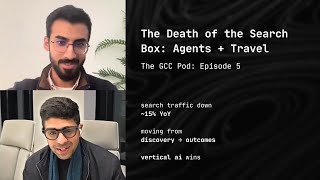
Muhammad Umar and host Speaker A argue that AI is replacing search engines as the primary way people find information, killing the SEO-driven content era. They explore how AI agents are reshaping travel and enterprise software, where structured data and compliance make corporate travel a prime testing ground. Dynamic pricing and AI-native platforms could eventually enable near-zero-cost flights.
Chapters
Today we're talking about how decision making itself is shifting from humans going on to a search engine searching for lists to choose from to now machines that are genuinely composing actual outcomes. And I know you and I have been having a lot of discussions offline about travel and I think that this gives me a good opportunity because that's a good lens to sort of look at all of this through, right Underneath all of that is something bigger which is how are agentic systems, trust and operations overall reshaping the way large enterprises, large businesses actually work. And you've been building genuinely hands on building AI systems inside these real enterprises. So if we were to start from the first principles, right, the search box is dying. We know this web traffic is like down maybe 15% year on year. And Genai is sort of becoming the new front door of the Internet. And you know, that's, that's what people are saying. So what actually breaks when the search box sort of stops being the primary interface? Let's you know, go with that first.
So you know, when we started building Code Ninja and one of the things for us was like how to attract traffic, how to bring more businesses to our websites. And at the time the common notion was, and I mean you need to create a lot of content, right? The sake of creating content was never to, I mean, of course that was, I mean it was never to, for example, help the user. That was never the macro agenda. Always it was like how to rack yourself up, how to write a lot of content. And there were companies like HubSpot, they used to like you need to. And they were telling their stories that they write. When they were building HubSpot they used to write about CRM and sales, three blogs every day. And they've been, they did it for a decade. So everyone was saying like the content is a thing and you need to write a lot of content and that content because that would give you the boost on search and Google and stuff like that. So there was a whole new wave of just writing content for SEO and stuff like that. And for the whole 10, 15 years that happened, the likes of Neil Patel and all that, they were masterclasses, how to rank your content and stuff like that. And we were victim of that too. Truly. If you really ask yourself, try to understand what the real thing was. I mean, no one wrote content for, I mean content mean no one wrote net new knowledge because they wanted the world to inform about that. Everyone wrote because they wanted a piece of the traffic, right? Truth was never the intended purpose, it was all lie. Right. So now that era is over and I think for good. So I think that's one thing that. No you. When for example, if search box is dying, it had to because you. And for one reason it's a lie. Right. If you are saying give me top five airlines and the, the airlines that are top five are. Because they're not top five. Because they're top five. They're top five because they have had, they had a lot of effort in writing the content and because. And now they are top five. That not what user ask top five. Right. Yeah, so, so that's as far. I'm very excited about it. Okay, that's, that's a great thing that, that, that search box is dying.
Right.
And now coming to Gen AI, it's not just like the truth had a chance. I mean I think currently Genai is also relying a lot on the same kind of content that from the content from these websites, the comparison websites and all that. But eventually the optimization function is towards more truth, towards more trust. So the first thing I think the exciting part here is that more and more right kind of information would be available when it comes to Gen AI when it comes to platforms like ChatGPT. Because at the end of the day user would come for knowledge. Where would people go for the knowledge base? They would, they have to have, they have to go somewhere. So they would go to ChatGPT and they're already going there and but when they go there, the best thing is the chatgpt Groq, they are optimizing towards the truth. What is the truth? And that's the first thing that's very good. So no more fake SEO content. That's number one. And second thing is the way these platforms behave, the interaction has changed. So for example, now I went to Turkey in 2018 and I had to do a lot of effort to find out what. Which where I have to live.
Right.
But. And then I picked one hotel and all that stuff. But now you have to give your budget, right. And it would do all the chatgpt and all these platforms will do all the heavy lifting for you. So it has. I mean why I have to do all those comparison and bullshit. So that's the second thing that I think is that's driving the people's behavior. So this first part, Yes, I think 15% year on year is good, but I can see, I can tell you in next two years there won't be any traffic left in these search. Mark my words, Google is a yellow pages of 1990s, right? When I talk about Google, means Google Search. Google is insanely great company when it comes to AI using Gemini and all that. I mean, I'm talking about Google Search, not talking about.
No, good, good clarification. I think, I think necessary, very necessary. No, but I think, I completely agree. And it's also interesting because I think visibility then, which was the goal with SEO and all of those things. It's very, very interesting because visibility now sort of, if you think about it, depends on being trusted by the models, as opposed to how many humans have clicked on something, right? Which changes because previously we were playing that game and we were forced to play that game because if you wanted to rank up, then that's how you had to do it. So if clicks now don't matter anymore, what does matter?
So trust is a very macro term, right? By the way, even in Google Search, because we have a lot of SEO stuff for our own websites. So even in Google, it's not that easy. It's not only the clicks that count. I mean, your web authority, your racks, your content, truly unique content and all that, all that matters, right? So that is what, for example, if your website is being mentioned by someone like Forbes or someone which is very high authority, proof of high authority, then you, your content ranks very high, right? But that, but the, the whole lens of trust would change. So in chargeability, all those things matter, but the decision making would be by the agent itself. And I have, I have, I've seen it firsthand, like, yeah, that somehow, somehow I've tested, like when you ask, what are the top 10 things, what are these things which, which are not just facts, which are very opinionated things. What I. But what my mind tells, that these should be the top. And that's exactly what charge beauty tells. So that decision making is now being outsourced to the agent, and we need to build trust with that agent and somehow that trust, that agent's optimization function is truth. How to maximize the truth. So, for example, I remember the top 10 cloud businesses in San Francisco, right? So when you write in Google Top 10 Cloud Businesses in San Francisco, I can assure you there's not a single company in the search that Google tells you that these are the top 10. Because Google gives you a blog link and in that blog, someone who paid for that blog is at the number one. And that's, that's how the top ten is organized, right? That's not. But when you ask the same through ChatGPT or Grok, the top 10 are different and those top tens are so for example, I was in San Francisco, I wrote top 10 cloud businesses. There was Google, there was Azure and all that. And there was another startup I was working with. And he was asking why my company is not in top 10. And they were. And he was beating his team, like, why you're not able to put his company in the top 10. Then I asked him, like, hold on, hold on. Are you in top 10? This is a question. Why are you saying you need to be in top 10 when you're not in top 10? So the question is this why he's constantly thinking about, thinking in terms of. Because he's thinking in terms of SEO. Yeah, that's not going to happen with jgpt.
Yeah, yeah.
So I think that we need to build that trust. So what I like to call is like, find your niche. I mean, the question, if you are not a top 10 cloud provider, you're not a top 10 cloud provider. I mean, no way you can be ranked as a top 10. That's not going to happen. You need to find a new way. And I think we need to closely align this thing with our sales strategy. So, for example, that guy, when he goes to sales, he tells the customer, look, we are a very young business. We've recently started this and that's our story. And we want to compete with these big players, but that's what we offer to the, that we bring to the table. The, that exact story needs to be reflected in your search now, in your chatgpt and search engines now, that kind of story. Because you can't fake your ranking and your profile anymore.
Yeah, yeah. And I also think that you mentioned the agents being trusted to control the outcome and you mentioned finding your niche. I think overall, if you look at agentic AI, adoption is early. Yes. But it's also sort of uneven. Right. I was looking at this other piece of research and it told me that 40% of executives are actually not using agentic AI. 30% are experimenting and 30% are at the scaling stage, but specifically in narrow domains like call centers or pricing use cases and so on and so forth. So my question is, is this like another, you know, cycle of hype that's, that's being built up, or is this generally an inflection point?
No, no, this is not. It's not hype. So I just had this meeting with a top executive of a company and Umar, what I literally saw was he built the entire platform. It was very close to finishing it using Claude code. And he was not an engineer. Right. So he was a Top executive. Right. I can tell you that executives would be using AI a lot and they're already using it, right? I think so. That's not true that executives are not using it. Most of them are using it both. I mean technically, like for example, AI for coding or AI for usage. Like most of the executives I know, they're using all platforms like GPT, Grok, voice agents from 11 labs, vSphere, Gamma, all the complete stack they're using. From this standpoint, if they are technical, they're also using lots of stack from the code, they're using Codex, they're using Cursor, they're using Claude code. So I think they're using it a lot now when it comes to travel. So what I found is like in travel industry, the executives are basically focusing on areas where, which are very specific to them. So for example, if I'm leading procurement or logistics or ground control, so I would find if, if I have something that can help me in that part.
Right.
So it's not like it's not broad, focused, like it's not like you're doing, you're using AI for everything. Specifically in travel, what I've seen is like there's a lot of usage of AI agents, but very focused on certain kind of niches. So that's how, for example, I've seen this one business, it's a airport maintenance business and their people are using very specific model designed for them and they're using it for very specific kind of tasks. So even in travel, executives are using lots of AI. It's just like they're not as broad as for example, probably in other domains they are very much focused on inside in the kind of areas that are very much related to them. As I give the example of airports maintenance already I was working with.
Yeah. And I think that makes sense. Right. But at the same time I think there is still like this, this trust gap that exists. And we brought the discussion back to travel. And I think what's interesting about using travel as a lens is that I think it focuses or forces rather, you know, AI to make decisions that are very real. Like decisions with money, decisions with timing, with feasibility, trade offs. You know, you want to do this, but you maybe don't want to give, you know, that another the same amount of priority. So it moves it away from generating just text. But at the same time, like why would you say like users still don't fully trust AI to finish the job? Like what would you say about that?
They do. It's not like they don't I mean I do so users do trust AI to, to finish their jobs. But I think one of the things that what we call that humans are very lazy.
Right.
I mean think about in your workplace. Think about yourself. Umar. You are using AI. You're using. I know you're using. You have your own AI stack. You're using I think 10 different tools. Most of these tools are part of your work stack in last one year.
Right.
It's not like I'm talking about ancient history. Just allow me for three days that I take back all of those 10 tools.
Yeah.
Would you be able to work? Yeah, I mean let's. Would you be able. You can't write your email now.
Yeah, that's how it is. Right.
I mean you, you. So I think people. One thing Anderson Mark Edison recently said in his recent podcast. He said like what he, I mean he was saying and I think he, he's right. He said like what people. I mean watching people doing something and asking them what they do are entirely two different things. So for example, if I ask you are you getting use of. I mean what I mean ask a general user of AI in America what's your stance about AI? And they're going to say AI is just, I mean they're going to kill our jobs and they absolutely hate it and all that. But when you see what they're doing, everything they're doing is they're using AI tools day in, day out day. Right. So but and it's fine, it's perfect. So I think people are usually the people can't go back. So, so, so that's one thing about AI that people are using. Another thing that you're trying to do is very specific about agents. Why we are not able to do complete, why we're not able to outsource an end to end job and why can't I have an AI recruiting agent who can hire a guy and just complete everything? It's we are on that track. There are certain things that are required. For example, we need to make sure how comfortable we are exposing all our workplace stacks to these agents tool use Everyday AI is getting better in tool use. Tool use is a very important thing. When AI is very good from middle to middle. We have to start it, we have to end it. But these things are improving. At the end of 2026 you would see a lot of jobs would be absolutely, absolutely killing it. I, I think AI would be a great recruiter in terms of like I mean I'm not talking about scouting. Scouting is a Very easy thing. I found you through scouting. Right. That's a very different thing. But scouting means where I had to convince you for days and months to join me. That's, that's, that's scouting. But recruiting means like for example I have a job I need, I want, I, I want a relevant fit. That's all I think that's, that's SDRs. Even other jobs AI would be. AI agents would be doing most of these jobs. So I think just wait for next six, eight months. And I know how, how quad code is good. Umar. Do you know how quad code and open 4.5. I mean you would be just amazed. What the hell is this? I knew.
It'S honestly how it feels like with a lot of tools out there now. Right. And you mentioned like AI in the workplace and I think I completely agree with the premise that you know, if you ask somebody what they think about something versus how they actually use it. Worlds apart, right?
But so never ask. Just watch them watch.
Yeah, I'm going to do that next. But so I also think like if we move away from or not move away rather but if we also add something else into this lens because there's a difference, right. Why it also depends heavily on how workplaces and businesses and enterprises define success. So I think let's talk a little bit about your thoughts on why does enterprise at the end of the day end up adopting agentic AI before an individual consumer. Right.
So again enterprises are so certain use cases. Again you started with the travel, let's say. So for example, corporate travel is adopting agent Ki faster than retail travel. The reason for that is if I am sending 20 people for a conference, so that's a corporate travel. So I know what the budget is, I know what airline they're going to travel. So there are lots of things that are locked. There's lots of compliance related things. Compliance related things that for corporate that's already there. So AI is very good with that. AI works agentica. If you want to make agentic care work, there's only one thing, structured data. Right. You need to make sure that data is structured and there should be rules. So that is the reason why for example in corporate travel, restaurant industry, in food and beverages, these sort of industries, the AI adoption rate is very high. The reason for that is already most of the data is structured, most of the things are already compliant, rules are established. So it's far more easy to build agentic experiences on top of this structured data rather than just. And why structured data? Because agentic AI at The core agent AI. To make these things end to end work, you need to be very good in tool use. And to make agents good with the tool use you need structured data.
You just have to figure out how to use the tools maximally. Right. And that's, that's, I think something that's important. I, so if we, if we bring this back to travel once again. The way I see it, there's, there's four futures when it comes to the travel ecosystem overall. So there's copilot commerce, there's AI experienced creators, there is supplier direct AI and then there's agent to agent negotiations which I think for now is a little bit still on the sci fi side of things. I don't know if you've seen those videos of like these people who are making one ChatGPT voice talk to another ChatGPT voice and you know, it's very confusing. So. But what's interesting is that I think all four futures are technically possible, but they're not operationally equal. So out of those keeping travel as a lens, which future actually wins?
I think it's not which future multiple futures would coexist, but I think operations decide winners, the players who control for example data freshness, decision latency. So when you talk about DC and latency, I don't know if you have used or have seen certain apps within ChatGPT. So for example there's a certain level of latency with certain apps. So for example, if you're using booking.com within ChatGPT, there's a bit of a lag as compared to other apps like Figma. So these kind of things are important, right? Who has written better software for these, these, these for ChatGPT, for Claude, this is very important. So expectation handling is, is, is, is a very important thing how you handle expectations. So these kind of things. So it becomes more operational. One thing I, I talk a lot about this is like, I think this is a time we need to put up, we need to put technology in the hands of the business users, the people who run operations, right, Rather than outsourcing these things to the just ctos and these sort of people. Because it would, the, it would, it has, the whole AI think and software thing has become a lot more operational now.
I think, I think you're right, like it's become a lot more operational so putting it into the hands of business users. But then that also makes me like think about how what, at least in my eyes, vertical use cases tend to create like real value. If you compare them to Horizontally. Right. For example, like guest allocation automation will save you hours. And then you talk about, you know, computer vision and physically like that brings you know, between like a 15 to 30% improvement in overall like labor efficiency and things like that. So why do these vertical use cases end up creating more value?
First of all, structured data. I mean the more think of like more focus you give to the AI agent, the better performance. Think about vertical use cases in travel is imagine vision AI deploying in every room where you have the live analytics, where you're assessing how much, I mean the overall condition of the room when the guest leaves, all sorts of things. Right. So the more focus you have when it comes to AI, which is more focused means which is more vertical you would make it. The better the responses would be, the better the results would be, the better the adoptions would be. So this is, I think that's the reason why vertical AI in travel, as I said earlier, I mean I've seen incredible use cases of AI in procurement, in logistics, in ground control, in food services, within the food services, in flight. So in these kind of use cases, the more focus you give to the aya, the better it will perform. So these are the use cases in travel that are already creating lots of waves and, and they're, they are basics. There are and they've created some incredible customer experiences, especially in cabin food programs that have been tailored with AI. They've created, they've created lots of brand loyalty and people are just, they just love these sort of experiences. The ROI is very, very high on these sort of things in vertical AI use cases.
And I think it also becomes about like looking at it from a point of view of like our goal is that we want to synthesize the overall customer experience and so that then obviously opens up like conversations about like bundling, moving from just dynamic pricing to actually bundling. Right. So event based bundles or you know, you see people in the lens of travel do things like wellness specific journeys and you know, very much context to where packaging that's guardrailed by these verticals is this, do you see value in this or is this just like smarter upselling at the end of the day?
No, I mean, I mean what I talked about like when it comes to in cabin food service and I mean that's part of bundling, like how you bundle the whole experience. Dynamic pricing. Pricing is already dynamic. However in, in air travel it's one of the biggest challenge now how to make pricing work for the customers. The whole industry works in a very different model. I Mean so dynamic pricing, it's already dynamic. There are platforms that, that provide pricing for these aircrafts but that has to, that would change eventually. So imagine you, I mean I think from two years or three years from now if you want to move from let's say Lahore to New York and you have a budget, right? And it's very, let's say you have, I mean you, you can't spend that much. You have a budget, you would have a flight for that. Currently it's not, it's not, it's not how it is like so for example. And currently it is like you have to. Even if you are looking for the cheapest options, budget options, there are very limited options and there is a, there's in a year there's a window where in those two, three months you can have those sort of flights. But I think with AI because I think there's a lot of latent potential available because currently in the industry but because the computation is so hard, you really don't have any mechanism to compute so much different scenarios because most of them existing platforms are rule based. So it's very, very hard as we move from rule based platforms to pattern based platforms from the ground up, making it purely AI native. I think you would have flights even in some cases close to zero, near zero price in the future because there's so much latent value that needs to be untapped. Especially when it comes to dynamic pricing for airlines.
And I really like that response because the way you frame it like latent value that exists and we need to capitalize on it, right? We touched on this a little bit last time in I think episode three or four. But we talked a little bit about like the concept of you know, death by a thousand pilots, right where, where you are trying to capitalize on that value that exists and you end up doing, you know, a bunch of different pilots. Why do these pilots fail even when we know that the tech works.
Let's start from. I mean how many pilots do we have internally in code ninja to make AI work? And I still think, I believe AI even if we stop improving AI most of the. And just say let's take the cutoff date today. And even we just use the current AI and adapt will just transform the workplaces on tracking flows in the way we work. The reason is we do not incentivize people to adapt the new kind of. To adapt this, to adapt AI. We don't incentivize. I mean I remember this quote, Charlie Munger never ever think about anything Else when the only thing you should think about is incentive alignment. So people, I mean somehow if not using AI gives them the incentive, why they would use it or adapt to this new paradigm, why would they do it? So it's always, I can tell you, I mean it's always people, people who don't adapt and have all those fantasies about that why it's not a good idea. And again, if you ask them, if you watch them, they use a lot of AI for things that relevant to them. But when it comes to improving workplaces and factory floors there you need to align the incentives. And also, I mean what is a culture? What is a culture? Culture means set of behaviors. Which set of behaviors you punish and which set of behaviors you reward.
Yeah, right.
So we need. It requires a different kind of culture to make company a truly first company where most of the. There are lots of departments, I can tell you a lot of department that are required, that are not required anymore. There are a lot of. But yeah, I mean so it's a, it's an adaption challenge. The companies who would adapt faster would you see, they would do better.
No, that's, that's true. And I think you know, culture both in terms of explicitly and implicitly. But then that you know, also makes me think about like if we talk about this new workspace workflow workforce, you know, model, we hear about things. I know you've talked a lot about things like one pizza teams. So how like I guess to close. Right. How do some of the world's most important businesses today actually build and run these systems? And, and then where does Code Ninja. Where does Pakistan fit into all of this discussion that we're having today?
Clearly one thing is very clear that code generation is. Code is not a skill anymore. Let's put it this way, it's not a. If the only thing you do is. I mean if the only thing you do is writing a Java code Python code. I'm not quoting myself, I'm quoting Stephen Wolfram. It's like your days are numbered. That's not a thing. And one thing, one thing we did wrong with computer science students were like we, we taught a lot of trade lot of, lot of diploma level thing to them and branded them that a degree of PS Computer science. That and that. I think this was not a good idea to teach so many programming languages in undergrad computer science courses. I think this is. That shouldn't have happened. Theoretical computer science is what was required. So for example theory of automata, physics, advanced physics, these sort of things Right. So one thing is like coding is not a skill. I mean, I'm not over exaggerating it. It's true if you see how cloud code works. So however, it doesn't mean like, I mean what it means is a software engineer would now be doing a true engineering work. They will be doing coding, they would be using these platforms, they would be integrating a lot of different stuff, they would be generating a lot of new ideas for the customers. There will be no backend, front end and design and all that stuff. That's, that's one person thing, right? That's not, I mean there won't be a team. So back to your PJ question. There won't be any, I mean there won't be any, any, any. There won't be a five people team. There will be one person who would be handling end to end thing. So that's, that's, that's coming and that is very exciting by the way. Right. It's not like the future of computer science or software engineering and all that. I think it was never brighter before. I think it was never this brighter before because now it's a chance to apply these concepts of computer science.
Into.
Areas like climate, into the natural world actually. But for that you need to go beyond just coding. You need to understand the problem. Right. And for, to understand the problem you should have a very good grasp of physics, metal models, chemistry, metal model, math. Right. These are the things, materials, electrical, so these sort of things. So it's very exciting and, but the ride would be very, very bumpy, I can tell.
More from Muhammad






FDE Epi : 16 | AI Agents, Billion-Dollar Infrastructure & the Future of Intelligence




