The GCC Pod Ep 7: AI Proving Grounds, Innovation Infrastructure, and Cybernetics
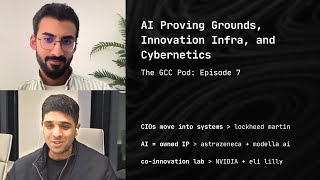
Muhammad Umar and host SPEAKER A discuss how companies are building AI-native organizations through proving grounds in regions like South America and Ghana, treating AI as core infrastructure rather than tools to buy. They highlight acquisitions like AstraZeneca's purchase of ModelA AI and partnerships between Nvidia and Eli Lilly as signs enterprises are internalizing AI capabilities, with data, compute, and energy as the three critical resources.
Chapters
Every week, my colleagues and I unpack what's really happening in the world of global capability centers. We're living in unprecedented times and most businesses aren't ready for what's coming. Many mistake using AI for simply adopting tools like ChatGPT without actually thinking about how their organizations operate. For example, how Ashish Vaswani has built R and J models, their first open source model described as a world class 8 billion base instruct pair. Or for example, how companies are setting up their entire data value chain to acquire highly specialized expert data sets. By setting up global capability centers in South Asia and South America. The real shift is happening elsewhere. Some companies are building their own models, others are embedding AI deeply into custom workflows. But many are securing long term advantages around compute, energy, data and most importantly, access to global talent. At the heart of it all is this. The future belongs to companies that can tap into the world's most capable, ambitious and underutilized talent pools and turn them into a strategic advantage. In the GCC podcast, I sit down with operators, founders and leaders to explore how the world's most important businesses are building global capability centers not just to cut costs, but to acquire proprietary data, develop custom AI systems and transform their products, services and workplaces into truly AI native organizations. This is a podcast about how global businesses are being rebuilt from the inside out. So at Davis, by the way, with the World Economic Forum, Talon Ghana is actually launching a government backed AI innovation hub. Very interesting. Positioned as a global AI proving ground, right? And it's essentially at its core it's an execution layer where applied AI and deep tech and real deployments actually get tested at enterprise scale. I think what's interesting about this is we've been talking about this quite a lot in our previous episodes. The infrastructure of innovation, right? Not just policy and so on and so forth. So why is a government run proving ground, as they say, such a big deal? And what does it change for overall GCC strategy when you think about it?
So it's very important to understand like what modern offshoring looks like, right? This is important. What does it mean by AI proving ground? Like, I mean it's not like this is the first time happening with like proving ground thing in terms of medicine. This has been happening from last two decades. Like, for example FDA local laws are very, I mean the regulations are extremely tough to navigate for example in the us so most of the companies, what they've been doing is they are building those proving grounds in South America where laws are relatively lax, they build the Drugs, test it and then bring it back into the US for the FDA approvals. Right. So you can find it like something like this is happening currently when it comes to AI proving grounds. And so companies are building global capability and capability centers not just for like onboarding. More engineers who would be building custom tooling for your business or stuff like that. What they're doing is they're building this AI proving grounds where they are deploying, they're building those micro data centers if you like, lots of energy and then most importantly, incredible infrastructure for data acquisition. And for them, once you acquire that data, build a model, deploying those models into the local setting, into those states to actually learn and then export that final infrastructure into the developed markets. So that's what AI proving ground means and that is a new form of offshoring. So that's why. And then if you see only business that's currently rising is gccs global capability centers like and what they are doing, if you see Most of the GCCs, they are mostly around AI proving grounds, they're mostly around data acquisitions. That's what's happening primarily in India, in Chile, but now we've seen it happening here in Lahore as well.
And I think, you know, this is obviously a direction, the Telangana, this announcement. I think it's obviously we can see it's the direction that governments are moving in but it also, I think if we just kind of extract from that, it raises a question on the enterprise side too, right? Especially for R and D heavy organizations about how leadership itself has to adapt when AI becomes embedded across systems. And I was reading this, an example of that is Lockheed Martin's CIO. Ms. Maria Demarie describes the CIO role as becoming sort of the orchestrator of AI across all departments. You know, engineering, hr, finance, focused on standardizing systems and using stuff like, you know, digital twins and model based, you know, approaches. So if AI isn't replacing these roles but, but is sort of redefining them, then what does that mean for specifically for R and D leaders but then also GCC leaders as well.
So I mean first I would discuss on that CIO role. So if you see, I mean two years back if you ask every major CIO what's your AI strategy? And their AI strategy was like buying enterprise license for ChatGPT, right? So that was like, I mean even in coding, if you see we were, we built AI, but most, I mean we haven't done much in terms of like at the time, in terms of hyper is a very later story like at the time we, okay, let's start using AI and it's a good thing because let's be the tool user. And then eventually you will find out how to build that tool, how to deploy that into your different organizations. I think when you talk about the roles and more how modern roles are involved, are evolved in terms of when it comes to CTOs and CIOs, what we really need to think of is like AI. Think about AI in terms of. Not co pilots. I've been saying this, but in terms of cybernetics we need to think about there's some of the work that only AI would do. And I mean we're just transiting from that copilot world to the cybernetics world. There will be certain tasks. So for example, expect this on LinkedIn three years from now. When you say the company profile, they would say, they're saying 400 plus people. Right. That's what this vision is.
Right.
And they would expect that it would say 400 people, 200 AI. Right. So that's how the description would be. So the people and the total workflow should be 600, 400 mid computers, 200 digital computers. Right. Digital AIs. That would be, that's going to happen. And why. So if you see, if you read a novel from Charles Strauss, Accelerando, it's set, it's a sci fi novel. Although it was like in 2005, it was written pre AI. And if you see it was set in 21st century, if you read it in that novel, it starts from 21st century, moves, travels across that century and it moves the word. You see how the word is moving from co pilots to cybernetics to the post human society, post human entities. It's felt like this Charles, Charles was actually time traveled and then into the future and came back and wrote that novel. It's so real and everyone needs to read that all the cncd. So there. If you see the first version was copilot, the second version was cybernetics. So for leaders we need to think about AI from the lens of economy.
Right.
So when I talk about lens of economy, so you need, you can't, you, you can't segregate the workload, you can't segregate AI as a tool. And what are the implications of this in terms of economy of the company and overall? So if I am the CIO and I'm running all those organizations, my job would be like, okay, what parts of my work can be entirely, not middle to middle, entirely suited for AI and what Parts are for humans. And for that I think the best example is for example, think about fine pricing is very important. That's why I said economy. So fin, they only charge you if the incident is resolved through AI, otherwise they don't charge it. Right. So these kind of economic models need to be thought through, but by the technology leaders. Like for example, if you are, if you want to reimagine hiring. So you need to think about, okay, for any first three, for the first three roles or enroll. That's less than five years of experience. Let's say I'm just making it up for all the people that we're going to hire who are with less than five years of experience. We're going to. All that hiring would be done by AI. AI would be done. AI would be doing it. You should be very comfortable in it right now once you set up that goal, that parts of the business would be run by AI and parts of the business will be run by the humans. And now think about what other leader you need to do. Right? That's one part of what I think how CIS should operate. And that's the only way you move beyond ChatGPT and stuff like that. I mean, and that's very important. Second, I would say is like since you asked, this is my favorite topic. Ask everyone in your company to wipe code. So the best way to learn about AI is use AI to build something, right? Everyone either if you are a, if you are an accountant, if you are a, I don't know, everyone in your organization should build something. We are in a transition again, coming back from referring to the accelerator. We are moving from a knowledge economy to a creator economy or tool economy, right? Everyone would be a tool maker. So we need to make sure how can we build, how can we help everyone to be a toolmaker? So that's, everyone needs to do wipe coding, composable wipe coding or some sort of stuff, right? So these, that's how. At least how I think about it. And third, I think one last thing I would say is like what whatever your business does, if you are a logistics business, if you are a, if you build sodas, if you're a Coke, let's say what does it mean for. So I think one of the important things the first time we need to think about if you're McDonald's, right? So no, okay, after building, after you have built best ride hailing experience and that customer experience. Historically we've used technology just to get a customer experience, at least in these big tech, in these Fortune 500 businesses. I think first time we need to think about real things. So for example, how to make burgers healthy, right?
Yeah.
How to make chips healthier. So these are the questions that we should set up. And then to chase those bigger goals, we need to think about how now AI can help because it would produce. I want to eat 10 burgers in a day. I think there's nothing better for me to eat chicken burger from McDonald's. I just love it. I can eat five burgers, but the only thing that's restricting me is I can't eat as many calories. Right. So I mean, well, imagine. So we need to think about in these terms, right. Pricing is very important. Pricing before product. And that would give you a very good sense of how to build AI. If you're only building AI and you're not only measuring productivity in some form or another, the best way to measure productivity is. Pricing is money. Money is what? Money is an information storage for labor. Right. So the best. So bring pricing into the picture. Right. And that's how you think, how, at least I am thinking about to deploy AI for. And then when you have set up these goals and these regions and now build AI proving grounds in global capability centers before that. I don't think there's any need.
No, I like the way you tied that entire sort of explanation up. And I think what I hear is, or let me rephrase that, part of what I hear is that leadership is then becoming more about orchestration and treating AI as this core infrastructure that's core to the business, that's native to the business. The next logical question in my mind, apart from the fact that your burger talk made me quite hungry, I think there's this. I was reading this recent piece of news. AstraZeneca has agreed to acquire ModelA AI to embed AI foundation models and agents into oncology R and D. So clinical development, biomarker discovery, quant pathology. So they're focusing on moving from having a partnership to having ownership. So why does this acquisition and similar ones, obviously it's less about pharma and more about how seriously enterprises are starting to treat AI in this way. So why does this acquisition matter beyond pharma? And what is, you know, if we step away from pharma, what's the meta signal for corporate R D?
I mean, they could have outsourced it to another company. I mean, the question what here at hand is like, they could have outsourced, let's say Infosys, because Infosys is a large R and D set up like for example, but they didn't why they are. And I think that's right and I'll come and I'll connect it with your GCC premise as well. But I think it's important, I mean have you ever thought of like, like for example, imagine I want to do something and I give you the money, take that money, be more intelligent than me, right? Be 100x more intelligent than me and then come back and tell me how to do it. Right. I think this is not automation.
This isn't.
I mean I haven't seen that before. So I mean that's, that's not going to happen. So historically what you used to, you used to talk to the companies for was like you wanted, you exactly knew what are the moving parts you wanted to get done. Certain thing, you outsource that thing to a third party party business and they would have, they would do it for, for you because they're cheap labor or stuff like that. But now it's not that thing because that cheap labor party is already subsumed into the models anyways. So now what's happening is companies are finding new ways to acquire companies or building those AI capabilities in house. So for example, if you are pharma company, one way is you outsource your drug discovery to a third party business and second is build your own drug discovery thing. Right? Because at the end of the day what is pharma? Pharma is like those, those. What is their IP asset? Their IP asset is a knowledge work. How different minerals and materials work together to launch new drug into the market. So in launching new drug you need that initial infrastructure of where you simulate the entire thing, do the trial runs and then of course launching it. So the whole thing the companies are now doing is like they're building those capabilities in house. And what is the best way to build in house capability? Either acquire something or, or build something through global capability centers. That's the only thing, right. And that's important and I think that's the right way to do. Although Koninja's major businesses through working with these companies and GCC is a new one. But yeah, I mean that's what I'm saying seeing is like building capabilities in house, especially capabilities that require AI, that require intelligence, building that whole supply chain of data infrastructure, building whole supply chain of proving grounds. All that in house is best done either through acquisition or through global capability centers.
And I think all of these little tidbits of news and specifically when we talk about pharma since that's the ongoing discussion, I think at the end of the day it all signals ownership. If you can't beat them, buy them kind of thing. And I think if we look downstream of that, how that ownership actually becomes genuinely operationalized when domain expertise, but then also compute and feedback loops and all of those things have to work together continuously. I think there's another announcement as well that I was reading up and I think that that's also probably a good one to share. Nvidia announced a partnership with Eli Lilly which as I'm reading, up to $1 billion over five years for a joint AI lab in the Bay Area leveraging Nvidia's next gen Vera Rubin architecture. And the focus is accelerating drug discovery development, tightening the loop between research and compute. And this was announced like about a week ago on January 12th. So taking that as a discussion point for this, what's the blueprint? How should GCCS copy this approach and even in those cases when they maybe don't have budgets like Nvidia does.
So I think you talked about loop. I just want to stick with that word loop when you talk about this story again, Nvidia and Eli Lilly. So it's all about how to build a co innovation lab, how to build a compute platform, how to come up with domain scientists, how to engineer different workflows, not just an AI team in a corner or your IT team buying chatgpts. So the real asset is the loop like data model, experiment, feedback and then improve model. This is what compresses timeline. So this loop is important. If you ask me what is the single most important thing in this loop? It's data. So data has this very scary little relationship with the builders. So at one point people started saying like data is important. That was the start of post ChatGPT Model 3 launch. And then there was a time when DeepMind started to say like AlphaFold 2 was trained at the same data, AlphaFold 1 and then AlphaFold. So they said like data is not that important. And then after thinking machine, Miramurthy reinforcement learning their approach, data again came back into the single most important component into the AI. So currently at this date, currently as we speak, the single most important thing in AI is energy, compute and data. Right? So in terms of that data acquisition, this loop is very important. So yes, I think for businesses what can be done is, I mean if you don't have like you talked about Nvidia level compute budgets, like if you don't have Nvidia level compute budgets, which I'm sure Most of the people doesn't. You don't have $1 billion. So I think what's important is like how to build that vertical micro lab. If you like one domain specific problem, one DataSET pipeline and one validation hardness and one deployment part like for example, how to, how to really focus on one thing and then build it from there. So how to build that vertical micro lab, that's I think, and that's not very expensive, especially if you're setting up gcc, let's say in South Asia or South America. I mean it's, it's not, it's not that expensive.
And I like that you stuck to, you know, the idea of the loop because I think what's common across all of these examples is that at the end of the day, I think the scale of the companies that we're talking about, right. The hard part is not experimentation, it's more about turning those learning loops into something that is repeatable and scalable. And I think that's also where a lot of enterprises taking an industry agnostic approach obviously sort of get stuck. Right. And then you know, partnerships like for example TCS and amd, right. They announced a collaboration to accelerate enterprise AI adoption at scale that was part of the announcement and emphasizing moving beyond pilots into production plus hybrid cloud, HPC and industry specific solutions. So what would you say about these, these integrator plus compute partnerships that have.
Suddenly become, you know, the biggest thing. That's what these integrators are doing. They're building GCCs now, they're building app moving routes and whatever they're doing is under that umbrella. Umbrella they're trying to do at least. So I think here what's, I think I like the analogy of invisible AI cu. It's not like they're not a system, they're not system integrated. But like, like they're. And they asked like Harry stabbings in 20 VC asked like what exactly you do, right? So like look, I mean we talk to the customer and I think it's a very good analogy. I use it a lot, I copied it from there and we're using it a lot now that like we talked to the customer like you have every component to make the cake where the company that makes the cake, right? So we make AI work for you. That is what most of the system integrators are doing now. But for that you need to have that infrastructure, that talent capability, that compute capability. You need to have that kind of a skill set to make AI work. So for example, if I talk about In Code Ninja, not everyone is capable to build. So there are very specific specialized teams led by Adil, for example. Those teams are basically that no full loop of the making AI work in these organizations. I mean, not saying it, I mean I'm not so. I'm just so. I'm familiar with one of the incident like for example, where we suggested something to a major enterprise and they said that it's, it's too ambitious and eventually that enterprise leader had to go. So because they couldn't have. They haven't had anything to show for. So what I'm saying is, of course, I'm just trying to not share the whole story. But what I'm trying to say here is like when you deploy AI, nothing is ambitious. I mean what you think is harder or a step change is not a step change. That's what AI is. That's what companies like and people like Adil are supposed to do. Like for example, how to make AI work, how to take those mental leaps where you otherwise. Otherwise, that's what it. Otherwise your total transformation would be using ChatGPT for all the knowledge work and using cursor for all the coding work. That's not how it's. That's not how going to look like. I gave this example to Rafa as well. Think about it. Why economics are important. If you want to understand AI, learn from the lens of economics and learn from the lens of. Imam is a mathematician who built stable diffusion and he is an economist. He's a mathematician. Economist and AI researcher. Right?
Excellent speaker.
So he said, recently said like, think about it, think about it. Like that's how leaders need to think about AI. Humans produce 10 million words in a year. That's how you generate intelligence, right? You generate intelligence with speaking. So 10 million words. What it means is like in terms of tokens, it means 7 million tokens. Let's round it off. 10 million tokens, you generate 10 million equivalent of 10 million tokens intelligence in a year, right? So when ChatGPT3 came in, GPT3 came in, that was like 600 per 1 million tokens. So essentially if someone has to compete with Umar Khan's level of intelligence, he has to spend $6,000 and they would have generated as much intelligence as Umar Khan right then. But that was like two years back. Right now Grok is $0.5 per million tokens. So essentially in $1 I can acquire the entire intelligence that you're going to produce in a year, right? I'm not sure. I spoke with Rafa. I'M not sure what does cognitive labor mean at this stage? I'm not sure about it, but that's the angle to look at for the leaders. So nothing is ambitious here. We are basically in times where we need to just take lots of bets. Some would work, some want, right. And we need to be very comfortable in uncertainty. We're dealing with uncertainty. So I think that's important to think about how you are thinking about AI, how you're thinking about making AI work, about partnerships and all that stuff. So coming back to the point. Sorry, I just read this, it's coming to the point why system integrators are important. Important is like making AI work if you have the competency. The true thing is that competency acquisition is not that most of the competent people are already in the labs, are already in the US So they're very. You don't have those many researchers and if you have very good researcher, you're building your own AI business. So for the business. And by the way, There are only 10 to 12 companies out there who are basically tech businesses. Most of the business in the world, by the way. I mean we are in the tech so much that we probably think everyone is doing tech. Most of the business in the world are not tech.
Right?
Out of Fortune 500 companies, I think not more than 6, 7, 4, 8 three companies are non tech. The primary business is not tech, right? So how they access to the talent or how they access to that infrastructure. So the system integrator's job is to acquire this talent and there's a new kind of talent. It's not like 10 node JS engineers, it's not like 40 net core engineers. It's a very different kind of talent. Acquire that talent, build that talent and help these businesses compete with, compete with their in the global market. So that's, that's how so. So for example, if you're a proctor gamble and you're trying to roll out AI beyond ChatGPT and cursor, you have an incredible researcher who did his, I mean, who's leading your program because his PhD from MIT and all that stuff and he's rolling out your program. And that's not enough because all the other, what that needs to make AI work is basically in those tech businesses who are giving them $100 million and $10 million and $20 billion or they're building their own business businesses. So basically these companies are wide open. So they're talking to those system integrators and trying to make things work for them, which Is at some point, is working. At some point it's not working. There are some micro innovation hubs within those big organizations, some very few people they've retained. So that's, that's how it's working. What a great time to be an AI researcher, by the way.
Oh yeah, yeah. No, so for today's discussion, you know, I wanted to take a little bit of a, a more focused approach in terms of what are some of the things that are happening around us. And I think across these handful of stories that we talked about today, I think if we zoom out, they all sort of point in the same direction. AI is moving out of labs and out of pilots and into genuinely regulated, owned, mission critical workflows. I wanted to end today's conversation by asking you to maybe summarize a little bit different today. Summarize this episode in one sentence.
If I ask, why don't you ask ChatGPT take this summarize far better than I do. But I think so. I think as I said, like, I mean I'm a huge sci fi fan. Every major Netflix series, every major book on sci fi, for example, if you want to Charles Tross and all those people, I've read them a lot. So most of my analogies are there. So for example, again I would say like, like one thing we need to think about is like what I mean, I mean refer to that accelerando book and we are transitioning from that co pilot moment to cybernetics moment. Cybernetics means humans and machines would work side by side. It felt like that AI would not helping women to do more. AI will be doing its job, Omar would be doing its job. And my budget would be if I am, let's say a sales guy. If I'm a HR guy, my budget, I would have a fixed budget and that budget would look like, okay, you have let's say $100,000. Let's say I'm just making it $100,000 for a year to run the HR org or $100,000 to run this HR or for a month. It's my monthly budget. And $70,000 would be allocated towards human intelligence. 30,000 would be allocated to digital intelligence and those 30 and the jobs would be very different. Like that assisting that co piloting thing is over now. We're not transitioning. I mean I was speaking with Rafia, she asked me this, how cursor 5.2 is executing end to end engineering task. You know that I mean Cursor has recently integrated Codex 5.2 GPT 5.2 into its platform and what to demonstrate that they've done is like they have executed the. They've termed this thing as GPT 5.2 as a model to execute long running tasks. So they run a task of creating a browser which the task ran for a week created rust browser generated 3 million lines of code in Rust. So basically that's not outsourcing, that's an end to end execution. That's not assisting. So basically we need to think about in terms of knowledge like what cybernetic things we need to make and it's okay if we have to push a little bit harder, things would go wrong at some point but eventually that's what is going to happen. And I want to just end by saying Umar. I mean we've been listening this a lot like there's lots of norm determinism. You need human in. In the loop. And that's true. That's so there's a lot of randomness. So Stephen Wolfram and I, I love this when he said I'm just keep on quoting it again and again. So he said like microprocessor is not defined by the randomness of electrons. Humans have built those towers of infrastructure on top of microprocessors to build determinism. So for example, if you are now switching on your Mac There's a 99.99999% probability that if you switch on the Mac it would switch on. Although the underlying infrastructure is extremely random. That's exactly what's going to happen with neural networks. So I think companies who are going to be ahead of the curve probably would have a very big chance to create more abundance for themselves, for the people around them. So don't be carried away by this thing like neural networks are hallucination and all that bullshit crap. That's all that's. I mean we are just a couple of scientific breakthroughs away from wiping out the entire classes of knowledge works. I'm telling you, mark my words, that's what happened. So we need to make sure how to use AI tools maximally in code ninja and trying to build a platform hyper helping somehow giving the developers the tool to interact with a lot of tools bring that generalization stuff into the software development. Then we're doing this GCC thing helping companies build AI labs there that comes with data infrastructure. One of the things you're working with Adil is open brain. It's a classic example of how can you set up on prem data infrastructure for these big organizations. So there's lots going on there. But, yeah, I mean, as Elon says, I'm not sure whether it would be certain or it would be good, but it would be very exciting. I guess that's what he said.
More from Muhammad






FDE Epi : 16 | AI Agents, Billion-Dollar Infrastructure & the Future of Intelligence




