The GCC Pod Ep 8: The End of Traditional Offshoring + Sovereign AI
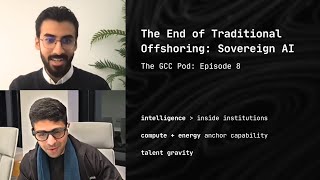
AI strategist Muhammad Umar argues that traditional offshoring is ending, replaced by Global Capability Centers that bundle talent, compute, energy, and sovereignty. Mistral and other frontier labs are building research hubs in South Asia, while smaller nations and universities are fast-tracking AI adoption through AI corridors and sovereign AI systems.
Chapters
Every week, my colleagues and I unpack.
What'S really happening in the world of global capability centers.
We're living in unprecedented times and most businesses aren't ready for what's coming. Many mistake using AI for simply adopting tools like ChatGPT without actually thinking about how their organizations operate. For example, how Ashish Vaswani has built R and J models, their first open source model described as a world class 8 billion base instruct pair. Or for example, how companies are setting up their entire data value chain to acquire highly specialized expert data sets. By setting up global capability centers in South Asia and South America, the real shift is happening elsewhere. Some companies are building their own models, others are embedding AI deeply into custom workflows. But many are securing long term advantages around compute, energy, data and most importantly, access to global talent. At the heart of it all is this. The future belongs to companies that can tap into the world's most capable, ambitious and underutilized talent pools and turn them.
Into a strategic advantage.
In the GCC podcast, I sit down with operators, founders and leaders to explore how the world's most important businesses are.
Building global capability centers.
Not just to cut costs, but to acquire proprietary data, develop custom AI systems and transform their products, services and workplaces into truly AI native organizations. This is a podcast about how global businesses are being rebuilt from the inside out.
So Mistral AI is apparently in advanced discussions to establish a GCC Global Capability center in South Asia. And they're starting with engineering. Excuse me, but they're explicitly designing it from the ground up in a way that it's sort of designed to mature into like frontier AI R&D. Why is a European frontier AI lab choosing South Asia? Apart from, you know, obviously cost advantage for core R and D, like what is really changing here?
So I mean, the first thing, I mean, I'm not sure how many people know about Mistral. Mistral has an incredible, has an incredible performance on coding benchmarks. For a very long time they were at the number one. So it's a French AI company anyways. Yeah. So I think this signals probably the, the death of the traditional offshoring. I mean historically we thought of offshoring as that execution method. We had that. Like if offshore means execution, I think what we really need to understand is like talent density has crossed a threshold where research, gravity can form outside the West. Right. So I mean setting up GCC doesn't mean like delivery centers. They are basically the brain centers. And that's why most frontier labs trust now offshore research with model architecture and Research loops. And so yeah, I mean, this is exciting. I mean, lots of opportunities. But this, we need to understand this is a new kind of work. I mean it's, it's not like that existing work, existing people can be mapped into this new work. There will be a bumpy transition. But yeah, I mean, there's so many researchers in South Asia, in India, in Pakistan, even in Southeast Asia. So I think it's a great opportunity for them.
So if, you know, this is the way I see it, like talent, gravity, as they call it, is starting to shift and to move. But the next constraint sort of becomes like, I think for me it becomes obvious pretty quickly. Like, research doesn't just follow like people anymore, right? It follows like power and compute and the ability to generally train at scale. Right? So G42, for example, in the UAE is beginning construction on a 5 gigawatt AI complex and they're merging like hyperscale compute, sovereign data and obviously taking like a regional AI autonomy kind of approach. So is this also just infrastructure? Is this more strategic in nature?
No, I think Elon described this like the unit of intelligence. The unit to see to, to measure intelligence is like intelligence produced per gigawatts of energy. That's the unit, right? So I mean, energy is the. As. As Alexander Visa Gross is like, it's the most. It's the innermost loop, right? It's the only thing that, that matters currently. So yeah, I mean, computer. I mean, if, you know, I mean, for example, if I talk about us before I come to G42, if I. So us has an incredible talent density when it comes to research. But what's challenging currently is like in the last 10 years, China has produced enormous amount of solar energy. And they're moving lots of. They're moving most of their consumer base that homes onto the solar and then making that national grid available for this data and AI work. This compute to power these data centers, right? So US was thinking, okay, what are the options for the US One was like, okay, can they replicate the same model in U.S. yes, they are doing it already. They're trying to free up lots of their energy to power these data centers, to power these compute infrastructures by reallocating national grid to the data centers and probably bringing the home consumers onto the solace, but that would take some time. So they thought, okay, maybe they can set up the grid data. They can set up data centers in Saudi Arabia, for example, and in space, right? So that, so, so it means why I said all of that was like, we need to Understand how, why compute and energy is important. So, so with G42 they have an extra, they are investing a lot in, they have lots of energy and they're investing a lot in the compute infrastructure. So I think that that's very important when you think about setting up gcc. So power plus land plus policy, that's the new trinity. Right. GCC used to follow talent only, but now it's not. I mean as AI proving ground or as setting up gcc, you need to come up with energy and sovereignty. So whoever controls training grade compute controls probably model destiny. So in terms of global community centers, I think we're already seeing lots of GCCs where setting up data infrastructure and setting up energy infrastructure is part of the overall GCC landscape.
Yeah, and you mentioned, we talked about G42 obviously in the UAE. You mentioned the US. You mentioned China. I think what's interesting is also that this is not just a story as of late, especially about large resource rich states. Right. I think smaller countries are also responding, but they're doing it in a very different way. And in some ways it's also actually more decisive than the larger counterparts. Lithuania for example, has launched a national AI center of Excellence at this university. I forget the name, I think it's Kaunas or Kaunas I believe. So yeah, they're setting this up as a national AI center of Excellence and what that's doing is it's tightly sort of combining academia and patents and in some cases even enterprise pilots. What would you have to say about these smaller nations that are moving faster? And some may argue clearly it's easier.
Moving things in government. It's not an easy thing. I mean in Korean I've been working with the government and it's so hard to move things there. Right. So the bigger the government, the harder is the infrastructure to move things from. But yeah, smaller states, they can perhaps revital faster and they, they also treat GCCs as national leverage points. You talked about this country, but I mean there is another country, for example Chile, Vietnam, Philippines. So all those countries are positioned, are doing a lot of work in terms of AI adoption in the government because the governments are small and they can move things quickly. So yeah, I mean at one end like that's that if you're, if you're a smaller state, you can launch programs faster. That's one thing. But the other point here is like building AI center of Excellence or GCC but partnering with the universities. That's something that I think I want to speak on. That is why someone I Mean it has a dual use historically universities. What I mean you go to the universities to learn, right? I can tell you like for example, if that's your goal, you don't need to go to the university. And I can see like in next 10, 15 years universities would be, I mean I'm not sure if people would go to the universities to learn. So what to do of that? Those massive infrastructures that have a legacy of more than 1,000 plus years, right? The university has been a very old enterprise. So Oxford, I think it was found in 1200 or something like. So we need to remodel all those universities. They're the talent, gravity to think about lums. So you know we partner with lums, right? If you open lums, computer science faculty, you find people from Harvard and MIT and Sydney utc. I mean you don't find these kind of researchers in the workplaces, right? They prefer to go to the universities, right? How to tap into those. Like if someone wants to work with code ninja and probably they want to build something on top of spiking neural networks, right? SNNs or for example if someone is for example coming up with this new approach of diffusion model or for example using or for example trying to change the configuration of gradient descent, right. I mean, I mean engineers can't do that. You need lots of researchers, right? And that's the kind of work when you are setting up gcc. So I think one thing that we need to think of is like how to partner with universities. So I was, I won't name but his kind of mentor. So he's, he has a lot of experience working with universities in US universities doesn't know the concept of deadlines. So there, there are challenges but, but I think that's, that's, that's what we need to, we need to cross that and we need to move to the other end where we can transform universities into the let's say gccs and help universities reinvent themselves and also fill in that talent gap, fill in that density gap. So for example if you want to train language model and you're using strategies, let's say as I said like you are using the fuel model but. And probably the best way to look at, for example if you are in London is to look for Oxford maths department, right? So, but they are, they don't work in the workplaces. So how to think about. So that is very important part when it comes to GCCs in South Asia. Your goal, your playground that if companies are setting up their GCCs it's very important to that, important that as part of those GCCs, bring universities into the picture so we can advance research, not just train models with the data sets.
And I also think, like you said, advanced research. Right. I think the true advantage, and we talked about speed previously as well. I think that entire sphere of advantage actually starts to show up when research stops being just academic. Right. And it starts aligning with, genuinely with, with national level priorities. Right. I think that's, that's, that's a very sort of, it's just something that I've started to see, I've started to notice, perhaps it's because of the kinds of conversations I'm having, but this is something that I've really started to see more. And even if you look at sovereignty and at a national level, the kind of work that's happening. UK's Department of Science Innovation and Technology has partnered with Google DeepMind. Okay. And what they're doing is they're working to deploy an automated AI robotics lab specifically designed for materials discovery, which is something that is so interesting and I know you're pretty passionate about this as well. I think this is so, so interesting because this is really where the line between like public policy and then genuine frontier AI work, right. It starts to kind of blur in the middle and it's such a nice.
Niche to be in.
We're seeing this a lot in Saudi Arabia as well. But generally what does it mean when frontier AI labs like Google DeepMind integrate directly into government priorities?
I think when I was doing my degree from gk, there was a program, Material Science and Engineering. At the time it wasn't, it was a, I think it was the most fascinating program.
Right.
And was completely misunderstood. Most of the material science science students when they graduated, they were doing sales jobs and things like that. But the most, if there is any engineering left, I would say it's materials engineering. Right. So, and what I mean, I've said I've had two courses, MM101 and MM102. What a what I mean it's so fascinating to study about materials and stuff like that. Right. I mean that's where lots of latent research and discovery is available. So yeah, I mean that was just on my, my passion for materials. But yeah, I mean in terms of, I think there are certain initiatives that only governments can take.
Right.
So Imad Mishtaq built. They've announced in FII about sage. It's basically, I think of it as like Saudi AI for government policies and regulations. Right. And the goal was like how can they just strip lots of regulations that just curtail innovations.
Right.
So it's an AI center of excellence in Saudi. But that was initiative taken by the government. This partnering with DeepMind, with the government and in the frontier discovery for materials. That's. I mean governments used to come forward and work with these labs. I mean lab is very, I mean labs for example, or small startups, they sometimes they don't have an access to the, to the government and governments people don't. Are not currently at the stage where they can understand how can they apply AI and cross in all these frontiers. So yeah, I mean one thing this partnership needs to be, needs to be better. But there's another thing, I mean why. I mean I would just take a segue away from this materials thing. I want to think about why sovereign AI is important.
Right?
That's, that's something. It's one like if you, I mean if you see kids today, they, most of them are interacting with AI through meta AI, right. That's their art, because that comes naturally with, with. So every kid is interacting with AI through their mother's phone or smartphone. Right. Because parents are not willing to give them phones and they're. So some are using tasks, but generally they're being supervised. So. So meta AI is the way they interact with these AI systems. Now you don't want the next generation to be trained into, trained by AIs who don't. For example, who doesn't understand your heritage, your legacy, your language, what does it mean? So for example, we are speaking. Let's see if you talk about, if you talk to ChatGPT in Urdu or in Hindi. Right. The kind of answers Charge would give you. I mean we don't use Urdu in kind of the same context as ChatGPT understands it. Right. Because it's not. The primary motive is not being trained on the. It's being. It's not like it's not being trained on our values, our culture. Right? What word is being used in which context, right. And then imagine your kid is being trained like this. So. And most of these big businesses are now trying to come closer to you, like AIs that are much closer to you. So I think one of the things we need to make sure is like every country at least should have its own AI, sovereign AI. So we are very comfortable. Okay. They're being. Interacting with something that who they are at its core, what the society. You don't want to be trained by AI who doesn't represent your culture, your society. Right. It's very important. And Mark mobile is far more dangerous than TikTok if you don't do that. So sovereign AI is, is, is extremely, extremely vital. And, but the progress is slow with DeepMind and DeepMind is the second biggest source of AI innovations outside Silicon Valley and it happened to be in London. So otherwise I'm sure the London government wouldn't have an idea, any idea what does it mean to fly in front innovation. And that's the state of every government except Abu Dhabi or Dubai or Riyadh. So there are few Middle east nations. So yeah, that's my rant on the government.
Fair enough, fair enough. I also think like, like up till now, you know, most of these examples that we've touched on, they sort of, they sort of assume that scale is the primary advantage, you know, if you zoom out and just have a bird's eye view. But I also think, and I wanted to talk to you about this, there's also like this parallel shift happening which is more focused on context and I guess human centric design is probably the right phrase for it. Humanzan for instance, has sort of emerged as this frontier AI lab that's optimizing models around relationships and community. And this made me think of this because you know, you were talking about Urdu and culture and heritage. It's sort of emerged as this model that focuses more on community rather than scale. How would something like this change the GCC model?
So if you think about like, I mean, I think down the line every city would have its own national AI, its own civic AI. So Bangalore would have its own civic AI system. Think of like government. So why city governments exist or why, why government exists? Government's role is to have the people who can think on behalf of people, right? So they said that condensed group of intelligence, if you like to call it, who have the power, who have the intelligence, who have all these things, then you select them and what they were really doing is that you're outsourcing your cognitive decision making to them. Okay, Take decisions on our behalf. That's what it is. Currently even there is no if there isn't any investment further from this point onwards, let's say AI breakthrough starts. AI breakthroughs are over. Everything is over. Still the current state of AI GPT 5.2 with maximal tool calling or Grok, they are perfectly fine to run the government of the cities, right? So that, I'm not saying that we should do that, but what I'm saying is you would see down the line and it's not very expensive either. The Cost is GROK is half a dollar per 1 million tokens, right? So I think. And 1 million tokens means you can upload the entire 12 novels of Harry Potters and that would be the context. And you can have that level of context within the same chat. So that's what one will. So I think this is civic AI is what we are seeing. And when you talk about GCC or AI proving grounds, it would matter which city is more adaptive when it comes to AI than others. So for example, if you are setting up a GCC in Bangalore rather than Hyderabad, or in Lahore rather than Karachi would matter. It would matter a lot because in one city the AI adoption would be far more. Because civic system is deployed, national data sets or provisional data sets are being created. People are more used to of how to create new data sets and stuff like that. So that would that. So think about it. Shenzhen in China, it's a manufacturing hub, right? If you want to set up your GCC in terms of manufacturing, you will prioritize this city rather than Beijing. That would happen when it comes to AI.
And I like, yeah, I mean, I think that makes sense, right? Innovation at the end of the day can sort of be like decentralized around context. And so that brings me to the next question, which is whether coordination, you know, we talked about civic AI coordination. Does that still need to be centralized? Because an example like this will probably set the context for you. Sentient AGI, which is backed by Polygon and Founders Fund, has launched or is in the process of launching decentralized AI research that is actually outperforming closed models on agent benchmarks.
Think about it, just think about it. I mean essentially, it's basically a decentralized research. I mean historically we thought probably you can only build GPT4 or chatgpt and AI by just making people, just by just having people in Silicon Valley or maybe in London, in DeepMind or maybe in France. But think about like the research has been truly decentralized and that's a good thing. And I think of decentralization not just as a talent density has been scattered across the geographies, but it's also about open source. So you think about, I mean in your introduction of the podcast you talk about Ashwin Vaswani RNJ model, right? It's basically an open model, right? It's, it's been. Ashwin was actually behind that paper, very famous paper. Attention is all you need, right? He was basically part of Google at the time, Transformers and all that. So it's an open world and it's, it's. Think about it like, I mean he's built the RNG model, we talked about it. It's 8 billion instructors. It's incredibly, incredibly powerful. Decentralization is not only about in terms of talent geography, it's also about how open source models. So rather than 10 people contributing, 10,000 plus people are the contributors for Examp. Stable, diffusion, stability, AI. It's an open source model that is basically a precursor of Dali chart. So all these major labs are actually basically they're building on the shoulders of the giants. So yeah, decentralization is important, but in both terms, not in terms of talent geography but also in terms of open source capabilities.
I think you've already partly answered this question, but I want to throw it back at you again because I want to kind of pick your brain a little bit. Can these decentralized labs like really compete with big tech? Like just straight up?
Paul Graham talks about this a lot. How Speed Boat can compete with Titanic.
Right.
So of course, I mean if you're smaller, if you, you can, you have a high velocity, it's not like just decentralized. Most of these startups are much smaller than let's say Anthropic or Chat GPT. So I think at the end of the day, I think if you see ChatGPT was an AI lab, why Google? I mean, have you ever thought like that? I mean, which company? I mean, have you ever thought that we would live in a world where Google search would, we would think about Google search like Yellow Pages. Have you thought about it? I mean, no, I mean think about it like an AI lab has just disrupted their business model. Literally. I mean we lived in 20, in an era where for 20 years we just were hooked to SEO and those racks and there were ads of things we never wanted to buy. Right? So that was the Google business model. So have you ever thought of like Google would be replaced by an airlab in terms of search? I mean Google is still the, is leading AI. But what I'm saying is. Yes, I mean, I mean that's exactly it should be and why it's happening and it's, it's doing. I mean, think about Deep Sea. I mean, you know, Deep wasn't even a company. I mean there was just, I mean there were some researchers who built this, funded by this other group. But think about it, expect more deep. I think people are not noticing RNG model is a deep SEQ moment. So expect more of. I mean that is going to happen.
Yeah, it is, it is probably is.
Not in terms of talent, in terms of energy and compute. It's expensive endeavor still. And you need a lot of GPUs and you need. But that too is in terms of infrastructure. Tinker, for example, accompanied by Thinking Machines product. But Thinking Machine is the CTO of OpenAI at the time she built Thinking Machine and they have launched their first product called Tinker. So Tinker, what Tinker does. So for example, if you have to train that whole language model, you have to understand and go into the plumbing and complexity of gpu, GPU infrastructures and also that research breakthroughs and research infrastructure. So Tinker is an API for developers. You can even, you can train language model now. So it's not that big, I think. Or e.g. nanochati, 3000 lines of Python script. And you can, it's not that hard. I mean, if you really, if you really think about AI, it's all about adjusting the gradient descent and the setting and adjusting with the loss function. And that's one thing in terms of breakthrough and the second is just find a way to create national level data sets, high quality data sets. So yeah, I mean you would expect, probably you would expect coding to launch a model. Maybe I will be working on something and I haven't told you about it.
Maybe we could talk about that in one of our future episodes then. But no, that's. Yeah, I think, I think I would agree with that. I think I would. And you know, you touched on, you touched on a few things. I think that made me want to shift the conversation towards training and collaboration. Right. I think so. Bagel Labs is doing some very interesting work around monetization for this, for taking a collaborative AI training approach beyond just hyperscalers. Why would you say monetization is such a big deal? Just because I think decentralization, it works conceptually, but if you think about it, it also breaks down economically unless incentives are designed in an efficient way in a correct way. So, so talk a little bit about like why monetization is such a big deal.
I mean, of course, I mean monetization, how would you accrue value? Monetization for training is important. So first of all, what it is like, think about is like this. I mean, to train a model, let's say you need to, you need to have a big supercomputer. But now let's say, I mean, I'm just doing this like imagine you can chunk out parts of training to the different parts of the world, to the different research labs around the world. And then you Have a way to map it up. So think of like you are not just so what happened to cloud? Right. So it is not one cloud infrastructure. There are, I think Microsoft have I don't know how many clusters of cloud AWS and all that. Right. And then they talk to each other and all that stuff. In terms of training, is that a possibility? So yeah, I mean it's, it's, it's. And if it's possible then probably you can train an AI model and be a part of this big group. And you are using the compute of your laptop. I'm just giving an example or MacBook to train that model and be monetized. Would you like it? I mean if you. Someone gives you money at night that okay, Omar, I need your laptop and MacBook to run for eight hours and then I'm just gonna harvest some parts of that compute and then train AI model. Would you be okay with that? And you're gonna get this much dollars and that would be happening all in your sleep time would be. You'll be okay?
I mean.
Yeah, that answers your question, the monetization.
Yeah, no, I think, I think yeah, that's fair enough. But it's also like, I think once these like distributed contributors that are so scattered around, I think once they can start earning GCCs, if you look at it from that lens also they become these very interestingly postured economic networks in a sense. And I think that while these distributed models are emerging, obviously these incumbents are also adapting. Right. And they're doing it in a very quiet but deliberate way. I think. For example, Meta has, has quietly shipped its first internal super intelligence aligned models. Is this like Meta, like catching up or is it. Is it more changing direction?
If I ask you, I mean before. I mean I just want to speak on a bit on Meta. If I ask you which of the. I mean Meta is this big business. The product you are currently using and that belongs to Meta, what's that product like? For example, do you use any product built by Meta currently?
Oh, are you talking about like wearables and such?
No, not wearables. Any other product. I mean if not wearables but any other product.
Like not really, no. I mean I'm.
You're what? Meta built in last 25 years. It's. It's a great acquisition House.
Yeah, that's what I was.
We should think of Meta. We should think of Meta as bending spoons rather than. So they've acquired WhatsApp. That's the, that's what we all use. They Acquired Instagram. They didn't both of these things. They didn't conceive this. Of course it required a lot of infrastructure to supporter. But then they tried to build AR VR headsets. It didn't work out well. They tried to build something on AI Lab Llama 3 models. They produced some very good open source models. But I've been using Meta AI through these variables. But I mean if you are using ChatGPT and you're using Grok, I mean, you know, it sucks big time. So, so I mean I haven't seen in the past any ground up innovation coming out of meta, but they have a very good acquisition capabilities. So let's see who they acquire now. That's, I mean, so that's what I think. So first super Intelligent Lab. I'm not sure how it's going to play out. I don't know. They've acquired Manus as well. They've acquired Scalia. I don't know why they acquired Scale AI. But yeah, I mean, what are you looking for? I mean why you need a data company of data? I don't know. So. I don't know. So there's lots. I mean, so yeah, I don't know. What is that? Intelligent? Super intelligent? I don't know what Internal super intelligent. I'm sure if they were, they would have made it external. Still nothing would have changed anyways.
Yeah, I think so. You, let's, let's bring it back. You talked, you talked about data. I think, I think data, computer control, all of these things are kind of being now treated less as assets and more like sovereignty. I think a sovereign AI consortium is also like forming across emea, which involves companies like Accenture. I know Dell's a part of it. I think Palantir is also Nvidia as well. And what they're doing is they're working to build these regulated AI data fortresses. Why are these enterprises acting like nation states? Like where is that coming from?
I think data we've been talking about, I mean everyone's talking about data is the new oil. There was a post when this got 2014 or Gas and it didn't become a new oil for the whole 10 years. So people thought, no, data is not. Then there was a deep end. People were saying we trained AlphaFold 2 on the same data as AlphaFold 1. So we really need scientific breakthroughs, not as data. But eventually it turned out that high quality national data sets are required to make AI work. Right. Think of it like if you see the physics, there's a YouTube channel called Physics of AI, right? So basically they try to combine to look at AI from the angle of physics. So if you really see how the world is operating, I posted about the universe is this joint computer running this cosmic algorithm. So the algorithm is like you need lots of compute, right? In the universe. So, for example, imagine there's a supercomputer, there's a lot of compute, then you need an interactive system. And then based on, based on that interactive system. And compute universe generates infrastructure around us, right? That's what it is. So that interactive system is data. Basically, the compute needs data. So every company is trying, every nation state should try to build their sovereign AI before their companies build their sovereign AI systems. So just imagine, I mean, you know, how social media has disrupted the countries, their power structure and all that, right? Social media was nothing. I mean, as compared to what AI is. AI in its design is very social, right? And now you combine AI with TikTok and decentralization. I don't know. So what I think before the big businesses build their data fortresses, governments should start thinking about how they can build their sovereign AI infrastructure. Imad Mushtaq is doing an incredible job here. Imad, I'm not sure if you. I think in our podcast, in my podcast, I refer to. Imad also met with Bilal Bin Saqib. So he's an. He's a hero, for example, when it comes to sovereignty. He's a Bangladeshi mathematician and computer sciences, but people know him from, as a founder of Stability AI. He's also stable diffusion. There are 300 million downloads of Stable diffusion model, right? So he's a founder of that. And he, because he has Bangladeshi heritage, which he speaks a lot on what's going on in South Asia and emerging world. So he met with Prime Minister Shabash as well. So I think he talks, he has, he has done this groundwork of building these sovereign AI infrastructures. And most of his work is open source. So his company called Intelligent Internet, I did one podcast on Intelligent Internet with Rafia too. So I think the infrastructure is there, the pieces are there, the scaffolding that's required is there, built. MAD has done all the groundwork. I think what we need to make sure is how to convince our governments to build their sovereign AI systems.
And I also think once you start actually looking at all of this and thinking from a sovereign lens, the sort of isolated approach really stops making sense. And APAC has also committed over $150.
Billion.
To this collection of AI corridors that span inland India And Johor and South Asia in general, kind of bundling land and power and policy and all into one. So talk a little bit about that. Like why these corridors instead of hubs? But taking a more isolated approach, I.
Guess think about corridors. I mean the core ideas like, I mean you declare rather than one city or one geographic infrastructure, you cluster different geographical infrastructure, they call it corridor. So for example, at one city or what, what geographical location? It's an energy. Well, you draw energy from there, you set up your data center in another place in other city that's a compute infrastructure there and then you have a talent hub in some other city. So you just call it a triangular corridor. So it's, it's a concept and you need to think about this thing like how AI is shaping, reimagining the geographical boundaries. So, so yeah, corridor is just another way of saying like you can split your GCC across the geographical stack.
Yeah, it's interesting and I think also like if you take that logic to its endpoint, I think the final bottleneck as we close is like less about infrastructure or capital. I think it's more about the human interface itself in that sense. Merge Labs has raised 250/million for what they're calling Brain AI interfaces. Very interesting. But what is, what does neurotech have to do with GCCs?
So merge or neurotech, I mean basically merging human with machines. So in gccs, I mean that's exactly, I mean we discussed I think two days back about AI proving grounds. The core reason for that proving grounds was like how can we. Because in the west industries are extremely regulated how what we can do to build AI systems, like for example we discover new drugs, trial and test, try and test in the improving ground and bring it back. So when you talk about merge and neurotech, it's all about how humans and machines can co innovate and merge merginess and stock. In a negative sense merging like human machine symbiotics if you like. So GCCs are actually, I mean what, what are GCCs? They are human machine symbiosis. You have compute, you have talent and you just try to merge them to create. For example the first news was mistral, that was more of like human machine symbiosis. So yeah, that is neurotech. That is basically gcc. The neurotech is a very broad term, merge for example if you talk about BCI interfaces and stuff but that requires humans like think about that in the world. Congenital, congenital cataract. Right. It's, it's a disease. The number it's a disease that's the patient of disease is widely available in India, in certain parts of India. Right. And cataract means motiya. So now you are building systems where, for example, you need to cure these patients or cure this disease. So in your AI proving ground, you want to access to those patients and you can work with them to build those BCI interfaces to see. So AI proving ground is far beyond just now data sets, you need these kind of things as well.
More from Muhammad






FDE Epi : 16 | AI Agents, Billion-Dollar Infrastructure & the Future of Intelligence




