The GCC Pod Ep 9: Making AI Work with Systems of Context
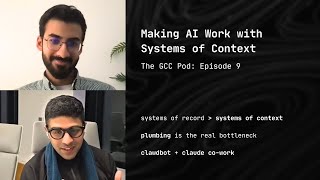
Muhammad Umar explains why most AI pilots fail and how enterprises should build AI-native organizations instead. The shift from spreadsheets to systems that embed language models requires massive engineering work. Many companies start with tools rather than business workflows, and legacy software economics like Excel's dominance make change harder than expected.
Chapters
Every week, my colleagues and I unpack what's really happening in the world of global capability centers. We're living in unprecedented times and most businesses aren't ready for what's coming. Many mistake using AI for simply adopting tools like ChatGPT without actually thinking about how their organizations operate. For example, how Ashish Vaswani has built R and J model, their first open source model, described as a world class 8 billion base plus instruct pair. Or for example, how companies are setting up their entire data value chain to acquire highly specialized expert data sets by setting up global capability centers in South Asia and South America. The real shift is happening elsewhere. Some companies are building their own models, others are embedding AI deeply into custom workflows. But many are securing long term advantages around computer energy, data and most importantly, access to global talent. At the heart of it all is this. The future belongs to companies that can tap into the world's most capable, ambitious and underutilized talent pools and turn them into a strategic advantage. In the GCC podcast, I sit down with operators, founders and leaders to explore how the world's most important businesses are building global capabilities centers not just to cut costs, but to acquire proprietary data, develop custom AI systems and transform their products, services and workplaces into truly AI native organizations. This is a podcast about how global businesses are being rebuilt from the inside out. So I think spreadsheets and email, if you think about it, they're still like the starting point of critical workflows. Like they're very much workhorses in that sense. But I think at scale they become dangerous in the sense that they're not very governable and they're kind of fragile. I think value is created when these various workflows are sort of unbundled into dedicated software. And you were saying this to me this morning as well, and I want to bring it back and maybe start with this. You keep saying that Excel is the most expensive software ever written. So if you could elaborate on that.
I mean, expensive, not in that sense. Excel is a great tool. I mean it's a civilizational software. I think when you talk about what is a software, software is a database and database cruds and some workflows on top of it. So Salesforce is a, is a, basically a database. A workday is a database. Every software, if you see every active system of record, is a database, right? But then you do lots of plumbing, lots of, in a way that you solve a very specific problem, right? So when you. And the opportunity, I mean that's what I was establishing point opportunities for the new businesses or for the companies that are building products are both. Whenever any major platform happens, platform shift happens. The opportunity is born in unbundling the software or bundling it with other things, right? It's both. So as I said, like Excel, when you talk about Excel, it was a major platform shift when Accel first came in. I remember I was listening to this podcast when Excel first came in, the people who built excellence. I forgot the name of the. They took it to CPAs and saw they were extremely surprised at like how changing in one cell can impact the entire sheet. And they said like it's their months of an effort, right? And they took the same product to the lawyers and they thought okay, I don't know what to make of it. And that's all I always say when it comes to AI, bring it to the CPAs of AI and not to the lawyers of AI, right. What it means is like value can only be seen by people who understand how to deploy it in ways others probably can't see. This is my take on this new platform shift which you are referring is like Accel is the most expensive software and you're referring to a point like for example, database replaced major Excel workflows with some of the. Because if you build. I mean why Salesforce can't be Excel, right? Because why you need a Salesforce. You can manage most of the relationships in Excel sheets, but then there's a lot of enterprise security business logic that needs to be structured in a way that you need a dedicated workflow on top of it. And that probably would happen with AI too. Companies would have very strong active system of records, would be able to build a strong system of context on top of those systems. So Salesforce, for example would build a very good system of context if someone wants to build it, although they are not doing it in the right way. But yeah, so that is an important thing to understand here that when it comes to AI, it's not going to strip everything off of the software, but it would move the system of records to the system of context. Just like Excel moved. Just like database and workflows moved a lot of a lot of business logic away from Excel and into those very degraded package softwares. Now that's a different question that do we need very large teams and very big software businesses to build those package softwares or build those software? That's a very different question altogether. What I am saying here is like the software would still be required just like database after databases and these database these Active system of Records, we still have Excel. Similarly, we would have Active system of Records after we have these AI native workflow systems. However, I doubt that Zendesk would be having the same kind of margins or Salesforce would be having 80% margin on top of whatever they are doing. That's a different question because software cost of building software would be near zero even. People talk about data, people would think about it's all about data. But then acquiring data would not be that cheap either. Would not be that expensive either. So yeah, I mean, but it's a spectrum from excel to vertical SaaS to now disposable apps or disposable software or custom build software if you like.
I think out of all of the things that you said, there's one thing that I kind of want us to focus on a little bit for obviously today. I think once you pull that business logic that you talked about, right. Once you pull that out of spreadsheets and emails and things like that, I think you run into a second realization pretty quickly, which is that that layer of intelligence itself isn't necessarily where things break. I think it's everything that's wrapped around it in that sense. So for instance, if we talk about LLMs in that context, performance across the board is kind of converging. If you look at OpenAI, if you look at anthropic other open source models even that are out there, I think they're all at a macro within like single digit percentage points of each other in terms of performance. And so if models are becoming this interchangeable, where does the long term value live? You know, in that sense.
I think in Code Ninja, I was discussing with Rafi as well, I think one of the goals for us for the next couple of years is to make AI work for the businesses. And why I've come up with this thing is making AI work in your use case in your workflow is extraordinarily hard. There's so much plumbing that goes into make AI work for the enterprise. So think about cloudbot. So cloudbot released two, three days back. It should show on X. Everybody's saying this and that and it's a pretty cool thing. We've set it up for us as well. But hardening Cloud bar for the enterprise grade security is. There's a lot of plumbing required for that hardening open source AI for enterprise grade reliability and security is a lot of plumbing. Similarly for models I hooked up Claude Cowork with most of my sales workflow, most of my engineering workflows with Hyper Right. So for example, I'm involved in a lot of sales, I'm involved in lots of engineering, I'm writing software, I'm doing sales and all that. I'm doing marketing. So I hooked making cloud cloud work. For me, extracting all those data sets and doing all that plumbing is not an easy thing. I mean, but yes, once you make it work, I mean I have made it work for my sales workflows, couple of my engineering workflows. It's amazing. It just blows your mind when you, it's a poetry, you see. I mean, you Remember yesterday at 12 or maybe at night how excited I was, was I just made some plumbing work for me and it was awesome. I was playing with Cloudbot with OPET 4.5 and automating lots of things. It's just, it's. But, but you need to figure out like you don't want cloudbot to access your checking account, right, and order things for so for enterprise. So if you're a bank, you can't do anything of Claude anything out of cloudbot because for you, the single most important thing is your data. The single most important thing is to protect the privacy of your customers and all that, right? So you can't let loose these things on top of your infrastructure. So what you need to do is you need to make AI work. So yes, intelligence is raw, but then tool use in plumbing engineering, plumbing, the organizational context, that's what makes it valuable. And that's, I think there's a opportunity there. But one thing I would also share is you talk about value and opportunity. Today US software spend is 1% of their GDP, right? The white collar knowledge work is 20% of its GDP. What do you think? What's going to happen to this 20%? What do you think? If you have any idea what cloud coworker is doing and what cloudbot and tooling like this is doing to the knowledge work. You know, this 20% would be software, right? But to make it happen, it would, there would be a lot of, lot of effort, a lot of plumbing that goes into it, but eventually it would happen. Maybe this year, maybe at the end of next year.
But yeah, yeah, I think it's, it's inevitable. And if you think about the scale of it, it's, it's extremely scary in that sense.
I won't say it's very scary, but very exciting.
Yeah, I mean, of course, of course. Don't get me wrong, right. Because I also think exciting in that sense of, you know, the question then sort of stops being how Smart is the model. And then it becomes about like. In the context of the discussion we're having, it becomes more about like, how does the work actually get reviewed and approved and, you know, corrected if need be. Because if you think about it, AI kind of behaves like this unlimited supply of junior workers who are very fast and very eager and in some cases very cheap, but unreliable to an extent without supervision. So why do we say that AI in that sense then doesn't replace experts, it creates. There's this phrase I was reading, it says it creates infinite interns. So talk a little bit.
I don't agree with this. Yeah, yeah, I don't agree that it creates infinite intents. I think it's. It has. It replaces experts in certain domains. What happened to your video editing? Tell me what happened. Like I told you that take these AI shots rather than plumbing it yourself, right? It's not like. Or for example, to the coders, when you combine models with tool use, that's. You see, even experts can't perform. It's not. Think about it. What I am currently, I've been in the last few years, I have thousands of messages that I have. So everything I did, I've written it down somewhere, right? And it evolves. Most of my, Most of my writing evolves. I don't. So if I've got some very new connection message, very new email, because as I said, I'm building Code Ninja, building hyper. I need to connect with lots of people in America, in around the world. So I rely a lot on cold emails. That's how I built my network. I relied a lot on LinkedIn, right? So, but I am. I always tried to come up with a new message, but I didn't replace the existing one. So he kept on adding thousands of messages. So much all of my ideas are written down, right? So now, for example, with Carbon, what I did was like I asked Cloudbot to find out link, go on LinkedIn, see which people are relevant to my profile and go into my message dump and see which messages are suited. What I brought up messages I can't match people, what kind of problem I can solve for them with the message they've crafted and the skill that I have and the capabilities that Code Ninja have. No human can do it. It's not about. I have replaced someone. It's a new class of work which now AI is doing. It's a new. So we need to think about AI when it's not about replacement. Infinite Interns, there's a kind of work that no one was Doing previously, no one could have done previously. This is a sheer mathematical computation that's going on that goes on into doing those things. Humans can't do it. There's a new class of work. Right. That's one thing. And second is yes, it does replace experts. I mean, I can tell you, you don't. If you're a coordinator in your job, if you're a project manager or product manager, your only job is to execute things on behalf of someone else. Right. You, you know, you're not required anymore. I don't know why your company is not, but you're not required anymore. That's true. I mean, think about how these tools, tool calling works now. So I was doing something, I was doing certain workflow last night and Claude Cover invoked, I think 286 tools to execute that workflow. Now which human expert can execute those 286 workflows? So I think yes, it would replace experts, it would create new kind of work as well. That was not possible before. But I don't agree that this infinite intern and junior senior. No.
Yeah, because I was reading about it and I think that there's a lot to say about both sides of the spectrum. Right. Of looking at it. I think if we kind of just disregard which side in that sense we're on and just talk a little bit about the human review loop that has been created. I think it creates these. Well, creates maybe one interesting side effect, which is that instead of eliminating software, AI then seems to be in some cases increasing the need for these very specific tools around it in order to be able to orchestrate and, you know, execute. And then at the same time, everyone is sort of going around saying, you know, AI is going to kill software. What's your opinion on that? You know, do you, do you believe that was it?
I'll go to Karapathi. So he tweeted yesterday. So like he told about his journey about AI. So he said, he said like last year it was like 80% was, he was writing manually and 20% was helping. So he used to scaffold application, 20% of that application with AI. And then he had to all the edits and all that manual work for the rest of the 80%. Now it's flipped. Now 80% is done by AI and 20% is with the agents at the end. And if you want to see, as they say, what is growing and what is. So you need to see the trend. So if you follow the same trend, this 80% will go in 90 and 100%.
Right.
So one of things this is for sure that software as a, as a work type, software creation as a work type won't be this much regarded, let's say, right? It would be. Remember in 90s bankers had, everyone had a crush on bankers. They wanted to do, to do a banking job, right. And then when we started everyone wanted to be doing a software job, right. So that crash would be over. You would see it happening maybe in this year or end year that is, that is gone, right? So that's on the software front. I was just trying to refer. Yes, but we would be needing a lot of software. Think about what's happening to the content, what TikTok did to the content. Mark my words, this would happen to the software, right? So what is a content? So what TikTok did was they came up with this. There were a lot of things like intent based graph rather than social graph. But other than that, their tooling was incredibly good. So you could create a video in ways which probably otherwise you couldn't. There were tunes and music and you could come up with extremely creative ways to create a video. Now think about you go back 30 years, the kind of video that TikTok allowed these young kids to create. You would have required a Kodak studio or these photo studios who would have charged you a lot of money and would ask you like come back after a month and we'll have you this video. But now any guy with a smartphone and with 12, 13 years old, he can, he's creating lots of videos. And if you go onto TikTok you would see, I don't know, millions of videos. What are those videos? There's humans expression of creation which they have reflected in the form of content. This expression of ideas would be. Now you see, would you now see in terms of software, you would see people, young people building software, playing around things what we now call white coding. But it would, I mean we TikTok for software or software creation or Pinterest moment for software creation hasn't happened yet. Right. It requires tools like cloudbot that would be hooked up with these models with some unique ways where young people can express their ideas in ways which otherwise were not possible. Right. So I think software building would be a commodity just like content creation is on TikTok.
Interesting. Yeah, that's an interesting way of looking at it.
And then people would ask like. But I mean, yeah, I mean still in your bazaar you have a Kodak studio, right? But they're not making $100 million a year revenue. If you're a software business or vertical SaaS, app or whatever, who you are, I don't know, but you. They would be still around, but those margins would be gone.
Yeah, yeah. And I think if we, if we sort of go back to something you said earlier. You talked about banks, and that kind of made me think about, you know, adoption. And I think that in BFSI generally, you know, AI adoption is sort of forcing these companies, and I think this is obviously a universal thing to finally sort of clean and structure and understand their data, which is something I think that, you know, everyone's been putting off for years and years. Why would you say. Not just talking specifically about banks, obviously, but generally why. Why are so many AI pilots failing before they even start?
So single most importantly, I told you, like, how I automated the entire sales ops, some of them, my engineering ops, management ops with cloudbot, with Cloud, Opus with Cloud, cowork, wrote some of the Python script and all that. Right? And it hurts your ego, by the way, if you're an engineer, you build your career around programming and writing these complex syntaxes and impressing everyone around you. And all of a sudden you say, like, I mean, when's the time that I would be able to write something on. On it? Because it's, it's taking all my cues in the natural language. It's not letting me. I mean, if somebody's sitting next to me and, and, and I have this relationship with him, like, he thought of me as an extraordinary expert programmer and he would be sitting next to me and say, that's what he does. So it hurts your ego, right? So anyways, so I was saying is, like, why I was able to make all that work for me is because I had all the data and all the context, and of course there's a lot of plumbing that I made that data AI available. And once that, that cloud cowork and all those tools, they did the job for me. But now when it comes to. So think about it like, ChatGPT3 was trained on one terabyte of data, right? JP Morgan had in house more than 100 terabyte of data, right? Think about it. What would happen to. I mean, what can we make out of it? Like, and so much data is behind the walls, right? Data walls, yeah. So that's the play. That's what we talk about plumbing. So, yeah, so there is a lot of opportunity to make AI work. You need data, you need context. Then you would see wonders.
So we understand, right, that data is the most important thing when it comes to actually getting value out of AI, but at the same time, cleaning data is incredibly tedious, painful. And then it also exposes this, this deeper divide into how companies are actually using AI. Right. You'll see some enterprises using AI for cost cutting and this is probably in most cases what's happening instead of thinking about it. Also from a revenue generation standpoint, like taking more of an innovation approach. So tell me a little bit about how you would frame the difference between AI saving or using AI to save, or the other side of the spectrum, which is AI business actually changing what the business can do.
I would think about both the areas. So coming back to data, first of all, where your data lives in the organization, if your data lives in Excel, in some old files in the database, that's one part. The other is if your dad already lives in, let's say databricks. Right. So they raised $10 billion. They will find out how to make sense of it. Right. You're in a good spot. But anyways, so I think in terms of, in terms of, on the data front, I would, I can't emphasize more on that, how important it is to organize your data because now it's extraordinarily easy, it's cheap to organize and now you need it. If you don't, your competitor and if you. So for example, if I have automated what I've just described to you, I'm ahead of so many people I have. If I, if I am able to build my own system of context in my organization and I'm not entirely relying on system of records and using that crappy dashboard 100th time to come up with tell me something and all that to make AI work, you need to organize all your data. That's, that's one thing. Just on that, on that note, what was your. And what was the question what you're saying?
So I just kind of wanted to understand like how you would frame the difference between using AI for cutting or.
That is a huge topic. I mean, AI. I mean, think about if you are building, if you, if you, if you are, if you have an outbound team. And one way to look at it is like you need to replace your entire outbound team with AI agent. Yes, it can happen. That's one way. And partly it's going to happen. And it is happening already by other ways. Like even without one team, there were things you were not able to do it because the mathematical or cognitive complexity of executing those things were hard. It wasn't possible. So I think the guest area for AI is to look in the organizational Workflows about things which were not possible before, right? Sales, the entire stack of sales is this, right? There's so much that can be done in sales. Content creations. There's so much you can do around content creation and then in engineering. Right? These are the two, three macro areas. But then for example, if you're McDonald's you're building burgers, right? You are. I mean if you're a city of a burger, your job is not to build an 8th ride heading app or ride heading food delivery app, right? And compete with other aggregators. You need to generally think about whether people would buy McBurgers or not. Because now they, I've seen people then they, they, they're charged and they, they, they ask them like should, what should they eat? And it's rare that chat GPT recommends okay, go eat burger. And they don't. So because they know burger eating burger with so much salt, it's not healthy eating. Drinking Coke is not healthy. So your job as a city of McDonald's is why you are not impossible foods, right? Why you are not, why are you not? That's the area of innovation that I mean I want, I can eat chicken burger from McDonald's for the rest of my life. I can eat five burgers a day, right? But I can't because then all that calorie intake and all that, you want to be fit and this. But imagine if someone comes in and says like we made chicken burger which is as much, which has as much caloric value as let's say black coffee, which means zero, right? So that's the area of innovation, right? So that's what I think. So we need to focus on what's the vision of the businesses, what you are trying to do and then think about that. For example, in Codeninja, my our vision is when we started building business like how to land a better point. We're helping some of the world's most important businesses, solving the highest priority problems in the west and creating opportunities for this part of the world, for the emerging markets. Both these points come together as one holistic outcome.
Right?
Right. So for me now, whenever I see about AI, but think about AI, how can I accelerate this mission? This is the mission, right? How can I accelerate if you are just. If you don't have a mission, especially when it comes to AI, in the age of AI, you will be struggling because simple execution of velocity dopamine based work because you are just sober calling you just work. And that kind of value would eventually, I mean how would you compete with, with these models, they are a colleague 10,000 times more than you. So Elon Musk was talking about like if you go back 50 years and if you think about. But if you're going back, take a spreadsheet with you, right? You with that spreadsheet and a laptop can compete top buildings with large scale towers and thousands of people in it. You can beat all of them with a spreadsheet and a laptop, Right. That would be a velocity. So this work on the mindset, that's not going to work out. We need to find a way to innovate and innovation can only happen if you have some level of vision, some level of marker to go about.
Yeah. And I also think that difference across the board, I think it shows up obviously very clearly in how AI projects are scoped out.
Right.
They fail when in most cases, you know, you start with tools instead of workloads. Like Steve Jobs, the way he said, you know, you, you start with the experience and then you work backward to the technology. Right. So I think a good illustration or a case in point is for example, why do you think AI chatbots, right. Fail so badly in regulated industries? Like talk a little bit about that.
I'll take a step back. So first of all, we've been working with customers in the US a lot and I've seen, I've seen so many CEOs, institution being fired by their boards. The reason for that is like they're not included. They are not letting AI integrated into their workflows. They have nothing to show off. The thing about is like I don't think it's, it's all, it's all about the bad interface and workflow problem. It's about people not willing to take the bets. They are just rooting. Their mindset is rooting to the legacy. They say like, I mean they think of the, the idea of humans about themselves that they're very special. They something extraordinarily brilliant is going on into mind and AI is just a digital how it's, it's wrong. I mean even I like to think consciousness is also a mathematical function. Everything can be explained in the form of mathematics. Don't think of yourself too special. So when, I mean we've recommended so many AI integrations and workflows into these organizations and some of them were able to, we were able to deploy some we couldn't get the approval. But the thing was like the reason for we were why we were not able to deploy. Those were like some of times it was thought like people that These leadership teams thought they are too ambitious. Nothing was ambitious. It was just like they were not willing to take that kind of a bet. You have to take a bet and currently now you just need to make a decision. It's not even a bet. I mean now most of things are sorted out. So I think for up to 2025 it was a breakneck pace. But even December 2020 people were not willing to integrate these kind of workflows into their systems. Design is a later part. Even Elon said about this, like probably there should be a company that can create forcing function that become a forcing function for these stubborn organizations who are not adapting AI. So that's one part that it's not. It's just a leadership problem. They're not willing to integrate this. I can tell you that most of the organizations currently with the current state of thought can replace most of their labor from their workplaces. Not labor in terms of like jobs. Most of the labor. I define labor. No one wants to do the work, the kind of work. Right.
Yeah.
That is labor. Right. They can do it, they can deploy in these sort of things, but they're not willing to take the bet.
Right.
So this is one thing. And also some of the people think that probably this is only a technology business issue because code generation is easy now. Companies who are building software, they're not being hit. Every company I know how people are now searching their toothpaste. So if you're a procter and gambler, if you are a unilever and you have a product like toothpaste and creams and all that, no one's going to buy them. If people would know there's a better product that's built by some skin care specialists and it's far more valuable, it's proven and validated. No more. You have no only distribution card and ads buying these models and can't solve your problem of selling those SKUs and all that stuff, you are in a tough spot. I've seen, you know, after Google search, which is the biggest search for buying Amazon internal search and now I've seen how Amazon got hit by like where people are asking ChatGPT what they need to buy and it don't. What if it doesn't require recommend someone from the Amazon store which traditionally the only place for them to go into every business, every business shopping and all that is going to come into the AI sphere and we need to think about how to make AI work for those businesses.
Yeah, no, that's. That's very true and I think Then you know, the question naturally becomes there's, there's, look, there's, there's hundreds of billions of dollars being spent on like data centers and chips and all of those things. But I think ROI is at the end of the day, unclear at the application layer.
So I can tell you on this, like, I got it. I can tell you on this. Like for example, when I was listening to this, a 16G podcast, it was like when steam engine was invented, no one came with a pricing or, or thinking about roi, that how steam, how much work or how much of the human labor this team engine would replace. That was not the pricing model or ROI model for the businesses because it's a new. I mean if you were previously doing work manually and now you have a steam engine, it would open up work types that were not previously possible. So I think these 400 billion or 500 billion, the first time ever I was of the view, yes, that a lot of this is hype and all that. I don't think Umar, this is hype. What I've seen in the last few months happening around, few of the things I'm aware of, it's not hype. They are new kind of work. There's so much latent innovation that would now be possible. And the, and I think the true Maya of knowledge work would be what kind of ideas you bring to the table, how original you are, what kind of you. So I was just, in the previous podcast, Rafa was telling me that there are more than, I don't know, 3 billion images people have used in last people have created in the last one month out of Nano banana. So image creation is commoditized. But the question was like, I mean still there would be people who would be creating truly original ideas who are coming up with true new renal ideas. What are those ideas? I think a lot of innovation is yet to uncover in math, in physics, in computer science, knowledge, work, sales, whatever you call it. So these 400, $500 billion or whatever, I think it's not a question of ROI. So when Steve Jobs invented iPhone, right at the moment he was discovering he was inventing this iPhone and smartphone with no keypads, he probably wouldn't have thought of like someone like Brian Chesky would come up with an idea of Airbnb. You can't plan. I mean now, now, I mean, do you think they would have gone into those presentations? What is the ROI of building this smartphone with no keyboards?
Right.
You would see a lot of Brian Cheskys, they're building a lot of cool things. And this is a time of entrepreneurs and creationists. I mean, everyone needs to think about to create things, how to create technology, what kind of ideas. So for example, you, in the last 30 years, of course, you have certain neural wiring and you need to think about what kind of can you transform that neural wiring into some sort of product. And if you are able to do that, then that's your business.
Right?
So, yes, this is. So I am not, I don't say I don't see it like ROI kind of thing. I think it would eventually happen.
And I also think like, at some point, not so far out into the future, AI will also kind of just become just software in that sense, right? Because once it starts working reliably, like I've even seen in my own daily workflows, like I'm using ChatGPT, I'm using Claude, different purposes. And I don't think about it as like AI anymore. Right. I almost stopped calling it AI. If I'm, you know, into my work, I forget that I'm using AI. And I also think like, every time you use a new tool or a system or an agent, there's also this like magical feeling that is like, wow, you know, so what do you think happens when AI stops being perceived as, you know, magical in that sense?
So I would say, like, I mean, Alan Kay said this, I guess Alan K. Like, technology, you can only call something a technology before, up to a point where it doesn't work. The moment it start working, it's not a technology anymore. Right? So, so when you talk about AI and software, I never think of software and AI, two different things. I think they are all part of computational machines. They are, they're. I mean, even today, I don't think AI is a mathematical function. Software is a mathematical function. So I don't, I. Even today, I don't think there is any difference between AI and software. This is one thing, I mean, why we call it software and AI? It's one thing. I mean, basically in 1940s, what Turing proposed universal Turing machine, that you can perform fairly very simple calculations and it would do all of the jobs. What it meant was like a simple machine would be able to perform calculations, would be able to perform math, would be able to perform, would be able to perform a call to someone. And he was saying, proposing this 1931 or 32 is a very famous paper. So you'll be, from using one machine, you will be performing all those tasks. And because he, he perceived this idea that every task in the world can be performed in certain level of mathematical computations, can be condensed into a fairly simple mathematical calculation. Then now you see your phone does call your video chatting. Then you are doing all of other stuff which are not. You're doing camera and all that which were purely a hardware stack and all part of software and one machine is powering all that. So think about it. Currently what's not happening is you still need precision surgical devices to perform cardiac vascular interventions. Think about like there's so many devices in the world that's currently not being reduced to this software stack or these computer machines, right? They would be part of it. They'll call all that as an AI or computing machines. We need to think the true lens I talk about knowledge work is the true lens is not to help people write software anymore. These are the trades. We need to think about theoretical computer science. We need to think about how to think in terms of computational machines.
Right?
And I posted about this. If I go back into university, you would never take a course of Java and this, this bullshit graph. I probably would more interested in numerical analysis, material design, physics, advanced physics. 1 of the degree in CH the time was engineering sciences. It was an intersection of hardcore physics, applied physics with and computer science and electronic engineering. What an incredible degree to have. If someone is listening this and they're planning to plan their future. BS Engineering Sciences in gik. It's an only program in Pakistan that currently offers this. So they should do that course. It's computer science, it's applied physics and it's electronics. That's the kind of degree that you need to have. Even computer science as a degree B SCS and all that. It should be just. It should not exist anymore.
Yeah, I think it's, I think that's, that's where, you know, I feel like that's where we need to go as as like an overall approach towards AI, towards software, towards thinking about everything from the first principles. And while I'm not a technical person myself, I ask myself often, I'm like, what is being a technical person at the end of the day, right? And I've had this discussion with you as well a few times where I remember my first conversation that I was. I was going on to speak with a CTO for you know, a sales call or something. And I asked you, I was like this guy's going to be technical. What if he asks me something? I don't know. And then we brought the conversation back to, you know, understanding things from first principles. And at the end of the day I think if you have that understanding, then it helps you, it helps you go a long way. Right? But coming back to all of this in the context of enterprise and how companies are moving forward with these things, I think if we talk a little bit about the differentiation in enterprise, I think generic SaaS and generic AI, these off the shelf tools, they very much fail in differentiated businesses after a certain point, right. It forces a certain extent of customization. So elaborate on this a little bit. Like we all know this is happening, we all know companies are moving more and more towards self build. But why are enterprises moving away from these off the shelf AI tools?
It's not like they're moving. So no one, I haven't seen anyone who is saying that they're not going to use their workday anymore. The people are still, the companies are using it and they would use it. I think on an average a large Enterprise used 400 to 500 SaaS apps, right? That's their internal tooling home.
Right?
But the challenge is Most of these SaaS apps are the system of records, their payroll systems and your sales and marketing and whatever, right? The organizations. Now what I am pushing for is how to move from those system of records to system of contexts, right? So think about database is an incredibly hard thing to evolve. It's very fixed rows, tables. It's not evolved from last 40 years we tried to come up with no SQL graph database. What a joke. But yes, I mean in terms of database we're fixed now we need to move organization from fixed data to the context which is stored in the neural nets to build those system of context on top of those system of records. So to hook those 400 apps and build a system of context, build those memory architectures on top of it where you can. For example, what is an innovation behind cloudbot? It doesn't have a model of its own. It's basically, I mean quote unquote, infinite memory architecture. So these kind of innovations, these kind of system of context needs to be built and then organizational context needs to brought into the equation, which means we need to make the data work for the organization. So bringing the data and moving the organization from the system of record to the system of context and that's an important thing. So for example, if you are, let's say, if you are procuring, if you're recruiting, let's say you, your, your HR department has opened up 40 positions or 10 positions and your sales is performing poorly, your bench, you have a lot of bench, then probably it's very, very hard for you to make a wrong decision because all those systems are talking and they at one point you would say why I am hiring those many people I don't need because I don't have. There's so many people on the bank. It's not so much demand coming in. But that's only possible if you move away from those crappy dashboards and bring the systems into transform your system into the system of contexts, the active system of records with a system of context. So currently the other workaround previously before that was like people used to do this and it n level integrations. There were lots of integrations startups. Mule was one of them that got acquired by Salesforce I guess. But now why those 30 billion, 20 billion startups existed because they help you integrate all your data in ways where you can make sense of the overall organization. But now that's, that's, that would be done without that that would be done with AI and where you actually would be able to build system of context into your organization. So for example, if you have a system of context and you let's say are a large inventory management business or inventory or if you have a lot large inventory and the question from database you would ask like tell me about this, predict me this with system of context your question would be very different. You ask me question tell me what are the things which are you think are most likely to end in next three months. That is the kind of question that is only possible to answer if you have a system of context. So that's something that we need to push towards. It's important as well because otherwise if we moved slowly AI would hurt us a lot and that hit would be taken by the people and employees first and then the business. So I think we need to make sure we adopt all these technologies earlier and kind of create that forcing function in the marketplace.
And I think that also like brings us like closer to the bigger reframing overall. That is, that is sort of behind this. I think at some point enterprises have to decide whether they want translators at the end of the day or genuinely owners of the system. I think uncertainty, confusion that exists around AI still at the enterprise scale. I think it creates this demand for taking this translator approach. But I think long term value will always belong to hands on builders. So that's what I think. I'd love to hear your thoughts on that.
If you use deep that if you use deep SEQ and if you use chatgpt is incredible model but once you use it it's equivalent to the equivalent to these ChatGPT and other models on the benchmarks. But when you use it, you say why it's not working the way ChatGPT does or Claude does or GROK does. The reason for that is it's not just a model and the weights. It's about the kind of engineering that's required to build a product that you can adapt. So now it's common. There are other platforms like Viscoflow but for a very long time nobody even 11 labs could have come up with a voice transcription as good as ChatGPT.
Right.
But it was an engineering feat. So we need to make AI work. That's the major thing. We should not be as in business be concerned too much into the, into AI research and how we need to think about what kind of workflows that we have and how can we integrate AI into these workflows to replace parts of work that no one wants to do, to replace to lower down our labor and to find out things that were not previously possible to bring to launch new kind of things.
More from Muhammad






FDE Epi : 16 | AI Agents, Billion-Dollar Infrastructure & the Future of Intelligence




