Job Search Problems? 6 Hidden Reasons Why (Fix Today)
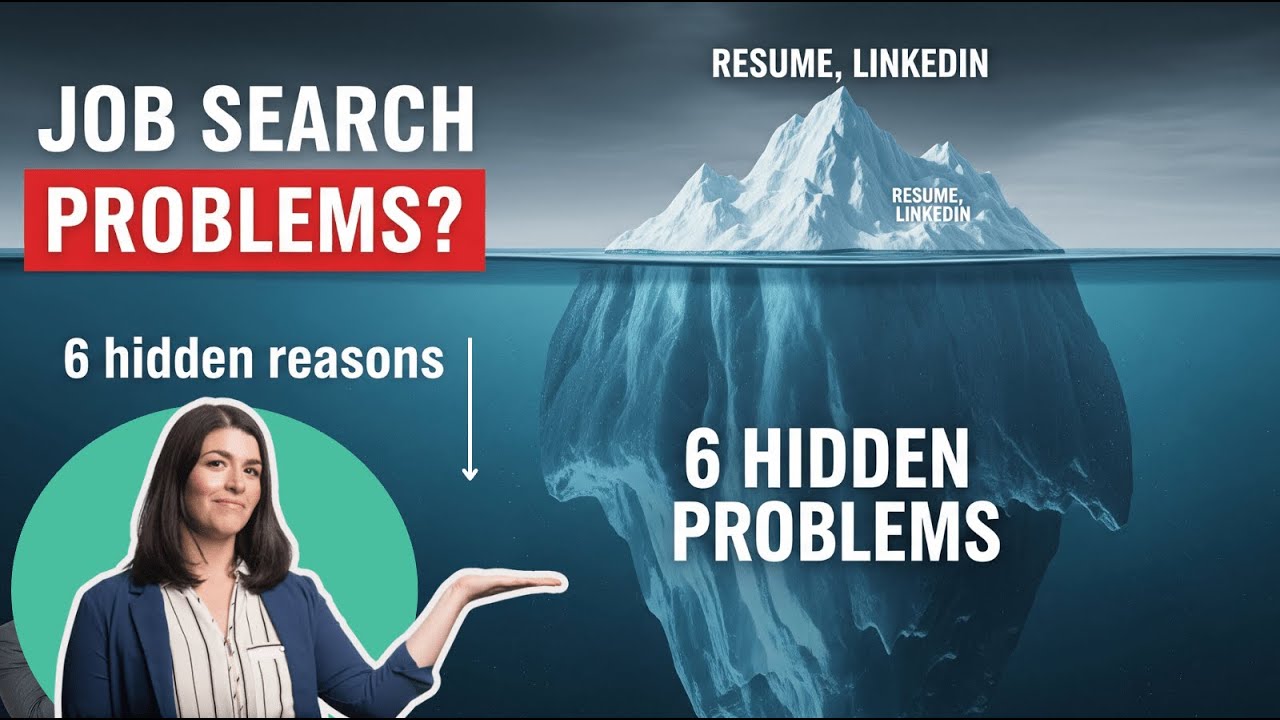
Career coach Natalie Fisher identifies six hidden obstacles keeping job seekers stuck: self-doubt, not learning from rejections, busywork, saying things you don't mean, seeking others' approval, and operating from scarcity. She argues these mental blocks matter more than resume tweaks.
Chapters
Hello. Hello. There's what we see and what we don't see in a job hunt process. And what we don't see is what's going on in the person's head. What we see is the outside of what they're getting. So very classically, people will be getting no job offers, but they'll be working really hard. They'll be putting in a lot of effort, but they won't be getting actual offers. And in some cases, they're not even getting interviews or not having actual conversations. So this has to— this just shows at the top. It just shows, it comes up in the person saying, oh, I'm working really hard. I'm applying to thousands of jobs. I've even been going on all these interviews, but I'm not getting offers. So we see that, but that's, that's the only part we really see, right? So as a coach, I see, 'cause I dig and I look for the, the, the problems that are lying beneath the surface that can easily be solved. And not always easily, but they can always be solved. Right? And the problem that most people have is they don't know that there's deeper problems that need to be addressed, and they're just looking for surface-level solutions, right? So surface-level solutions like, oh, tweak my LinkedIn, tweak my LinkedIn profile again, or tweak my resume again, or just go on more interviews, just do more, right? And this can be applied to like when you're in the workspace too. It's like these problems beneath the surface are what need to be addressed. And when you can address these problems and when you can define the problems in a way that you have power over solving them and you, you can cut out all the drama, cut out all the, like the beating yourself up or blaming yourself, or cut out any of the emotional charge. We can just look at the problem and say, okay, this is a problem and this is, these are 3 potential ways that I could solve it and these are 3 potential ways I can move forward. So some of the problems that I see, and I'm gonna go in great detail into this in my next 3-day series, so sign up for that. My next 3-day series, it's gonna, it's gonna be Solve Your Way to a Six-Figure Role and Finally Get Paid What You Deserve. I'm gonna go through the problem-solving framework to land high-quality offers that high achievers use. So self-doubt is a big problem. Self-doubt creeps in and out of the process. You might be feeling great one moment, and then the next moment something happens. Someone asks you something, someone says something, and all of a sudden you're back in self-doubt again. This is a problem that needs to learn to be managed. Okay? You're gonna need mental resilience, mental strength, and tools to manage your mind around your self-doubt so that you don't keep getting sucked back in by the self-doubt. Okay, the self-doubt, it'll be there, but it can't rule your actions. It can't rule the way that you show up. Okay, that's a big problem. Not, um, value extracting from fails. So this is a huge one. I will coach so many people and they will be like, oh yeah, I went to the interview and they said this, and then I realized that— like, they'll say something off the cuff when really there was a huge lesson there that was missed, right? So somebody asked the question, They didn't see it, and then I'll be able to see, okay, what were they thinking when that question was asked? Immediately they went to self-doubt, or they made the decision that the person wasn't interested or that they didn't have what they were looking for. And so they kind of checked out at that moment, right? It's another example of a problem, not value extracting from the, the failures, right? And this is a problem because what happens if you don't solve this is you just keep going back and doing the same things again, and you miss the opportunity to really strengthen your skill. And be ready for when those things come up again, because people are always going to have objections as to why they don't want to hire you, but they're not going to clearly voice them all the time, but they will come through their questions, right? And you have to have a really keen eye to detect exactly what it is they were concerned about so you can address it beforehand. Okay. And this is a skill that we're not taught. And most of the time what I find happens is people will just decide, oh, they weren't interested and they'll kind of just want to be done with the process and want to just get the rejection over with, when really there was so much gold there in the lesson. Another problem is doing busywork and not actually producing results. So, a big common thing where this happens is people will be opened up a bunch of tabs on their browser window, not really sure what jobs they want to apply for. They'll open up a job description and then be like, oh, But I don't have this and I don't have this. And all of a sudden self-doubt is coming back in. They're not allowing themselves to actually take any action in this direction. They're just deciding that they're not going to apply, and maybe they're postponing the application or they're postponing talking to a human. And then sometimes the deadline passes and they just don't even do it. So that was time wasted. That was busy work. That wasn't some— that wasn't focused, clear action that was producing any kind of result for a win. or for a fail. It was just wasted time kind of spinning in self-doubt. Okay, that's another one. Another one is congruency issues. So these show up where people are answering a question, for example, and they get caught off guard and they don't know how to answer the question. So they will kind of maybe, maybe try to BS their way through it or try to say what comes up, but their thoughts aren't aligned with what they really feel and what they really want to communicate and articulate very clearly. So they end up Showing that, that incongruence shows up, and then the person who you're speaking with can detect that there's incongruency there, and they'll feel like something's off about what you're saying because it— because internally it feels like it is. So like a big question people get asked is, did, uh, why did you leave your last position? Or why did you get laid off? Or why? Or— and, and if you have any kind of anything that needs to be cleaned up about that, that's one example of an incongruency that I see a lot really stumbling people. So when you can clean up that incongruency and you can learn, like you can decide how you want to talk about something really clearly and really succinctly and calmly. So you have no drama about it and you get to just tell them, then you clean up that incongruency and you instruct them how to think about the situation that they're asking about. So you instruct them how to think about your layoff or the reason why you're no longer at that job, right? But you have to lead. And oftentimes people don't know how to do that. That's one thing we do a lot in my coaching container is we talk a lot about, okay, I really wanna say this, but that doesn't sound right. So can you help me come up with a way to say it congruently so that, you know, it lands powerfully, but it's also truthful for me, right? And that's tricky because you don't want to say things you, that, that are too honest, cuz we don't need to give them all the information, but we also don't want to feel like we're holding something back and being dishonest or disingenuous in any way, right? So. Yeah. And congruency issues come up a lot. They are one of the biggest problems that people don't see solving, right? Or don't see that they need to solve, right? Um, other people's approval, that's a big one. So if you are in any way looking for someone to approve of your answers, if you are looking for your family or your friends to approve of your job change, or you're looking for approval in any area, that is going to guide your decision-making in a way that isn't congruent for you, that isn't going to serve you the best. Because as long as you're looking for other people's decisions, you're missing your own wisdom and what you think is right, what you want to say, and being true to yourself and living a really honest, um, life and continuing to go through a process in a really honest way. Instead, you're looking for approval from others, and that also is a very unattractive energy to be in. So the last one I've got here, and is— and I've got, um, a list of them that we're going to go through in the class. So it's Solve Your Way to a 6-Figure Role and Finally Get Paid What You Deserve. We're going to go through the whole problem-solving framework, um, so sign up for that below, where is lack versus sufficiency. So when people are in lack, when they're feeling like they don't have enough, or something has to work out, or they're in that survival mode, that is going to be a blocker. Okay, you can't show up from service when you are feeling in lack, when you are self-focused, when you're really concerned about your own survival and future, that's going to be really difficult for you to show up powerfully in service and the way that you need to show up in order to create the results, in order to get the job you want. So we're going to talk about that, and I have ways to get, get you into that sufficiency space where you need to be so that you can problem solve. So if any of these resonated with you, leave me a comment below. Give the channel a thumbs up if you liked the video, thumbs down if you didn't like the video, and leave me a comment if any of these resonated with you. And we're going to go through the rest of them on the training. So I hope to see you there. Sign up for it below. If you can't make it, sign up for the replays regardless, and I will see you there. Bye-bye.
More from Natalie






How To Sound Good Without Having All the Answers (In Meetings & Job Interviews)


