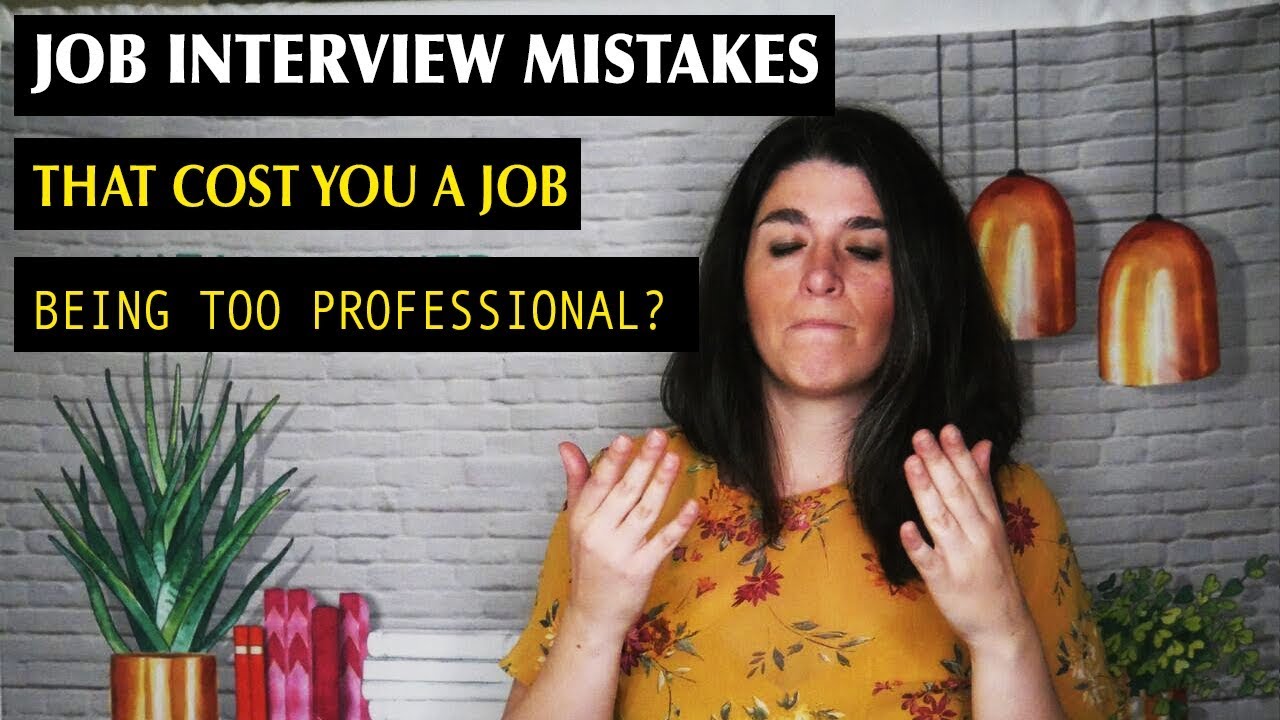
In this video, Natalie Fisher argues that the common belief that interviewees must appear ultra‑professional—wearing a suit, speaking with big words, and being impeccably polished—can actually hurt hiring chances. She explains that the dictionary definition of "professional" simply means being paid for a service, not a specific appearance or demeanor. Over‑polished candidates can seem rigid, robotic, and difficult for interviewers to connect with on a human level, making it harder to stand out. Fisher advises viewers to dress well but stay comfortable, let their personality show, and be authentic, emphasizing that genuine connection often outweighs flawless formality. She concludes with a call to action to download her "Ultimate Situational Interview Guide," which provides concrete example answers and a formula for communicating value in interviews.
Chapters
Why being too professional in an interview could cost you the job. So in this video, I'm going to talk about why being too professional can actually hurt your chances at the job you want. So a big mistake that a lot of people make is thinking that they have to be ultra super professional in interviews, and I get why you might think this. It makes total sense. It seems like that you have to put on a suit and tie, and this is what we're told to do. And in some cases, this might be the case. I want to share with you a little bit of a perspective though on professionalism. So continuing to believe that you need to be super impeccably polished and professional is where a lot of people actually go wrong because if this were true, it would mean that 100% of people who went to the job interview acted completely flawlessly professional would get hired every time and they don't. So what does it mean? What do you need to do? What does being professional even mean? So when you're going in for an interview, it seems that you'd want to be super professional, right? Well, what does professional even really mean? So the definition of professional in the dictionary is actually this: a person engaged in a specific activity as one's main paid occupation rather than as a pastime or a hobby. So basically it just means that you're someone who gets paid for providing a service or a job, or in this case, you're going in for an interview. It means that you're going into a meeting with a person who wants to pay you to do a service or a job. In reality, the definition of professionalism isn't what we think it is. It's not wearing a suit and tie or combing your hair really nicely or speaking really eloquently with big words or having your hair done perfectly. It doesn't actually mean any of that. And if you go to the dictionary, you'll see that. So being professional actually just means that you get paid for providing a service. Being too professional makes a person more difficult to connect with. So someone who is too polished and too professional, for lack of a better word, can come across as very rigid and very difficult to connect with as a human. So that's not always going to be ideal for the interviewer. And so you want to be aware of that and let them see someone with some personality. Because if everyone comes in thinking that they need to be super polished and super exact, they can act in such a rigid, specific way that everyone is going to be the same. Same, and they're just not going to stand apart because they're just going to seem like another robot. So hopefully that makes sense. So continuing to believe that you need to be uber polished could be costing you the job because the interviewer feels like they can't connect with you on a human level, and sometimes that works against you. So that's happened before with me in debrief rooms and interview rooms, and I can tell that if someone would just be a little more themselves, show a little bit more personality, they would have done much better. And because we're human beings and we like to feel a connection rather than a disconnection. So dress well, be comfortable, but be you and make sure you're being yourself. Because remember, if they like you, great. If they don't like you, that's also great. If you want to learn more about my strategy for interviewing well, you can get started right now by clicking the link below and download immediately The Ultimate Situational Interview Guide. In the guide, you're going to find 10 concrete example answers where you're going to be able to fill in the blanks with your own stories. So you're going to get the concrete examples of the 10 most commonly asked interview questions. You're going to get exact answers for what's worked before for myself and for my students. And if you get stuck with your own stories, you're going to get 25 questions to ask yourself So that you can get those out on paper. I'll give you the formula of what you instantly need to do to communicate your value in your next interview, and of course a series of examples, which we all love. So thank you so much for watching, and if you'd like to watch another video from me, click here. If you want another video in the series, click here. Otherwise, I will see you next week. Oh, subscribe to the channel. Leave me a thumbs up if you liked the video, a thumbs down if you didn't like the video, because I'm good either way. Thank you. Bye.