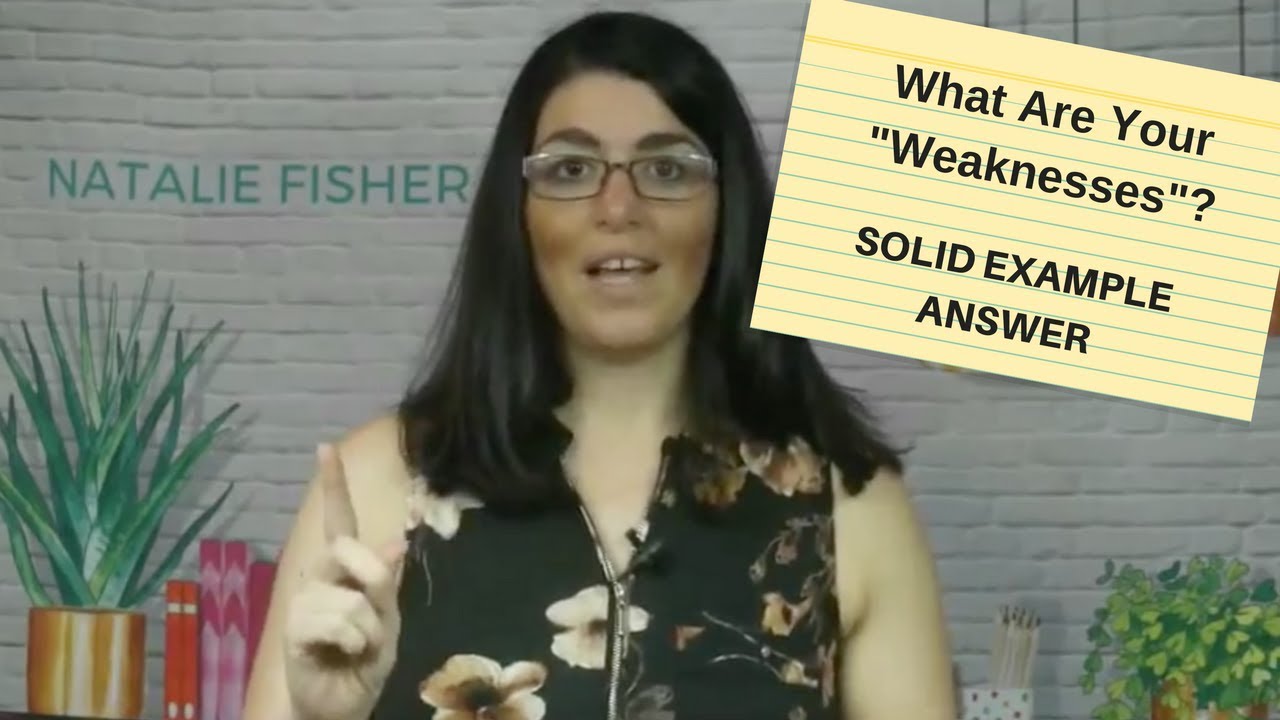
Career coach Natalie Fisher breaks down how to answer the interview question about your weaknesses. Instead of clichés like "I work too hard," she teaches a formula: name the weakness, tell a specific story where it mattered, explain what you learned, and show the result. Her example: she taught herself Photoshop on Lynda.com to finish a brochure when the designer got sick.
Chapters
Hey there. In this video, you're going to learn the psychology behind this weaknesses question is asked. Why are they asking this question? And a concrete example of how to answer this question. So I'm Natalie Fisher and I'm a speaker and I help new graduates or people who are lacking less experience get the job offers that they want by using different outside-the-box strategies. So if you're not feeling confident or you're having issues getting the job offers that you want, you know you can do the job once you get in it, but you just don't have the experience to get you through the door. That's what I'm here for, so stay tuned. So before we get into it, I want to share a couple of things that you first need to understand when answering these this question and every other question confidently. So the first thing, what even is a weakness? So I think of it this way: If you didn't know how to do something, and now you do know how to do it, so for for example, you didn't know how to create a PowerPoint presentation, but now you do because you learned. That was a weakness, but now it's not. Just like any of those other common weaknesses that you hear about, like public speaking or customer service or whatever the weakness is. If you didn't know how to do it before, you learned how to do it, now you're good at it, it's no longer a weakness. So sometimes a weakness is just a skill that you haven't mastered yet. Weaknesses are neither good nor bad, they're just facts of life and everybody has them, even your interviewer has them. So it's not a characteristic about you, it's not going to be something that you were born with, and it's not going to be a strength pretending to be a weakness. So that's what it's not. Okay, so now that that's out of the way, let's get into it. The psychology behind why they're asking this question. So They're asking this question to get an idea of how human you are. They want to see if you're able to own up to the fact that you're not perfect at everything, which of course nobody is. No one likes someone who's good and perfect at everything. And also they want to throw you off a bit and they want to just see how you're going to respond. All interview questions are just kind of, you know, feeling you out. So they're going to want to see if you're going to be honest with them or if you're going to try to say a weakness in disguise, which we don't want to do. It's all too common for them to hear the answers like, I try too hard, or I work too much and I don't take a break. And so those answers won't do, and I don't recommend them because you just sound like everyone else. So concrete examples of how to answer this question, that's what, that's what I'm going to talk about now. So first, you want to frame your weaknesses as stories. So every single answer that you can, you want it to be a story. So you can use a story for this one too. So for example, a formula for how to answer so that you can fill in the blanks and come up with your own answer. That's what I'm going to show you now. So first I like to explain to them what a weakness means to me. So I don't really consider weaknesses things that will get in the way for me to get my job done. An example of what I would say. I don't really consider weaknesses things that are going to get in the way for me to get my job done. So for example, what I mean is that once there was a career fair happening and the next week our designer was in charge of brochure design and it needed to be done by the deadline to get it to the printers. And our designer then called in sick and ended up on medical leave, so she wasn't able to deliver on time. So you might say that Photoshop was a weakness of mine, But since, because I had absolutely no experience using it and I knew that these brochures had to get done regardless, so I took it upon myself to go online, find a resource called lynda.com that I'd used before. I taught myself the key elements I needed to use Photoshop so that I could get the brochures done. And then the result, I got them to the printers on time and I was able to get them back for the career fair. So this may have been a weakness, But I learned how to do it because I needed to get it done. So it didn't stop the progress of the project. So when I have a weakness, I work through it and I get to the other side. So it's never stopped me before. And there you have it. That is what this question really means and the example of how you can answer it confidently. So you want to sell them on how you have worked through a weakness before or how you're working towards it now. Thank you so much for watching, and remember, answering this question is one thing, but there's a lot more to interviewing than just answering the questions alone. So in fact, if you only answer the questions alone, you've already lost. So there's a whole strategy at play, a whole interview strategy at play, and there's so many things going on in the interview that you need to be paying attention to. So if you'd like to get started right away, you can download my free guide below. I've put together this really comprehensive guide. It's got— when you download it, you're going to learn about the formula, how to answer the questions, and you're going to get a ton of examples just like the one in this video and 10 more. You're going to get fill-in-the-blank templates so you can start getting your own answers down on paper, and you're going to get all this in a beautifully designed workbook so that you can start preparing for your interviews. Oh, and I almost forgot, there's also also 25 questions in there, 25 very important questions that you can ask yourself to get yourself thinking of your own stories. If you have trouble coming up with them on the fly, which a lot of people that I've worked with do, you can come up with your own stories a lot faster, more effectively when you download that guide and check out those questions. They're on the very last page, so you want to scroll down. So thank you so much for watching. I hope you enjoyed this video and the example of the weakness And I hope to see you next time in the next video. If you liked it, give me a thumbs up. If you didn't like it, give me a thumbs down. Leave me a comment. Tell me what your weakness is. Tell me what you think about the whole concept of weaknesses, and I will see you next week. Bye! If you're gonna— if people leave comments, I like— I love when people leave comments. It's really awesome. If someone's gonna leave a mean comment, why Why would you bother to leave a mean comment? I mean, Superman is not out on the internet leaving mean comments about people or saying mean things to people. Putting yourself out there is tough, so I understand I'm gonna get mean comments. That's okay. And I understand that people are gonna be jealous of my eyebrows. That's fine. That's just something I learned to live with.