Building Wealth Through Multifamily with Quentin D'Souza | Payneless Flipping Podcast
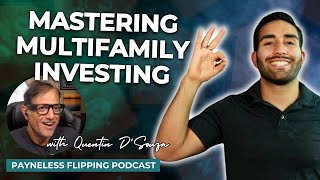
Quentin D'Souza went from teaching to owning 580+ apartment units across Ontario by using the BRRRR method and pivoting to multifamily in 2015. He quit his job in 2013 after generating enough cash flow, and founded the Durham Real Estate Club, which grew from four people to 300 members. He explains why multifamily offers bigger equity upside than single-family rentals and how Canadian CMHC loans with 40-year amortizations make the math work.
Chapters
Welcome to the Painless Flipping Podcast, where we're dedicated to helping you succeed in real estate by taking the pain out of wholesaling, out of real estate investing, out of any venture that you're trying to get into. That is our goal, is to help you out. So I bring on amazing guests, experts in their fields, to find out how they got started and what they're doing. So right now I got Quentin with me. How are you doing, Quentin?
Hey, I'm doing well. Awesome.
Well, I appreciate you being on here. Just for everyone that is watching, is listening to this or watching this, me and you don't know each other that well, so this podcast, I'm just gonna get into it and learn as much as I can from you. And hopefully, everybody that's listening can, you know, get a lot out of your experience. I know you've been in the real estate investing game for quite a while, right?
Yeah, about 2 decades now.
Oh, wow. Okay. Well, let's dive right in. Do you want to kind of tell everybody a little bit about how you got started, what you do, and then from there, we can kind of dive in a little bit deeper into your experience? Sure.
I mean, uh, I— how I got started, um, so I've been investing since 2004. Uh, I started with like a pre-construction house that I sold in 2008, and I was like, wow, this real estate thing is pretty good. I made like more on that pre-construction that I did in that year of working, actually like the last couple years of working. So I thought, wow, this is pretty interesting. So then I bought, um, I started to buy more properties. So I was buying 4 or 5 properties a year starting in 2008, and I was, uh, burying them at that time. And, um, I, uh, by the time I got to 2013, I had created enough income from those long-term BRRRR projects to quit my job as a teacher. So I was able to kind of build that up using BRRRR and also taking on partners. So in 2009, I started to take on partners on my projects. And yeah, and I kind of grew from there. 2013, after I quit my job, I flipped about a dozen properties my first year. I did some assignments, I did, you know, rent-to-owns. And then in about 2015, I said, man, I'm working harder than I did when I was, when I was teaching.
Yeah.
And so I decided that I was going to change things up a little bit and I started buying multifamily properties. So I started with like a 6-plex in 2015 and kind of scaled from there using the same strategy of using partners and then refinancing, doing BRRRRs, but on multifamily.
Okay.
And now I have just over 580 units in Ontario.
Wow.
So that's where I focus, Ontario, Canada. I do have properties in the US. I've got 4 properties down in Florida, and I'm involved in a bunch of private equity and LPs all over the place. But majority of my, my wealth is in my multifamily in Ontario. So that's where really where I focus. A lot of my time and effort. I run a local real estate club. I have since 2008. Okay, because I didn't have a network at the time. And there wasn't really meetups and stuff like that. I just kind of created it myself at the time, there wasn't that much going on. And so I was able to— I started with like 4 people in a coffee shop. And now we have like 300 members, we'll have events every month, you know, 60, 80 people will come out. And it's a lot a lot of fun. And we do that in the, the Durham region, uh, in just outside of Toronto. And, uh, yeah, it's been, it's been really good. I've written about 6 books on real estate investing and, uh, you know, done all the hard work, and, and now I'm, I'm kind of enjoying the benefits of that. I try to travel 3 or 4 months of the year. Yeah, uh, just got back from Tampa yesterday. I've been— this year I've been to Ireland, Iceland, Nepal, uh, Mexico, uh, Florida, and I'm heading back to Tampa in 2 weeks.
Wow.
Yeah, try to travel and enjoy kind of the fruits of my labor. Um, yeah, but that's amazing. Yeah, thanks. I could keep going, but no, man, you said—
you said about, uh, 50 things that I want to talk about. So that's great. Well, first off, let me ask you this. I got a lot that I got out of that. So what did you teach when you first started? Not when you first started, but what were you teaching before you got out of it?
Yeah. So first I was an elementary school teacher and then I was, I was brought into the board office and I was teaching teachers. I have a master's of education and I have my principal qualification. So they were grooming me to get into administration as a, as a principal. But I had to make a decision and, and I decided to kind of continue on with my business versus working for somebody else.
Right. Yeah. So let me ask you this. So in the United States, being a teacher just in the normal school system, it's not— you don't make as much, I would say, as you can in Canada. Canada, they pay you pretty well. So when you started getting into real estate, was it because you were more interested in real estate or was it the money that drove you? What caused you to want to leave? Because obviously you're making good money, right? Or decent money. As a teacher?
Oh yeah, for sure. I mean, by the time I left teaching, I was making six figures, right, um, at the board office as a consultant. But I think, um, uh, what happened was I had created so much income from my portfolio, I had to make a decision. And, and before I, I left teaching, I kind of talked— my, my kids were really small at the time, like my kids were like, uh, maybe like 6 and 2. And, uh, I, I decided to bank my paycheck for a year to kind of show my wife, hey, look, I'm, I'm banking my paycheck and I'm just using the income from the properties and I'm able to keep doing what I'm doing. And so she was like, you know, pretty comfortable with that. She was still taking a risk with me, right? Because it was, uh, it's a big deal when you have small kids. You know, it's easier to do when you don't, but it worked out great. And, you know, actually my first flip project I did in the summer of 2013 or '14, I can't remember which year it was now, but like, like in July I was doing my first flip project and I made $100K in my first flip and I was like, congrats, I made more than my whole year.
Yeah.
And, you know, like take home because amazing. This is awesome. So, you know, I got a lot of benefit from that. But then I also kind of learned the value of time and money. And, you know, you can get— you can make more money, but you can't make more time. So it's a balancing act when it comes to it.
So, so you not only— you saw maybe this would allow you to free up your time, right? Because you probably enjoy teaching. Teaching is probably a fulfilling thing, but you saw more time.
I mean, that's— and I still do it through the club. So every month I'll start off with like some economic fundamentals. We'll look at some macroeconomic, we'll look at what's going on in the local markets, and I'll teach different strategies because I've done pretty much everything. The only thing I haven't really done is short-term rentals. Uh, it's just not my, my thing. But, um, uh, I, uh, I've done pretty much everything else in the business. So I tend to like share based on my experience. But really, I'm focusing on, you know, continuing to purchase more apartment buildings and, you know, just continue to grow my own portfolio and manage what I have. Like, I'm pretty happy with what I have. And even if I hold on to it for the next 20 years, based on the previous 20 years, I'm— I'll be really well off.
Yeah. And you said in 2008 or '09 is when you started the Durham meetup, correct?
Yeah. Yeah, that's right. Yeah.
Yeah, how was that experience? Like, was it, uh, did it explode after a couple meetups, or did it take a long time? And did you have to stay resilient if it wasn't like growing like you thought it would? Tell me about that.
Well, really, I was just creating a peer group, and at first it was, it was a lot of fun because we would meet at bars and we would pretty much drink afterwards. So, so it was, you know, it was like an hour of meeting and then 2 hours of drinking, and, you know, it was, it was, it was fun. And then I started to kind of formalize it with more presentations and it got bigger. You know, it was, it was hard. Like the first, I would say first 4 or 5 years, it was like maybe 20 people that would come out and that's it.
Wow.
And, um, you know, it wasn't until I became a full-time investor anyways, and, uh, really I, um, I was making income outside of the club that could support my, my, my lifestyle, that the club started to get bigger.
Yeah.
So it was kind of interesting how that occurred. Now, like, the market's really soft in, in Ontario, and there's less people coming out to real estate events in general. But I think, like, it's probably the wrong mindset because this is the time when you should be sharpening your saw. This is when you should be educating yourself so that you can buy the right properties to position you well, or, you know, do the kind of projects that make the most sense. Because in, in this type of market, like, you could do well flipping if you're purchasing for the right price. Of course, you know, people I know that are doing assignments right now are doing really well as long as they're purchasing it for the right price, right? So, you know, um, it just depends on what your purchase price is. So, I learned a lot at the time about running, and I was an educator, so I liked presenting, so it wasn't too much work for me. But, yeah, it took a while to gain steam and become what it is today. And, even now, if I stop doing it today, the only thing that would bother me is that I'm an educator and then I'm not sharing with anybody anymore. It would kind of like, you know, you have to have more reasons for doing what you do other than money. And I mean, you need money to survive, so don't get me wrong, but you also need to have other drivers once you've achieved a certain level because it's not going to satisfy you just to make money. You need to do different things. So for me, the club is a way for me to give back and help to educate people and try to put them on the right path because there are a lot of people that will take you off the path. There's shiny objects, there's all this other stuff, and you got to figure out, you know, as an investor, you know, how to stay on the right path so that you can continue to succeed, right?
No, that's 100% true. So let me ask you this. You've, you've done it all, right? You have the assignments, fix and flip. Other than you said you haven't really dived into short-term rental, um, Going back, looking back, do you wish you would have stuck with— because focus is such a big deal as an entrepreneur, like staying focused on one thing. And you've done it all, and I've done quite a bit as well. And so like, looking back, do you wish you would have just stayed in one lane? Maybe just stayed signing or stayed flipping or stayed keeping burring? Or are you happy with like multifamily? You wish that was the place that you started out? I'm just curious, like, because there's so many different ways. So if you had to go back, what would that focus be on?
Yeah, it's a good question. And hindsight is always 20/20, you know, when you're, when you're kind of reflecting. I think they all had a purpose. Like, when I had been flipping projects after I had quit my job, I think I needed that in order to feel that I could make it work no matter what. What, um, I mean, if I would have kept all of the properties that I flipped, I would have made probably millions more than I did. But that that wasn't the purpose at the time, right? You kind of have to find where you are at the time and make decisions based on that. I think I'm okay with having done everything that I've done. I think in 2013, '14, '15, I was just doing too many things at the same time and they were all working, but they required a lot more time. Now I feel like I can I'm— I have a much larger portfolio, and it takes me a lot less time to, to manage the same amount. So for me, I think that is a much better way of growing and continuing. Like, I, I don't— I don't need to hustle, uh, you know, at the same level as I did before. But when I'm closing on an apartment building or I'm refinancing an apartment building, I have a lot— I have to invest a lot of time into getting those things done. But then once I get them into my system and my processes, then, you know, the systems and processes take over. And, uh, and so that, so that is where, like, if I'm in hold mode, which I am right now, I'm still underwriting properties and I'm starting to see some multifamily make sense now that it hasn't in a year and a half. But, you know, until I actually close on something, I, I don't have a huge time commitment., from the, uh, the maintenance of the portfolio because I have so many other people doing what needs to be done for me, right? Yes, either employees or, you know, uh, just, um, different partnerships, different third parties, you know, they're all doing what they're supposed to be doing and that helps me to free up my time.
Is there, uh, when it comes to when you were burying the properties, do you, do you feel like multifamily just makes so much more sense to keep those as rentals versus a single family? That's just like producing one, one revenue stream, I guess, from that one house?
Well, the difference is that I think that the way that you evaluate singles, like 1 to 4 unit properties in Canada anyways, and it's probably the same for the US, is that the way that you get an evaluation of a property is based on the property that was sold down the street in the last you know, 90 days, right? And that gives you a value of the property. But multifamily properties are basically little businesses and they're based on net operating income. And I feel that the size of the business that you buy affects the size of the amount that you can increase the value. So if I'm buying, like, let's say I'm buying a duplex, you know, and the property value goes up, 10%. It's still not going to be the same as buying a $5 million building and I'm able to increase the net operating income and increase that so that the value of the property increases by 10%. We're talking about like a $500,000 increase in value. And so what I find is with the multifamily is that like the, the jumps in net worth are much higher in apartment buildings, and the ability to refinance, to pull out capital in order to put back into your business, um, in order to continue to grow, it's much larger in multifamily than it was in, or that it is in the 1 to 4 unit space. And also, like, there's, there's been— it's not the same as in the US. In Canada, there's been a war on against investors by, uh, the Government of Canada. Like, they basically, you know, declared war, and it's, it's become very hard to buy multiple properties as an investor. Financing is challenging because of stress tests, and the, uh, the amount of funds that are available for, you know, people who have a certain amount of properties has, has really dried up. And I, I don't think they understand the federal, at the federal government level, that investors provide rental properties for people to invest in or to hold on to and to live in. And so they're affecting the rental supply to a large extent because of their misunderstanding and misallocation of blame. You know, they, they like to blame foreign buyers, they, they like to blame other people, but none of them take on any responsibility for it themselves. They don't see themselves as overtaxing the, you know, homes and, you know, creating problems because of the amount of development fees and charges and things that they put on the, the, the, the building of these properties that causes the prices to increase. It's always somebody else who's the problem. It's new immigrants, it's, you know, whoever else. It's never, never the government. It's always somebody else, right?
Their regulations and their laws are making it more expensive for the, like, the person that's living in the property, right? Like the— yeah, so they just don't— they don't get it.
Yeah. And the rules that they have, that they created, like, like, um, the— so like, for example, the, the financing. And I'll give you an example of the difference that's a benefit in Canada, not just, just a problem. But I mean, we have CMHC financing for multi-family in Canada. In the U.S., you might have like, I guess, HUD financing would be a good example of multifamily. Um, that financing at CMHC at like a 40-year amortization, um, you know, makes the property cash flow at like a DCR of like maybe 1.2, whereas, you know, you'd have to get like HUD financing to be able to do the same thing, but you won't be able to get the same amortization, uh, level. So that's another reason why I think you know, the apartment buildings in Canada make a lot of sense because I find that the, the yield that I can get and the IRR is higher in Canada than the US on multifamily.
Just because of the amount of time it's amortized, is that what you're saying?
Yeah, and the debt coverage ratio, because like if you can get like MLI Select for CMHC, you can have a DCR— one, you can come down to 1.1 DCR on your apartment building, which means that you can pull out more cash. It And you can't do that with the— I mean, but you have a lot more variety of products in the US. Like you'll have bridge financing that's interest only and things like that that you use in order to, you know, reposition an apartment building before you refinance. We don't have those same type of options, but it's that CMHC option with the higher amortization that makes the, you know, people think that, that like the real estate business is about bricks and mortar. It actually is about financing. It's how you finance things that, that makes sense. And if you can get the best financing out there in Canada right now, which will happen— yeah, makes a deal happen, right?
Yeah, same things with like hard money lenders, right? Like if you're going to, uh, flip a property but you're, you're borrowing money at such a high interest rate, right, it's, it's very difficult to to, um, make a deal happen, right?
Yeah. And I would say that in the active space, like flipping, I would consider more active income, or assignments, right? In that space, I would say that relationships are more important than the bricks and mortar, right? So it just depends on the strategy that you focus on that makes the most sense. I still think relationships are really important on in the multi-family space, but I just think that financing is what makes deal's, uh, pencil. And yeah, so it's just a little different, that's all.
So this has been amazing. I, I love all the information you give me. To wrap up, I have, I have a two— like two— a question, but it's like two ways to look at it. I want to get your opinion. So, um, when I hear about people that own quite a few, uh, units, right, like 500, 1,000, you know, 10,000, whatever the number may be, um, I'm assuming you don't own all those, and most people don't own those outright, right? Where they just own it and they don't have to pay monthly payments right there. So have you considered like, okay, let me scale it back and let me just own a couple, or whatever, how many you can just own and not like continue to leverage? Or do you like to leverage, to leverage, and you're just— the goal is just let's acquire as many as we can because it's fun?, or like, or I want to— because I'm sure you don't need to do any more. So I'm just kind of trying to figure out what, what the game plan is.
Well, okay, so I, I have, uh, let's say I have 100, uh, 100— well, I have about $125 million in assets. So my asset base is large, and I own between 50% and 100% of the asset, right? So let's say I have, uh, like the— what I own of the $125 million is about $75 million in an asset Okay, now if I were to own $5 million and our, let's say, $10 million outright— oh no, let's, let's say $20 million outright. Okay, okay, so I own 100% of that. Okay, now let me ask you another question. In 10 years from now, if we can both agree that real estate will perhaps double in price in 10 years from now, What will the difference in asset base be if I own, you know, $125 million where I own 50 to 100%, or $20 million while I own 100%?
Well, I would assume that you're, you're going to make way more in 10 years by owning the, um, not owning it outright, but owning the 70% of the $125 million.
Is that correct? That's correct, right? Because your asset base that you have doubles in size, but your debt doesn't necessarily double in size. Depending on how many times you refinance. But even if you are refinancing to pull capital out, you're still taking advantage of that capital either to reinvest or to, to invest in other things that you need, whatever it is. Like, it could be private equity, it could be something else to give you some diversity.
So owning it outright in the long run is not more of a financial gain, right? Like, it doesn't really make sense other than maybe you would say like Dave Ramsey peace of mind, right? Or would you say there's really no peace of mind even in owning it outright?
It depends on where you are in your journey. So I say that people move through 3 different stages when they're investing. There's like the, the growth stage, there's like the, the, the building stage, and then, then there's the, like, uh, I would say kind of like the ending stage. As you get, like, you know, those are the mom-and-pop landlords have owned the same properties for 20 years. They typically have low debt, high, uh, equity, and high cash flow, and, and that's what they want, you know. And I think it just depends on where you are in your journey that will affect how you look at things. For me, I, I see it a little differently. I see it as more important to have an asset base because I still believe that the dollar is going to devalue over the next 10 years. And it's more important to me to have a larger asset base because I know that the value of that dollar will be worth half as much. I mean, if you, if you think about it, if you're, if you're taking like a 2 to, let's say a 3% inflation rate and you multiply that by 10 years and it's compounding, that's at least, let's say 35% depreciation in the value of the dollar. Well, a $75 or $125 million asset base, that means that that's going to be going up by that percentage because the value of the asset underlying asset is going to be the same. It's the dollar value that changes.
Yeah, so technically, like, your money is just decreasing by a ton over time, but your asset— if you have all your, uh, like, a lot of your investments in assets, it's just going to be continue to go with the, uh, I guess the inflation, right?
Is that how it works? Yes. Yeah, exactly. And it could be like gold, it could be Bitcoin, it could be like, uh, real estate. It just depends on what the asset— I always encourage people to own assets assets that will pay you because that way—
that's exactly it. Yeah, love it. Well, hey, Quinn, I think we got a lot to talk about over time, and I'll be going to your event. It's a pleasure to meet you, and, uh, you know, I'd love to have you back on in the future. I think, uh, you'll be a hit for my people. They'll— I know we talked about some high-level stuff, but that's what it goes. I think most people want to do the high-level stuff. They get into the wholesaling and the fix and flipping because they wanted to develop that wealth. So yeah, no, this is great.
No, it's a great way to start and it's a good way to create income and it's a good way to— and like, as an active business, like, I've got friends who run flipping businesses that, that they're not actually flipping, they're just, uh, wholesaling properties, and they do well, like, like a million clear a year, no problem. And like, it's— there's some real good money to be made, but it's still an active business, right? You have to treat it like that.
I love it. All right, well, Quinn, we'll be seeing you. I'll be seeing you on that, uh, November— I think November 13th is that when you're having. And where can people find you if they want to learn more? If they loved this conversation, they want to find out more about you.
Sure, I'm happy to talk to anybody about real estate for 15 minutes. You can, uh, you can book a call with me, quinchendesouza.com. Uh, if you want to come out to one of the events, it's durhamrei.com or.ca. Either will take you the same place and you can come out to one of our events as well.
All right, Quinn. Well, again, what a pleasure, and I'm looking forward to soaking up as much as I can from you as, uh, as I'm here now in the, in the— I'm in Lindsay, if you know where— you obviously know where Lindsay is.
That's where I live. Yeah, I used to own a property up there.
Yeah, there you go. All right, we'll be talking soon. Talk to you later. Hey everybody, what's up? It's Nathan Payne, and for the first time ever, we just released this insane training bundle that has literally everything that I've learned from doing a combined 4,000 deals in real estate, all from starting with absolutely no previous business background experience or any real estate experience. Plus, there is over $19,000 worth of free gifts that we're throwing in, all for an insanely low, low price. If you want to get your hands on this, be sure to click the first link on the description below right now.
More from Nathan





Why Traditional Wholesaling Keeps Failing You (Use This Pre-Flip Method Instead)





