Calling Sellers Live! | Wholesaling Real Estate Ring | Full Episode (Deal breakdown and Live Calls)
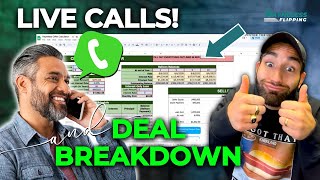
In this live YouTube episode, hosts Nathan Payne, Nathan Valley, and guest Lane Peterson walk viewers through a real‑world sub‑2 wholesale deal, demonstrating how to analyze numbers with a "Painless Offer Calculator," negotiate seller‑financed terms, and structure a zero‑percent seller carry. They explain the difference between inbound and outbound leads, discuss creative financing tools such as sub‑2, novation (white‑glove net‑listing), and accelerated seller‑carry programs, and highlight the importance of motivated sellers. The trio also covers practical call techniques, market‑specific ARV calculations (70% vs 90% rules), the role of cash flow versus appreciation, and tax advantages of depreciation and accelerated write‑offs. Throughout, they make live outbound calls to sellers, illustrate how to handle objections, confirm appointment times, and share tips for lead follow‑up, pre‑foreclosure sourcing, and using tools like skip‑tracing. The episode emphasizes a mindset shift from chasing cash‑flow deals to solving seller problems with creative structures that appeal to investors seeking appreciation and tax benefits.
Chapters
What is going on, everybody? You know what time it is. It's time to call some sellers live. What's up, guys?
You don't know what's going on.
What's up? What's up, guys? So if you don't know who I am, my name is Nathan Payne. Been in the business for several years. Our goal is to help you do more deals, period, right? You're getting a lot of opportunities. If you're not getting a lot of opportunities, get more. And if you don't know what opportunity is, you need to know what it is. But our goal is to help you. That's my goal. I know a lot of deals. Want to help you do more. That's me. Nathan Valley, who are you?
Yeah, guys, my name is Nathan Valley. Done a bunch of deals, bunch of different states. Probably the thing people have seen, if you have seen anything from me, was a while ago I did a 30-day challenge to where I picked brand new market and did a deal, a $20,000 deal in 30 days by just spending about 2-3 hours a day Monday through Friday and with $0 in marketing. The reason why we're doing this, guys, is there's a lot of people out there struggling to wholesale real estate, and we don't want you to be one of them.
Who are you, Lane?
I am Lane Peterson. How's everybody doing? I'm still rocking my Cinco de Mayo hat. It is still May. Oh, so I got to get my money's worth. I am a nationwide wholesaler. I've been wholesaling for the last 15 years, broke out, went national before COVID hit. And yeah, I've been buying virtual for quite a few years now.
I love it. So guys, that's who we are. Just so if you're like, why am I listening to these jabronis? They don't know anything. That's, that's so you guys know, you know, where we're coming from. Our plan today is to call some sellers live. We have a sub-2 deal that we're going to break down. Lane actually got it 2 weeks ago on our first call where we're doing this, negotiated it. I'm gonna break it down for you guys. Yeah, on this call. Yeah, 2 weeks ago on this, this specific call we did Thursday. So we're gonna break it down. I'm gonna bust out my spreadsheets, show you guys. We're gonna see if it's a deal or not a deal. It's a good deal. And, uh, that's our plan. And our promise is we make calls, okay? So it's not just us yapping the whole time. We're gonna make some calls. Let's go right into it. Lane, do you want to kind of explain while I pull up my spreadsheet what the scenario of the deal Like, what's the story?
Yeah, for sure. This was an inbound lead. Uh, now everybody, you gotta know the difference between inbound and outbound. So somebody went online, I don't know what they Googled, but they Googled sell my house, sell it cash, sell it fast, whatever. They found one of my web forms, one of my landing pages, filled out some information. The lead came to me. So that's an inbound lead, right? So that's a very warm lead, about the warmest you can get when they're coming to you to sell their home. So this one came in, Francisco is his name, just outside of Atlanta, your hometown, Mr. Payne. That's it. And he was, he was on the MLS, so he was active with a realtor. He had bought this house only about 3 years ago, so not that long ago. The person that he bought it from had already rehabbed it, um, had already fixed it up, and then he got a job transfer. So he got a job transfer, he had to go. The house wasn't selling, it was sitting there, it fell in and out of escrow, uh, so he was getting super frustrated. And I was talking to him, I was like, listen, I can make you a cash offer, but it's going to be a little bit less than what you paid for it. So, you know, that didn't make sense. He didn't want to come to the table having to write a check to close this house. So I rolled into asking him if he's ever heard about selling his house on terms, seller finance, sub-2. Didn't know anything about it, explained it to him. Listen, you have a 3% mortgage in place, is what I told him. I said, that is a very, very valuable loan. Nobody can get a loan like that. I don't even know if I'm going to be able to see a loan like that for the rest of my days. You know, maybe we will if the whole country gets the flu again and the government wants to start printing money. That's the only way we're gonna— that's the only reason we saw those, those interest rates. The whole country got the flu and the government printed money. So I said, you have a very valuable loan. I want that loan. I can pay you your asking price, but the caveat is that loan is going to stay in place and your equity, I'm going to pay you out over time. He's like, okay, I just need a little bit of cash in my pocket. And I said, okay, how much cash do you need? And he's like, I would love $15,000. I said, how about I give you $20,000? So I'm giving him $20,000 down. I'm taking over his FHA loan at 3%. and he's happy. Gets him on his way, gets some cash in his pocket. I buy the home. So let's run through the numbers.
Let's do it. Okay guys, so what I'm going to show you right now is called the Painless Offer Calculator. Lane— Lane's got that calculator on his desk from Walmart. I got—
you know, like, show them. It's the same numbers as your spreadsheet.
It's true, man. You're right.
Hey, fun fact, guys, just, just kind of proof there. If you're sitting here being like, oh my gosh, I can't do deals because I don't have the Painless Calculator, Lane is here as proof, guys. You, you can use whatever you got.
That's it. You're dang right. You got to know your numbers, right? That's right. All right, so let me share my, um, my screen so you guys can— my tab— so you guys can see what's going on. All right, so let's run through these numbers. So this is the Creative Offer Analyzer. Okay, we're gonna see cash— what's the cash-on-cash return after we throw in the numbers. We're We're gonna see what this thing looks like. All right, so Lane, what is the purchase price that we're looking at on this thing? $300,000. Okay, and how much money down? Is it— is this what you're getting it for? Is this what you were, um— this is— I want to do the numbers of what you're getting it for, just if you were to keep it.
Yeah, this is it. Okay, so $300,000, I'm giving them $20,000 down.
Okay, so that's 6.7% down from the purchase price. Well, according to this, let's see. Yeah. Okay. 6.7%. All right. So what is the loan amount? Do you know?
I should have had that in front of me. Yep, I do. Hold on.
Because I think it was like $225,000, wasn't it?
So $235,000. Just $235,000 even. It's $235,198. But just— yeah, $235,000 even.
And then he's at a 3% interest rate, correct?
3%. $1,700 PITI.
So his monthly payment according to this is $704. But then you're saying he's got interest and taxes and interest.
Right. Yeah. Taxes and insurance.
Taxes. Sorry. Yeah. Taxes and insurance. Okay. So then are you doing a balloon payment or are you base— are you—
yeah.
Are you doing a balloon on this one?
So I'm doing a balloon for his equity, not for the loan. The loan I'm going to keep in place for the duration of that loan, which we always do.
Okay.
Gotcha. But he's got— he's got significant equity there between $235,000 and $300,000.
Are you doing, are you doing any interest-only payments to him?
Nope. This was a pretty good deal. I was able to get him to carry his equity at 0%, zero payments due, due full and payable at 10 years.
Okay. Gotcha. So let me go over here. This is where the expenses come in to see if this is a good deal.
Just real quick, Lane, can you kind of break that down? What, what exactly does, does that mean for people watching?
So if I have a purchase price of $300,000 and his loan is $235,000, so there's $65,000 of equity that he is owed, right? Yep. I'm going to give him $20,000 at close. So he is going to do a carry for $45,000, but I don't have to pay him that $45,000 until 10 years, nor do I have to make payments on it.
And Why, why would he do— or I guess you can either answer why would he do something like that? Why would that be in his best interest? Or more, more specifically, how were you able to frame that to him in the conversation?
So we'll get into that. But he has a little bit of a higher payment because he did not put homeowner's insurance on this home and his lender penalized him for that and put a very high-risk policy on the home. And so instead of only $1,700 PITI, it actually bumped him to $2,000 a month. But I'm going to get a new policy on that. I'm going to get it back down to $1,700. But because there's not hardly any cash flow and because it's eating at him every single month and because he needs to close quick because he can't afford these payments at all, those are the terms we were able to, to reach because of, you know, because of his terms, I was able to kind of negotiate the price pretty well.
Yeah, because I'm running this like it with the interest rate at 6— sorry, 3%. Like, his payment should be extremely low. So he's getting— according to this, he's getting wrecked.
Yeah, because of that. It's called a high-risk policy that the mortgage— the lender is going to put on you if you don't put homeowner's insurance on the home. And he was just— I don't know if he was just lazy and he wasn't doing it, but he definitely got penalized for it.
So his payment, one more time, is every month— what is it?
It's right about $2,000 because of that insurance policy.
All right, let me go back to sharing my screen really quick. And by the way, guys, creative is something that's— yeah, like it's not something in my opinion that some— like someone can just immediately master. It takes time. But look, we'll look at this. So you're saying his monthly payment is about $2,000. So what I'm trying to do, guys, in this cash-on-cash return to see like if this is a good deal or not, if you're going to rent this out, you're also going to have maintenance cap, you know, maintenance costs, management, vacancy, vacancy, and on top of, um, you know, the payment, right? So actually, we got to get his monthly payment. It's actually going to be more. It's probably going to be like $2,600 a month, right, with all those expenses, wouldn't you say, Lane, or no?
No, that's, that's everything included. The $2,000 is PITI, so that's property.
No, no, but if you're going to rent it out, and if you're going to like buy it and, uh, like to rent it out, you would also have to take into account, you know, management, vacancy, maintenance costs, correct?
Yeah, that would come off of your total gross rent, right?
So what is the total rent on this property? Like, what would you be able to rent it for? $2,450. $2,450. To be honest, bro, like, unless you get that insurance policy, it's a really tight deal, bro.
Yeah, so the cash flow isn't sexy. The cash flow is not sexy, but the terms on it are sexy. So you have a 0% seller carry, which is phenomenal, and you have a 3% loan.
So those are things that people really, really love because 3% is great without the insurance.
And you got to understand, like, we're in the wholesale business, right? We're helping this individual solve their problem. But also, I'm going to wholesale this to somebody that this really makes sense for because the reason the wealthy buy rental properties is why? Appreciation.
Appreciation.
30 years later. Appreciation and appreciation, right? It's not about the cash flow. Anybody that is wealthy that has a business that's just spitting out cash, whatever it may be, you know, Amazon or a tech company or whatever, they need to offset their income with taxes, and buying real estate is the best way to do that. So they're not really concerned about the cash flow on it, right? They're buying a good asset, it is cash flowing a little bit, maybe not much, but immediately they're able to depreciate that on their taxes, and then all the while it's appreciating over time. And so they're becoming more wealthy. They're increasing their wealth and getting rid of their tax liability as much as they can.
Of course. No, I agree. We all agree on that.
Yeah. One thing I want to, I want to point out from that, that's, that's so important. Took me a really long time to learn this with wholesaling. Moral of the story, or the takeaway from that, guys, is stop assuming what you think a good deal is or isn't. There's some kind of, you know, general parameters, but again, property is worth whatever someone is willing to pay for it. And again, a lot of times I see, especially newer people. They're like, oh man, who would buy that deal? Or they'll see an investor, they'll lose out on an offer or on a bid to another investor, like, ah man, that's that, that dumb investor, how could they do that? No, the investor, they're probably a big-time investor. We do it all the time. We, we, um, we sold a deal, um, a little while ago to where— I think we told the story recently— we had offers where they were coming in around $160,000, $170,000. The guy we sold it to paid $250,000. It's not because he's just some newbie that has no idea what he's doing. They're a massive company. They flip hundreds of homes a year, you know, rehabs. So sometimes people are just playing a different game than you might be realizing. So don't assume too much. And, and the simplest thing you can do, guys, is when you— and when you have the most important piece, motivated seller, right? Figure out what, what's the best possible terms and solution that I can get in place. And then I can just ask a buyer, hey, are you able to make this work? Is this a good price for you? What are you willing to pay?
A lot of deals, man, because a lot of the time we sell deals that leave our head— we're scratching our heads and we're like, I don't know how that dude's making that work.
You know?
Yeah. And, you know, it's always good. It's always good. Like, I know you guys talk about this a lot. Know your buyers, know what they want. You know, like a lot of people do reverse wholesaling. Reverse wholesaling is you go out and you find the buyer first. You know what their criteria is, you know what they're looking for, and then you go find them a property that meets their criteria, right? I've been in the game long enough. I kind of know what the sub-2 wholesale market will bear. And I know this property is valuable to that type of buyer. Now, the cash flow is not sexy. The cash flow on this deal is not sexy, especially if that insurance, that high-risk insurance has to stay in place. But I know it doesn't. I'm going to go get a new policy. I'm going to get that payment down to $1,700 a month and it rents for $2,450. You know, that is going to make sense even with your, your property management, all your expenses and, and everything else involved, your vacancies. So that, that for me, and that's how I was able to negotiate with him the zero payments to his carry because the cash flow is not on $2,000 a month payment. The cash flow is not there. And I explained to him, I said, listen, Francisco, there's not any room there to pay you per month. I'll be going, I'll be going backwards quick. I'm not in the business to write checks every month, so this has to make sense for both sides.
It just makes— I think you could even get it less than $1,700, right? If it's a 3% on a house that's worth— the loan is like $225,000, like it should be less than $1,700 a month with the new policy, don't you think?
I think it's going to be right in there, just with the taxes of that property. I think it's going to be right in there.
Okay, either way. So guys, that's kind of like a breakdown of like, you know, if you look at it through the lens like, you know, a noob, right? Like I, you We all want just immediately like, it is a cash flow, right? But if you have the right buyers, it doesn't mean— we all met with a buyer who's like, look, I just got to put my money somewhere. And he doesn't really care so much about the cash flow. Now everybody wants the cash flow. Like, it's not like these guys don't want to make money. They just— it's not always the end goal. So you just have to have the right buyers. And there's— it's kind of crazy out there. There's lots of guys with money out there that need to place their money, and they're everywhere. You just need to know where to go.
Yeah. People don't understand how much you save or how much a wealthy person saves on their taxes by buying a piece of real estate. Nathan Payne, if you want to do the math right behind you, if you bought a house for $400,000, so say I bought a house for $400,000, the government is going to take 80% of $400,000 because they, they factor 20% of that is land. You can't depreciate the land. So you take $400,000 times 0.8, that's $320,000 that is depreciable.
So you're saying because you can depreciate the 20%, 80% is depreciable, right?
Yeah. You got to take the land out. And that's, that's what the government uses for the land is 20% of whatever you bought it for. That's $320,000 and divide that by 27.5. That's the magic number. The government thinks that you can depreciate this for 20 and 27.5 years. Who knows how they came up with that number, but I know in 27.5 years my house is still going to be standing, but they let me depreciate the entire thing. That is $11,636.
Nathan, let me do the math. Okay. 27.5. I'm actually going to do the long way, dog. I'm just kidding. I ain't going to do it.
Well, it's $11,636 with my Walmart calculator, so you can do it the long way all you want.
$11,000, uh, 3 $6,300. $6,300. And you're saying that's how much you can depreciate off of your taxes per year?
Per year. Here's the cool part, here's the cool part. They let you do accelerated depreciation.
So how many years? You can do it 5, right?
You can collect it all? No, no, sorry, that's how we got to—
yeah, that's how we got here. I think they let you do— isn't it 5 years they allow you to depreciate, or I can't remember? When you do accelerated depreciation? 7.
7. Okay. Well, you times that by 7. What you got on the Walmart? $81,454. So if I am— if I had that at the end of the year and I owe $100,000 to the IRS in taxes, why don't I just go buy this sub-2 deal? That's $300,000. I'm only putting $20,000 out of my own pocket because that's how much the down payment is. They don't care. I'm saving $81,000 in taxes. By buying that property.
And they don't care about how much you put down on the property, they just care about what the value of the property is, correct?
Yep, they just care about the value. It's just like if you bought a, uh, an SUV to offset your taxes at the end of the year, but you got a loan on it, you can still depreciate the entire value of that SUV or that truck that you bought.
Amazing.
That's how the government— that's the calculation the government uses for you to depreciate a house. And that is why the wealthy buy real estate.
You're telling me someone just saved $81,000 by doing accelerated depreciation on like this year, for example, on one property? On one property. Now we also have to say that they also cannot sell that property and like within—
correct, this is all deferred. This is all deferred. So if you go and sell that, the government's going to want the money back that you took.
Of course.
So you know, the wealthy They don't sell nothing. They don't sell anything. They keep it and they just get more wealthy and more wealthy. And then they go take a loan out on it and go buy more properties and depreciate more and keep getting more wealthy and more wealthy.
Now, let me ask you a question about that really quick, and then we'll get some calls. You— this is on a sub-2 deal, but you're able to depreciate that property. Is that seller able to take that to depreciate his property as well, or no?
No, you both can't.
Okay, so you have to have that conversation with the seller and be like, bro, I'm getting the tax benefits. Or is it because you bought it, you get to do it? And he—
they don't—
you bought it, you're on title, you own that house. They sold it. Okay. Yep, they sold it.
Do you know how that works on a contract for deed when you aren't on title?
I'm not going to get into tax implications. I'm not an accountant or a lawyer, so—
all right, all right, good, great.
Whoever is paying the interest gets the tax benefit.
Okay, that's a good, that's a good model. Now, um, everybody, I hope this has been helpful to show you guys that you don't need necessarily to make like an amazing cash flowing deal. Like, personally, I want cash flowing deals right now. Like, I, I'm not in a position where I need to buy a bunch of rentals that aren't that good of deals, in my opinion, to, to offset my taxes. That's just not where I'm at right now.
Yeah, build your cash machine, build your cash machine first, right? Yeah, have a tax problem, then start buying rentals, but make sure you got, you got a tax problem first.
That's a great— yeah. And that's honestly, we had that conversation with that, that our team yesterday. There's a lot of guys that have tax problems and basically we solve that problem by giving them these kind of opportunities. So anyway, great. Anything you guys want to say before we hop into some calls? That was really good. Thank you, Lane. Actually, I haven't really dived too much into this stuff. I just have never really learned it.
So thank you. One thing I wanted to point out back to the I just look at real estate in a really, really simple lens. For anybody that, like, if your eyes glazed over a little bit, it's okay. I'm one of those people too. It's all right if you didn't follow all of that. If you're like, oh my gosh, do I need to, like, understand every step? No, you will one day. Or we— when we, when we get to where Lane is. But if, yeah, if where you're at right now, if you're like, oh my gosh, what does this mean? All, all you really need to understand to be able to crush it in wholesaling is he had a motivated seller. He has a motivated seller with a problem that he can solve, and then by having the right conversation, was able to just say, hey, well, this is the only option that we can potentially do. Do you want to do it? And the seller says, yeah. And here's the thing, even if, even if Lane were to have an issue with buyers with, with the way the terms are set up right now, even if they're like, ah, we can't do that, but we can do this instead, You still have the golden rule correct, which is having a motivated seller, because that motivated seller— worst case scenario, the buyers say, hey, we can't, we can't do those terms, but we can do these instead. That seller has no other option because that is a true motivated seller. And that's where, guys, when you're working with true motivated sellers, this business is super simple because all you're doing is having a back and forth conversation, right? And you're letting the buyer, you know, or you can let the buyer tell you what they need it to be at, and then you just relay that information to the seller. So you don't need to kind of overthink things. It's good to learn all of this stuff over time, but if you don't understand all of that right now, it's totally okay. We're looking for motivated sellers, problems we can solve.
Yeah, and it's honestly kind of cool as you get deeper into this, guys, the amount of more deals you can do and squeeze out when you have these tools in your tool belt, arrows in your quiver. So don't get overwhelmed, but just know if someone needs to sell, there's a solution. Okay, there's a way to make it happen.
So anyway, yeah, that's the first thing. You get a motivated seller. I mean, that's the first step, right? And there's price and there's terms, right? If they set the price, I can pay whatever price anybody wants as long as they give me the right terms, right? I'm just like, no, you can't. What if they want $1 million for a house that's only worth $300,000? I could do it. You take $1 million, I'll pay $1 a day or $1 a week. I can pay $1 million for that house. You can pay whatever price. If they set the price, you set the terms. If they set the terms, like my seller here in Atlanta, hey, I need to be out. I need, I need to be out like yesterday and I need to go and whatever. Okay, for that, for those terms, here's what I can do. I can put $20 grand in your pocket and I need, you know, your equity spread over 10 years. So you just have to know that like if they set the price, you can get to the price as long as you get the right terms.
Yeah, they don't get to get the price and to get their money now. That's, that's right. Yeah, that's why you have terms, right?
Yeah, you can't get both, best of both worlds, or whatever the saying is.
Have your cake and eat it too. All right, Lane, let's get— let's make some calls. Let's show these people, uh, okay, what it looks like, what, what the real deal. Because a lot of people, they think this is like, oh, you know, as soon as you get that person, it's amazing. Like, guys, this is a business, right? It's not like you call and they're immediately just like right by the phone. Just, I'm glad you called, Lane. I was waiting for you.
You know, I'm going to show you what I really— Exactly. So the first one I'm going to call is somebody that I did already have a conversation with. He called, he reached out to me yesterday and he's got a big house outside of Atlanta, wants pretty much almost retail. And I told him I would run some numbers. I'd call him back. This is a perfect novation. So those that don't know what a novation is, you know, you basically are doing a net listing agreement with the seller.
Right?
And so what I do for a novation is I take the ARV, whatever the as-is condition, the, the what I can list it for. I take that ARV, I times it by 90%, and I minus out my novation fee. So ARV minus my novation, and that is my novation offer.
Lane keeps it really simple. I like to have a spreadsheet. He's, he likes to keep it really simple. I dig it, I love it. But I'm just showing you guys, basically what he's doing is he's just taking The, the— do you say ARV or did you say as-is listing price? Did you—
which one do you do? Yeah, as-is, whatever the condition is currently.
So same thing, that's what we do on the spreadsheet is basically we say, look, price as-is, what can we list it for? 90%, just so it, you know, sells quick. And there you can have— it's up to you whether you want to say your, your commissions, your closing costs are included in the 90%. You can change this to 95%. It doesn't matter, but basically you're just saying, hey, what could I— what would it sell for on the market right now? And I have to discount a little bit and then include my fee. So that's how the novation works, everybody, if you didn't know what that is.
Okay, here we go.
Let's hear it.
All right, just so everyone—
sounded like a robot. When Lane calls and when I call, when any of us call, it's 3 calls.
Why? Back to back to back. Hello? Hello, Aston, this is Lane from yesterday. How are you? Okay, good. Hey, thanks for taking my call. Did I catch you at a good time? Yeah, uh, you and I were talking about your home. Um, you're wanting to get it sold, you guys are wanting to downsize, you got too much room, too many bedrooms.
All right, can Call me back, okay?
Call me back. Okay, this is Lane, right? This is Lane, yeah. When do you want me to call you? Uh, call me about, uh, half an hour. Okay, sounds good. Thank you. All right. Yeah, we're not getting anywhere with him, but I like it.
Let's talk about that guy really quick. You crushed it. You said, hey man, I catch you at a bad time, and basically he's like, call me now or I'm, I'm on the john, you know, whatever he's doing. But basically, you— that was good, because imagine if you just would have went into that, he wouldn't have been—
he was using phone as a GPS.
Okay, there it is.
That's— yeah, because I made that mistake. I made that mistake the other day, Nathan Payne. You know, you, you, you called me out. I, I had a conversation with the lady. She sounded like she was like rushed, and I didn't ask that question. And so the whole conversation just ended up being a little bit rushed. So I appreciate you pointing that out.
Nailed it, man. Now when you get to talk to him in an hour, it's gonna be solid and smooth. Now just to let you guys know, my radar, my spider senses immediately, Lane, when you're saying, hey, he's got too many rooms, he wants to move out. Like, that's just like not motivated, right? Like, that's not saying you're not doing a good job, but just for us, like, so everyone can watch this, it's like if someone wants to move, just from my experience, and it's because they want to downsize or get a bigger house, it's usually someone that's not going to accept a cash offer. It's so you have— that's why Lane's like, hey, we're going novation option on this one because the motivation for a low, low cash offer for someone that wants to upgrade or downgrade, it's usually not enough. Would you say—
would you agree? Yeah. And I, I quickly explained that because I already did have a conversation with him yesterday and I kind of hit him with what— where my cash offer would be because he started at $470,000. I said, hey, I'm not even going to get to $400,000. So we're a ways off. And then he quickly came down to $450,000 and we had a great conversation. The house is big, it's got a lot of bedrooms, and that's why I was throwing it out there so that he remembered who I was. But now the phone call is, hey, I can get to your $450,000, but it's in this, in this other program that we have. It takes a little bit more time, but I can get to your number. And then I go into the explanation of what a novation is, which, by the way, I never use the word novation because nobody knows what that is. I call it— I either call it our accelerated program or I call it kind of just our white glove experience, you know. And I explained to them, and we have to be upfront and tell them, I said, hey, I can get to that number. It's just going to take us a little bit more time. I'm going to stick my marketing department on it. You know, we're super good at marketing. I'm going to stick my team of realtors and my investors because I have tons of investors that are looking for houses. And we are going to put it on the open market, which means MLS. But I don't say MLS because MLS scares people. And I say, hey, we are going to put it on the open market, but we will handle everything. The $450,000 is just like a cash price. It's going to be net to you. If our investor brings a realtor through, we're going to take care of that investor, take care of all the closing costs. Take care of everything, and you don't have to do anything, and you walk with your $450,000.
How's that sound? So let's go over this really quick for everybody watching. So you have a seller who's not necessarily like in a, in a rush to sell or not super motivated. You can still work with those people, guys. You don't— don't throw those leads away. Lane calls it white glove experience, accelerated novation. You guys, whatever you want to call it, you basically— there are ways to work with those sellers. So, and we run into a lot of those people right? We run into a lot of those people who want retail, but maybe their house isn't like— needs a little bit of work. Lane, let me ask you this. Have you ever put money when you've done a novation? Have you put money into the property for them, or do you usually just put it on there and then usually put that in the concessions and have—
Yeah, I don't. I try and just list it for a price that will get it sold as is. And then when they do their inspection and ask for repairs, I give either a concession instead of having to do the work.
Yeah.
Agreed.
Same here. Well, one time I cleaned up the place to make it look better.
It's like $1,000. 100%. Yeah, I almost don't even give them an option of that. I'm having professional cleaners come through.
You have— because— and new pictures taken, because a lot of— well, this— oh yeah, not new pictures, because most of the time they're— it's not listed on the market. But you definitely want to get good pictures and make it clean so it sells quick. Those—
so Nathan, I mean, I know you and I, you know, we, we do deals, so we do them separate as well. That is why I do 90% of value, because that gives me 10% to hire a realtor to contribute towards closing costs. And I don't want to— me personally, I don't want to find like a flat fee realtor. I want to pay the realtor a commission that they're going to be motivated to work and they're going to work my deal because then that means that me and my office is less. They're going to take the pictures, they're going to take professional pictures, they're going to make their full boat commission. You know, maybe I get them down to 5% instead of 6%, but right now, so then they're working. You know, they're not, they're not a discounted brokerage and I'm getting a discounted service.
So you hire a legit agent versus you're using brokerlist.com where it's $99 and you do the whole thing yourself? Yep.
Okay, cool, cool. And guys, like, just to answer real quick, why, why would somebody do that? You know, why, why pay 6%, right, which could be $20,000, $30,000 or whatever, when you can pay just $100? And a lot of that comes down to, you know, it, it all depends on your personal preference. But paying that agent one, you know, I know in real estate investors and wholesalers, I know we like to poke fun at agents, right? And they poke fun at us. All part of the game. But guys, to be real, like, that is their industry, right? Like the retail market, MLS, that's what they do. And when you do find a really good agent, they're worth their weight in gold. Same as when you find a really good investor, really good wholesaler. We are worth our weight in gold with what we do. And so when you're able to find a really good agent, that gives you more time, energy, and focus to spend it on the things that you're good at, which is more motivated sellers, more investment deals, rather than, you know, listing on the MLS and dealing with retail buyers.
Yeah, whatever your preference. I do have a question for you that I think a lot of people I've thought about when I've heard about Novations initially, why would they work with you when they can just go directly to hire that agent that's going— you're going to use anyway?
Why would they use you? Yeah, and it's a good question. And one thing that I always try and do is— and that's kind of a, it's kind of a barrier that we as wholesalers put up for ourselves— is we try and put ourselves in the situation of the seller and, and ask us like, why would I do that? When really that's like kind of like number one rule, don't ever do that, because you don't know why, you're right. I mean, sometimes they don't live there and they don't want anything to do with it. Sometimes they don't like dealing with people and they would love to have the white glove experience, because when you do novation, you are getting power of attorney to sign their listing docs, to negotiate price, to deal with all the realtors, to deal with the inspectors, to deal with the appraisers. I mean, people just do not like to do that. And so for them to just have their guaranteed $450,000 is, you know, it's, it's very relieving. And so a lot of times it just works for, for people.
Gotcha, gotcha. Yeah, so there you go, people. To answer that question that I've had, it's they literally— you do everything for them. Obviously you're going to run it by them if you need any of their feedback, right? But usually if you get them that price that you agreed on, you just get it done.
So I like that. I'll see one, one real small thing I wanted to point out, and it's, it's funny, guys, there's so much you can learn even just from, from a 10-second conversation. At the end of that call, right, the guy's like, oh, I'm using my phone for GPS, I can't chat right now, right? Lane does an amazing job. 'Got it, no problem.' And the seller's like, 'Yeah, uh, I can talk, talk in, in an hour,' right? And then Lane reconfirms, 'Got it, I'll talk to you in an hour,' right? So when the seller does say, 'Hey, yeah, now's a bad time, I can't talk right now,' don't just say, 'Got it, I'll call you back later,' or, 'Got it, we'll talk, we'll talk soon.' You always want to nail down a specific firm time and then reconfirm that with them. So again, a little tip, but that was, that was perfect.
Well done. This next gal, her name is Wendy, uh, she called in this morning as well, and now I'm calling back to give her an offer because she didn't have a lot of time. This thing is like out in the middle of nowhere in Wisconsin, so I'm not going to be super aggressive on my cash price, um, because you got to know your markets, right? Are you in a, are you in a buyer's market or a seller's market? You got to know that to be able to know what you need to offer, because if you're in an area that does not have a lot of cash buyers you got to adjust your, your offer price to be a lot less because it's going to be tougher to sell that. There's not a lot of cash buyers in this area.
And Lane, you know that because you've done deals all over the country. Have you done the research or do you just kind of know that Wisconsin isn't as hot of a market?
Well, so yeah, this one I've already looked at it. I get on— a matter of fact, I got a video that I can, I can post, but I get on Realtor.com and I see how many months of inventory that market has. Okay. And if it's, if it's more than 6% or 6 months, that's a buyer's market, right? So you got to be way more conservative on your list price. So on this one, I'd probably be like 70% of ARV minus repairs minus my wholesale fee.
I want everyone to understand that. So when the traditional model of 70% of ARV minus your repairs, my wholesale fee, like that works if you're in markets that are slow, but if you're in a hot market good luck finding that deal. And if you live and die by that, you're going to lose a lot of leads. Sometimes we're wholesaling deals at, what is it, 90% of ARV? Like, it's crazy. So if you're stuck in that, that's why you're losing out on deals. Okay? If you're in like a good, nice, good market, like a major metro. Anyway, let's give it a call. By the way, shout out to this comment. I thought it was funny. Y'all got beards.
Guy enjoys Is he talking about mine or yours?
All of us. The evolution of beards for all of us. That's it, man. That ain't hot. That's not a hot flipper market. I guess it depends on the area.
Your call has been forwarded to— we're gonna get somebody here.
You know what's really cool though? When you called that guy the second time, he picked up. So it's not like they don't have their phone glued to their forehead or their hand. They got it. You just got to demand their time and get them off Instagram or whatever the heck they're doing on that phone.
This lady is a hairdresser, so She could be occupied.
You're calling her, she's messing up the back-to-back calls.
Okay, I'm not waiting around. I'm calling another lead right now. Love it. This one I have not talked to at all. It came in earlier today.
Charles. Hey man, why you waited so long for that one, man?
Get on that. Oh, come on, Charles, we're calling you again.
We ain't letting you off the hook, Charles.
Now guys, one of the, one of the biggest mistakes I see newer people make is they'll call once, no voicemail, no text, and they do that maybe twice a week. Call 2 to 3 times back to back to back, right? And call them 2 to 3 times, 2 to 3 times a day.
Hi, is this Victor? Yeah, how can I help you? Victor, my name is Lane. I appreciate you taking my phone call. I was calling because you had submitted a property of yours on one of our websites. That you may be looking to sell.
Oh, that's not true.
Thank you. Oh, okay. I apologize for that. So that's an interesting situation is I just started dialing, right? Because I wanted somebody to answer. A lot of times I get what we call address-only leads. Somebody went to my website, somebody entered an address, and then they stopped, and then they left, and they went and they didn't finish. They didn't put in their name, their phone number, and all that. So I will take that address address, and I will go and skip trace it. And I'll— and I'll still call that person because there's a reason they went to my— went to my site. They're looking to sell. Something's going on. So this guy just denied that he never submitted his property, and he might not have. His neighbor could have done it, or somebody doing it as a joke.
There was a couple things that, that were really good even in those 5 seconds, guys. There's a lot to take away. So one, it's subtle, but if you guys notice when he said— what, what was the seller's name again? Victor, right? Victor. He goes, hey Victor, pause. He paused, and you hold that guy. Silence is one of the best tools you can use in negotiating or having a conversation in general. He waits for the guy to respond. And then the other thing is, this seller didn't really give any opportunity for it, but there will be times where they're like, oh no, I'm, I'm not interested in selling. Like, no, no, wrong address or wrong person. Oh, try to like jump in and cut them. And again, that I'm— this isn't for you, Lane, that like the seller just hung up the phone. But a lot of times, guys, when, when you're making these calls, you'll have a split second to where you can jump in and kind of cut the seller, be like, oh wait, so you don't— you don't own the house here on 123 Main Street? And you just want to reconfirm, right? And a lot of times they'll— they will reconfirm and just say, yeah, no, that's not my address. It's like, okay, got it, I'm so sorry about that, right? But now you know 100% this is the wrong person. Or what happens is like, yeah, that's my address, but I'm, I'm not interested in selling. I'm like, okay, got it. Well, that's, that's so weird because somebody filled out a form with this address. I don't know, is it— could it be a family member or someone else, right? Because sometimes, again, like you said, someone could have filled it out and then they start kind of second-guessing, like, do I want to sell it right now, right? And you just kind of want to understand, is this just wrong information and I need to get it— this kind of lead out of my system, um, out of my CRM? Or is it, no, this is a lead, they just might be a little cold right now and we want to keep them in our system and keep following up, and then also confirm that we have the right person and the right information.
Yeah, I, I agree, and I love what you said. I actually talked to sellers who, like, they've had problems with their neighbors and, like, disputes. So a neighbor will fill out their information on my site, on multiple people's sites, knowing that they're going to get blasted. So it does happen.
It does happen.
That's so—
all right, well, I think we're going overtime here, so I appreciate it, guys. Um, hopefully they, you know, we were able to drop some, drop some nuggets here teach a little something. Of course, me, what I always try and pride myself in is I'm in the business to help people, and I want to be able to help them in every way possible. They're calling me for a reason. Something is going on. They want to sell their house. So have all the tools in your tool belt to be able to help that, that seller, whether it be cash, creative, or innovation.
And one thing I want to point out is, guys, a lot of you probably don't have all of those tools in your, in your tool belt. Well, that's totally okay. I didn't either when I first got started. You can still talk with sellers. There's still people out there to where they need to talk to somebody and they have a problem that they need to get solved. And you might not know how to solve that specific problem right now, but that's okay. You can work with somebody that does. Reach out to somebody like Lane or Payne or myself. We're happy to work with you and, you know, get that deal, get that problem solved, help that seller and get the deal across the finish line, and everybody makes money in the process.
That's right. And just, Lane, I know you got— you probably got to dip. There was one question that came through about pre-foreclosures. You can dip if you need to, Lane.
I know you probably got—
no, it's okay. So one of the questions that came in from the live we're out here doing, it says, would love to know more about foreclosures. How would someone like me, like me, identify a property like that? How do I know? Basically, like, how do I know about pre-foreclosures? How do I get of those? So I just want to say there's foreclosure and there's pre-foreclosure. There's notice of default. What do you call those in Arizona? Notice of Trustee Sale. Notice of Trustee, right? So notice of default, notice of trustee, pre-foreclosure. Those are the ones you're looking to work with. You're looking to work with those people that have not been foreclosed on. Once it's been foreclosed on, it's owned by the bank, and that's a different— you don't wholesale those unless you own them. I know there's some tricky ways that you can do it, but like you want to find those notice those NODs, pre-foreclosures. You find those lists, you can find them on Batch Leads, you can find them on any different services. Now, when it gets to Batch Leads, it gets to Privy, it gets to any of these softwares, it can be a little late to the party depending on the county and the area, right? It all depends in the United States, but I get mine directly from my title company that gets it immediately, right? So it depends how you want to get it, Lane. I don't know how you do in AZ, but I get it from my title company for free. And then we skip trace them and it's fresh versus waiting until it hits a service that, you know, maybe might be a week behind. I don't know, Lane, you want to talk about it?
Same thing. And in Arizona, it's pretty easy because everything is public. So as soon as, as soon as an individual is served with their foreclosure paperwork, it's filed with the county, it's filed with the state. And so the information here in Arizona is pretty readily available. You just go search the county tax records. But if you're wanting to do it more on a nationwide basis in other markets, you got to know how to get them in those markets. It's not, it's, it's not just, you know, easy by searching a website or something. Each county in the United States is different.
That's, that's, yeah. So I just, so I want to say to everybody, each county, each, each county in the United States is different. So you just got to know where you're doing, where you're doing deals. So each county is different. So yeah, that, that's pretty much it. That's enough for, uh, that's, that's enough. I've kind of gone over, but hey, I, I love doing these calls with Lane. I love doing them with Nathan. If you guys enjoy these, do us a favor, uh, like these videos. Wherever you're watching, because it tells the algorithm, hey, these guys, like, we, we appreciate— I'm learning. It means a lot to us. Like it and then subscribe. I know you're watching at Lane's— Lane's got a YouTube channel, I got a YouTube channel, Nathan's got a YouTube channel. If you guys want to support us, great. We're going to keep doing this because this is what we love to do.
Any—
you guys have anything you want to say before we dip?
Lane crushing on the phone as always, guys. A lot of, a lot of good stuff to take away from today, and, uh, we'll see you all next week.
Let's go. Later, everybody. Hey everybody, what's up? It's Nathan Payne, and for the first time ever, we just this insane training bundle that has literally everything that I've learned from doing a combined 4,000 deals in real estate, all from starting with absolutely no previous business background experience or any real estate experience. Plus, there's over $19,000 worth of free gifts that we're throwing in, all for an insanely low, low price. If you want to get your hands on this, be sure to click the first link on the description below right now.
More from Nathan





Why Traditional Wholesaling Keeps Failing You (Use This Pre-Flip Method Instead)





