How to avoid the number 1 sales mistake with Dan Rochon
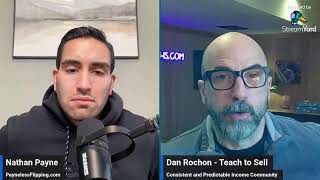
Dan Rochon, a real-estate broker and investor, says the number one sales mistake is feeling not good enough. He maps how circumstance shapes thought, feeling, action, and result, and outlines a four-pillar framework: belief, lead generation, organization, and leadership. His book Teach to Sell comes out June 2026.
Chapters
All right everybody, welcome to the Painless Flipping Podcast where we bring on experts in their fields in the real estate industry that tell us how to improve in our game so we can do more deals, close more deals. Right now today, got Dan Rochon with me. He's going to teach us how to sell. He's going to help us figure out how we can avoid the number one sales mistake that we deal with. And, uh, yeah, the goal is so we can learn more and crush it. That's what we want. We want more deals, Dan. So can you— you're gonna be able to help us with that?
Let's learn more and crush it, my man.
Let's go for it. So Dan, give me a short, like, 30-second to minute intro of who you are, and then we're— like I said, we're going to dive into, uh, what you got for us today.
Uh, sure. Yeah, my name is Dan Roshon, and I have been in the real estate space for about 25 years or so, and a majority of that was, um, started as a wholesaler long, long ago with the Bandit signs. Every once in a while, uh, it's probably been a few years since, but, but up until the last few years, every once in a while I'd find an old Bandit sign sticking on a telephone somewhere. Yeah, but that's how I got started. And then, uh, in 2007 I started selling real estate, and, um, um, you know, I had quite an experience there. Um, you know, first 6 months of sales had zero. Um, and then April 2008 had my first closing. April 2009 bought the brokerage I worked for and owned that for 10 years. I was a Keller Williams Realty franchise. I was the operating partner. Sold that 2018. And, uh, so So today I'm still in the real estate space, still an investor, still a broker, and, um, uh, still investing, you know, um, you know, myself. And I'm also coaching and helping people to be able to get a consistent, predictable income.
Man, I love that. So let me ask you this. So you've been in the game for like 25— you said 25 years?
Yeah, thereabouts.
So through— I know I've talked to quite a few people on the podcast I've had on, and they've Everybody has like their different niches that they go for. Have you been kind of pulled towards like getting into multifamily, getting into like industrial, getting into like different avenues of real estate, or have you always just stayed with being, you know, wholesaling and being the broker and agent?
Yeah, it's mostly— sorry, I'm giving myself insulin here. Sorry. So it's mostly, I would say, it's 65%, 70% of my business today is brokering. Around 30% or so would be investing or wholesaling or doing something like that. I have throughout the years, I've experimented in different pillars, different streams of things. And what I recognize is that once I really recognized my true talents, then I tend to stay in those two towns. I used to flip 3 to 4 homes a year. I don't even really so much do that anymore myself. To me, I can have a greater profit or almost as great of a profit by maybe bringing in an investor to purchase a property, getting the commission on, 1 or 2 commissions on the front side of it, representing them on the back end of it, getting another commission there. And then, you know, it ends up that I would get, you know, call it 80% of, of the revenue with, uh, if I was to flip it myself with, you know, 0% risk. Yeah. And so once I've sort of figured out my lane, I've tried almost everything, um, but today I, I, I know what my superpowers are. I know what the opportunities that I can really thrive in, and that, you know, I stay focused in those lanes.
I love that. Yeah, because I know when I talk to a lot of different people, a lot of different ways to go, a lot of different pillars like you said. But, um, I think wholesaling is a great way. It's less risk. And so being a real estate agent, like you said, is a, you know, broker. You don't take down the asset. Um, I like that.
I will too. Like last year I took 3 or 4, you know, there was one I made a couple hundred thousand dollars on, on a like one deal where it was like I could not buy it, you know, like could not not buy it.
Yeah, yeah, yeah.
I mean, if something like that comes along, I will do it in a heartbeat, right? But it just— it has to make sense.
Of course. Of course. You look at all the deals. So let's see. I'm curious. So did you always want to get into real estate or what brought you into it 25 years ago?
I was waiting tables, so I got in real estate more investing around 25 years ago. And then in 2007, I got in real estate, you know, as an agent. Um, and so in between there, I was a waiter at a high-end steakhouse in, in Washington, DC. And one day, my buddy Bill Cribbin was scooping butters with me, you know, into the ramekins, getting ready for the shift. And I was miserable, right? Like, I hated, you know, like, being in this box 14 hours a day. That's why I used to call it. And I wanted to be able to create and design my life. I wanted to be able to help people achieve their pro— their, their goals, solve their problems. I wanted to be an entrepreneur. I just didn't know how. Right? And so I wouldn't necessarily say I always wanted to be in real estate, but what I always wanted to do is I wanted to be an entrepreneur. And coming up, I didn't have the mentorship, the guidance, or whatever. And so, uh, you know, it wasn't until really my, my late 20s, early 30s before I really, um, you know, implemented this as a business strategy. And so, um, and then through the time, I recognized that, you know, if you want to really develop wealth, it's, you know, property ownership is, you know, particularly today With AI technology, big data that's changing the world, is already changing the world about, you know, will real estate agents be needed 5 years from now? I don't know. But guess what I know will be needed 5 years from now? Real estate.
Yeah.
And so, you know, so buying and holding is really the pathway to wealth. And that's going to be resilient through the changes of our society.
Yeah, that's actually a question I wanted to ask you about since you've been in the game for so long, for 25 years, is What do you think's going to happen with being real estate agents, with wholesaling? But you said it, you're like, who knows, man, it will change.
That— here's what I can tell you with certainty, it will change, but so will the world, right? I mean, even when you look at it, there's not— it's almost not an industry. I mean, maybe some service-based plumbers, that type of stuff, but even, even at that, with mechanical type, type things, you know, some of that will be challenged. But even you look at like the movies, like they can make a first-class movie today Yeah, the technology that they have today, that would be a box. It would just break the charts and the records, you know, with, with AI. Yeah, they could do that right now. So imagine 5 years from now where we're going to be. It's going to be crazy.
No, it's— you're exactly right. I've thought about real estate agents because I do help. I do quite a few novations and it's pretty— the process is not too difficult now like you and Yeah, so it's definitely going to get disrupted. I don't know how, but—
Yeah, I will say this though. I will say this about it. It's the same way as like an attorney. You know, I do look at it like I do believe that the human aspect of it will always be necessary for many, many people, right? Like I would not ever be in a situation where I would hire myself as my, you know, I'm not an attorney, but I would represent myself if I went to court. I wouldn't use AI to sit there and defend my freedom. I'll never be in that situation, but to say I was, like, there is, like, I just would not trust it. I would want the human element. And, and so there's people in, in real estate transactions that would feel the same, where they're looking for somebody like me with the experience of many, many years, many, many transactions. AI doesn't have that. I mean, you know, they can replicate some things, but there's a nuance of, of just seeing things that, you know, is more experiential than anything.
Yeah, we're in agreement with that. So I love that. Thanks for answering that. So let's get right into the— what we want to talk about today is how to avoid the number one sales mistake. I know you're— you teach to sell, you talk about sales. So let's, uh, let's break— let's dive that in. Let's dive into it.
Yeah. All right. So the number one sales mistake, I, you know, been toying around with this for many, many years. And over the last couple of years, I wrote my second book called Teach to Sell: Why Top Salespeople Never Sell and What They Do Instead, which is going to be published by Simon Schuster. In, uh, in 2026. And so, um, and we can talk later about how people can, you know, get a, you know, uh, you know, pre-order that book and get some really, really cool gifts with that. But in that book, as I was, as I was going through that, I recognized that there was a recurring theme, you know, as, as me, you know, I've, you know, from owning a brokerage to my own personal sales to, you know, I had 150 agents that worked with me when I owned the brokerage, and then coaching thousands of agents through my career and business owners and investors and What I realized is the biggest obstacle that we come across time and time again is that pervasive feeling of not good enough.
Hmm.
Okay? Is my process good enough? Am I good enough to go make a cold call? Am I good enough to be able to convert an investor or an investment opportunity to be able to convert it to an opportunity? Am I good enough? Am I worthy? Right? And so when you look at that, it's really self-doubt, it's an unclear sales process, it's multitasking, it's negative assumptions, all-or-nothing thinking, procrastination, lack of guidance, limited support network, giving up too easily. These are some of the things that manifest as that number 1 sales mistake of not good enough. So there's just different versions of it, and that's really the starting point. Whether if you're, you know, like I was 20-some years ago, you know, dipping butters into a ramekin, you know, at some point I had to believe that I can go from being a waiter to being an entrepreneur. Like, I had to believe in it. I had to believe I was good enough, and then I had to believe the, you know, the things that I put together were good enough. And that is the number one sales mistake of what gets in the way of Teach to Sell and what gets in the way of of, of entrepreneurs to achieve their success.
So to me, that sounds like it's self-development, like that you got to believe in yourself. Is that correct? Am I assuming correctly?
Yes. Um, but that's like a little bit whimsical, right? Like, you have to believe in yourself. Okay, great. Now what do I do with that? You know what I'm saying? Right, right. That's why I wrote the book, because I wanted to give people the actual steps of here's what you do with that, right? I'm going to give you a scientific Here's what you do with it. I'll give you one right now, for example. Okay, so let's say that it is like I'm looking for a greater belief in myself and I'm hitting roadblocks. Like, say I have a ceiling. Imagine that, you know, like you're like a flea jumping up to a ceiling and there's a ceiling of achievement and you're not able to break through that ceiling of achievement, right? Okay. So how— and you get the same results over and over again, time and time again. So how can you break through that ceiling of achievement? There's a thing that psychologists— and again, I outlined this in the book— that psychologists say about, uh, about being able to, to, to get through that cycle. It's called the self-coaching model. Okay. And if you could imagine if you had like a white piece of paper— uh, well, any color paper, it doesn't matter— but you had a piece of paper and you, and you took it and you just— a blank piece of paper— and at the top of it you start drawing a clock. And at the top of it you wrote down the word circumstance. All right, so now imagine we have a circumstance in the world that we observe through our 5 senses. When we observe it through the 5 senses, we assign that circumstance meaning. We also filter it based off of our experience, our culture, our upbringings, etc. Okay, and so there's a circumstance, something happens, we observe it. So now we wrote down the word circumstance at the top of the paper. So now imagine the 2 o'clock position on the paper, on the paper, write down the word thought. So you circumstance at the noon o'clock position, the word thought at the 2 o'clock position. The circumstance leads to the thought. Something happens, I observe it through my senses, I assign it meaning through my filters, my culture, etc. And then I have a thought about it. Right now, let's fast forward down to the 5 o'clock position. So the circumstance, thought, and now it's going to be feeling. Now I have a feeling about that thought. Now let's go over to the other side of the clock, over around the 7 o'clock position. And now I'm going to have an action. So I go circumstance at the noon o'clock, thought at the 2 o'clock, uh, feeling at the 5 o'clock, action at the 7 o'clock, and then finally at the 10 o'clock would be result. So now what we're going to do is, because we just wrote this like in a clockwise position, we're going to put an arrow in between each one of these. And that's where you get that closed cycle. Okay, that's why you keep hitting that ceiling of achievement is because that's a closed loop. Something happens, you observe it through your feelings, senses, etc. And that, that's the circumstance. And then that leads to a thought. Now you have a thought about it. Now based off that thought, you're going to have a feeling about it. Now based off that feeling, you're going to take some sort of action. Now based off that action, you're gonna get some sort of result. And then based off that result, that's going to feed back into the circumstance and complete and continue to roll through. How do you break through that? You break through that by sort of stepping sideways and understanding that we are subconscious beings, not conscious beings necessarily. What I mean by that is we spend the majority of our lifetimes in our subconscious state. There's opportunities to feed that subconscious state, and those opportunities to be able to break this pattern would be, uh, things that I go through in the book such as meditation, affirmations, reading, exercise, prayer, relationships, uh, spiritual connection, etc., right? And so it's sitting there saying, I'm going to take an intentional, uh, I'm going to be intentional about changing my programming so that I can have different thoughts. Yeah, right, because that's where it starts, right? It's the thought, right? And once you have that thought, that leads to feelings, etc., etc., etc. Now when I can have better thoughts, I can end up having better results, right? And so, and that's a way I just gave you like a very, very simplistic explanation of that, which I hope that your viewers—
No, no, I love that. I'm all about this stuff. Like thought is the seed of action. I like, I've studied a lot about this stuff myself. It is the way to level up. It's like leadership, right? Like you're not going to be able to lead anybody if you're not at that level. So you're getting—
Last thing about that though is that you can control your second thought. You could program your first thought. And what I mean by that is through doing daily activities of, you know, the, the things that I mentioned— meditation, affirmations, visualizations, you know, etc.— that you can change your first thought through time. But everybody has the, has the opportunity for to, to control their second thought. So something happens, if you have a crappy first thought, no sweat, just change it.
Yeah, yeah, no, I like that. I read a book by— I'm sure you know about 7 Habits of Highly Effective People, the Franklin Covey guys. They talk a lot about like—
yeah, I got that book sitting on my desk somewhere here.
Yeah, no, I love that. Like, they talk about there's like, there's stimulus and there's a response, and between stimulus and response there's a space of time. And that's basically you being able to act accordingly is going to impact the, the response, right, to the stimulus. So I love that because it's like, you know, you usually without diving in and reflecting and being self-aware, you just take action and you just live life and you just go through life without kind of being aware that you can change your thoughts.
So now if you're, if you're an investor and you're, and you're, and you're not, you're having the results that you want, great. But if you're an investor and you're falling short of the results that you want, it really starts with who are you going to choose to be? Right? And that's why this is so vital, because once you're able to change yourself, now you're able to be able to achieve your goals. We're all capable. We are all capable. Whoever's listening to my voice right now, you are freaking capable.
Yeah.
All right, now let's put that aside. Now, if you have a— oh yeah, but— and all these reasons, right? The self-doubt, the unclear clarity, etc. That goes back to if you're having some negative chatter in your house, in your mind right now, when I say you're capable Guess what? You're experiencing the number one sales mistake, and I already gave you a way to be able to get through that.
I love that. So is this a daily— in your book, is it like daily things that you can apply, like the applications to, uh, get your mind right? Is that, is that kind of like what the book is, is showing you tactics and things to do?
Uh, well, in the book, there's the, the demon in the book is, is, is not worthy. The, the, the hero of the book is the reader, and the guide of the book is Teach to Sell, right? So That's only one small section of the book, right? And, and so, you know, when you're looking at a business, developing a business, if you can imagine— I'll give that, that, that new— let's get a new piece of paper, right? So a new piece of paper. Now we're going to draw on a new piece of paper, we're going to draw a building, okay? And I'm going to give you like, here's the 4 pillars of building a building, right? So it's going to be— so, so if you draw like a line all the way across the, the, the page, and then below that line you're gonna, you're gonna put the word belief. Okay, so if you can imagine belief is the foundation, okay, and then you can put to the left and the right, you can put a little box around the word belief that's below the ground. So then on the first level of the ground, so this is we're building that building, would be lead generation. All right, and so then above the lead generation would be organization building, and then above the organization building would be leadership. And so we just drew like a building there, right? The foundation being belief, and then on top of that is lead generation, And then on top of that, second level, organization building, and then leadership. And the definition of leadership, by the way, is to teach somebody else how to think so that they can get what they want. All right, so now we just built that building. So, there's 4 pillars there. So, what the book does is it goes through each one of those 4 pillars, giving you actionable advice, actionable, like here's what to do. And I just gave you one of the actionable advice in the belief section, right? Because that's the foundation, right? But now, once you believe in yourself, now how do I find business? Right? And then I go through and I outline every single different way that you could find business, and I give you coaching in the book to sit there and say, listen, don't do all these ways. What do you do before? Like, it's a blueprint to making a million bucks is what it is, right? Like, and actually multiple millions if that's what you want, right? And it's just, you know, what do you want, right? And so, so how do— like, if Dan's going to give me and teach this, so if he's going to give me, call it, 35, 55 ways I could find business Well, goodness, I don't want to do 50 of those ways. Then what's my advice to you?
Don't.
Yeah, but because before I give you the different ways to get business, I go through and I walk you through exercises about who are you being. Yeah, right, like, like, what are your superpowers? Now let's figure out your superpowers. Now let's look at these 50-some ways to be able to find business. Now let's, let's relate my superpowers with the different ways to do business. Now let's do that 5 days a week. As a real estate agent, I've had no-broke months since 2008 as an agent, right? Of all the things that I've done— I've owned joint ventures and I've done investments and, and brokerages and I've owned many different companies— the thing that I'm most proud of is the fact that for all, you know, many, many years of no-broke months. And that's what the book describes to you, right? And so, uh, so that not worthy, that number one sales mistake is a recurring theme throughout the book. Okay, of the antagonist, and then the book shows you how to be able to overcome and defeat that demon.
Man, I love it. Sounds like a good book.
Thank you.
Yeah. How long did it take you to— obviously this is just a lot of things that you've learned over time, but, um, how long did it take you to write the book?
Uh, yeah, it's a hard question because it really, uh, my first book called Real Estate Evolution, which I self-published, took me 13 months to write. And I wrote that in 2018, and I took about 1 to 3 hours a day, uh, from like 4 AM to 7 AM-ish in that time period. I did not take a day off, and it took me 13 months to write my first book. My second book, I probably toyed around with it for around 3 years, but it wasn't a consistent effort like my first book was. And so then it took me around 3 years or so to write, and then after I wrote it, it took me around 18 months to get a, uh, you know, one of the top 5 publishers in the world to be able to say yes. So that in and of itself was a few, you know, like, I can't tell you how many nos I got, right? And then, uh, and then it's been ready for— it's been ready for the, uh, you know, for launch for a few months. Um, and, uh, the publisher, you know, selected a date in June of 2026 to launch it. And so that's where we are today, is, is, is it's ready to rock and roll. Um, a lot of people get it in the pre-sale, which they get, um You know, if somebody went into teachtosellbook.com, www.teachtosellbook.com, right, they would get $10,000 of digital training. And then they'd also see an opportunity to get 5 weeks of, of me walking— of the author walking them through the how to implement the book. They'd get a PDF of it now, and then they'd, you know, you know, get the book when it, when it comes out in June, if it hasn't already come out, depending on when you're watching this, right? But right, you know, people are interested in getting a step-by-step guidance through it and access to $10,000 $100 of digital training, go to teachtosellbook.com and they can, they can hook themselves up, man.
I love it. You've given, provided a ton of value already. I'm sure your book is, uh, is amazing.
So by the way, real quick, before you ask that question, the goal of the book and the goal of my mission, my mission professionally is to help 1 million salespeople to understand how to have consistent predictable income right now. That's from years and years of me studying, implementing, leading, studying others, right? To give you, here's a foolproof plan that you can have consistent, predictable income that's been developed, you know, over really since I've been 12 years old, right? Like a long period of time and shared in a way that's simple. Sorry to overtalk you there, Nathan.
No, no, that's good. No, I love it. Yeah, you're getting— yeah, that's what it's all about. Getting pumped about what you do that I see your passion. So let me ask you this. I did hear you saying you wake up, you were waking up at 4 to 7. To write this book. Do you wake up at 4 o'clock every day?
No, but I did for years. What do you wake up? I wake up. Yeah, I don't, I don't, um, I don't set an alarm. I wake up when my body says wake up. My, my, um, my staff starts at 8 AM. My first meeting with them is at 9. Typically I'm up around 7. Um, now if I'm working on a project, then yeah, then my, my body may say, hey, you got to work, wake up early to work on this project because I'm very rigid in a way that I'm very committed to my discipline and my habits of the way that I work and I lead generate and I find business and people to be able to help. And so I don't want to get distracted from my day-to-day activity. So that's where I have to wake up early when I'm, when I'm working on a big project like that.
Yeah. And I love that you're saying you're very disciplined with your lead gen, right? Like that's, I think a lot of people that are brand new to this business underestimate how that's like the lifeblood of this business. Like you need to be generating leads, you need, whether whatever, however you do it, right? You said you have like 50 different ways that you explain it. How do you find business? Um, I'm assuming when you've coached or as you coach, you probably run into a lot of people like, hey, I'm not— this business isn't working.
Is it?
It's probably lead gen is probably one of the biggest issues, right? Along with—
it's probably, it's probably belief.
Belief that they're— yeah, okay. That's—
I was talking to a guy earlier today, right? And I'm like, all right, what do you want? He tells me what he wants. I say, what's getting in your way? Here's what's getting in my way. What do you need to do that? I need to make the call. Well, tell me about the calls you made. I haven't made any. It's not— he's not making those calls because he's— that's an outcome of him not believing in himself. That's an outcome of him not having faith in himself. So yeah, you're right, it is the lead generation, but it's deeper. The root cause to that not getting on the phone is I don't believe I'm, I'm good enough, right? And that goes back to the number one sales mistake.
Yeah, good enough, or that it won't work because I'm not good enough.
I had another guy I was talking to earlier today. He's like— and he was saying, he's saying, yeah, Dan, I, I, I haven't been doing my lead generation as much as possible. So tell me more about that. He says, well, I, um, I start and I don't get the results, and then I stop because the results are frustrating. Guess what? It took me 18 months to get Simon Schuster to say yes to me. That's only one activity, right? I did a TEDx talk in Italy about 5 days ago, right? I just got back. I'm back to work today. And it took me many, many months to be able to get somebody to, you know, the right venue for me to present the— and that's on the Influence Gap, right? It took me, you know, to be able to figure that out, right? When you look at successful people, the greatest successes in this world are the greatest failures. And what I mean by that is the ones that you perceive as success They have freaking struck out more than you can ever imagine. That's why they have that perceived success. Nice. Right. And so it goes back into that lead generation when you get kicked in the teeth and most people cry, right? Well, that's an option. Or you could just understand you're going to get kicked in the teeth even if you've been doing this like myself for freaking, I don't know how many decades, right? Right. You're still— I still get kicked in the teeth daily. Yeah. When we started this call, I was on a sales call. When we started this call, I was overlapping, right? Yeah, I didn't convert that, right? And what did I do? I said, all right, hung up the phone, sent my staff a message, and then said, hey Nathan, how you doing? And I poured into this conversation. I literally got rejected while we were— while I was on the phone, I got— I was getting rejected, what, 20 minutes ago.
And I love, I love the honesty, and I love that because, uh, a lot of people, they see the success, especially with social media these days. It's really easy to compare and see the results, right, the successes. And everyone thinks that these people they're just always successful. But no, you strike out. It reminds me of Abraham Lincoln. He, I think he struck out like, like 4, 6, 5 times, like trying to be the president. More than that. I mean, he was striking out his whole life until he became president.
So yeah, until he wasn't. Until he changed the world.
I know, it's amazing. It's amazing. And people just see the highlight reels of social media, but they don't see what it took to get there. So I think, uh, I love your message, and I think it's so true. I, I resonate with it because I'm I'm the same. I feel like you got to become— you got to become the person in order to get the results you want. You don't just get to get the results, you have to become them.
Yeah. And I have a recommendation on that as well, Nathan. I align with you completely. And my recommendation is when we focus on more about who we're being in the world and less on the results, we can have a more fulfilling life. And so— and what— and then to be able to make that happen, you have to remove ego. Right? And so when you— and, and you and I, look, you're probably a few years younger than me, right? And so, well, probably when I was your age, I was probably being run by ego. Today, you know, my ego's still there. I'm not gonna be— you know, I'm gonna lie to you, but, but I, I'm more grounded, right? I'm more like, okay, um, I don't need to be number one. I need to be able to put everything into this life that I can possibly put into it for me to enjoy the journey. Now when I'm enjoying the journey, what I'm finding is that the outcomes are becoming greater and greater when I'm not necessarily focused on the outcomes. I know the direction I'm heading to, and I have the vision of where I'm going, of how I'm going to help people, of how I'm going to impact the world in a positive way, impacts the sales community in a positive way. Like, I know that I'm going to help a million people to understand how to have consistent, predictable income. But that being said, it's not about the number. It's about who do I choose to be. And when I choose to be that person, my mission, it automatically freaking just takes a life of its own.
I love that. And I agree 100%. Well, hey, I appreciate you being on here. We're going to put this out here. Maybe we can get you back on right before your book launches. But it's been a pleasure. And you have anything else you want to say before we wrap up?
Yeah, I want to say to your audience, because we talked about the number one sales mistake, right? And I gave you a framework, the self-coaching model, to be able to do that. I gave you a resource, you know, Teach Yourself book.com to be able to get, you know, a blueprint of how to be able to walk in that. But I want to leave with you, uh, the thought to understand that you have the right— whoever's listening to this— you have the right to be able to design your life. You have the right to be able to achieve your success. You have the right to be able to achieve your destiny. And I want you to understand that Now, once you understand that, because I think almost everybody listening to my voice right now can understand that that's a real thing. Now guess what? Now you get to choose. What are you going to do about it? My encouragement is that you choose whatever you can be passionate about, whatever you can have joyfulness with, whatever you can be able to have fun with, and whatever brings you positive blessings. And then freaking do that like your life depends on it, because guess what?
It may. Yeah, I love that. Well, hey, Dan, excellent conversation. And, uh, everybody reach out to him. The website again is teachtosellbook.com.
Is that right?
www.teachtosellbook.com. Nailed it. All right, we'll see you next time. All right, everybody, we'll see on the next one.
Later.
More from Nathan





Why Traditional Wholesaling Keeps Failing You (Use This Pre-Flip Method Instead)





