Invest with your heart and not just your wallet- Multifamily Syndication
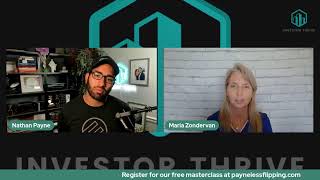
In this episode of the Painless Flipping Podcast, host Nathan Payne interviews Maria Zondervan, a wildlife biologist turned real‑estate investor and founder of Blue Vikings Capital. Maria recounts how she entered real estate by buying a college‑night infomercial course, quickly house‑hacked a four‑bedroom home, and continued to acquire properties while working as a wildlife biologist. After earning degrees in environmental policy and business, she shifted full‑time to multifamily syndication in 2019, driven by a personal mission to secure long‑term, independent housing for her autistic son and other special‑needs families. Maria explains her market‑selection framework—targeting growing metros, using simple population‑growth data, and diversifying beyond Florida to the Carolinas, Ohio, and even Rapid City, South Dakota. She describes her partnership‑centric syndication model, emphasizing networking, local boots‑on‑the‑ground partners, and investor relations. Her social‑impact venture, Valhalla Villas, is a nonprofit under Blue Vikings Capital that acquires multifamily assets to provide affordable, supported housing for autistic adults, linking residents with nearby university programs for skill‑building. Maria also shares community‑building efforts: a free step‑by‑step investment guide, a forthcoming book, webinars, and a Facebook group (Bright Futures) focused on special‑needs planning. The conversation closes with her mantra—follow your heart and passion, and the rest will fall into place.
Chapters
What is going on, Investor Thrive Nation? This is Nathan Payne on the Painless Flipping Podcast, where I bring you experts that help you learn how to get into real estate, not so you don't have to make all the mistakes yourself. So I brought on Maria Zondervan to tell us a little bit about how she is investing with her heart and also, you know, with her wallet, but, you know, doing the same thing. And that's, that's what it's all about. You want to feel good about what you do. So Maria, thanks for coming on here. And the goal of the whole podcast is so it's not painful for people to get into real estate, so they can learn from our experiences, from your experience, so they don't have to make all those mistakes that, you know, we made in the beginning. So how you doing, Maria?
I'm doing great. Thanks so much for having me.
Oh, a pleasure. Pleasure. So, Maria, you know, this is the first time we've met, and I love meeting new people. But, you know, for people that don't know who you are that are going to watch this and listen to this or watching this live, Uh, tell us who you are and how you got into real estate.
Yeah, you know, it was one of those accidental things. So, um, I actually got into real estate when I was in college. One of those dang infomercials that I had, um, saw while I was up late night studying, and I ended up buying that. I was like, you can't buy real estate with no money, this is a joke, kid, I'm gonna spend my money on this course. Yeah, that's money I ever spent. Didn't have money for textbooks after that, but that's all right.
Wow. You just went for it. Wow.
Why not? You know, when you're a college student, what do you got to lose? I didn't have a penny to my name, so why not?
Wow. That's amazing. Okay, so you bought the course. Did you, did you immediately take action on the course or did you just like, look, look at the information and learn?
No, I absorbed it. I mean, I like really, really absorbed it. I took it like it was a college course, you know, like there's going to be a test. Well, the test was going out there and knocking on doors, and I actually ended up buying my first place, got in on a lease option, which is probably something that people are familiar with now, but it was rather unheard of back then. But did that before I even graduated college. So I had my first place before I graduated, before I had my job, before I got married, any of that good stuff.
Wow. Did you move into this yourself or did you do it the lease option where you like gave it to someone else and you No, no, we—
I moved in myself but did house hack because I couldn't afford this place. It was a huge 4-bedroom house on acre lot with a pool. I mean, I had all that. And again, I was a broke college student, so could not afford that. So kind of house hacked, which was not a term that people had heard of back then, but I basically rented out about half the property, kind of split in half, and, and that helped pay, pay for it. Yeah.
Wow. That's That must have been the party house, huh?
Well, there was some jumping off the roof and into the pool, but, you know, it's—
Wow, that's amazing. Okay, so what happened after that? Like, did you say— did you, did you graduate with a degree and pursue that, or did you just like, hey, I like this real estate thing?
I like the real estate thing, but it was never my passion, and I've always been one that followed passion. I just wanted to make sure there was a backup plan and that I was building something for the future. It wasn't really about money now. So I actually went into wildlife biology. So I became a wildlife biologist, ended up working with endangered species here in Florida where we got some crazy critters. So worked with some crazy critters for years and years, loved that, but continued to buy real estate along the way the whole time. The nice thing about real estate is if you set it up correctly, it can kind of run in the background. You know, the acquisition part can be painful. Sometimes tenants can be painful, but it's not an day-to-day job, as you know. So I just kind of kept accumulating it. Anytime I moved, uh, whatever house I was living in, I'd keep it, rent it out, move to the next one. And, um, yeah, just kind of did that.
Wow. I want to know about these critters though. What kind— you said these were some wild critters. Like, what was some— what are some that pop up in your head that you remember that you were—
well, I mean, it's, it's Florida, so of course we got alligators and snakes all over the place. That's pretty common. Yeah, but I also worked with the far more mundane creatures, you know, uh, eagles, woodpeckers, scrub jays, lots of different birds and tortoises. And, you know, if it flies, slithers, or crawls, or even swims in Florida, I've probably worked with at some point.
My goodness. Yeah, I went to Florida with my wife to the Keys, and we saw a manatee. We were swimming. That thing was big. Yeah, we're big bird watchers as well. I don't know if you're a bird watcher.
Oh, absolutely.
Yeah, yeah, we go out there. We have a, like, an eBird. We have all these birds We have these apps and Merlin and we listen to birds and that's what, you know, we were looking for some cool birds in Florida. We saw some good stuff.
So I actually got to manage the biggest hotspot in Florida now, which is the Lake Apopka Wildlife Drive. I think we recorded over 365 species of birds out there.
So are you kidding me? Wow.
So I mean, guys, come down, check it out.
I definitely do. Yeah, we're, we're, my wife is really big into that. She's from, uh, Toronto, uh, Canada and well up in that area. So they all love the bird stuff. So that's how I— she got me into it, and I'm like, let's go walk in the woods and look for birds. So that's cool. That's cool that you do that as well.
Super popular. Super popular. Yeah. So yeah, so it was not your traditional real estate trajectory, but I've always been one to keep your options open. So even though I got a wildlife degree, I actually ended up getting a master's degree in environmental policy. I also got an associate's degree in business because I was like, business, you need that for everything, right? So yeah, while I was getting education, let's get something I can put into other things. And that's come into play now later as I have switched, right?
Wow. Okay. That's amazing. So you've been acquiring assets along the way and now would you say full-time it's multifamily? Is that what you're going after?
Yeah. Yeah. That's, that's all I'm doing now. Made that switch in 2019. You know, we all talk about our big whys and I had a pretty big why. My, my oldest son has autism. And as he was maturing into adulthood, school was coming to an end. You start asking, like, what's next? Will he ever be able to be completely self-sufficient? Do I need to support him for his whole life? What happens when I'm not here anymore? Where will he live? How will he support himself? I need to plan for that. And planning for that meant scaling faster than I had been doing. In, uh, in real estate. And, uh, so I said, time to go full-time into this. Um, wildlife biology was awesome, still love it, still go out in the woods and play. Um, paid for it now, volunteer and do it. But, um, but it was time to do that and scale faster. You got to go into multifamily. I mean, that is the way to scale fast.
I love it. Okay, so are you specifically looking for, uh, multifamily in specific markets? Or is it anywhere you can find them? How's that work?
Growing markets. I stick to the growing markets. I know you can make money in stable markets. You definitely don't want to be in the ones that are dropping where people are moving away from. But I prefer to be in the growing markets. It's just a safer place to be. Florida, of course, has huge growing market, but it's also super overpriced at the moment. So got properties in the Carolinas, Ohio, got South Dakota deal right now. So you never know where you're going to find them. My, you know, always willing to look anywhere as long as it makes sense.
How can you tell if it's growing? Is there like a website that just tells you if it's a growing market?
Yeah, I mean, it's as simple, simple as Googling, you know, is such and such city growing or what is the population growth rate of— got all those statistics will pop out for you. And sometimes that growth rate will be negative. It's like, okay, no, don't want to go there. Hmm.
Okay. I would just assume that any major metro in the United States is growing. Is that not true?
Not true. I mean, we see people exiting out of parts of California and New York, and there are other sectors where people said, hey, we can work remotely now, so we can live anywhere. We're going to go where the sun's shining and we don't have to shovel snow and where it's not quite as expensive to live. So I've seen a lot of people migrating to different parts of the country.
Interesting. Any, any place that you're like a little shocked by? I mean, you said South Dakota. I'm a little shocked, but by that.
Yeah. So that was actually a surprise. Somebody, you know, approached me about this particular property and I was like, well, I don't know anything about South Dakota, first of all. So I'm going to have to do a whole lot of research. But this was Rapid City, South Dakota, which is the second largest city there. It was a 268-unit property, beautiful on 29 rolling acres. I'm like, this is gorgeous, but what brings people here? And then the more I dug into, I'm like, wow, this place is growing faster than the national average, like 7 times faster than the national average. This is awesome. And most people didn't know about this little market, right? It was kind of hidden. So still able to get it at a killer price off market, you know, things that would be impossible for me to get here in Florida. So going to bring our investors some really big, big money on that one. So looking forward to that. We'll be closing that September. Yeah.
So tell me about the acquisition part. You obviously you're getting, you're getting investors in doing the syndication and raising money, but like, how are you acquiring these properties?
It's through partnerships. A lot of them are not deals that I have sourced. The South Dakota one, for example, that was another team, lead sponsors, where they brought me in after the fact, which is really nice that they had that kind of trust in me. So that happens a lot. You know, it's all about networking, who you know. They always say your network Was it your net worth is equal to your network or the other way around?
I always get them mixed up. I think, I think they both work both ways.
Yeah. But I think the point is get in the right rooms with the people, get to know the big players out there and team up with them because you always want boots on the ground in any place that you buy. So if I find a good deal in Tennessee, I'm not going to try to take that down myself. I'm going to find someone in Tennessee to partner with. And, you know, but I'll help them. I'll do whatever I can for it. And vice versa, people reach out to me when they need help because they're overwhelmed, they're busy running their property. So maybe they need somebody to handle investor relations or bring in those investors or whatever it takes. So it's a team sport, which is another reason I love multifamily, because you don't have to do all the things. You don't have to be the person that finds the deal or finds the investors or runs the property or handles all the, the day-to-day minutiae or deals with the property manager. You just have to be good at one of those things. And then find people to do the other things, right?
I like that too. Focus, right?
You got to do it all.
Yeah. Yeah, it's very true. So what part of Florida do you live in?
And by the way, I'm in Orlando. Yeah, we're, we're getting those hurricane bands coming by now, but yes, but we're safe and the power's on.
Okay.
The Big Bend got the worst of it. But yeah, it's hurricane day here today.
Wow. Well, do you, do you happen as you're in your network and like doing real estate deals, do you happen to come across a lot of single family? Opportunities or not? Not really.
Um, you know, somehow I'm on all the wholesalers' lists, so I get a lot of those. And of course I go to all the local meetups and there's lots of things coming through there. So yeah, I still see those, sometimes get tempted by those. I have to keep telling myself, you know, that's not my world anymore.
You gotta stay focused, right?
It's a good deal, it's right around the corner. But, um, but I've got a kid, my youngest son Alex is now getting into it And so now I kind of start feeding those to him. So he's had a couple of properties under contract. Unfortunately, they fell through. So he was getting a little discouraged. I'm like, you can't give up in this game. You know, it only takes one to really hit to do really well here.
So, of course.
Yeah.
Yes. The reason I asked you is because I actually do deals like my markets. I focus on single family or Atlanta, Dallas, Tampa, Orlando area and Salt Lake City, Utah. So For example, if your son needs any help, I have amazing buyers out there that, you know, if he's like, hey, I can't move a deal, or even if he needs help, you know, we can help out with that.
Appreciate that. Wonderful. Thank you.
Yeah, of course. So tell me about this autistic— this, this— I'm not sure how that ties into the multifamily. Tell me about that.
Yeah. Yeah. So I started a nonprofit called Valhalla Villas. So Valhalla, that's, you know, the Viking equivalent of heaven, I guess. And my main company is Blue Vikings Capital. So it's got this Viking theme going because I'm originally from Sweden, so land of the Vikings. And, um, so Valhalla Villas is a nonprofit and it's got the mission of providing affordable housing to autistic adults and the services they need to live independently. So that's, uh, take some of that burden off the parents who are wondering, you know, where's this child going to live, are they going to be able to be independent, who's going to look after them, especially if something happens to me. So Yeah, so that's, that's the mission there. We are hunting for a cool complex near the University of Central Florida now. So if anybody out there is listening and they know of a willing seller for 50 to 100 units around the University of Central Florida, that is where we are hunting right now because they have a really cool program where the students can— some students are specializing in special needs education and such— can live with autistic adults and teach them the ropes of independent living before they're fully on their own. It's a really cool program. We just need to find the right place for that to launch.
Okay.
But yeah, we buy these places just like any other syndication. We bring investors in. Sometimes that's even parents of other special needs, you know, either the people who might end up living there or other people are special needs parents who want to set something up in like a forever hold that they can put in a trust for their special needs kids. So it's just a great investment opportunity that they don't have to worry that their child might inherit it and not know how to reinvest it once that property sells. Right. Because we're not going to sell these properties.
Oh, okay. Yeah, that's interesting. So, so as people invest in this nonprofit, you're going to use that money to find a property, you're saying, in Central— where did you say? Central Florida. Okay. And then there's the school there has people that can help, you know, the people with autism or special needs. Improve their skill set so eventually they can move out on their own. Is that how it works?
Yeah, so they would be moving out of their parents' home but with some assistance from the nonprofit. So there's a support system in place that helps get them to their jobs or helps them with their social skills, help them with all those independent living skills like just keeping your place clean, handling your finances, all those kinds of things. And then there's somebody living kind of with them in their own own room separate that can kind of keep an eye on things until they're completely able to live on their own, and then it'll be their apartment basically.
Wow. You know, I don't know if you've seen the show, I think it's Love on the Spectrum.
Have you seen that?
Yeah, that's amazing. I love that show. So is it true that there's just like a big spectrum of like someone that's like you barely can tell and then it's very difficult for them to live? Is that— is that you probably have to deal with a lot of that as well, like people that don't need probably as much as others.
Is that right? Right, absolutely, absolutely. And they're, like you said, there are people where the general public may not be able to tell unless they know them really well, of course, see those signs. And then there's those that really, really struggle. Some aren't even verbal, you know. It's, uh, there's a huge, huge spec— it is a spectrum. It's not a linear progression where you're, you know, great at all things or really bad at all things. It's, um, kind of pick and choose. But the one thing they kind of have in common is all of them have pretty poor social skills. They're going to make lots of social blunders. So that can be difficult when you're venturing out on your own.
You know, I find it endearing. I, I love it because they're just so— I feel like they're so honest, you know.
They're, they're—
well, right. I'm sure you have a lot of stories where it's like honesty is like Wow, yeah, I wish you didn't say that. But no, it's, it's, it's, it's like, I think life is a miracle. And just to see all the different, you know, personalities and things that are out there, it's, it's, uh, it's wild. Yeah. Um, but okay, so, so the goal here is, you know, as you grow, your, your why is to set your family up, uh, so if something happens to you, or, you know, later on, they're set up.
Is that correct? That is the goal. And then also the goal of helping other special needs families do the same for theirs. So writing a book about that now. I've got a new website that's going to be launching. I'm doing a lot of webinars through my Facebook group, which is, uh, oh my goodness, Bright Futures, a special needs community where there's a lot of webinars about, you know, how do you secure that future for your special needs child, um, you know, what kind of wills do you need to set up, guardianship, um, medical stuff. Housing is a big component of that. What government assistance is out there? How do you get Social Security? How do you set up special needs trust? All of that, we cover that. So, so the goal is not just to help my son, but to help so many other parents out there. We know a lot of them, a lot of good personal friends, right? Years of my son being in school with these individuals.
Yeah. Wow. It sounds like you're on a great mission. I'm sure there's a lot of support out there for you as you get your word out there and your message out there. I'm sure you felt that as you've been going out there and telling people, right, about your—
Absolutely. Yeah. Really feeling it. Really feeling it.
All right. Well, can you kind of let the, the audience know where they can find you if they want to reach out to you or learn more about how they can work with you?
Absolutely. Blue Vikings with an S capital dot com is the best way. So Blue Vikings capital dot com. On there you can find all my social media links if you want to follow me there. I spent nearly a year writing a book all about the step-by-step guide, basically, on how to choose your first passive investment. And then I decided instead of selling that book to just give it away for free. So you can pick that up on the website.
And for you.
Yeah, thank you. Thank you. And then there's the link to the nonprofits is all also on there. So yeah, lots, lots of ways, but it all starts at bluevikingscapital.com.
I love it. Send them one place, right? And then they can figure out where they want to go. Um, do you have any suggestions or any golden nuggets, anything you want to leave with the audience with before we, we wrap up?
Uh, just if you're following your heart, um, everything else will fall into place. Find your passion and go that route.
Wow. Follow your heart, follow your passion. I love it. Well, thank you, Maria. It's been a pleasure, and we will, uh, you know, I love to see your journey as you go. I'd love to see how it goes.
Thank you, thank you so much for having me.
All right, thanks for coming.
More from Nathan





Why Traditional Wholesaling Keeps Failing You (Use This Pre-Flip Method Instead)





