Wholesaling vs Flipping: The BEST Strategy for Beginners (2026)
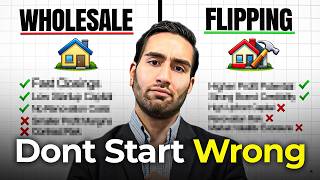
In this 2026 YouTube video, real‑estate investor Nathan Payne argues that beginners should begin with wholesaling before attempting fix‑and‑flip projects. He explains that the flashy "big check" mentality is misleading because it hides the true costs of both strategies. Payne defines "active profit" (the fee earned by finding and assigning a deal) versus "risky profit" (the net proceeds after buying, renovating, and reselling a property). He details the financing realities of flips—hard‑money loans, typical loan‑to‑value ratios, interest rates, points, and the need for repair budgets—showing how a single bad flip can wipe out a new investor. By contrast, wholesaling involves lower capital outlay and quicker payouts, though it still incurs marketing and overhead costs. Payne shares his own experience: hundreds of wholesale deals across the U.S., a $250k+ loss on flips during COVID, and the lesson that flipping too early can lead to financial ruin. He recommends a concrete sequence: complete 10‑20 successful wholesale deals, master deal analysis, build cash reserves, then transition to flipping. Throughout, he uses analogies (big‑check illusion, poker bluff, video‑game boss fights) to illustrate risk. The video ends with a call‑to‑action to schedule a wholesale coaching call and a teaser for his next video on scaling a wholesale business.
Chapters
There's hidden math in real estate that makes a $10,000 wholesale fee way more valuable to a beginner than if they were to have made $50,000 on their first fix and flip. And ignoring this one thing is actually what gets a lot of investors going broke. Now, in this video, I'm going to finally settle the debate between if you should start wholesaling first or if you should start fix and flipping first. You're also going to discover the difference between active profit and risky profit, and that chasing big checks can actually get you in big trouble, and the step-by-step process of how to take your wholesaling business to start fix fixing flipping properties at the right time, not a moment sooner, not a moment later, because I don't want you guys to get in trouble like I did fixing flipping too soon where you lose money. I'm going to be getting into that. I don't want you guys to lose money like I did. My name is Nathan Payne. I've wholesaled hundreds of deals across the United States. I've helped hundreds of other wholesalers grow and scale their businesses. I will let you guys know that although I started this video off saying I've lost money, I've made a lot, and I'm going to show you guys exactly how to avoid the mistakes I did. So without further ado, let's dive into why you should get into wholesaling why you should get into fix and flipping and which one's best. So let's talk about what we all see. When you go on Instagram, Facebook, any of these social media platforms, you see big checks. I don't care if it's from real estate. I don't care if it's from any industry. People just want to show that they're winning. And the issue with that is you don't get to see all the things behind the scenes. You don't even get to see how much they actually really made on their fix and flip or how much they actually made on their wholesale deal. You just see the check, but that doesn't include their expenses, the interest they paid, the employees, the overhead. So They all are just showing you the checks, but who cares? Because they could have made $100,000 on that check, but they could have spent $150,000 to do the remodel. First of all, we got to get our minds right, and we got to say, hey, I cannot look at checks anymore and say that's the real deal, because you can't. It's just like looking at a girl on Instagram or whatever— not saying you should, I don't, I'm married— but if you were to look at a girl and you're like, oh, she's really cute, and then you meet her in person, and then you got catfished, it's not even a girl, right? Or it's AI. It's the same thing. It's not even real reality when you see a check other than and it looks cool. I'm probably the only one that's going to tell you that in wholesaling and fix and flip, it's never really what the check is because there's expenses and people have things that to pay for, right? Let's start off with that. Don't chase the big checks. And we have to get down to what really is the moneymaker and what's the best way to get started. Because when you're fixing, flipping a property, there's a lot of things you guys don't know about. You don't know that you have to get a hard money loan most of the time. Most— 99% of flippers do not just have $100,000 or $1 million just sitting in their bank account that they put into a property. They leverage hard money loans. Let's say you're buying the house for $100,000. The hard money lender will give you 85%, 80%. Sometimes they'll give you all of it, but most hard money lenders will just give you a certain portion of it. So 85%. And then you have to come with the rest of it. You either got to come with $20,000 if it's 20% that you need, or $15,000 if it's 15% that you need. Not only that, you have to pay the interest of having that money, and it's usually 12%, and you need 2 points. Usually it's 2 points, 1, 2, or 3 points, which means that's a percentage of the amount that you're borrowing you need to bring. So it's like $2,000, $3,000, depending on what you're borrowing. You need to bring money to even borrow the money. No one really talks about that. So you need to be able to have money, either borrow it and then bring the rest, and you need to be able to be able to pay the interest. You need to be able to find the contractors. You need to also be able to have the repair cost money for the repairs. There's a lot of things that people don't talk about. So when you see that check for $100,000, Well, that check does not say, okay, also $60,000 of that was repairs. $20,000 goes to the contractors and employees, whatever. Right. And interest and blah, blah, blah. It goes on and on. You don't see all that information. Same with wholesaling. So I'm going to flip it the other way. If you see an $86,000 wholesale fee, that's the biggest one that I've had for wholesaling. You don't see that $20,000 of that went to overhead and $40,000 went to marketing. Okay, you don't get to see the full picture. That's why I keep on hammering this, is we got to get away from the big check thing because it's a facade. It's not real. It's an illusion. All right. There's costs whether it comes to running a business with wholesaling, fix and flip, or any business. So forget the checks. Now, I have to be real with you guys on one bad flip can rock you. It can rock you. Now, with wholesaling is you have expenses, but it can't rock you like a flip can. I'll explain to you guys, like with Wholesaling, you can have marketing costs and you can have employee overhead and softwares and stuff like that. But with flipping a house, you can buy a house for $200,000. You can think it needs maybe $60,000 in repairs to be able to sell it, and maybe you're going to sell it for $300,000. So you have your margins worked in there. But what happens when you flip that? You buy it for $200,000, you try to flip it, and it's not worth $300,000. It's worth $260,000. Your repairs aren't actually $60K, they're $100K. That doesn't include the expenses and the interest and the fees that you're going to have for selling it, holding it. The list goes on. All right. So one bad flip can rock you. Now, let me pull the curtains back a little bit on my story. I've been wholesaling since 2018. I've wholesaled hundreds of deals across the United States, not just in one market. I do it nationwide, all virtually from my laptop. And I decided to get into fix and flipping during COVID right? Because all these properties I saw, all the people that we were wholesaling deals to, they were crushing it. So I was like, okay, Team, let's start flipping houses. So we were flipping houses and we were crushing it until the interest rates went up and we got rocked. Okay, I think we lost $250,000 on fix and flips. All right, now that is the biggest losses I've taken in my business, and I've never taken losses like that in wholesaling, cuz you can't spend your marketing, you can't spend yourself into $250,000 in debt in wholesaling unless you're just dumb, right? Unless you're just trying to market so much and you can't even close deals. But the issue with fix and flip is one moment you could be making money and then overnight interest rates can change, or you can find a problem on the property and you can get wrecked. So one bad flip can rock you. Now with wholesaling, you're paid to find deals, right? You market, you find the property, you negotiate with the seller, you make the money by dispoing it, and you sell it, you wholesale it, you assign it to an end buyer. Okay, you're out of there, right? But when you decide to do that part of the process and then flip it yourself, your timeline to get paid is longer and your risk is higher. So there's the active, right, the active profit of finding the deal and just getting paid that way, and the risky profit of taking on the property and flipping it as well. Now, can you make tons of money flipping? Yes, but you can also lose a lot. But the only way I would flip is if you know it's a screaming deal and you could even sell it at a discount and still make money on it. I want to tell you about a little bit of a metaphor so you understand completely how risky it is to flip when you don't know what you're doing. It's like you're at the poker table, right? And you see somebody next to you with the sunglasses and you can't see them. You don't know if they're bluffing or not, and they go all in and they win their hand. I don't— guys, I'm— I don't really know much about poker, but I'm just saying, like, they win a ton of money and you're like, oh, I can do the same thing. But you don't know that that dude's been playing for 10 years. You don't know that he's, uh, got tons of money, and if he did lose it, he's not tripping. But you don't have the information, so you're like, oh, I'm gonna go all in too. But I have a dollar in my account, but— and that dude has $100 million in his account, so he doesn't care. And going all in, maybe he didn't have a good hand, he was just bluffing. So it's the same thing with fix and flip. When you're new, you don't have the resources to, to risk. If you try to gamble and you, you roll the dice on that deal So guys, be careful with fix and flips, all right? I think it's good, but at the right time. You have to be able to get into it at the right time. So in a nutshell, I just want you all to know that real estate's not necessarily about what you make in the beginning. It's about what you're risking, because you want to stay in this game for as long as you can, right? You want to build your business, you want to grow. Again, one bad flip can take you out of the whole business, and you're going to have to go back to working at Walmart or Smoothie King, where I used to work back in the day in high school. You're going to have to go back., right? Because you're going to run out of money. You got to pay it all off. Just be careful. All right. Know that fix and flip is good, but just you have to come in at the right time. If you're unsure which is the best path for you, if you should get into fix and flip now in your wholesaling business, or if you should just start wholesaling wherever you're at and you just want some advice, check out the link below and book a call with me. But even if you do have the money to start fixing and flipping properties, should you do it right now? So before you decide whether you should get into fix and flipping because you have the money or if you should just go into wholesaling, you got to understand that they're two separate jobs. They're two separate businesses. So it's really funny when wholesalers are like, hey, that, that fix and flipper is— that buyer is gonna steal my deal. No, he's not. It's because it's a completely different business. That fix and flipper, he wants to flip houses. He wants to coordinate. He wants to get all his contractors ready to fix the property. He wants to deal with properties and deal with like the actual physical asset of the real estate, right? He doesn't want to talk to your seller. He doesn't have to negotiate with them like what we do on the wholesaling side. So let's understand that they're two different things. And let me break down how they're two separately different things. So with wholesaling, wholesalers, they deal with sales, marketing, negotiation, disposition. I'm even going to break it down simpler than that. You have marketing and sales. That's what it is. All right, we market to find sellers who are motivated that want to sell for speed, convenience, or ease. All right, we're dealing with marketing, marketing, marketing, marketing. All right, we're trying to generate motivated sellers, we're trying to generate leads. Fix and flippers, they don't deal with that. They don't have to talk to a seller directly. They're looking to fix a house. They're looking to, you know, figure out what they should put in the kitchen or in the bathrooms, right? That's their process. Our process is marketing, generating leads, and then once we have the lead, is converting the lead and figuring out if we should wholesale it, if we should fix and flip it, if we should do novation, how we can monetize the lead, how we can squeeze as much money out of that deal's lead as we can. That's, that's our goal. Market, generate the leads, close the leads. Once you're at a point where you can fix and flip it yourself,, then you can take it down and flip it yourself or just stick to wholesaling and assign it. Now, with flippers, they deal with budgets, contractors, logistics, timelines. They have to figure out all that. They have to get their money ready. They have to know what finishes or what improvements they want in the house. They got to be able to know their budgeting, if they can make it work with the contractors they have and the bids they got. There's a lot of different things that go into fix and flipping, but it's completely different than wholesaling. Right? You need to be able, as a fix and flipper, to know who can fix and flip the property for you, who can do the renovations and remodels. Now, maybe the fix and flipper that you sold to is going to do the rehab himself, but still, that's picking up a hammer and beating on the wall or fixing the stove, or I don't know, whatever they do to fix— I do, I know what they do. I fix and flip properties, but I'm just saying it's just a different business. It's a different, whole different thing. So a lot of the failure of wholesalers getting into fix and flipping too early is they don't really understand that it's just a completely different business. Right? And they want to get into it. They think it's going to be all glitz and glam, but they don't see all the issues and all the logistics that they're not aware of. Now, if you get into fix and flip too early and you don't have the systems, the processes, the money, the contacts, you're going to lose out. And if you don't know how to analyze deals and you don't know what's a good deal, and if this neighborhood is actually good and you don't understand the comps that well, you could lose out big on that deal too. So Be aware of that before you get into fix and flipping. So you're probably wondering, hey Nate, do I have to choose one though? Nah, man, you don't have to choose one. You can do both, but you have to do it again, like I've been saying, at the right time, right? You can't go into fix and flipping too early or you're going to get rocked. If you don't get rocked, you probably got lucky. There's a lot of investors and flippers that I've talked to that have lost tons of money throughout their flipping careers. And if someone says like, hey, I've flipped hundreds of properties and never lost money, they're probably lying to you, okay? Because that's just— that doesn't sound realistic. But you can do both. You just have to make sure that you go in at the right time. And I would recommend getting into it after you've wholesaled at least 20 deals, at least 10 or 20 deals, so you understand what makes a good deal. You understand how to analyze what's a good deal. So let me break it down just a little bit further for you guys, all right? So I do believe that wholesalers can get into fix and flip But the thing is, you got to get into it at the right sequence. So as I was saying, you can do it with after 10 or 20 deals. Let's break it down a little bit more. So after you're able to acquire the skills that let you know if a deal's good, you're able to find your own deals, right? That's what you've acquired through wholesaling is you can find properties. You're a marketing whiz, hopefully, and you're able to find opportunities to negotiate good deals. Now that you've done it enough and you can understand if that's a good deal or if it's in a good area and you understand the comps, then it's like, okay, I feel safe enough to take down this property. And you've talked to enough cash buyers and you've wholesaled enough deals to know, hey, this is normally where cash buyers are buying at. I'm pretty safe at this price. And not only that, but if you've wholesaled 10 or 20 deals, you've got some cash reserves. So if you're flipping a house and the repair is $70K instead of $50K, well, hopefully you have $20,000 or you know how to use credit in order to spend that money so you can get it back once you sell the property on the MLS and you've listed it. So this kind of all comes down to like a video game, right? Like if any of you played Mortal Kombat and Sega Genesis, that's, that's what I used to rock back in the day. So in Mortal Kombat, you would not fight the boss. You would not find Goro or any of the guys at the very top until you leveled up. It's the same thing with wholesaling. You don't want to fight the boss. You don't want to flip that property when you haven't even beat up a couple of the smaller deals. You haven't even made $10K, $15K on a wholesale deal. You don't want to go up and face Johnny Cage when you're not ready. I'm not ready to fight Goro. I'm not ready to fight Johnny Cage. Who's some other people you guys might know that I wouldn't want to fight? I don't know, maybe like the Hulk. Again, I don't know who's watching this, but you don't want to fight the final boss until you have leveled up. That is what I'm trying to tell you guys is Wholesaling has its place. Fix and flip has its place, but in the right sequence. Once you've leveled up, don't get in there too soon or you could get rocked. And for me, like I told you guys, I got rocked. I lost a ton of money fix and flipping during COVID right when the interest rates went up. Now that was just bad luck, but also I should have been aware. I should have been smarter and been like, hey, this potentially could happen. And I was buying skinnier deals, okay? As a wholesaler, I should have known I shouldn't be flipping these houses because these aren't that good of deals. I didn't listen to my gut. I didn't listen in here. I just like, oh, let me just run the ride, the wave. Everyone's doing it and it'll work out. It didn't work out. I lost, like I told you guys, $250,000 plus $150,000. I can't remember. It was a lot. All right. I've had to pay back a lot. I went against my wholesaling instincts and I had those. But if you're brand new, you don't even have those instincts. So get into wholesaling first, learn, and then start fixing and flipping once you have those those scars, those battle scars, and you understand how this business works. So in a nutshell, wholesaling gives you that dang armor. It gives you that armor that you need. And then once you get into fix and flip, you got that armor and you're calculated and you're ready to go to battle. All right, so let's wrap this all up, guys. Should you get into fix and flipping or should you get into wholesaling first? So hopefully you understand from this video that I think there's a time and place for everything, but I think you should get into wholesaling first. That way you can understand how deals work, work. You've built up some cash reserves. You built up the confidence and you have the armor in order to go to battle to fight that final boss, to fight Goro, Johnny Cage, the Hulk, whoever you want to fight. You're ready. But don't get in it too soon or you could get rocked and you could be game over. Get, get your teeth kicked in and you could go, like I said, go back working at Smoothie King like I used to work in high school because you, you got to pay off those loans that you got rocked in and you lost tons of money flipping. Don't be like that. Don't lose out. Guys, wholesale first. I got your back. If you're interested in learning how to wholesale, just go to the link below, click it, and schedule a call and let's chat. But remember that flipping versus wholesaling, that's not really the question. But I want you guys to leave with this, that the best strategy, it's not necessarily between should I get into fix and flip or should I get into wholesaling first. They're both good. It's just the sequence of wholesaling first until you're ready to start flipping. All right, so take that. If that's one thing you get from me. And if you like this video and you want to see the strategy that I've used to do over $2 million in my business assigning and wholesaling properties, then check out this next video right here. Peace out, everybody.
More from Nathan





Why Traditional Wholesaling Keeps Failing You (Use This Pre-Flip Method Instead)





