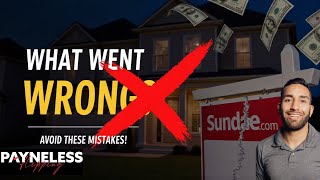
Nathan Payne breaks down why Sundae.com collapsed despite raising $135 million from major investors. The real estate marketplace charged 4-5% commissions but burned through cash on marketing and expansion into 30-40 markets while sellers rejected low offers. Payne argues real estate is too local to scale nationally, a lesson other iBuyers like Zillow and Opendoor learned the hard way.
Chapters
In this video, we're going to be talking about what the heck happened to Sunday.com, the real estate company. Welcome back. We're going to be talking about Sunday.com, what they do, what happened to them, the rise and the fall, and what's going to happen with them going forward. If you're in the real estate game, knowing all the other real estate platforms and marketplaces out there is vital. To your progress in doing deals. By the end of this video, you're going to know exactly what Sunday.com is if you have no idea what I'm talking about and its role. You're going to know exactly what Sunday's about and the controversies around them. And I'm going to talk about an article I just read because I was curious to see what happened to them. So to kick things off, let's talk about what Sunday.com is and what they do. The first time I heard about Sunday.com was about 2 years ago, and they were a wholesaler or a company that did real estate deals in California. But all of a sudden, they came up with this model, but instead of wholesaling deals to their buyers, they told the sellers that they would present their offers that they got from their buyers directly to the seller and they would just take a commission. Now when I first saw this, they presented themselves as the home buyers with heart. They said they were going to be like, oh, we're all going to be super transparent about the situation and we're just going to take a little bit of a commission. And they were taking a commission of like 4 or 5%. And again, let me explain what they were doing. So if a seller like me wants to sell my house, but I want to sell it to an investor, I would go to Sunday.com and they would would say, okay, we're not buying this. Let me just send this to all the buyers we have and they are going to make offers and we'll present these offers to you and tell you, and you get to decide if you want any of these. So the sellers would be like, okay, great. There's no obligation to sell with you if I don't get an offer I like. And when I saw this model, I was like, oh my gosh, this is a great idea. They're just going to tell people exactly what people will offer. And I thought it was going to destroy wholesale. I really did. I was like, wow, this is like transparent wholesaling. But what happened was they weren't really setting the right expectations with the sellers. The sellers would be like, Yeah, sure, I'll let you see what people would pay. And then the sellers would get the offers back, they'd be low, and they'd be like, no, I'm not interested in going with you. So Sunday was getting a lot of opportunities that they were paying tons of money on marketing of people that were saying, yes, let's do it, and using their services and spending all their time and money, and they weren't accepting the offers. Not only that, but a lot of the people at Sunday felt like there were some shady things going on in the company. According to the article that I read, they were saying, hey, they felt like they were taking advantage of people. And look, I don't know a ton about what went inside with the business, but I know when they first came out about a year, year and a half ago, that was a lot of competition I was facing when I was talking to sellers. They were like, "Oh, I have Sunday.com. They're letting me know all the offers going on." So I was like, "Wow, this is going to sweep the nation." They opened up in multiple, multiple markets, but now they were like— I think they were in a total of like 30, 40 markets. Now they're down to just 7. The company, it got Dr. Phil, it got a bunch of, you know, Will Smith, I think a bunch of people invested. I think they raised over $135 million in this company. So again, I saw that and I was like, oh my gosh, they're gonna take over. But it just didn't work out. And there's an article that I read that I'm gonna send the link here that you can read it too. It's just there was a lot of issues because they expanded too fast. They went from having like 500 employees to like 100 right now. And they went from paying like their acquisition reps like $70,000 to $20,000. They just weren't able to make a lot of money from all the spending, all the marketing that went out. I mean, I was even getting mailers to my house. So the reason why I'm bringing this up is because I saw the model that they had of being like completely like, let's just transparent, let's just make the offers and let the seller decide. And it didn't work. And it's really interesting to me because, you know, sellers, they want options. And, you know, Sunday was giving them options, but the business didn't work. And this article again shows you why they failed. And I don't know what's going to happen to them, but it's not looking good. So just to recap what I was talking about, the reason why I made this video is I had the same question. So I researched and looked at this article, and this is the only article I could find about Sunday.com. Now look, the reason why I was so interested to find out what happened is I've done multiple deals with Sunday. They used to be in Utah. We flipped several of their houses. We ended up wholesaling a couple of their houses through double closing, and it was a great lead source because they spent so much money to get leads, and then we just made offers. But I guess it just isn't a sustainable model to spend tons of money on marketing and then and, you know, hope you get offers and then hope the sellers accept. It's just— it wasn't sustainable. The link is in the description if you want to learn more about Sunday.com. Another reason I'm making this video is, you know, you have the iBuyers like Zillow, Redfin. A lot of these companies go out there— Offerpad, Opendoor. A lot of these companies, they try to take over the whole real estate market in the United States. They all try to expand. And what I've seen through my experience as a real estate investor is every market is so hyperlocal. It seems extremely hard for these companies to be be able to go to every market in the United States or multiple in scale. It's just everything is different. There's a lot of moving pieces. So my opinion from what I've seen so far, I think it's going to be extremely difficult for like one company to take over as a home buying company, as a wholesaler, as an investor. I think it's only going to be in specific markets, maybe limited markets. I'm making this video now, but maybe in the future someone will crack the code. I thought Sunday was going to do it. They didn't. They're going down unfortunately, because like I said, I liked using them to get deals, but You know, let's keep our eyes peeled. Let's see if anyone can crack the code and build a nationwide company that buys houses easily and scales. If you like this content, subscribe for more, as I'm always coming out with videos about real estate investing and how you can do more deals.