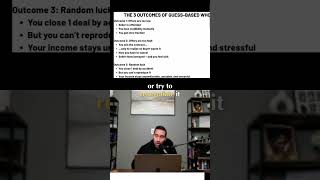
Nathan Payne argues that wholesalers fail because they guess at after-repair value, repair costs, and buyer profit. This creates three problems: offers too low alienate sellers, offers too high can't be resold, and lucky deals aren't repeatable. He shows real data from his own deal to prove guesswork kills consistent income.
Chapters
The real reason why the traditional wholesaling model fails 97% of wholesalers is not because they're lazy. It's not because they're bad at sales. It's not even because they can't find enough motivated sellers. It's because the traditional wholesaling model forces wholesalers to guess on everything. They're guessing on ARV, repair costs, buyer profit, which inevitably leads to completely guessing on every single offer you make. There are 3 outcomes to guess-based wholesaling. Number 1, your offers are too low. The seller is offended when you make a low offer. You lose credibility instantly and you get zero traction. Number 2, your offers are way too high, so you win a contract only to realize that no buyers want it. Now you have to go cancel the deal or try to renegotiate it. The seller feels betrayed and you feel sick. Or number 3, you close the deal by random luck. You just happen to come in at the right time after the seller has been beaten up by other wholesalers lowballing them or lying to them or wasting their time, so they're just fed up at this point and they're just ready to sell and get it done. Or you just got lucky and the seller just is asking for low enough for their house so you're able to make a deal work and wholesale it. But you can't reproduce it. Your income stays unpredictable, unstable, and stressful. This is why guessing destroys deals. This is real data from one of our deals.