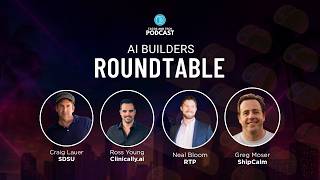
In this AI Builders Roundtable hosted by Neal Bloom, Greg Moser (CEO of Shipcom), Craig Ross, Ross Young (CEO of Clinically AI), and other guests discuss the rapid emergence of agentic AI tools and their practical deployment in real businesses. The conversation starts with a brief recap of recent AI news (Claude 4.6, Codex) and quickly moves to the OpenClaw project, which Greg has been experimenting with under the name Jarvis. Greg explains how he rebuilt Shipcom’s software stack using AI‑generated code, created a sandboxed, multi‑tenant version of the agent called Marvin, and integrated it directly into Slack to act as an AI coworker for his team. They explore concrete use‑cases such as generating OTP‑code pipelines via Twilio, automating ticket creation, and performing cost‑saving analyses on BigQuery. The panel debates the economics of AI‑driven mental models, noting the unprecedented valuations (e.g., a developer’s model sold for a 10‑figure sum in weeks) and the shift from execution bottlenecks to perspective bottlenecks. Security and compliance concerns are examined, especially for regulated industries (SOC‑2, HIPAA), with Greg describing how Marvin isolates API keys, uses per‑user sandboxes, and enforces strict data handling. The group reflects on the broader “adoption layer” – the set of tools and processes needed to make AI coworkers usable without heavy engineering overhead – and how Slack serves as the social hub for AI‑human collaboration. They also touch on market dynamics, including OpenAI’s acquisition of OpenClaw, the rise of autonomous agents, and the future of AI‑native organizations. The session ends with optimism about experimenting with Marvin and revisiting progress in a few weeks.
Chapters
Startups get the party. Startups get the party started. Startups get the party. Startups get the party started.
You want tech and tacos, tacos and tech, you know we got it.
Hey.
Startups get the party. Startups get the party started. Startups get the party. Startups get the party started. Startups get the party. Startups get the party started.
You want tech and tacos, tacos in tech, you know we got it.
Hey,
Welcome back to the AI Builders Roundtable. We had so much fun recording the first one. We said let's come back and do it. And it's also because within 10 minutes of publishing, it was already old news. So we have to continue to come back and talk about what's happening in AI land. And I thought I'd bring back some friends who are constantly building, been building for decades, but now we're building all the time. So, Craig Ross, welcome back. Greg, welcome, welcome. Quick round of intros. Craig, give us a quick little intro.
Okay, I'm back for round two. We did an AI roundtable last week, Ross and I did with you, and it was great. My background is I'm a native here of San Diego, grew up here. I worked for Qualcomm for close to 20 years in the early days on the technical side and then branched off and committed myself to angel investing in startups and then mentoring and helping startups and, you know, make it through their earliest zero to one seed stage kind of progress. So that's been my background.
Awesome. Great to be building with you at SDSU together.
Sdsu, yeah.
My name is Ross Young and glad to be here for the second version as well and discussing what we're building. But I'm CEO at clinically AI and founder, been in tech around 20 plus years, have always been in tech for good. So protecting kids online, previous company, we built an AI based tool that looked for early indicators of suicide, school violence, sexual abuse and substance use disorder in children. That product now protects over 27 million kids. Today I'm building a tool to help the people that help those kids by doing chart writing and chart auditing and behavioral health and large enterprise systems and school districts that are Medicaid funded. But it's fun to be building in the AI world today with all of, all of the changes which we'll dive into here in just a minute. But glad to be here and learn a bit more about. About Greg.
All right, Greg.
Awesome. Yeah. So, hi, I'm Greg Moser. I'm the CEO of a company called Shipcom. We run operations for Emerging consumer brands. So mostly our business is operating warehouses, providing professional services, team and providing technology to the kinds of brands that follow you around on Instagram and Facebook and sell you, you know, hats and T shirts and all the fun stuff that follows you around social media. Those are our customers. So I get the real pleasure of having my customer base all be kind of founders of their own startups in one form or another. And so it's a lot of fun that we get to do. But I also refer to myself as a recovering software engineer. Prior to being the CEO here of Shipcom, I was our cto. And prior to that I was a software engineer for many years and have been thrust back into the role of. I don't know if you can call people software engineers anymore, that vibe code with AI tools, but I feel like I'm sort of building things again, which is a little bit interesting. So it's been a lot of fun with the world as it's changed over the last few years here.
Yeah, well, the world's changed a lot just in. Well, first of all, great to have you guys here just since we put out the last episode, which we put out the episode the day that Claude 4.6 came out and GPT released Codex. So that was a big day. And since then, curious what you guys have been. What has been flagging or distracting you? Your Twitter X feeds or enabling new tools that you just ditched last week's tool? What's on everyone's mind lately?
Well, I mean, the big news is, I mean, I think the Open Claw, for those of us that are heavily addicted to X or Twitter, I mean, the Open Claw saga has just been amazing. So the acquisition by Sam at OpenAI was pretty intriguing.
Yeah. Strong agree, strong agree. It'll be interesting to see how that whole thing evolves. For sure.
Yeah, the story's quite, quite dynamic, right? You know, Peter sold his company for 100 million, you know, I think six months ago or so, and then built, I think 74 projects in GitHub and played around with them, had some fun, wanted to build his own, you know, agent essentially. And it went, it went viral. And I think the story out there is anthropic. Sent him a letter. OpenAI sent them an offer. So an interesting kind of approach to competitiveness and the new changes in AI. And I think it signals something quite interesting because what was it, eight weeks from launch of his GitHub, 180,000 stars and an undisclosed amount, but probably in the 10 figure Bs to move it forward. But he stayed true to his open source approach and essentially we don't know what the contract says, but from a writing perspective it will stay Open Source and OpenAI will support it and he'll run the new future of agents which are supposedly going to be autonomous, which is moving us closer and closer to AGI, which I find the story wild that in 8 weeks you can get know a 10 figure exit. Like that's got to be record time.
Yeah, for sure. Yeah, for sure. Very, very crazy.
What about, what about Mac Mini sales? What have those just gone through the roof in this time? Why didn't Apple try to buy this as well?
This. So Neil, this is what I think is so fat. This is the fascinating part of the story is what he's was trying to do is, you know, how do you create truly agentic kind of, you know, self running, self perpetuating, self learning agents, right? This is not a new idea, right. Every lab, every tech company has had a team of people focused on it, many of them PhDs. And so it's always interesting to me is how somebody can be, come at it from a, from a different angle, from a different direction and just nail it, right. And that's clearly product market fit like he, he, he assembled together probably two or three perspectives, one of which was that it absolutely has to run locally on your computer because it has to have access to all of the tools that you as a human being have on your computer to really generate that. It's really about judgment that you want to be able to talk to this agent about the intent, not how to do it, but the intent. Hey, go order me some food at, you know, with, at McDonald's. And it uses its judgment to figure out which of the tools at your computer it can use to actually go do it. Does it make a phone call? Does it send an email? Does it use your browser and go order it directly? Does it go on Instagram and send a DM to McDonald's? Like that, you know, and a couple of those others that are probably derivative. Ross of his 72 other projects that he was hacking on. But this one guy out of Vienna just nails the product market fit for a totally obvious thing that was on everybody's roadmap. And I think Sam did the right thing and he just said why, why fight it? Let's just buy, you know, let's just buy his mind, support the project and get all the learning. So I think it's, it's amazing me that happens, you know, in plain sight. But he's the one that came. Came up with the right answer.
Yeah. The Apple topic that you brought up is quite interesting. They have been so silent on AI. Right. They have doubled down on Siri, of course, but it hasn't done much. Now their hardware is being used for it. Right. And the shortage of Mac Minis that were out there, actually, after our last conversation, went and bought three Mac Minis and went in and got into the terminal myself and got some openclaw going and, and because of the security discussions, created its own Gmail, created its own kind of APIs through anthropic and through OpenAI and Telegram and whatnot. So I have been dabbling a little bit and it's interesting to be able to use and make my own personal calendars for kids and go and do things for me on a proactive basis with a cron job, which is quite nice.
I love it. I know Craig's been, Craig's been building. You built something in Codex. I know you tried working on something for me. Yeah, but not on a Mac Mini. Right. It was just on your.
Yeah, I, you know, I was not wise and I've been hacking away on my desktop. Yeah.
Even I had a story from last week with WhatsApp. Still hacking away. Interesting.
Yeah.
Right.
So I've got, I've got competing robots that are trying to challenge each other over the Telegram channel. So I, I, It's a mess. It's sort of like my, it's sort of like my book. It's a mess. I got. I need, I think I see Ross's mind. I see how it works. You got a clean Mac Mini, clean environment, well compartmentalized. That's definitely where I should be headed.
Yeah, yeah. And, well, the other thing is, how does this go enterprise.
Right.
Because OpenAI has, you know, exploded on the consumer level. Anthropic. Right. They went from 1 billion in revenue to 14 billion in revenue in like two months. Right. Since they launched, launched Cowork just for Mac and then they just launched it for Windows as well, which has its own challenges, but from a billion to 14 billion. ARR. You know, after they just raised 30 billion on, what was it, a $380 billion valuation on their Series G, I think it was. Is quite interesting to watch. And the struggles that the product has had, watching them operate as nimble as a startup at that scale is something that the world's never seen.
Yeah, Yeah. I think that kind of almost like ties back to some of this weird explosive value sort of stuff that's happening. I mean, Obviously the revenue generation is very real and that's a very real thing. And I think of all the companies, Anthropic is the one I'm probably most bullish on. Only because they are chasing an enterprise model with real customers and real money behind it and real value propositions and all of that kind of stuff. But even going back to the sort of open claw purchase, right, this idea that somebody can get a 10 figure exit in a matter of weeks by themselves, right, that's really weird and kind of unique and whatever, right. Like that's, that's a very new sort of concept. But I think it, it's sort of interesting and I don't know whether it's going to last, but basically that's like we paid for like the context of that guy's mind. Like, like just somebody's mental model is worth that amount, right? Used to be like, well it has to be the mental model. And then you got to go and actually put in years and years and years and years of development cycles and time and energy in order to build value of that size and scale. Because the whole moat is the fact that you've gone out and built all this stuff and whatever it is. But we're in a moment where we're like, just your mental model alone is worth like incredible amounts of money. And because the belief is that leveraging that mental model to do something is not expensive anymore, right? Like that the actual creation that comes out of that is nowhere near the cost anymore. So actually the idea got way more valuable than some of the execution. Maybe, I don't know, it's just a really crazy thing. But it's very juxtaposed to sort of the anthropic, you know, raising another round because they went from a billion to 14 like you said, Ross, you know what I mean? So it's interesting to see how value, not all value that's being created in this ecosystem is being created kind of the same way or being valued the same way, which, which I think is kind of fascinating.
Well, there's startups on Idea stage alone of former researchers from another lab that are raising 500 million on a 4 or 5 billion without having to create open the claw. It's like the promise of an open claw down the road. He had to go build it and got users and got kind of the same valuation. Well, I guess he got the full payout, he got the full 5 billion and didn't have to give up dilution at all of his company.
But still, I don't know yeah, it's a big deal.
Well, I think. I think that the, the ability to get that level of revenue is a source that's never been able to be tapped before, which is the human capital budget, the number one line item across anybody's P and L. So, you know, the fact that now you can tap into what was being paid to humans from work being done by an autonomous AI agent, I was thinking about, will there be an AI staffing agency that deploys agents eventually. And that's kind of what organization is going to be able to do. And we're getting a taste of the future of actual autonomous work that you can train it to do, which is scary. And really what Elon predicted so long ago is these making, you know, human life and work almost too abundant because of the work that these agents can do. So it's a really exciting time.
Exciting time.
It is. It is very cool. I want to see.
I think it's. I just want to jump to seeing some stuff being built. Can we just jump to. We okay with going straight?
Yeah, sure.
Well, just to give a little context, everyone's. Well, first of all, I have seen Greg many times now during the day, where I can tell, and he has said he's been tinkering all night because he is just building back to building all night. So I can recognize that. But Greg, why don't you introduce a little bit more about shitcom, how it was operating yesterday versus how it's, you know, operating today based on.
Yeah, well, yeah, yesterday was different than today, different than two days ago. Right. It is really moving that fast, which is really cool. It's certainly what I want to talk about here. I think, to set the stage for this though, and, and before I show you guys what what we built or what I've been building, it's kind of important to talk about how I got here. Right? Like, like why and where and how do we find ourselves here? So, like, the LLM hype cycle has been going on for. Right. And I have been kind of like quietly watching for the last year and a half or two years. I've been sort of watching, going, okay, there's stuff coming out and this thing may be applicable in my business or maybe not applicable in my business. And, you know, I'm clearly going to have to figure out how to reorient my company to an AI native world. And for what it's worth, I still move atoms around. Right. We are a company that does shipping and logistics for emerging consumer brands. We got 150,000 square foot warehouses. We got boxes. We print labels out and humans put labels on boxes. And like, yeah, we tinker with humanoid robots and things like that in the warehouse, but it's still a little clunky and whatever. And so we get into some technology in the physical world, right? But even with that, you know, and I'm, and I'm up against a whole bunch of competitors in my space and you know, I'm watching the AI thing going on, going like, huh, like. And then, you know, the hype cycle's continuing. The hype cycle's continuing. You see a lot of people out there, like, I don't know, pick a figurehead. Whether it's a Y Combinator figurehead or a Eric Schmidt figurehead or whoever it is, which is like, you know, companies that come out today that are AI native are just going to eat the lunch of like, definitely Salesforce is going to get crushed by some new day AI CRM because like innovators dilemma. Large companies aren't going to be able to adapt quick enough. They're going to bolt it on, but these upstarts are going to. And I'm sitting back having a little bit of an existential crisis. My going like, and the markets.
Sasspocalypse is real.
SAS apocalypse is real, right? But even in my own industry, I'm going like, well, okay, I have physical stuff so that might help. That might like physical buildings might be a moat for a little while. I have no idea, right? But this is terrifying to me. And I'm like, am I about to miss the biggest like bandwagon of all times? Do I need to quit, shut down Shipcom and restart my business as an AI native company? Because my company is. We're not that big. We're about 100 employees. But is that too big gig of an organization at this stage to really reinvent yourself in an AI native way? Because I believe in that future because the org charts look different and all of this sort of stuff. So really started contemplating a lot of those things last year. And then in October, I hadn't touched code in, I don't know, a while, I don't know, maybe a decade or something like that. And I was like, what's this? Like there's this thing called Cursor. It's gotten a lot of hype. Let me download this tool and I opened up Cursor and I gave it some command, build me some app and I was like, whoa. It was like I was a year and a half late to the vibe coding party or something. Like, wow, this does a lot of stuff. But I was a pretty hardcore engineer before, and so then I was like, okay, how do I prompt this thing? And I did a bunch of work and I spent basically two months kind of over the holidays of last year rebuilding our entire software stack by agentically, right? So just like deploying agents to rewrite software for us. And our software is a lot of, like, transactions, data management. So orders live in 10 different systems and products live in 10 different systems and sort of bringing all those things together and giving business intelligence around it. That's kind of what our, what our core platform has already has always done. But I got to a, I got to a wall in my developing of the product and what would happen was I was up all night working on something and I got like 10 hours of context working with, you know, a coding agent. A lot of thought went into, what's our technology selection here and why are we going to go with this framework over that framework? Okay, let's do that. And then I'd come in the next day and I'd call my actual CTO and be like, oh my God, all these things, I made all these decisions and da, da, da, da. And he starts freaking out and he's like, wait, what's going on, Greg, you're moving too fast, right? I can't keep up with the rate at which you're producing things. And who knows, you might just be creating a bunch of garbage somewhere else, right? And what I realized was that all of our LLM or many of our LLM experiences, including Open Claw, at least to a certain extent today, are sort of designed to be 1v1. Many of them are. So a lot of you go into ChatGPT, you ask a bunch of questions, you have a dialogue, and then you maybe share that with somebody else, whatever. But it feels very one v one. You're, you're, you're having a one on one chat. And I was like, that's just not going to work for me. You know, I want to be developing these things in groups. I want other people's brains on this. I want to bring in additional humans into the loop. And I went to my CTO and I was like, man, we got to figure out that how we can do all this coding develop. Because I had this epiphany of like, how can I take a feature request from a customer and ship it within hours, right? A customer tells us a feature request on the platform, it goes through a development pipeline, and we can ship it within hours. Because if we can increase the feedback cycle of the product that we're doing. It's just going to make us outpace our competitors. But in order to do that, I sort of want to do it in a social way because different people have different thoughts and ideas and, and whatever. And so I was like, gosh, I really want to do all this in a tool like Slack. You know, I want to have, I want to have group conversations and I just want, I want AI in it with us. And when we want to ask AI, we ask AI. And when we want to talk to humans, we talk to humans, but treat them like a co worker. So I've had this idea of, you know, AI truly as a co worker, as somebody you hire, as a chief of staff or whatever that you fully treat like a co worker. And I was drawing diagrams of how to do this and how we're going to create persistent memory and, and all this stuff and kind of thinking about it. And all of this is on the back of this sort of big vision that I have, which is sort of reinventing humanity's relationship with work. I think that humanity will go through a meaningful change about their relationship with what work means. And I'm really interested in playing a role in that whole process and sort of shepherding people through this. So I'm going through this whole experience, okay, how are we going to do this? How are we going to build our software faster? How can we increase the cycle times with which we ship features and all of that kind of stuff? And also how do I reinvent our organization as an AI native company where we only use AI native tools? And all of this is going on and I'm spending way too much time up at 4:00 in the morning, morning thinking about these things. And all of a sudden what pops onto the scene is open cloth, right? And I'm like, whoa, okay, this is super interesting. This is a piece of technology that gives me a lot of what I was working looking for. Gave me like the first 90% of what I was looking for, which is something that you truly treat like a coworker, right? Something you really do just treat like somebody else, which is, I can't remember if it was you, Ross, or you, Craig, who said, like, you know, I set it up with its own email account, it gets its own API keys, right? And by the way, that's a huge thing. Please don't ever give an AI agent that has the kind of autonomy that OpenClaw does access to your email, because your email is your keys to the Castle, it is where all the two factor auths and reset your password goes. So, like, never do that. Please give it its own email address and treat it like you would any other human. Like, I wouldn't hire some new VA and give them keys to my car and, you know, my credit cards. Treat them just like a co worker, right? And when you treat them like a co worker, it creates the right security boundaries around it. So. So I install openclaw. Cool. And I'm kind of one of these, like, full throttle go. So people are like, oh, you know, I installed it on my machine. That's dangerous. Okay, I'll go buy a Mac Mini. I'm like, well, I'll give it a vm. So I just spun up a VM in. In Google Cloud, and I'm like, this is ridiculous. Why don't I just make this thing the owner of the Google project that it's sitting in so it has full owner access over the entire Google infrastructure. So it can make anything that it wants to make on Google Cloud, which I know is incredibly terrifying for a bunch of people, but it could spit up like a thousand VMs if it really wanted to. So I have to put some, like, budget controls on it. But fundamentally, it's. It's like, really got superpowers because it could get off if you did one machine and put itself onto a thousand machines or whatever it wants to do. It can build all sorts of stuff, right. With no real need for me to interact. Okay. So I set this thing up. I gave it the name Jarvis, that like, 90% of the people that set up Openclaw named their bot, right? So I spin up Jarvis and I give him all this agency, I give him all this tooling, and I start playing with him to solve problems in my life, the personal stuff in my life, but I don't. Most of my problems are work problems, right? They're organizational problems. They're people problems. And so I started inviting Jarvis into all of these meaningful conversations in my working environment. And. And I can share. I can. I can share my screen and kind of show you guys some of what that looks like, because we are now. It's like Jarvis was spun up as my chief of staff, right? And. But I'm like, hey, you can talk to my chief of staff. I don't care. Go ahead. Like, use them as you see fit. He's my personal chief of staff, right? So let me share my screen here, and I'll. I'll show you some of what that looks like in a real company. Right. That's like, you know, this isn't like, we're not just a software company trying to, you know, sell a software product. But I've got hundreds of people that have real problems every day, and I'm like, how do I bring Jarvis to bear on those real problems that we have every day? Right. So. So let's see what you guys are looking at now. What are you guys looking at? You guys see my slack here somewhere? Oh, I did that on the wrong screen. Hold on, let me get that. Shared. Right, share.
We saw you and Neil slacking.
Yeah. About cool stuff. Craig and I. Yeah, that sounds right. Okay.
Because it's in Slack. He externally connected me to his Slack. And so I have been talking to Greg's chief of staff for the last week, just having a relationship with. With. With Jarvis. Related to Craig.
Yeah. So, like, let's talk about practically, you know, what some of these things are. So where did it really. Where did it really kick off? Let me just grab Jonathan this one. So, okay, so, you know, I go, this is my head of operations in this channel, right? I've got. This is my cto, Jake. I got Jarvis here as my AI agent. I got. My head of operations here, runs the operations. Like, hey, Jarvis, meet these guys. They're important in my life, you know, and we were doing some. Some wacky stuff in the beginning. We. Oh, we were on a call. That's right, we're on a call. And we had some technical issue where we have to write these cartonization scripts. It's like, really random stuff. And my CTO is going like, oh, this is going to take us forever. I'm not sure if we can. I'm like, I think we could do it. And so I start this conversation like, hey, how do we write this script in our bespoke thing? And it writes it and it's like, right. You know, and now we're. Now we're having a dialogue about whether or not this script it wrote was right with my cto. And he's like, oh, okay. Actually, yeah, that does kind of look like it would work. Okay, so you're like, I'm in a meeting, right? I have a CTO kind of doing one of these. To me, like, oh, that's going to take time and energy. And then I go in and I'm like, is this fast? And then all of a sudden, his guard comes down because the work's been done. Right. Well, that was an interesting experience. And Jonathan Montgomery, my VP of operations, he's just trying to Solve problems all day, every day. He has more tech need than there could ever be enough technical engineers to solve problems for him. So we have this experience and this goes on. And then this was on Wednesday, February 4th. And so the next day on Thursday, Sean's like, you know what, I'm gonna, I'm gonna ask, I'm gonna go back into that channel with that Jarvis character and ask him a question, right? And, and, and what do you, what he. There was some tech tickets. So we asked Jarvis to create a ticket in our ticketing system, which he did. And then, and then, and then, here we go. Jonathan says something about OTP code. So we have employees who need to log into portals like Walmart and Amazon and things like that. And so the question becomes, okay, we have a shared login, but it wants to send that one time passcode to somebody. Except everybody in my organization. They, you know, which one of us is going to put our cell phone number in here to get the one time passcode. So sometimes we use the Authenticator app, but Walmart Portal doesn't let us use the Authenticator app. So it's like, we got to set up a phone number. So John starts asking us like, hey guys, can you like figure out something with a phone number and HubSpot that routes to an email? And Jake's going like, ah. And then he asks, and we asked Jarvis like, could you whip this up right? And Jarvis like, sure, no problem. So Jarvis gets into Twilio, creates a phone number, originally sends it to the email address, and then John and you know, hey, I got the phone number and it works now. And then, you know, John's like, oh, that's cool. Can you just slack it to us? And Jarvis like, yeah, sure, no problem. Slack. So from, you know, basically our VP of operations has this real just kind of day to day problem at 7:57am and by you know, noon, Jarvis got a fully working OTP code channel where now when we log into the Walmart portal, it drops one time passcodes into this, right? So this was just like the first example of this. And as you can imagine, I have a whole bunch of slacks of this. And so then I see Neil. On a Friday night, we go to the symphony, right? And I go, Neil, I got to talk to you. I'm going to raise another series A and I want to talk to people about what I've been building. And I'm like, you know what, I'm not even going to tell you what I've been building here. You're an Investor, I want to talk to you about what we've been building. So I'm like, hey, Jarvis, here's Neil. He's important. He's an investor of mine and I want to go recruit him to help raise some more money here. And I say, Jarvis, what have we been working on at Shipcom? What are the game changing things that you've done here? And he's got meaningful things. Like the one time passcode thing that was done in the last week is there he did. He went into our entire BigQuery infrastructure, like analyzed the billing, wrote scripts and had implemented like a 70% cost savings on our bigquery costs. Right. Just because it's like it took no energy to do these activities. Worked on his voice system with our sales guy. He did a financial analysis with our CFO about, you know, risks and pitfalls in our financial plans. Right. And so I was like, okay, we've got open claw is clearly valuable here. We've finally gotten the agency that we're kind of looking for out of a helper. And using him this way makes him incredibly social. But this is pretty high risk. I can't just like give Jarvis as he is over to my customers as the solve to my customers. Right? And because he's mine, it's my vm, it's my thing. And while openclaw is incredibly powerful, it does have some pretty significant limitations around it. And no matter what, I have envisioned this type of user experience for our customers for months and months and months and months now. So I'm like, well, I'm definitely going to jump the gap from this just being a me personal agent to how do I give this personal agent to all of our, all of our customers? And instead of thinking of it as a personal assistant, we have created Marvin. And what Marvin really is is the best way to describe him. So this is like a big thread of me, of me testing with Marvin. But effectively what Marvin is, is we're referring to him as an AI coworker. Right? So Marvin can get into topics and channels with you the same way that we were doing here with our VP of operations. And what's really cool about Marvin and the way that it's architected and worked is if I introduce Marvin to you on Slack, like Ross, if I, if I introduce Marvin the same way you would introduce an AI co worker, he becomes a Marvin, meaning that you get your own Marvin. So when you talk to Marvin, when I talk. So when we're in a shared Slack message channel like we are in this one the difference is when I talk to, you know, the AI agent, it responds to me. It has all of my stuff, it has all of my memories, it knows about me personally. And it executes inside of a sandbox that is a Greg Moser sandbox that I have that I am authenticated against. That is only me in that same Slack channel. If I was talking here when Neil writes, it's like, oh, I'm a separate secure infrastructure that is tuned just to Neil. Right. And so what this now means is I can essentially give open claw over to all of my customers without them ever having to learn how to set up a server or, you know, build something for themselves or whatever that is. And these sandboxes spin up and they disappear. So if somebody's not talking to them, they. They don't, you know, doesn't run. It's not a runtime that runs. And then what this does for us, like the big. The. The big picture of this is I'm very focused on what I call the adoption layer. So in investing in AI, there are like the four layers everybody talks about. Application, foundational model, data centers. Some people put edge computing in that category as well. And energy. Right. That's like the four major investment cycles. But I actually believe that, you know, in my mission of reinventing humanity's relationship with work, you know, there's a whole adoption layer to this thing. And so the focus that we have around, around Marvin is how can I bring down the barrier to get humans to utilize this tool and get real value out of this tool very quickly with no technical setup and no nothing. And. Yeah, and so that's what we've been building. So now I'm like, you know, just wrapping up. Oh, I. Oh, super fun. By the way, I built all of Marvin. The whole sandboxed experience, the security infrastructure, you know, we run it on our API keys, we bill the customer for our utilization on our API keys. All of that was built in Slack with my CTO watching. You know, I'm sorry, with my CTO watching and other people in my organization chiming in with their ideas and things of that. So, like, Marvin has been 100% built in a collaborative, human centric sort of way, and I never left Slack to build it, which is kind of a crazy. A crazy idea.
That's awesome. Congrats, man.
Thanks. Yeah, yeah.
This is a glimpse of. This is. This is what, you know, this is a serious glimpse of the future here now. Right? This is it.
I mean, that's is 100% here now. It is 100% here now. And we are actively solving problems with customers. We are actively using it. Oh, that was the best one. The other AI, it's so crazy. And this is the hard part. It's so hard to retrain our thinking. I get a phone call from another investor. We got listed number two on the, on the, on some list of best three pls and whatever. And I'm telling him, hey, we got this amazing thing. And he's like, you gotta like get that out. You gotta send out an email, you gotta publish it on your website. I know, but I gotta, I gotta, you know, I gotta go hire a marketing manager because we don't have anybody to do that kind of executionary stuff. And I'm like lamenting all these people problem with them on the phone and at the same time like, oh, hey, I need to demo this Marvin thing for you. And so I spin up this Marvin channel and I'm like, hey, you know, we, we got this. I added my investor. I'm like, hey, we had this whole thing where we got listed on this list and I'm supposed to send out an email to everybody and we use HubSpot to do that. And it's like, great, I need an API key to HubSpot. So we add Jake to the channel. Like, Jake, you put an API key to HubSpot and the next thing you know, it's written a whole article and shipped this thing out, right? And so the thing is, there's like a bajillion tools out there that are, oh, we're an AI email marketing tool or we're an AI this tool or an AI that tool. And I'm like, I don't want that. I don't want to fit together a thousand different tools. I want the, I want the Swiss army knife, right? And maybe, you know, maybe one of these days, you know, Marvin is like, hey, we really need an AI centric email marketing tool will make it more efficient for me. I'm like, fine, go buy that tool. But, but my point is, you know, having this level of autonomy and agency when you really empower it inside of an organization is really powerful. And I think we're in a little bit of a unique organization because, you know, we, we certainly send it. Like I'm, I'm very tech forward risk on, let's get people using it. Let's figure out where the gaps are and figure out what the issues are. And so, and so it's cool. Now my finance team uses it and everybody in my organization is like drastically Increased our productivity in the last week.
So what, what is the difference between JARVIS and Marvin again?
Yeah, yeah, sorry. The reason you see JARVIS in here. So JARVIS is my personal AI. It's like a, it's a vanilla open claw and it's what I've done most of my like initial discovery with. It's like when you're watching JARVIS here, this is like me working with openclaw. Marvin is a deriv. So Marvin sits on top of this platform. So this is our, this is like our, you can imagine like we, we have data, right? We have things like orders and, and products and all of that stuff for our customers. And we've always called this system Marvin or Marvin os and it does data conflict resolutions and things of that nature. And this, which is like kind of the cornerstone of it has always been the chat interface was just kind of like an ll. Like what we had, what we've always had historically was okay, we have an LLM interface that can consume data, right? There's a zillion tools out there where you're like, hook it up, make it, you know, give it a rag. Access to data and then you can ask about your company's knowledge base and you can do all that stuff. But what we really wanted was, we wanted when you chat with it, for it to actually be able to do things, to create software, to launch campaigns, to solve problems and all that. And so we replaced this user or this chat interface with basically an open claw containerized thing so that instead of chatting just with an LLM, you're actually getting a full server that can do a whole lot more power when you talk to it. And then I've always thought that this interface is going away. I think the idea of SaaS companies long term is probably going to go away. We build a portal because people are comfortable with it right now. And right now people feel like they need to go and look at orders and do all that stuff. But in reality, I think most of life will end up being more like this, right? Where you're the portals go away and you're more just talking to things that solve problems for you or, and spitballing ideas and creating things. And if you need a view, it, it generates the view on the fly. And so we're just trying to bring it more into a chat interface. So we iterated on it and. Yeah, and that's Marvin. So this is like, like you guys are getting like the immediate sneak peek. I can.
So, so Neil, just so you know, I mean, just so Greg just gave the Best articulation for why OpenAI bought OpenClaw. Right.
Which is the.
The model that we were all familiar with was that we would write software that would essentially just take a user's text and feed it right into the LLM. And OpenAI is selling token to do that. So it's a great business. But what Greg recognizes, oh, there's actually a more valuable use case which is if you replace that architecture with a front end knowledgeable agent, it will still use the LLM eventually. But there's a lot of other stuff that you want to do before you just simply hit the LLM for some token usage. And OpenAI by Fine Open, Open Cloud kind of gets. Gets some mind share around how to architect their systems to enable that model. So that was a nice coming together of the two themes. Great, Greg. This is fantastic.
So anyway, I'll introduce you guys to Marvin. You can start using him, you get some free credits for him. It ends up on our API because we use the LLMs. You can use any model you want. It ends up on our API keys and we bill people for that with a small markup on it and you can share it with other people and they can use it in their organization and they don't have to worry about the security of openclaw or any of those sorts of things.
So Greg, what do you do you mind if I ask a question? I'm just going to barge in. So I'm just curious like you talked earlier about. Since execution is no longer the bottleneck, it's really about perspective, right? It's mental model that is kind of the value. And you have moved yourself to a different place with a different perspective now of how software gets built, of how customer engagement happens? What do you tell a new hire that comes into your organization that may probably have some of those old, old ways of thinking about software development and the traditional stuff like how do you. I'm experiencing this in a very real way.
How do you.
How do you transition somebody to the, the new perspective, if you will.
Yeah, so I was wrestling with this a lot. You know, I was up at a conference in San Francisco. I'm advising on an AI finance startup and we got this question a bunch, right? What did new kids coming out like, how do you advise them? How do you orient people to an organization? And that was a real problem. It is, it is hard to do that. If you remember when I was talking about the four investment stacks and this kind of epiphany of the adoption layer, that is really where I'm focused. So the. The channel is where you do it. So what happens is. And I'm now doing this with our vendors, right? So. So I got on a phone call today. Actually, let me share one other thing because this will be. This is very topical to what you're. What you're asking about here. So I got on a phone call today with our. Let me make sure this is the right one. Is this what I think? Yeah. Okay. So I got on a call with a marketing agency today. Right. I'm sorry, an outbound sales agency today. And I was like, look, two different three pls in our space went out of business. And I had told them two weeks ago, hey, two major three PLs in our space went out of business. We should go hunt for their customers and go and recruit them. And you can find their customers by doing a Google search for the facility address and the word returns. Because any of their customers that use that facility put on their e commerce website that the returns go to this address so I can know who all their customers are. Right. And so I kind of send this sales team off to do that. And the guy comes back and he's like, I kind of did that, but I struggled. I didn't know what to do. I used OpenAI's got some deep researchy version or something like that. I tried to do it. It wasn't that successful. Look, this pause. You guys use slack, right? Yeah. Okay. I joined these guys, the slack channel. I just go, jarvis, can you do these things? And then I. And what's so important about the adoption and the learning? The points that you're talking about is the group chat. It is the social part. It's the fact that I'm like, hey, just look over my shoulder. See what I'm doing here, right? I'm going to help do it. It's not that much lift off my back to kind of show you. Because I'm just kind of having a conversation here. And then what happened? That's exactly what happened. When I indoctrinated, you know, Jonathan with this, he saw me come in here and, you know, challenge my CTO with some questions, a way to do things. And next time he didn't like, wait for permission. He was just like, jarvis, can you do this thing now? Right? So for me, I think that this concept of socially sharing AI utilization is the key to adoption, if that makes sense. Yeah, yeah.
Interesting.
Yeah, yeah, those are really good points. And Greg, what you built is incredible. And again, a glimpse into the future because then it's actually the present now, which is I can't use OpenClaw inside of my business because of the security challenges in it. I can't enable my staff to do something like that. And frankly, you know, in our business where we're dealing with, you know, Phi and Soc 2 type 2 and you know, in some cases, unlimited liability, caps on breaches and things of that nature that we need to think about, you know, giving a product the keys to your systems, your HubSpot, your, you know, your Gmail, like we talked about, you know, earlier, to do things is really scary. So I think there's going to be an interesting resistance and, or dive into the pen, testing of it. Right. Of the SoC2 of itself. So you mentioned that you built the security infrastructure around it. I'd love to hear about how you, how you think about this. Could go into a company that's highly regulated and be able to operate, you know, independently because you're going to get some shadow it that someone goes out, you add it to their Slack channel and now their CTO is like, what the hell is this? So how do you, how do you
think about this is how yammer. This is how yammer proliferated back in the day, by the way, guys, remember, remember, like, everyone added yammer to like the company account and then Microsoft had to buy it and turn into SharePoint.
So yep. Yeah. So I'm a big fan of these historical models and I'm like, oh, cool, I've got one of these right now. I really think that this could be a thing where I can just infect all these organizations. You know, it's a great point. So my wife works in medical device sales. Highly regulated industry. You know, I built Marvin and I started chatting with her. I first started, first introduced her to Jarvis. Like you schedule the kids and do all this stuff, but. But then I introduced her Robin. I'm like, you should use this in your company. And like I'll. You can use it over teams. So, like use it over teams and you should share it with everybody. You should just use this. She's on like the AI steering committee. It's classic, huge company. They're trying to decide if they're going to spend, you know, $30 million on the AI co pilot from Salesforce or whatever garbage thing they're spending it. I'm like, you know, you should just start using this and like, just rock your whole company's world. The day that I said that to her, she's like, you know, we just got a notice that we're only allowed to use Microsoft Copilot because they've got it locked down and we're not allowed to use any other LLMs and whatever, right? And so, you know, for me and for Marvin, I am like zero interested right now in going after any business that's in a regulated industry or what. That is a massively up, uphill challenge for a lot of things. I would say, you know, one of the benefits of the customer segment that I'm in are emerging consumer brands. These are founders of companies that are super kind of like tech open and tech forward and sort of stuff. And honestly, they're running fast, right? They're just like making widgets in China and selling them to people and stuff like that. They don't have the kinds of, you know, security concerns or PI, you know, any of that sort of stuff that normally would plague something like this. But I would be lying if I didn't think that, you know, this thing can grow virally and that things like, you know, in fact, in many ways, you know, when you control the adoption layer, right, you can actually influence more safety and more security and more control. So one of the examples of this that we did is no API that you can't give it an API key, basically. I mean, you can, you can literally drop it into the chat and give it an API key, but it responds with, hey, that looks a whole hell of a lot like an API key. Please delete the last message. Or can I delete the last message? Because by the way, when I oauth you gave me access to delete messages. So like I will delete that message for you, right? Because it's bad. You shouldn't have that in your second. In fact, you should go and change that. And also here's a link, you click it and you get a window where you can save that key and it saves it in a secure spot, right? And then the cool thing about the way Marvin works is it's basically a router that authenticates who's talking to the open claw sandbox. And then when the open claw sandbox wants to talk out to the world, none of those API keys or anything are stored in the open. So like none of the secure data gets, gets stored inside of it. It proxies out to like a, hey, add the key to this thing and then send it off in sort of a deterministic programming way where LLMs don't actually get the keys to anything, right? So the ll and that's the risk, right? When you give a tool that's got a Lot of agency and a lot of ability to do things with someone. It has the raw text that's a problem. And so that it's, it's like a pretty simple, you know, security measure. There's like a thousand more that we need to make. Like me and Neil have a conversation about the fact that we're going to fire Ross and then I end up in another slack channel with Ross and he's like, hey, were we going to fire this guy? You know, you're like, whoa, wait a minute, I didn't want you to tell that to this guy over here. That's a problem. Right. And so there's, there's a whole bunch of other safety or privacy or those concerns as well. But again, like, I hope one day, and I know that one day, if it's not Marvin, it'll be something else will solve kind of the SoC2 and HIPAA and, you know, and so we'll wait for those industries to catch up.
Yeah, no, that's super interesting. And the only way through is through, right? You know, because, you know, the, the open claw, you know, excitement of facade, people are carefully looking at it. And then, you know, it hits you, you know, in your dream at 4 o' clock in the morning is, you know, as you're in a dream and awake state together of how to iterate and make that better. And then, you know, somebody, you know, like myself sees the ability to do that and thinks like, okay, I can't use that in our business, but what are some of the measures that potentially need to be done and someone else is going to iterate on top of that, or fork Marvin or however you're doing it with, you know, in, in the GitHub. But I think this is something. They can get 100, 180,000 stars as well. Can you beat eight weeks, Greg?
We'll try. We'll try.
Like in the lead up to this podcast, by the way, I worked on getting interviewing Jarvis on the phone so that Jarvis could join this conversation, by the way. So we were already there a week ago. Greg was watching it because it was me, Jarvis and Greg talking in Slack. It really was just me and Jarvis because Greg was busy at a conference.
Conference.
And we almost got there. We almost got Jarvis to join this pod around that couldn't quite get it on the phone side. I think it was a phone system issue. But in the meantime we found out. I was like, where's Greg through all this? And he's like, oh, he's at a conference, he's racing Cars tonight, like, oh, what kind of car? Jarvis place a bet. I pick.
He's gonna do a Porsche.
What do you bet Jarvis? And we actually had old bet and like we placed, replaced it and Greg chimed in later and said it, it was a portion, a mega task.
And just out of curiosity, does Jarvis save that context somewhere?
Oh yeah, yeah, he does. So the whole deal is, and that's one of the biggest innovations in openclaw is the way that they did the memory storage. They did this sort of. He did the. Peter did this basically three tiered memory storage thing that actually just works really well. And that's a, it is a pretty big unlock. But it's, it's really interesting because I'm like, there's actually not that much code in Open Claw. Like it's actually not, you know, it's not like crazy, it's just some concepts, right? So it's weird because it's like if I got asked by an investor, like what happens if Open Claw gets, you know, proprietary by. It's like the cat's out of the bag. It's not like there's nothing here. You know what I mean? And by the way, I've already iterated on OpenCloud. Jarvis has been working on himself the whole time, right. So he's like, I can fix myself from here. I don't need anybody else's involvement in this, you know. So it's, it's really interesting.
Fascinating.
Yeah.
Yeah.
Well, thank you guys for letting me share some of this stuff. I appreciate it. You guys are like first eyes on it. And I appreciate, you know, discerning folks taking a look at what we're, what we're playing with and what we're building.
Yeah, I love it, Greg. And the fact that you run, you know, 100 plus person organization and had a problem you need to solve for your business and this spun out. Did you, did you segment the IP and put it in a separate area? That's. You don't have to answer that.
But no, I'll answer it. I'll answer it because it's a good question. I got asked this, I just raised around and right after I finished, I showed the lead investor the software. I never even showed them what I was doing while I was raising the round. And there of course immediate was like, are you doing this as some separate spin off thing? And I said no, that's not what you guys are investing in. Right? You guys are investing in a team of people. What comes out of this organization is whatever comes out of this organization. It's completely unfair for me to be like, oh, I had this new idea and so I'm going to step on the backs of other people. And there are some incredible, incredible stories. Slack being one of them, that were born out of organizations that were not originally designed as this and ended up, you know, the thing they built ended up being a thousand X what their original vision was. And so if that happens at Chipcom, great. If it doesn't, if it ends up just being a tool that we use because Anthropic comes out with their version of this tomorrow and gets all the codes, that's also fine. Right? My, my core focus is just staying on the front edge of becoming AI native and what does that mean? And shepherding this through the evolution.
That's a lot of integrity and why you have the reputation that you do. And a lot of folks, I think, would think differently about that. But that really shows a lot of alignment and loyalty and respect for the, for the injection of capital that you're getting this spawning off new ideas. So love that. And that's a nice tidbit for someone to, you know, stick a feather in their cap with.
Yeah, I appreciate that. Thanks, Ross. Appreciate it.
Well, I'm excited to get playing with it and have Marvin teach me what I, what I, you know, the world is my oyster to a certain regard of trying it because I think it's a little bit like you said, the only way through is through. That was a good quote, Ross. And just try it.
So, yeah, I really like that.
Let's come back in a few weeks and see where it's at.
Yeah, cool.
La vida San Diego school of rappy rapping Fire tortillas round jalapenos in these modern times of craft beer and coffee My coating yoga posse fold the body origami we be surfing Coronado eating tacos el gordo the tacos stand in puesto lucha libre and sombrero gotta shout out to cost Angels by the ocean watch the sunset the Hoya shows entrepreneurs trying to get funded When San Diego Startup Week is popping in the summer Oceanside, the Tijuana SD be full of hustlers from couch surfing to penthouses right on the beach. Tech leaders who believe stars are within reach we interview and founders who be shooting for the Moon SD TechOS with your host, Neil Bloom.
Come on.
Startups get the party. Startups get the party started. Startups get the party. Startups get the party started. Startups get the party. Startups get the party started.
You want tech in tacos tacos in tech, you know we got it?
Hey.
Startups get the party Startups get the party started? Startups get the party Startups get the party started? Startups get the party Startups get the party started?
You want that tacos? Tacos in tech, you know we got it, hey.








