Building San Diego's Product Management Community
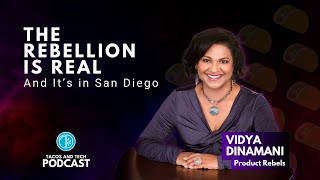
Transcript of a Tacos and Tech podcast episode (host Neal Bloom) featuring Vidya Dinamani discussing building San Diego’s product management community, the upcoming Product Management Summit, Product Rebels, customer‑centric product practices (follow‑me‑home), and community building efforts such as ProductTank and local meetups. The conversation also touches on career background (physics → software → Intuit → entrepreneurship), the importance of early customer contact, and conference logistics/audience. Tone is conversational and promotional.
Startups get the party. Startups get the party started. Startups get the party. Startups get the party started.
You want tech and tacos, Tacos and tech, you know we got it. Hey.
Startups get the party. Startups get the party started. Startups get the party. Startups get the party started. Startups get the party. Startups get the party started.
You want tech and tacos, Tacos and tech. You know we got it. Hey.
Welcome back to the Tacos and Tech podcast. I'm your host, Neal Bloom. And I'm so thrilled to have on longtime friend, startup community builder, investor, product leader extraordinaire, and co founder of Product Rebels, Vidya Dinamani. Hey, Vidya, thanks for joining us.
Oh my gosh, Neil, so excited to talk with you.
When you reached out and said you are starting a whole new product summit, I was so thrilled because yes, we have not had a lot of product leadership in town beyond great product managers themselves. And so I'm so excited to dive into this. You want to give us a quick headline? What is the Product Management Summit that's coming up this summer?
It is a place where you can get world class speakers and we don't have to leave home. I mean, how perfect is that? Like all these conferences come to San Diego, but for product managers, for the longest time, you know, we're going up to the Bay Area, we're going to New York, we're going to Ohio or we're leaving the country to go talk about product management. I was like, enough, like it's time we had something right here in our backyard. And why wouldn't everyone want to come to San Diego? So I'm super excited. That wasn't quite a headline. That's why I'm so excited about not having to go anywhere to listen to these incredible speakers.
Yeah, no, we're thrilled as well for a variety of reasons that you just mentioned. On top of making sure we have high quality product management talent, seeing our high quality tech companies here too. So even just you know, selfishly to make sure our companies and talent are mixing in that regard so that we keep building great companies here. Yeah, you've got a deep background obviously in PM and a variety of areas. Like you help so many companies in a variety of areas. You take us. I want to hear like the product manager story because obviously you don't grow up in high school being like, I can't be to be a product manager one day. Where how did you end up down this career path?
Maybe one day they will, right? Maybe, maybe we can Hope. Gosh, how did I end up here? So I'm, I'm a geek. I started off, I have a degree in physics, Neil, so you can hold that against me. And then went into software development, software engineering and very quickly decided that I really love the mix of technology and business. Got an mba, which way back when, and I'm not going to age myself, but way back when was a shortcut into getting into business. Went into management consulting and then landed my first job, my first real job, I'd say, because everything else was, you know, technology, it was consulting. But I went into it and I spent over 10 years in Intuit leaving and leading product at a TurboTax and just had the most incredible experience around how to build customer driven products, how to think customer first, how to bring those practices, you know, leadership in product. I was just very, very lucky. After then I continued my career in product and then, gosh, about nine years ago, started my own company. So the product, I'd say the journey. Although I have technology built products, I built websites, all of this stuff before I really felt like I started it into it.
That's incredible. Journey, physics background. We'll come back around to that a little bit and, and how you pull on some of those things for product. Because I have a mechanical engineer background, which has nothing to do with what I do today. Right. As well. But people talk about Intuit and I see it as, you know, a bit of like the OG product company, not just locally, like abroad because of how long it has been this crazy beat really like consumer software company. Was that still its ethos? I mean, was there like this playbook and bible that you have to read on day one that says here's how you will do product or what is it like to be, you know, at a place that like espouses product?
You know, I think of it as two things. The first is the founder of Quicken, Scott Cook. And one of the things that he talked about, which I think is truly the spirit and ethos of the company, is this idea of follow me home. And I know it sounds super creepy, but he would talk about, he'd hang out when he was, was making Quicken, he'd hang out at Costco and he'd watch people buy his product and then he'd asked to follow them to the office, follow them home. And this idea of deeply understanding who your customer is, being able to go to where they are and not do a focus group, don't bring them to your office, but go to where they are and sit in their apartments, sit in their home, sit in their offices and watch. That's the culture, that's the spirit. It's like it's built into the DNA of the company to the point where the CEO does this and all the way down through the entire team. And so that's one piece of this which I think truly sort of represents a spirit which is you can talk about customer centricity, you can talk customer first, but what are you actually doing? And there's nothing like sitting next to someone who is struggling through the product that you built that you thought was absolutely perfect. There's nothing more humbling than that. So that's one piece of it. The second happened while I was there. We were, as you say, we've been around for a long time and we were thought of, I would say it's a pretty kind of old school software company where all these newbies, back in the time it was Facebook and there's Google and all of these incredibly innovative companies were springing around. What Intuit did is that we took a deep dive into how to become more innovative and we wanted to feel like we're a new kid on the block. And so we learned design thinking, we had this entire sort of innovation practice. We learned to, to bring together the idea of learning from customers with really new, modern innovation practices. So those two pieces, I think are truly part of the DNA of Intuit.
I mean, it's really true. You see it from the talent that comes out. And obviously the sticking power of the product is real in that regard too. You and I both mentor and advise at SDSU and we actually teach a lot about pre consumption consumption and post consumption. And I feel like if I were to put my finger on the follow your customer home, it's a little bit of post consumption. But maybe I'm wrong. Where do you think all three layers that you've kind of learned how to follow your customer on their journey during pre consumption and post consumption, do you think?
No. And I love that you brought that up because I think you and I spent lots of time talking about how to get the students, the entrepreneurs, in front of customers as soon as possible. Don't sit there and think of an idea too long, get in front of someone. So this whole idea of when you've got an idea before you build anything, you're prototyping, you're testing, you're iterating, so it's the entire cycle. I think the example that I gave, when you're watching a product totally post consumption and you're kind of getting that true understanding. But before you do anything like that, before you build anything, this idea of understanding deeply what the customer problem is, being able to translate what you see into this is what's missing. This is where the spark of innovation happens. You have to understand your customer. So yes, before you do anything, even if you have a kernel of an idea, you should be following your customer home.
Yeah. And I think we see this eye opening experience with students and really all entrepreneurs we talk to about this because and let's face it, we're all guilty of this. Entrepreneurs just want to build.
We all do.
It's a human nature thing. Right. We just want to tinker and build and build and build. And we have to like do the opposite. Right. We have to like train our brain to like put down the tool and talk to the person having the problem. And so I'm curious, once you lifted your head out of Intuit and just kind of looked at the rest of the world, like where have you applied that? Like where, where are the crazy paths it's taking down besides starting business because you've seen such a big need for it?
Yeah, no, that's a great question. When I left into IT and I became a product leader at a local company, it was really with a view to how do you bring customer centric practices into an organization? It was over 60 years old. And building up a product team, none of which had ever spoken to a customer. He's a very successful company growing, they were going really well, but they'd never ever spoken to a customer. And I think that was a bit mind boggling. But that was a culture change. And kudos to the CEO, to the leaders that they enabled this change in behavior because it is complete change in culture. But that little snippet into oh, the rest of the world doesn't work the way the Intuit does gave me exposure to starting to work with other organizations and other teams and, and it led us to creating this foundational practice. And it's really what Product Rebels is based on. It's this idea of groundwork which is how do you truly understand the customer problem? Because they have many. How do you describe that problem without talking about a solution which is really, really hard? And then how do you deeply understand the behaviors, the characteristics, the attitudes of the customer so that your solution actually meets a need? And as I know as we spend so much time talking to entrepreneurs, it's not only a need that's met, but they're willing to pay for. And so that combination is really taking me down the path of no matter if it's a really early stage startup or It's a Fortune 50, everyone in product is fundamentally struggling with the same thing, which is how do I narrow in on a really important problem? How do I solve it effectively in a way that people will pay for? That in a NutShell, is product 100%.
And really, it really is also entrepreneurship. Right. How do you solve a problem that someone assigns value of worth solving? Right. So it's hand in hand. Most founders are product people. They just are, you know, having to do everything. So they don't assign themselves a product role per se. Right. But eventually there is a whole team spun up around continuously learning about the pain that someone is suffering that is worth solving which, which is awesome that there's finally, you know, an assigned group that they're just constantly on the hunt for that. At what point did you realize there was a community or lacking that in San Diego? Like, I wonder how long it took because you were just in it, doing it for so long.
It's funny because when I try left into it, we're very insular. Then I worked in a company and it's only when I started my own that I lifted my head and I said, gosh, where, where are the product people? I'm used to having this community. I'm used to tapping in. I belong to a group that's sort of the product leader equivalent of a YPO type event. We, there's product leaders from all over the country. We meet twice a year. So I had that. But I, no one I, you know, and I think as entrepreneurs ourselves, you spend a lot of time by yourself and you need to get out, you need to connect with people. So I reached out to mind the product, which was it's a really big organization and they have product tanks all over the world. And I said, I raised my hand and I said, I will run product tank in San Diego because very selfishly, I wanted to be able to talk about product with people. And so that product tank, I think the first one was, gosh, about six, seven years ago now. And we've grown in a really nice way to a community of over 2,500 people. And so many people have said, I really look forward to this because you need to step outside of, even if you're in a product team to learn from others, to get inspired, just to be able to share some of the struggles that you're having, share some of the things that you're learning. And I think especially now, Neil I mean every other sentence has got AI in is really challenging product managers and product teams, it's challenging organizations. It's a huge opportunity for new teams and new entrepreneurs. But it's a really big challenge for those incumbents. And so how do you think about that? You can't sit there in front of your computer and as much as you know, you can chat all day long with ChatGPT and Gemini and all the rest of it, you need to talk to people, you need to connect with humans. And so that was the start of the community. And I think the conference is really the culmination of having these bi monthly meetings. And it's definitely, you've done a beautiful job building community. It's hard and it really is, it's passion project. You do this because you love your community, you want to bring people together. But it's a lot of hard work too.
It is a lot of hard work. It'd be very easy to just kind of focus on the job in front of you and not connect with others. And so it does take extra energy. But then once you've actually put in the time and energy, you realize how much richer the not just the community and relationships are, but the work in front of you as well too because you can share and get feedback with someone you had coffee with that morning or that group you see that night. So I think you obviously have seen a huge value in that and I think we actually value it. The curated community post Covid so much more, right? It used to be general tech conference, general everything and now it is product managers working on late stage software, you know, only in vertical SaaS. Right? It's like people are very particular with their time and therefore only pick certain things to go to that they know will they'll have an impact on themselves and be able to give to. But you were ahead of that. You were, you saw that there was a huge hole for, you know, kind of PM community locally pre Covid and I think that's why you're, you know, a head start ahead of that. I've noticed from like 10 years ago when I first started kind of advising and even I guess building my own companies. San Diego companies, if you compare them to other cities, were lacking in adding the PM function to these startups. You know, like you wouldn't see it until they're like at series A or B and it was just an engineering team and a sales team and maybe a marketing team somewhere else. A company with the same amount of employees and they already had a PM right? At 20 people or even 15. Do you think we've caught up as word got on at the early stages of how soon to add PM as a general function?
Yeah, such a great insight. I think we have been a little slower. I think of that as there's so many more opportunities and it's almost people are always seeking connection somewhere like the Bay Area. I think for us in San Diego we're very spoiled for where we live. And so this idea of seeking community was less of a priority, especially if you worked in some of those bigger organizations. I think as the economy has grown, as we have so much more diversity of companies now, there's less of this. We all work for a certain industry and in a certain group. We've watched the startup community explode and we've watched the number of companies and there's so many successful companies coming out of San Diego, which is incredible to see. So I think the maturity of product function I think was there in certain pockets, but we just didn't really connect and communicate with each other. The more that we have done and the more we bring in best practices the idea of, I mean a founder is always the first product leader, but when you bring someone in, how you now leverage some really smart fractional people as you mature in your company, there's more options. And again, this is the reason to kind of get out and connect with these different types of organizations and structures because you're seeing multiple ways versus you either don't have someone or you're in a big company and it's a completely, you know, is a whole function organization. So I think we have got bigger, more diverse and I think we're now more connected to understand all the different opportunities that we have. So yes, I think there's been sea change in the last 10 years.
I agree. And I think having both remote workers move to town who are maybe a PM function for big tech or even late stage tech where it's just ingrained in the culture that was pre Covid. We were already seeing that. Now we're seeing whole 5,000 person Apple office here, a software team. Now they are building that whole siloed function. The talent's in town now. Now we got to connect them and now we got to say hey, by the way, you don't have to go up to the bay to meet that and hen, you know, the product manager summit. So tell us like what's gone into this coming to fruition because obviously it's a month away but it's been in works and in probably in your brain for a long time.
Thank you for saying that. It has been, it's been something I've wanted to do for such a long time. I've been involved as an organizer for what's called the Product Leaders Summit up in the Bay Area. That's now the seventh or eighth year. What we, and that's a very curated experience. We have over a thousand people apply, we let 120 people in and it's a magical experience where people connect lifelong friends. It really is. There's a secret sauce into how do you bring a group of people together. But it's not a conference, it's actually connection. And I think that's what's been the back of my brain. I didn't want to really do just another conference. I wanted something that was the right size to have people truly connect, have meaningful conversations that help them both professionally and personally and to listen and get inspired by world class speakers. So I cheated. I talked to people who'd been at the Product Leader Summit that are now friends and they're coming in. These are people who speak all over the world and are incredible speakers. They talk in front of audiences of thousands of people. There's, there's people who've got 20 plus million viewers on TED talks. They're incredible. And I, I really just cashed in all my favorite ships and said please come down to San Diego. And they are, they're going to be here. We're going to learn about leading thinking and AI and, and the practice of IT and product beyond just tools and, and what it's doing to product management. But how to truly think about this in a way that I think, you know, Neil and I, you start, you know, you started this conversation with, which is what does it mean to solve problems more effectively? Leveraging the technology versus technology first. And I think so many teams, I think we're struggling with technology first. So we're going to hear from speakers around that we're going to hear about product best practices, going to hear about communication. I'm just thrilled that we've got this caliber of people coming down and connecting and, and what the team. And I've got an amazing group of people who volunteers in our product community have stepped up to help with this conference. They're thinking about the experience for attendees. So it's not just sitting and listening, it's how do you connect with people. And there's a really special experience, several that they have put together to make sure that people walk away with these types of connections that will make A difference to your career.
I'm so thrilled that it's, it's coming and I want to attend even though I've never formally been in a PM role.
Oh yeah, you have to come for sure.
And I hope we can bring some of our SDSU zip students as well to, you know, show them the early pathways for this.
Oh, let's make that happen.
Yep, 100%. Tell us a little more about the kind of the prototype of the person coming. Is it everyone working just in software or is there hardware PMs, like, what's the, you know, think the makeup of the room?
That's a great question. You know, product. I'll tell you about the kind of clients that we have and while there's many of them that, that are assess tech, we've, when we talk about product, we have covering healthcare, talking about med tech, we're talking about femtech. We've got all sorts of different industries represented. So, you know, given San Diego's makeup and again, we just talked about the diversity, there's so many different types of applications of product. I don't think we should limit it to just software. I would say this is a great opportunity to lift your head and to see what someone in a different industry is doing or, you know, some of the talks will be around software and tech, but, but not all will be and they're not specific to it. It's really more about the mindset and approach to product than it is actually more of the mechanics of how to do product management. So I think if you're in product, if you're a founder and you are the de facto product leader, or if you're in a small team or if you're a large organization, I think you'll walk away with something that will help you 100%.
I mean, anytime you've got this curated room together, I will say, you know, seeing Ravi Mehta on the, on the bill is awesome. I would love to hear him speak. I follow him on X in that regard and he's just one of many great speakers. So we'll link the summit in the show notes what's the website so we can make sure also that people can find it out loud.
Super easy. Product manager, summit.com.
Nice that you're able to get that even with. Just surprised someone didn't have that domain already.
Super lucky.
Well, it's in San Diego and we all know in San Diego part of the lifestyle is what we eat and what we eat in San Diego are tacos. That's for sure, I'll ask. Maybe tacos are going to be served there. But if they were, what would be your favorite taco spot and what do you order there?
It's a really long way from my home. I live up in the North County. But City Tacos, University Avenue, north park, it's to die for. You've been there, right?
I have. And there's an Encinitas location. So you can head to Encinitas if you'd like for a little closer spot. But I understand.
I'm going. I have no idea they're in Encinitas. Okay, that's way closer.
Way closer. Right next to. Right across the street from the fish shop on the south side of downtown Encinitas.
There, I'm there.
Yeah. Do you have a favorite taco at City Tacos?
Yeah, you know, I'm vegetarian, vegan, and they have a killer one. It's like, I, I don't know the name of it, but go, go get that one. Because even if you're not, I mean, it's amazing. Everything, everything they put together is incredible.
They have some really good vegetarians. Like, I've had a squash blossom one. I think one of the. What's the other ones? There's like a pepper one. There's.
They've got one Potatoes in it. That's like yummy. Yeah.
Potato one is great. Both the vegetarian and the non vegetarian. The Mexicali is meat and potatoes, which is my favorite. But just the potato one or the poblano pepper one. Yeah, like they have a lot of options, which is why I'm still only halfway through eating my way through the menu, which is why it is also my favorite spot as well too. So now it sounds like we need to go meet up in Encinitas to go there for sure. Done. Let's do that ahead of this summit so we can talk about where else we can be helpful in connecting communities here. So excited that you're bringing this to town, starting it up from scratch. Another entrepreneurial effort of yours, one of many. And thanks for bringing this to town. Thanks for being on the pod. Thanks, Vidya.
This has been. I'm so grateful for you. Thank you so much.
Thank you. Cheers.
Startups get the party. Startups get the party started.
You want tech and tacos? Tacos in tech. You know, we got tacos. And tech is on smash for the green guacamole. Keep accountants counting beans. Contador Quentan Frijoles found us trying to raise some queso la vida. San Diego school of rappy. Rapping fire tortillas round jalapenos in these modern times a craft beer and coffee my coating yoga posse fold the body origami we be surfing coronado eating tacos el gordo the taco standing pesto lucha libre and sombrero Got a shout out to cost angels by the ocean watch the sunset La Jolla shores Entrepreneurs trying to get funded when San Diego Startup week is popping in the summer Oceanside, the Tijuana est? Be full of hustlers from couch surfing to penthouses right on the beach Tech leaders who believe stars are within reach we interview and founders who be shooting for the Moon SD TechOS with your host, Neil Bloom. Come on.
Startups get the party Startups get the party started. Startups get the party Startups get the party started. Startups get the party? Startups get the party started.
You want tech in tacos, tacos in tech, you know we got it, hey.
Startups get the party Startups get the party started. Startups get the party Startups get the party started. Startups get the party? Startups get the party started?
You want tech and tacos, tacos in tech, you know we got it. Hey.
That.








