Building the Underground Super Grid
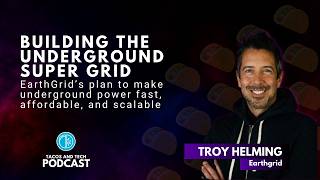
Troy Helming founded Earth Grid to build underground tunnels carrying power, fiber, and water using plasma cutters that reach 27,000°C to vaporize rock. His robot drilled a 10-foot granite tunnel in 2.5 hours, and the company now operates as a regulated utility in 46 states, offering a faster alternative to overhead power lines that take 10-20 years to permit.
Chapters
Startups get the party. Startups get the party started. Startups get the party. Startups get the party started. You want tech and tacos, Tacos and tech, you know we got it.
Hey.
Startups get the party. Startups get the party started. Startups get the party. Startups get the party started. Startups get the party. Startups get the party started. You want tech and tacos, tacos in tech, you know we got it.
Hey,
And welcome back to the Tacos and Tech podcast. I'm your host, Neil Bloom. I'm thrilled to have on Troy Helming, founder and CEO of Earth Grid. Hey, Troy, welcome to the pod.
Thanks, Neil. So happy to be back on talking with you.
I know it's good to have you here. It's been a bit since I've seen you in person, so hopefully I'll come out and see some boring soon, which would be awesome. But do you want to give us a quick high level overview of what Earth Grid is and then we're going to take it all the way back?
Yeah, sure. So Earth Grid has patented technology that I invented about eight years ago that is essentially plasma excavation and tunnel boring, using effectively like Star wars lightsabers to vaporize rock and soil with a Mandalorian jetpack blowing all the bits of rock out the back of the tunnel or out of the trench.
Love it. Very visceral and it's working, which is awesome. I have some melted rock on my desk from when I came out and saw it maybe two years ago, I think.
Sounds about right.
Yeah. It has come a long way, which we're going to talk about. But why this? I got to know where did it all start from you in terms of going underground.
So the origin story goes all the way back to 2016. At the time I was running my seventh company, Pristine sun, it was the leading developer of community solar farms in California and about a dozen other states. Anyway, we had a project in Northern California. We had to downsize by 75%. Lost out on three fourths of the potential revenue and value of the project because the transmission line that we're connecting to didn't have enough capacity. We looked at another line and it was about 3km away under protected creeks and wetlands. And we're like, okay, let's get a permit to do an overhead line. And that was going to take almost 18 months minimum, probably two or three years. So we would have lost our contract. And we got quotes for going underneath the 3km. And the cost was so insane, it was like a third of the cost of the solar farm. So kill that idea. Anyway, so we're disappointed. Drowning our tears over beers. San Francisco bar and one of my solar engineers, Dominic, is bragging to his girlfriend about how when he was a Navy seal, he used to go underwater and cut through the side of enemy ships with a plasma cutting torch to take over the ship. You know, plate falls in, water rushes in, Pow, pow, pow. We're like, dude, you're such a badass. But that night I woke up in the middle of the night, I was like, huh? He said it was 20,000 degrees. Could take his arm off if he wasn't careful. That's hot. That could probably go through rock. Up all night researching. Couldn't stop thinking about the idea. Eventually built a little prototype as a secret side project with my own capital. Funded everything for the first few years. Fast forward to today. We now have our first machine that's fully commercialized. It's digging ditches and trenches and ground vaults and caves and bunkers. That's the excavator and the tunnel boring machine. I'm sure we'll, we'll talk about that.
Wow. So it all came because of some Navy SEAL technology which probably has been around a long time, right? Wasn't revolutionary to the Navy SEALs either, that recent. But you, I think even further back, you've been, you went through like the 90s fiber broadband wars, which also was underground. Right. And as well as in many other energy worlds as well too. Just take, set the stage a little bit for just like what's, what's been the ground war, if you will, for, for trenching and tunneling.
Well, I've always been fascinated and passionate about clean energy, renewable energy. And that's because when I was a kid growing up, one of my chores as a little boy was to maintain our solar hot water heating system that my dad put on our house. He built his dream home. He's a successful entrepreneur as well. And it heated our pool, our hot tub, our water in the house. And in the wintertime we shut the pool down and it heated the air in the house. So it was a really cool system. I was around it since I was a kid, right. And I heard about my parents talking about our dependence on foreign oil and the oil shocks and all that. And so. And my mom came down with cancer and we live near coal plants which have all this mercury and toxic pollution. I thought that might have played a role. So anyway, I always wanted to get in clean energy, but I got out of college business school, there were no jobs in clean energy. So I went to work for AT&T, did telecommunications for a while, did projects, hardware type projects for businesses and so forth. And then I started the first wind farm company in Kansas, and that became the largest wind developer in the entire United States in 2017 and number three in 2018. It's now a $35 billion division of Enel Green Power, the huge Italian utility. But in building wind farms, and then I, when I sold that company, I switched to solar. We encountered so many challenges with interconnection. The biggest impediment to the growth of clean, renewable energy, which is by far the cheapest form of energy. The biggest blocker impediment is lack of transmission lines. So I'll pose a question here to you and your listeners. If you had to guess, how long do you think it would take to permit and build a new overhead transmission line in the United States or in Europe? The answer is the same in both places.
I mean, it's got to be years. Just don't know how many. Or is it a decade? I don't even know.
Yeah, the typical range is 10 to 20 years and the average is about 15 to 16 years. And most projects never get built because community opposition, oh, it's going to cause cancer for my kids. It's going to lower my property values. It's ugly. Blah, blah, blah. So they really struggle to get those things built. And if we could go underground, put them underneath public roads, we could do it in a year or two. All the permitting and the construction, regardless of the tech, whether it's ours or somebody else's. So anyway, that was a big kind of, I don't know, cloud hanging over the wind and the solar industry for decades. And when I came up with this idea, I was like, whoa, this could solve that. We could rapidly accelerate the clean power revolution because we're electrifying everything. Cars, heating in our homes, our stoves, industrial processes, everything is moving to electric because it's, you know, it's a more consistent, reliable form of energy. It's not as volatile as fossil fuels.
Amazing. I mean, one to talk about clean energy sounds like it was way, way before it had all the names that we have called it today, that's for sure. In general, people just need reliable and sustainable energy. That's it. Right. That doesn't harm us, actually empowers us to do more. Was that evident even back from 90s and early 2000s, that regardless of the technology, solar versus something else, it was just that we were lacking energy and we needed access to 10 or 100x more. Is that what was powering you?
Yeah, that. But also just the notion that coal was so dirty and expensive. And I saw that, I did a lot of research when I got into the industry. I saw that it's a technology industry. And technology costs lower every year. Right. Whether it's wind or solar, the cost of those forms of energy generation keep lowering every year. And the faster the industry goes, the faster the costs drop. And that compared to an extraction industry, whether you're extracting oil, gas or coal or uranium or whatever, those costs, you know, they fluctuate, but generally they're on an upward trend in terms of cost of extraction because we've gotten the easiest sites, you know, already, already developed. So I knew that eventually those lines would cross. And I even wrote a book back in 2004, please nobody read it because it'll put your eyes to sleep. The Clean Power Revolution. But I, I wrote about this and I built the, My dad's an economy, so I built the economic case and I was like, okay, probably sometime in 2015 or 2020, those lines are going to cross. It actually happened in about 2008 for wind and about 2012 or 13 for solar. Meaning, and it's now cheaper to build a new solar farm or a wind farm than to leave an existing gas plant or coal plant operating. It's actually cheaper to shut those plants down and build new solar or wind. That's how, how much the cost is dropped.
Wow, interesting. And, but energy companies, I mean, the big thing for them is maintenance and machinery. I'm guessing in some of the pieces, why they don't, you know, actually go maybe chop off a limb, which is kind of what it feels like. Is it just risky?
Yeah, I mean there's, there's sunk cost in these multi billion dollar 100 million plus, you know, power plants. And so it's, it's a difficult proposition to tell your investors and your lender, hey, we're going to shut this thing down and write it off as a loss because we're upside down. We're losing money on this plant because solar and wind are kicking our butt. Here's another little trivia question. In the last five years, what percentage of all new power plants in this country were solar, wind and or batteries?
It's a good one. Over 50%. 50, 50, 60% maybe.
Yeah, it's well over that. It's about 95% of all new power plants in the last five years were solar, wind or batteries. Very little coal, actually, no coal. We've been Shutting coal plants down every year. And a little bit of nuclear, mostly natural gas, has come online in the last five years. But in terms of that little 5% sliver.
All right, we're making progress, that's for sure. One big area that's missing, obviously, is the construction aspect of it. And actually, once you have a plant, you got to get whatever it is to the people. Right. And energy is just one. There's so many other infrastructure pieces that need other things now, now. And we'll get to data centers because, you know, we'll get there because we have to. But how is it all. When. Even when you wrote the book and even as you saw this coming around, the trenching, tunneling piece, how is that all mathing in? Because it's hard to math policy and regulation into all these pieces. Right. How do you start figuring out those kinds of costs to, you know, bring power to people?
Yeah, well, it's not just cost, but it's also permitting time. Right, Right. Need for power, as you already pointed out, is so acute for data centers. The, you know, the explosion of AI is just part of it. You know, data center energy growth was growing really rapidly even before AI became so popular, and so such an integral part of our economy anyway. And so permitting for overhead, as we already discussed, takes so long. The two things that can slow the clean power revolution to get more cheap, renewable power. Our permitting, which we talked about, an interconnection, which we talked about, which means lack of transmission lines. And so as I. As I talked about, it's kind of a perfect storm. When I came up with this idea, I was like, okay, well, we can go underground. And it's about the same cost to go underground as overhead. Now, it used to be like, 7 to 20 times more expensive to put power lines underground, but with our tech, we use air, which is free, and electricity, which is cheap thanks to solar and wind. And so our cost to put it in is so low, it's up to 90% lower than conventional underground. So I'm like, all right, we got the cost pretty well solved because it's apples to apples on. On overhead. Permitting is way faster because nobody really cares if the lines are underground. And then on that note, Earth Grid over the last five years, spent quite a bit of time and money becoming a regulated utility. We're a Telecommunications utility in 46 states and counting. So as a utility, we basically get near guaranteed access to put our. Our. Our tunnels under any public road, whether it's state, county, or city roads. So that makes permitting super Fast, because we get that, you know, the utility benefit, and we're a public benefit corporation, and that helps us with those utility status acquisitions. And then third is interconnection. So we're talking to a number of solar and wind developers and data center companies, and we're saying, hey, we can be your underground extension corps. We can connect a solar farm over here that's been waiting seven years for somebody to build a transmission line so they can build their project. I hear this all the time, but it's only 20 kilometers, you know, 15 or 13 miles away from a data center site or a substation that has capacity near a data center site. And so we're looking at a lot of those kind of opportunities where we can solve that problem. And to your point, it's not just power, it's also water and fiber, and they need fire suppression, and sometimes they need natural gas as a backup or as a supplement to solar or wind. So anyway, we're super excited that we're kind of in the, in the right place at the right time.
Okay, let's. Let's take it back a little bit to just like the development, the technology development, but more because there's a lot to peel back here. I think we. You also underplayed the being a registered utility, which we'll get to as well, because that gives you. That helps a lot in terms of time and cost on a lot of things. But back in 2016, what was the state of plasma? Was plasma even looked at as used in construction or anything? Or was it really like a very niche, niche area, like where you're seeing it?
Yeah, it was used primarily in two areas for cutting metal. You know, plasma cutters are, were and are a very common thing to cut through metal because plasma is the four state matter. Right. It's solid liquid gas and then plasma, and it's very hot. Our temperatures are 27,000 degrees Celsius at the core of our, of our lightsabers, if you will, plasma torches, anyway, plasma cutters and then furnaces. So plasma has been used since the 1970s in like, steel arc furnaces, solid municipal waste, where they, you know, basically take trash and turn it into dust and slag and ash, that kind of a thing. There were other use cases like remediating contaminated soil using plasma furnaces and things like that. But those were the two primary use cases. Nobody was using it in construction. It just was this idea that again, was inspired by this Navy seal. And, and so I did look up, though, there was an old paper from Los Alamos national laboratory in the 1970s where they put plasma on rock and it worked. But there were issues like they didn't have very good power control electronics back then, price of electricity was expensive relative to the economy back then, blah, blah, blah. Anyway, so hopefully that answers your question.
Yeah. And so what were the first things you did technically? Like, what were the technical milestones you had to get to to actually start, you know, melting? Melting rock?
Yeah. Well, after I did a feasibility study with a big plasma engineering firm and filed a number of patents, we built the first prototype and like so seeker side project and a, you know, warehouse in Oakland with a leaky roof and dirt floors. Anyway, it was a pretty sketchy place, but we punched a hole through a boulder with a rudimentary robot that just basically slid the torch forward through a boulder. Like a, maybe not quite a car size boulder, but like half the size of a car. And it worked. And we're like, holy cow, that was fast. And went right through it. Because I was like, this is either going to be a billion dollar company or a nothing company. And that was the moment of truth.
Amazing. What time period was that?
That was, let's see, early 2018. We finished the prototype in late 17 and started testing in early 18. And that's what. After we punched the hole through the boulder, that's just the first technical challenge. Then we realized, oh, gosh, how do we get all the spoils, including lava, out of the tunnel? And so we spent a number of years perfecting all the various subsystems, including our code name for the spoils removal system is Thunderdome. And we came up with a system, took seven iterations to finally get it right. But we came up with a system that is solid state, meaning no moving parts.
Oh, wow. You want to share more about that?
Sure. Yeah, it's. We filed some patents on it too, so we can talk about it now. But it basically, we just fluidized the spoils. Plasma at that temperature causes either spallation, which means the rock just kind of flakes off in little bits or flakes like cornflake sized bits. Probably don't want to eat it. Or dust or sand or lava. Those are kind of the four primary spoils that we have. And so we fluidize that with basically a vortex, a violent tornado inside the tunnel with movement of air. And then we use powerful mining vacuums to extract all that material. So it turns the lava, and there's usually no more than 20% lava, even in high silica rock like sandstone, but it turns the lava into silica. Sand and everything else in the sand and dust. And because we don't use water or chemicals or lubricants or drilling bentonite or any of that, it's all dry and we can sell it. It's useful for concrete or asphalt manufacturing.
Wow. Is there a part that's also ends up being structural because you're heating things? Is there anything hard enough that actually ends up being like wall structure pieces from this If.
Yeah, because we're non contact, we don't ever touch the rock. We, you know, we're using energy. It's energetic boring and drilling. We're not causing fractures all over the rock. We're not grinding away at it. And so we're, we're not weakening the rock like conventional tech and we're not paying to get rid of the, the muck. The toxic mug that could, you know, burn, burn your leg off if you stand in it. But the structural, if it's hard rock, there's hard rock like granite tunnels all over the world that have no lining at all. There's no concrete or structural in there at all because it's strong. There's caves all over the world, you know, that go through earthquakes and anyway, but, but our, our Atlas patent anyway, it's automated tunnel lining and application system. So we're, we spray with shock beating concrete as need line the tunnel. But to answer your question, if there's silica in the rock or if there's sand in there, it will create a glassy lining or it will anneal it and create some level of ground support and structural support, you know, before we come in and strengthen it, if we need to strengthen it.
Wow. So I remember and I think we first met in 2022 which is I think when Interlock Capital first participated in a round of funding then at that time the idea was both tunneling and trenching, which trenching has its own, I'm guessing different needs because now you can't go underneath as much stuff and you don't have your open air so you lose some of the heat. Like what's the difference? Take us through a little bit between the difference of those two and if that's still strategies that you're going through.
It is, yeah. For sure. There's a need still for trenching and excavation and you're right, we lose up to 80% of the heat to the air because it's not in a confined space. So we're working on designing what we're calling dragon wings that will fold over the trench as we're torching on it and we have videos on our YouTube channel and people can, can check it out. They want to see it. But yeah, there are needs for trenching. Like we're talking to some of the big, most of the big tech companies, hyperscalers and on a site at a data center they have multiple trenches and sometimes it's a trench underneath a trench underneath a trench because you've got water and sewer and you've got fire suppression and power and data and there's rules in code and how far away these lines have to be from one another and they crisscross and they're all over the place. So we have that. We have one of the world's largest tech companies asked us to bid on carving out a huge hole in the ground for a water cooling pond in granite next to a data center. We have utilities that are asking us to carve out the side of mountains so they can pour another concrete pad to expand a substation. And they can't use dynamite next to a substation because it will cause vibration and transformers can be damaged if there's any vibration. In fact, we did a test for the Norwegian grid operator STNET in Trondheim, Norway and they put like 30 sensors all over the ground, the rock wall and everything to see if there was going to be any vibration with our, our process and they detected none. So they're like, okay, so we're now, we were just told that we're going to be getting our first project in Norway to do what I just said carve will carve out the side of a mountain with the excavator.
Wow. So a lot of use cases. A lot of use cases, as in a variety of ways. I mean you're, you're a technology. You're also full like prime contractor, if you will, for doing some of these projects. And then being a registered utility, you own your own projects too, right? Theoretically, you could go build your own tunnels. How do you, how do you look at this kind of as company strategy? Like what. What is the big vision versus what's today? And all those pieces.
Yeah. Well, for those who are curious, if you happen to go to our website, you'll see our product names because we have a sense of humor, so I'll just share them. But Badass and Boom are our products. We're not going to sell these machines. Instead, badass stands for boring and drilling as a simple service or boring and digging as a simple service. So that's our construction model that we just talked about. So we'll either be the prime or a subcontractor to a big prime or whatever. We come in, we solve hard rock problems. We have no geology risk at all. We can get through anything, including the hardest rock, like basalt and granite and quartzite and gray whack and everything. We've done over a thousand tests. We can go through anything, even steel. So. So we'll do that on a construction type basis and margins are going to be good like 60 or better. We've been told by one of the biggest construction companies in North America that they turn down over 2 to $3 billion a year of trenching jobs because they don't have a good solution that is, you know, quiet and non contact and can get through the really hard stuff. So, so that's a business model for both the trenching and the tunneling. BOOM stands for build on, operate and maintain. So as a utility. Yeah, we'll own the tunnel because as a utility AT&T Verizon, Crown Castle, they own their own conduits underneath the roads as well. Right. Or above or whatever. So we'll own our own tunnel and either we'll lease out space for decades and collect lease payments by being an underground real estate developer and leasing out space for water, power, fiber, gas, freight tubes, hydrogen, whatever, or we'll put our own lines in and we'll charge a toll on all the commodities flowing through our tunnels. And that generates revenue for decades, which is why we want to take the company public in a few years. And we have bank of America and a few others we've been talking to about taking us public.
Amazing. Huge and huge opportunity, obviously. And it's in the technology is now showing that it's, it's doing it. What's next? What do you need to knock down next to start laying the ground for some of these pieces?
Yeah, the only thing that's missing is capital. It's not just hardware, which even your listeners know, deep tech is hardware. But industrial technology or industrial machinery is very capital intensive. So we're raising our series A right now we have two lead investors and it's going well. We've always oversubscribed our rounds. We're going to offer it on crowdfunding so you can find us on we funder. For us, it's one entry on the cap table, but it allows basically anybody, retail investors, to take part in this creation of what we believe is going to be massive wealth as we go out and build an underground network of tunnels, effectively an underground super grid. Power, fiber and water and freight moving around, around North America and Eventually we'll connect continents around the world. So anyway, capital is, is number one. But number two is we built our first field ready tunnel boring robot, the excavator. That was ready in the fall of last year. And that's why it's bidding on projects in Norway and the US and we're going to start making money finally, which is very exciting. Revenue customer contracts are being signed. But the tunnel boring robot is a harder problem. But we got the Thunderdome, the spoils removal system integrated into it. We built it and we have videos on our YouTube site and so forth. But we just completed our first tunnel. The world's first plasma board tunnel. It's just under 10ft into the mountain, about three meters into a granite mountain. And it's one meter diameter, a little more than three feet in diameter. And we did that in about two and a half hours. And so that's fast. That's way faster than diving carbide bits going through granite. But we weren't optimized for speed. So we're going to break that thing apart. We're doing a show and tell two of them over the next month or two for people who are interested as either customers or investors at our testing facility near Yosemite national park in California. So people can reach out to us infoarthgrid IO if you want to go see the tunnel, see the machine anyway. Gotta perfect that machine. So we'll break it apart, rebuild it. We learned a lot and perfect that. And we think that'll take a few more months.
Okay. Yeah. And there's some great videos from the engineering team of kind of vlog style of getting it to there, which is awesome. I love that you guys are building in public like that. You take us through a little bit of this AI moment because I think most people are seeing the demand just skyrocket everything is it the feel the same for you compared to the energy demand and now suddenly with what's going on there for sure.
Yeah. I mean we're getting inquiries from a lot of different locations and sources to solve the infrastructure problem. Like we've heard that some of the big tech companies own property for data centers that's still dark because they can't get either power or water to the site. Fiber is easier and so we can potentially solve that problem again be the, you know, the connection between the source of water or sort of the source of power to, to the site or someplace near the site where they can access it. So, so yeah, it's, it's a great, a great time to be in the underground infrastructure business. And the need is, it's, it's unbelievable. Even if, if you subscribe to the notion that AI is a bubble, as I said earlier, the need for compute power, just the data centers, even without AI is growing very, very rapidly. And even if AI is a bubble, it's not going to stop. Maybe it slows down a little and maybe it doesn't, maybe it accelerates. But the need for power is crazy and we can solve it with solar and wind if we just have enough transmission lines.
Speak to a little bit of how you're powering your tools themselves. So we actually didn't touch on that part. How do you power a plasma system?
Yeah, there's a misconception out there, in fact, even some incorrect articles that have been written, that we require a huge amount of power and it's, it's a lot, but it's not that much. We need for the excavator about one to one and a half megawatts. And for the tunnel or one meter diameter, we need about one and a half to two megawatts. So we actually own our own generators. You know, we have, I think, two and a half megawatts of generating capacity. So worst case scenario, we can burn natural gas, gasoline or diesel to run the plasma torches. But most construction projects are permitted over some period of months, you know, before you, you know, show up at the site, you know where, how much power you need and this and that. So give you an example for subway tunnels, for any type of tunnel, using conventional tunnel boring machines like Elon's company or anybody, anybody else using more conventional technology, they need power too. They need sometimes 10 to 20 megawatts or even more if it's a big machine. And so they simply, again, permitting takes months, sometimes years for these construction projects. And so they simply say, okay, local utility, we need temporary power on the site and here's how much we need. So that's our first choice, is to just use grid power because our biggest expense is electricity, right, Running the machine. But because electricity, as I said earlier, is cheap on a wholesale basis because of solar and wind. We're still, if we get access to grid power, we're still far, far cheaper than any other alternative for, for trenching or excavating, with one exception, dynamite. We're about the same price if we're using grid power and we're more expensive if we're using diesel power. But dynamite's not allowed to remove rock in a lot of areas. If you're near any homes or structures and that's where we can come in. So anyway, yeah, either use a generator or use grid power. And the last thing I'll say is a lot of our projects we're talking to customers about there's a solar or a wind developer involved that wants to build a new solar farm or a new wind farm farm. And they're telling us, look, we'll give you power for free if you can help us solve this problem and, you know, get us connected to our customer.
Amazing. Well, look, you've been in the business a long time. Energy, especially clean energy, has this two sip stored one step back often because of so many things. Politics, new sexy, hot things. How do you like, tell me about a moment where you're like, oh no, you know, like we missed our moment or the tech's not going to get there fast enough. Does it. Have you ever had those in so far in Earth Grid?
Oh, in Earth Grid. No, we haven't because we're energy agnostic or infrastructure agnostic. You know, I think infrastructure is purple, you know, blue and red states, blue and red counties, blue and red. People can all agree that we need better water, power, fiber, broadband, all of that. So we haven't really been affected by that. But I have had some very unpleasant periods of my life in what I call the solar coaster with the solar industry going, you know, up and down and having setbacks. Whether it's, you know, a politician in Washington D.C. that's anti renewable or whether it's a dispute in Congress where a tax incentive is not renewed. All forms of energy generation, except for renewables, have permanent tax credits, but renewable energy has never been made permanent. And so when it lapses, the whole industry shuts down until Congress pulls their head out of the sand and renews it again so that we can compete on a level playing field with coal, gas and, and nuclear and everything else. So there's been, yeah, there's definitely been moments. Whether it's tariffs or Congress or political issues, there have been challenges. But as we said earlier, even despite that, the last five years, 85% of all power plants are solar, wind and batteries. Why? Economics. Cost curve is just so attractive that despite all of the noise and nonsense, the industry still continues to find a way to grow.
Well, and like you said, regulation stops lots of people. You have found a way to use it as a weapon. Right, Right.
Interesting. I have not thought about it that way, but you're right, that's good.
That's a judo superpower right there. To actually be like, well, we are utility. And we are going to ride the wave of regulation. Regulation to a certain regard.
Right? I love it. I, I'm gonna give you credit for that the first time.
Okay. You can have it for sure. Ten years from now, when you know when, do you think you're more proud of what's changed from how much infrastructure you've built and how much things are flowing or from how or from what is actually just changed from our quality of life because of what's flowing underground?
Yeah, that's, that's a tough one. I would say the latter quality of life because in 10 years I believe Earth Grid will own a super grid and underground super grid and we will be providing better broadband, cheaper, cleaner power. Our food, our air, our water will all be cleaner because there'll be less toxic pollution from gas and coal plants. So yeah, it'll be quality of life that I'll be more proud of.
Amazing. Well, 10 years is a long ways away. We know that for sure. But you've been working in many 10 year frames for a while and this 10 years feels like, feels like the next 10 years is your moment here for the robot to break through. That's for sure. Break through a few thousand miles and then like you said, through other continents. One thing that probably has already have a great quality of life is the things that we eat and therefore probably won't change too much. Maybe how food is grown, I don't know, but the food itself, luckily we love food and being the tacos and tech podcast, everyone's got to know what is the food that you go to, what are the tacos that you grab for at the end of a day when you're shaking off all the dust from a grinding site or a boring site? Sorry.
Yeah, my go to spot is LT Toucan, like the toucan bird. It's in Richmond, California, which is where I live. I live in Point Richmond, by the, by the club on the water. And anyway, so yeah, Tacos L Toucan is, is my favorite. They have red burritos, red tacos and just. Yeah, it's amazing. And they're open super late. Sometimes I'm up late working or working out or training ninja warrior obstacles or whatever. And so it's, it's my go to love it.
All right, well, I have to come, I have to come visit. I still haven't been to Richmond to see you. So that will happen. And then maybe on a trip out to Yosemite to see the job site in the next few months we will stop and see have some elan tacos and burritos. I'd love to do that.
Sounds great.
Troy, thank you so much. Thanks for being on the pod and thanks for building building the underground super grid.
Thanks for having me, Neil. And I appreciate your time and attention.
Of course.
Tacos and tech is on smash for the green guacamole keeper. Counting counting beans Contador Quentan frijoles found us trying to raise some queso la vida San Diego school of rappy rapping fire tortillas round jalapenos in these modern times a craft beer and coffee my coating yoga posse fold the body origami we be surfing coronado eating tacos El gordo the taco standing puesto lucha libre and sombrero got a shout out to cost angels by the ocean watch the sunset La Hoya shows entrepreneurs trying to get funded When San Diego Startup Week is popping in the summer Oceanside the Tijuana St be full of hustlers from couch surfing to penthouses right on the beach Tech leaders who believe stars are within reach we interviewing founders who be shooting for the Moon SD TechOS with your host Neil Bloom. Startups get the party Startups get the party started. Startups get the party Startups get the party started. Startups get the party Startups get the party started. You want to checking tacos tacos in tech you know we got it.
Hey.
Startups get the party Startups get the party started. Startups get the party Startups get the party started. Startups get the party Startups get the party started. You want tekking tacos tacos in tech you know we got it.
Hey.
Sam.








