Burbank Tech Talk - The Future of Creatives - Full Panel
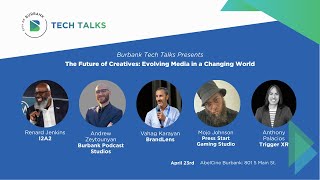
Renard T. Jenkins moderates Burbank creative leaders discussing AI's impact on creative work, XR applications, and what the city needs to keep talent. Panelists stressed that AI generates but humans create, and flagged economic pressures and the need for affordable collaborative spaces and youth programs.
Well, first of all, thank you for coming and welcome to our Burbank Tech Talk. So my colleague Marissa, she is usually the one who does these introductions and she was out sick today so excuse me if I read off of her her notes. On behalf of the City of Burbank Economic Development Division, I would like to welcome you all to today's event. Burbank is the media capital of the world and as a high tech hub, Burbank's competitive environment attracts businesses because of excellent city services and desirable incentives of no city income tax and no gross sales receipt tax. Our Investment in the 1 Burbank High Speed Fiber optic broadband network has favored the growth of the creative industry. Burbank also boasts several important components that make it a strong part of the local tech ecosystem, including flex and creative office space and co working space. Our economic development team plays an integral role in fostering entrepreneurial growth in Burbank by providing mentoring and networking opportunities via our Burbank Tech Talks and the Startup Burbank Pitch Fest. And speaking of the Pitch fest, here is the flyer for our upcoming pitch fest on June 26th. So we hope to see you there. There are many exciting things happening in Burbank and we invite you to join us as we continue to grow and evolve. It's a great time to consider Burbank as your next home base. If you have any questions, feel free to connect with us. You can find out more information about our upcoming programming and resources@choose burbank.com and now I'd like to pass the mic over to today's moderator, Renard Jenk.
Thank you so much, Odette. Good afternoon everyone. Good evening and good morning. If you're joining us internationally or if you're on a plane with me and I'm crossing time zones, I am Renard Jenkins and it's Renard T. Jenkins. There's some other Renards online. Don't follow them, just follow me. I am a recovering studio executive. I have been in the business for 37 years, so I'm excited about where things are going, but I'm also cautiously optimistic about where they're going. As we know our industry goes through change. Probably about every 10 years we see something happen and we see a seed change. We see people actually start to pivot and figure out what their next steps are. This one is particularly disturbing to some people and I want to acknowledge that fact that yes, we have a technology that has the ability to do a lot of things and in the wrong hands it has the ability to do a lot of wrong things. But what we're looking at as far as this industry, just in general, we've seen things come and go. We've seen us move from analog to digital. We've seen us move from standard def to hd. We've seen us move from manual to automation within our supply chains. We've also seen the influx and the prevalence of computer generated graphics. And how many people remember when that happened, Everyone was like, oh my gosh, the whole world is crashing. Our industry is going to come down. We're not going to be in jobs anymore. But it was because of the VFX industry, how they actually embraced it and then begin to generate new jobs and begin to generate new opportunities. That's what I see us doing right now with artificial intelligence. We have to think differently about it. Look at it as a tool and then look at how it can actually enhance your workflow. But really and truly look at how you can move along with it. Because AI is not a creator. AI is a generator. And it generates based off the knowledge that we actually put into it as a model. Human beings are creators. If you've ever asked AI to write a script for you, I guarantee you you're going to rewrite it. I'm not going to sit here and tell you that it's going to pump out something that is theatrically ready. I can tell you right now, if you ask AI to create an image for you, it may or may not have many appendages. So you are going to have to go back in and you're going to have to do some image editing. It's never going to get it exactly right. However, there are tools that are being created, just like there were tools during the digital transformation for photography that are allowing you to be able to manipulate these files in a way that only humans can. If you've ever asked AI to say, hey, I'd like for you to create a cinematic scene for me in 16 by 9, can use a 14 millimeter lens. I want a nice wide shot and I like for the characters to be looking at the screen. When you give me this image, you will get images and you will get images. And you have to iterate and iterate and iterate until you get close to where you want it to be. And then you have to actually still go back in and manipulate it to be what you want it to be. When you talk about text to video, looks great if you want to moonwalk your way through life, but it does not look great. If you are trying to get human physics into Play, however, that's something that we can do today with human beings. So with that, I'm going to tell you to be optimistic, to be cautiously curious and to lean into what's happening in our industry right now. But don't panic because we've been here before and not only have we survived, we've actually thrived. So with that, I want to thank you for coming out and spending your evening with us. And we're going to get started here with this illustrious and I do mean illustrious panel. So we've got Andrew Zitoyan, who is the CEO of Burbank Podcast Studios. We have Vag Karayan who is the co founder and CEO of Brand Lens. We have Daniel Mojo Johnson who is the founder Press Start Gaming Studio. And we have Anthony Palacio who is the SVP and creative director at TriggerXR. You can see we have a really well rounded group of people who represent various aspects of our industry and they're all right here in Burbank. With that, the first thing I want to do is give them an opportunity to tell you what each one of their companies do. And we're going to start right here with ZAG and have you start us off.
Awesome.
Thank you. Thank you. Hi everyone. I'm glad you were able to make it. And so a little about myself and Brad Lenz. So I'm Vahag. I've been in burbank for over 26 years now. I love it here. It's awesome. It has its ups and downs. But I'm here to stay and we'll discuss about some of the challenges that we're facing right now in Burbank later on. So my background from NASA to missile defense to medical devices, then I started working for entertainment partners, which you guys love and hate probably at the same time for about five, six years. And after that I was able to leave and build my own company. RAM Lens. RAM Lens. What we do is we basically build a platform that allows any organization, any company to get user generated video content directly from consumers and make it very easy for consumers to submit video content. It's either collecting user generated content or doing building experiences and activations that people can participate and have fun with and post on social media. So we basically try to make that very easy to do. That's me.
All right, Anthony, you're up next.
Paul.
Can you hear me now? Yeah, I'm Anthony and I'm one of the founders at TriggerXR and it's been around for 20 years and we got our start doing film marketing for all the local studios. That's personally my first love. We've evolved and have started doing digital experiences not only for. For films, but for brands and recently sports and so augmented reality and most recently in like, virtual reality. And yeah, it's an interesting field. As Renard said, you know, AI is starting to become like, you know, a prevalent entity in how we do work. But as you said, it's a tool that's to be used. It's not something that's necessarily like, driving what we do. So.
Yeah. All right, Andrew.
Check, check.
Hey, everybody.
I'm Andrew Zaytunian, one of the managing partners at Burbank Podcast Studios. It's literally what it sounds like on the tin. We are a full service podcast production and management agency. So if you want to start a podcast, if you have one and you need clips made for you or you want production work done for it, that's what we do. In a nutshell. There's a little bit more of my partner saying, daggers into my eyes, but I can't remember it off the top of my head, so you'll have to forgive me and I'll pass it off to.
Bella. Ella. Hello.
Sorry.
You can pass the other one off the 4J.
There we go.
Hey there. Okay.
Hello.
Hello. Hello.
I am Mojo. I'm a video game design teacher. By day, excuse me. By night, I manage. I'm a founder at Press Start, which is a creative hub for students and community where they are trained on how to create content using all new technology like Unreal Blender, Houdini, and all the. All the AI you can think of. I strongly encourage using AI for my students and for the community as well, and basically building the ecosystem for them to be able to create content and monetize their content in a platform housed just for indie creators.
I think that's awesome because when I was a kid, you know, the only thing I could monetize was cutting people's grass. So always good to see that the younger people are going much further than I did. I didn't actually tell you what I do, other than being a recovering executive. I am the founder and CEO of i2A2 and we are a technology studio and a lab. We focus on building tech for. And we're B2B and we focus on building tech for artists and making it transparent. Our goal is to make sure that people can focus on the art and less on the tech. And we also create animated content and, you know, pitch decks and all that wonderful, fun stuff for studios and everyone else. And we also do marketing and research and content engagement. So you remember the old focus groups. We take you all the way to 11. It's got neuroscience involved in it. We have biometrics as a part of all the stuff that we do. We truly give you deep engagement and not just your general sort of group think of having people in a room. So that's what I do. But we're going to get back to the panel because it's all about them tonight. So, Andrew, we're going to start with you. Podcasts have just exploded. You know, it's almost like everyone wants to be an NPR announcer now. So tell us, what's the happening thing that's going on in the podcast world? Also? What is the sort of technological advancements that are helping you in your space?
We're still trying to work. There we go.
There you go. So.
The podcast space is very fascinating. It's basically been exploding, as you guys are all aware. Everybody here, I'm sure, has watched or watches a podcast, and what. What it is, is kind of evolved, too. It's not, you know, back in the day when Apple started, they. There's no way they envisioned what it would turn into today. So I think my, you know, idea of a podcast is expanding way past that. I think it could look like a TV show. I think it could look like, you know, your kitchen, and you're just recording in there, doing whatever it can look like, anything. So as far as that, as far as where it can go, I don't. I don't really see an end to it. I think podcasts are just going to continue to evolve and expand, and you're going to see different kinds of things, things that it's even hard to verbalize because there's no way to know what it's going to turn into. But you're going to see weirder and weirder stuff. I think it's already kind of like that, but it'll get even stranger because people are going to get bored. People are going to want to do new things, things, and that's just the natural state of it. So if there's anybody in the audience, for example, that wants to start, one, my immediate impression would be to tell you is just do it, because you may like it, you may not like it, but without even trying it, there's no way for you to know that. And your flavor will continue to add to that experience of everybody else, and it'll just continue to snowball and snowball and snowball. So I think it's here to Stay. I think that, you know, and some of you may work for the industry, so please don't take this wrong way, but I think that traditional media is on its way out to a certain extent, and maybe not the future, but I think that eventually you will see, you know, podcasts maybe not over. No, I'll, I'll commit to this. You'll see podcasts overtake traditional media. So that's where I see it going. That's kind of how I envision it. It's just a really, it's a mixed pot, a lot of things good and bad, and we'll see where it ends up from here. So.
All right. No, now that you've pretty much alienated half of our audience, you know, there's nothing else, nothing else I can do with that. I will say that we're going to come back to you in about two years and see if your prediction is correct. All right. All right, Vog, we're going to come to you for, you know, really, you're on the front end of trends as far as brands and marketing and things of that nature. What trends are you seeing in how brands engage consumers through the use of short form content? Not like podcasts, but short form content.
So you know what, actually there's a good transition from podcast to what we're seeing, you know, basically on the podcast. And you're seeing more and more people trying to be creators. You know, they're trying to be, you know, they're trying to do podcasts. If you backtrack 10, 15 years, you know, ago, all of us would be sitting here looking as like, oh, no way. No, I'm not going to do anything like that. I'm not a creator, right? But now everyone is a creator and that's how we see everyone and that's how we see the world, and that's how the world is changing. You are consuming content on TikTok, Instagram, YouTube, shorts, we have short form video content. So I'm sticking to short form. But generally you're consuming content that your peers are making. Every one of us is a creator and that's what we are seeing and that's what we're trying to capitalize on. So on our end, the short form video content, we basically give the brands and any organization the ability to build experiences. So regular people are not shy to participate in. So things like on screen instructions where you could pick up your camera and follow the prompt on screen and record your own video. The reason people are not really creating, not everybody fully committed to creating is because you don't know when you pick up, what am I going to say? What am I going to do? Imagine if that bar is brought down now. That makes everybody creative. So the trends we're seeing in general, the trends are going that way. Everybody wants to do something, create something, because everyone is consuming more and more content. So what we're trying to do is bring that bar further down to bring everybody at the level that everyone can create. Of course we cater to brands. We are B2B and they create the experiences so you can participate in. Those are the trends we see.
So very cool, very cool. You've redeemed our panel now. So I appreciate that, I appreciate that. So, yeah, trust me, we'll get to the alienation. So speaking of aliens, let's talk to Mojo about what's going on in the gaming area and. No, no, no. It's an easy one. No, no. Well, how do you design games that create both emotion? You got it? Are you good? Yeah. There you go. Okay. How do you create games that create both emotional connection and community? Remember what I was saying earlier that AI can generate, but it cannot create. It also cannot emote. To be honest, there are some people who are working on some things and trying to get close to that expression. But how do you approach the emotional connection with gaming as well as, you know, dealing with the tech and dealing with not only being a teacher but also a student of the gaming industry?
I would say first of all, like everything that Press Start is geared towards is, I guess I would categorize it as emotional and like community led because that's our main, our main focus is to, to reach the community and reach those stories that are untold by those, those, the people in the community. So anytime I'm teaching somebody, especially like a first time student or someone in the community, I want them to, to I explain to them that we want like when you're creating whatever it is, if it's a character, a rock environment, whatever it is, like take something from your personal, for your personal background, something that, that feeds your creativity to, to put into whatever you create. So you can see yourself in that even if you're using AI, if you have a story, if you're a writer, okay, this, I got my characters, I got my, my, my environment, I got this, that and the third, maybe I'm going to use that AI to help me flush out an environment because one of the details aren't fully flushed out. But you, you want to, I would say to using, using that as a, a more as like a, as a partner or assistant, as somebody that can help you on a project rather than shying away from it, looking at something that, that, that's, that's scary and intimidating and like it. It's the analogy I like to use when it comes to. Sorry if I'm going off on a tangent. I feel like I'm going to a lot of different places. But like using AI is like. Using is like doing, doing the dishes with an octopus. You have like a lot of different reach and you can do so much more. And as a party of one, like when I first realized that I'm going to be the one taking this, this journey on game design, when I said I'm going to teach myself every aspect of game design, I learned every single aspect of it just so I could go and then teach that or if I knew that I was going to have to do every aspect by myself, how I'm going to go about doing that. Now with the use of AI, you have that partner to like flush out ideas or like bounce ideas off of. And so equipping the community and the kids in the community and everyone in the community with those tools and let them know that not to be afraid of it, to embrace them. Yeah, that's.
Well, you can tell you're a storyteller because I have in my mind right now an octopus doing dishes. That was such a great visual. You know, that's really cool. But I like what you said about teaching someone how to be well rounded because they used to call those of us who were both left and right brain. We were called unicorns. And people would often think, why is that kid overdrawing in the corner? But then that same kid could come up and do a calculus problem with no issue. Teaching them to be well rounded in our industry right now is a great skill to have because pivoting in this industry is how you get longevity. Understanding that is a good thing. So now we're going to go to Anthony and we're going to talk about something that's been around for quite some time. People have been playing in the XR space for quite some time. However, it's never sort of just exploded as big as people actually thought it was. The valuation for XR companies at the very beginning were very, very large. And then people were like, well, well, it's not going very far now we are seeing that explosion actually take place. So from your vantage point, what's driving that and how do you see that becoming more of a play in the entertainment space?
Yeah, it's been around for a long time, like 15 years. We did our first AR experience for District 9, so it has been around for a while. Yeah, I think the first, I think the first iteration was more of a thing of like, build it and they'll come. And I think over time you kind of realize, okay, that's not really going to work because we're just not seeing, seeing the traction on that. So now I think especially with the way that, you know, the economy is, it just, you know, ticket sales obviously have taken a hit. Right. So studios are looking for a return on investment. They're not only looking for something that is splashy, but they're looking for something that is going to just overall enhance the story and really, really make a difference in a campaign. So it's not, it's not enough these days just, just to make a face filter and call it a day. So case in point, we did a project with Sony Pictures for the Phantom movie and one of the big story plots is, you know, this horse gets overtaken by this symbiote. So how are we, how do we, how do we enhance that? How do we make that story part of, of someone else's story? So it's short form video or post that on social. And so we used AI to help tell that story and we worked with Getty Images and use their machine learning model. We did the front end plugged into their scan to see if there was an animal in the photo, if it was awesome, if there were people in it, can't use it. We're talking about the animal here. Let's make that story about the animals, that people shared it and it was a hit for the studio. That's what they wanted to tell. So it really is more about how the tech is going to enhance a story. Much more than just doing it for gimmick's sake. There's also the aspect of utility now that just wasn't there before. And we're seeing an influx of sports leagues coming to us for that utility.
So.
Like real time scores, telemetry and wayfinding at events. So those are the types of aspects that people are going to be wanting to use AR for or xr not only just to make things look pretty, adding effects over like a stadium, but actually finding where the exits are or what the score is now or who the player on the field is there.
That's a pretty immersive experience too. The folks down at TV Global in Brazil have been playing around with sort of using the biometrics and the analytics across the pitch when they're having some of their soccer games or some of their football games. And it's amazing to see how involved you get with keeping up with each one of the players. Like stats. It's almost like a video game where you're like, okay, I'm going to see. Until. When does his battery go? When does he start to lose his power? And so forth. So it's an interesting way to watch live sports. So, yeah, that's pretty cool. So we're going to get. I purposely went down the line to give you the. The chance to get to know each one of our panelists. Now we're going to talk a little bit more generally about what's going on in the industry, and each of them represents a different part of the creative ecosystem. But the question I have for you now is how do each of you Define creative in 2025? How do you define what is creative, or who is a creative or how to be creative in 2025? And that's open to anyone who wants to answer.
Does it. V. Stop.
Stop.
V. Yes. I feel. I echo when he said, I feel like everybody is a creative, no matter how others receive it. So you're a creative in some kind of way and having that. Having that access to be able to create, create faster. So if I'm the writer out there that doesn't know how to storyboard or know how to draw or the artist that doesn't know how to necessarily how to put out a story and put the pieces together, but they can do amazing concept art. Those are, like, things that you can stitch together using, like, AI platforms, I guess. And to help people that don't feel like they're much of. Much as a. A creator, have them to bring that out more. I feel like that's another way to use the tool like an AI tool to, like, help you be that creative that you want to be if you're not necessarily. If you don't necessarily feel like you're that creative.
All right, go ahead and just.
I'm gonna swap over to this one. We're just gonna pass the screen one, guys. Yeah. I want to echo exactly what V and what. What you just said, but expand on it just a little bit. I think that it goes past that. I think that, you know, a cook in a kitchen is now creative. I think that a roofer is now a creative. I think that anybody that's making something has that potential in them because the space has opened up so much that the minute that you pull out your phone and you record it and you upload it. That's it, you're done. You know, it's just instant. So I think that it's all encompassing at this point that, you know, it's, it's no longer a thing where you have to have some special talent to be able to, you know, say that I can create something or I am creative. No, you all are.
So at the very least that content creative because it is content you're creating. So at the very least your content creator because, you know, as soon as you're putting your, your life out there.
Yeah, I mean, I would.
Play over this, I believe.
Yeah, I definitely would agree that. Yeah, everyone at this point is a creator doing. Can be my mom. I mean she can create some mean tacos. Absolutely. So everyone in.
Don't.
Can't alienate. But yeah, I think for the most part there is so much content being generated. But in, in my, in my field, you know, I'd like to think, you know, my team, we're, we're in charge of that creation.
Yeah.
For our clients. But what I found is that the most successful projects have heavy, heavy participation from our partners, from our clients and heavy input. I just don't think that creation is created in a vacuum. It is an active participation from, from groups of people. I think that's where, that's where you strike gold is, is having that participation level more than just one person's life experience, but multiple people or from expertise. Look, we know who our audience is, so this is who they are. Build it for this and then validating that through, you know, through tests, market research, just small, small, you know, test groups, things like that.
So. Yes, and through I282. Yes, yes, yes. Very, very much so.
Just to look like how many stories, how many different stories are there in this room right now? But every single one of y' all have at least one story you could. Yeah. That you could share and be like, oh, why this person? We click the like on this.
Let me tune into the next one.
What else you got for. Yeah, it's open to everybody. And like one of the things, the press start platform that we, that we're doing is like it's a two part festival. The first part of it is for creators of all backgrounds. So if I, if you have a filmmaker and a 3D modeler and music, music maker, music producer, those people come together and, and create something together and then the second part of the festival is for them to showcase like a, A what is movie showcase premiere. Like, like A premiere.
But it's.
Yeah, there you go. Thank you. Film festival. That's the word I was looking for. But yeah, so it's like, like, like I see that as well. So that's why it's like creating that platform for people to have a place to create and, and share their content that they're creating. It's not just locked down to YouTube or Netflix. And you, like, have a bigger platform for any. For others to create.
Yeah.
So I'll add one thing. So then the question becomes, if everybody's a creator, how do I differentiate myself? So how can I be better creator than others? I think there's two ways. One is you're going to have to be able to think out of box. Stuff that hasn't been created, stuff that you know is going to be a new experience for other people that's actually very, very hard to do. So there are people who do that, and that's awesome. That's why sometimes you. You see feature films that blow your mind, et cetera. So there are some people who are really, really creative that differentiate themselves. So you either can be that person or there's. My favorite quote of all time is the future is here is just unevenly distributed. What that means is somewhere someone has done something that in your industry or in your vertical hasn't been done before. So can you find that and apply that in your vertical and make that creative for that vertical? Now we have AI. So if you can be creative enough to be able to use AI as your sidekick, because it knows a lot about a lot, and pick from places that will apply in your area to be creative that would make you differentiate from others. I hope that was.
And plus, nobody has the same story.
No, no, you're exactly right.
I guarantee nobody has the same story as me. And I guarantee my story isn't the same as everyone else's. It's about how you put it out there.
Yeah, I think those are all good points. I have a theory when it comes to creativity, and I believe that we are all creatives. I do believe that, and I think we were all creatives starting in kindergarten when we were playing with blocks or clay or whatever it was. And we don't lose that until it's beaten out of us through life. So not to be a downer, but all of a sudden when you find yourself maybe having a therapy moment right now, but you find yourself in an executive suite and you're there and you're enjoying yourself and you realize you're like, what in the world am I doing? I'm a creative. How am I going to survive in this space? Well, you begin to use that creativity to actually be creative within your job that you have. So, you know, for me, that was one of the things that helped me last 37 years in those types of jobs because I enjoy the creativity of not just leadership, but in creating things. And so I do believe that we're all creators. And I do believe the VOC hit it on the head when he said, how do you differentiate yourself? It's the same thing. If we all now have this superpower of AI, what makes what we do special? You know, when I think about the fact that individuals who have an English major, for years, when it came to technology, they were all like, no, I don't want to be a part of this. This is crazy. I don't even want to have to learn math. I don't want to have to learn this. I learned English. Now, if you're an English major, you have a leg up on most people because you understand the language and you understand how to actually create prompts that can get more out of the system than a person who does not have that superpower. So there are ways that you can differentiate yourself. And that's a very good point. Very good point. I love what you said there. And I love what the rest of you said, too. Don't get me wrong, I love All God's Children. I'm not trying to play. Not playing favorites here. So when we talk about that now, we also notice that with this sort of influx and almost like an overload of content, we've also noticed a change in audience behavior and a change in the way that brands are starting to manipulate, because it really is marketing is manipulation. We know that. It's manipulate the environment to take advantage of it. So from your perspective, what do you see that drives, I'm going to say, positive audience behavior. That is actually something that we can lean into from a brand standpoint or from a product standpoint.
I actually think it's fairly simple from a brand's perspective. Just go with whatever fun people are having on the particular platform that you're advertising on. So if you're on TikTok and you're seeing that.
Excuse me.
And you're seeing that people are, you know, doing a certain thing that they're clearly having fun with. Well, maybe that's something you lean into. The only question there is, I don't know what, you know, production time looks like in that environment, as I've never worked in that Environment. So I have no clue. So you do need to be able to iterate very rapidly and whether that means you have, you know, small couple people teams where you can do that kind of work in or not, or a different method, but I think that, you know, that's one way to do it at the very least is just lean into the fun people are having on the platform and see where it goes. But you need to be able to rapidly iterate. You can't just have a month long devt cycle on that piece of media, otherwise that trend is gone.
Yeah, and Andrew, I think you, I think you have a good point there. The other thing is how do you, I guess modify your process when the distribution platforms or the distribution direction changes? How, how do you do that?
Sorry, can you maybe rephrase that?
Yeah. So think about it. Like you said, go to where the fun is and essentially be the fun. Now we know that a lot of these apps, they pop up and they go away and then the new latest thing comes out. How do you quickly pivot to be able to do that? What do you suggest in that space?
So it's kind of like what I said. I think small teams work best for that kind of thing. You know, if you're a big company, you can put it together. A small team. I don't think that's necessarily an issue. Whether there's a, you know, desire to do that is a different question. But I think that that's the best way to do that. So create small teams within your company. Maybe decentralize the process. You know, have a couple teams that work on different apps. So one team works on Insta, one team works on, you know, TikTok. And they're separate but they can collaborate if they choose to. But that way they can both iterate independently from each other and be able to respond to changing trends on those apps separate from each other. So a little bit of flexibility to your teams, I think it's probably the way to do it.
Okay.
Yeah. I think to that point is start small. So if there is something that you want to build and something that like say, you know, that you know, will attract the viewership that you're looking for. Like, for us, like we're, we're building XR experiences.
Right.
It's daunting. And I think the first instinct is you want to be all things to all people. But I think the thing to keep in mind is be useful and what value is this going to add to that specific person. So in, in like a sports aspect of It, Right. We, we're building experiences that are educational so it's a deeper dive into those sports. Yeah, but we'll only build a few modules to start, see what the reaction is, see where we're getting, you know, the most interaction from and then expand from there so we don't just throw everything at it and then hope that people react to it positively and then forget about it. Instead of blowing all of that money, one big massive thing, we'll start relatively small and then expand it and then look at the different platforms that you can maybe migrate that to. So maybe it'll start on headset, but can it migrate over to a phone or vice versa? Yeah, so that's, that's another way of looking at it as well.
Good.
It's awesome.
So from the brand's perspective, you know, as far as marketing is concerned, you know, generally digital marketing and whatnot, definitely the direction is authenticity. I think the word has been overused, you know, but it is true every one of us now because we see so much different content everywhere. We gravitate to whatever is authentic. And I think that's one of the things that's going to differentiate between the AI platforms. AI creativity versus something that is created by human, authentically validated, etc. So that's the direction that is going. By the way, I'm a huge AI, you know, proponent. So I'm. But there's that. But that at some point we as humans are going to want that, that authenticity is going to become even more and more important. But as the developer direction is going, so a lot of brands are leaning towards influencer content. Obviously we know, we see it, we shop through influencer content etc on social media. But the direction I see it heading, and that's kind of basically what we're betting on is that we as users, as consumers are going to be part play part of that. If I'm passionate about my car, which I am, I'll be happily create a short video or something for the brand because that's something I like know. So we are all like extension of brand, you know, little, little influencers that can influence the people around us. So that authenticity is a big, you know, component right now. And I don't see that changing. That's just going to become more important as AI starts becoming everywhere.
And that, that's. So the, you know, you mentioned authenticity and that is one of the things that we, you, you can tell, you know, automatically when you, when you see an ad or you see something come up, you can tell automatically Whether it's an authentic, you know, endorsement or if someone's just being paid to say something and that, that's really, really good. So we're going to bring this back home. And Zach, since you're, since you're the, the resident, long lasting Burbank person, we're going to bring this one to you first. You know, Burbank's role in this whole ecosystem, you know, this has been a hub for media and entertainment, it's been a hub for creativity. It's been a hub for a lot of things over the years. So in that vein, what resources or community elements do we need to build to retain creative talent here in this region?
This is where I start. Alienating.
Yes. This is where you alienate the audience.
No, but I have a little. So, you know, let's acknowledge AI is disrupting everything and it will continue disrupting. That doesn't mean the studios are going to go away. They'll be there. But, you know, studios with less people, you can do more. There's no question about that. It's going to happen. However, in order for Burbanks particularly to stay relevant in the world, just the way we have been in media space, we need to invest into something smaller. Entities that are trying and creating disruptions. We need to have things that the city needs to help things startups or creatives, just like every one of us here, resources, you know, spaces where we can collaborate, you know, subsidized by the city, helped by the city, etc. Etc. So not just focused on the big studios, how to keep the studios here, but focus on, on, hey, what if the studios get smaller? What if the studios decide to leave? What if, you know, it is a real disruption, what comes next, we got to be betting on that as well. Yeah, I think that's where the city can help and actually allocate more resources. That's what our city needs, where the smaller players who could be disruptive and then sudden something becoming big and then basically fitting the whole city. Not fitting, but in order.
Yeah, yeah.
Becoming the next player or two. I think we. Burbank is doing a little bit, but I think it can do a lot more. It's not. I don't think it's doing enough.
Okay, that's my. I would say by investing in the youth because they are the ones that are going to be the ones that are holding positions in the future. So the more access they have, the more they have available to them, the better the outcome. And I think things are starting to downsize. Whether they get bigger in terms of, like, game design studios. More, A lot more indie studios are popping up because they have more access because they can make a game and whatever they need to pretty much at their house. And the production studios are getting smaller because people can green screen their room and start making their content on their own. Unreal Engine gives you the access to be able to, to, to do things like that blender and other 3D packages like that, along with AI, like, so if they have the access and they have a place to create this content. Like summertime comes up, kids completely shut, shut down. They sitting in the house, picking their nose, scrolling through whatever they're not creating. They're not keeping those creative juice flowing. So they have enrichment and something to keep them active during the summertime, during the downtime. Boom. Yeah, keep doing that.
Oh, I was just going to say, like, to your point, I think collaborative spaces is huge. We've got a lot of, like, remote people. But having collaborative spaces in Burbank that, you know, VR developers, mixed reality developers could go to create this content and possibly collaborate with other, you know, creators would be huge.
Yeah.
And, you know, that could be a commercial space that could be used for an educational space as well. And having those, those resources available, available to people that may not, you know, otherwise have those resources. And then that ties in again to what you were saying about that level of authenticity. So then getting people that may not, you know, have access to it previously, being able to, to learn and collaborate with people that do know how to build them would be awesome.
And aside from AI, I think probably the second biggest elephant in the room is probably the economics of it all. And I'm not even sure if this is the right place to ask for this, but somebody please call Sacramento and ask them to figure that out, because I think the state is probably doing more damage than any city in California. And, you know, maybe I'm not as hopeful as some of the other panelists on here, but I think that we need to figure out a way to either rein in some of these, some of the excess increases that we're seeing or otherwise figure out ways to maneuver around them, you know, like doing things at your house or at, you know, a small little office that, that you're renting out somewhere. But I think the economics are definitely doing a lot of damage as well. So it needs to be renewed.
All right, I think it's time now for some questions from our audience. So let's see. We've got one in the back already.
Yeah, I'm sure I'm not the only one here.
And tell us who you are.
Hey, Ernie Burbank, resident for 50 years.
All right.
Yeah, so I'm in the sound business, and so I'm sure I'm not the only one who hasn't worked in years or months, whatever. Pick your number. But it seems like, what are the studios doing? Where is the. You know, I don't understand how these, you know, the streamers or the big companies. I know they're all trying to maneuver. Where's the best place to monetize their product? But you can't have a business if you don't make anything. I know a lot of this sort of cutting costs. You know, after the bubble of COVID made sense to kind of regroup and say, okay, we spent too much money. We don't have the subscribers. Now we're spending too much money on the Game of Thrones. And, you know, now all the. All the shows seem to be, you know, Real Housewives, you know, and so that's a cheap way to make money. But scripted television is, like, going away. And I've been in animation for a long time, and even Disney's making less scripted animation. You know, series television for kids. They're all watching YouTube and TikTok, and they don't want scripted television anymore. So I want to know, does anybody have an idea where the content is coming from? I'm in post, so, you know, somebody's got to make something for me to make it sound good. If they don't make anything, you know, if everything is a podcast or everything is just shot on their phone and then uploaded to TikTok, then where is the business going? Anybody have a clue?
No, I think, you know, I got to tell you, Ernie, I think you sort of hit on a lot of the reasons that there really is isn't an answer right now. The streaming wars decimated the studio model. It exposed it for essentially what it is. And then we have content being generated by everyone, and people have sort of decreased their level of quality. It's no longer like, oh, I want to have, you know, the big blockbuster, and I want to go on Saturday night or Friday night and watch this. People are being entertained by things that are a little, you know, less quality. I'm not gonna say it's bad, but it's less quality. And we've learned to accept that. Do I see us coming out of this? I strongly believe that storytellers will rise. I believe that that will happen because a good story can make bad visuals look Good. You know, you will watch something that has low quality if that story is engaging to you. So I think what we have to see is more, more being put into the storytelling aspect of what we do. And then we'll see sort of our industry change. I think ZOG said it, you said it best when you said the studios are changing. They're going to be very different in the next few years. You know, we're going to see the independent studios like really have their heyday. If you haven't already seen it, I mean, look, a 24 has just been killing it, you know. But they're not the only one. Macro which is right here in, you know, in LA is another one that has been putting out incredible content for years. You're going to see more of that happening. And don't give up on animation because I was just in a meeting today and there's more animation coming, I can promise you that. Because that's something that my company does as well. That we saw a wonderful sort of renaissance of animation over the last two years. All of a sudden we had just this great stuff coming out and then the one that was really pushing a lot of that and I'm not gonna call her name out cause it's in public. But they pulled back after realizing that series weren't making as much money as they thought, but features were. So you're probably gonna see more of the wild robot type animation coming along. You may see some series kind of get out there, but if a series gets picked up, it's of kind got to be good and it's got to be good within, you know, whatever period of time that they're using for their marketing and research. And if it's on a streamer that is usually about 28 days. So if they don't see a certain number by 28 days, that series is not going to get picked up for a second season. So that's why you're seeing sort of this, this condensing of what's going on. And you know, I'll definitely, you know.
Sorry, I've been dying to say something.
Please.
Brain juice is going. Oh, I think that it kind of goes back to what I was saying in regards to, you know, social media. Teams at companies just expand that thought process out to media in general and how you would create it. So instead of spending $300 million just on production for a film, you can split that amount up several different ways from five different different films with original authentic content instead of this. And I don't know how all of you feel about it, but we're basically just getting rehashed. Reused storylines, they're not new, they're not innovative, and quite frankly, they're. They're just boring. So if you're spending $300 million to make something boring, nobody's gonna watch it. Nobody wants to pay for that. You know, they'll. They'll do something else on the animation front, just copy the Japan model, do what Japan is doing. They're cranking out the anime, and the amount that they're releasing is only increasing year over year over year. Why is that? A lot of it is the same stuff, but they. They slightly iterate on a theme and. And it just does. It just does numbers. You can do that with Western animation. I just. I guess there's no demand for it, which is tragic because our art style is really unique. I mean, you know, it's sad to see it being underutilized, I think.
Yeah. When you can make a film for 20 million and it cranks out in like, what, three, four months to 2.6 billion.
The first Joker, Godzilla. Minus one. Yeah, there's a few more examples out there.
Crazy.
There's no. I don't think there's utility in spending that much, much money anymore when you can, you know, a lot more.
Yeah. Ernie, we're gonna let someone else speak first, and then we'll get back to you in just a second. We got another hand here. Yes.
Hi, I'm Brenda Trainer. I'm not a creative in the sense of doing.
Yes, you are. You heard what we said.
I have a creative heart, and I. I love the fact that you recognize that we are, in fact, all creatives in many ways, creatives also. There are creatives who are artists who don't care about where their message goes. Bam.
Go.
Right. They have a need to create, and that's all they did. We got through about 80% of this presentation tonight before you even mentioned the word audience. And I think the idea that we are all creatives and we all have a story to tell, but without worrying about the numbers, who's watching it, who's paying for it, is what is, in fact, hurting this audience. We've split up so much if, what, maybe a billion people listen to a podcast. That's fantastic. Well, there's 299 million other humans in the United States that aren't getting your message and are not giving you the opportunity to provide the impact of whatever your story might be. And I think that's something that the industry has to turn around. And look at far more closely than it is. And I'd love to hear your thoughts about audience impact and closing that communication loop about reaching people and how you get to them.
Well, because I2A2 is a content engagement. I am not going to. To. I'm not going to sell you on us, but, you know, if you are looking for content engagement, please come to us. I will say that I think really paying attention to audience trends, that's really one of the things. And I say that because. And we'll use animation as an example. Last year, there was an animated series that came out called Blue Eyed Samurai. No one knew about it. No one thought it was going to be anything. As a matter of fact, it was sort of. People were just like, just get it done and get it out of the way. It became like the biggest animated series on the network where it was actually streaming. And all of a sudden they were like, oh, my gosh, we've got to do another season of this. They were listening to the audience. They got that. But if they had gone back with the model that I explained earlier, where 28 days, they didn't see the kind of numbers they were looking for and they just got rid of it, that would have never happened. It would have just been sort of, you know, downplayed and would have gone away. You're exactly right. The audience drives the direction of what actually we. We watch. How many of you and this just an is, you know, an unscientific poll. How many of you are tired of superhero movies? Now, I'm going to ask that question again. How many of you were excited when the first Iron man came out? That goes back to what Andrew was saying. We're worn out because it's a regurgitated story or trope that's being used over and over again. Original content that actually engages and reaches the audience is the only way that we can survive in. In this industry. We can't keep regurgitating. So, yes, I hear you, and you're exactly right. Audience matters. And it's just like what Ernie was talking about. Audience matters, but also creatives matter, because if they don't create, then you don't have an audience to feed. And if the audience is not fed, then you don't have any money to actually start to create. So it does feed itself. Yes, you can.
So looking from a little bit different perspective, but more of like, I actually believe, you know, obviously, standard capitalistic model of supply and demand, I think audience drives what is being made. So in what. What that means Is especially the younger audience tend to want to watch more niche stuff. They want to see their influencers. So their, their time instead of going to Netflix watching series or you know, even a feature film, they spend that time watching short form content. And they're going to be replacing us, of course, as they grow up and that's going to become the norm. Now I'm not saying in totality that's exactly what's going to happen, but that is a shift that is happening right now. They are going to places, they're watching things. They're not necessarily big budget, et cetera, built. So and that's kind of what, what is being. That's why let's say the influencers blew up. Everybody is an influencer now. Well, not everybody, but you got some big influencers that everybody follows. Like you mentioned, you know, 1 million, 10 million followers, etc. Who is an influence? What's an influencer? I was like 10 years ago, I was like, what the is an influencer, you know, but now I'm in that world and I see all that happening. That's the reality and that's what's happening. These influencers are real. They are influencing the world and people want to follow and see them. What that does, it takes eyes away from the rest of the content. Now, I hope that's not fully true, what I said because I'm still an investor in EP and EP is a big player in the space, but it is the reality. Some of that eyeballs, some of that time is going to other places.
Just to expand on this a little bit, I think what you were describing, ma', am, is what I would call audience fragmentation or atomization. So, you know, you said 300 million people. That's roughly how many people in the United States, right. Do all 300 million of those people need to see the latest Lion King movie? Probably not.
Disney would say yes, it's a good.
Thing I don't work for Disney. So Disney would say yes. But here's the thing. Disney could still capture a good chunk of that audience audience by making different kinds of movies. So yes, maybe Lion King, you know, only gets 50 million, but maybe you make a, you know, a Snow White or a Little Mermaid. Obviously not these, but you could make different things that are different than those stories that you know, in total, in total will lead up to that 300 million number. But I, and sorry, I know you, you, you said you're invested in ep, so this might be a little bit not what you want to hear, but I think that we're never going back to that old model. I think those days are done. The Internet crushed that it's done in my opinion. So better to catch up with the times early. Let's not make a repeat of what happened during the dot com boom. Let's actually speed up. Let's actually, you know, invest our money in multiple places that could potentially lead to success versus big failure on big failure on big failure as Disney has demonstrated over the past few years.
All right.
But that's that that was still the same five years ago, 10 years ago. They could have made smaller features and reached similar or same audiences. That could have happened back then. It's just, you know, so it's not what you're saying. Not necessarily. It's not only today's reality. That was real then, but they didn't invest and do that. So the difference being is that now you can make the feature films or whatever or you will be able to make it for a lot less. And I think that's what's going to make the difference. So you can actually invest less to get more or less of small pieces to get that big thing. Big engagement from audience.
Yeah, I think. And actually Staircase Studios, which is AI Studio here in the. In the area, they are going to test your theory. They are saying I think it's 500,000 per film and they're trying to do 30 films, something like that. I think it's like 30 films. So they're going to test that theory that you just described and we're going to see where that goes. All right, we have time for one more question.
Thanks a lot guys.
My name is Matt.
Have a. I'm independent producer. My producer have a little film pressure company. My wife Pele Pictures. Mojo. And I've been doing Unreal Engine for a year and a half because I'm fascinated by it. Also because I'm a line producer and producing. I kind of want to know what's under the hood. But studying it has been absolutely fascinating. And I watched something last night. But this is combined question and observation. I watched something last night where this guy made his own short film on Unreal Engine. He used move AI for the choreography. Then he used an audio AI which he could change his voice, which each character. And he was a one man show. That's fascinating and budgetary. That's a great idea. It takes away the collaboration which is what I'm really involved in. But my question is this Mojo and I'm ignorant about vfx. That's why I'm Studying it and I love it and I've been enjoying it. Where is AI going to evolve with that platform? Blender Nuke, Unreal Engine 3D Max. Where is it going to go from there? Because it is really a very dense program and you know, there's a lot going on. You know what I'm saying? Thank you.
QD's mine.
Yes, I think I'm actually familiar with the video you're talking about. I think the AI component you used was 11 labs. Yeah, yeah. I actually use that as well. But on the AI front with Unreal, I was just using this last night. There's a AI, it's called Ludus and it'll actually help you blueprint and script out your coding and C it for your projects, which is absolutely amazing. I just tried it for the first time last night. But in terms of that a lot of the 3D packages are starting to incorporate AI into the workflow. So making things easier for, for like blueprints. So if you're. Let's say you're just jumping into Unreal and you wanted to make a cinematic where our doors opening and you wanted to some. Something to trigger that door opening. You go into the AI, the Ludus AI type in. Could you help me script this part out? And it'll incorporate that into the blueprint. So the world for that is absolutely. It's. It's. The door is wide open and it's amazing on how it's advancing and being able to use those components to help you build out your vision. Absolutely amazing. And to, to your, to your point where having them all like play with each other, like how AI integrates with Unreal. And Blender also has a package where you can use, use it for what is it for storyboarding and for creating textures, environments, geometry node setups so you can create like environments with just that. So as being a one person team or very small team. It's absolutely amazing for that. That's. I'm glad you asked that because those are the kind of things that I'm teaching my students daily. And I want the community, the community and the students and everyone to know that when you are approaching this as maybe like a single artist or like a small group, that you have to leverage these, these tools in order to make your vision come, come to life. And yeah the, and for you, for someone not to use that and they're limited on their resources, it doesn't make sense to me. So 100. I would love to stay in contact with you and help you out in any Way, shape or form. Yeah. And I'm so glad to hear you. And I hope other people are doing the same thing because yeah, the, the things that you can do in Unreal and the ways that you can just incorporate the AI now and going forward, I know it's not going to step back from that is it's just going to be game changer.
Yeah. Well, I want to end go by going back to our good friend Ernie. So thank you very much.
I'm also on the side a songwriter and today I was writing a song with AI which all my music friends will hate me for. But in terms of using AI as, you know, leaning into the concept of it because I'm a lyricist and I don't have a band to write with. I do have a band, but they're never around when I want to write with them, so. And I'm always. If I'm having to write for the singer, then I have to worry about his range and what he likes to sing about.
Right.
So today I wrote a song just like I called it Turn the Page.
Right.
So with the AI program, you can use it as a tool, which is what I'm doing is it's a songwriting partner. Since I don't have the five guys in the room with me, I'm using that to write. And I came up with 20 different versions of the song, which was really amazing. My friends, even my music friends, if I don't tell them it's AI, they're blown away. As soon as I tell them it's AI, they're pissed off.
Right.
So it can be a useful tool for me because I don't sing, I don't have melodies, I don't have a band. I can like just demo a song because I used to do a lot of demos for other people and that was painstaking and laborious.
Right.
To just, you know, work, you know, Woodshed a song. And so in that case, I see it's a very valuable tool.
Right.
And so I think, you know, leaning into what, what you can use it for and not be afraid of is good. Kind of the question is how do you monetize all of these great ideas? Like should like imagine when. Because I'm big into animation. I've been doing it forever. So when Adult Swim was around, right. That was the only place anime was being watched. Right. And certainly R rated versions of it.
Right.
If it wasn't Disney, it had to be like on Adult Squib late at night. So I've been working in anime for 40 years. And so, you know, Crunchyroll's got the. Pretty much got it all. Sony bought Crunchyroll. Now it's all Sony.
Right.
Everybody has a little taste of it. But that's while my work went to Texas. Right. So I've been. I've been doing it for 20 years, and it all went to Texas, and I'm out of work now. So they're doing it all there because they don't pay anybody anything.
Right.
So that's the problem is, like, all this content creation is great, but what is the new. Where is the new channel to watch it? Everybody's got to flip through YouTube or. The reels are one thing, but how do you set up streaming for. You know, here's the, like, like the black mirror concept where every episode was different.
Yeah.
You know, that's kind of fun. And, and not the same old thing. Because I've worked for Marvel and I've worked for Disney, and it's, it's all retreading, you know, the same old things. And that's why Marvel doesn't create anything. I mean, the last. The last Spider Man Multiverse was kind of the most interesting thing I've seen.
Yeah.
And, and I, I love Blue Eye Samurais, one of my favorite animes. I didn't. That's the one I haven't worked on. So, you know, I think it's a. It looks amazing. It's not cg, right?
Yeah.
And, And I, I. That's the one thing I watch for fun, you know? So I think, I think there's a. There's a place for it. I also wonder what they're going to do with this Warner Brothers, all these stages they built, what are they going to be doing in there with all of that? So I'm just curious.
Well, I will tell you that contractually I cannot say anything about Warner Brothers. And I will say, anytime you need a singer, I'll be happy to turn the page. I will say this, that distribution is changing. It is changing, and it is based off of what our panel said. The audience's appetite is driving where all of that goes. There are ways for you to create channels. Yes. YouTube has now surpassed broadcast television. Okay. So creating a channel on YouTube is really, really simple. Keeping an audience on YouTube is where the art comes in. Understanding how social media works and essentially coming to someone like Zog and having him help you understand how to keep people's attention, you know, breaking things up into short form in order to actually have them happen. There are other areas, like gala films, if you haven't tried out Gala Films. Gala Films and the series Razor rzr, it was meant to be a feature, but it was presented in 12 to 15 minute episodes. And it also is built on a blockchain which gives you the opportunity to buy portions of the actual series. So you can then get in and you can trade and you can do all of these fun things. So it's sort of the gamification of, of the distribution as well. So there are ways that you can do that and you can go on and you can create, you know, a Vimeo channel. You can actually create, to be honest. You know, if you want to spend a little money, you can create a fast channel that you can get some time on. Good old public access, if you want to believe it or not, it's still there and people are still doing stuff. It's not as good as Wayne's World, but it's still there. I mean, there's so many ways you can hit on any of the social media platforms and create. I'm now seeing, and it bothers me, to be honest, and I blame you. I'm now seeing these sort of like these really bad skits that pop up on Facebook and it's like all shot with an iPhone and it's really, really high. You know, it's high digitally done and everything. And it's really poorly written, but they get you, you get hooked because right at the end, someone will do something totally stupid and you're like, oh, I gotta watch the next one to see how stupid this turns out, you know. But yes, I blame you. These are your people. So with that, I really want to thank you all for coming out to be with us tonight. This has been a lot of fun. Please give our wonderful panelists a hand. And we're going to be around for a little while. So let's just all go out, get some drinks, have some fun, and talk a lot about how we're going to make this thing work.
Please join us outside.
There's still more food, more drink.
We'll see you back late June at.
The Burbank Start Pitch Fest.
Thank you all for coming. We'll see you guys soon.








