Burbank Tech Talks Jan 2026 Full
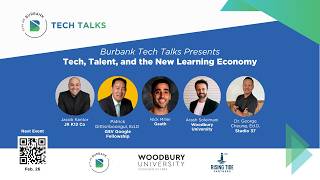
A panel at Woodbury University discusses how K-12 and higher education are adapting to AI and new edtech tools. Speakers include district leaders, a superintendent, an app developer, and Apple's education lead. They emphasize that districts face budget pressures and enrollment declines, and that edtech companies need to listen closely to teachers and students rather than impose solutions.
Chapters
Hello, good evening everyone. How are you all doing? Um, on behalf of the City of Burbank's Economic Development Division, I want to welcome you to tonight's event. The Burbank Tech Talk events are part of our entrepreneurial programming series to help support industries that are growing and changing within the city, including media and entertainment, healthcare, and education, as we'll be covering here tonight. If you're familiar with our events, usually we have 3 or 4 a year as well as the Pitch Fest, but actually new at the end of last year, we added some new networking-specific events. That's been really fun, a great turnout. We've had 2 so far. If you haven't signed up yet, there's a QR code here, and you might see one on a slide in the front lobby as well. This one will be at Idyllwild Tavern and should be a really great time. So again, strictly networking, grab a drink, bring some friends, meet new people, share ideas, and connect. If I did not get a chance to meet you, or if you didn't get a chance to meet me or my colleague Odette, um, at the beginning of the event, we're going to leave some business cards out and we'll be here for a little while. If you have any questions about starting your business in Burbank, entrepreneurship opportunities and resources, or just want to share what's going on in your industry and how the city might be able to support you, we'd love for you to shoot us an email, give us a call, or reach out. If we can help you with anything specific, please do let us know. We have free one-on-one business consulting services, consulting services for companies, mentorship opportunities, and resources and incentive links as well. So want to make sure that you're supported, whether you're ready to start your business in the city, or you're just beginning the inkling stage of an idea. Woodbury University, our amazing hosts today, we want to thank them for everything. I'm going to actually introduce now Dr. Sharon Townsend, who's going to talk a little bit about Woodbury. And thank you all so much. Thank you very much. It's such a pleasure to be here and welcome you to Woodbury University. I was born and raised in Burbank, so I do have a vested interest in this, and I serve on the city's Creative Workforce Task Force and really care. This city cares about you, and that's why you're here tonight, and I hope you'll take advantage of every meeting and every task force. They care about the creative industry. Woodbury is 142 years old this year, believe it or not. I know everybody says we're the best-kept secret. We started out on Wilshire downtown. We started out as a school of business, and I'm proud to say that 142 years ago there was as many women in class as there was men. It was, it was equal opportunity way back then before that word was invented. We now consider ourselves not only a school of business but a school of creatives and innovators. So welcome today, and I hope to see you again. I'm going to turn this over to Jacob.
Awesome. First off, thank you for being here on a Tuesday night in January with us to do some learning. My name is Jacob Kanter. I run JKK12. I am the Chief Dodo. I'm the district office door opener. I work with school districts all across the country. And we're here because of the way people learn, right? The tools are changing from AI to creators to employers. Things are definitely changing. As Neal Bloom and I, as we were talking about this event, we were looking at different perspectives in the room, right? Like, who can we bring together that would challenge each other's thinking? So a superintendent, a consultant that works at a large company that you guys are all familiar with, a huge edtech solution provider, but also the higher ed space. And really kind of as we go through tonight's program, there'll be a bit of a challenge for me to the entire group. But first off, thank you, panelists, for joining. I'm going to give everybody a chance to actually introduce themselves. But also, as you introduce yourself, one question, one thing that you've seen recently that made you think that the future of learning looks different.
All right. Good evening, everyone. Just want to thank Neal as well as Jacob for having me here. My name is Dr. Patrick Gittis-Rabungo. I'm the self-proclaimed longest last name you'll ever see. If you wanted to buy a vowel, I'm selling vowels before you leave today. Please stop by and say hello. I'm the superintendent by day of Lynwood Unified School District. Lynwood Unified is located in Southern California off the 710. We're right between Compton and LA Unified. I am part of the freshman class of superintendents. I've been a superintendent only, only 6 months. Just so we're clear, I'm not a seasoned superintendent. Freshman. Prior to that, I was the assistant superintendent of technology and innovation. So my path to the superintendency did not take a traditional path. I worked on tech most of my career in public education, was in the edtech space, but also was a teacher, a coach, an administrator, principal. But my passion has always been around tech prior to coming into public education, which I have been in 25 years now. I was actually a web developer in the dot-com, dot-bust era. So yeah, if you guys remember that, Pets.com. Yeah, so yep, those of you that, you know, we're dating ourselves now, sorry guys. But, uh, that, that kind of expertise I think really lends itself well in public education because oftentimes in this day and age, you know, of our students coming into our schools being digital natives, the pandemic made everyone cloud native. Now they're coming to our schools AI native. Those are the things that I'm thinking about as a superintendent and a school district leader. So your question on what excites me or what, what I'm looking at, I think anything that has to do with workflow automation. I love this tool called N8N, which is workflow automation for agents. I love deploying agents. I do not know how teachers, administrators, principals, superintendents are doing their jobs now without workflow automation and AI. So that's one tool that I would say I highlight.
Thanks. Go ahead.
Thank you so much. Even in this first hour, I've met so many interesting people. I look forward to meeting the rest of you after these talks. So my name's Nick. I represent Goth. So we're an app and web platform that provides study resources to students. AI tutor, flashcards, study guides, anything you can imagine. We have millions of student users. Most of last year we were number one in the App Store, so we're very popular among high school and college students. And I also was a former teacher, love being part of education, was in special ed for many years, and transitioned into the consumer app side of things a a few years ago. So let's see, the future of learning. I'm going to take this as a parent and not as a Goth representative here. Just going through my son's— he has a ClassDojo app at 4 and 5 years old, and they're promoting AI reading tutors. So it's already this thing at this very young age. I have to start thinking what's best for my son. Should I expose them to AI? Should I get my daughter, who will be 3 in a few months, ready for AI literacy? So it's just happening so fast. So I'm glad we're having these talks to figure some things out.
Awesome. Cool.
Nice. Good evening, everyone. My name is Arya Soleimani. I'm actually from Woodbury University. I'm professor and chair of graduate programs here at Woodbury University. We have multiple graduate programs. I oversee design programs, architecture programs. And about myself, I have a doctoral degree in architectural robotics. I've done a lot of research with K-12 education. I initiated a program here, grant-funded program on design computation, Bachelor of Science in Design Computation, which is kind of blending design and computer programming and a lot of AI integration as well. And in terms of the question, one thing that you've seen recently that made you think, one of the things we've been seeing in school, this kind of how students quickly go from idea to prototype. So I remember back then when I was a student, I'm not too old, so there was CAD, AutoCAD, CAD 12, even before going to do architecture. I started learning about the software, was command-based, and so you had to type in. So when I started architecture and I showed that I know CAD, everybody was like, God, he's a god, this is the future of architecture. But now when I look at it, I'm like, this is really— we live in a different world. I mean, the things I had to spend time, like hours, to generate just one drawing, here students get quickly through AI. So that kind of transition is mind-blowing. And actually, I've recently wrote a book published recently, Designing with Algorithms: A Mathematical Guide. So the premise is that AI and computational tools, they're very powerful, but the important thing is understanding the workflow, how to steer the outcomes. And this is something we try to instill in students.
Hi, I'm George Chung. Thank you again, Neal. I'm the founder of Studio 37. I was a former educator myself, was a professor, and then now my daytime job is I work for Apple and I work with school districts and support people like Patrick and superintendents all across California. I think it's interesting to think about that question, Jacob. As I look at a lot of kids and I I literally walk through thousands of classrooms. I see what we all went through isn't what they should be going through anymore. So quick tip, if you're a parent, if your classrooms for your kids look like the classrooms that we were in, that's a red flag for me because that's not preparing our kids for the future. Because ultimately the future isn't the future anymore. The future is here. And one of the things that I'm— I've been working on now is called the Genius Project. And it's really discovering that genius within our children. It's discovering that genius that we ultimately know that each child has, and yet we have to really have them embrace that, love that. And then from that point, and especially because if we don't have them love it, they won't be able to live it. And it's interesting because if you think about children, when you ask them when they're little, you say, "How many of you are creative?" Everybody will raise their hand. How many do you think in high school raise their hand? Maybe one. And that's a sad statistic. And so my thought is, how do we lean into finding and having them embrace that genius that's built within them that we all see within them? Thank you, Jacob.
And I'm a sales guy here. So for everyone in the audience that's like, I have a question for somebody, right? Question for Patrick. as you guys will mingle afterwards. He was CTO of the Year in all LA County before he was a superintendent. OpenAI also just launched its cohort of districts that give free access to teachers, and he's in that first cohort. So something to talk about.
Just me, the district.
The district, the district. George, one plug for George, right? Like, all of the districts in California that buy products from where he works, his team ends up training them on how to use them for special ed, for IEP, for you name it, right? So there's a very unique group of really technology-forward, uh, thinkers here. So thank you guys for joining. But, uh, Patrick and George, first question, um, you're kind of boots on the ground, you're seeing students, you're seeing teachers, you're seeing parent concerns. What are the biggest shifts happening inside schools and what's working on the tech side and what's falling short?
So I, from my perspective, I see 4 different kind of inflection points. Number 1 is really around budget constraints. I think, you know, if you live here in Burbank, if you go to school in Burbank or you go to school anywhere, you'll see that many of oftentimes, you know, the school's enrollment is declining. So across California, birth rates are going lower. We're looking at, in, even in Lynnwood, which is densely populated, 4-mile radius, 70,000 residents, 12 elementary, 2 middle, 2 high schools. We used to support 16,000 students. Now we're down to 10,000. So if you think about that, we are dealing with budget constraints. We've had conversations around school consolidation, school closures, which is very painful if you're a parent, if you're a community member, if you're a staff member, that can be very painful. So that That's one area that I, I'm dealing with in the K-12 space. Second is this idea that, you know, because of the pandemic, because of AI, because of data, this whole child approach to learning is becoming more and more prevalent. So which means that teachers, staff, administrators, you know, depending on the needs, whether Families come in with housing insecurity, food insecurity, job insecurity, you know, all the stuff that, you know, as parents, as individuals, we have to deal with. We have kids now that come to our schools that have all of those exponential needs. So this whole child approach, social-emotional learning, you know, all those aspects. When you enroll a child, you enroll the family now.
right?
And so that kind of community school wrapping your arms around a family becomes critically important. So that's, that's the second area that I think is very important. The third is return on investment. So some of you who live and work in Burbank know that Burbank is probably going through some challenges right now, but there's other districts that also have the same challenges. All the investments that we've made during the pandemic, ESSER, with edtech tools, products— sorry, Apple, right? Platforms, whatever it is, you know, we want a return on that investment. So one of the things that we piloted in Lynnwood is this thing called outcomes-based contracting, not new to the private sector. But new to K-12. So instead of getting into a contract where I'm paying, let's say, $5 a kid and paying that full contract, I'm going to take that contract, I'm going to divide it in half, and I'm going to say I'm going to give you 50% for base. The other half is going to be based on milestones that you reach along the way. Those are KPIs that we identified. Those are OKRs in the private sector. There are all kinds of of objectives that we can identify. They can be student-related, they can be staff-related, they can be all kinds of different outcomes that we identify. So that's the third. And then the last, which is why we're probably here today, is around AI and data. Like I was in the hallway talking about MCP, Model Context Protocol, from an IT tech perspective. If you ask other superintendents what MCP is, they're going, oh, I saw that on Tron, right? They're not going to know what, what an MCP is. They're not going to know what go-to-market strategies are. They're not gonna know what product market fit looks like because that's, that hasn't been part of their schooling. That hasn't been part of their credentialing program. So AI data, like being prepared for an AI strategy, kind of thinking about infrastructure as well. I would say those are the four inflection points across the board when it comes to K-12. That's a high level view, but that's what I would say.
Yeah, and I want to stack on that last comment that Patrick said. When we think about educators and the education system, it's a totally different system. It's— a lot of people from business will say, why don't we just do what we do in education, what we do in the business sector? Unfortunately, the system in itself is totally different. The mindset is different, the training is different. And so if you try to plug in something that worked for business into a school system It just doesn't work well because the ROI is one, you're not seeing it as how many students, for example, all of a sudden know math or something. It is like years down the road where the return on investment to some degree isn't realized. And so that in itself is kind of a hard thing to see. Another thing that I am stacking on to everything you've said, one of the things I've also seen is that there's a huge shift that is occurring. Again, I look back to when all of us went into school systems. If you have a child, I've heard this happen quite a bit where the parent or the child comes home with a homework assignment and says, hey, this is my homework assignment. And the parent says, oh, that's— I remember doing that in 5th grade too. Well, that in itself is alarming because you think how many decades later The same assignment is the same thing and literally people are brushing off this assignment that was stored in the garage because their cousin did it 10 years ago. We're moving from this era of, frankly speaking, where it was an assembly line concept. Then it moved into internet and then we're still moving and we're still behind because again, the system in play isn't what business is. What drives business obviously is what we get from the return of sales or something like that. So as we move in there, we're coming in with two polar opposites. AI— and I see this a lot— AI is just a new front of technology that's moving forward. Whether it was the internet, whether it was devices, now it's AI. You have something very much in the forefront of things while you have a system here that is not. And so how do you put two systems that are very I wouldn't say polar opposite, but one that's literally decades behind and one that's literally behind schedule from a day ago, right? So when you put those two systems together, how do you move that? And so I use the analogy: schools look at— and the Burbank Airport, I fly often out of this— when we think about going off the landing, it's 0 to 400 miles in like split seconds. Right? That's what schools feel like if we're thinking about AI. AI is actually thinking about, we're in the air 400 miles an hour and you don't feel it because we're constantly at 400 miles. So when you think about that kind of odd paradox, that's where the difference of mindset and thought process is. And so connecting the dots is something that is delicate. And I often, when I'm advising superintendents and their leaders, I say We're trying to move to the North Star. How do we move a degree? Because we know that shifting, trying to move to this direction takes a while. And so it's a mindset cultural shift that we have to think about because we're dealing with people, frankly speaking.
Just one more thing to add, I think along with that social emotional learning aspect, I think we're starting to see now screen time being a huge issue. So you'll see another inflection point now happening on going back to basics, because at the end of the day, what matters is the type of positive relationships that happen on school campuses. So that kind of interaction— if you guys can remember how many teachers, if you went to a public school, impacted you, and they fit on one hand or two hands, that's pretty sad, you know. So like, you want to be able to identify if a village It takes a village to raise a kid. So identify more than just on your head.
Yeah, I want to second that. That is one of the things that there are people that we can easily identify. If I said, who's your favorite teacher? You'd probably be able to name that person. Mine is Mrs. Cooper, 6th grade teacher. She was the one that told me not to take a test and know how to take a test. She told me how to think critically. She told me how to think creatively and when we think about the skills that are in demand, right? Those are the skills that are in demand from our kids because frankly speaking, as things shift, those are the kind of skills that companies right now are looking for from our students. And so I lean into the Genius Project because it is about discovering those geniuses within our kids, loving it, and having them live it from, from that point of view.
Um, Neal and I had Miss Grofsky, I think, in 4th grade. So I'm just throwing that out there. So I'm going to trade us, switch topics a little into industry. And, you know, one of the questions I want to prompt everyone with, but I kind of, as I was sitting here, I had an aha moment of like, what do tech companies, what do districts or even folks wish that tech companies knew about districts? I think it's something that Patrick talks about a lot, that 85% of his budget is actually spent on staff, right? Staff salaries, teachers, benefits, you name it. So as some of you guys have tech tools, you're really fighting for that 15%, and that is tables, chairs, pencils, paper. Like, that's a small amount of money that goes into all of the other stuff. So that kind of threw me for a loop the first time I learned that. I was like, oh, fighting for a much smaller piece of the pie. So as I transition us to the industry, so Nick, you know, you helped scale Goth into the number one education app. What are students doing on the app that have surprised you?
So Goth has changed so much in the past, let's say, 5 years. So we were founded 5 years ago. We were a scan and solve math app. So you take a picture of a math problem, we'll give you step-by-step solutions. Great. You can click through a little more and maybe see a little bit more detail. And that's the extent of it. High school math, college math. There is no back and forth, no asking for more, for more help or to clarify. 2 years ago, 2 and a half years ago, LLMs are everywhere. We're able to integrate with Gemini, ChatGPT, and many others. And now what we're seeing is students don't just want the answer. So that's still definitely the most important thing. We want to be accurate. We want to give them the right answer. But now they can start chatting with the bot or the AI right away. So they can say, clarify, give me an example. This doesn't make sense. So they're really like iterating at how they think on the go and not just like accepting what we're giving them, which is a really good sign. Now, this behavior, it really depends if that student's in high school or college. So high school students still very much motivated by getting the answer quickly, fast, and maybe not chatting as much. But for college students, and maybe this is because professors are tailoring their work differently, it's not so much just getting the right answer, but really understanding concepts. So college students thankfully are going in the direction I think we all want students to go in, not just accepting what AI is giving them, the questioning and tailoring it to how they understand.
And just a follow-up question, I know peer-to-peer self-guided learning, like, how are you seeing it evolve?
So peer-to-peer, Goth, we're on the outside of that. We don't facilitate, we're not a social network, but so we don't facilitate these interactions. But because we produce tools, flashcards, quizzes using AI, they're shareable. So what we're seeing then in these peer-to-peer groups, see, maybe something like GroupMe, a lot of students use our in-person sessions, they will share our resources. So if they find something beneficial, and that's really the best way to promote a product or our app or any app, is to get validation from a peer and say, this worked for me last week when I took a quiz. Let's make it again this week and I'll share with, with the group. And it really, it gives that student a way to contribute. Maybe they weren't naturally like going to share and give ideas to the group, but they say, hey, this worked for me. The self-guided thing we're much more involved with because we have an AI tutor. So we really think like, why does a student use an AI tutor first? They could want to like go through their thoughts. Maybe they're afraid to ask questions. Maybe they don't want to ask the quote-unquote dumb question in class or to their TA. So AI tutors provide that like judgment-free zone, which is great. And thankfully, there is some promising research in the last month. Some researchers in Berlin, they say AI tools work really well alongside formal education resources. So I guess as someone here who's representing a consumer app, I don't want to say like this is the only way, AI tutors, we're taking over. It's not that at all. It is a companion to these already great resources that are there and the benefits we're starting to see.
And then last question, you and I have talked for years now around like, you know, how do you get in the solution into schools? And we've talked, you know, Patrick, we talk all the time around how was AI perceived 3 years ago as ChatGPT launched. It was all things cheating and everybody being very worried. But you're clearly having success with student downloads, with college downloads. How do you balance short-term needs of students with sustaining long-term benefits for the org?
So short-term needs for us, and we try not to think this way, but it's getting a lot of users, maybe they'll pay for our subscription. Um, that's great in the short term, but we want students to stick around to find value in our app. Um, and one way to do that is with tools like a tutor, um, with flashcards, with things they can share with the group and really contribute. Um, so one of the challenges is, do we keep chasing really small features Um, the students tell us all every day, we want it to be free and we want XYZ and everything else in between. So we obviously can't do that approach. We can't just keep building, keep building. Um, so we do need to, as a team, we want to hit a home run and do something really impressive and that has long-lasting effects. We think developing this tutor, which a lot of companies are doing, might take us in that direction. But the challenge is we just don't know. I think that's the biggest thing right now.
Thanks. Switching gears, talent pipeline in Burbank and beyond and kind of taking the higher ed for Dr. Arash. What's Woodbury seeing in terms of student interest and career readiness in the world and how kind of AI is reshaping that? And clearly expert in also writing a book. I would like a copy for, for my—
Absolutely.
Signed copy, signed copy.
Thank you. Yeah, I would love to sign a copy if you have copies. I think this is a really good, great question. We are seeing— sure, sorry, I was supposed to know that.
I'm very—
so we're seeing two things at once. Obviously students are much more capable. As I mentioned before, we had to I spend like hours to generate one drawing. With a few keywords, they make things like they're mesmerizing. I'm like, did you make that? Did you make that rendering? Did you— how did you do it? Like, 2 years ago, a lot of these AI platforms, they were introduced. So I think this is amazing, this is wonderful. At the same time, they are anxious. Is it what it's all about? Is this real skill? So I think career readiness isn't just about software anymore. There was a time that students were graduating 10 years ago, they knew like this XY software, they were like super successful in market. But now it's beyond that. So I use these terms, we used to train technological consumers, but now we're transitioning to technological innovators. So students when they graduate, they're not waiting for, okay, I just know how to use these platforms. This is what I've learned. And I think this is where the power of AI critic can come to play. So they can transition to new environments. So this is what we are seeing. And one other thing I think, especially being in Burbank, I mean, the bar is high. Students are looking at studios, entertainment industry, tech, architecture firms. They want hybrid careers. So we get a lot of students, they want to do, like, despite, like, traditional education, they want to learn more about doing minors, doing dual degree programs. So they ask for curriculum flexibility. So there is the cultural transition shift. I think this is a very timely discussion here as we are going through this transition. So in terms of skill sets, also interdisciplinary approaches. So if you have a student doing architecture, it doesn't mean that they only are within their boundaries. They want to take classes in computer science. So we see a lot of these transdisciplinary kind of collaborations. And at Woodbury in particular, in our design fields and architecture, we are treating AI as a multiple supplier for iteration. So traditionally, we used to design from point A to point B, reaching like one design outcome. Now they have this AI, the AI platform to create variations, something we call variant-based design thinking. Instead of looking at one dictated solution when they get at the end, they can look at variety of solutions and choose the best one out of those. I think this is the power of AI when it comes to any disciplines. Yeah, I will stop here.
One additional question. As higher ed kind of shifts, do we think that companies are pulling higher ed along, or is higher ed still expected to lead?
It's a good question. So being an educator, companies are definitely pulling. That's what I would say. And I would say two cycles are much faster than academic cycle. So I think the constraints, they come from industry, but at the same time, the foundation, that critical thinking, this comes from education. So I think this is like a two-sided kind of thing, even though I would say a lot of things can be AI'd in future. One of the things I would say in academia, I don't think AI would, can replace that at any point. So when we see students, we work with the students, we find their strength and goodness within the student, and we help them to nurture that. And this is something that I cannot see AI would replace it. And again, that critical thinking, that, that's something that comes from education. And definitely The bar and constraints come from industry. So I would say industry is pulling the tools forward. Higher ed has to lead the meaning forward. And, and there with expectation from industry, there we see that they're requesting for students that can adapt to different environments with this, like, living in a world dealing with complex problems. So students can adapt to different situations, how they can handle and how they can work in like interdisciplinary environment. This is, this is something very different from like 10 years ago or 15 years ago, the way we were training students.
Yeah, which is why I do think the role of K-12 in preparing kids for the type of skills and mindsets that are distinctively human become critically important because those kindergarten rules still apply. You can't play in my sandbox, I gotta be able to play in yours, right? So like conflict resolution, emotional intelligence, you know, like you said, critical thinking, problem solving, like that aspect of K-12, like those foundational human innate skills, you know, that could be developed over time, that, that becomes critically more important from a K-12 perspective.
Yeah, yeah. I think the idea that When we think about education nowadays, it is very much those quote soft skills that we keep on talking about. It's so essential, and I love just kind of converting it into the idea of essential skills because the reality is that there's a lot of people out there that have quote qualified skills, and let's be real, using AI you can aggregate a lot of information out there. But I know companies, and I work for pretty large company. Those companies are looking for that human touch. And so how do we continue to foster it all the way from TK to higher education and create meaningful understanding? Because like you said, AI is not at that point where they can quote replace us. It's actually needed for us to be there with that.
And, you know, curveball question for everyone that was not on this. You know, I think the dynamic of higher ed is changing, right? Like, I have a 5- and a 6-year-old. There's some young kids, but also college students and high school students. Neal Bloom and I have young kids, and traditionally, right, like in Burbank, the schools— people moved to this area to get into a better school, to fight for a better chance, and whatever that looks like, right? I spent 10 years in college and career, so I knew that tutoring and test prep and college admissions and counselors and those folks. I know counselors charge $250,000 for your student to work with them on essays. So like traditionally that's been the mindset for parents, but that's changing now with what higher ed is and like what students are able to build. So like what do you look at as— I know you have a student that's in college and one that's going to be applying soon enough. Like what's the dynamic of higher ed in each of your guys' household as you're thinking about it?
I mean, for me, you know, I don't know if this is like Tiger Mom syndrome, but college is something that, that is an expectation for us. I mean, doesn't matter where. So I have a 17-year-old daughter who's a senior in high school, and I have a 20-year-old son who is a junior at UC Irvine. 20-year-old going on 17, just so you guys know. So I think prefrontal cortex, yeah, of course. But I would tell you that college is an expectation not because of, of the degree per se, but I think it, it's still, you know, your title, a door opener, right? District Office Door Opener. I think it opens doors. It's like the minimum requirement. It's supposed to help develop further skills. It's supposed to enhance that. It's supposed to give them an opportunity to grow socially as well when they're young adults. And so I think college, you know, whether it's a trade school, community college, I think it creates structure, which is so important, like, from my perspective. I think structure, systems, that stuff really matters when it comes to, like, an 18 to 22-year-old, because we know that there's statistics around disconnected youth. 16 to 24 that, you know, aren't anywhere. So that's what's important. So college expectation, yeah. But, you know, I think more so the things that come along with college.
Nick, same question.
Yeah. So my kids are very young. If I thought about my 2-year-old daughter going to college, I might cry. But yeah, but yeah, college is still kind of number one in validating someone's credentials, the rigor they go through, the structure. I think what we see— I think this was probably in 2025— like companies like Roblox, Databricks, these really big tech companies are like, you have to be— I think they call it AI native. Not entirely sure what that means, but I think what they're intending is like you have to be ready to leave college with the skills that make you a more efficient worker from day one. And yeah, I think institutions need to adapt to this and many have, you know, provide opportunities for students to show their qualifications, show that they have these skills that may not be tracked in grades or in an internship just so they are ready to leave and be on their own.
Yeah. Same question.
Sure. Thanks, Nick. My kid actually will be coming out in 4 months. So it's a work in progress. She'll be born in 4 months. So it's a long time to get into college. Thank you. Thank you so much. That's a very exciting thing is happening. But speaking of college, I think what I see with college, I think Totally agree. The skill set, the experience in terms of collaboration, communication, critical thinking, a lot of these skills won't happen virtually. It's like a one-on-one interaction thing has to happen. And also breadth and depth within a college degree program, that's the kind of deep mindset will be nurtured and built through like a college degree degree program. But obviously this is changing. The, the college experience, the university experience is changing. So the way I see, basically, actually I was going to use that for your final question, as like a studio-based university system when there is collaboration between industry, like industry inputs, like real-world outcomes and projects, AI tutoring, and educator critic throughout. So this would be like a strong model. And we are trying to push for that at Woodbury. I was talking to Nick. We have this required internship for all the programs on campus. But the question is that, is that enough when a student graduates? But yeah, I would totally agree that college degree program is still something that is about breadth and depth. Set of skill sets that you cannot just gain them by learning that software or working at that company. This is like a process, but a studio-based learning environment, that's what I'm like kind of pushing for.
Yeah, it's interesting because I think higher education to me has always been a separate phenomenon than the growing up into your TK now to 12th grade. And I think it's a question I've questioned whether or not I have a 5-year-old and an 8-year-old, and I'm thinking 10 years from now, what's that going to look like for them? So I actually don't even know what that's going to look like, even though similar to Patrick, I'm very much like, you know, I've got a terminal degree, I've got my doctorate and things like that. And yet when I think about the value of what education is, I actually think about it all the way back down to the TK. What experiences are we gaining for them that actually connects the dot all the way to college, right? So if we're giving them books and just saying memorize, memorize, and then some of my college experience, sadly to say, was memorize, memorize, memorize. That is not the kind of college I want my child to go to. So very similar to this idea, like, how do we have them, have them do critical thinking, that college experience of, you know, I want them to enjoy college, I want them to experience things. And so thinking about that, how do we bring that all the way through a connection to the system when they're starting all the way from TK to K? Because ultimately you can't just give something and shell shock them from senior year to freshman year, because flat out, I almost failed college, I almost failed my doctor program. Because there was a lot of shell shock because there was a huge transition. So we have to start this from the very young age and build them all the way until they get to the company. Because frankly, again, when we have our students or children become adults and they are in working forces, you and I know it's really difficult. Some of the best teammates are the smartest and they're the most difficult, right? And those difficult ones, I mean, let's be real, As much as they know, it's really hard to work with them. And so we think— I think about the college experience. How do we actually bring that across the board from when they're very young? And so I move my children— I'll say it right now— Downey Unified because they're focused on that. I know working with Patrick, they're focused on those skills and the test results aren't necessarily, you know, one for one. But when you step into these classrooms, when you talk to Patrick, when you talk to leaders that really care, in the sense of that, you get that sense. And that's the kind of leadership that I look for when I look at districts, because it's not so much the results, it's what those result— the leaders are creating to create for our students.
And similar to George, I have a 6 and a 5-year-old, right? And I'm constantly talking with George and Patrick around stimulating them in a way. And, you know, one is 6 and loves Crunch Labs, and I swear is going to be an engineer. If college started today. The other loves gardening tools and can be outside cleaning up leaves for 5 hours. So, like, different interests and how do we nurture those interests and get them thinking about careers and all this stuff even as early as. So, as we kind of think about closing us out, so we covered a lot from AI, consumer tools, schools, universities, talent. One question for everyone, and we'll kind of go in a row. If you can design one new institution or tool from scratch for a new learning economy, what would it be and who would you build it for? Yeah, sure. Or if anyone's ready, go ahead.
Yeah, I'll start. I mentioned the idea when I was in the classroom, and the reason why the name of my company is called Studio 37 is it's It was founded from my classroom when I was in the classroom teaching students that were behind, frankly speaking, at-risk EL students. I had special ed students with disabilities, deaf and hard of hearing. What I noticed was that they weren't lagging behind because they had something missing. It was the fact that the system wasn't supporting them. And I realized— and I see a lot of heads nodding in it, and I thank you for that— because I realized that there's something special about every single one of us as human beings. Starting from the day we were born. And so the Genius Project is something that I'm building to really help and support kids and adults to discover that genius. Because the fact of the matter is, there's all of us that if you imagine societally, if we could actually lean into that, everyone, and build a better world, I mean, goodness, can you imagine where we would be at right now? I mean, our society curing cancer, curing all these things. Doing medical developments across the board, thinking about engagement for students, we wouldn't be worried about so many of the things that we're worried about now. I think it's interesting as I continue to write this book, or I'm about to launch the first book, the second book of loving it, a lot of people that have discovered it still don't believe it themselves because frankly speaking, I don't know if you've ever heard this phrase yourself to your— when someone says, oh, that's great that you just did that, and you're like, Doesn't everybody do that? Well, you might actually be leaning on your genius and people— you're not even loving who you are. And so when we realize how much of a genius we are in all of that, then we can truly live it. And so the Genius Project is really focused on— I mean, and it brings me to tears because I think about my students. What if we could lean on every child to discover that? When we talk about next generation, they're our next generation. How better are we going to leave this world for them? And frankly speaking, I'm scared right now because we're not, right? And so thinking about a better society, a better world, I want to leave that for them. So the Genius Project is based on that concept of really living, discovering it, loving it, and living their genius within.
I think along those same lines of the Genius Project, George, that's pretty inspiring. I think about, again, this is because I'm a technologist by nature, right? I think about data portability. I think about being able to have everyone own their data in the same way that we have, you know, a wallet app for stuff, right? We've seen learning credentials before, but I think more so now than ever, like being able to take your lived experience take your geniuses and being able to take that wherever you go and being able to connect to learning in a way that says, hey, George, I know who you are, I know where you came from. Let's see now, like, let's take your lived experiences, take your geniuses, and figure out ways we can now connect you with other resources, other job opportunities, other connections, other networks. I think that aspect of learning credentials, you know, data portability, being able to have your kind of knowledge graph that gets built in with you wherever you go. I think in this day and age should be easier now more so than ever, but everyone wants to build their moat, everyone wants to have their walled gardens, everyone wants to have their own data because that's where the money is at, right? So I think this capitalistic nature that we have should now, you know, open up this idea of data being owned by the individuals. So like if I want to get my data I have to opt into it. We're starting to see that with those cookie things that we get. We're starting to see that with GDPR nationwide, but I do think that data portability was something that I'm looking for.
So it's the what tool when I—
Yeah.
Okay. So I brought up— From scratch.
Yeah.
When I brought up research earlier about the great things about AI tutors, and I like bringing it up because it makes golf look good. But one thing I did, I left off, and I'm glad I wanted to address it, was AI tutors work well with the formal resources when students have self-regulated learning skills. So that's a really big caveat. Like, they have to be able to have most of the skills to, like, get started. Yeah, think clearly about the steps, engage, and then rethink things. And then start again. So let's say half the students have those skills, maybe. We're releasing all these AI tools. They're using them like crazy. There's no stopping that. They're going to use them. So I would want a tool that supports their development in those SRL areas. So then they're not just using these AI tools, these tutors, and getting ahead quickly. But then not really developing any skills. That's not good for us, it's not good for the students, teachers, anyone. So yeah, focusing on those skills.
I kind of touched upon that. If I could design one new institution or two, what I would build is like a learning studio or studio-based university, which kind of sits at the bit between university and industry where there is AI tutoring, faculty critics, and constraints from industry. So still, the university system is based on seat time compliance, grading, testing. What I see in future would be a college experience that is based on proof of capability and real-world project where there is input from both industry and also community in terms of like demand and need within, throughout the education process. That's one of the things I would, I think, and we have tried, we've been trying. So when I, I think the time also is like another critical thing I wanted to touch up on that. So when we introduced like a new kind of culture. When we introduce that, is there the capacity for it at the time being introduced? For instance, the degree program Bachelor of Science in Design Computation, when we started, everybody was like, okay, what is this degree? Is that design? Is that architecture programming? So sometimes it takes time for that, but I would say bringing this like hands-on studio-based experiences builds up that culture as well.
That's good.
Neal Bloom. Sure. I think we have a couple minutes for some questions from the audience if anyone has any. If not, I am prepared for lots of questions. I'll do, I'll do one for the group. Each of you, 30 seconds. When somebody comes up to you after this and says thanks, what would you like for them to ask you about? Anyone can go.
I guess there's so much negative news about AI. So how we develop our products that go off how we're thinking about students and learning. We've obviously taken some low-hanging opportunities in the beginning with like scan and solve and get the answer and step by step, but really just more like how we're thinking about developing products. And then everyone here has so many great ideas from school districts, from the university. I want to hear those ideas as well.
So 30 seconds, what kind of workforce development, internships, externships apprenticeships that you can offer students.
It's good.
Yeah, I would definitely say like any internship collaboration opportunities, getting involved, uh, sponsoring studio projects here, uh, would love to hear any of those thoughts or feedback.
I think if you're a company and you're approaching me, I think, um, seeing what that need is for the school districts, that instead of just selling a device, and if you're a school district approaching me and asking me, what is the industry looking to— how to support you? So if you're— again, difference between the school districts and a company— if you're a company, what do schools really want versus just a device thrown at them?
And you can talk to me about shoes, hot yoga, LA, whatever, whatever. I can chat all things. Uh, if any questions, we have a mic to go around as well for any of the panelists. And if not, there's also Neal Bloom. Go ahead.
I was wondering, I'm coming from education too. There's so many bad news these days about how bad screens are for kids. And I love technology ever since I'm a kid, so I have very mixed opinions about that. Just thinking about the new focus is like, how can technology support— and you were, Patrick, talking about all the social emotional regulation— how can technology be used to encourage the connection between human to human?
What's your take on that? Not just like talking to— I use AI all the time, so I love Twitter.
Yeah, you have Twitter.
But yeah, can AI be mediating the human I, I think any type of interactions that you can build into a product that forces that type of conversation or that dialogue, I think that's important. Meaning that, hey, check in, check in with your teacher, like little triggers that, or, you know, what is it, nudges that they call it, right, in data science, to force that relationship. Because at the end of the day, K-12 is about building positive developmental relationships with kids. So if a product can do that and help you along the way, guide you, gamify it, those are the things that, that I think would matter. So any type of triggers that you can built in to say, hey, check with your teacher, stop, pause, you know, talk to a teacher or talk to a colleague, something like that.
I think to stack on to Patrick's idea, the distinction between passive and active learning— passive learning is like just sitting in front of something and passively watching, right? And active is how do we engage them? How do we do multimodal learning? How do we get them to think? And there's a term of depth of knowledge. How do we get them to these higher orders of thinking? How do we get them to synthesize? How do we get them to critically think, reflect, right? Not just regurgitate, like, tell me what one means. One. Tell me, you know, like, get them to actually think and analyze. So, and again, I think in that sense of what you're saying It's about deeper learning and it's about getting them to do things, meaning students, rather than just sit there and get.
I was going to add one more thing.
Sorry.
I think, you know, if you're in the AI space, you know that instead of prompt engineering, everyone's moving to context engineering route now, right? So I think the term context is something that could be we need to teach kids at an early age, you know, whatever that looks like, because context matters tremendously. I'll give you an example. So if I get a call today from a principal that says fight occurred on my campus, which happens, right, I will ask for context, not just from the principal. I want context from the student. I want context from the other students. I want context from parents. I want context from everyone who's involved, because that context helps build the type of data that I need to inform my board, to inform, you know, whatever it is for safety concerns. So like, I think context— I like that term context engineering because contextual kinds of things matter tremendously.
Question here as well.
Dr. Tamari spoke about the slow-moving nature of schools and education.
I would say it's similar in government, and I was reading an article about basically how the lack of guardrails in AI can erode trust when the technology is moving faster than the policies. Now, there's legislative policy, there's also school policy, so— and there's also app policy for something like that. I was hoping you all could speak of you know, how do you maintain trust, especially with all the bad news and the screen time, you know, from a district policy perspective, app policy perspective, if you could speak to that.
Yeah, yeah.
So, uh, I mean, we build trust very early on by addressing the needs that students come to us with. So that's being highly accurate. So that's great in the early stages, but as the product has evolved and the questions become more complex, more personal, more quote unquote out of bounds, we've had to become way more restrictive in what we— how we respond to students, how we guide them to resources. So the trust is still there that we're there to communicate with them, but we are so mindful of not really nudging them in any harmful direction. And maybe that's because I'm part of a much larger corporation and there are many eyes on, on the company. But we want to be there for them, but we are just so careful about not, not giving too much outside of the academic context to them. I don't know if that answers.
I think when it comes to trust, trust can get operationalized in a number of ways. Number one, you would have an acceptable use policy, you would have some type of data protection California Student Data Privacy Alliance form that you require a vendor to actually fill out. I think when it comes to AI, one of the things that we do as a district is we have this AI fact sheet. So on the back of every bottle of water or of any food, you have nutrition fact sheets that are here. Why can't we have a nutrition fact sheet when it comes to AI for any tool that we adopt, implement like incorporate or purchase. Part of the challenge of filling that out is that we have an 18-point checklist, if you will, right, where we want to know the model, we want to know how the model is being trained for biases, we want to know how you're mitigating that, mitigating when it hallucinates, right, because we all know it hallucinates now, how much tokens it's going to be used, etc., etc. So all the technical details that we want a vendor to complete, to fill out in an AI era. So more and more school districts, I think they're going to go down that path, if you will, because it's not just about how you're safeguarding student privacy, it's now how you're contextually making it aware of your local data. You're— it's, it's very nuanced when it comes to working with school districts. Every data, like how we describe and code kids, if you will, is so nuanced. So like, that needs to be taken into consideration as well. So doing a nutrition fact sheet, looking at an 18-point guide, requiring vendors to do that is something that we do in our district. I can tell you now that I have not implemented any AI tool off the shelf. The only ones that I've incorporated is the Google Workspace Gemini tool, and then we're using OpenAI, right, as well, but in an education ecosystem. So that's my worry, is oftentimes large language models, how they work, it's often in a black box. So like, I want to open up that black box. I want the vendor to tell me what's in that black box.
And there's COPPA, there's FERPA. I know in Utah, you know, they're very AI forward, they're very technology forward. They have their own version that sits on top as almost like an umbrella policy that vendors have to sign that they guarantee that they are doing XYZ by student data and all this stuff. And, you know, I'm sure everyone's seen the news recently with some organizations getting hacked and student data being out in the wild too. So there's definitely some reservations from some districts, right? I think the conversations change from cheating to— we're morphing because we're 3 years in, but it's definitely still there.
Oh, and I would add to that, make no mistake that these foundational models that are out there, they're by definition capitalistic. So you guys probably already heard OpenAI is now delivering ads on the free version, right? So your experience from chatbot to chatbot is also going to be fundamentally different because of the partnerships that each of them have. So, hey, book me a 7-day trip to Japan. Okay, Hey, would you like to use Booking.com? Oh no, I want to use Expedia. No, I want to use this one. So know that there's going to be partnerships that get established from platform to platform.
Question?
I'm curious about what I would call whole learning, because I know as a child I failed history in high school. And then when I went to summer school, I had a completely different teacher. First teacher said, "Read a book, we're going to take a test." And I fell asleep. The second— the teacher in summer school jumped up on the table and reenacted the whole thing. I got an A in summer school. So there's a big difference in how people, you know, kids learn. And so I think part of why kids love games so much because it's so interactive and it's wholly dimensional about sound and sights and information. Are you finding that correlation about how kids learn these days? Like, I don't, I don't know if AI does any visuals or does sound effects. I'm in the sound, I do post sound, and that's what I focus on. So I do anime and games. I've been doing games for 30 years. I did the very first LucasArts game. So I know how much, you know, this all matters. Kids can play for 12 hours straight if you let them, right? And what if they were learning something along the way? So I'm just curious if that's been interleaved into any educational AI programs or how you see that working.
So the benefit of AI in the last 3 years and changes have really been in the last 2 to 3 years is any resource can be made immediately for any student for any need. So that's wonderful. Okay, whatever a student needs, how they learn with graphics, without graphics, charts and all that. The challenge is, and I brought this up earlier, is like, does a student know exactly what to ask for? Are they using the materials correctly? We can build whatever they want, but of course we want them to use something that's beneficial to them. So I guess that's where you guys come in, like getting them ready to explore these tools.
And yeah, I think there is a science to learning and development and that, that science of learning and development can take many different paths to your point. So that kind of, I don't know, The term is like neurodivergent in many ways, but the path that students have, it's very individualistic by definition. So the learning trajectory, the gamification that builds in rewards, that builds in some type of engagement, that builds in triggers, nudges, data science principles, if you will, I think that along with ownership, agency, because those are the things that are attractive to many kids because they're able to, you know, like configure, configure their character, configure their meme, configure whatever it is. So that ownership and agency becomes now their character. So I would say whatever, can get developed around that, I think that gives that student that agency, that voice, that choice. I think that matters tremendously even when it comes to cognitive development, when it comes to stickiness, when it comes to viral sensations, if you will, that go on in the space. So that's why gamification, to your point, is very important, but not crapware. Sorry, but not crapware. In MySpace, I see a lot of crapware, meaning, hey, open this book to page 1, answer the questions on page 5. Now it's online. Lame. It's lame. And then again, that's why instructional design matters tremendously.
Like, that's, that's an aspect that, that, that's probably for another talk, but I've seen the correlation between the actual cognitive thinking of someone to get past a test. You know, it is a test, but it's also cognitive planning and thinking and strategy. And all these games have so much strategy in them.
Exactly.
A game's not a good game if you can, if you can finish it in 40 hours. Okay, so that's why they make them so hard. I don't even want to play them. All right, so I, I, they, that's kind of the rule is 40 hours for an experienced player because they're going to charge $70 a game, right? And they might sell 10 million of them. Oh yeah, because these games cost $100 million. So that kind of technology I think can be applied into learning. That's what I'm just wondering if you've seen anything like that, like anything to that degree.
George, um, I don't know if this answers your question, but you led into the idea of like teachers and their students. And I mean, research has definitely shown that the most influential person is the teacher. And, and so with that being said, there's an art form, there's a science, there's a methodology, a pedagogy that's inferred and learned. So being— and I like saying this because people, when I used to be a teacher, people used to kind of say, oh, I could teach too. And I said, oh, so if I walk into a garage, I can be a mechanic? I mean, the reality is that there is actual thought process, higher understandings. And when I think about the connections between the technologies, technology is another tool. So how do we use tools to one, accelerate that learning or even transform it? And the tools now are super sophisticated, right? When we think about someone building a house, a screwdriver— even prior to screwdrivers, but screwdrivers It was a tool. Most people don't use screwdrivers, they use a power tool, right? Because it accelerates it. It even transforms some of the things that they do. So even on a larger scale, beyond the teacher, you need good administrators that really foster an environment for the teachers— not the students, but for the teachers— to feel that they can, quote, fail forward. Because they're going to experiment. AI is an experiment. I mean, things like technology, it's— I wouldn't say the Wild West, but it is like the new frontier, right? And as we enter new frontiers, we need leaders to allow that to occur and understand still that we rein them in. And so having superintendents that understand this piece of the new technology, which is AI right now, and understanding the education is critical to allowing the teachers to feel that thought process. And so not specifically answering your question, but rather knowing that teachers are the most influential, how do we equip them, right? Give them that environment. And really it goes back to that leadership to create that environment for those teachers.
I would also add like a very small thing to what you brought up. Seymour Papert and Vygotsky from MIT, They clearly, I mean, from like decades ago that we humans are tool users. We learn through making. And at some time it was like LEGO Mindstorms, giving form to your thoughts. But now there is another tool, which is AI, can also give you real-time feedback. So that kind of tool aspect of learning education, I think, I agree, is very important. And this, real feedback, being part of that, the learning process. I think that's like another amazing thing is with the sophistication of the technology that we're using.
And I think some of it also comes down to the respect for teachers, right? Teaching is a very hard profession, right? Like I have a first grader and a TKer. There's 20 kids in that class that are 4 years old. That is a tough job. They should be making $100K. They should have all the respect from parents, like the respect side of, you know, having young kids and seeing it firsthand, like, plus teachers in Burbank, can you afford to live in Burbank? Are you commuting in? Are you commuting out? Like, this is all, all plays into, right? Like San Francisco Unified, like, can teachers afford to live in San Francisco? Are they commuting 2 hours each way? Like, teachers are leaving the profession not because they don't love, seeing students light up and learn. They're leaving because they get no respect. They aren't paid well. They have to commute crazy hours to get it. Like, those are all— should be basics for, for our society, right? For the future kids that are going to lead one day.
I was told this is the last portion.
The last 5 minutes discussion was amazing.
You all read through all the questions. But I would like to anchor on 3 of your points and ask a question to the leaders here.
Jacob, starting with yours, the one that the teachers are facing with respect, pay, and all of that stuff, for the toughest job, what are What are the education institutes doing to solve that?
That's a question. And with Dr. Chang mentioning our education system didn't change for 250 years, we were all trained to become blue-collar factory workers.
And that's how it has been.
We've been researching for over 18 months, and one of our co-founders is 40 years into education.
Research.
So what we are getting to is, what are the other side of the table doing to get AI into the schools? You gave all the feedback, these are the checklists you want, and if there are companies who are taking all of it, how can they come into your schooling ecosystem?
Because there are lots of red tapes, First question around teachers and what districts are doing for teachers, I think would be better for Patrick versus myself. I work with a lot of districts and a lot of the conversations are slightly higher level around like student learning, but definitely have conversations about happy teachers.
But I feel like Patrick might be I think when it comes to teachers and teacher burnout, I think part of it has to do with the organizational culture that gets established. It's making sure that you provide as much support resources for teachers to be able to do their job. Again, to your point, teachers are not just teachers anymore. They're counselors, they're psychologists, they're mom and dad at the same time. So the structure of the school— I mentioned it earlier— schools And kids and families have exponential needs, which means the teacher is now required to act many roles because oftentimes school is the only place where kids get that type of structure that they need. So keeping them celebrated, keeping teachers motivated by recognizing their accomplishments I mean, those are the things that are part of culture. Peter Drucker said it best, right? Culture eats breakfast for lunch, or innovation— strategy eats, you know, culture for breakfast, lunch, and dinner. I know I can't remember that. It's getting late. But I would say to the point of trying to break through and fill out that fact sheet, that should be a founder's job in terms of developing it and marketing it to an education K-12 space. Because if it has to do with kids, you better be damn sure I'm gonna protect every freaking kid in my district from any type of like data minder, whoever it is, right? Like, that's my job, my role. So that's why I ask for a lot. Doesn't matter because I will not compromise when it comes to the kids in my district. I hope you feel the same way with your own kids as well. So that's why I ask for that. So to penetrate the market, you got to do your homework. That's what I say.
But that's so easy now with AI, right? Like you can do deep research. I work with 5 companies at a given time. They rotate in every 90 days and I do a lot of coaching up front where like, hey, we're going to go talk to Patrick. Patrick is not your average consumer. He's gonna ask you some very deep questions that if you're not able to answer, he's not gonna give you a second chance, right? Like, you gotta be ready. You gotta do your research. Every district in California has an LCAP. Their LCAP is their strategic plan for what they're being held for by the state, right? If it's facilities, if it's happy teachers, if it's student wellbeing, whatever their goals are for the year, we can find all of that online. Those are all public things, right? As you approach districts, like, you can do a lot of that research in advance. I mean, you can put an agent on it. Here are my meetings every single, every single day. Find me the LCAP and like what their 4 strategic goals are for every single meeting. That way when you come in, you can just say, hey, I did my research. I see these are your goals. Have things changed? Because I think I can— I solved for one of them. But if things have changed, then like we should take this conversation differently.
Yeah, one of the things, uh, to piggyback off of that, you can do your research. One of the things as I've leaned into Studio 37 is we have to create win-win situations in business terms, right? Like, yes, you want to get your ROI, you want to get your units sold, and I've been very, uh, I've had superintendents very blunt with me saying, you know, you sell us these devices, X amount of devices, but the difference is that you personally, and they— he was pointing at me as a person saying, but I know you're here for us as a district. And so I think when you come into any school district, you're not just there to— because companies, superintendents, they know you're there to sell the device. But if you're— all you're doing is to sell the device and it's not a win situation for them, which is doing your homework, making sure you're doing this with efficacy, making sure you're thinking about the students in mind, the goals that they have, the strategic plans that every superintendent has laid out. If you're not thinking of those things and you're thinking my device is the best cookie in the world, I mean, frankly speaking, you're going to see the door again and again.
All right, one last question.
Thank you for making room. I hope— oh, there we go. Um, so understanding, especially in the educational space, the limitations that you all face to really push the advancement of a lot of these technologies, what are some of the ways that you remain proactive knowing and understanding that you're going to receive that pushback in that space while also pushing to integrate these technological advances in, in your space?
So Goth is a slightly, slightly unique— we don't actually sell directly to schools. We're purely to the consumer, but we still have the same challenges, right? So we need to speak to students, and these are college students, as often as possible. We work with thousands every year really to create content with us and show us how they use Goth, and they're all over TikTok and some go viral, and they're very proud of that. But we have to keep that conversation open. Sometimes when we speak to students, we sometimes get like, things are good, I'm doing that. We're just not sure if we're ever getting the whole picture from them. They may not know exactly what they need. Maybe they're not comfortable speaking, but as long as we keep that dialogue open with them— and we've recently started speaking to parents of high school students, so it's still a way to learn about them— but we're constantly talking. We want to hear from you, any student, because again, everyone is different, how they learn is different, and you might guide us into this great period where we develop something really, uh, that can transform learning for students. I mean, it's only going to come from students as you're the ones who use our product.
I think I operate in an interesting double-sided marketplace where one of my marketplace, even though I don't sell to them directly, is a district leader that trusts me to vet a solution and be like, I think this is good, but I'm not the buyer. I'm bringing you something interesting. If it sucks, let's tell them it sucks. That's how we're going to get better. And on the other side, I mean, some of my conversations even today with one of the founders I support is, hey, you think you have a great product, and I agree it's great, but like, my opinion doesn't matter here. Your opinion doesn't matter here. We have to go talk to the person who's closest to the problem, and they need to tell us if this is a solution that solves for what they're working on. Not every district is created equal. They're going to be solving different things, right, depending on what that evolution is. So I think a lot of it is also being— keeping founders in check. And not because I have some power or anything, but like, hey, like, we need to come to the conversations not just prepared and doing our homework, but also humble that we know a little bit about what you built. We don't know that today Patrick was dealing with, you know, a walkout that happened and students leaving campus. Like, if that happens and we have a scheduled 2 o'clock meeting, that meeting is being canceled. And sometimes people get mad at me and I'm like, I can't control fire drills or emergencies that happen. So it's kind of almost level setting for both sides of, hey, solution provider, we have to do all the right things to just get in the room and then we have to do all the right things to make sure we're finding signal for something that they are solving for that we could help with. And if not, like, that's okay, we're still doing some learning. But that kind of dynamic of like, Being a company that needs to sell a product to stay in business, but also being a thought partner with the district to say, oh, you know, Patrick might give you an idea where you can actually add it on to your solution. It wouldn't take long, but then he might buy it because it solves for something that he's working on. So kind of being open in that marketplace.
Yeah, I think the best case for this is also doing some type of a research practice partnership. And what I mean by that is I don't know if Woodbury does this or not, but creating a studio, to your point, and then working with potential founders and, you know, entrepreneurs to come in and do some type of rapid cycle evaluation of a product, I think that can give us a lot more opportunity to provide that feedback, to then look at product market fit, to then enhance, to make those enhancements moving forward. I think doing things with people and getting user stories, which is part of the product development cycle anyways, that matters tremendously because now you can identify use cases and we can see those use cases capture our voices. So that's, that's going to get you in.
I think one of the big things when I'm working with school districts as well as edtech companies, I think it sounds simple, but the biggest word is listen. Just listen to what the school district is saying from an edtech point of view. Being able to sit in the room and understand, as Jacob said, understand what's happening. Because a site principal from a superintendent have very similar but very different roles, and then you have a director in between and all, all the different roles, and they see things in a different lens. And, and so sitting there listening isn't just about saying, okay, just give me and I'll advise you, but rather sitting there and Realizing, does my product fit in this? Maybe it doesn't, and that's okay because sometimes it doesn't at that moment. The fact that you're there to listen, and then on the vice versa side, ed tech companies, when I'm listening to ed tech companies, I'm constantly listening to, well, maybe you're not actually listening. No offense, but you're not actually listening. You're saying this is the best thing as sliced bread. Take a pause and just think about what you're trying to achieve. What are you trying to achieve? And so it does go to some of the basic Business 101 and also the communication connection. And so when you're trying to lean into this, again, how do you create win-win situations for your company as well as for the school district? Because ultimately their products are the students, right? It's not the same as your products.
And then I think as I coach founders, I think we're always trying to present the yellow brick road. Here's the different ways other districts are using it based on your 4 goals. Like, this is how others are using it. Does any of— do any of these examples resonate with what you're trying to solve for? And sometimes the answer is no. And sometimes a company will get good feedback and I'll hear about it later. Like, why did you connect me to that person? Because there's some learning to be had, and we don't know until we have that conversation to find signal. But that's one of the things I, you know, I work day and night with a lot of the companies I support is I can get you in the room, but like, they're not buying because they're my friends. They're buying because you're solving for something that's going to move the needle for students and make their lives better. If we can find that, then they are going to potentially be customers. If not, then we made a new friend, and hopefully you can see each other at a conference and be friends in the future.
So, um, thank you all.
Let's give a hand for our panel.








