Burbank Tech Talks - #LATechWeek Edition - Full Panel
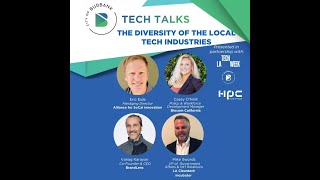
Neil Bloom moderates a panel of Southern California innovation leaders from Biocom California, LACI, Alliance for SoCal Innovation, and BrandLens. They discuss the region's strengths in software, hardware, life sciences, and cleantech, plus workforce programs like Generation STEAM and Biotech certification. The panel covers funding sources from VC to SBIR/STTR grants and explores how AI is reshaping local industries.
Hello. Good evening, everyone. Nice to see everybody here today on this fall evening, dare I say, after all of this hot weather, please grab your drink, grab a snack, silence your cell phone, if it's not already, and then come on over and take a seat. There's lots of, lots of open seating in the front row, if you're so inclined, as it were. My name is Marissa Cardwell and I'm with the city of Burbank's Economic Development Division in our Community Development Department. I'm here today with part of our team. There's Odette in the back and our fearless manager, Mary Hamzoyan is here as well. We're here this evening to answer any questions you might have and give you more information about the city. If you're not familiar with the Burbank Tech Talks program, it's part of our entrepreneurial programming series. We're really excited to be working with Neil and Rising Tide partners on today's event as a part of LA Tech Week. Our entrepreneurship programming has several different facets, so we hope there's something that is exciting and useful for you. Networking events like, like today, special events like our startup Burbank Pitch Fest. We also have resources that we provide for small businesses and startups in partnership with some of our friends like the Burbank Public Library, who's here this evening. Great resources through Job Connect, one on one consulting services free through our partners with SCORE and the sba. The SBA is also here and can give you some more information on all of the resources they have for small businesses. But before I turn it over to the panel this evening, which is going to be amazing, I wanted to give a little bit of a plug again for the city of Burbank and the great resources that we have. No city income tax, no gross sales receipt tax. A city rich in jobs, 162,000 jobs high, highly educated media tech workforce that accounts for more than a thousand employees in the area. Amazing resources like co working space. Much like the space we're at here today, the Hollywood Production center, which is almost completely leased up. So if you, if you like what you see, you might want to check in with the team here because this is an amazing co working space right in the heart of downtown Burbank. We also offer business consulting services. So if you're a small business and you're located in the city and you need assistance with your business, we're happy to offer services to you free of charge. And we also offer site selection services. So when you're ready to take your Startup to that next level. You want a brick and mortar and you want to locate within the city. We're your people as well. So basically a one stop shop business, concierge, business liaison. Anything that we can do to make your life as a entrepreneur a little bit easier, we're happier to do. So with that, I'm going to turn it over, I believe to our friends at Hollywood Production center who are going to give a little bit of an intro and talk more about this amazing space. I did say I would plug the only co working space with a rooftop patio. So think about that.
Thank you. Thank you so much. Hi, I'm Sarah. I'm the building and sales manager here at Hollywood Production center in Burbank. This is our sixth grade location. We have two in Hollywood, three in Glendale, one in Burbank. We've always owned this. Cartoon Network was our tenant. We own the property. So we have the ability to be flexible with leasing. We specialize in single offices to locking private cubicles. We have apartments. We're all inclusive. I mean we've got it all between our entire portfolio. So if you guys need a space to rent office, host meetings or hold an event, please feel free to reach out to us. You can reach out to me at any time during the event or get in contact with me during the week.
Okay.
Welcome and enjoy the festivities and welcome to Burbank. I think I turned it off.
Okay. Okay. And without further ado, let's start our panel. So let's bring our panelists up. Casey, Eric, Rahag and Mike, welcome the panelists. All right. Hey everyone. Happy LA Tech Week. My name is Neil Bloom. I run an investment fund, Interlock Capital. Born and raised San Fernando Valley, worked in the aerospace world, solely software company and now investing in companies from software to hardware all over in the early stage space. And I've assembled a great group to share their perspectives on a wide range of conversations in talent, technology and kinds of companies that we are seeing locally. Southern California, Louisiana and even into the Burbank area as well too. So we're going to have a fun conversation together and I thought it'd be great if the panels each introduce themselves first. Casey, why don't we start with you and start from there.
All right.
Maybe it's just ladies first or just happen to starting on this side, but. Casey o', Neill, I'm with Biocom California. I am our policy and workforce development manager. Biocom California is the largest life science trade association for the state of California. And we serve the life science industry in A number of ways ranging from getting access to capital in front of VCs, family offices and what have you to policy at the federal, state and local level. We advocate for the life science industry. We also help with workforce and talent development. We host a number of events ranging from happy hours and hangout networks like this all the way up to large conferences. And we help our industry companies get access to discounted services. Excuse me? Discounted services and supplies.
I have a 15 slide deck here somewhere, isn't it? My name is Mike Swords. I'm the VP of Government and International Relations at the Los Angeles CleanTech Incubator, or LACI. We are a nonprofit technology incubator located in downtown LA in the Arts district. We're located in a campus called the Lacrettes Innovation Campus, which is a 3.2 acre property owned by the Los Angeles Department of Water and Power. It's an incredible space. I highly recommend all of you come down and visit. We have public tours every Wednesday from 11 till 12. LACI was created by the city of Los Angeles back in 2011 to help support the growth of the green economy in LA. We've helped over 475 companies since we opened our doors. We've helped our companies raise over a billion dollars in follow on funding. Our companies have created over 3,000 jobs and they've generated something like $675 million in revenue. So I'm sure we'll talk a little bit more about some of our programs.
Yeah, thanks.
My name is Eric Eity. I'm Managing Director focused on capital access programs at the alliance for SoCal Innovation. The alliance is an organization that tries to support innovation across Southern California, which we define from Santa Barbara down to San Diego. It's a huge footprint, 40,000 square miles. There's a lot of potential. It's very diverse and we have our impact only through partnerships and relationships, some of which are on the stage here. But we work closely with the university community, the investor community, the corporate community, and I work very closely with founders and venture capitalists that are trying to scale their businesses right here in Southern California. So thrilled to be here. Been working with Burbank over the years. Want to give a shout out to Marisa, Mary and Odette and certainly to Neil for the invitation to come back and hang out with you all and enjoy some conversation. Looking forward to the discussion.
Awesome. Hey everyone, I'm Vaha Karayan, co founder and CEO of BrandLens startup here in Burbank, believe it or not. So I'll be rounding off this awesome panel. As you can see how diverse the group is. Everybody representing some piece and I'm basically representing the startup side of things. Furthermore, going back to my earlier days, starting from JPL to biotech to medical devices, all the way to entertainment and now startup. So we'll be talking about all that diversity and the diversity of talent here in LA and Burbank area. But a little bit about brand lens. We are a content collection platform. It enables the simplest use case to have everybody understand easily would be if you wanted to get testimonials from anyone, you can use Randlens to easily get testimonials. And actually furthermore, if you guys, anyone wants to run a little small campaign for your parents, for your loved ones and have collect videos from other people easily who would answer certain question and then easily share all those videos back to the whole group, our platform can do that. But of course beyond that, we work with organizations like Hershey's to engage with their customer base overall, like all the consumers, and create fun content and such. So that's us.
Awesome. Thank you. It's so great to have you all here just to kind of set the stage a little bit. You know, we're sitting in a building that used to be, you know, headquarters of Cartoon Network and now has become a place that many businesses call their headquarters. It's very interesting to see that it's not just happening locally, it's happening globally of just times that are changing, industries changing into new from using whether technology or other kind of workforces. And I think that's the story of LA and Southern California for a long time, right? Whether it's been agriculture turning into media turning into life sciences and clean technology. And that's kind of what we want to talk about, like what are the different industries that are represented here? And I'd love to kind of pick on Eric first to kind of talk about, you know, tell us a little bit some macroeconomic aspects of what is the impact from a few different industries from Burbank, Louisiana and Southern California in that regard.
Thanks, Neil. It's a great question. Burbank is obviously, and I'd say Southern California is most well known for Hollywood and entertainment. Tech is a strong brand, but it's certainly not the only thing that Southern California produces. In fact, Southern California is a top three innovation hub. Boston Consulting Group, which is a partner of ours, wrote a paper in 2018 called Stars Aligning, saying that Southern California has all the key ingredients to be a breakout innovation hub. And in fact, we are a top three innovation hub. Already. And reports, studies and events have only added more credence to that since then. I think one of the challenges about Southern California is our diversity. And I'm not just talking about identity. Although we are hugely diverse just here in LA county, we speak over 220 languages. I'm not talking just about geography. We're massive spread out and each of our communities are quite different. But I'm also talking about the industrial diversity or the sector diversity. We have the number. We have the biggest manufacturing, manufacturing hub in the country. Most people don't know that. We've got a huge aerospace cluster that builds off that engineering capability. We also have a massive biotech and life science sector that's growing that my colleague over here will talk about. And then our clean tech sector is also really booming. Mike's going to share more about that. But we have consumer tech, we have med tech that's really strong down in Orange County. Biotech is massive across the region. There's a lot here, just to cite a few statistics. And this is from the first half of 2024, the LA Seed report. The number one sector was software. Venture capitalist investors love software businesses. It's been a long, consistent player across LA and it continues to be the number one sector. 162 billion was, or 162 million rather, was invested in the first half of this year alone in software. The number two, which I think is a remarkable resurgence, is the hardware deep tech sector. Really building off of a strong legacy of aerospace, clean tech and other industries. 88 million in the first half of this year. So it's great to see kind of these resurgent sectors creating jobs, building off of the very local Southern California capabilities here. And I think there's been a lot of activity in deep tech recently. Alliance was actually involved with Deep Tech Week hosted a couple weeks ago. But we've got great companies here from Boeing, Raytheon, big companies, but also, you know, companies that have become very big, like SpaceX, that are really kind of elevating Southern California in terms of opportunities here. And it's the last two years has been absolutely on fire with the growth in that sector and investment. And the Defense Department's really looking at Southern California specifically to help it fuel its kind of its own kind of objectives. So I think there's a lot of opportunity in Southern California.
Totally agree. Thank you for that. And something I know that's near and dear to your heart is kind of the eastern part of la, where you're rooted, where we are tonight, you know, a lot of LA Tech Week is on the west side. And when the city of Burbank approached me, we were like, absolutely, we need to be sharing the love and bringing people together on this night. And I think Vahag, you kind of are representative of a lot of the talent that's throughout la. You have somehow been able to do aerospace, Med device media, all kind of here on this part of la, Right? Speak to that a little bit.
Yeah. So I don't believe that being on this side or that side, it actually makes a big difference in my opinion. I think a lot of the events are concentrated there and maybe there's more concentration of talent, but that does not mean that on this side, on this side there isn't the talent and, and the force that we can actually get to create something. You know, I'm talking about innovation hub or whatnot. As far as far as. Oh, my bad, that's better. You guys can hear me now. All right, cool. So as far as like overall, my career path, as far as going from Burbank to, you know, whether it was Santa Clarita Med Devices or Sylmar Med Devices, that's kind of where my devices I was or here, jpl, NASA and then Hughes Research Labs in Malibu. I think the key is, while I agree with what Eric was saying, I think the diversity helps our ecosystem and not only from diversity, from the cultural diversity, but I think the diversity of overall different technologies available. The issue here is, I think historically every one of these large organizations have been very looking at things with very siloed. As in like everyone wants to hire somebody who is a niche, someone who knows deep about something.
I'm building Med Device. I only want to hire Med Devices.
That's right. And they're missing the boat. I think the innovation comes from hiring from other disciplines, somebody who has seen other things and seen with a different light. They come in, they question and they come up with something new. So the innovation actually spurts from that. I mean, I, I feel like I contributed to that and especially in med devices. I was a very near dear to my heart at the time. Then I came to Entertainment. A lot of people was like, oh my God, you're moving from Med Devices to entertainment. How are you going to do it? Absolutely no difference. You know, learning the sector is not that hard. As a matter of fact, I don't know. I think the representative group here. So overall, as far as like the people and talent coming up right now, I think the only constant here as the term has been overused is change. So the only way we can combat that change by actually learning and understanding different industries and being able to be agile, to transform from one to another. That's how anyone can stay relevant, especially with AI looming coming in. Or else your job can be outsourced to AI. Anyway, I don't know if I answered your question directly, but I think it was. I'm very passionate about that diversity of generalist approach to being able to solve problems.
I love that. Speaking of med device, that's like one leg of life sciences, do you want to speak to kind of the breadth of all the different industries that really that are kind of under life sciences within la?
Sure, I'd be happy to. So I want to poll the audience first because I use the term life science all the time. But I like to kind of see, you know, and don't be embarrassed if you don't know what it is. But who here thinks they know what the term life science means? Raise your hand. Exactly right. Like what is that? The study of life? Well, you. Yes, kind of. So life science is a very broad term and it typically is about supporting the longevity and the health of one's life. It can be plant life, it can be animal life. We've really focused on human life. So there are various sectors there. And when we think of drugs, you know, medicines, that's therapeutics, that's the biotech portion, the biotech sector. But then you have medical devices, you have wearables, you have things you see in the hospital. In addition to that you have agriculture tech, you have food tech. And now we're starting to see blue tech. So, you know, down at the port of Alta of Los Angeles, there's Alta Sea and Alta Sea is growing. They're doing a lot of work with algae and nutraceuticals. And you know, there's, there's so much about the unknown that is the ocean that we can explore. So I'm very privy to sit in the seat where I don't come from life science, by the way. Speaking of a generalist, I come from entertainment. So I actually came out here, went to Pepperdine. I was a theater acting major, signed as a dancer and I was like. I worked at a visual effects company for over two and a half years. That was great. But I kind of felt like there was more and I knew I always wanted to be a part of a non profit and so I knew I could wear a lot of hats. I had that generalist thing down. And so there's a lot of transferable skills that I Don't think people realize that are so important to the industry. So whether, you know, and a huge misnomer, you know, misconception, people think that to work in life sciences and to be a scientist, you have to have a PhD. That is absolutely not true. You don't even necessarily have to have a bachelor's degree. So we're working with folks from all sorts of educational attainment levels, getting them trained up, getting them, you know, great paying salaries, awesome benefits at these companies where they feel like they're actually making a difference. So I hope that when you leave today, now, when someone uses the term life science, you know, that's very, very broad.
We're going to come back to the workforce part because you teased that just for a second. But I want to kind of ask the same question to Mike of like, what is the breadth of cleantech? Hardware, software? I mean, it's so broad in terms of that. Can you kind of break down, especially locally, what that includes?
Yeah, I mean, clean tech really, or some. Some people use clean tech and climate tech interchangeably. Some people think there's a distinction. But it cuts across every sector. I mean, clean tech is really close to clean tech cuts across every sector. It, you know, can be transportation, it can be energy, it can be textiles, it can be agriculture, it can be health. I mean, it really just cuts across so many different areas. Housing. And that's what makes it incredibly interesting, especially in light of what we've been talking about, that it attracts people from so many different industries. You know, there are a lot of folks who think that you have to be an engineer or, you know, trained in the sciences to, you know, be an inventor or a creator in this industry. And that's just not true. I've been involved with LACI for 16 years now as a board member and as an executive. And I don't have an exact number, but only a small percentage of the founders that I've met were people who were trained in the sciences. I mean, a lot of the people come from the entertainment industry, they come from real estate, they come from a lot of different areas. Some of them have software backgrounds, some of them have hardware backgrounds. So it's really just an incredibly diverse range of talents. Especially now, you know, in Cleantech 1.0, it was really focused on energy, right? It was about solar and wind. That was really where a lot of the resources and time and energy of the startup community was going. But now it's gotten so expansive that, you know, like. Like I said, I mean, it just cuts across so many different types of careers. Yeah.
So I mean you literally could have a company that's in both of your veins, like a life science that is doing energy from, you know, kelp in the sea.
Let me just add one thing. We hosted an event with a local university last night, an alumni event. And there were a lot of young recent grads from this university there. And I probably talked to at least five or six folks who were currently in a non climate, non clean tech related industry who were looking to make the transition and they were, you know, some of them were only out of school a few years, some were out 10 years. But there are a lot of people that are getting pulled into this industry now. It's, it's so much easier to recruit now for a startup than it was five, six years ago. I mean there's just an incredible amount of interest from the colleges, the universities, the trade schools. It's really amazing to watch.
I was gonna say, I actually have a perfect example. One of our member companies between kind of like the clean tech and climate and you know, the human condition. So one of our member companies, name is Pro Ve and what they do is they, they basically help detract insects and pests from crops using bug pheromones. So they create mating disruption and they divert these bugs from the crops. It's a lot better for people. It's, it's, you know, natural, it's organic. You're not going to get cancer by ingesting these types of, you know, crops, these foods, these, you know, vegetables. So it's, it's just really interesting that the intersection absolutely exists between Lacey and, you know, the life sciences.
So yeah, it was just reminded me of some fact actually talking about graduate students getting out of college. Actually not very much known fact, but 3/4 of graduate students with whatever degrees they graduate from do not practice what they graduate from. I was like, wow, I'm blown away when I found that out. Three quarters.
Why don't we speak to some of the workforce aspect? You guys are kind of alluding to some of the places that talent are coming from or where they're going to. Can you speak to some of the ways that the Lacy's got kind of a workforce development angle from a talent perspective?
Yeah, absolutely. So we started to recognize probably five years ago that there was a real issue with having the right number of trained people for certain new industries that we're developing. Our startups were having a hard time attracting talent or at least talent that was the right fit for their organization. But we Were also just hearing from a lot of our partners that they were having issues with identifying. So we work with the state of California to set up a couple of programs. Very early pilot type programs focused on job training. And what we did was we really focused on underserved communities. First we wanted to make sure, you know, it's kind of built throughout in our DNA that we want to make sure that the benefits of this transition are shared by everyone. And so we created a pilot electric vehicle charging infrastructure program and we did one cohort. It was hugely successful, it was over subscribed. And then the pandemic hit and we had to move it from being a very hands on experience where people actually go out and fix chargers by hand to it had to go online and be virtual for a while. But that didn't impact our ability to deliver the programming and we just saw a huge spike in popularity. So we started to expand the number of programs and now four years later we have EVSE training, the first all female EVSE training program in the United States. We have battery and energy storage installation and maintenance training programs. We have design programs, we have a micro grid training program, we have a micro mobility training program. And all these were first of a kind and all of them are fully subscribed and hugely successful. And again, it's a pull. You should meet some of the people who are signing up for these programs. A lot of entertainment folks have started to make the transition recently. People have been in the entertainment industry for, you know, in some cases 15 or 20 years. You know, the entertainment industry is struggling right now and there are people who are looking to make a career transition. And so we're seeing a lot of folks want to go into the climate space. And so I think that if you build it, they will come. You know, if you have a very intentional, deliberate development of a program anywhere, it can be here in Burbank or in south la. There is a huge interest in working in this space. And if you build the programs, they will get subscribed and they will likely be over subscribed. And there are a lot of partners like the State of California, the county of la, the city of la, who are willing to provide significant grant funding in order to do these training programs. We partner with the city of la, we partner with the county, we partner with the state and we've started to develop some interesting partnerships with the federal government as well.
It's amazing.
Mike, you and I got to talk after this because I sit on the LA City Workforce Development Board. So we talk about the industries that are up and coming and we want to make sure that we nurture those right. So when I think about nurturing, you know, Biocom has two 501C3s that provide kind of the workforce development arm of what we do. And one is called Generation Steam and that is STEAM education for K through 12 students. And then we have Biocom California Institute, which really focuses more on high school level, into college and even, you know, midlife career transitions. We want to make sure that diversity, equity and inclusion is at the heart of what we do. We try to make sure that we're serving the veteran population, military transitioning. There's really a job for everybody in life sciences. Like I said, it's so broad and if there's something, if there's a passion that speaks to you, we can help you with that. So there's a number of programs we have as well. So there's always going to be the typical, you know, webinars for professional development. But we have a fellowship program which is really great. So I actually just came from Charles Drew University, which is the only historically black graduate institute on the west coast. Just a little factoid. But so we had a workforce symposium and it was educating these people whether they are again students or if they're mid career transition. What's life science? What does it take to work in life science? Navigating the hiring landscape and then you know, kind of discussing the fellowship program that we offer, which is a six month program where they're paid, they're paired so that the person would apply to be a part of the fellowship, they'd get paired with a life science leader, whether they're like director or even CEO level. And they get six months with this individual to kind of mentor them. You know, the facts are clear, they're straightforward, that mentorships really help people propel not only in their careers, but in their life in general. So having that person guide you kind of through what your resume should look like, you know, how important networking is and you know, kind of tips and tricks that's been very helpful for developing the industry. We also have a biotc program. So this is brand new. This has been in the making for 10 years though. So we worked with Griffel's Biologicals, which is a, it's mostly a plasma donation and processing plant. And they worked with Cal State LA and worked with us at Biocom Institute. And what we can do now is we developed a curriculum like a body of knowledge. And these individuals, whether they have their bachelor's degree or not they can. As long as they take these courses, they get access to an exam. Right. And once they take the exam and they pass, they have their Biotc certification that's like the blue stamp. You are, you know, more desirable and hireable in biomanufacturing. You have what it takes and it's industry informed. So it's, you know, even though things change and they evolve, it's always going to be industry informed by the local universities and by industry. So that's just a couple to name a few. Oh, and one plug is the generation Steam. So every year City of STEM is a non profit that's based down in Downey, but they have a huge, huge festival. We're talking like 25,000 people in a day down at the LA State Historic Park. And the purpose is to kind of reach those underserved communities and expose these kiddos to all the different, you know, STEAM careers. So I'll be sure to invite all of you to that when it comes in April.
Amazing. Thank you for that Eric. Is there other like talent resources that we should be aware of for a few other kind of the subcluster communities that come to mind for you? You mentioned software being one of the biggest funded areas for VC dollars. Where is that talent coming from? And is there pipelines for that specifically that you know of?
Well, in Southern California we are so lucky to have a critical mass of top universities. So we've got five of the UC schools that create a lot of intellectual property that becomes the stuff that like startups build from. We also have amazing state schools, tons of great community colleges that do a lot of the workforce training, but they also need to interact with industry to really understand what industry needs. So we could, we create a lot of talent. That doesn't mean that we, there still doesn't need to be some training, but the fact that we are actually recognized as a top talent source as well. One second here. So CBRE in 2023 in their annual Tech Talent Analyzer report ranked the LA OC region as number 14 and San Diego number 20 globally for tech talent. So we do produce a lot of talent. We have the population here. I mean just la county is 10 million people. That's a lot of people. So we could support a lot of industries. And so those are some of the options. Like a lot of them are educational. We don't personally do a lot of that training, but these groups that really know the industry needs at LACI and Biocom really are.
I have a question for you. I think I read that the LA region, greater LA region has the fourth most amount of engineers of any city in the country. Have you seen that?
I believe it's second only to Massachusetts.
Okay, okay.
And I was going to say that we actually have the most NIH funding of any other county in California and that's the National Institute of Health. So we have some of the most grant funding coming to these universities than any other county in California. And that says a lot.
Zavag, you touched on something where so one, you're building a new company now. Congrats on taking the leap again, software, AI kind of company. And you mentioned you like talent from other diverse industries. What kinds of roles and what kinds of backgrounds are you looking for and how are you finding them local here, especially in Burbank?
All right, so we are pretty early on, you know, pre seed for those who understand, you know, the denominations of the startup ecosystem. So our developers, believe it or not, so we have founders here in la, we have developers outside of Los Angeles, they are in Armenia. But from hiring perspective, when I was in entertainment and Med devices, I think depending on the pool, depending on the role that you're looking for, I was thinking while you guys were talking about Lacy and Viacom, it really depends if you're talking about engineering force, which is mostly what I've been involved in, engineering and marketing and whatnot. I think most of the skill set is fully transferable. Actually a lot of innovation will come across, across as long as you know the stack that you're working on, it's fully transferable. So you can hire from any industry across here. And I think given that after Covid is more and more we can work from home or at least hybrid. I know it's moving towards coming to office. However, anywhere in LA is a fair, fair game. You'll be sourcing from people from la. But I'm going to throw one quote here. So I think I was talking to a friend of mine, he's actually founder and CEO at Service Titan and I was asking for, I asked him specifically for this. It's like you guys started a while ago here when, you know, especially on this side, there's not a lot was happening, was happening, but not that much. How are you guys getting your engineers? And then you know, in your initial people he was like, well it wasn't really that hard. Our focus was let's hire smart and hard working engineers and we will teach them or they will learn on the job with us. So when you're a startup, some of that is actually necessary to bring in engineers who are innovating and willing to learn and do things differently within your startup. So I mean we know Service Titan. I mean they're huge and they're right around the corner. So. And according to him they never had a hard time hiring.
Great.
Because they're such a big talent pool here and if they are like you say, it doesn't matter the industry or they're coming in because that part can be taught. It's about being, you know, problem solvers in that regard. That's a good story from Service Titan. And Eric, you've been on this area for a while as well too. Do you want to speak to any other stories that come to mind of just where local companies have pulled talent from trends wise?
I mean we're lucky to have Caltech and JPL in our backyard. And a lot of JPL folks, they love, they love to do tech and sometimes they want to do it on their own outside of a government contractor. Right where you know, there's some constraints like they want to be able to fly free and develop novel problems. I've met tons of founders that have come out of JPL like Bahag over here and I think that's fantastic. That is good for the ecosystem. There's what's it called? Bill Gross started a venture lab, Idea Lab. It was the first venture studio and that's in this side of town. They've incubated tons and tons of companies and inspired lots of people to take a different model of trying to support entrepreneurship. That's something that's in the Tri City area right here where we're at. There's some other big companies like Age of Learning and others that have come out of this region. So we do have great companies. Service Titan's an amazing one. We have examples on this side and I know we're going to see more in the future. I think because of jpl we also have a lot of satellite oriented companies. It's not just El Segundo or Long beach. We have them in this area as well. And again I think it's because of people established like, like living on this side of town. They start their family life here or their life is based here and they want to build here too, which is fantastic something.
So we've been talking talent for a while and when a group of great talented either founders or just talent pool exists, usually you start learning together how to solve customers problems which usually turns to scaling into a business which at some point talks about raising some capital to scale it even further. And I know a lot of your organizations really have a lot of access to resources for capital, whether it's SoCal alliance, both I think from the tech transfer side. So helping academics turn their research into businesses and obviously connecting the venture connect side too. Can you kick us off on kind of talking about the other side of resources of capital for companies locally?
Absolutely. And I want to preface this, that venture capital isn't the answer for all businesses. It's actually a very small subset of companies that are the right fit for venture capital. But a lot of businesses do need capital to grow. The Small Business Administration has loans that they partner with local banks. You could get, you could get loans that could help fund your business if you're doing hard science. Sbirs the Small Business Innovation Research Grant, it's a $4.5 billion program nicknamed America's Seed Funds. Research coming out of the lab of universities that has the potential to commercialize in the marketplace. So that's a huge benefit. That's non dilutive capital, meaning you do not give any ownership away of your company. And so that's a great opportunity. It's not very well promoted, but if you're on university campuses or in research labs, it's an amazing resource. And we're a huge beneficiary here in Southern California. But if venture capital is something that you're looking to do, the alliance can be a partner for you. We work with founders that are venture ready and we use our network with venture capitalists. We have over 300 relationships with VCs and we use our network to open doors for the founders who don't have those relationships. And venture capital still tends to be a very closed system. You need a warm introduction or you need to be in the right networks to get access. And so we help founders free of cost. We don't take equity to give them that assistance because we want them to grow and be successful and have the capital they need to grow. We've helped 24 companies raise $112 million over the last couple years. And we recently raised a venture fund and have had an active summer of writing checks. We've funded four companies and we have three green lit that are in the final stages of diligence. So it's been quite active. And that fund was just launched in May. So it's, it's been great to be helping to deploy capital at a time when it's slowed down a little bit. But there's a lot of potential here and there's a lot of help too. And I'd also say crowdfunding. If you're like a consumer based business with a community behind you, that could be a great option too. That's really grown and helped a lot of companies.
Thank you. Do you guys want to speak to some of the capital resources?
Yeah, I would just say that one of the things that. Lacy, can you hear me?
Okay?
One of the things that I think we've done very effectively is prepare our founders for investment. So we, we devote a lot of time to getting them investment ready. You know, there are a lot of really smart entrepreneurs. A lot of them come out of, you know, academia and they're highly educated in certain fields. However, you know, raising money is more of an art than a science. Right. And having the right pitch and knowing how to sell your vision can be really difficult for some entrepreneurs. And so we spend a lot of time, what we call our Unlocking Innovation team, on getting investors ready. And as you may have heard earlier, we've helped our companies raise over a billion dollars in follow on funding. And so there is funding out there. It is a challenging environment for clean tech, early stage clean tech companies. But I think Lacy and there are other resources here in the Southern California area that do a really good job of linking up entrepreneurs to investors and different types of investors. I just wanted to touch on something Eric said about the sbirs. We had a visit to our campus last year from Vice President Kamala Harris, and so we were doing all this preparation work for her staff to talk about all the ways in which the federal government had helped support what we do. And we made a list of all the SBIR grants that our startups had received since we opened our doors. And it was five times as big as I thought it was. I think we like something like 70 or 80 of our companies have gotten SBIR grants. And so I knew it was, you know, we were doing well, but you lose track of, you know, how many of these things. And so the SBIR grants are a great way to get funding. I would also say there are a ton of angel investor groups in Southern California. We work with a lot of them. I'd be happy to, you know, talk with anyone here about identifying the angel investor groups. And just in our space as you, I think most of you probably heard of the Inflation Reduction act or the Bipartisan Infrastructure Law and the Chips and Science Act. I don't think they get as much attention as they deserve sometimes. I won't go off politically here, but there is a ton of federal funding flowing into climate tech and infrastructure. And so, you know, if you're able and eligible to qualify for some of those tax credits and some of that grant funding, it's a good time.
I was a beneficiary of SBIR and STTR grant. I was a co investigator back in the day. I worked for a startup that actually was solely based on SBIR and sttrs. But most of that comes from university campuses. Actually some of them actually require that startups work with the university campuses like STTRS is the main one there. So beyond that, I think that it's important to understand one distinction about VC money or angel money. I think Eric alluded to that. But keep in mind, every time you're thinking you have a great idea and you really want to raise money, the great idea has to be that next big company that's going to turn into that next big company. I'm just kind of very loosely defining it just so you guys get a sense that's what the minimum requirement would be to raise capital, where you sell part of your company before you even have a real company. But let's say you start with that. There are other funding sources, including corporations. They do have their own, some of them, they have their own VC funds, they have business development groups that go after and co invest with VC funds and angel groups and they also actually kick off their own project. So if anybody is here in the large corporation and you can look into your corporation, see what innovative stuff they're doing, and you may be catching a startup coming out of that corporation.
That's a great point.
Thank you.
So Biocom California has a number of ways that we help the life science industry. Because if there's one thing you should know about biotech and being a founder, it is not for the faint of heart. If you have a great idea, it takes approximately eight to ten years and a billion dollars for one drug to get to market. And that one drug oftentimes most startups fail at the clinical trial phase. So everybody's heart is in it. But it takes a lot of money and it takes a lot of resources to baha'. Og. Your point? Yes. It's very important to partner with the university system, which we have UCLA, USC, Cal State, LA and Caltech. Caltech, like Nobel laureates come out of Caltech, they're just right down the 210. So they want to pair you with profess and they want to give you the resources at the incubators on campus so that you can do what you need to do and that you can kind of Cut those dollars down. The sba, SBIR grants, the non dilutive funding is very important. We also do work with family offices, high net worth individuals. We want to educate them along with the VCs about what's out there. Just because you haven't been a VC that's been investing in life science doesn't mean you can't learn and pivot and add a new sector. We see it all the time. So we have our venture hub. We basically bring these founders in and we work with them to kind of pare down their pitch. And these scientists, to your point, like, very, very smart, but you got to bring it down, you got to talk in layman's terms and you got to sell it. You got to sell it in 30 seconds. So we work with companies on their pitches and that could be a really nice crossover for entertainment. You know, how do you present and publicly speak? How do you, you know, slate cameras going? Right? You get three minutes max. That's your selling point. So it is, it is challenging to get that capital going. But what we've seen is, you know, L A used to be considered a flyover city or a flyover county. They would go from San Diego and Torrey Pines or Scripps is all the way up to the Bay Area where all the tech is happening and life science and, and so we were kind of forgotten about. But you know, in my time at Biocom, which I only started in 2017, I went from seeing the life science industry non existent on the top 10 hubs for the in LA to number five. So it's happening. But I always ask myself, like, what came first? Is it the chicken or the egg? Right. Is it the innovation in the news or is it the news finally talking about the innovation and they need to come together. So we've had a lot of help with local news publications bringing attention to the life science industry. In the greater Los Angeles area. We have these spotlight events. I would love to at some point spotlight Burbank and kind of talk about what the potential is. Because we like to look at these different micro clusters that we see popping up all greater Los Angeles for the life science industry and say, okay, what are the opportunities, trends and challenges? You know, oh, you need more funding. How do we help you with that? Oh, you need more talent. Okay, what kind of talent? You know, and so we kind of try to troubleshoot those live in a panel discussion like this. But we get a lot of, you know, reporters tuning in. And so, you know, since the pandemic, you don't necessarily need to be down the road from your investor. You can do these deals over zoom. And so there is a lot more funding we're seeing coming into the region. We also, in addition to some of the largest universities, we have some of the best research institutions. We have City of Hope, we have Cedars Sinai. So we're all working together and we do have all the raw ingredients.
Amazing.
Well, just when you thought a tech panel wasn't going to mention the AI word, that's how we're going to end it. And that'll be our last question here before we take some of your questions and we'll get back to kind of some, some, some networking here in a second. But AI, you know, just like soft the phrase before software was eating the world, AI seems like it's not necessarily eating the world, but maybe powering the world. At this point we gotta ask how are you seeing it specifically powering a few different areas? Who wants to take the first, first tack of this within there? Why don't you go vahag specifically just because you can ground us in what you're building.
So yeah, there's a lot with AI, right? I mean, where do I start specifically? So I was in San Francisco Tech Week. I thought LA was. We are talking about AI too much. San Francisco has been eaten by AI. Even the posters on the streets are all AI. You know, they talk a lot. So it is undeniable is the next best, next thing that is coming up or it's here and it's changing a lot of the ways that we do things, including that, you know, a lot of things that, you know, let's speak about the elephant in the room. A lot of folks are worried, you know, what's going to happen to our media companies, large companies here in Burbank, you know, not that they're going to go away in, you know, in a year or something. But I think key is that AI is disrupting many different industries and it will start disrupting those industries. And I think it's in a good way. It's just like any time when you have a recession that happens in any economic condition, what happens is then you start doing things better with less. What AI is doing is turning that better or, you know, doing more with less. At the San Francisco Tech Week, I was at an event where Carta was presenting. So Carta is a company that actually has startups. They have all the preview of the startup funding and everything that is coming up. And their data is already starting to show that startup, initial startups from pre seed to seed. The number of people working for the startup is going down already. They can see the data is showing and they're attributing that to mostly to AI. Some of it is through, you know, we had a bubble that burst in a VC and now people are doing more with less. But AI is playing key role. They actually said that. We do believe that this is contributing. AI is a significant contributing factor. It's going to go lower. So that means two founders can put up a company and actually create something of value for many people and then grow from there. That tells you that a lot of industries are going to get disruptive without jumping into details. But I think that's kind of the breadth of the disruption that we're looking at.
San Altman, the founder and CEO of OpenAI, famously has said he believes we will within a few years see the first one person billion dollar revenue company.
Oh yeah, I heard. Actually I do have one thought around the AI though, so I don't think that should be. There's two thoughts here. So it shouldn't be scaring us. You should be scared only if you're not agile. If you're not willing to change. And this goes back to the initial thing that I said. If your skills are transferable, you can quickly get to do something different where you do more with less. So I think the key here is that can humans change quickly enough at the speed that the technology is changing things and that speed is accelerating? I think that's the disruptor here is the speed of how fast things are changing. The fact is, at the end of the day, we all serve humanity, right? The AI, everything is going to serve humans. To add more value to each one of us. That's what we require. Yeah, I want more with less. We want more better stuff. This is why the companies are doing what they're doing now. We're going to, they're going to do even better stuff. What's going to happen? Humans are going to evolve and they're going to start feeling, doing a lot more and creating a lot better things for consumers. At the end of day, that's kind of what equilibrium will arrive at. Until then, there could be some disruptions of economic workforce, people trying to catch up and whatnot. But I don't believe in the long run that's going to be a big deal.
Great point.
I listened to a bunch of Scott Galloway's podcast. I don't know if there's any Scott Galloway fans in the audience, but Scott talks a lot about I've heard him say this numerous times. You should not be worried about AI taking your job. You should be worried about someone who knows how to utilize AI that will take your job. And I think that's kind of how I look at it. I think everyone's just going to have to be adaptable and resilient and flexible and learn new skills and it's going to disrupt industries. But you know, I work for an organization that is building companies that we're hoping are going to disrupt industries. So I'd like to look at it optimistically and think that there is going to be a lot of disruption, but it's going to be creative destruction and disruption. But I do also look at it as a human and I'm a bit worried about the energy use of AI and other new technologies. And I'm also worried about how there's already a great economic divide in our country and how it might exacerbate some of the current economic divide that exists. It's interesting, something specific, Can I just add one? I do have friends who are very optimistic that AI will help solve the climate crisis. So I don't know enough about it to know where that's heading yet, but there appears to be an optimistic wing who think that AI is going to help us accelerate the development of solutions to the climate crisis.
Yeah, well, I think specifically to AI, which really is such a big name and so many sub technologies underneath it, very much like the way we dissected biotech and life sciences and specifically to climate tech too. Like what powers AI is data. And what industries have so much data are aerospace, life sciences, think of genomic data and that, and ocean data if you will, or kind of engine data if you will. And so there's a lot of industries locally that are actually going to be powering data wise and then you'll see the blurring of the line where now cancer and pharma might be really purely a AI technology and way less wet lab science. What are some other trends like that that you're kind of seeing where the kind of, the blurring of the lines come together?
Well, I want to say that, you know, policy plays a huge part in this and there's a lot we don't know. And you know, AI is going to make technology rapidly evolve and we do have to be wary of that. So you know, the legislatures are, they're looking at kind of what the laws in place should be with big data, data gathering, gathering data on children, consumers, you know, so these are things to think about. These are kind of the things that we're a little bit wary about. We also don't want to stifle innovation and, you know, cause a lot of layoffs because now people don't have jobs that they thought they could have because they're doing the work, you know, kind of programming AI. The trends that we're seeing, we're seeing a lot more folks using wearable devices. You know, if you have the, if you have the smart, you know, Apple Watch, if you, you know, have a Fitbit that's get gathering your data right along with everything that they're doing in genomics and the CRISPR technology, gene editing, it's like, oh, my gosh, it's, we're in the future, you know, but when you gather this information, there's going to be a lot new wearables that are not going to be addressing, like the sick care as much. They're going to be addressing preventative care. And I think it's going to be important to kind of get ahead on that. And you know, what I think that we're seeing that could be a huge pro is that if the machine learning gets accurate enough that it can predict the way these drugs will not only interact with mice, but humans, then we could save a lot of time and money and get people the cures they need and make sure it's, you know, obviously this is with FDA approval and accuracy, but. But it could cut down on a lot of those costs that these brilliant minds, because they're not afraid to fail again. I think that one of the big takeaways is, you know, it's okay to have a generalist mindset and you need to evolve. I think Vahag makes really great points. I think also, don't be afraid to do the work. Like, we can't be afraid to evolve and learn and do the work and ask questions because we need to put ourselves in the position to kind of Excel and that could potentially save lives down the road. And it creates a lot of new jobs. Like I said, the City of stem Festival, there's a lot of kids that are doing hacking and JavaScript development and all sorts of really cool things. So we're just trying to make sure you're thinking outside of the box.
Well, that's. I think. Do you want to say something?
I just, I want to reflect upon just five years. A little over five years ago, I started the alliance and some folks in the region were really trying to figure out what Southern California's next big thing was going to be. And Some people in the community were really saying, hey, we should get behind AI. It cuts across all these different sectors. And we started digging in on, like, who are the global leaders in AI? Southern California wasn't on the list and the US Wasn't even a strong top five. You know, places like Canada, Montreal and Toronto were investing heavily. Places in China, Europe was like, investing heavily in AI. What. I'm. So what. What's. We don't know how the. How the story is going to end, but we do know that California is in the game in a serious way right now and that is exciting for the technology opportunities here at home. So that's just one reflection I have. Like, the last few years, California has surged to the top. We are a global leader in this lucrative sector that's going to have major opportunities in the future.
Well, thank you. Great way to wrap it up. Do we have some questions from the audience that we want to do, or we can kind of break and do it separately as networking? Just raise your hand if you want. All good. If not. Got one there. Hold up, I'll run up to you with the microphone.
This question is for Casey. Casey, I don't know if you've come across the work of Tim Spector in the uk. He's working with an app called Zoe and they're doing. They've developed a methodology to do epidemiological studies, if that's the right word, in real time or near real time. And I just wondered if you. If you see any of that. I'm looking into that right now because the whole medical field is about to be turned on its head as far as I can see, because of the discoveries of what he's found to do with the gut microbiome.
There's definitely, you know, in terms of microbiome, like I said, when we talk about the nutraceuticals. One other thing that we should also be aware of when we talk about, you know, the microbiome. So, like, your epidermis is the largest organ. Right? Right. That's your microbiome protects you. There are so many different forms of tech and so many different kinds of life science manufacturing. I didn't even talk about skin care, but folks are kind of transitioning more from, like, the, you know, the harmful things you might put on your skin to things that are good for your skin and protecting your microbiome. Like I mentioned, you know, algae products, but I know folks have looked into, like, snail products. I know there's all sorts of technology happening, but, you know, it's Interesting. You bring up the UK and I'm going to look into that because we do work outside, even though we're a life science, you know, based company that focuses on California. We're doing work outside of California, we're working with Seattle. We're, there's a lot of, you know, life science stuff happening in Austin. Of course there's Cambridge, Massachusetts. We actually, my boss just had a meeting with London Partners yesterday. So they're talking about how they're growing their life sciences community and that one of the things that's super interesting to see is where, you know, life sciences is slightly slowing down in the Bay Area. In San Diego, they have a lot more vacancy for wet lab space. We don't have any in la. We are kind of running out of wet lab space. We're at a about a 1% vacancy rate and what we found is that London Partners was experiencing the same thing. So I know that you guys have a lot of life science going on there and we're excited to continue talking to our international partners.
Awesome. Well, thank you. Any last questions here? Okay, let's, let's end it there and let's give a hand to our panel. And so we went, you know, in a sense broad with kind of our first and return to Burbank tech talks across a lot of industries. But as we'll be doing this quarterly next quarter, we're going to go, we're going to go deep. We're going to focus on healthcare. We're going to talk about from all the way down from the customer, hospital and patient care and the companies in the full stack that are playing in that space. So keep an eye out for our January event which we'll be doing in the health, tech and healthcare space and I hope you'll join us. And with that, thanks again to the panel and we can hang out here until about 8:30. So please enjoy. And thanks again for coming. Thanks so much.
Thank you.
Thanks guys.
Great. Appreciate it.








