Burbank Tech Talks - Looking ahead in Media
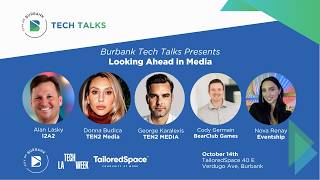
Panelists including Marissa Cardwell and Neal Bloom discuss how AI is changing media, music, film, and games. They cover production efficiency gains, copyright challenges for artists, and new opportunities for independent creators in Burbank's creative economy.
Chapters
Thank you so much everyone for being here today at our Burbank Tech Talk event. This is the first event in our next kind of, I call them semester or series here. We had a networking event a couple of weeks back. It was amazing. At the Green Room at the Castaway. If you have not been to a networking event with us, check it out. That's new this season, so just wanted to mention that as well. Of course. Today we're taking a look at media and tech in the the new age of AI and advancements in technology. Also we're going to be looking at healthcare, medical and higher education. All three of those are growing sectors for us here in the city of Burbank. So they're of great importance and we looking forward to hearing from professionals in the field and also hearing feedback from you on the industry. My name is Marissa. I probably should have led with that. I'm actually Cardwell comma Marissa. My name's a little bit backwards on my name tag here. Representing our economic development division today, this event is a part of our Entrepreneurial Network series. Our team works in entrepreneurship, business attraction and retention and also tourism. Some of the services that we offer for for entrepreneurs, small business owners and large business owners like yourselves include one on one consulting services, free in business training services for you and your employees, business concierge assistance through permitting processes, land entitlements, developments, anything you could need. As a business owner, we want to be your one point of contact. So please feel free to reach out to myself or our team. We're happy to help you with any issues, concerns, questions you may have. On that same note, I want to talk about a little bit why Burbank is a great place for business. Hopefully you all know about our highly educated, highly skilled workforce. Jobs rich in entertainment, media, Technology, more than 1,000 media companies in the city, high speed fiber optic network provided by our very own Burbank Water and Power. If you have questions about that, you can ask afterwards in the back. And then also access to amazing creative co working spaces much like Tailored Space where we are today. A great opportunity to check out how you might want to start your business, what area you might want to be in. Grab a hot desk here and then when you're ready, contact me. I'll get you a brick and mortar 2,000 square feet, a nice little spot. We'll get you started right. That's the next step. So I'd like to introduce Brittany from Tailored Spaces. She's going to give a little bit of an overview about the space here and Then we'll go ahead and jump into the program.
Hi everyone. I'm Brittany. I just want to introduce you to Tailored Space. We're a network of co working locations throughout Southern California. This is our newest location here in Burbank. So we're very excited about that. We offer everything from private offices, suites, virtual offices, hot desks, as well as conference rooms if you're looking for obviously this event space. And we have a recording studio as well. Everything is month, month. We pride ourselves on being all inclusive and very community focused. We're very excited to be here in the city of Burbank. They've been wonderful to work with, so we're thrilled to get this kicked off. We have free day passes for everyone who's here today. So if you want to stop by the desk on your way out, we also have a raffle for a free hot desk for three months. So stop up by the front desk and we're happy to show you around or give you any more information. Thanks.
So thank you so much to our hosts. A little bit of housekeeping, if you have not yet heard, restrooms are up the stairs. You can just follow the signs, of course, snacks and drinks over there. And I know most of you probably already have your phones on silent because it is 2025, but just in case, why don't you go ahead and silence your phone so we can have you interacting and active in today's panel. So without further ado, I'm going to turn it over to Nova and get the rest of the team up here.
I'm Nova and I'm going to invite the panelists up right now. We have Ellen and Donna, George, Cody, all welcome. We're going to have an awesome talk today. I'm so glad this is about media and music today.
And I was talking with you guys beforehand and I love the optimism in the room. I know being in the entertainment and music industries myself for over two decades now, things have been feeling grim. We've been through a lot from COVID to the writer strikes to now the fires and like this strange, shifting, evolving landscape of AI being introduced in new ways. So I'm really excited to dive into this talk a little about me. I love the tech, the intersection of like tech, technology and creativity. So I started as a music producer and composer and then I started mixing music.
Doing a lot of things anyways. Then I started building studios as well when Covid hit because people were moving from working in studios to working in their homes. So now with that transition, now we have AI and This introduction of like automating things to such high quality levels, it's really miraculous what AI is able to do. So we're going to talk about how that's revolutionizing what we're doing here in Burbank, how there is still a healthy industry in which we can utilize these technologies for us here in the room to get ahead. So with that, I'm going to actually start with you, Alan. I would love to hear a little bit about you and what you do quickly and then we'll pass it on to George quickly.
Okay.
I've been in the movie industry, entertainment industry and the technology industry for a really long time. I'll date myself here. I worked on the original Teenage Mutant Ninja Turtles and stuff like that. So ultimately. But I've been in the tech world and I've worked for my, you know, Amazon Studios and Amazon Web Services in a sort of hybrid role. I've worked in essentially, essentially venture capital for this. I worked for Panavision. I worked on the very first 4K digital camera with a company called Dulce. And I had a long career in visual effects which gave me post traumatic stress disorder. And so I used to work for Digital Domain and Rhythm and Hues and places like that. But you know, long sort of long tail background in tech and all of that kind of stuff. So that's what I do.
My name's George and I've spent my entire professional career in the music industry. I was an artist signed to Universal when I was in high school and then I built a management, event and ticketing company that I sold before starting 102 with Donna, which is a content distribution and music marketing company.
I'm Donna. I am one of the co founders of Ten2. I studied finance, so by trade a finance person, but by no means actually a finance pro.
I started my career in entertainment at caa in motion picture lit and talent. From there I started music management and brand strategy firm. And then when I met George and Covid hit that's when we started, started to ideate 102 and then launched from there.
I also started in finance a little bit, but also not a finance bro, I guess as I would say. I then moved quickly over to games and I worked at Riot Games for about seven years and did everything you can do at Riot Games. Not quite the beginning, but near the beginning. And then I shifted over to Epic Games and I worked on the Rocket League portfolio. Ran their product portfolio for the last three years. Everything you see in Fortnite, that's a car that was us Now I am the founder and CEO of Bear Club Games and we're going after a new market there, so.
Amazing. I love how we have perspectives from several different areas and arenas within media and music. I'm excited. I'll actually start with you, Cody. Tell me something interesting, new, something exciting that AI is bringing into the gaming world right now and how you're kind of mixing mediums with what you're doing.
AI is a very contentious topic in games right now, as you can imagine, with all the creative that is there, but it isn't all negative. A lot of the things about games that are very hard and very expensive is the production of games and AI. Closer my mouth. Okay. Oh, well, I sound great.
The production of games itself is a huge opportunity for AI and you're seeing a lot of integration into tooling and just efficiencies there that lets the teams focus more on creativity by themselves. So I love seeing that in games and you're going to see more of it definitely over the next couple years.
And remind me, is there an experiential element to what you guys are doing.
Right now, specifically at Bear Club Games? Yes, yes, there is. One of the things that's huge about our studio and what we're trying to build is the learning aspect of AI for players. So being able to efficiently and effectively learn what players are doing in real time and then give them changes to those experiences almost immediately, which is something that took thousands of hours of training before you can now do in like a minute or two. So it's really interesting to see that.
Do you think that's going to go mainstream? Like it's just going to be the norm that.
I hope so, but I hope we're first.
No, yeah, I think it will become the norm for context. A lot of my experience early on at Riot was behavioral experience was like understanding player behavior. And we definitely spent manual hours doing this. You can already see that going away. It's already turning into a very automated process of learning player behavior.
Okay, yeah, well, we love the sound of that. Alan, I'm curious, is there a similar.
Mixing of mediums and.
Evolving landscape within visual effects and film and like everything that's being made production wise in this town right now with the advancement of AI?
Yeah, I'll say definitely. The AI also is very contentious, obviously within the movie industry. I do a lot of these talks and I've embraced AI, you know, kind of in a huge way, but I'm always getting chased around by the Frankenstein villagers with pitchforks and torches, you know, who are like, you are the dev. And so ultimately though, yeah, there, you know, but here's the thing, you know, there's this kind of hype layer to it. Like, I'm sure you guys have all heard of the Tilly Norwood story, right? The AI actress that's going out. And I mean, honestly, it's such BS the fact that someone would think that we would have an AI actor in 2025. Of course, when I heard that, I realized, I mean, it's the hype that's the product, it's not anything else. And so of course I, you know, when I, the actors start having apoplectic fits, I tell them, oh yeah, it's been trained on Stanislavski, meth, you know, and that kind of stuff. So they like literally start having a meltdown. But you know, honestly, the real effect of AI is in the low level stuff. You know, I was in the visual effects industry for many years and how many people know what rotoscoping is? Do you know what rotoscoping is? Okay, so roto is one of those things that's like someone punching you in the head repeatedly. And the automation that can come from that, from AI is an incredible efficiency win. And it goes across the. With things like paint work, all the kind of low level visual effects stuff. And we all know there's just not that much money in the sort of ecosystem anymore, so we have to be really smart about it. And that's where AI comes in.
I could talk forever on this subject, but you don't want to hear about it. But there's a lot going on. But not in the sort of hype layer that you hear. There's not going to be an A.I. tilly Norwood actress signed with CAA anytime soon, but there's going to be a lot of efficiencies. So feel that might happen in news. News, news broadcast. Yeah, maybe, you know, where you can, where you're feeding it essentially an already generated script that would have been on the teleprompter. Sure. I think it's already happening in China, to be honest with you. And so, you know, that's. That's sort of fine, right? You know that, that's sort of fine. But I mean, the fact that, you know, to think that it's going to be, you know, emoting and all of that kind of stuff in 2026 or 2027 is a, it's a pipe dream. But as you and I were talking about, AI has already affected the industry. I mean, back in the days when I Worked in visual effects. We have a tool called Massive and Massive was a crowd simulator. And remember we used to hire extras. Right. We don't hire extras anymore. When you need 10,000 Roman soldiers coming over a hill, that was done 10 years ago with machine learning. So you shouldn't be completely surprised that this is happening.
Yeah. And I do want to circle back on this and dive deep about like the workflow and like how there are actually new opportunities with AI and how there needs to be prompters and operators of it. But for now I do want to kind of go back to, you know, the financial aspect of this and how there's so many artists out there and creatives who have built businesses in these industries and are looking. Okay, well what's next? How can I get ahead? And so I want to, I want to talk with you, George or Donna, whoever you, if you feel to touch on this. How are, how are you helping artists with the transparency and the understanding of like how they can monetize their careers now in today's age.
I want to comment real quick on what he said.
So I kind of disagree with that because there was this AI. AI has been around forever. It's just like a consumer facing term now. But there was this influencer called Little Michaela on Instagram seven, eight years ago, Avatar. And a friend of mine was behind it and they were generating, it was a seven figure a year business. Then at Wimbledon they had that influencer this year who went, generated millions of dollars in brand deals. And then they came out and said, hey, it's an avatar. And now in the music industry recently there was a musician who just signed like a $3 million deal to this company. Hallwood. Neil Jacobson, who used to run Geffen started this. So I think that.
I think it's going to happen a lot sooner. I think people with this SORA too, which we're seeing, a lot of.
People are comfortable with it. I think.
I'm like a. So I came up in that time. Like we joke, Donna and I joke like pre smartphone, pre Internet. And we're like the greatest generation ever because we know what life was before.
B.C. whatever we want to call it before whatever. And.
We do a lot of this right. And part of our business is we collect and track user generated content for our clients. And our clients are Frank Sinatra, Dean Martin, Benson, Boone Somberg, huge tier one clients. And we're getting.
Billion, billions, billions of views a month. I would say we probably monetize, collect and track. Three billion views a month, maybe more. Eight billion And I. My And Donna, you can comment on your point of view is that I think people are okay with AI. I think there's this line that's blurring on the romantic. Like romanticizing and not to discredit acting in any way, but it's. It's happening. It's. And if you don't accept it and move with it and people are going to be comfortable with it, the Sora like the Jake Paul thing going crazy shows. I think that it's going to happen a lot sooner if it hasn't already happened. Right. Like we might be engaging with an avatar that we're unaware of.
Right.
Possibly.
So it'll be interesting to see. And in music, it's happening in a big way. We final thought and then you can answer the question because I forgot it.
The way we got exposed to this is we represent a big hip hop catalog. And one of our staff approached us and said, hey, there's this AI video last year that's actually really cool around our client's song. So we reached out to the guy, we brought him in and we started working with him. And this was like pre Suno Udio all that. Then all of a sudden, same employee goes, hey, there's this song going off on UGC in our system called BBL Drizzy. And you have to check it out. And it's this joke record this guy made using Suno. And then it was the center of the Drake Kendrick beef that created Not Like Us, all of that. And it all stemmed. And there's a really good article on Billboard about it. And I think we realized and we jumped on AI music very early, built a relationship with Suno and realized that this is happening. Huge music producers are using it. There are songs right now in the top 100 that are being created with this tool, but people don't know. So, like, I think it's very naive to think that people don't want it and it's not happening in pop culture.
I also think that the. The productivity and workflow obviously is the. Is the primary thing right now that we're seeing. That's the biggest impact in music. In particular, saying that AI is AI artists and AI music and everything is going to replace all artistry and everything around an artist. I think that part is probably naive because in music, film, tv, et cetera, but music in particular, there's a level of emotionality that I think other forums may not have as much. There's memory and attached to musicality. And I think diminishing that piece of the artistry. Again, I'm speaking about music in particular. Diminishing that to a single kind of AI tool or replaceability removes the elements of music that make us love music to. To begin with, going to concerts. We all remember the first CD we bought, like, all of those things. Yes, AI will. Will probably is currently and will continue to expedite the productivity and the production around it, but there's still a very fundamental core component of music that will take a while to replace.
I totally agree. And that's exciting to hear because I want us to stick around, you know, like us humans.
I'm rooting for us because, yeah, like, I mean, the emotion part of it, but also just the human connection, trust part of it. Like, I know during COVID there was like a big social media switch up where people went from very, like, highly produced videos to just sitting in front of their camera and singing with the phone mic or whatever. And it's like, I think we went from like, real to now we're like even. Or we went from like, very edited to very real. And now we're like, kind of playing around with this AI, like, super, not just us in front of the camera thing. And it's interesting to see where it goes because, like, Suno, for me, like, my music supervisor is here in the back. Andy. Shout out to Andy and Beta Patrol. But we were working on a Barbie commercial this week, and it's like, I'll go to Suno and like, listen to something just different and just see, like, oh, I kind of like that hi hat rhythm, whatever. Like, I'll replace what I have right now and like, do something like that and use it as inspiration. But at the end of the day, it's like, I think our human minds can't be replaced like that. So it's really exciting to hear that you have that same view and that it is about that human emotion at the end of the day. Okay, so I do want to circle back to the finance part of it. How are you helping artists tap into certain revenue streams online right now that otherwise wouldn't be tapped into?
Because we need to monetize this human stuff.
You know.
Like my dad said, if it doesn't make money, it's a hobby.
That's true. Didn't make that up. How are we. So we identified during COVID an opportunity that existed in maximizing content revenue for artists. Big artists, huge artists that everyone knows were not. And again, it's not that these labels or distributors were doing it incorrectly. It's just they are Worried about so much. And we saw this opportunity to think about.
Monetizing video content, audio content, music publishing content, how to track, collect and create transparency. Because historically, I'm not super familiar on the media, like the film side, but on music, being muddied and gray was a business strategy.
Right.
So I think one of the royalty.
Statements are very hard to decipher and read and you get them, who knows, every, like, whatever increment of time. So transparency around, especially the accounting, reporting and finance element for our business was first and foremost, if you can't do that, you shouldn't be in it, you know?
Correct.
So what's the question? AI and finance or just finance or.
Just like the streams of revenue that you are helping clients tap into?
Yeah. So like, again, now we're living in a world where digital, for an artist, even though the sentiment is that payouts are lower, which is true, much lower than selling a physical product, in theory, there's infinite scale. So that's how we really thought about the monetization and the tools that we built was infinite scale and compounding.
Compounding someone's work. So historically, Donna's an artist, she releases an album. Historically, you release an album once and maybe you do a music video, a lyric video, and a deluxe version and that's it. We look at that as an opportunity with various permutations and ways that you can put together that same album and repackage it for a different audience. So for a lot of our clients, we're releasing content in 10, 12, 15 different ways and then we're able to track it and create exponential value and transparency.
Interesting. I do want to circle back to one thing you said about the SUNO tracks being major a list. Producers are using this. Isn't that a legal nightmare though? Because they don't own the copyright then, right? Doesn't suno?
I don't think so. The debate right now is in the. So if I use SUNO and I write lyrics, I own the music publishing, but the master recording, because it's AI technically and maybe the law has changed. Anyone can rip me off, right? But I. If I wrote the lyrics or the melody, the publishing, the composition side of the copyright, I would then be entitled to that. But technically. And again, the law is evolving.
But.
But again, it's more about workflow than saying, hey, I'm going to make an AI song and put it out, because anyone can. It's more about, hey, I'm an incredible producer and I can make 10 unbelievable songs a month with Suno, I can now create 10 ideas an hour, pull from it and get influenced. And then maybe I come up with a really cool melody that I then like.
You write three parts of the stems and you sing into it and it turns into a trumpet solo, for example. Like, that level of productivity is obviously unprecedented and just like expedites infinitely.
And I think that again on AI is if you embrace it and you look at it and you learn from it, you still have to have taste. Right. Like that's the element of AI is like anybody here can come up with a song, a video, whatever, but if you have taste and a vision and you can take from it and pull it and build, that's what I think. Those are the people that are most successful.
Yeah. Using it as a inspiration efficiency tool. Yeah, yeah.
But like if I'm going to make AI songs, anyone can do that, right?
And they're not necessarily, I mean, well, they're not good yet. I don't know. I mean, getting better. It's pretty convincing. Especially voices.
Scare me from that point. And again, debatable. But from a trend standpoint, there's likely going to be so like a huge barrage of garbage that then we're going to start evolving towards more curation because we kind of have to. And there's so much content that we're going to need it filtered again and then it'll be the MTV era all over again. So we're going in cycles, really. My opinion.
Yep.
How about in the gaming world, Cody? What are we, what are we looking at in that world with AI?
I think mostly the same, to be honest. There is a little bit of difference in games in that the majority of platforms and where players are are kind of consolidated already and they're owned by either the engine sphere, which is mean like an Unreal Engine, or a Roblox engine that requires additional layers of complexity to actually get involved with. But those engines are building AI capabilities into them right now. So I think same timeline, maybe a little bit longer, you'll start to see a similar problem show up, which then again probably pushes you out into a more curated experience.
I think ultimately the biggest challenge in all of this is is making your voice heard. Not like my voice heard, but like your content heard. So distribution is still the biggest problem for every kind of media layer. If we can figure out a more tailored solution through AI there, then all bets are off. We'll see how fast everybody can ship something. So.
I think the one thing I will say about games, that's a beautiful ringtone, by the way. I really love that.
Praise the Lord.
The one thing I can say about games is what we're seeing right now in game development, and we were talking about this beforehand before we even got started, but web browser games are coming up big now. And the reason the web browser games are coming up big is that anybody can now make a game that's like a Nintendo 64, not even Nintendo 64, like a Nintendo or Super Nintendo quality. Pop it on a web browser and anybody can pick it up and play it. And you'll see things like that popping up in Instagram, Instagram and TikTok, and there'll be more interactive entertainment from that. That's a new medium for games. That's not what the future or the past has had. So we'll see a lot of that grow up too, which I think is pretty cool. I'd prefer to see humans do it, but it is pretty cool that we're seeing that come up so fast.
So it kind of sounds like what happened in music a little bit, where it started getting really saturated because of just the ease ability of being able to create.
Yeah, it definitely is. I mean, I'll use Roblox as an example. Their CEO hopped up on stage a couple months ago and said, hey, we are building this engine to be AI first, meaning they want player, anybody to be able to come in, prompt a little bit and build a world.
So.
And I think that's a really cool vision. It would be interesting to see what creativity comes out of that.
What about in film, Alan? What are we looking at as far as visual effects? Like, are people being replaced? Or is it just becoming a thing where it's part of the workflow, that you just have to learn how to use these.
AI softwares to make this faster. And is the pace picking up?
Yeah, it is. And I mean, ultimately we get into a lot of kind of sticky areas here where, look, you know, I'm sure you all saw Tron. Ares was, you know, the theater theatrical release is dead. I'm gonna. I can say that. And you can chase me around the parking lot with torches and pick forge bars, but the. The releases, for all intents and purposes, dead. And ultimately, you know, Netflix won the streaming wars. And so this question of monetization becomes really, really critical. But the idea that, like. Yeah. Is it replacing people? Visual effects was always an absolutely terrible business. It's really not a business, it's really a hobby. And ultimately the thing is that it's already getting rid of a huge layer. AI is already getting rid of A huge layer. Like for a long time we've been outsourcing to India and to China and for rotoscoping and for paintwork and for what's known as match moving and things like that. And that layer is already gone. And so ultimately this operational tempo that you're kind of describing, which is essentially people are, you know, it's Hollywood. It's not now, it's. Right, right. You know, it's basically, that's what we always used to say. And so ultimately that operational tempo is, it's not slowing down, it's increasing. And AI is the real key to that. And so within specifically visual effects, you know, ultimately it's, it's already hollowed out a huge portion of the, of, you know, the thing. And also. But you know, look, the bottom line is if your kids or your brothers or sisters want to get into visual effects, slap them across the face and tell them Alan Lasky sent that. Okay, Just don't get involved. It's a terrible business. And so ultimately, yeah, is AI going to. It's already done, you know, but if you can, here's what you can do. If you learn AI and you can be that sort of, you know, one man band who can do a lot of stuff. And that's sort of what I've been doing is teaching myself all the different tools, then you, you have a chance of doing something but, you know, can you make money? That's a different story.
Well, what part of the industries do you see flourishing right now.
Here in, in our, in our, you know, there's people doing really interesting stuff with AI and I think the really kind of, you know, I don't want to be Debbie Downer, you know, you know, like, I don't want to be that person. But the thing is that ultimately I've been doing a lot of my own sort of film stuff and using SUNO to create the music so I don't have to get content strikes on YouTube and things like that. And ultimately when you go out past the 30 mile zone here and past CAA and Warner Brothers and Disney and you know, all the sort of people that we've been kind of beholden to for so many years, there's a lot of really talented people out there. And the big question is how do we monetize that? Right? Because that's not YouTube. We're not going to be streaming, you know, to a certain extent. So they're. The big question for us in film is how do we monetize.
It's changed that much 100%.
And look, I just. I. You know who the Doer Brothers are? Do you guys know who that is? So the door. I just entered the Door Brothers contest for their film just to see what other people were doing. Oh, my God. There are people in South America, in Africa, in all over the place who have now gotten. The gatekeeping has blown. You know, the idea that you have to be some, you know, connected Nepo baby to get in to tell stories doesn't exist anymore. And it's break. That wall's breaking down really fast. There's some very talented people out there. Really good storytellers.
Wow. I mean, we go from music to gaming to film. It just sounds like we have the tools at the tip of our fingers to make really cool things in such a different way now. I mean, it's amazing, actually. And I'm encouraged that we use it for good and for art in a way that continues to shape culture. Because I know for me, that's why I became an artist. It's like I don't. I believe in humanity, and I want us to remember that humanity. That's what I think art does. It reflects back who we are. So on a local basis here in Burbank, I'll let any of you hop in on this. Where do you think we need to be focusing? How can we keep things local? How can we keep things in person? How can we keep making media strong and the community here flourishing?
Mind if I take that one or just Berman? Well, we talked about this a little bit when we were talking about Burbank. And you guys remember Burbank was where the Skunk works was. This is where Kelly Johnson invented the SR71, the P38. This is a. This area has a history of innovation that's really strong. And I. Now, the young lady who represented Burbank has left Elvis has left the building. But ultimately, the thing is, I would love to see some kind of financial incubation happen for new projects, like new AI projects, new music, new video game projects here that could essentially foster innovation.
I like the sound of that.
That might be a pipe dream, but I don't know.
It's what we do in the startup tech world. Why not?
What can we do here?
Yeah, I think that, again, it's just fostering innovation because we're. I personally, I don't want to speak for Donna, but I am so bullish on AI and technology as a whole and have been our whole business. Right. Again, I was an artist. I got into electronic music. The genre itself is about pushing the boundaries of technology. So I think from a creative services space, we have to reimagine what the future looks like. And it's. To me, music is becoming like the producer now has more leverage and power than ever. Because if you have great ideas and you know how to articulate and you can use the tools, your output can become better and you can work with artists and create stuff historically you may couldn't do. And I think that's cool. Again, it democratizes access. But then you need taste and you need to teach taste. And it's about going back to Donna's point, curation and pulling back. Like, less is more in this digital era. And if you can create a culture and a community that teaches that, because they don't teach that in traditional education.
I think you'll be a lot more successful. Not only here, but you'll produce people who are more successful in life.
What do you mean by less is more? Sorry.
This is a Donna quote, but I think we live in an era now of like, more content. More. If we're running a marketing campaign more. We need 10,000 pieces of content, when in reality you would be more impactful with a hundred really good ones. Right. Or Netflix. Every time I open Netflix, it's like 90%, 8% stuff I've seen already, 1% of something that I actually watch through. It's like a joke. I never finish anything because it's just crap. Right. So if we spent more effort on teaching quality because we live in a culture and society now of like, shortcuts that. And again saying, hey, technology is the lubricant to getting there faster. It's not. I'm stealing your line. It's not a shortcut. What's the line?
Yeah, it's the lubricant. We don't cut corners, but we encourage. Yeah.
No cutting corners, but getting there faster and in a more productive way is what we're talking about.
Yeah.
So to sum it up, I think if you. Because there it is a place. LA in general attracts creative people from all over the world. Now it's up to like saying, hey, whatever era we're in, 3.0, 4.0 is a different mindset. If we're trying to romanticize an era that is dead. MTV shut its doors. Right. On video content yesterday. Great. It was awesome. It was super important part of my life. But it's not the future. And you have to accept that. And I think, like the entertainment industry as a whole, and it's all I've known. I was Signed to a major. I manage artists on majors and we still work with it traditionally likes to look in the past then instead of look in the future. And I think like, culturally we have to create an environment to foster that.
Mindset in a way it's not.
Go ahead.
Oh, I was going to say, I also think in general it goes back to the the less is more concept is kind of simplicity is mastery and mastery is simplicity. And what we always say is like, it goes back to the barrage of content and the voluminousness of content through AI and otherwise is going to foster an era of needing to pullback. Like take off that accessory, that one accessory before you leave your house, look in the mirror, take off the earring. It's kind of that concept because when, when there's an inundation and there's a lack of inherent quote unquote quality with it, it's time for the pullback. It's time for the more curated experience and that's what audiences will want. And it ebbs and flows and, and trends go up and down. So I think, think, you know, when, when there's a barrage, there's a corresponding pullback.
Well, as a millennial, I'm so here for that. Oh my gosh. Do you guys remember when the artist release was a thing? Like the countdown to the release date? I want that back. I want less is more again. Okay, I'm here for it. What about you, Cody? What do you. What do you think is. Is keeping us here? Local, community, together, all the things.
It's kind of funny. I, I'm listening to this and I think about it from. I'm going to think about it from a games perspective. I don't know if a lot of people know that, but games as a whole, from an industry perspective is very West Coast, West Coast, California, Seattle, like up and down the coast, and over the last five years, China, Vietnam, like even India right now are taking a lot of the work that was done in the west coast.
Overseas. And it's showing up. You're going to see it in all the distribution channels. Most of the games that are doing really, really well have some kind of broad globalization tied to them. And I think to bring that type of business back to where we are today, and I think that's a very tough thing to do. But I think if you're going to try and do that, you have to cultivate a protective area of creativity like we're talking about in an almost cost effective way because we're losing on cost right now. We're like five times more expensive to develop anything in Los Angeles. Like, it's, it's kind of absurd, but there's. Comes with that a lot of inefficiencies. There's come with a lot of like Moneyball policies basically down to the lowest common denominator. And I think there is room here to bring that talent into new exploration and taking bigger risks that we haven't done in the last 10 years. Use the new tools that we have, let people run free with them and give them the space to deliver and make that space. Burbank, make that space. Santa Monica, make that space la. And I, I really think there's an opportunity to do that if we can kind of get out of that cycle of lowest common denominator wins. So there's not. I don't think there's a better place in the entire world from a talent perspective than where we are right now, especially in the games industry and the movie industry and music. Right. So finding like the actual municipalities to support that is huge. Would be huge.
I also think that we have over time kind of moved away locally, even have moved away from this sentiment of experimentation. It's become a kind of rinse and repeat. Oh, what's worked. Let's do the same thing over and over again and, and love the Marvel Universe. But it's basically that in a lot of ways. And the entertainment industry inherently was designed for experimentation and pushing boundaries. And we've moved very far away from that. And nobody wants to lose their job. I understand. But if the experiment goes wrong and you were the ideator of it, it's a bad look. But I don't. I think removing that just even a little bit allows people to feel freedom to experiment. And that's kind of why the entertainment industry exists to begin with. And I think starting that sentiment locally, et cetera, will help tremendously.
I agree with that profoundly. Like, I come from a product management background and product management has become reduce risk at all costs, make the most money off of like the sponge squeezing. Right. And I think what misses is that last step in, hey, I'm going to give you the information of where you should maybe go from a strategic perspective, but creatively, like, take it and run with it and do something amazing. And if it fails, cool. At least we did all the risk assessment up front so we know where we're gonna fall, if we fall. So like, I think that's missing and we've lost that and we can bring that back for sure.
Yeah, I mean that's Any business risk startup, it's like, you don't know, there's no guarantee. So maybe we got a little comfortable in the process, it sounds like, and it's time to switch it up. What do you think, Alan?
Yeah, I mean, to me, look, and I'm. Don't, please don't think that I'm anti union or anything like that. I was an IATSC member for years and. But that's one of the ice walls that we're facing right now, unfortunately. Like, the thing is that there's this sense that. And you know, look, I always use the Bronze Age collapse as the, as the metaphor for this, where we've had a total systemic collapse. And ultimately you talk to any producer and they will tell you, are you kidding me? Shooting in la, you're insane there. I mean, literally, we're not going to ever do it again, considering the costs. And so ultimately the thing is that we've hit a wall. And that sort of wall, it has to break down. But, you know, I don't know how to do it unless people die. Like, they just got to die off. I know that sounds horrible and it's, but it's, there's, there's got to be this kind of like layer that dies off because I, you know, I talk to people that I've worked with for years who were in the local 600 camera union and the local 80 grips and local 44 and all of that kind of stuff. And look, I know these people really well, but the bottom line is that, you know, that world doesn't exist anymore. And you and I had the discussion about the Yamato, the, the Japanese battleship that they built in World War II, that they set sail that was literally obsolete by the time it hit the water. And I always tell people who want to do this job, don't be the deck gun coordinator on the Yamato. You're fighting. You're on a ship and you're doing, you're fighting a war that doesn't exist anymore. And of course, that's why I'm chased around the parking lot with, you know, torches and pitchforks, because I'm trying to be as, you know, kind of realistic as I can about this. And ultimately I'm trying to, you know, it's a bitter pill to swallow. I don't like it any better than anyone else, but we have to metabolize that.
I mean, it sounds kind of exciting for independent creators, despite the potential lack of funding. But if the machine is struggling right now, then there may be A gap for independent creators to come in and create at that level, potentially using AI and maybe kind of replace this unionized centralized industry to a more creative independent.
And you know, look, I spoke at another Burbank thing a couple of months ago that was run by the city of Burbank as well. It was run actually by the Library of Burbank with the world's most loony. And he was the great guy, Hubert the librarian. But we had a, this came up and look, the bottom line is we had a whole panel about kind of keeping work here with local government and all that kind of stuff. There's got to be a kind of governmental sort of, there has to be a local government and kind of, you know, really sort of, you know, city of Burbank, City of LA, you know, and not just Governor Newsom giving us $750 million in tax incentives. That's not going, you know, great. So we can pay, you know, we can do the same thing again over and over. We can make another Spider Man.
People like Spider Man. But you know, look, I mean, the bottom line is that that's dying.
Okay, so little lightning round, let's wrap this up. I'd be curious just in a sentence or two, a bold prediction or opinion, what you think is coming from within the next five years within your industry.
Wait, I want to make one quick comment on the independent thing from a music perspective.
Okay.
Yeah, independent music is growing in terms of market share in the music industry. Right. I think it's a combination of sheer release volume and just artists have more opportunities other than traditional record labels. But the risk that comes with that is the artist then has to build a team that looks very different than if you're signed to a major label. Right. So all of a sudden, and we have a couple very big independent artists who are, have full on infrastructures and it's a different mindset. So I think that you hear like, oh, independent artists are thriving or they're not thriving, but I could be successful. It's a completely different mindset and I think it's really important to acknowledge that. Right, because that's a big deal. Like you have to assemble a team that can then manage your infrastructure as a business, not just be an artist. And that's a completely different mindset.
So what do you think in a little sentence, five years from now, what the artist.
Trajectory is going to look like?
That is a very tough question. I think unfortunately the artist cycle has become shorter because you have to be a marketer, an artist. You have to Be everything. And fans forget about you quickly. Unless you're really prolific and you are really, really Kendrick Lamar, Adele, etc. Can go away, put out an incredible body of work concept, tour it. But that's like the top of the top. I think that we're going to continue to see a lot of. Like, last year was one of the best years of breakout artists. If you watch that Grammys. It was unbelievable. Chapel, Ron Benson, Boone, Sabrina Carpenter, Teddy sw. It was like Dochi. It was unbelievable. So I think artistry is thriving and the tools and the. But unfortunately, I think the career cycle is shorter.
And we have to think about empowering that and helping you, you know, create and stay relevant and not have to be so stressed out, like, oh, I have to drop a song every six weeks, because that's what you do, you know.
Yeah. As far as, from a music standpoint, I think again, it ebbs and flows. I think we're going to go back to the era of the Madonnas and the Lady Gagas who create worlds around their Personas, and that, again, fosters the longevity of career. It fosters the duration of their album cycles and their single cycles. In no world are hits any less valuable. The hits are the things that kind of keep the lights on. But ultimately, creating worlds and having fans that are committed and dedicated and interested in you and read the liner notes, remember that. That, I think, is going to come back because we've been inundated with the TikTok singles and the artists don't always match the hits and we want to go back to that. And people are craving it.
Yay.
I love that prediction. Okay, and then what about in the game world? Anything crazy coming up, you think?
I think only crazy is coming up.
I guess if I were to do it in one sentence, I think you're going to see a lot of new IPs from smaller teams that publish and distribute along geopolitical lines. So a lot of relationships across borders, very specific relationships across borders. And then the teams that really nail, like, micro audiences, like, are going to be the ones that succeed and then they will get gobbled up by the big ones. I think a lot of consolidation and that's for games. Games is kind of, no offense to the rest of you guys. Games is kind of winning right now in terms of media dollars. I think you see a lot of big game publishers acting as M and A and buying up a lot of entertainment across the globe. So I'm excited for that working in games, but it's going to be an interesting Time, for sure.
So you want my prediction in film or.
Yes, sir.
Or. Or not. Well, I think ultimately the. The reality here is that we don't need to be the Amazing Kreskin, because the first part of this has a. Already happened. It's this. It's collapsing right now. I mean, when, you know, if someone had told me the. A couple of, you know, months ago that Warner Brothers would be up for sale, right? I mean, you know, and Disney would be crashing and all that, I would say, you know, are you insane? You're high. You know, there's no way that's going to happen. But it is happening right now. It's. We're literally in the middle of it right now. But, you know, the thing that makes me excited is all the seeing the pockets of really crazy sort of guerrilla warfare. The one that I really love is the idea that. Do you guys watch Flow?
Have you seen Flo? Do you know what I'm talking about? It's the Latvian animated movie that two dudes made that won the Academy Award for best Animated picture, and they used open source software called Blender to do it. And they won the Academy Award. And it's an amazing film. I would highly recommend that you watch it. That's going to be the future. And what I love about this is that the gatekeeping is starting to break down. The gatekeeping to essentially making and distributing content is breaking down. And that's the most exciting thing because, I mean, you guys have, you know, like, you can't get a meeting with, you know, some of these people to pitch your idea, but now, screw it, you go off and you do it yourself like these two Latvian dudes did, right? I mean, ultimately, that's what you do. And now with the rise of the really powerful AI tools, I think we're going to see some really interesting things. The big question then of course becomes, how does it get monetized? How do you get paid for it? Right? Because the standard distribution channels have broken down completely.
Wow. Big times. We live in. Crazy pivotal moment here. Do we have time for like a question or two? Because I'd be curious where everybody's head's at. We got the guy in the glasses.
Okay, we'll take two questions and then I think our panelists have said that they will stay to answer them on your own.
Introduce yourself. Yes, my name is Luis Vega. My understanding is that AI is not copyrightable, that. That things that are created using AI do not necessarily belong to the artist. The Getty had the first AI photography exhibit, and it was an issue because it was created with the usage of AI and they couldn't copyright it. Are you aware of that or is that.
Of course. I come from a family of intellectual property rights lawyers, so ultimately yes, I am well aware. And the thing is that ultimately if you look at some of these. Have you looked at like Disney vs Midjourney or any of that stuff? Do you read these, these cases? Yeah, I mean these are, it's going to. How are you a lawyer? How long do you think it's going to take to settle that one?
It's 10 years easily. And the thing is that ultimately these, you know, yes, there are copyright issues and everything, but by the time those get hashed out, there may be no copyright holders to sue. I mean ultimately this is, we're getting into brand new territory here. So ultimately, yes, that is an issue. And certainly people who, I don't know what direction is Disney, it's that way.
Right.
Warner Brothers is sort of there, there is probably into, there's, there's a team of lawyers right now in those buildings with the seven dwarfs holding them up who are basically like, you know, essentially like they're, they're in there and they, that's how their salary for, you know, you put your kids through college using, you know, these, these lawsuits against Mid Journey and against sewer, you know, OpenAI and all of that kind of stuff. But this isn't going to get, this may not get settled in our lifetime.
I think it's extra complicated too because if I'm not mistaken, AI is obviously trained off of music. So what is it referencing to create that body of work?
Yeah. How do you unwind the copyright?
It's very, very tricky. So yeah, we're going to be figuring this out for a while. We have another question. Hey guys, I'm Cadison. I'm a stand up comedian.
So do you guys feel like a.
Tick tock changes the music industry forever? And also for Donna and Andrew, question, do you guys work with stand up comedian? You guys know like right now the number one song is golden from K Pop Demon Hunter.
Right.
So do you guys feel like animation border, like music industry in different kind of era as well?
Thank you, mcat.
Currently we work with all kinds of entertainers.
You should answer the TikTok part of it because you have a very strong opinion and I feel like it's valuable.
Was your question, did TikTok change music? Yeah, 100%. I think.
TikTok's unbelievable because it, it caused YouTube. Right. A multi, multi billion dollar company And Instagram Meta to completely introduce products to react to TikTok. And when you think about that, that's like pretty unbelievable, right? So these giant companies are reacting to this startup and then from a music standpoint people are legitimately making songs specifically for TikTok. And there's huge artists, huge songs popping up and people are producing songs. There's remixers that are on staff at a lot of these labels that are re editing and rearranging songs. And there was an interesting study by a company called Chart Metric that showed since TikTok came, how it changed the length of a song, the intro, the chorus, the arrangement. It's super interesting.
Long term we'll see what happens, right. How that impacts like where it goes. But it's changed. Like every record label has a viral marketing team, right. Every label has a research person and people have. It's legitimately changed the course of music. Like where we're living currently is because of TikTok in music. It's unbelievable.
Yeah.
Do you want to add to that one real quick? I think it's not just necessarily changing music, it also is like changing pretty much all entertainment. Right. Everything.
If I were a business student 10 years from now, I would be really excited to take a case study on TikTok because it's time to market examples like TikTok dances to Fortnite or Tick tock Music to Fortnite dances is like an actual time to market evaluation. The faster you can get there from TikTok then is the more money you'll make off an emote or, or even like you said, artists creating like just stems that can be put into like a 30 second video just because they know it's going to be a dance. Like that's amazing. I think. So we'll see what else comes out. But that's the first big one I think that's really done that.
Okay, we have one last question.
Yeah.
Hi, my name is Josh, founder and CTO of Next Sound. So I've been seeing a lot of things in the industry, like when it comes to like the ecosystem, the infrastructure, I've talked with a lot of publishers. The number one thing is that the industry is slow. There's a lot of legacy platforms when it comes to administration, publishing, registration and getting these things at scale. So when you look at a platform like Suno that has millions of users now, there's tens of millions of things being generated daily and we talk about 120,000 songs going into the actual music database daily. And it's kind of Like a thing right now, but it's tremendously growing past the point of the legacy industry being able to handle that. But there's new thing in regards to stablecoin ecosystem infrastructure. The closest thing we have to it is looking at coin market cap where there's plenty of value, is being handled easily daily. You'll see Bitcoin at 60 billion to 80 billion plus volume daily. So there's a lot of transactions. How do you see that ecosystem translating into the music industry and what companies do you feel will or will not make it to that?
Good question.
Yeah, I think we're witnessing, we're in a really cool time because there are these legacy companies that have just sheer market. Right. They've positioned themselves that they own the copyrights and they have so much bargaining power with the platform because ultimately it used to be Tower records, right now it's Spotify. And if you look at the market like the, the cap table of Spotify initially, Warner, Sony, Universal, Tencent, there's like a crazy graph that shows for companies that control the music, control Spotify, et cetera. And unfortunately there's supply chains and a lot of things in there that were not designed for this output. Tunecore, for example, is going through a huge lawsuit from UMG because it's a DIY distribution platform where anyone in here can sign up, distribute music. But with that comes a lot of fraud, right? So TuneCore is getting sued for $500 million because people, Donna can upload and say, oh, I uploaded Rihanna and I'm in Rihanna's Donna. And that's happening at a huge scale.
So I think that stablecoin, blockchain, all of that is incredible. But I think again, going back to what we mentioned earlier is the elephant in the room, at least in music, is the royalty accounting. Right? And high level. If I'm a label, I'm essentially a bank offering an artist a very, very high interest loan. So it's in my best interest to spend money, keep them underwater and recoup at a huge rate, 180% return on a loan. So I think in theory what you're saying is accurate. And that's what we're. We are building our business, our royalty model and we're paying out tens of millions of dollars to artists through super transparent ways, but on a monthly basis. Right? Most labels or distributors pay to you quarterly. So I think that it has to happen. I think it can happen in the independent sector, but I think the gatekeeper in that old system you referred to, it's not in their business model to be transparent and they're publicly traded, so now they're concerned about profitability.
So it's super complicated. It's like such a complicated. So what we have to do is allow independent companies and musicians to thrive. Because if we as independent companies can get enough market share and come together and force this change, then it will happen. But I think I'm right with you, man. But they don't want that. Right. Like people go to. When I was in my band, I remember getting a statement and we. We moved to the UK and we met with our business manager and we were going over our statements and there were like $800 dinners billed to us that we were paying 50%.
Recoup. So 50% on top of the 800. Right. And then we started doing the math and that's when I realized I'm not. I'm not. Being an artist is not in my best career interest. Because we're gonna have to make like $10 million before we see our first dollar because of the way it's built and we never approve these marketing expenses, etc. But that stablecoin system you mentioned, I think that's the future of it.
Great answer. I love this talk. I'm so glad we had this today. I want to invite the Neil up because he organized all of this and he's the one that builds communities and brings people together within industries. Take it away. Thank you so much for having us.
Well, thank you.
And let's give another hand for our panel.
Yeah.
I'm Neil with Rising Partners. We convene innovation communities just like this. And I think some of the biggest things we heard of just how much change is happening. The biggest thing to do is show up and share with each other so that we kind of are level settling with each other and sharing knowledge quicker because change is happening so fast. So kudos to all of you for coming out tonight. We convene actually on an almost monthly basis now for the city of Burbank. And so our Next event is November 19th and it's a pure happy hour for startup Burbank. We'll send an email out of where it is, but November 19th is our next event. And then we take a pause in December, but we're back in January. So thank you all for coming out. We still have food and drink over there. Feel free to if you got a question still lingering that you want to ask the panelists. Thanks for coming out and we'll see you again soon. Cheers, everyone.








