Catalysing Startup Ecosystem 2021 - Neal Bloom
Neal Bloom, founder of Startup San Diego and director of Interlock Capital, explains how he built San Diego's startup ecosystem through a nonprofit, community events like Fresh Brewed Tech, and local angel investing. He covers ecosystem mapping, incubators, diversity efforts, and how the community adapted to virtual events during the pandemic.
Hello everyone. Hey Neil. Hey Sunik.
Hey there. Thanks for having me.
Yeah, so hi everyone. Welcome to our session. Today we are really, we are really happy to have Neil Blumang, Director of Interlock Capital to share on how to catalyze the startup ecosystem, especially around the region. Neil, welcome.
Daniel, thanks so much. It's been fun to share some notes with you on clubhouse and you know, good to connect our communities from Southern California and Southeast Asia. So thanks for having me.
So what time is it at the point of time over at your place?
It is 7pm Friday night.
Nice. Thanks for doing this on a Friday night. As some parts of this in Southeast Asia we are heading into our lockdown but yeah, so we will just try to enjoy this as much as possible. Just a few housekeeping rules. The chat at the right hand side is basically you can chat with everyone and if you have any questions for Neil, feel free to go and pop in in the question session. Other people can actually go into the question sess and vote up the questions that you want to be asked and we will get Neil to actually share. Just before I get Neil to present himself, I'm just Neil. For those who do not know, Neil is a serial entrepreneur that operated both in the aerospace ad tech, talent tech and marketplace. He's currently the CEO of Rising Tight Partners and the Managing director of Interlock Capital which I think he will talk a lot more about this. And through his grassroots effort that Neil has helped multiple organizations and actually helped to spearhead the entrepreneur focused community that is helping entrepreneurs and company grow in San Diego and throughout Southern California. So welcome Neil and we are all so excited to actually hear from you guys. So I'm just going to let you present and take it away man.
Okay, thanks Daniel. Appreciate it. It's so good to be with you all. Let me share my screen. And so you know, 18 months ago or so we were lucky enough to work with the US Embassy in Kuala Lumpur and Wasili fellows program to host Sunech 2 in San Diego. Can everyone see my screen? Just want to check. I think I'll see it in the chat.
Yeah, so we can see your screen but it's not the full screen yet.
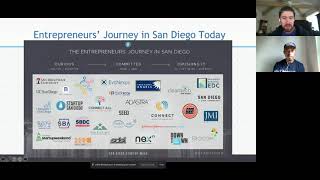
Yeah, no worries. Once I go to full screen I won't be able to see airme which is fine. So just want to make sure we're good. So I will start this. Perfect. So yeah, we were lucky enough in San Diego to host Sunaik in fall of 2019 for a whole month which was incredible. We got to share a lot of Stories got to show him what was going on in San Diego, Southern California. I was supposed to come visit you last summer, but the COVID pandemic had other plans. I'm so happy that we made arrangements to do this virtually. It's a thrill to be with you tonight for me. Morning for you. I hope we can take your mind a little bit off the pandemic and talk about the things that we've learned during the pandemic, things that we've done kind of iterate. And that's what we do as entrepreneurs. We pivot, we look at the situation in front of us and we go in another direction to meet the need. So my name is Neil Bloom. I would say I'm an entrepreneur, serial entrepreneur. My background is actually that I grew up in Los Angeles. I went to school at University of California, San Diego, and studied mechanical engineering. And then I worked in aerospace actually for five years. Working on the space shuttle program, which was at 22 years old, was incredible. Honestly, I wouldn't say it was a dream of the lifetime because I didn't have plans for that. But what was incredibly cool to me was working with people that all they ever wanted to do in life was work on the space shuttle and put people in space. And so to be surrounded by incredibly talented but also inspired people really rubbed off on me. And at that point, I knew I wanted to work on things that made a difference and had an impact. And so along the way, I started to find my entrepreneurial itch. I felt like I was surrounded by only engineers. And, you know, it was a little homogenous for me. I needed some diversity of skill sets of thinking. And I started to just tap into what are my other. What are the other skill sets of mine that are lacking and what would I be fulfilled with. And it actually led me to an mba. And so I started getting an mba, a master's in business by night. And I was exposed to marketing and entrepreneurship and came up with a few of my first ideas. One of those ideas became my first company, a company called Portfolium, which the website still exists today, portfolium.com and it is a site that helps connect new grads with jobs and opportunities using a very visual format. So think about kind of Pinterest meets LinkedIn was kind of what we were going for. We wanted you to be able to show your skill sets to help you get that first job, as opposed to telling it, you know, by bullet points on a resume. And I had no idea what it meant to be an entrepreneur. I Didn't know what a startup community was, but I knew that this idea had legs because I had talk to enough potential customers, universities and students. And so my partner and I both left our jobs around the same time once, only once, we had applied and got into an incubator in San Diego. And that's what actually brought me back to San Diego. I was living in L. A doing aerospace, moved to San Diego to join the Evo Nexus incubator, which was an incubator that did not give startup capital and did not take equity. And so we called it a pro bono incubator. And it, you know, really what it did for us was surround us with 30 other startups and entrepreneurs in one physical room. And that brought density to us. And every day we ran into, I mean, every few minutes we ran into another startup that was working on something totally different but had falling into the same problem as us. Right? They were, how do you actually start things? What do you do for all the administrative work like getting a bank account and a business license and accounting and taxes. All that part we kind of lamented together around, which was great to have someone kind of bang your head against the wall with someone else. We also, though, got exposed to each other's networks. So while I was working on Portfolium and maybe I was at a stage where I was ready to raise capital, another company had just raised capital three months ahead of me, and we got to get overlap into their network. So let me stop there and actually speak to a little bit, a few lingo things, language items about startups and small businesses, because that's gonna be important throughout this talk. In general, most businesses have started as a small business and most businesses stay that way, stay as small businesses too. When we're gonna talk about startups tonight, we're gonna going to talk about businesses that may have started small, but have aspirations and potential to grow very big. And to do this, or even why they would want to do this is because they're solving something that is big in nature and an impact. Maybe it's curing cancer or changing the way that we get to work, mobility, or maybe even the way that we communicate virtually. These are big tasks that you wouldn't open up a storefront and just say, I'm going to invent Uber and it's just going to be on the corner store, right? We're talking big change, big impact. And so that's the lexicon we're going to use for startups. Tonight we're talking about companies that start as an idea go to a two, three person team and end up changing the world with billions of billions of dollars of revenue, maybe hundreds, if not thousands of employees. And so along the way, there are a number of things and resources and community leaders that help that company get to where it takes, because it really takes a village for each of those companies. So just want to make sure that we're on the same page there also. Daniel, I'm just going to give you a shout out that because I can't see the airmeet screen, feel free to hop up and join at any time. Interrupt me, read questions from the chat since I am a little blind here. All right. So along the way of Portfolium, I really got exposed to the Startup San Diego community. This was a group of entrepreneurs who had said, it's not enough that we only build our own community. We also want to build the community around us. That makes it easier for all entrepreneurs to start and for employees to join in as well. And that became a nonprofit. And I'm going to dive into a lot about Startup San Diego, about some of the ideas that we learned in creating a nonprofit and in our awareness of what was going on around us in the community, too. I eventually sold Portfolium and I started a tech blog called Fresh Brewed Tech with a podcast. And I'm going to talk a little bit about that as well. That turned into really a company called Rising Tide Partners that I'm running today. So Fresh Brew Tech's really a blog. It's not necessarily a company. Rising Tide Partners is my communications company that runs tech blogs and tech communities. And once I got lucky enough to be able to write angel investments and write checks, I started Interlock Capital. And that was only 11 months ago. So I'm going to take you through those are the areas that I'm going to focus on is creating a nonprofit for startup awareness and startup community that puts on events, the tech blog to really focus on communication and make sure everyone's on the same page about what's going on around us. And then investment. This is really a focus of local capital, investing in local companies. So we'll dive into this. A few things about our community. San Diego is actually a very entrepreneurial city. One in 200 people started a business in 2017. It's actually fourth in the United States. So already it's a community that wants to start businesses and, and do. But 97% of our businesses are small in nature and will stay small. These are could be retail shops. It could be a sole. You know, attorney or lawyer who just, you know, starts their own, their own practice. So in nature is a wide range of entrepreneurs, but it is at least we have a group of, we have a population that has a propensity to want to start, which is a good turning point for us. The other piece though that is really interesting that, and you're going to see why I cover this is that in the United States, VC and venture capital investment dollars still a really small chunk to women and really small chunk to diverse founders. And you're going to hear from me how we've looked at this and tried to be forward thinking in how we measure this and how we address it. So I just want to make sure these numbers are up front for you. Okay, so what does a community need? A community. I see two different pillars of community needs and I get inspiration from this, from Brad Feld's book called Startup Communities, one of my favorite books. And he put out a brand new version of this book one year ago and he put out a volume two, also called the Startup Community Way. And so I highly, highly recommend Brad Feld's book. In fact, I read it yearly. And I had Brad Feld on my podcast last summer where we talked kind of some deeper concepts around this. So check out Brad Feld's book Startup Communities if you haven't yet. So here are the two pillars of what companies need to get off the ground. We call them ecosystem resources. These are kind of basic like things that come from service providers, investors, capital, talent, clients and business admin. This is your lawyers, your legal, your accounting, your taxes, all the kind of service providers. This is the stack that really is pretty formal to this date, but it exists in most cities that help companies get off the ground. The other column is not so straightforward, but is just as equally important for a company to find its way, find its legs and start on its journey of starting. And sage advice. This is kind of mentorship. This is not just someone who's built a business, but someone who has built a business like yours goes so far. You know, if someone, if you are building the Next, you know, LinkedIn, the generation three of LinkedIn, why not have someone who's already done it before tell you, here's what I messed up on and here's where I could have cut corners on that could help save you some time and money. Focused events, events that put you in the room with potentially the people that you need to meet. This could be potentially talent. This could be co founders, this could be investors, this could be mentors to Give advice. But events bring that together. We've obviously seen now we've had to do that virtually and events are even more important now because we're not actually running into each other all over town and inside other spaces. Brand awareness. We need the potential for be able to talk about our brand, our company, as a differentiator from some other company. We need to be able to learn how to tell our story and say, here's what, we're different, here's why you should come work with us. And even as a city, as a brand awareness, why is Kuala Lumpur different than Meleka? Like, that's important for everyone to know that if you want to work in hardware, you go here. If you want to work in software, you go here. You want to work for government agencies, this is a good spot too. And so that brand awareness is super important. And then collaboration, so no one actually ends up working in a silo. You don't work on just your own thing. You usually are situationally aware of what's happening around you and you find ways to share knowledge and kind of trade, hey, I have a specialty in this and you have a specialty in this. Let's help each other out. And so that collaborative spirit is another whole stack. These four pieces on the right are really important for a startup community to have and be aware of where they come from. So I think the next slide is really busy, so I want to preempt it. Yes. So when we started looking at the San Diego community probably about seven, six years ago, what we had were a lot of nonprofit organizations and government entities and universities, a lot of groups that were in this space on the left that all were helping companies, startups get off the ground, but total in isolation, they were trying to be everything to everyone. They said, we can help you start, we can help you get funded, we can help you sell. But no real organization can do it all. And so what we did as Startup San Diego is that we decided to map all the organizations and I'm going to show you that right now. So this is what we came up with and I'm going to talk you through this. We call this the entrepreneur's journey. And what we think is that from an entrepreneur and really the company itself, it has some starting points and some ending points and some places in between. And we call these buckets, we call them three buckets of where you could be in this journey. These buckets are not the same length in time. So you could be curious for a few months, you could be crushing it for years. Okay? So don't think about this as a time, how long you're in here, but really about where the company is in ideating an idea. So you come up with an idea, but it's not a business. How do you validate that? What are the organizations that help with validating that idea? Okay, usually at this point, if you're in ideation mode and validation mode, to discover is there a market and are there customers for this, you might not be full time on your business yet, but once you come over the hump and you validate and you say, yes, there's a market, I know, I have customers. Maybe you haven't built anything yet, but you are committed to this idea and you move into the committed bucket. And this is at the stage here, this is where you start to build, you know, a prototype that then starts getting customers, that then starts getting you revenue. And at some point you might need capital, you might need to hire people. And so there's a series of organizations in our community that help you with that stage. This is not representative of every organization in our community, but it is the kinds of organizations in our community. And so what we say here is there's a lot of universities that are in the cureus ideation and validation stage. There's some incubators and places where you can go to present your idea and pitch it and see if people will jump in and help you. One million Cups is one of those. And then the committed stage is more your incubators and accelerators. This is where you're going to potentially live and work full time on your idea. This was Evo Nexus. This is the one that I got into. There's other ones like this, like Hera Labs and adestra that are actually female focused incubators in San Diego. SDSI is San Diego Sports Innovators and they specifically help sports tech focused companies. NextCubed incubates, digital health companies, and same with Johnson and Johnson. And so you can see some of these start to individualize based on industry you might be in or gender specific. But at this stage you are really incubating your idea. And either you've launched it or you're getting ready to launch it. But you're at the stage where you're full in on your idea and the last bucket here, crushing it. And this, this really is where you're going for growth. You've got an idea, it's working, and what you need to do is pour, you know, some gas on the fire to take your idea and spread it because, you know it's already working. And so these are some of the organizations that we've identified that you know, have, have helped companies grow significantly.
So Neil Daniel here. So just, just now you were mentioning like, for example, Evo Nexus is actually a non for profit, pro bono incubator. I think like a lot of us are also curious, like how does that work actually? Where are they getting funding? And are these people actually angel investors themselves?
Yeah, it's a great question. It's a really interesting model where the large corporate community of San Diego has stepped forward and say if we incubate companies early on, it will pay out to us down the road. And so you have large real estate companies giving space. A building owner gave an entire floor, 40,000 square feet for it. You had our largest employer, Qualcomm, give their time, mentorship and capital to the program to pay for the salaries of the workers of Evo Nexus. And you have the city government also give also space and data for companies that want to work on civic tech to use the city data as like a sandbox to build and test ideas in. So really was and is a local grassroots effort to incubate companies that we know if we give them free space now, they will grow up to, you know, needing their own space and it will pay off because they will take their own floor later once and they'll. And they'll pay for it. And that's great. So it kind of was an incubation from, you know, the service sector and the large corporates to say if we incubate companies, it's good for the whole community. And that's Evo Nexus model. They have since turned on a way to take 1% equity in the company for that pro bono work. But they still do not give capital. And that's more of a long term strategy for them to just think, you know, we could have 10 years down the road if we have a little bit of equity, it could pay for this forever, you know, indefinitely. Is that what you're asking? Yeah.
Yeah. That's really amazing. And just also to welcome our other audience that have just popped in, if you have any question for Neil, feel free to ask in the question segment on the right hand, on the right hand side. And I will actually relate to Neil. So Neil.
Okay, great, thank you for that. So when Startup San Diego, when we mapped these organizations, we realized one, all these companies can't help every company at every second of the day. Right? You know, if you're in this, whoops, you're in this middle bucket, you really should be focused on these companies and then let them go to these organizations. And so what we decided to do was convene all these organizations together around the table physically. And we called it the Startup Coalition. And that was the first real time where all these organizations learned really what each other did for real, as opposed to what we said we did on our marketing websites. And we built collaboration, but we also joined each other's boards so that we really could see how and what we operate. How do we operate? Can we help? Can we fill in gaps? And that's when the San Diego ecosystem really started to flourish. I would say this was about three years ago. And that's really where we got some legs underneath us to share and help companies. Because otherwise companies, they would, in this box, they would spend their time going to every organization here and saying, can you help me? Can you help me? Can you help me? And you know, an organization way down here like this is JMI Equity. They write 30 to $50 million checks. They have no business talking to a company who's still in ideation mode. But yet you didn't know where to go as an early stage founder. And you say, well, I guess I should meet everyone in the community. And you'd spend all your time meeting all these people as opposed to just meeting the people that can get you over to the next step. So that's one important piece that we got once we laid this out on paper. The other piece that I'm going to advance to is that we really understood that what's super important that as an entrepreneur goes along their journey here, we cannot wait as a community for that entrepreneur to go through this whole thing and then sit and then have like an exit or something great happen and then decide, I'm going to give back at that point. Because this could have taken 10 years to go through this whole thing. What we needed to do is inspire and find ways that entrepreneurs that as soon as they move forward one step, they need to turn around behind them and look back behind them and help someone behind them too. And so we really put this, this mentality back where if you've gotten into Evo Nexus, you go and help the companies that didn't get in and say, here's what I did, here's what my application looked like, here's what my company looked like at the time. Let me help you get into Evo Nexus next. The same thing for if you've gotten investment, say from Tech Goes Angels, you should be able to introduce companies to techos angels that you think may be ready soon. So that's what we talk about with mentorship intros, resources. It is incumbent that we make sure that as the entrepreneurs get help from the community, they give back to the community. Whoops at every stage as well too. So that's a big piece of the feedback loop that we have now put into this cycle. So let me dive a little bit deeper into Startup San Diego. Unless, Daniel, you've got another question. Okay, so Startup San Diego, I'm going to give you really what happened to US during the 2020 pandemic. Startup San Diego is what it's really known for are our events. We put on events called San Diego Startup Week, which we put on seven. Before 2020, they were just a week long. In 2020, we went to a whole month virtually. We also put on this thing, this virtual event called the Startup Series. And this was all about how do you get into the mindset of an entrepreneur? If you think you have an idea, you may have a great idea that is ready to go. You know, you may have some customers lined up, but mentally are you prepared? And so we put on a five part series that talked about mental health, it talked about how do you look at your skill sets versus your co founders and are they opposing? Do you fill in each other's gaps or are you two of the same person and maybe you've got a lot of gaps between that. So you know, that was a series that now live on our website. You actually go to startupsd.org there'll be links throughout this and I'm sure we'll make this deck available and you can watch those. So that was one thing that was big for us actually during the virtual site was being able to record all of our events and now make that a resource for our community. We also turned our networking, our monthly networking events, First Mondays into a virtual networking event which was all about connecting. You just show up and you get randomly matched to someone every five minutes. Pretty standard event for us now, but actually when you'd show up in person, you'd be in a giant room and it would still be on you to go up to random people. With this tool that we started using, it automatically moved you to someone new every five minutes. It forced you to meet someone new, which was great. Third Mondays was similar to First Mondays, but it was all about talent. Who wants to work at startups? And so what we did was, you know, we do resume reviews, we'd have recruiters there who would give, give you advice on your LinkedIn or your other, you know, other places where you've got your resume to then match you with startup entrepreneurs and executives to see if you're ready to work at a startup. And then lastly, like I mentioned, the Startup Coalition, we really, we focused on convening as many of the organizations in our community on a quarterly basis to share notes, to really see each other sometimes, and then start working on some initiatives together. One other thing we did that was really like measure our community. And so in 2020, we took some time to say, what is our community made up of? And, you know, we've got our social reach, we've got our email reach, we've got a slack community that's open, that's probably over 3,000 now. And the biggest thing for us was also measuring gender diversity, accessibility. And there's some other factors we look at. We look at, are you a veteran from the military? Because San Diego is a strong military town. We also look at what's our collaboration across the border. San Diego sits right on the border of Mexico, and we actually have a really strong engagement with the Tijuana entrepreneurial and startup community. And so we started measuring that as well too. Who comes across the border, comes to our events. And then because of that, we actually started throwing some of our events in Mexico too, so that we could bring our events to where the population was. And we started moving our events around. And 2020 obviously changed that on us. So, yeah, that was kind of where we started in 2020. And what we started to change into, the big thing that we did was that we decided to write a report on what did we do at the end of the year. And so I know this is a little busy, and so I will make sure you go to this website if you're interested. We wrote our first ever impact report. What did 2020 do to us? And the biggest thing was actually figuring out how to measure this. Now, there's two reasons why we did this. One, we wanted to be able to tell a story to potential funders and donors that, hey, we actually do stuff, we make an impact. The other, we got government funding from the Economic development Department that said that they to continue getting our funding, we need to show that we have helped create 100 businesses. And that was hard for us to figure out, you know, because if you meet someone at an event and then you don't see them for another year, it's hard to keep track of them. And so it really pushed us to put in sensors into our emails, our surveys that we started sending out more often. Into our events and saying, what did you get from this? Did you meet a co founder? Did you take your idea to the next level? Did you go from curious to committed? And it really started to take, you know, take root. And that's what's flowed into this report. And so in 2020, we hosted 2,000 entrepreneurs through one of our, one or more of our 13 events and the conference. We launched that five part workshop series in collaboration with a few other groups. We supported displaced San Diegans who, you know, used to either lost their jobs or, you know, change from running a company to saying now I need to, I can't run my company anymore. It wasn't getting off the ground. I need a job. And so we helped create a local job board and we created that, that we, we got that the coalition to start together as well too. And so with that we started the Entrepreneur in Residence program because we had a lot of people with a little bit more spare time who put in volunteer hours. So the EIR program I'm going to mention in a second, but those six EIRs put collectively in 1200 volunteer hours to run all these events. And I will say Startup San Diego is almost entirely volunteer driven. It is one employee, our executive director, our fearless leader, Alexa Ray Navarro. It is the board, people like me who are entrepreneurs and for entrepreneurship. And so our whole board is pretty much entrepreneurs and then it's community members who are also volunteers who are also entrepreneurs themselves too. A little bit more of the impact report we wanted to also talk about. So I talk about this here. The EIR program that we created, it's a one year program. You dedicate yourself to the community and our organization and for that you're given a mentor from the board of directors. So I mentored someone every quarter and then we'd rotate through. And we think that these young entrepreneurs, by being mentored with more experienced entrepreneurs, really felt purpose in giving those 1200 volunteer hours. We were able to hire some part time staff with some local government funding. Actually there's a local program in San Diego that pays for the first 150 hours of an intern. And so that covered, you know, three months worth of work for a part time marketing person for us, which was huge. And so till that person that gave us, we had 150 hours with, we ended up bringing her on still part time. But we have kept her on now for 10 months as a part time marketing person that we are now paying out of pocket. We also during startup month we launched an incubator. So in October we hosted 10 companies and for four weeks they were also assigned mentors. And every three days we ran three companies through some pitch practice and like a pitch your deck breakdown. Every week there was like a check in with the whole group. And at the end of the month there was a pitch competition. And so with that, we want to measure are we incubating something that's representative of our community? And so founders of color and female founders was something that we wanted to be able to report back to. One other thing that I don't think is representative on here. No, it's not. Is that our. I think it's back on this piece. 43%. This is honestly in a tech community, especially at a tech conference, kind of unheard of in the United States. Most of the time it's 10%. You saw that I had a stat earlier that 2% of women founders get funding. This is super important to us and that's why it shows up in our face a lot. And we think it has happened because the organizers of our community are gender split, men and women. And therefore the language that we write, our marketing materials, the curated talks that we give, we make sure it's women and men designing it. And so therefore it's a gender parody and gender split. And so we're really proud of that. And so we keep that dashboard in front of us all the time. And that's flown into other parts of my life as well, which I'm about to talk to. But right here, I'm about to leave Startup San Diego. So, Daniel, do you want to ask any other questions at this point? Okay. If not, we can keep going. So Startup San Diego is an area that I have focused on. It is a community based, inspiring entrepreneurship. But when I also look through the lens of am I, is our community getting on the map of the rest of the world? I saw that lacking. I felt that the brand awareness wasn't there. San Diego has one of the largest biotech communities in the world, yet still under the radar compared to most cities in America. And so I decided on my own to build kind of what I call evangelism as a service. What this means is broadcasting all of the things that happen in San Diego from events, jobs, who gets funded and what, what companies are moving to town. And so that was what I decided to build fresh brewed tech from. This is a tech blog that has a podcast we put out, we write our own articles and we put newsletters, email newsletters out every week that talks about what's going on in the community. Who's been acquired, what jobs there are, what events are happening, what companies have gotten funding, things like this, we put in news out there. I know it looks a little busy here, but if you go to freshbroodtech.com, you'll see kind of more of our style. And we've also started putting on events where we started bringing 20 people together around the table curated and make sure that those 20 people spend a lot of time together, getting to know each other. We do it quarterly and we're just about to launch a hundred person networking event, kind of similar to what this is, but around industry. So we're going to do a cybersecurity event, we're going to do a mobility night, that's one grouping. And then we're also going to do skill set based learning. So we're going to have marketing night, sales night, tech night, where we bring together experts in their field. But it could be any industry. So that's what freshproof Tech is. I'm happy to talk more in detail about that if you have questions. This has turned into kind of a whole business for me because city governments have asked me to kind of white label this and do this for their city. And so say a city of Carlsbad. It's a city in our community. They've said what you're doing is you're promoting businesses in a specific region, you're writing about them, you're connecting them and then you're broadcasting it. Can you do that for our city? And so I've built now Rising Tide Partners into kind of a communications company that broadcasts awareness about businesses in that city. That's as much as I'm going to go into about Fresh Brew Tech because I know time wise, I know you're all giving a lot of your time. So I want to be mindful of that and get to questions too. The last piece that I've been working on over the last year is Hyper Local Capital. So a lot of our companies, they start building an idea, they start validating that idea and they need to hire people potentially. Right. They can't take all of their ideas and that one person or two people can't totally get it off the ground. Especially if it's one of these startup ideas that is going to hit a home run, you know, or what we call a grand slam, where it's going to grow so big that it needs a whole village to run it. And so that's where outside capital usually comes from. And interestingly enough, San Diego doesn't have A lot of local capital. A lot of our companies get funded from venture capitalists or even angel investors who are not in San Diego. They're in San Francisco, Louisiana, New York. And the actual reason behind this is that San Diego hasn't had a lot of exits. We actually haven't had a lot of companies acquired in our town or gone public, which is usually where capital formation happens and then returns back to the community. And we haven't had a lot of that in San Diego. And therefore there isn't a lot of local capital. And so we decided to find it locally first. And so I was writing my own angel investment checks. These are like $25,000 checks, and it's hard to write a lot of them because you put a lot out, you put a lot of your time in. And I ran into kind of a mentor of mine. Let's see if he's on his picture here. He's not. Anyway, I ran into another angel investor in town who had helped me a lot when I was at the Evo Nexus incubator, and he was also doing angel investing. And we kind of lamented like, man, it's hard to write 10 of these a year or even 20 of these a year at 25k. What if we could write less of them? Less total dollar amount, but more of the checks? And that's where Interlock Capital is born. We call it an angel investment syndicate. And what this means is we create our own company. For each investment we want to do, we invite all of our friends and the community members that want to join in, and we then write one check into the company. This is typical. If you've heard of the website Angellist, I know it's gotten very big in India as well. Angellist India. It is a way to write one big check as opposed to a bunch of angels writing a bunch of small checks. And so that's what Interlock Capital is. And the thinking behind it is also that we don't just want to be the money, we want to be the help. Because we're all entrepreneurs. We've been there before. We know not just the hard things around, like hiring and press and that kind of stuff. We know the hard things where you have a bad day and how do you mentally wake up the next day and face your employees and get back in that mood? We've done that before. We've felt the highs and the lows. And so what our big sell to companies is that we're entrepreneurs. We have maybe even been in your industry too. And so we Understand even like the complexities of your industry. And we can fund you as well. And so we're allowing people to write as little as $1,000 checks into our one big check. And so, you know, we now let me show you some stats around this or actually first I'll show you a few of our companies. You know, our goal is to find, evaluate, fund and support the best companies through our venture partner network. And so the venture partners now where there's 200 of us who have written at least one check into some of these companies and this is a good, good diverse grouping. To show you, Cast is a company that is a watch party app. So if we all want to watch TV together or play games together, you can do it on Cast. So pretty, pretty much a pure tech play. Verity is a sustainable products company. So they want to eliminate plastics from your bathroom, from your deodorant, your shampoo bottles, your toothpaste and your, your skin care, your makeup. They're doing all actually metal where you get refillables and you send them back. And so that's a hardware play for us. And in the middle we got Impossible Foods, which is a super late stage company, maybe you've heard of them, they're kind of like beyond meat and they are making protein based or plant based protein. And so we just invested in them. So not an early stage company. So this kind of shows the diversity of what we're able to do when a bunch of angel investors combine to write one large check. Let me show you some more stats around this. So we've only been around 11 months. We started, we wrote our first check last late June, early July. We've now written 12 checks for a combined 2.7 million in funding we've put into companies. We're averaging about $160,000 per investment and it's taking us a little less than a month to make each investment, obviously. So we're kind of going through this kind of quick. The smallest investment we made was $80,000 and the largest was Impossible Foods at 930,000. So we're kind of in between here. We tend to be averaging between 100 to 200k is where we feel good about investing. But that's not enough to just say here's the deals. We think it's super important to hold ourselves accountable, to invest in the kinds of people and be the kind of investors that our community relates. And so we've started our own dashboard. If you go to Interlock Capital transparency, we've started to measure ourselves on some of the things that we hope to be better at. So we're over 55% of our companies have had female leadership. We have not started serving ethnicity yet and other things like religion maybe we haven't actually, we haven't really figured out those parameters, but we know we want to and so that's why we've held a spot on our website for that. The same with who are writing the checks, our venture partners, our investors. So 203 of us, 14% are women. That's not good enough that we need to get to 55% gender parity there. We want to be reflective of the community that we want to be living in and investing in and we should be that as well too. So we put that in there and it flashes us in the face to say we can do better. And the same with ethnicity as well too. So we hope to measure this and show this to the world and say, hey, here's how we're doing. If you have ideas how we can do better, we're all ears as well too. I think that's the last. Yep, that's my last slide. I know I went through a lot of stuff quick, so I am absolutely willing to dive back into anything here. But hopefully there are some snippets here that takes that you can take back to think. Here's what I can take back to my community or to my company or to an investment initiative as well too. So happy to take some questions here. Let me get out of full screen mode, but also I want to make sure that you've got some resources here. So if you want to take a screenshot or anything, we'll make this deck available. But here's how you can get a hold of me. I'm happy to give my email address. I can't promise I'm very good at responding to be honest, I get a lot of email so it's not my favorite way to get a hold of me. If you do find startupsd.org slack actually I'm really responsive on Slack, so if you really do want to ask me a question, they're totally fine. Follow me on Twitter and LinkedIn. Those are the two platforms that I'm the most active on. And feel free to check out the three sites where I put a lot of my time into startup sd.org freshbridtech.com and Interlock Capital. So that's how you can get a hold of me. I will, I will get off this window, but keep it open here so that you can, you can see this if that helps. I see. What's the slack again? Let me write it for you, Aziz. And. And here. All right, I'm gonna get off sharing so that it's a little easier to see us. Is that okay? Daniel, hold on. I can't hear you. Right. Might be your headphones. Yeah. Okay. It's not just me. Others can't hear you too. But hopefully you heard me. Hopefully everyone heard me throughout. Well, feel free. You know, while we get Daniel back on, feel free to ask more questions in the chat. I'm able to look and see them now, and I'm happy to. I'm scrolling back up through the chat now to see if I'm missing anything there. I am seeing one from Arvind. How important is it or not for local ecosystem builders to connect and partner with other ecosystem builders globally? I think that's actually really important. What I think is big is sharing notes, what's working and what's not. It's really easy to, you know, kind of put your head down and say, I'm just focused on my city. Here's what's working for me. But you would never know that maybe just one city over, one state over, one country over, they're having similar problems and they've attacked it in a very different way. And so I think it's really important for ecosystem builders to get together and share notes. Right. Talk about, hey, I think Daniel's back.
Yep, I'm back.
There he is. I'm going to finish that thought real quick. So, ecosystem builders sharing notes. You know, if, let's say you're both putting on like a Startup Week, how do you go about finding your funding? Right. Some may say we've been able to write grant. Others say we've been able to get corporate sponsors to write funding for us. And sharing notes of how you do that, even sharing your pitch deck, I've done that many times. I've shared my fundraising pitch deck with another Startup Week, say, in Seattle or Texas. So I think it's really important to find communities where ecosystem builders share those notes. And I can share a few of those. There might be some communities. Clubhouse is actually a great place to find other ecosystem builders. Lately I'm finding. And then Brad Feld's book that I mentioned, startup Communities, he's started an online community that I will look for while we're talking here and drop in the notes as well to find other ecosystem builders throughout the world.
I have to actually share the link. So on the chat.
So.
Okay, thanks a lot. So next question is Actually, from Goki, what if you have an interesting model, good product, but in your opinion, the wrong?
So again, what if you have a good product? That's where.
So in the question session, what if you have an interesting model or good product, but in your opinion, the wrong?
Ah, that's super important. I find as an investor, I am investing in people, not necessarily the ideas. I think every one of us could have the exact same idea for, say, Uber or Grab, and we all could execute it totally differently. And so for me, I look at who is the person that is building this, and I try to do this by taking as long as possible to get to know that person. Right. I would like for them to not ask me to invest for as long as possible and let me watch them without them really knowing. I'm kind of watching them. Right. I want to see how they execute. I want to see how they problem solve. I want to see who they surround themselves with. Do they surround themselves with the same people as them do? Yes. People. Or do they surround themselves with very diverse people who have different thought processes and fill in each other's holes, you know, like yin and yang. So I think the who is the most important part. The team, Especially in the early stages, maybe later down the road, once you've got $100 million business, maybe it's a little different. But the who, the entrepreneur is absolutely everything. And what we call that in the States is backing the jockey, not the horse. Right? So it's the person who's riding the horse that actually is the one that wins the race, maybe not the horse itself, not the muscle. Good question. You want me to take. Let me take the next one here. How do you work with to be inclusive? It's a really good question. So we started one measuring are we inclusive? So are there gaps and holes? And so what we did, number one was we measured our board of directors. There's 12 of us that we looked at. We did a board matrix where we looked at the age makeup of our board, the gender, even the sexual orientation, the geographics where they live in the county, and then what are they good at? You know, are they good at marketing, sales? And what industries do they do they revolve in as well, too? And so we first looked at that, looked at ourselves, and said, all right, if we have some pretty big issues, then we gotta imagine that's floating into our community as well, too. So we looked at and we found we had a gender, we had an age issue. I was the only one under 35. Everyone else on the board was over 50. And so, you know, maybe our language and the people we were attracting wasn't representative of the total community. So that was step one was looking at ourselves. Step two was looking at and asking and surveying our attendees that were there language that we were using or other barriers that were stopping them from engaging in our community itself, whether that was a price of an event. And so we've now figured out a way to sponsor people if they can't afford an event. So something we did this week, we wrapped up Startup San Diego Convergence and we allowed anyone to buy a cheaper ticket and donate it to a student. So we had 100 tickets available for free for students who needed it. We did the same for veterans, which we also talked about as a big population. So, so that was another piece is around like price if that is a barrier. And then geographically we looked at where are our events pre Covid where are they happening and are they stopping a certain group of people from actually participating. And we found that it was true. They were all happening like say downtown San Diego. Well, we had a lot of people who were in north county, probably 30 minutes north. And so we decided to start putting some events up there. And we also mentioned we had a lot of people from Mexico wanted to come to our events. And we started doing our opening night of startup week in Mexico too. So geographically we decided to move our events around so that we had accessibility to where other people who would normally say ah, it's too far for me or it's not in my community. Those are, those are some of the starting points of how we addressed accessibility. It's getting a little dark in here. I'm going to quick turn on a light real quick. So I'll be right back. Okay. I can't hear you, Daniel. What is the unique selling point for San Diego? Let me take this one. And I'm not here to pitch on San Diego, it's just the learning laboratory that I have lived in. But San Diego is unique in that it's got a very strong biotech community. This is a community that has matured, had growth of billion dollar exits multiple times over 40 years. It also is a very strong military town. And so because of that, since the 1940s we have had a lot of innovation in aerospace that has stayed in the community as well as ocean faring. So our Navy is big here and so we've got a lot of ocean science, that research that is also big and is kind of part of our university system. Our university system is also a crown jewel, we have three main universities and 13 community colleges and another four universities and combined they produce some of the largest amount of engineering talent in the country. So a large big talent pool of engineering talent that honestly we don't keep locally we lose a lot of them. And that's a constant problem that we talk about is how do we keep the talent that we just trained local. And honestly, it's not a San Diego only thing. I see this everywhere. Los Angeles has this, New York has this. Everyone's moving to where the big brand name companies are. And for us that's in San Francisco or was pre Covid. But anyway that's some of the selling points I would say of San Diego.
Thanks a lot.
Let me scroll up here.
Oh yeah. Hey Daniel, I'm back. Sorry about this. Yeah. So Dr. T is asking this question. Is funding one of the most difficult issue for a new startup? How common is equity crowdfunding or peer to peer lending in the US so in Malaysia there is actually a lot of P2P. I think basically it's like crowdfunding for startup, very similar to syndication but a bit different in terms of the structure. Any comments?
Yeah, crowdfunding equity, if we're talking equity based crowdfunding where people commit to, you know, taking investment in a company for a little, you know, hundred dollar kind of thing that is been around but has only gotten very popular, I would say within the last six months to a year it has been, I would say for whatever reason it wasn't a popular route. It was kind of the alternative route you went when you couldn't get funding elsewhere. But now it is mainstream. And because a few things, one, people have realized that when a community invests in products that they love is a great signal, right? When you say I love this product so much, I want to be an owner that tells the entrepreneur and the investment community, wow, that's something really prideful. And that for whatever reason that wasn't the thought before. So there's some legitimacy there now. And the government has also, the US government has changed some laws to enable it crowdfunding to be more popular too. So you can actually raise more through equity crowdfunding. Now it used to only be 1 million, now you can raise at least 5. For Regulation A and then Regulation CF you can raise up to 25 or 30 million, maybe even up to 50 million now. So it is becoming more popular and I don't think it's looked down on, it's just looked as another similar path to get venture funding.
I think That's a very good.
And by the way, also I think.
That'S a very interesting trend actually to think of it as a signal of your consumer really into your product and your business.
I totally agree. And now you're seeing venture capitalists actually raise money this way. So we're even looking at Interlock Capital. We may open up crowdfunding so that anyone, not just accredited investors, could put money into our eventual fund. So that's the next level too is saying anyone could be an investor in anything. Yes, it's a great trend.
So for those who want to ask questions, feel free to just drop it into the question section. And also we can actually bring you up to ask some of the questions. Sunak, do you want to ask your question?
Basically? Yep.
Can you guys hear me?
Yes.
Yeah, so my very next question, I think a lot of cities or different countries having a very similar issue. For example, like every country like Malaysia, Singapore, Indonesia, they want to, they are fighting to be a regional hub for tech or startups. So how can we actually come together and play nice, coexist together and thrive together instead of like competing? And I believe that there should be a better way other than seeing it as a zero sum game. Yeah, what's your thought on that, Neil?
Yeah, so I think every city is unique and differentiated for its industries, that it's in for its talent pool and should lean into that. No city should be everything to everyone. You know, even our largest cities like San Francisco is not going to claim it does the financial stuff that New York does. And so they're just not going to compete. So if, if the biggest cities in our country can't compete in that regard, little cities shouldn't either. So I think cities should really hone in on what they're really good at, what they have available to them and then they can collaborate. So in Southern California, we've got Los Angeles, which is creative capital. Hollywood, you got gaming. Kind of a very consumer focused population that creates things that the average consumer sees. While south of it, Orange county and San Diego, we're more of the B2B scene. We make things that are kind of inside other things, kind of like the intel inside. We do the telecom, we do the devices at your hospital. They're not sexy, but they're just as much needed. Right. And so if you as a person want to work on things that are like brand name known, you go to la, if you want to work on the things that maybe are kind of behind the scenes, you venture south a little bit. And I think Those cities have learned to say, here's what we're good at and here's the kinds of people that we want to live in those kinds of cities. And so that awareness of itself as a city really helps them collaborate. And the flow of talent, I think goes appropriately.
So we have a question from Lin Wei Shen, who's a student. How would you advise a student to have an interesting startup idea, but being a student unable to prepare sufficient capital to help, to get more help?
Great idea, great question. Thanks. Thanks Linux. So capital is not the end goal. The whole point to get capital, it's not like your journey is not about that. Your journey is to listen and find the customer. And if you always make the customer as the place that you're chasing to get more of your customer, even if you haven't built anything yet, just getting an awareness of who my customer is, the money will come. And so I believe that the best thing students, or really any potential entrepreneur can do is get curious and hungry to get advice and find feedback from their potential customer. And if you do that, they will come, the capital will come. If you can tell someone that, hey, I've got 100 people on my wait list that just are saying, when you build that product that you've been telling us, I will buy it. You will find ways for capital to fund that idea. Just be hungry, but really be hungry to get real data. Not, you know, a friend's friend group saying, yeah, I like what you're working on. Like find significant ways for someone to say, I would pay you, you know, or I even will put down, you know, I will buy a pre order to show, here's how interested I am in your idea. And so to do that is a lot of skills. You got to learn how to communicate your idea without having to build it. You have to learn how to ask questions and then stay quiet and just listen. These are a lot of skill sets that you actually can spend your time on now before you make one line of code. And there's some great books out there I'm sure you've heard from. Zero to One is a great book. The Lean Startup is another great book. But all of those are skills and tool sets that the potential entrepreneur can take on now without spending a dollar on engineering so far.
I want to invite Safwan from Magic to actually come on if you can actually accept the thing. But this is a follow up question and I think you mentioned it earlier. You mentioned about storytelling, you mentioned about storytelling and how do you tell a story to sell Your ecosystem. My question would be like, how do you attract talent? So coming from Lakka and also looking at various places, how do you actually attract talent to San Diego? And that's a lesson that we can learn. Safun, we'll get to your question and.
Sure, it's a great, it's a great question. And as an entrepreneur, you quickly learn that storytelling and selling is everything, right? You have to sell someone of your vision to join you. Maybe it's a co founder you have to sell, maybe an investor that you're onto something and you have to sell talent to jump on this wild ride with you, right? So as an entrepreneur, it's a skill set that you need to learn storytelling to sell and close. But as a region, it's an imperative that we actually don't fight each other as companies, right? So it may feel like, yes, I'm hiring and I'm hiring away from the company that's right across the hall from me, you know, kind of stealing talent. But what we really need to do is increase the total talent size in our whole city. And so if we all learn how to speak the same language around what's great about Malacca or what's great about San Diego collectively as a whole group, we then are saying the same thing to outside talent that is interested in our community. So one way that we do that is one, we all say the same stats, right? We all know that here's the population locally, here's the number of startups, here's the number of venture capital. So first it's awareness of our local population, make sure we're all saying the same thing and then being outspoken and promoting the community, not just our companies. Because when we only promote our companies, it looks like we're fighting. And talent says, you know, like, why choose one company or another when I can just go to Apple, you know. And so in San Diego, we've learned to tell the San Diego story first before our own company story. And there's actually a great website, let me, let me drop it in here, called SD Life Changing. And this is 80 companies came together in San Diego and said, let's build a website for the person who's not local to get to know our community, get to know like from living, where are the right neighborhoods to live in, where are the industries that we're really good at and stuff like that. So check out, that's kind of an interesting one to see how a local community came together and said, here's how we tell the San Diego story before our own Individual story as a, as a company too. And one thing that they do which is really fun, we pass one Instagram handle around every week. So every Tuesday we call it a Takeover Tuesday. And a new company shows what's it like to work at that company. But for 52 weeks, we have 52 companies that talk about, hey, here's what it's like to live and work in San Diego. And that's just one little tactic that we took on besides that website.
That's really amazing. I'm going to steal that idea. Let's get. Sorry, you were saying something before we get Safon. Safon, you can unmute yourself while you answer.
No, no, no. I was going to call him up too. I was just taking your job. Sorry.
No worries, man. Safon, are you there?
Yeah, I'm there. I'm here, I'm here. Hi, Daniel. Hi, Neil. Apologies for the background noise. My son is trying to do his Fakie180.
Do a kickflip.
He's done that. Okay, so how may I help? I add in observation as well as question as well. This is for just a quick introduction. I'm working at Magic Malaysia Global Ammunition Agency in Malaysia. Rather than telling your name, we work with startups. I know that, Daniel, you're not a stranger to Magic. So how may I help?
Yeah, no, there's a lot to be done, I think. Gopi and I were chatting, but you have a question to Neil, right? And also.
Yeah, yeah, go ahead.
So I have an observation as well as a question, Neil. Observation that I put in both the session there. Is that what I find, this is my ninth month in Magic. What I find is that there's a lot of agencies and initiatives in Malaysia seems to be targeting the tech communities, offering from funding, grants, programs, platform, etc. But what I also find disturbing is that how seemingly disconnected these programs and agencies and offerings are. So the question would be in terms of do you see some similar happenings or challenges in San Diego in your community and how do you tackle that?
Yeah, we did see that a lot. We kind of see it where say a specific agency or organization kind of acts like a silo, right? They feel like it's only up to them to fund and help the startups community as opposed to an awareness that there are other agencies, organizations that want to help too. So to an entrepreneur, an entrepreneur is going to go everywhere to help get funding, right? And get any resources, right? They're not necessarily beholden to one organization, right? Whereas say Magic or say the city of San Diego thinks like, well, we're the one stop shop. They got to come to us. Right? So in Bradfeld's book, he talks a lot about how it's the entrepreneur needs to be at the center of the community. It's all about them, not the agencies and organizations and government, universities at the center of the universe, you know, and that flipping mentality that if everyone's in it to help the entrepreneur, really change it from fighting to collaboration. And so that's why we at Startup San Diego, we created this grassroots nonprofit that is only entrepreneurs for entrepreneurs. And we then said, we're open to working with every organization who is open to that kind of collaboration around us. And so it kind of changed the center of the universe. Right? And that was big. It certainly made a few people upset. Right. Who thought the magnet is them. Everyone should come to us. But truly, if we want to build our good company and good companies, we got to put the companies up on the pedestal and say what's right for them is right for us and not the other way around. So for us to do that, it took us kind of an outsider to government agencies and nonprofits to get everyone around the table and say, share your cards. What is it that you offer? What is your grant? Do you help that one person company? Do you help the 50 person company? Do you help them at their ideation stage or much further along? And that's when we created that map, that visual. Right. The flow diagram that said, okay, you're good at this, you're good at this. And once we realized, hey, we're all actually helping, but we're helping at different stages, let's just get on board at that. We can tell a company to go to this agency when they need this and this for this. So it took us a while. I mean, I would say it's been decades in the making, but it really takes probably an outsider or someone who's not beholden to one organization to convene everyone and say, let's play and let's build bridges between us and let's not replicate the same problems that we're all facing. Is that helpful?
The way I'm explaining it, Excellent. I mean, thank you so much. I mean, we. I find it useful and I'm coming from outside of magic. You know, the first 100 days I mentioned to my team is that we need to start with the entrepreneurs first. Yeah. And try and sift all of these programs. And I mean, it's tough, but just for those entrepreneurs out there, tech startups that Are listening in. We will try and help. Just send, I don't know, I mean maybe Daniel or maybe Sune can send an email later if they need any help especially if you are from Malaysia. And also just a quick, quick just to share that, you know, do go to MyMagic, my campus because that's our initiative to pull all of the tech startups and so that you know, you don't have to go everywhere.
Yep.
Thanks Dan.
Thanks a lot man. Really appreciate. Next we actually have Janice, Janice from Indonesia. Hey Janice, if you can unmute yourself. Are you there, Janice?
Hi Daniel. I'm trying to open my camera but it's not working. I'm so sorry. And maybe if the connection is not really well because it's in Malaysia. Okay.
Yeah.
I have a question actually if we talk about co founders I would say it's volunteering things, right? Being a co founders and what if our co founders founders the motivation has shifting has shifted to another company, maybe another visions what should we do and how to go forward because until these days I'm still waiting for the answer but it's been days and it will be months. So what should I do or what should the organizations do? Thank you.
This is a tough one. Janice, I feel for you because you know, finding a co founder is kind of like finding like a partner in life, right? You have fallen in love with the same idea obviously because you're working on it. You probably have different skill sets that make you compatible and now someone's got a different managing, different expectation of how much time to put in. This is super tough. I've been through a co founder breakup and it was pretty detrimental. It was pretty bad. I went, it mentally broke me for a few months. I've since learned all the mistakes I made, which we had a lot of verbal agreements but not a lot of written down. We kind of avoided having the hard conversations with each other especially because our backgrounds were at the time engineers and we avoided having tough, tough chats with each other. But that's what partners need to do. They need to be able to talk about anything. And you're probably going to have to have the hard conversation and put it out there and say here's my expectation. I plan to be all in on this. And maybe you don't have to put it as an ultimatum yet, but you can ask if you haven't had the conversation, say you know, what are, here's what I am expecting to do. I'm all in. Are you as well? If not, let's adjust our mentality. And let's adjust maybe your. What you're. You're in charge of as well as maybe your equity in the company. Like all those things are on the table. But you need to have the hard conversation. What may be helpful to you is to do it. You could have someone help you have that conversation. So maybe you have a mentor or maybe there's an investor already in the company. They may be able to sit in the conversation with you and guide it if you think you're not capable of having it yourself. But it is something that even if it falls apart right now and one of you leaves, it probably is going to happen at some point anyway. And so sooner than later. And it's good for you to learn how to have that hard conversation for the next time too. But hopefully I'm not saying it's failed right now, but you need to get comfortable with having the hard conversations.
Thanks a lot. Thanks a lot, Janice. Hope to answer your question.
Yes, yes. Thank you so much.
Next, we actually have Putri from my alma mater, mmu. Hi, Putri, are you there? Okay, ask.
You can hear me?
My screen went frozen.
It's all right.
We can hear you. All right.
That's great. Okay. I posted up a question over here because here in the university where I am, I'm with an entrepreneurship center in mmu. I'm based in Malacca. So what we are trying to do is we're trying to build an ecosystem for students. I've been with this center for the past maybe four years, I would say, but I began to realize that it's not really easy to get students to stay on with their startups, to stay on with their ventures. I'm not saying to scale up. I'm just saying to start even. So, in building this ecosystem, what do you think is the most important thing that we should look at? I quite like when you highlighted that capital shouldn't be the end goal. We've been telling the students this over and over again that just because you don't have money, that doesn't mean that you cannot start. And then just because your app is not good enough or your venture is not perfect enough, it doesn't mean that you cannot start. So what is the key thing that you think that we should pinpoint? Because I realized you also highlighted. Sorry, I have a few points here because I realized that you also highlighted about mental health being. And not many startup ecosystem builders have actually talked about mental health being, especially in building entrepreneurship mindset. Maybe you want to say something about that.
Yeah, let Me touch on this a little bit. It's a great question. It's tough, right? What's great about universities is that they do have a lot of the resources that seem appealing to make a startup hub. They've got physical space, they've got people that intellectual property. And it's very appealing to say, wow, we could incubate companies. But at the same time, what's tough about startups is that we are building companies and have to grow them so fast to catch up to the incumbent. That, you know, the ones who win have usually done it before, right? It's, it's if you are learning how to do everything as professional the first time, you're learning how to do sales, you're learning how to hire, you're learning how to manage while taking on capital. It's really tough, right? And that's why the ones who've done it four, five, six times usually are very successful at it. So what I propose for students is to expose them to those skill sets. Maybe they don't learn them as at all in one go, but give them three month internships every three months for the first year to experience other corporate life. It could be a startup life, a large corporate, a smaller company and put them in different industries and different environments to say here's what it's like to work. First of all, you may not and they're going to pick up culture, they're going to pick up management, they're going to pick up individual contributorship. And then you say what do you dream of for your company? Not just your idea, but how would you build a company based on the things you've seen. So I think internship and apprenticeship and exposure is really first needed to a lot of our students. So bringing that first is great. Show what it's like to work at a startup so that they can envision I want this or I don't and then give them the skill sets and toolkits to how could they learn a lot about themselves, right? What are you good at and what are you not good at? So I think that a lot of resources go into that so that you pick a co founder that fills in your gaps, right? Teaches you a lot of those things about are you a good manager or are you not? You know. So I think those are some of the resources that we should be putting into our schools to help students that'll be good for them professionally, whether they work at a company or they start a company. But the biggest thing is showing experience. So bringing a lot of experienced talent onto Campus as well too. Even past internship just to tell stories is pretty inspiring for them as well. So. Yeah, I think it's just kind of a. Hopefully that I gave enough ideas and answered around the question enough. That's great.
Thank you.
Thank you for your question. Next we'll just get Arvind to. So, Arvind, are you there?
Hey guys. Yes, I'm here. Hey, Daniel, thanks for setting this up and giving me a chance to drop out of Saturday morning cartoons. Yeah. And Neil, nice to meet you. So I have a very quick question which I'll be able to explain a bit more. It was a bit limited in the, in the question section. So we have a lot of government agencies in Malaysia. We don't just have a, you know, like a, like a, like a city authority, but probably anywhere between 30 to 40 government agencies that touch on entrepreneurship and startups. So you can imagine the fragmentation and the silos and the overlaps. Insane. What's the pitch to, what's the pitch, what's the pitch to a government, to any kind of public sector body, right. To say, listen, let's support the private sector, support the ecosystem builders instead of trying to crowd out the private sector.
Right.
You know, so one of the, one of the, just one of the observations that I've had here is that we don't have many accelerators here in Malaysia because we have a lot of government accelerators, you know, that, you know, disincentivize private investment. So, yeah, what do you, what do you, how do you.
That's interesting. You know, right now there's an interesting conversation happening in the United States of where experienced entrepreneurs should move to. We have this great migration of tech talent happening in the United States where they're moving out of the big cities and they're moving to cheaper cities, places that don't have taxes, like Florida and Texas. So Miami and Austin, Texas are pulling in a ton of experienced entrepreneurs. And so the question of us in San Diego, we say, hey, local government, shouldn't you, you be in the running too? Like, shouldn't you want to attract these people? And the government there says, well, sure, we want tech here, but we've got to cure this homeless problem here or we got to build enough housing for people here. So that's the fight we see today right now of what government should put its time into. You know, should it be social services or business attraction? Now the pitch for business attraction that we give is that we should. There's a lot of people in power, poverty, and we have the potential to Raise them up out of poverty by teaching them new skill sets that could, you know, be contributed to the tech community. We have at any given point In a 3 million person population county, we've got 35,000 to 50,000 open software jobs that are going unfilled that either they're outsourcing it or hiring someone, you know, remotely. We would love to them to hire local and that tech job is going to pay four times the rate of what poverty rate is for us. So that's one of the pitches is that upskilling and reskilling talent should be a priority. We should take people who are working in non tech jobs that are still stuck below poverty and give them the opportunity to apply that to technology that will change people's lives and lift them up for generations to come. So that's one way that we do it. The other is we look at where our government makes money from. And so our government, locally, our city and county, the significant amount of money they actually make is from hotel taxes. So we're San Diego, we're very much a big tourist town. Either that's business tourism from our convention center or just general personal tourism. And so we have been able to craft narratives that say, hey, the money you're making from hotel taxes, let's put that into grants for startup accelerators, startup programs, but not just any program, put it in the less fortunate communities, places where entrepreneurship is not as high a percentage propensity as in the other centers. And so that's something that city of San Diego has done. They've created a business accelerator. It's a million dollar a year program funded off of hotel taxes in say a high density African American community to really promote and help a population that maybe wouldn't have thought entrepreneurship was a path for them but now gives them that avenue. So those are just some thoughts of how we think about how we can, how local government can get involved in the community. It is still a hard sell to say, hey, you should just fund more tech jobs when the national conversation is yeah, but tech jobs make housing problems. Price is really high and it prices people out who are already in poverty. So I don't know. Those are some of the conversations that we tend to struggle with locally. But I think we're winning over on the talent attraction when it's local talent. You know, like let's lift up the talent that doesn't have opportunity and give them an opportunity by working in tech. Is that kind of what you're asking?
Yeah, I mean the talent part is a really good Pitch.
Right.
And I like how you framed it. Thanks, Neil.
Yeah. One other piece of that is also looking because of our connection to Mexico, the cross border piece, we literally sit right on the border. And Tijuana is often looked at as kind of a complimentary manufacturing hub. So we design and engineer things, then we make them 30 minutes south of us in Mexico. Well, we're trying to like, fill in some gaps there. And so we're actually trying to get talent to learn more of the engineering stack in Tijuana so that companies can have a presence in both cities and do both appropriately too. So that is a regional push. I wouldn't say like, well, maybe the entrepreneur actually like someone in me. I would say, yeah, I would be open to opening an office in Tijuana and hire Mexican engineers right alongside the assembly line and have them come up to our office in San Diego and vice versa. I think there is this cross border, it's good for both sides piece as well that we fill in the skills gap there.
Thanks a lot, Arvind.
Thanks, Arun.
The next question we actually have from Raven, based on your experience, what are opinion and major reason a lot of startup failures to progress?
It's a big question. There's a number of reasons. Founder problems, you know, could be one, not, you know, just not the right fit. Weren't the right on the same page? Didn't listen to your customer enough? And so maybe you spent a lot of resources building your idea before you talk to a customer. Running out of money is absolutely a number one reason, whether it's mismanagement of it or you couldn't find it, you couldn't, you weren't close enough, you didn't have investors in your idea. Right. And, and oftentimes you don't have the money to bootstrap that. Right. So there's a whole number of reasons why I think it's important to, to study that, to study failure because we should track that and to learn about, you know, your own propensity to fail. Where do you fail at times? Where do you shy away from the things that are hard? That's where you should lean into and learn about yourself and push past it. I think that, you know, filling in our own kind of our own weaknesses is really the biggest thing we can do for our own company and our own self for the long term.
Thanks a lot. I want to just check with Gopi from mdac. If you can actually hop onto your laptop, we can actually bring you up to ask a question, but we will go to Manso From Tegas. Great sharing, Neil. And Neil, some advice on building small town startup ecosystem. So I think Neil comes from Sarawak and there's a bunch of small town and they're looking to revitalize the startup ecosystem.
Got it. Okay, so this is a good question. I'm going to quickly turn on some more lights. It's getting darker here, but I can still talk while I'm up. I think number one, the entrepreneurs should be promoting and building their community. Whoa, got a big glare there. Sorry. I think it should be the business owners who should be compelled to want to help the community. That's the first business owners who are experienced and those are the first ones who should step up and say, hey, I want to meet people who want to start businesses. They will find, you will probably find that someone helped them and they will want to give back as well too. So that's usually the places I like to go first so that people who want to start a business learn from people who have started businesses. So that's number one, I think is just building a business community people. But these are also how to business owners that are open to mentoring. Right. And mentoring could be informal mentoring. It could be just sharing your story. You, you wouldn't even believe how cathartic it feels for someone to tell their story and say, I've been at it for 20 years, no one's asked me and here's what I've learned. And they all of a sudden feel like they've contributed and then they start giving more of their time. And you can start asking for an hour a month to do that. 12, 12 hours a year is kind of a great starting point to ask, you know, ask 20 people to do that, give one hour a month and you start filling up sessions. Right. So I think those are starting points. It's starting from the business community, getting the business community to help the future business community. It's good for everyone. So that's the starting point, I would say. But look at the book Startup Communities and Startup Community Ways by Brad Feld. I think everything he says in there applies to any size city, no matter what. And that is that the entrepreneur is at the center of the universe.
That's always great advice. So we have Zobo from, I can't get him on, but Zobo from Mongolia. I'm interested in writing checks through interlock. Do you have any startups that are looking into writing checks right now?
Yeah, thanks. Thanks Sobo. I appreciate it. We're always open to talking to, to syndicate members. You can Fill out on Interlock Capital there's a way to get in touch with us. We've got a little form that we ask a few questions about your background so that we make sure that we know where to pull you in for evaluating, helping evaluate companies with us. So go to in Law Capital, fill out the the form there and it'll auto set up a meeting with either me and my partner to talk with you. We've got a huge amount of deal flow right now. We've got a lot of deals we want to put, we want to run through our platform coming up. The way that it works is we in it, we talk to a company, we quickly assess what gaps there are in the diligence so we look at our group and say who has experience in this space, come join a call with the company. So if you're in telecom, it's a telecom company, we may bring a few people there. If it's in VR we'll look at our group and say who has VR experience. We form a little diligence team, meet with the company, we write up a diligence memo. We put that memo on our platform. We've built a light little platform using Bubble IO and airtable. We then send out an email saying hey all venture partner investors, new deal, we're ready to invest in. Let us know if you want to invest with us. And that's kind of our process. It's pretty quick and clean but we probably have 100 plus companies that we're working on various stages of diligence that we would love to get through our process. So yes, we've got plenty of deal flow. We'd love to chat with you and anyone here if you're interested go to Interlock Capital and fill out that form and you'll auto get a 30 minute meeting with me or my partner to talk more. Thanks for that.
I also just want to wonder in terms of Interlock Capital, are you looking to invest outside of San Diego or outside of the states?
Yes, we are, yeah we're happy to. We've got investors outside the states and we have, we don't have a deal yet outside the States but I've been looking at a few London companies. I've talked to one of our, one of the companies we just invested in I think actually is based in the co founders in Shanghai. So yeah we're open, we're open for business worldwide. We don't have any specific thing that says we can't so absolutely, yeah, it's.
Like a truly global world and it's also very interesting because I've been speaking to a lot of founders, been raising funds over on Zoom, and it's such a new experience. How do you find the experience so far, like evaluating startups remotely and et cetera?
Oh, it is tougher for sure because I'm very much like invest in people, right? And so, you know, for me it just takes having more meetings, I think, I think I need more touch points with someone, you know, maybe what used to be an hour coffee now is like three 30 minute zooms, right? To kind of get to the same spot where we would have if we would have met the first time. It also means though that your deal flow network, who introduces you to them is super important now, right? Because those are kind of validators to your own regard, right? Did you already know that person? Did you have a relationship? Do you trust them? And so I think I've probably leaned on like where I've started measuring where my deals are coming from so that I kind of look at are they from trusted sources. That saves me from what I would have missed from the in person connection. What's something that's interesting is I started Interlock Capital during the pandemic with my partner and I've never seen him in person like yet during the pandemic. I've met him previously, but we have run Interlock Capital without us seeing each other in person. We've invested $2.7 million without him and I purely off of Zooms. So it's absolutely doable. We just got to learn about yourself. What do you perceive about weaknesses of yourself and what are you not good at? I get distracted easily, so I found I need to have something in my hands, kind of like a fidget thing, like a pen clicking or something, and that keeps me focused on the screen. Whereas when I was in person, you know, it's hard. You can't just be distracted, right? It's kind of rude. Whereas it's kind of easy to like do other things when you're on a zoom call sometimes. So for me that's just something I've learned is like I gotta stay focused more than I had to work at it more now.
Thank you very much everyone for your questions.
And kind of like a fidget thing, like a pen clicking or something, and that keeps me focused on the screen, whereas when I was in person, you know, you can't just be distracted, right? It's kind of rude. Whereas it's kind of easy to like do other things when you're on a zoom. Call sometimes. So for me, that's just something I've learned is like, I got to stay focused more than I had to work at it more now.
Thank you very much everyone for your questions. And I just want to, before we move on to the networking session, just hang around at the table outside. There's two things that one is like, I think Vivian from Singapore Women in Asia actually said that she liked the inclusion of diversity in whatever you do. So that is always very to my heart, actually, in terms of. Because Southeast Asia comes from such diverse culture and working together is always a good thing. Any final advice would you give to all the ecosystem builders or everyone who wants to catalyze their startup ecosystem in either their small town or their city or in their country?
That's a big one to leave you with. But my favorite quote that we heard at Startup Week two years ago was that you don't have to be great to start, but you do have to start to be great. And what that means is anything you've been thinking about starting, there's no reason to wait. You can start working on it. You can work on an initiative in your community now just by talking about it with someone else. Get it out of your head, Let yourself hear it out loud. Learn how to pitch and tell your own story to someone and get feedback. So start. That's the biggest thing I can tell anyone. Whether you're starting a company, starting an organization, starting a movement, you got to start to get it off. It just won't happen overnight. You and I know, Daniel, like how hard you got to work at something to actually make it happen. It doesn't just come one day. So start. And I will tell you, if you start and keep moving it forward, it will be great. So that's the best advice I can give you.
Thank you very much. Great advice for people who are starting startup ecosystem. So for everyone, feel free to stay back and network with Neil. Neil will be hanging around in some of the tables, so we will be also at some of the other tables. You can meet folks from all the way from. I think there are folks from Thailand, Indonesia, and also Mongolia. And I think there's someone in China. So I'll see you guys all soon in the table. Thank you a lot, Neil.
Thank you guys. It's been such a thrill being with all of y'. All. Thanks for spending your Saturday morning, you know, talking about this. This fun stuff that we're doing.
See you see at the. See at the launch area. Bye.








