Co-Founder Matching & Building A Team: Key Insights from Neal Bloom’s Lunch & Learn - Startup SD
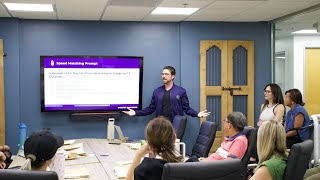
This chunk is a transcript from a 2025 Startup San Diego Lunch & Learn where Neal Bloom leads a session on co-founder matching, founder market fit, and team building. The event includes community announcements from Jenna (OpenClassrooms partnership with Miracosta College, apprenticeship program details: one-year placements at $25/hr across IT/data/marketing roles and Dept. of Labor registration claiming $1.47 ROI) and interactive exercises (Founder Market Fit canvas, speed networking). Neal shares personal case studies (Portfolium — acquired by Instructure; founders later built Drata) and investor insights: emphasis on team and founder-market fit, equity splits trending toward 50/50, common early-stage technical vs. go-to-market founder split, and practical advice for pitching one’s "superpower."
Questions this video answers
One year, $25 per hour (20 hours/week).
$1.47 back per dollar spent.
Portfolium.
Drata.
As you all know, we're small, nonprofit and all of our work is made possible by our partnerships and sponsors. We're in partnership with Downtown Works. Thank you, Downtown Works for hosting us. We have a slide for our sponsors that we'll get to. But before we do that, I just wanted to bring up we have open classrooms here today. She's going to give you just a quick spiel on what they do and thank you for your support because with your support, we're able to bring all of our programming to everyone. So come on up. This is Jenna.
All right. Hi everyone. Nice to meet you all. Yes, I'm really excited just to get to know each person. I'd love to hear your story, what you're working on, what you're passionate about. And again, we're just totally aligned values, mission in the sense of creating community, supporting entrepreneurship, supporting businesses and startups throughout San Diego and really boosting the local workforce development, economic development. So pleasure to be here. I was able to attend San Diego's Startup Week last fall and also sponsor the first Mondays at ClickUp. So this is my first time coming to the last Friday. So really cool. Whoever wants first come, first served, but grab a bag, just don't, you know, jump over each other for it, but, you know, ran out of some bags. But whoever would like it, feel free. So in a nutshell, what we do, we are a B corporation, so we operate on federal and state grants and again, the goal is to boost workforce development, economic development, and in doing so, it's helping people from disadvantaged backgrounds, unconventional backgrounds that are making a career change, for example, and a lot of them are. Through our partnership with Miracosta College, we have apprentices that are pretty much ready to go for roles. And this is a one year contract, 25 per hour in roles of IT, Python, data and cybersecurity and social media marketing. And as you know, for AI, you need data and you need Python, for example. So that's why we're here, is to really be a free benefit and service for startups when they're working on a AI, again, data, tech roles and marketing, you're able to hire at a reduced rate. So it's a win win. Because startups that are bootstrapped and they're struggling and you're trying to figure out headcount, you can now build your founding team, but really think about long term investment and long term commitment and culture fit. In doing so you can interview at no cost.
So.
It'S a way to help outsource and delegate and Hire locally versus Philippines, India for example. And it's also allowing people to make a career change, to change their lives, to break into a tech career. And as we know it's really difficult to do these career changes to have people look at a piece of paper and consider you. And I know that Neil is also the expert with AI and what's happening in the workforce, ed tech space or at least I. So I'm really excited to hear more but I think it complements in the sense of where ed tech is going, where is workforce going, especially technology and matching for example. So I just mentioned these roles. So this is just an example of, of marketing. So if you need a marketing person, that's HubSpot, Google Analytics, HTML, also advertising campaigns, SEO, website analytics. So these are just some examples of what they're able to do for you and that they are doing again, very hands on work like advertising campaigns, content strategy, customer segmentation, maximizing customer lifetime value. And we're registered with the Department of Labor so they get a certificate and again they're being coached and mentored from a wide range of mentorship. So the differentiator is that we're ensuring a positive customer success journey, positive learning experience and that the candidates are receiving that coaching and mentorship throughout the year. I already mentioned this, so if you.
Refer, can you go back to that site real quick?
Yes. So essentially I'll tell you what the disqualifiers are because it's one, it's one year. So some people want a freelancer for one week. That's not a fit because you're thinking of someone in a very short term transactional way. So it's 20 hours a week, one year minimum 25 per hour. So again, if you're hiring a Python developer, that's typically 80,000, 100,000 or more for a tech person. Now you can hire someone 30,000 to 50,000, which is extremely low. So it's a great way to hire a skilled quality person in tech roles. So yeah, if you recommend a company that's hiring, we're happy to pay you $100 per company. So if you're referring to 10, 20 companies every month, we can talk about a revenue share agreement. And lastly, we have a very small sponsorship budget. But again our goal is to just get this word out to help businesses and again to help people break into tech careers. So if you know other communities that are getting together regularly or networking events, conferences, mixers, breakfast, lunch, we've done them all, happy to help out with whatever we can, but we're happy to sponsor ongoing for the a year commitment or like six months of. We can do this monthly, we can do this weekly. So I appreciate everybody's time. I think I already talked about the why. But again, Diverse pipeline reduced rate. If you check out apprenticeship.gov every dollar spent, you get $1.47 back for ROI. And the apprentices are trained and mentored the entire time. So yeah, that's it. Thank you.
Real quick. Yes. So you said it's a one year contract, correct? Are they, are they hiring? Let's say I'm a startup. Do I write the contract with classroom and pay classroom $25 an hour or.
Great question. This is a great question. So you're hiring that person directly and actually 90% get hired full time afterwards because they just love them and they're really happy with them. But through Department of Labor it is a one year contract. So if you decide. No, we're still going to work with them. They're part of the alumni. But you are hiring them directly. There's other paperwork involved, but it's because again, the grant is funding their education.
Got it.
This is just for San Diego.
Yeah, we have a high priority of placing 100 people in San Diego and Bay Area. So I manage entire California, but we also cover entire US, LA, Orange County, NY, we do events in all these cities. So if you know other people, we can sponsor events in Bay Area. We did an event in New York in April, I was there and actually we're global so we have an office in Paris and I was there a year ago. It was amazing. But yeah, we'd love to meet you all and just thank you for your time.
Well, hey everyone. Some new faces, some friendly faces. Hopefully by the end. We've got some exercises. Thanks to Erica for putting this slide sale. These are beautiful slides that I did not create myself. Neil Bloom, serial founder and important to today's talk. Actually not founder of Startup San Diego. I would consider myself Employee 1. So there are five original people and then I was the next. So they started it, they got the first event which was actually San Diego Tech Week was year one and I was an attendee at the event in June of 2013. I was visiting from LA because I was looking at do I want to move down, move down here? Because I was in application for an incubator here called Evo Nexus. So I showed up. I love meeting 30, 40 founders. And I immediately we met one of the organizers and said how can I help next year? And so I kind of took on the role of the next year, 2014. We actually were not a non profit until 2016 or 17 so we were just an event and then incorporated three years after we created. But I love where Startup Singer has done and we'll talk about standard startup Week and everything that's happening this year soon. But we're here to talk about one plus one equals three. That is what co founders make happen in companies. Okay. And we're gonna understand that math by the end of today because we're gonna do a few exercises to get us up and talking to people and finding our ying and yang. Cool. All right, quick. I don't know if there's even a. I'll give you a quick background. Aerospace engineer, mechanical engineer undergrad, ucsd. Started in the defense and aerospace war world. Worked on like big stuff, big physical things, the space shuttle, Bradley fighting vehicle. And then through a, through the layoff of 10,000 engineers, decided to create my first startup which was going to be LinkedIn for engineers, like help them find their next thing. Because one, I didn't get let go and I had a ton of survivor skills and my eventual co founder did get let go and we thought well let's use a new tool to get him into the workforce. And in fact he used our tool, the very first version called Paperclip which you'll see with the version eventually came in his first interview with SpaceX back in 2012. He didn't get the job, but we got to use it to test and try. And so that was my big pivot from hardware into software and really from engineering into go to market. Like I never touched engineering again once I founded co founder portfolio. But here's what we're going to talk about today, like overview and I'll spend a very short period on this because we're actually going to do this stuff. We're going to talk about team structure, what's it like in the early stages. Why does it matter to have hard conversations up front and not wait for it. And I'm going to give you some real case studies, real stories, real talk of what really happens compared to what we talk about with our names and titles on the kit. How to find the right person. So how to find your co founder, how to find. And we'll dive deep on the importance of being super thoughtful. We're going to do a little exercise of the founder market fit canvas. This is something cool. Erica found that we're going to play out and it's really fun little activity workbook for you. But even more Fun is we're going to do some speed networking. We're going to do five, five minute rounds where you're going to meet and practice these four questions and start quickly assessing each other and stack ranking. Be like, who could be a good match for me? So we'll do that. But let's talk about the importance of equity. So equity is. And first of all, let me do a poll here. Who is currently co founding or founding a startup right now? Who has ever before. Okay. It's like 67% of the room at some point or not. Who was thinking about it one day. Okay. Who has done startup solo? Solo founder, co founder. Okay. Majority co founder, no solos. Interesting. Cool. Well, this is super relevant because what we're seeing over time is that what for a startup. Yeah. Who never wants to do startup again and who never wants to. Yeah. Who's scared of partnership. I get it. I understand. So over time this is some interesting Carta data. Carta is a platform that pretty much manages your equity, manages your cap table. It manages all the documents that go into the legal structure of who owns your company. And so they have access to a lot of data here. And they're saying over time co founders are actually coming to more of a 50, 50 agreement, which is interesting. It used to be more like, oh, I started, I left my job two months before you, so I get more or you know, I wrote the first line of code. No, it's actually over time two founder teams are going 50, 50. I think there's a few reasons for all this, by the way. That's coming up a bit, especially now. A lot of Companies are taking 10 to 15 years to get to an exit. And so. And you need like 10 rounds of funding to get to an exit. And so dilution matters a lot. And so the more equity you have matters. But even more than all this, co founders, founders are a different breed in your company than anyone else ever will be. So you may be founder and CEO through exit or you may step out and hire a CEO. A founder has very, very specific magical skills. And if a founder lasts through the whole life of the company, they are showing impact through the entire life of the company. And so I think we're seeing that founders matter from day one all the way to the end. So anyway, just kind of an interesting data point case study around this and this is a very pretty personal story I'll tell you. This is my co founder of portfolio, Adam Markowitz. We were two aerospace engineers, he was one who built a product for him to test at SpaceX. We were really carbon copies of each other. We were aerospace engineers, both from ucsd, graduated at the same time, both started the first day at a job together and had lunch every day together for like four years. So we became good buds and we talked about it at lunch. This idea all the time, like visual helps so much more than words of a resume. And so the first version, Paperclip, he said, I want to start to learn to code. I'm going to just watch YouTube videos, I'm going to build a version of this thing that we've been talking about. And I said, awesome, I'm going to go see if engineers would use this. And so I just started talking to people kind of early customer validation. Very quickly we realized that it wasn't seasoned entrepreneurial engineers that this worked for. It worked really well for like no work experience or first job. And at the time, 2012, 2013, think back to some of you then who maybe were getting out of school then, like I was. Some people were not starting LinkedIn until they had already been in industry for a few years because they didn't want an empty LinkedIn. Now I hear students are starting in high school. So in a sense we started to see this volume of like pre LinkedIn. There's not a tool to show that you're employable. There's just you and some paper resume saying, I can do these things. I haven't had a job yet. And so that's what we became this visual summary of what can you hire me for? Because just because you have a degree from somewhere doesn't mean you can actually do the job. Right. And so that was what we were trying to bridge. And so we actually became more of an ed tech platform. We sold into schools, got their entire student population on students started tracking all the things that they were doing and eventually autosave all their work to say, hey, you just saved your entire four year history of what you did. Just hit print or just walk into an interview with your iPad and you can narrate your life. And so ultimately we were acquired by Instructure, which makes Canvas, which is like the new blackboard. Because we were integrated with them so well. We had a huge amount of data about students that alumni associations were loving. They were like, whoa, this is everything we want to know about people that we are going to spend the rest of their life getting to know. Give back to school. We could actually talk to them day one of the college experience and say, let's build together your career. So we were kind of a tool for the alumni association to actually have a the relationship with students earlier in their life. So early in our days, we said, let's be co founders. And we actually brought a third co founder. Royce Daniel actually was. We hired him as our first CTO for their first round of funding. And so we Adam, because he had gotten let go, he had a lot more time than us. The other two co founders who started coding, and he's built the first version of Paperclip, not at a company at all, just a name and some website. And then we got into Evo Nexus and the other two co founders, me and Royce, left our jobs the day we got into Evo Nexus and went full time about a year after him. And so out loud, at that moment, we still hadn't actually incorporated. Maybe we didn't create an LLC off of LegalZoom just so that Evo Nexus could probably do some connection to a company. And you didn't have to ask. We just did a carbon copy boilerplate of what Legal Zoom did for the managing partners of an llc, which had no, you know, anything about equity split. It was just like people, you're the three members of an llc. If you do that, it kind of auto does just like, I think three ways. But actually out loud, we had actually said, oh no, here is our equity split. She said it out loud, but never memorialized it on paper and never updated the LLC member agreement. That was. Anyway, a year later, we raised our first round of funding and now our first our investors demanded that we were a C Corp. So we had to convert from LLC to C Corp. Which meant we also had to change the incorporation documents, change our. Our cap table in a sense, because now there's new people cap table. And now we were having a different conversation as co founders saying, are we still in agreement on the equity split? And we were not. So that caused, you know, kind of two years of work to come to a boil, which ultimately we had, but we didn't have it at the time when we founded the company. We had it two years in when your memory is totally different, right? One year later, I left the company. So three years and then three years later, he sold the company. Great story about this though, which I'll tell you, kind of the long tail of co founders. And by the way, acquisition was great for everyone. There was a bunch of investors in San Diego. Everyone got like 6x their money. We actually got acquired kind of again a year later by the public company, got taken private. It was all really good, except the acquiring Company took our product, promptly put on the shelf and it's never to be seen again. But that's what happens to your baby. And so Adam and Daniel teamed up. They had a two year earn out, which usually means about a year into it, you're already working on your next idea. And a year and two years in a day you incorporate your new idea. This is exactly what they did, which is Drata. And they came out hot. They, within 18 months raised three rounds of funding. Kind of fastest unicorn in San Diego history to date. I mean I think they've. Yeah, over a 2 billion valuation. I think they're doing, I think it's public over close to 100 million revenue all in like three years. And this is all the power because they worked together before. They've already learned how to work with each other. They learned about company culture, they learned, you know, who's good at what. And so kind of cool to see a team too where they're at. And a very San Diego story. Any questions? Because that's just kind of like case study. Okay, so let's dive into a little bit and I'm going to give you my perspective from an investor. Okay. So I've gone from founder, had some starts and exits and now I'm really squarely just investing in companies I've invested into 30 or 40 personally as an angel investor and then 40 or 50 as venture capitalist, like managing funds of other people's money. So in a sense I see, I get intro to. I'm gonna give you my flow of how many companies I see more so that you see, understand the lens of what I'm looking through when I'm seeing a company. Okay, I get probably four intros a day to brand new companies or not brand new to founders of varying areas who are interested in raising. That usually turns into probably one or two calls a day or meetings with those founders which may turn into at maximum, one check per month, one investment. So think about how many founders who meet that pretty much have to say no to for a variety of reasons. But where I'm investing at the earliest, earliest of stages, pre seed and seed. It's so much on team and a lot less on product. But there are aspects and Marc Andreessen kind of hits this kind of really well. What's most dangerous? A bad team, Weak product or a poor market? Anyone have a guess?
Bad team.
The answer is it's kind of both. A great team meets a lousy market. Market wins. A lousy team meets a great market. Market wins. A great Team meets a great market, something special happens. And something special is really what venture capital is. A lot of businesses like I'd say 99.5% of businesses are small and are going to stay small. And that's on purpose. Their business model is to sell and solve a problem and continue to do that for the customer. A venture capital kind of startup which I'm assuming we're all kind of here on the premise to talk about. I didn't really ask that ahead of time but Startup San Diego kind of serves the market of you know, from small to massive growth kind of scale up companies. Something special means that there is an outsize something happening. Either it's an outsized change in technology really which means solving a massive problem that could maybe just be done by a small business usually means you need outside capital to scale the technology and the team. So that's what I'm going to continue under this framework of thinking that we're talking about scale ups which all starts 2 to 4 person founding company and some massive change over time. Yeah. What about the product? The product, yes. So we're gonna go through it right here and that's kind of market. I would say the product is the market. The product is what? The market. What is solving a market problem. Yeah. So this is kind of an interesting overlap to show where magic happens here. Founder and market. We call it founder market fit. So this is a founder who really knows their market super well. Maybe been the customer before of what they're building or built a business and then got acquired and it's going back to kind of the same industry that they know. That's what we call founder market fit. I'll give it it's example what I'm looking at right now. The founders of Google Analytics which was started here in San Diego called Urchin, acquired by Google. They then spent the next 10 years at Google building the full marketing and ad stack within Google. We're at Google AdWords AdSense like the full stack. And now they're building the future of Google or AdWords but for the LLM world they call that found great founder market fit. Like they have spent 15 to 20 years just building the digital ad network at scale product market fit though maybe a whole different thing. Right. The old model of ads is different and LLM's modernization hasn't been proven yet. And so we would say we don't know what product market fit yet is for them because they aren't monetizing and so we don't know real customer feedback except that sounds cool. I want it when it's ready, not product market fit. Product market fit is take my money, I need it, I need it really bad and I need it for 10 years and it'll change my life. So difference in terms of what you want to hear from your customer to know you have what we call PMF product market fit. Any questions on kind of this overlap? I will say the earliest of stages like when you're we're talking about here how to find a co founder. You're nowhere near this. Product market fit comes from actually building a product, being in market, serving the customer and scaling the business to meet the need that the customer is saying generally you're nowhere near that product wise when you are choosing who should I build this business and product with. And so that's why we tend to focus a lot on founder market fit at this stage of who is your co founder and are they investable in that? Make sense kind of answering the product piece. Okay, so let's talk a bit about the founder market fit canvas. And this is really about, this is really about. It's actually how I look at this as an investor, I look at myself as a talent skill. So I am out meeting people and unfortunately I'm stack ranking everyone against each other. So if I'm gonna meet 20 founders doing ad tech naturally I'm gonna say alright, well this person's done one year of it, this person's done 10 years of it, but I'm gonna have my own rank and everyone else is gonna have their own rank. And this is kind of think about this the same as when if you've ever done recruitment for hiring, you've got your own little rubric in your head, right of what you've done, what school they go to. Some people use it that way, right? This is a form of, you know what we do, Assessing, right? Assessing, judging. There's lots of words for it. But that is what founders end up doing on their pitch deck. Say it's usually shown in and now they would compare this probably they just put bubbles of logos of companies they've been at and that proves that the founder has the market fit. There is so much more to it and this is why it's super important to go deep on yourself. So what is your superpower is what I call it, what is it that specifically that you are great at and the self assessment, what are you not good at and what do you not like doing? Those actually are two different things because you're going to shy away from both and what you're going to be looking for in your co founder matching is someone who loves those things to fill in the gaps of the things you don't like doing and you aren't good at. Okay. And typically within the co founder let's I'm going to continue to use the two co founder because it's just the easy way to talk about the two buckets of skills that you need in starting the business. It's typically a technical person and a non technical. And I'm saying I'm going to keep this in within tech, software, hardware, all life science is hard, pretty much still the same science side, the non science. It's really someone who can build and understand technology and not just build, but scale and deliver really a product to a customer that solves a problem. And so that's all under technical. And then there's the non technical which is go to market, which is distribution. How do I actually reach and touch my customers and get them to engage and be an actual customer? So those are the two buckets really that we look for within founders. And so and this is a very San Diego thing. A lot of companies in San Diego are too technical founders like I was with mine and they just kind of divided and conquered because of. Well out of necessity. Right? Well, someone's got a code and well I guess someone's got to do the other thing. That was us to a T by the way, my co founder Adam wanted to code. I said I guess I'll do everything else. By the way I had never done any of that other things I had to learn on the spot how to hire fire, do sales, do marketing, how to fundraise. And so I would say if you were to put me down here, relevant expertise, I would say zero was words for us. And therefore our fundraise was incredibly hard because we were first time founders with no expertise in anything. What we were doing, what we got called product, we were going through Tecos Angels, which is now new fund. We were the rocket science guys. So they were buying into us because we were rocket scientists, which sounds really smart, let me tell you. My wife uses it in a way that shows that I am not that whatsoever. But that was it. That's all they could summarize us because that's all you get summarized with right? You saw how I explained the future of ad tech company, you know, pretty much a sentence is all you get. 15 years building ad tech, great, that's you now. You've been bucketed as that. And so this is super Important to learn to tell and pitch yourself to yourself first of all so that you are showing directly and authentically your superpower, your skill set. So that when you are out meeting, finding another person, your compliment, you're seeing like the real complimentaries. Any questions on that? Okay, we're gonna do this practice in a second and actually maybe why don't you all start doing this do a little personal thing. Maybe we'll go around the room and actually we'll do. I think that is the exercise, right? Yeah. Yes. So everyone write their let's call it not story superpower now in a way that you would introduce yourself in one and two sentences. Someone want to try first? Give me a minute or so.
So my real superpower is I can sleep anytime, anywhere. Probably won't invest in that.
So depends you started night sleep.
I on it. I genuinely love solving problems, starting with math when I was in school, engineering when I was in college, and then really through customer interactions in sales. And I know people think of sales as very transactional, but I never thought of it as transactional. Even selling clothes at my dad's clothing store all the way through very technical semiconductors or sales. It was always what is the problem that this person is trying to solve? And then being a strategic thinker, not a superpower, but something a competency, I can put their problem and then the landscape in which it exists and then go out trying to put the best solution forward to help them. Superpower being really careful also. So problem solve the sleep. The problem solving and then really genuinely caring about them getting their problem solved.
I like it. What? I like the sleep. Well yes, I can relate to that too. So if you're starting at nine or ten sleep, which is the next version of eight sleep, let me know. I want to know as soon as you're starting. But what's interesting, 11:11. I think what's actually great story about that is actually a very San Diego story. And I know you're a UCSD alum like me. So technical background, which is how you started and how you actually are the go to market person. You are the non technical person but you understand technical. It's a great way to kind of bridge that. Right. And so you are on a deck saying I'm the CEO but all it says there is UCSD alum, electrical engineering. Someone might be like why you you're just. Oh, you just divvied up two technical people. No, you've got the answer which is here is my background in go to market, sales and marketing Understanding, But I can understand technical products. So that's important. Kind of do the drill down on that for yourself.
Right. So the language that I can communicate in is a technical language, but it's really. That's not the superpower. Understanding the technical language. It's the business or sales capacity within lab.
Right. And how, let's say continuing on this, like if you were pitching as a co founder, you'd probably go into industries that you're in. Telecom, silicon, smartphone. So you understand like hard tech and that kind of thing. But then the sales role that you had with it and that's it. Like that's your founder slide of like, this is my background and expertise and how it's related to what I'm building now, which is hardware for sleep. Right.
Like I would make. Yeah, I'd be, you know, I've had extensive experience with companies around the world doing B2B sales complex. Like, then you would drill down a little bit right. On the actual experience. That makes you right for that CEO position, that co founder position.
And the dream thing that I want to hear is that. And when I was at ti, we actually put the first chip in a mattress. So we actually did smart sleep 20 years ago. So now I'm doing 11 sleep to a new level with AI, but with the hardware that I built and know how to sell, boom, Take it all the way home.
But it starts high level with what's that superpower. And then the specific experience that's relevant.
To what you're doing now in your company. Anyone else want to take a crack at pitching themselves the superpower?
I can try.
Yeah.
I should probably try some fundraising.
Okay.
So in two sentences. It's hard to put a lot in.
So.
So.
Warm us up by introducing who you are to your companies.
Sure.
So I'm Pedro arellano. I'm the CEO and co founder of Wallaby. We are an AI data B2B software company. Very early stages. We've been around for about 20 months and just entered that stage of having a early version of the product and market, acquiring our first versus customers, and then learning so much that you realize, oh, we're doing things wrong. We gotta go this direction now. So that's the stage that we're at. It's pretty exciting. There's things about who I am. I'm an immigrant founder, I'm a Latino founder. But I think I'm gonna focus on what we've done.
What is your superpower?
What is your superpower? Eating.
So my superpower is people connecting, finding and building teams. I think that is what I'm really, really good at. And I think it shows in this particular startup because of the founding team that we put together, the things that Neil was talking about, of complementing strengths and having really hard, intense conversations, being able to work through them in a way that's actually very healthy and supportive and human. I think we've been pretty good at that because the founder journey is hard and you go through moments of extreme elation and also moments of really dark depression where you feel really lost. And those moments can lead to a lot of tension within a team and you can have very tense disagreements. And every single time we've been.
Very.
Vulnerable with each other and have been able to solve a problem in a way that feels like we are supporting each other with an interest of making each other successful. And I think that's been key to us still feeling like we're making progress and moving forward and that we want to do this. But my two statement intro would be that I spent the last 25 plus years helping companies make better decisions and my team and I helped build the $37 billion business intelligence market and we built one of the first commercial AI business intelligence tools.
That's where. Awesome. Love it. Done. What I like about your opening, about the people side that you actually didn't mention in your two sentence, which I'm in agreement with, is about building teams, people. Because actually all founders need to be great at building teams. They need to be great at outsourcing themselves as quickly as possible. When you started as a one or three person team, your chief doer, but very quickly, once you write that playbook, you have to hand it off and be like, now it's your turn so I can go solve the next hard thing, right? And so actually I believe all CEOs and really founding teams are their own chief talent scouts, meaning they have to be, it has to be innate that they are great at hiring and attracting the best talent possible. So I liked hearing that that was what you're good at. Because in fact all founders need to be good at that. And either you have hired before, you haven't, which is tough. If you like a student startup and you've never even had a job, you always get the question, how do I look better at that? Well, find your own way to hire. Maybe it's in a club and you brought, you know, you're the start of a club and you brought people in and you handed off and grew. A club is how I tell students, at least get some exercises under your belt or you've actually done it, you've built a team from zero to, you know, multibillion dollar company kind of. So love hearing the people side of that. And I actually look for that in a big way. On the whole founding stack, what is your relevant expertise of attracting talent? Because that actually will never stop. Even when you're $100 billion company and you're the CEO or not, you're just like the founder of it. You are still on the look for the best, trying to attract the best talent to what you're doing. And so that part is always hard to work in to your founder story. But I liked how you did it. What were the attributes of your co founders that filled in your gaps?
So there's three co founders. One of us is our chief technology officer, our technical co founder. He's a world class brilliant engineering mind. I was a computer engineering college. That's my degree and I should never program a single line of code. But he's just fantastic at it and he's very so, so good at solving technical and engineering problems. And then our third co founder is a bit of a hybrid between technology, science and marketing. And his superpower one is the science because he comes from an AI LLM background and he's been really influential and helpful in figuring out how to solve these particular problems. But also he has a background in operations as a former military, military intelligence officer. And that experience has been fantastic at helping us figure out what's the right way to solve these really thorny problems. For example, the first time that we needed to pivot, there's all kinds of directions. There's these really big, big nebulous, massive, overwhelming problems that you don't even know where to start. And he has this great ability to figure out like a framework of how to think through a problem that just allows us to solve problems like that. So I'd say engineering is one and then problem solving is the other one.
Cool. But on paper, maybe three technical people who have all found their superpowers to be different.
Yes.
Right. Operations, which is really like problem solving but also scaling what has already been figured out. It sounds like. Yeah. So interesting. Awesome. Well done. Anyone else want to try it? Okay, I'll try.
I was, I was a co founder way back when and also as you know, was wife to a founder and co founder, but an investor and also known to show investors. Yes, I, we were an angel investor in Portfolium and I didn't get a nice return. Well, 50% of a nice Return. So let's see, when I, I started a tech food tech company and I, my co founder was a Cornell MBA grad because my ex taught at Cornell. And so what I had was my superpower is identifying pain points and then doing something about it. So if I'm on a bus and young people are sitting in a chair and a lady standing, I will make it happen. And all the way to, you know, being part of a couple times when my ex started startups, you know, being a cheerleader and seeing it all the way through, I was trying to find an easy way to take deliver locally sourced, high quality, freshly prepared meals to your home. Because I was a busy mom. I looked around, raised my kids in.
La Jolla, blah, blah, blah.
And I saw a wealthy educated mother with McDonald's at the soccer field or whatever and I said, what are you doing? And she said, well, I don't have time. And so I thought this is crazy because if I wanted to eat the way I wanted to eat, I would have to go buy the special chicken, buy the special veggies at the farmer's market, source it all, cook it all myself, etc. Etc. So I built this company called Uber Food. This is before Uber, by the way, still in the trademark. And so, but my, but this is like before Google was really, I mean people use Google for research and whatnot. But I would say that I was experienced, older, connected, had friends in low places, high places, friends with the CEO and the garbage collector type range and had been around the block, had raised children, all that. And then my co founders, this young, smart MBA who could make a mean spreadsheet. It's kind of like me with Erica who's like operations queen extraordinaire. So we complemented each other really well because I brought all kinds of hands on the ground trying to solve a specific problem designing it, but neither of us had the food background or the, you know, all of it. So there was, there was huge learning curves that we both went through together, but we complement each other really well. Anyway, that's just a little.
Okay, well done. Okay, just going to move on for the sake of time. We're now going to do this one on one pair with each other. So. And I'll let you do this on your own because this kind of the end, I think, right? We're supposed to be pretty much done here. 1. So I would welcome all of you to do a few rounds of this if you can, which is kind of this, you know, maybe the first three is what we just Did. Now, if you are in the early stages and maybe you want to start something one day, like, practice this part too. Practice. Kind of saying out loud, here's what I think my complementariness is, right? Here's the opposite of my superpower. So therefore, I need blank. Just saying it out loud and trying to verbalize it is a really good exercise. You may change and that's okay, right? Like, you may find over time, like, oh, I mean, I thought I needed this, but after talking to a lot of people or meeting that person, I think that actually complementariness is this. But it's just really good to just practice. It's like a muscle. The more you do these things, the more you'll feel good. It'll just, like, get stronger. And something I didn't mention, like, co founders, especially in the tech world, this is someone that you potentially are going to spend the next, like, about a third of your day, by the way, sleeping, not sleeping, and working. So it's a third of your day. So a third of your life for the next 10 to 15 years. Like, this is about the amount. Same amount that you spend with a spouse, right? Or maybe even more. At least in my world. I spend way less time with my wife than in my working world, I think. So it actually is like someone that you're like, is your partner for real. And so it means you should spend just as much time scouting and learning to do founder dating, more even than even your partner in life. So anyway, just leave that with you. Okay? I'll let you guys partner on your own. I could just say you guys.








