Dev & Data Night x CTO Talks March 2025 Full Panel
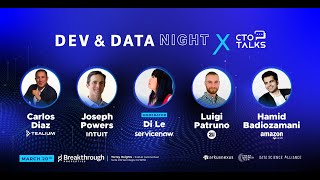
Dai Li moderates a panel with engineers and data leaders from Wallaby, Tealium, and Intuit discussing AI's real impact on work. They cover hallucinations, data governance, trust in robotics like Amazon Astro, and how teams should actually upskill for LLMs.
Questions this video answers
Pedro De Jan
Amazon Astro (Amazon Lab126) — referenced by Hamid Badio Zamadi
Hey everyone. Good to have you here. Thank you for coming.
Devin.
Date night and CTO talks.
Woo.
We are excited. This is our first Devin day tonight of 2025. We ended last year with a silent disco check the halls holiday party which was pretty fun. Maybe we need to do that more often. And tonight we're going to have an amazing conversation, probably a little bit more skewed on data science and of course the two letter word AI. But first, we're really excited for you all for coming here to seeing the brand new Breakthrough properties. Tory Heights really haven't been moved in yet, so we're some of the first to put on some events here, which is awesome. So thank you to the Breakthrough team for helping us out. Thank you also to the Data Science alliance for being a great partner in bringing together an awesome group tonight. If you haven't heard, the Data Science alliance, it is a nonprofit leading and stewarding data science throughout the world, based here in San Diego. So we're excited for continuing to do stuff together. I want to also thank our partners, Archis, Nexus and CTO Talks. Marcus, you want to introduce yourself?
Sure.
Thank you.
This is a fine example of working together.
We have three different communities putting together tonight's event. So in case you haven't heard about the CTO talks, we're a monthly meetup group for tech execs. We meet all over town and we basically consider ourselves a platform for exchange of thought leadership. I see some of our members here are regulars. So great to see you all. And yeah, I just want to thank the team, you know, obviously Neil, Brittany, Sam, Dee for helping put this together. It's been wonderful getting to tonight and I hope you all enjoy our wonderful panel.
Amazing. I'm going to put Pedro from Wallaby on the spot who is showcasing some of his product. You want to come up and give a quick 60 seconds that you didn't know you'd be doing, but that's what you do in startup land. Yes, Neil.
Cool. Thank you.
Thank you very much, Neil. Good evening, everybody. My name is Pedro De Jan. I'm co founder and CEO of Wallaby. We're a software company that's reinventing data analytics for the age of AI. We help marketing and revenue teams analyze data across our Martech stack. No dashboards, no coding, no data pipelines, all former tableau. We know this space very, very well. We're sitting there in the back. I can demo the product, answer questions, and this is my crowd. I grew up in the data analytics space, started my career in a company that many of you may not have heard of called MicroStrategy. That's how back I go. So if you want any stories about back in the day of bis, I'm happy to chat. Thank you very much and enjoy the event. We're going to do this at the end or. No, not now. At the end. Okay. You can follow us on social media at the end if you like the panel. But I am very excited to bring up our hostess with the mostest. Make sure you're checking out her shoes. And let's bring up our our moderator to kick off the night. Thank you very much.
We can show us to the Someone I gotta turn off. I lied. It's like I'm walking on sunshine. I am in. Maybe I will take the leg. This is weird. See, this is how you know it's not scripted. Who else throws their red shoes in the corner? Oddly, I am so humbled and thankful to be here today. I was able to nerd out with fantastic group of panelists earlier and I'm so excited for you to meet them. So first off, I would like to introduce Carlos Diaz. He is the Director of Data Engineering operations at telium. With over 19 years of experience across Capital One, Instacluster and data stacks, he specializes in big data technologies. Very appropriate for the conversations we're going to have tonight alongside traditional database systems while bringing expertise in DevOps, cloud infrastructure automation. His career progression demonstrates consistent leadership in architecting scalable data solutions that deliver business value. Please, a round of applause for Carlos. Anywhere you like, please. Next we have Joe Powers. He is a principal data scientist vexperimentation lead at intuit with 5 years of progressive experience there. After earning his PhD from Stanford. We will have to talk more about that in a bit. His career includes roles at Kidaptive and Genetech where he developed expertise in human behavior analytics, statistical modeling and experimental design. Joe specializes in translating complex data into actionable insights while leading teams to implement reproducible data science methodologies that drive product improvement. Please, a round of applause for Joe. I thoroughly believe that people that work in tech have the coolest fashion. And the first time I met them I was like, fantastic shoes. Love your sweater. I deeply appreciate your sartorial choices. And speaking of phenomenal sartorial choices, last but not least, Hamid Badio Zamadi. Did I say it wrong? Did I butcher it? Don't hang me. Please have a seat. But Hamid is a software developer and investor with a dynamic background in robotics, aviation and artificial intelligence. A former founder with a successful Exit. He blends entrepreneurial experience with deep technical expertise. He is also an active investor with Interlock Capital where he supports early stage startups shaping the future of technology. Passionate about building and backing impactful innovation, he works at the intersection of software, hardware and AI. And my close personal friend, also ever so stylish Hamid and. Hello everyone. I am your host for the evening. My name is Dai Li. I am an AI ethicist but the grounding of my work is at the intersection of UX research, governance, policy, but also just making sure that people are doing good things with technology. I am very excited for tonight's conversations and to kick it all off, I would love for each of you to start with. Does this work? I'm going to hand this to you. We might have a little bit of asmr. So if you are annoyed by that, I'm sorry, test, test. If you are excited by it, I will give you my Venmo after. So as Neil kicked off, I mean if I were to hold a poll right now and ask everyone, how many times do you think you're going to hear the word AI or the, the two letters AI tonight? I'm sure it'll be in the thousands. But with it being inescapable, to avoid the question how has AI or data impacted your role and how have you seen it change since coming into your position? And I'll start with you Carlos.
Yeah, so let's see how has it impacted my role? I think when I first started.
I.
Think it was back with Capital One. I started doing a lot of. It was when first AI started becoming known and you started hearing a lot about ChatGPT, a lot of these new models that were coming out and.
As.
A company we were prohibited to, from using AI to do any kind of like helping with our programming, helping with those kind of things. But little by little you would go home and we would start, you know, doing our own research and starting understanding how it works and, and getting those hallucinations that sometimes you thought were way off. But that was our introduction later. I started as I was interviewing people, I was realizing that some of their like responses, I'd be interviewing people and I could hear them typing in the background. So I would, I would start thinking like, okay, their, their responses are a little too perfect or sometimes some of the things they would say were, were not really on par with exactly what I was asking. So I think that was my first interaction. But little by little it started becoming more of a norm and the models that were allowed to use eventually at Capital One were very strict and we were only allowed to use them for certain types of applications. So that was my start.
You're so right about being able to recognize AI generated context and just for information to everyone, if crucial is present as a word in your block of text more than five times, don't do it. Just don't.
I think the biggest change I've seen is how quickly people are able to learn new methods. I was saying this earlier that we have hundreds of analysts at Intuit who traditionally would be a very SQL tableau focused workflow in TurboTax. We've actually upskilled them to data scientists over the past year. And so it's just been very cool to see how quickly someone who has domain expertise and understands data is able to extend into very sophisticated modeling and derive very valuable business insights. That would have been off limits if you were just looking at descriptive statistics that you could get through SQL. These are things historically that it was like, oh, you would have to hunt the Internet and piece together this chapter from Coursera with this chapter from a textbook and maybe a few stack overflow posts. And now the LLMs are actually able to meet you at your current ability level very quickly. And so it's just been very cool to see people just grow their skill sets very rapidly. And this isn't just generating code that they don't understand. You know, the way that you can actually work with the LLM to explain the code back to you and really probe it for a deep understanding of what you're doing. It's something like on call office hours is like what I would compare it to. And that's just probably the most profound way I've seen it change my work.
Hamid.
Well, before we begin, I would like to say Happy Nowruz to all my fellow Iranians. I am Iranian myself and today is Nowruz, which is the Persian New Year.
Persian New Year.
Thank you.
You're right. Today is the New Year.
I'm happy to be here, so thanks for having me. And also before I answer the question, I would like to ask if you can humor me with an experiment. Please take it away and experiment with all of you. Being a software guy, this, this experiment is going to be programmed. So let me, let me, let me say it this way. From the moment that I hand the mic back to you, the, the experiment begins and it's a bit of a game and I'm fairly certain you guys will be able to, to guess it early on, but the game ends when I speak the words you have discovered the lie, which also means you've discovered the truth. But the game is I am going to try to deceive you in some way. Lies, exaggerations, omissions, whatever, And I'd like you to see what the lie is. So this first answer doesn't have a lie, because I haven't handed it back to her. So technically speaking, that's not the case. The biggest way that this AI has impacted me as a software developer has been actually a little scary, because it does look like software development is going to evolve tremendously as a result of this. You can't get by anymore without using LLMs to generate a piece of code for you. It's not enough to generate a project yet, but it's getting there. It's getting there.
Depending on the project, of course.
Of course, yes, but for smaller things. And when I say small, I mean it's beginning to grow. Multiple files, larger applications that are. That are happening. In fact, Microsoft CEO recently said that he foresees a future where all you have is a database and the rest of the business logic is going to be conversational with someone who needs the application cutting out the developer entirely. So in my opinion, that is going to be a game changer. And it's exciting because I think it'll evolve the role of software developers tremendously.
I believe that too. And before you tell a lie and give me the mic, I believe that thoroughly. Because anybody that says that engineers and programmers and technical computer scientists are not creative have never presented them with a completely ridiculous interface they needed to build and then have to find a way to navigate that. But I would love to see software developers be able to tap into that more creative side of their work and problem solving rather than the debugging unit tests, UI tests and more. But please tell me a lie.
Oh, it's going to be hidden. You're not going to know until later.
So the experiment is ongoing.
The experiment is ongoing until I speak.
The words and Hiro is going to give you the floor. Well, since we're talking about industry and the topic of AI is completely unavoidable, I would love to know, from your perspective, what is the biggest misconception about AI in your industry, from your domain that you've seen? And please, anyone can take this one.
You want me to take it? Sure.
And then just to level set, Carlos brought up a term earlier called hallucinations and I just wanted to share the definition. Hallucinations refer to an AI output that is erroneous or does not align with Expected patterns or what reality may be for the context of the output. Please continue.
So I think one of the biggest misconceptions is probably going kind of related to hallucinations, but it's like going into whatever model that you use, whether you know, it's ChatGPT or Claude, whatever model there, everything that it feeds to you, it's based on some data that was fed to them, to the model. So the data that is fed to the model isn't really visible to us. We don't know what data was fed to it. So it could be erroneous data. It could be data that, you know, has some biases in it. So. So the biggest misconception I think is, is that what you get out of it is always going to be the correct answer. You brought up programming. So I, I've tried it to have it write programs for me, and it does, I would say it does about 70% of the work correctly, but there's a good portion of it that isn't perfect or it isn't correct, or you have to kind of really drill down and ask multiple questions to get to the right, you know, the right piece of code that you're trying to write. So I think I would say that's the biggest misconception.
Yeah, that's a good one. I've always equated algorithms to kind of recipe building. And similar to what you're saying with code where it's 70% gets you there. If you ever ask an AI to write you a really good Bolognese or a carbonara recipe, and then you show that recipe to an Italian friend or family member will be very upset with you. Very upset. 70% there, but 30% wrong. It still can be quite wrong. Joe.
Yeah, commented. There's still a lot of room to add value through your taste. You know, I mean, like, you can very rapidly stand up an application, for instance, but it'll be very ugly and hard to use. Not just ugly aesthetically, like just difficult to navigate. And I. That's a piece I haven't seen supplanted yet. I mean, it's possible. Like, it certainly learns my coding style over time. You know, I don't know if that next leap can happen where it can learn an aesthetic, but right now, at least there's still a lot of value to add through exercising your taste.
Something I've seen in some of the code reviews though, is it does definitely choose better variable names than some of the scientists that Hamid and I have worked with.
It does help out there that's for sure.
Mike down. Please continue.
All right, well, I took some notes, so. So I don't forget. But basically the biggest misconception, I think that most folks I talk to that aren't in the field have.
I think the mic is off.
Is it?
Or you're not.
You can't even, you can't even tell.
Put it in your mouth because I.
You can't. The biggest misconception, or am I speaking now too loudly? Is this. Okay, everyone. Okay.
All right.
Is that, that folks believe that it's some kind of omniscient all knowing thing. And it's not. It's more like a. More like an over enthusiastic intern, you know, eager to learn, makes mistakes, you have to handhold it. You know, it's fast and eager, but it's also prone to making hilarious mistakes. And there's a number of examples of that. For example, the, the one I think we were talking about. Or was it with you, Dai? The legal example where it basically a lawyer used an LLM to generate a brief and it hallucinated, or rather it made up a case that was non existent, gave it a year and everything, convinced the judge. It wasn't until later, when the decision was handed down that they discovered that, oh, this was actually a fake case. It didn't actually exist. So you do have to handhold it. You can't trust it 100% of the time. It's not all knowing. It's susceptible to bias, but it is very, very useful. Having said all of that.
Yeah, that's similar to the Air Canada case where a customer was talking to the chatbot. Chatbot hallucinated a bereavement refund policy, pointed to the directory of where that policy existed, says, yes, you can within 30 days get a refund. They absolutely could not get a refund. It went to court and Air Canada was like, it was a chatbot, it wasn't us. And the court was like, no, you, no your fault. And it was a whole big thing. But it led to a lot of big press, especially in Canada. So we talked a little bit about data and I want to touch on something you talked about, Carlos, where it's like the relevance of data, the availability of data, the basis of data. And data is completely in your purview at your work. What are your thoughts around time, relevance of data? Oftentimes when we're working with LLMs or the models that we work with, we think of data as this giant pool. But the context of when it was taken, when it was applied, is Also very significant.
Yeah, that's a really good question. We actually have a lot of challenges with that, whether it's governance, whether it's know, laws, there's. So I don't know if you guys are familiar with the, with gdpr. So gdpr, we, you know, we're, we're mandated to not, not keep certain customer records for X number of time, you know, a certain amount of time. So you know, that's one big thing that we struggle with all the time because we have to create systems that are, that are constantly checking and we have, you know, multiple, we have petabytes of data that we, we manage and we have to constantly be checking all that data to make sure that there is no, you know, there we, we put a lot of like TTLs on data if, if TTL is like a time to live marker on every piece of data that we save. So sometimes those TTLs, sometimes we have to go back and check. So we're having to expunge data all the time. So that's one problem. On the other side of that, we have data that is, that's constantly coming in. So right now I work for Telium and it's a customer data platform. And what we provide is a holistic view of a customer to our clients. So if you are, I don't know, Nike or, or you know, whoever, whatever company it might be, you want to know, you know, this customer went to the website, they, you know, clicked on these five items and they went to the store and they were looking at these other, they purchased these other items and, and you want to have that holistic view in real time. So the, the pressure is to provide that real time view of the customer at any point of time. So we are having to purge data, but also making sure that the latest transaction or the latest touch point with that customer is relevant at the time that the customer is requesting that. So it's a little bit of a challenge. But we're constantly building our systems to be able to work around those types of problems.
Yeah, there's a frequent saying in the, in our industry space, like garbage in, garbage out. And it's an oversimplification of data because it lacks context. Like, just like real life, someone may find my shoes garbage, but to me they're extremely relevant to my sartorial choices. And the parallels can be made to data where depending on the use case, the application, the intention of like the output, the data matter significantly. I wanted to touch on, since we're talking about data and Joe, you mentioned about Working in the decision science space, how does data impact your line of work and what are some of the things that you're doing with data and how does that inform the greater picture around the work that you.
So for product and marketing decisions we rely a lot on AB testing. But there's a sense that I go, this is objective. You're putting multiple experiences out in the product and you're getting to see what wins. But increasingly I kind of embrace that there's an enormous amount of subjectivity and judgment in what enters that funnel in the first place. So in that pre testing space, how are you leveraging data to get more promising, you know, higher potential for success ideas in there? And that's a space where there's just, you know, an enormous amount of need for like human creativity and like domain knowledge. And, and again that's something like you know, saying earlier, we've, we've really started to lean into like we're a very seasonal business in tax. You know, we're not like Netflix where you know, you're filing your taxes every evening before you go to bed. So you know, we've got this kind of like precious window of time, you know, to make hay and then you've got this eight month downtime. And I think it's just a very cool opportunity to be able to use a 40 year old company, to be able to use our historic data, to start using things like causal inference models to identify in maybe a semi objective way. Where is there more opportunity? Where are the obstacles worth removing in a customer experience? So yeah, I think that's a emerging area for data.
You may have influenced all of us to reevaluate our life choices. Maybe our lives would be better if we did our taxes at night.
I'm sure someone's had this. Someone's probably had the idea.
Well no, you're here during crunch time. Right. So thanks for making the time. You're probably slammed at work.
I mean Carlos brought up petabytes amounts of data. We worked in robotics together and I want to pivot a little bit in talking about robotics. How does data influence how you work in robotics and how you change the behavior of the type of robots you work on? And of course if you could share the type of robot that work on as well.
Sure. So I work for Amazon lab 126 on a consumer robot called the Amazon Astro. I can't discuss too much of what I can do of what I do internally, but I think overall data and what we collect and how we use it is Very, very closely guarded, I'm proud to say. I work for at Amazon. I was surprised I couldn't even download my own data. We have extremely rigid safeguards for privacy protection. And also, I think anytime you need to use the data, there's a plethora of steps that you have to take for mitigating biases. So the methodology that you use in collecting that data is also highly regarded and very, very well guarded. So that. So let me start off with that saying. The challenges of collecting the data, how the data is used itself, though, is very interesting because robots make decisions that impact the real world, and we have to be very careful with the type of data that we're able to consume, because the robot may make decisions that are unexpected to the end users and unexpected in ways that are sometimes delightful, but sometimes not. The best examples I can give are ones where people are surprised that the robot knows so much about you and you didn't necessarily think that it could infer all of this based on just the simple interactions that you've opted in for. And yet we need to make sure that we are able to be transparent with the clients as to exactly what we know, how we manage the data that's consumed with the AI and how it's able to reach those decisions.
So very cool. Very cool. There's a saying among industry individuals that 2016, 2017 was kind of like this height of machine learning and deep neural nets, and then 2020 hit, and we got sophisticated algorithms, and then 2022 hit, and generative AI was like the big thing. And now agentic AI is the thing, and there's going to be future classes of AI that will be popularized. But since we've all been in this industry over five years, in the last five years, how have you seen your specific industry change? And then I'll go to you first, Joe. So considerate.
I think that, like, among those trends, like, I would. I would have thrown like, big data in before that too, you know, before that hit. But.
But we've been saying data so much. I felt weird about, like, repeating that word again.
Oh, I think there was a lot of marketing attached to these, where it was, you will no longer need to think, you will no longer need to make difficult decisions once you have enough big data, enough machine learning, enough AI. And I don't think any of that's true. I don't see the need for good judgment going away. I think you need to show good judgment about how you use these tools, and part of that is recognizing their limitations and they can be used very effectively within those limitations. And so like, you know, in my specific field, like I work a lot on experimentation and one of the big shifts I'm seeing is, you know, there was a very large reliance on statistical significance testing in industry the same way there was in science for the past 100 years. And I'm seeing that shift. I'm seeing a much broader adoption of Bayesian modeling. And part of that is just realizing that a lot of what we do in industry is really more about optimization than it is about like scientific knowledge building. And so that's like significance testing is like not well aligned with optimization. That's not what it's made for. And so I'm starting to see that shift and then there's a lot of friction as that comes. That's probably been the biggest shift I've seen in the experimentation space.
You're so right with that. For those that work in product, especially in software product development, there's this never ending pursuit of reducing cost. Taps, clicks and cognitive load. Doesn't matter what the product is, that's the optimal goal. How about Carlos.
So what was the question? I'm sorry, one more time.
Oh, what are the biggest changes you've seen, at least in the AI space within the past five years, relevant to your industry?
The biggest changes? I think it's, it's gonna be just the, I feel like little by little there's been more governance on to what, you know, what, what it is that we're allowed to use. What you know, as I think it's, it's, it's kind of the cycle of, it's more, we're coming up with things after the fact that you know, we realize a problem comes around because of a data model that we're using. So then we try to address it after the fact. Where I think eventually where it's going to go is we're going to have more governance as to like can, you know, having laws trying to say, you know, like I think one big thing that could solve a lot of the challenges is having metadata on the data that is fed into these AI models so that we know, know where that data came from so we know identify if there's some bias in the data or what is responsible for generating some of the answers that we're getting from these AI models.
Traceability was huge for that. That would also help, that alone would also help a lot with generating the type of documentation that's typically very tedious, like model cards. Hamid, please.
Yeah, so for, in the software development Field, obviously it's had a massive impact. In fact, I think one of our friends, colleagues, Cody, was mentioning this. He's a principal engineer, he's very, very smart guy. Admire the guy greatly. He says if you're a developer, you need to have a prompt ready when a task comes down. Let's say you've got a JIRA ticket, you got to write some piece of code, have your prompt ready because you'll tune it, you'll modify it, and your development workflow has shifted from writing a piece of code from scratch to having the LLM generate the code for you and you making some small modifications here and there. And I have found productivity has increased using this method extremely. When it comes to writing code to begin with, most of the time developers are testing, not actually writing. So in that regard, not yet. But when it comes to actually generating new code, I would say that's been a huge shift and we're able to create a lot more applications. I don't know how good quality those applications are, but we are able to create them faster. So yeah, that would be my biggest impact.
I would say all three of you touched on something that I've noticed as a change as well. From 2017 to 2020, there was a lot of sensationalized news around AI and tech and especially when ChatGPT hit. I find now that we've kind of moved from the attitudinal barriers and the hysteria around the sky is falling and skynet to almost an AI hype fatigue. And I see this too in responses to AI generated content, to people now being able to discern from AI generated text and not and so forth. So Carlos, you touched on governance a little bit. There's a growing call from the public sector, from even practitioners, from industry folks, for more governance. How are you finding that balance within your own company on establishing governance but needing to still progress in development?
That's a really tough question and more of a looking at it from a philosophical approach. I think that if we look at governance, I almost feel like we really have to take a step back and look at when we're generating a, A, let's say an LLM or you know, a data model or what we want to find out is what is the goal of this, right?
We.
I think an important thing to identify in the beginning is to identify the goal where we're struggling. I think because a lot of companies that are generating these AI models, they're for profit companies. So for profit companies tend to focus on the profit. And maybe I'm not saying anything about aws, but I think like, if there's.
I don't, I don't work for aws, so.
But if there's, obviously, if, if there's a goal driven AI model that, that has very strict boundaries on what it is meant to do, I think those are some, some kind of foundational things that we could establish and make it less about the profit. Because if we're always thinking about profit. So I think you brought up robotics. So if, you know, you could have, if you have a robot, let's say, and the goal of this robot is to go make me a cup of coffee. Right? How do we tell the robot to test for all these other things that could happen that are, maybe it makes a cup of coffee perfect, it brings it to me exactly the way I like it. But we have to tell it also to, hey, don't run over my kids when you're on the way to, you know, make me some coffee. So I think governance around those kind of things, of thinking outside of the box of what are all the consequences that could come from a model, I think those are probably some pretty important topics to address here and in the future.
I do see that as a trend where a lot of the trust and governance discussions are now moving and trending more towards a risk management and like an evil eval point of view from this space. Hamid, I wanted to ask you because you brought this up about human factors and understanding that robots are operating in a physical space space. So there's almost this relationship that happens between people and the robot and we often see the words trustworthy and adoption conflated with each other in robotics specifically, what does it mean to have trustworthy systems? Like, how do you. What are the characteristics of something that is worthy of human trust?
Well, by the way, you mentioned something about Amazon. I'm not at all represent. So disclaimer. These are just purely my opinions and do not reflect those of Amazon or, or a subsidiary.
I should have. Since. Since we're actually recording now and we're in the thick of it, I'd like to set the disclaimer that all opinions on this stage are of our own. We work for companies, but these are not the opinions of our respective companies.
Yeah, of course, but so thank you for bringing that up. I should have, I should have led with that. So you asked about adoption and trustworthiness and you know, trust is. Trust is a funny thing. It takes forever to build and it takes seconds to destroy. And I think trust, the adoption is driven by the profit Incentive, as, as you pointed out, the trustworthiness is to keep that profit incentive for, for the long term. And the, whereas the adoption is. How many businesses will adopt this particular technology? And in my opinion, everyone will. I don't think there's going to be a single industry that won't be touched by this. Whereas the trustworthiness is whether the AI deserves to be trusted or used. And that is going to rely heavily on how it's been created, how transparent the company is with the data that it's collected and trained the AI model on. And frankly, the brand itself is going to have to be trustworthy as well. So when it comes to robotics specifically, I think the bar is much higher. You know, you can't make mistakes. If you, if, if the, if it was a language model that is teaching you a foreign language, for example, you make a mistake, no big deal. If it's a robot that spills hot coffee on you, that is, that is definitely a major trust breach. So.
Or kills your cat or your cat.
How do you test for those? I'm trying to think. Yeah, I can't answer that question because, because that's a problem that I'm working on. So, yeah, I'm not, I'm not. We have ideas, we have good ideas, we have promising ideas. And that's about all I can tell you.
Like in your Air Canada example, like, there was a, in the legal example, you know, there was a suggestion hallucinated, but it came with authority.
It came with authority.
It came with authority. And that's, I think it's like an interesting area to probe on. It's like when I use LLMs at work, I'm serving internal customers. I'm building tools that other data scientists and product managers use. I'm not serving directly the end consumer, where it's an area we have to be very careful about. It's much stricter oversight for financial use of AI, but internally you can be.
More.
More liberal, you know, like, you can, you don't, you can assume that you have something of an expert who's engaging with the model. They're not taking it just at face value and like misfiling their taxes or something like that. But yeah, the, the question of how to validate suggestions that are not coming with any authority beyond, like, this is the average answer on the Internet. I think it's a cool one because it actually puts a lot of onus back on the consumer to come up with plans to validate if the suggestion it's receiving is safe. And in my own career. What I've found is that data simulation is an invaluable tool for validating suggestions from LLMs when I'm entertaining like, oh, would this be a promising statistical model that we could use for decision making at the company? One of the reasons that data simulation is so valuable is that like your company has similar performance year over year. You know, you have a sense of what conditions to expect. You know, for instance, like TurboTax, we do not have the degree of outliers that like an Amazon can have. You know, there's only so much money you can spend filing your taxes, whereas like, there's an infinite amount of money you could spend on Amazon. And I'm sure there's a whole team of people dedicated to the folks who are in the farthest tail.
Absolutely.
But you know, given the conditions that you could expect at your business, it's actually trivially easy to then get the LLM to simulate data under those conditions and then like, look at the long term effects of the model suggestions that are coming through. And this can allow you to make like, feel very confident about implementing suggestions that previously you might have felt like you had to take on authority alone.
Yeah. So there's a huge sector of research right now that's going on on looking at not just how people trust language models, but how do we create a more discerning public to essentially mistrust models and lead with a little bit of skepticism first. So we have about 10 minutes left or until Neil kicks us out of here and we move to party mode. It's very difficult to talk about AI and automation or robotics without talking about the future of work. But I don't want to descend into this doom and gloom type conversation. I want to start with you, Jo, because you share an anecdote that I thought was completely inspiring. How has data and like just the entire industry shifted an aspect of work that you've seen?
How has AI shifted an aspect of work in my industry?
Yeah, and again, it's like talking about the future of work where people are going to have to potentially change what they're doing, pivot careers or learn to adopt in this new age of AI.
I think like one area is that like upskilling is more within reach than ever before. You know, you no longer need to cobble together a learning plan from various sources. They're incredibly. LLMs are incredibly effective at helping you build that learning plan and at bridging to like where your current ability and understanding is at related to that. It's like, you know, a Lot of machine learning. There was this whole thing of garbage in, garbage out with LLMs. One of the most interesting things is that in terms of documentation, it's like garbage in, gold out. You know, you can feed some really lousy documentation into an LLM and get back a very useful course of action on like how to navigate a poorly documented product or package.
It's very true.
It's insane. And so it's like what used to be a very steep learning curve to learning maybe a new package that you're not using all the time at work, but maybe it has some uniquely relevant application you can be up and running in no time, despite the lack of documentation that's available for that package. So again, I see a lot of it as just, it's this upscaling ladder that is widely available and for the quality of what you're getting, it's incredibly cheap, you know, compared to, you know, traditional modes of learning that you would have to engage in and time efficient as well.
Yeah. So I wouldn't say that gone are the days of YouTube videos or YouTube videos on 2X, but it's nice to have that supplemental method of learning and like a coach that you're not afraid to look stupid in front of if you're asking silly questions. How about you, Carlos? How have you seen the industry of work change in your domain?
So definitely the biggest thing is productivity. So productivity has gone way up. You know, talking about feeding data, you know, feeding, asking it to. Whether it.
I, I.
My daughter was applying to college and one of the things she did is she had help her write her essay for college acceptance. Essay. It's a good thing. So there's, there's some positives there, you know, obviously at work also there's a lot of positives. There are some negatives though. I think that you have to wonder like we're, we're having it, we're almost having it think for us. And I, I worry about like my, in my daughter's case, I'm like, well, you could use that as a reference, but you're not going to use that as your essay. You have to like, think on your own and, and maybe get some ideas from it. But it's the same thing at work, you know, like if, if it helps me be productive and I can just feed it what I want it to, to write a program for me, for example, and it just gives, it spits out a program that works perfectly, let's say, just out of the box, it, it had no errors. What are the chances that I'm going to learn something from that? Am I going to go back and look at line by line to understand what it did and why it did it that way? Or am I just going to, oh, it worked here, move on to the next topic? So I think that would be one of the things I would, I would be a little concerned about.
The prudent user would ask the AI to explain it line by line for you and it would go through. But of course that requires foresight. I completely agree. I think there is a risk there.
Hamid, please. What's the future of work looking like in robots?
Not just robotics, but also development. Like I said earlier, I think every field will be touched by it. In fact, I'm curious how many of you use an LLM on a daily basis? Just look at that. Beautiful.
Actually, I want to know this for my own personal research. Ulterior motives here. How many people here use ChatGPT? Perfect. How many of you pay for ChatGPT? Okay, now we're going to get a little deeper. Who's using anthropic Claude? See my people, I appreciate you. I do care about ethics and transparency. How many of you have tested Deep Seek?
Wow, nice.
Oh, I like this audience a lot.
Okay, I'll ask one more. How many of you run your LLM locally? Very nice. Also very nice if you're privacy minded.
See, we care about privacy.
No, that's fantastic. This is. What a great crowd. I think, yeah, it will shift the balance. You talked about productivity. I think it's also made the landscape much more competitive. And if you're not using it, you're going to fall behind. And it is an extremely effective learning tool. It's very effective at summarization and interpretation. So, yeah, I see the potential. I'm very optimistic about what it'll enable us to do. Just today we had a problem with these mics and Neil asked an LLM, hey, how can we fix the problem with these mics? We have these. And it came back with a useful answer. Now how, how interesting is that, that we were able to just do that at this talk, whereas before this option was not available to us. That's a tangible thing. How many people have been in conference rooms where you've had. There's always audio video issues. Right? So yeah, I think that it'll make the landscape much more competitive. It'll ease a lot of things, but at the same time it means that we also have to shift our own brains to be able to, to understand the risks that are involved when we when we use such a thing, because it's operating at the limits and anything that operates at the limits is dangerous by definition.
I find that humans tend to value things that are created and presented without artifice. So there's still a level of stigma, at least professionally, in saying, oh Yeah, I use ChatGPT to help me with this proposal. Whatever. When I think about many of us here, we're probably working with teams and that are navigating, working with AI and integrating it into their workflow. Because of your professional experience, I'd love each of you to close us out and give a piece of advice for those of us working with teams, leading teams on how to help upskill up level and make a more productive use of the technology within our own teams. Anybody can go first. I won't call you out this time.
You always have the best openness.
I think that building on your existing expertise, where is that opportunity to extend what you already have? I mentioned causal inference a lot just because that's been a big theme this year. But causal inference begins with expressing these mental models of what matters in a space. It's very expert driven. And then the statistical part is phase two where you validate if those relationships hold up. So I just bring that up as an example of. It's a kind of one step further, maybe two steps further because you're learning both a new programming language and a new approach to modeling. But it's building on the existing foundation that those analysts had with the databases and with those parts of the business. So I think finding ways to like build on the existing foundation is, you know, extending the skill set, increasing the productivity. But it's, it's not like a completely radical departure that like eliminates everything you've learned prior to this.
Yeah. If anything, it enhances it. Yeah. Is better with it. Carlos, since you have the mic.
So let's see. How could I think that just if everybody becomes more familiar with the pros and cons of it and understands how, how to structure your questions, structure your prompts, like you just brought up, like, yeah, it, it gives you. It could give you a whole program and you could take it and, and run with it, or you could take it and have it explained line by line. What. What is this doing? What that's going to really help us learn from, you know, some of the things that we're, we're getting out of it. Yeah. I think if, if we're always thinking outside of the box on how we can use it to help better whatever it. I've Asked some crazy questions. And sometimes you could even ask personal questions that I think you brought up earlier. Like, I'd be shy to ask that to somebody, but with an LLM, like, you know, you can just throw those out there. So, yeah, I just think outside the box. Throw your random questions at it. And I think, yeah, it's, it's, it's going to be great for me.
I would say don't be afraid to use the LLM to think about the LLM. So if, if the LLM comes back to you with something, ask it to explain what it. Why it thought, what it thought, and it'll go through an explanation, and then you'll be able to do a much better analysis of whether the judgment was biased, a key part of bias detection. And also, don't be afraid to add to it. Right. There are many layers and safeguards that you can do to sandbox an LLM, especially in your organization. That, for example, in your case, if you have rigorous testing around every bit of code, not just whether it builds, but whether it does what we expect it to do. For most cases, I think you'll be able to, to, to capture it. It would be the edge cases, which you would have to watch out for, but I would argue you would have to do that with human beings anyway. Right, the edge cases. So, yeah, you know it's coming and embrace it. You know, that's my, that's my advice.
And then my last advice from putting on the ethicist hat is like, be okay asking the hard questions. I mean, I've been in the rooms with CTO mandates. I need you to AI all the things. I was walking the floors at CES when I was like, so what made you guys decide to make an AI powered barbecue and AI powered water bottle? And it was real. Ask the questions. Do we need AI for this? What are the ethical red lines? What industries, what sectors do we need AI for? When we talk about autonomy over your data, when people hand over the keys, how long are those keys handed over for? For now, at least in the United States, it's in perpetuity. But, you know, that changes. I would now like to open it up to the floor. And we will one of us run the mic around and have you ask questions. Do you want a tiny mic or a big mic, sir?
I can project pretty loud.
Oh, okay. Well, I'll give it to you.
No, you deserve a mic.
So one of the. You're all a lot more technical than I am. I'm a founder. One of the recent things that I did before I built my first MVP with technical co founders, things didn't work out. I was frustrated and I decided, you know what? I think with today's tools, I can figure it out. I used replit, cursor, lovable, lots of YouTube, Reddit and forums and I just shipped my first, my first product yesterday. So I feel great. But part of me keeps thinking that I in this magical mystical wonderland of my head, that having some sort of like super technical co founder might be able to make me faster at building product. I don't know. There's a lot of catchy phrase about vibe coding and just like making AI do everything for you, but in my experience, I have AI generate one page of code and then later it doesn't work. And then I'm like, what's wrong? And I realized that it hallucinated and there's like several typescript errors that it made in its previous response. Getting to the point are as technical people are you all, is your skill in extreme depth of knowledge in every single area and language of code or is it more in problem solving through why something didn't happen? Because I have been trying to read my code and I'm not perfect at being like line by line seeing, oh, this does this. But for the most part I, I try, but I don't know if you can just give me some pointers on like analyzing, analyzing my code. What technical co founders, I'm sure they would help, but am I doing it right? Am I doing it wrong? Or do I have to like go take classes to make sure I'm like a super masterclass expert in every single area of law of code when the LLMs are kind of like 85% there? I don't know, what do you think.
I would say as a general, sort of, as a general guide point, I do think a technical co founder would be beneficial. However, having said that, your experience with coding is pretty much what most developers experience. You're reading code and looking things up almost, I would say 90% of the time and 10% you're actually typing the code out. So figuring out where the problems are is most of the game. Build issues, deployment issues, all of that get in the way. But first of all, I'm very impressed that you got as far as you did with just a pure LLM. It's actually an inflection point in my mind. A guy at the talk said he, he was able to do it, but I do still think that, that you need people in the loop. I don't know for how much longer? Could be 10 years, could be forever. We, I don't know. But it would benefit you because they bring an insight and an experience that I think LLMs can't be relied upon. Right. You. It's not dependable. It doesn't have the same motivations as your co founder might.
And I'll speak from a governance side and policy side of it. Your technical co founder, especially in the LLM space, will be better versed to navigate licensing around libraries that the LLM may have sourced, the longevity of which the LLM may have provided you a specific resource. And I don't know your business, so I'm kind of generalizing here, but there's a lot of stuff that comes out of the LLM and depending on US regulation and more may not scale or withstand the test of time. Compliance wise, but also governance wise in what you're doing. And that's without knowing your product. I saw one other hand back there.
Joe was going to comment.
Oh, oh. So please Joe.
Oh, I was just thinking about how like there are types of expertise that are not documented anywhere and it's just making me think about how those are off limits to LLMs and the kind of expertise that a person develops over decades of experience as a developer. How much of that is documented versus how much of that is an implicit knowledge? Yeah, no, just an enormous amount of intuition and implicit knowledge. No, it's. Right. But you wouldn't even be able to write it down. Yeah. Which would probably speak to the benefits of having a technical co founder, especially.
When you start getting into deep domains like finance, robotics, medicine, legal, anything like each domain has their own specialties. That technical expertise in that lens with that domain knowledge. Priceless.
Hi.
Thank you. Great conversation. I was gonna bring up a couple of things. I'm a little older than a lot of people in this room and if it's interesting, these conversations about you got to trust the AI and all this.
No, no, no, no. No one said trust.
You do gotta trust. You don't trust the AI, but you gotta.
Please.
You gotta analyze it and assess it and whatever and then trust the data after your analysis or whatever. But the thing is you've got to be able to look at it and be critical of it, of what it's producing.
Yeah.
And just, just. I don't know if you got that from me, but I'm completely antitrust. Like do not trust the data, do not trust the AI. Do not trust anyone next to you. Always verify. Right.
I guess I wanted to bring up though it's in human nature though, that a lot of this, because even with television in the early days, they used to call it idiot boxes because people would look at it and assume what they were getting was, was gospel. And if you go back in the radio, you go back to the television, to newspapers. So I think it's kind of interesting that I probably shouldn't say trust, but it's that being critical of what you're getting, it's probably pretty accurate, but you better validate it 100%. Right. And I guess there was one other thing I wanted to add.
And it is harder and harder with synthetic data to know what is actually true and what is not. And it does become much more difficult. So absolutely verify.
Yeah.
And I find that I do a lot of writing and things like that and it's great for research. But then I look at it and I say, I wouldn't have said that the other question or not a really good question, but it was an interesting observation when you talked about upskilling and things like that. I guess the thing that crosses my mind is and some of the research I've done on this, there's a lot of things that we don't even know yet that the skills that we have in our developers, like you talk about robotics and robotics 10 years ago to today, I don't know how many fold increase, probably almost a thousand fold increase in 10 years. But we look at like Intuit and the comment about doing taxes on a nightly basis. That leads up to a whole other discussion. Could there be a better way to do taxation and do it in a way that we've not thought about. And AI would lead us there, but it's going to take a lot of creative talent to build that stuff. And AI is not going to build it. It's going to be the developers and that talent that we've been engineering in this community that I think would pick up on some of that and bring that creative inspiration to the future.
Thank you for your comment, gentleman with the faded red T shirt right in the center. I was merely suggesting the properties of the color, not on the age of it.
Trust is a good segue to the observer of one, people couldn't be trusted with Instagram, Facebook, et cetera, to just Google.
I heard it though.
Yeah, that was the lie, not yet the so. And I think somebody talked about like educating people. And I don't know if by people you mean tech people or people as in all people, because to quote Tommy Lee and Men in Black, people are dumb panicky animals. Right? So if, if we miss the opportunity to, to, to educate the masses on the simple cut and paste to Google to prove your Facebook feed wrong, how do we trust people with this extraordinarily powerful tool of misinformation?
It's a risk reward system. So something I'm finding in at least the research I'm doing in the human factor sector is that the repercussions of me sharing a false article and this happened, there was a study where a university published a headline that said 90% of people share headlines without reading it. And then the whole article was lorem Ipsum. And then they shared the data on this being shared. But the repercussions of me posting your article, your article on my Facebook feed are minimal. The repercussions of me using a language model at work and needing to be held accountable for that work is entirely different. Something that I'm finding in talking to service workers and service workers are a big part of a non technical population that are having autonomous systems imposed upon them and they're line of work is that that trust barrier and the verification and the type of rigor that they have to apply to their work is now heightened because with or without the technology, they are still held accountable for their performance in their line of work. Now, culturally, socially, the way we approach art and music and the ethics around content creation, that's a completely separate domain. But what I found is, at least with a majority of people that I speak to that are non technical, and again, that's my demographic that I usually speak to, is that there's a heightened sense of risk and awareness towards the implications of this level of technology, whether professionally or whatnot. So it seems more important and they feel like they should be inclined to be more critical of these systems or at least that's what they say to my face.
Yeah, I just want to follow up. I brought up the idea of purpose versus profit driven models or I think that a lot of times you brought up Instagram or Facebook, whatever when those, when those platforms first came out, everybody. Well, I know, I thought, oh, how cool. You know, I could see my, you know, high school buddy that I haven't seen in years. And, and there they are. And I could see what they're up to, but we didn't really think about the future of what that was going to bring. And you know, there's a lot of discussion about, you know, biases and.
Maybe.
There'S, there's, whatever it might be, the, the conservatives versus the, you know. Right. And, and those are things that maybe we're not thinking about right now, but I think with a good, well, purpose driven model and that identifies the boundaries and we can actually start to at least prepare ourselves for what could happen in the future with things like that.
We do see purpose driven products like Anthropic's Claude Anthropic was built from founders that departed from OpenAI and their entire ethos is around transparent and interpretable AI hugging faces. Big Data project was one of the first code based LLMs that allowed for a data opt out pipeline. So there's business in what you would say is generally thought as altruism. Why am I yapping? I don't need to be yapping. This is.
Oh, we have a question. We have a question.
So also on the topic of trust, I can really relate with a gentleman who said that he just sold his thought of the non technical person who just shipped his product yesterday. So I'm an aspiring product person, a non technical person and on the topic of trust, you know, I in general am a skeptic and I'm one of those people who always will approach the, you know, the AI output with a high level of skepticism. But when I'm developing my product, you know, I also need to sell it. So I need people to also trust my output that I'm basing on, you know, the LLMs. So how do you find that balance?
The balance, sorry, I think Joe has. What's the balance between what?
So the balance between skepticism and being able to sell to the public because.
In a way like over your skepticism I think you keep for yourself but you have to try to convince other people to trust you.
So I'm interested in knowing what our ethicist thinks about that.
I mean like trust is what makes things move, you know, I mean when you're, you know, obviously in tech there's a lot of collaboration between product developers, data scientists, et cetera. And you know, we've all had experiences where there's like teams that have a high degree of trust and a lot of that is trust in the rigor of, you know, your colleagues. And those projects move fast. But a lot of that becomes trust without verification. It's not unfounded trust, but those are the projects and the teams that move and we've been on those collaborations that break down because you can't assume that rigor in the colleagues and everyone's checking each other's work and getting suspicious about ulterior motives and those projects don't move.
So.
Yeah, I don't know how to how to answer that from a product person.
There's a trade off.
It's a perfect answer.
I think through transparency there's like trust in the rigor of development. Right? So when the advent of LLMs, but also prior to that just models were always considered black boxes, companies started releasing things like model cards. Think of model cards like nutrition labels, but for your models. Oversimplification. But people found that they needed to start being transparent about testing practices, what types of bias mitigations, best practices, how should this be used, who should use it, who should not be using it. And just a level of transparency and communication will go a long way in that trust. And not just transparency, but like interpretability too. Do people know why your thing is doing what it's doing, or is it doing what it should be doing? I see the cane coming. We're running out of time.
Well, before. Before we do this, has anyone discovered the lie? Speaking of trust.
Oh my God. See, when you handed it to me, I was thinking in my head, but I was like, don't react, don't react, don't react. Keep it cool.
The lie is that most of my answers every time I look down at a piece of paper were chatgpt driven, Actually La Olama driven. And so any answer that I gave where I wasn't looking at the paper was my own. Otherwise I had assistance. And the experiment is whether it can pass the Turing test. And it clearly did. And I ask you now, AM I the AI's agent or is the AI my agent?
Brilliant. And that deserves a slow clap. Thank you so much, everyone. Can we get like a boring, like.
Round of applause for our panel.
And then also for our hosts. Thank you.
Well, thank you guys. An amazing job, amazing conversation. I'm sure the panelists will stay around if you've got some. A few individual questions if you want to. Let's also let them go out and get a drink also too, if you.
Know, if you guys would like.
So you guys go to where you want to be, but I'm sure people will come up and ask you. We put on a series of events, so Fresh brewed tech, if you follow us. We put out a newsletter one to two times a week, a podcast one or two times a week highlighting the San Diego tech ecosystem. We're interviewing builders, we're putting out an episode, I think, going out today of like top 5 tech news stories going on in San Diego, tech wise. And then CTO talks, which is a monthly gathering with a different tech talk. And you can follow them and go to their next event every month here in San Diego. They also do events in other places. If you are down here from Orange County, I think there's a few. I think they do some Orange county ones, some la. So thank you to our partners. Thank you all. Have a good rest of the night. There's still food and drink, so please enjoy and we'll see you again soon. I think our next event, Dev day to night and see two talks. We're looking at a June July timeframe, so we'll keep you posted. Thank you guys. Have a good night.
Yeah.








