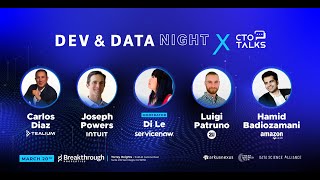
Dai Li, an AI ethicist, discusses how AI and data have let domain experts learn modeling faster and extract business insights. A key misconception: treating model outputs as always correct. Development workflows now rely on LLMs for generating code.
Hey everyone. Good to have you here. Thank you for coming. Devin. Date night and CTO talks. Woo. Tonight we're going to have an amazing conversation, probably a little bit more skewed on data, science and of course the two letter word AI.
I am so humbled and thankful to be here today. My name is Dai Li. I am an AI ethicist. But the grounding of my work is at the intersection of UX research, governance, policy, but also just making sure that people are doing good things with technology. How has AI or data impacted your role and how have you seen it change?
I think the biggest change I've seen is how quickly people are able to learn new methods. Someone who has domain expertise and like, understands data is able to extend into like very sophisticated modeling and derive like very valuable business insights. That would have been off limits if you were just looking at descriptive statistics.
What is the biggest misconception about AI in your industry?
That what you get out of it is always going to be the correct answer. We are, you know, having to purge data, but also making sure that the latest transaction or the latest touch point with that customer is relevant.
Your development workflow has shifted. You can't get by anymore without using LLMs to generate a piece of code for you. It's not enough to generate a project yet, but it's getting there.
Upskilling is more within reach than ever before.
Thank you guys, an amazing job, amazing conversation. Thank you to our partners. Thank you all. Have a good rest of the night.