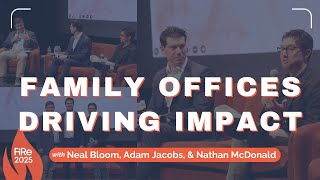
Nathan McDonald moderates Adam Jacobs and Neal Bloom on how family offices invest for impact. They discuss why family offices can fund deep tech longer than VCs, how to bring the next generation in, and whether family money can replace shrinking public research budgets.
Questions this video answers
70%
60%
8,000–10,000 formal single-family offices (claimed)
30,000–100,000 households with >$100M net worth (claimed range)
$70–$150 trillion (claimed range)
All right, Good morning. How's everybody doing? Good. All right, well, we are very excited to talk about our most favorite topic, which is family office capital, Family offices driving impact. So my name is Nathan McDonald. I'll be moderating the panel today. And I've had the good Fortune the last 25 years to work with private investors and really see the evolution of the private investing marketplace from individual angel groups, individual angels, growth of venture capital growth now with family offices and private equity and the convergence and reconvergence and all the ups and downs along the way through our economic ups and downs, our technology, the different frontiers of technology past their last 25 years. So excited to talk to Neil and Adam today. Really appreciate them joining us to talk about how family offices are driving impact. And so just wanted to set the stage for everybody up front. Family offices a bit of a new term. Most all the family offices are brand new since 2010. I pulled up some data just before the panel here today. 70% are new since 2000. 60% of the family offices are new since 2010. We're looking at somewhere between 8 to 10,000 formal single family offices, and we're talking about 30,000 to potentially up to 100,000 different households that have over $100 million of net worth. So we're all certainly aware of the growth of wealth within our economy and globally and how those family offices are now putting that capital to work and how that's impacting innovation and how that's driving the impact. So we want to jump about that today and think about where we're going to be in the next 10 to 15 years. We've got somewhere between 70 and $150 trillion of assets that are owned by our senior generations, and those are going to go somewhere and be managed by someone or something and be invested. And so we're very passionate about creating and scaling and building out systems that can really make the most of that opportunity to empower the next generation with entrepreneurship and investing and be able to fund all these great ideas and these great innovators. But how do we do bring together the right capital with the right people at the right time to drive the most impact, which is ultimately our overall goal. So with a little bit of a primer on kind of what a family office is, again, it's typically a high net worth family. They have decided to go ahead and bring on their own advisory team to help them with their investment strategies and whether that be philanthropic, for profit, but they want to be in control. They want to have values aligned investing that lines up with their family business, their values, their objectives, and then obviously working together with other families to invest, co invest. And obviously we're here today in the Qualcomm Institute and we couldn't be more fortunate to have Adam Jacobs here with the Jacobs Sheriff Group. Obviously his grandfather was a big part of the, a big chunk of the campus here and a lot of the local community. So appreciate Neil and Adam being with us. And Adam, love for you to just kick us off and you've had a chance to kind of grow up with technology all around and grow up in this community and just have a really interesting perspective. And can you talk a little bit about the meaning of impact for your family office and how you guys think about it? And what do you see as kind of one or two top impacts in terms of the growth of family office capital and social good?
Yeah, thank you. And first of all, thanks for having me today. Pretty cool and wild to be sitting in the Qualcomm Institute theater here, knowing how much my family has had an involvement here in San Diego. Honestly, you can't really drive anywhere in San Diego without seeing our name somewhere. In fact, both of my kids were born at the Jacobs. What do we call it? The Jacobs Medical Center. We just call it Jacobs here. Jacobs Medical Center. So very cool. Full circle there. You know, one of the things our family's always had instilled into us is, you know, while we live in a capitalist society. And yes, Qualcomm and even before that, Linkabit was a for profit company. How do you use what technology you're making for good? There's a lot of great products out there. They don't make the world a better place. But in the case of Qualcomm, they were able to connect people and yeah, it became Fortune 500, led to a lot of economic boom, especially here in San Diego, but around the world. But at the core, that technology helped the world be a better place. That's been the forefront of everything our family has done, whether in health, tech, biotech, you name it. And so, you know, that's usually the first checkbox on any company that comes approaches us on that. So, you know, and that's the for profit world. There's also the nonprofit world where you can also look to make an impact. And you know, we actually refer to that as also an investment rather than a donation because you're investing in those organizations that do great work as well. So that's what we're all about.
Fantastic. And Neil, come on in. Why don't you tell us? Obviously we know about Adam and his background. Let's hear a little bit about your background and obviously appreciate all the work you've done in the local ecosystem supporting tech entrepreneurs and really excited to hear a little bit more about what you've seen in terms of the impact of all those successful tech entrepreneurs, their family offices, they're turning around and investing. Obviously not every entrepreneur is going to be successful. As the Qualcomm example, many have more moderate exits and opportunities, but they want to recycle that capital. So tell us a little bit more about your background, some of the work you've done, and the impact you've seen in getting those folks to engage in the family office community.
Sure. Thank you. And thank you all for having me. It's so nice to be here. UCSD alum, mechanical engineer here. Your grandfather gave us a silver ring at the silver ring ceremony. He was the speaker to kick it off that year 2008, which was pretty inspiring, I feel like for me at that. And I immediately went off and worked in the space program, worked on the space shuttle program, launching the last 12 launches to space. I was a launch operations and test operations engineer. And it was actually the retirement of the space shuttle that kicked off kind of a bigger inner purpose for me. The retirement really actually what it meant was it shut down an industry and it let 10,000 people go who were some of the smartest people I had ever met in my life. I was inspired by them who had put people in space and all they ever wanted to do was that. And so I actually started a startup called Portfolium, which was going to be the LinkedIn for engineers, a visual platform to transform the things you've worked on, to connect them into what you could work on. Many pivots later, as entrepreneurs learn, it became really more of like a visual resume platform for startups students. It just works much better. If you hadn't already filled out your LinkedIn or resume yet, we could catch you then and say, here is your employability. And so I jumped into the startup world building an ed tech platform where UCSD was actually one of our sandboxes, if you will, as alum, they let us test and try in a variety of places and eventually built a pretty good business and sold it to a public company. And so I was fortunate enough to have exit of my own and, you know, financial and also a ton of learning around that. And pretty quickly after that, it launched my angel career. I started investing in other founders that I was inspired by, which turned into a community of investors where other technology founders who were starting to have their own success said, I want to do what you're doing, I want to empower others. And that was the birth of Interlock Capital. And so in 2020, a group, it was just 40 of us at the beginning, exited. Technology founders locally in San Diego said, let's start not just funding, writing checks, let's actually invest in the people that we believe in, in the areas where we believe we can actually impact them the most meaning areas we've worked in before. You heard my background already. I think I pretty much could only help in aerospace and ed tech. I shouldn't be necessarily going to giving opinions on other areas, but I have a network that is made up of a composition of diverse backgrounds. And so Interlock Capital became this community of diverse subject matter experts, putting our focus and energy into areas where we think we can move the needle beyond a check. And so over the last five years we've been doing that. We've invested into 45 companies.
As a.
Group where we invest. And what I've very recently realized is not only are we giving our expertise, our capital, our time, our energy, we are learning as a group how to build our own future family offices. And so I'm launching very shortly here something called Rising Tide Partners, where we as an investment community are not just investing directly into startups, we're investing across the board, philanthropically into ourselves to grow a multi generational platform where we have everlasting input and we learn to honestly from other family offices. We learn to show up in our community, not just in our companies and in our families, but as business leaders. We say it's on us to shape the future. And that future includes where we live. And so that is what I'm embarking on going forward with, learning from how to build companies, how to build capital networks, and now hopefully how to build the future family offices. And so it's pretty timely to talk about it today.
Thanks, Neil. You know, just getting people going, getting them investing, getting that momentum started. I saw a quote, all compounding, everything compounds as long as you move forward and you engage. And so even the act of getting that many LPs together, showing them the investment process, helping them with their family offices, the cascading impact of that community, then working together, working on other deals, there are areas of opportunity, really, really makes a big difference. So unfortunately, the sad facts of the matter are that, you know, less than 25% of family office capital makes it to Gen 2, 10% makes it to Gen 3. And so that's what we're up against is a huge statistical prediction that the majority of all this wealth that's been created is going to go away, it's going to be wasted. Something's going to happen where it just, it doesn't get utilized in a proper manner. And so, you know, it's very motivating as we see all these entrepreneurial ventures, everybody working hard, you know, how do we get more of that capital into a mode where there is a, there is a structure, there is a value to align system for making investments and ultimately we got to engage the next gens. And so, you know, that's the next topic here is, you know, how do we engage the next gens and really create that capacity to take this magnitude of wealth as that grows in the future. And how do we educate, how do we engage, how do we lead those organizations? So I love Adam, to share from your perspective. Again, you grew up as a third gen, but you're familiar with your peer group, your family, but just other folks, you know, we. What's been the approach that you guys have taken that's been so successful to really scale out and engage? And what do you see other family offices doing successfully to get next gens involved?
Yeah, good question. So first of all, I'd say I consider myself fortunate that I had a foot call it in both worlds. Qualcomm didn't really make it big. Don't get me wrong. We were very comfortable, but didn't have its big pop till I was in the fifth or sixth grade. So I lived a somewhat normal life here in San Diego. Okay, there was a few things around with our name on it, but not like today. And I'm the oldest of all the grandchildren, so some of my younger cousins didn't have that experience. And right or wrong, indifferent. You know, there's certain things that I notice in that, you know, for us, I think the biggest thing is trust. You know, some of these big founders, big wealth generators, the older generations, they made that money and it's really hard for them to let go. And they probably made that money because they were hands on, rolled their sleeves up in deep, micromanaged everything and were part of every decision made. And it's very hard for them again to let go. What I'm very fortunate about is our family has a lot of trust in the next generation and now the third and hopefully with my kids being the fourth, to let them fail, to let them learn, but not in a way where it's always Trying to please the wealth generator to get the yes or no. For example, my situation, I received my inheritance already while my grandparents parents are still alive so I could talk to them, hey, what did you do about this? What was your goal, what was your motivations, et cetera. And it showed me that they trusted me to go and make good decisions and not waste it all. Some of it's mistakes you're gonna make, but that's how you learn. And I do think going forward that biggest thing is trust in the next generation being able to let go and, and developing, letting people fail but you.
Know, in the right way, giving enough of an allocation so that we can lose a little bit, learn a lot and then be able to be trusted to make better decisions with the really big decisions that are coming down the road. Neil, would you like to jump in and I'd love to hear some of your perspective thoughts as you've worked with all these exited tech entrepreneurs. What are you seeing as kind of a philosophy that works for them as they're looking to get the next gen engaged?
Yeah, it's been interesting with my friends and peers as we have had exits, significant new forms of wealth, and seeing how different everyone takes it and with the planning in mind or not. And I think what's been really interesting is to see where the personal interests and the professional interests either converge or diverge to a certain regard. And some of the times someone builds an incredibly deep technology company, has an exit and the next thing we want to do has nothing related to the last thing. And for me, from kind of a investment manager perspective, in a sense, who's going to bring more deals to say, hey, I'd love your expertise in this because you spent 20 years building and accumulating around it and now they're completely interested in something so orthogonal. It's really interesting to me. And there's no way to pattern match that. And so the idea that what you put your interest into, you might be brand new to it and now you have a significant amount of wealth and you're pouring that into it with no background into it as well. And so that's been interesting to watch and to learn how much should we give advice and feedback as a group and community and say wow, like you know, if you just did this again like you did for the last 20 years, the next 20 years can be so much easier for you or the versa that says, but you have the freedom to explore, explore and learn and do whatever you want right now because of how much effort you put into Building and having that exit. So that's been interesting for me of just like watching my peers in a new generation in that regard. The other part that's been interesting is watching my peers bring their family into their professional lives for the first time saying I want my kids now to be a part and learn because I didn't get the chance to meet and be with them at all, not meet, be with them while building a significant company without the. And the kids have to go and do this. It's more just I finally have the time to introduce them to my interests and my passions in there as well. So I would say for me it's more like guiding a community through learning and experiencing, you know, this gen 1 if you will of how to actually lean in and be not just the starved founder that they spent majority of their lives being. Right all their wealth originally was just like on paper and now it's a whole new side and so yeah it's just like a whole new exploration for us and I feel there's a lot to learn from and the fact that we're physically in San Diego and a lot of us are here, I think something special to be able to learn and do it together. So I don't know, it's just kind of a really good exploration moment right now.
It's so great when you're working with the kids and my kids are in their teens now and those kids are still very, very little and you know, you see them going from, you know, what, what they need, what they think they need which is more Xbox times. It seems like that's always the answer. But you know, what do you guys want? You know and really thinking about, you know, what do they want? And as our kids have become now 14 and 17 year old teenagers, it's really cool to see that emerge and it's, it's going to be closer than you think there. So enjoy every, every day when the kids are little. That was always the advice our investors gave me and it was very well approved. So as we look out into the future we're at about five and a half trillion of assets under management in the family office and obviously that has having a big impact but that's going to double in the next few years and become bigger than private equity, bigger than the current vc, bigger than hedge funds combined with. And so that's going to be a world that we're already a few years closer to being in. So as we look over the horizon we look at, you know, how is that amount of wealth going to impact what we do as entrepreneurs funding innovation. Love to get thoughts from the panel. You know, what do you guys really see as the key impacts? We're kind of at Family Office 2.0 now, but it feels like with the next gen engagement, it's about to step up and really become much more organized and, and connected both within like the San Diego community, but along the west coast nationwide there's more consortiums evolving. Love to have you guys look into the crystal ball and where are we going to be in five years? What do you think the impacts will be?
Wow, five years is a long time, especially the way technology is going these days. So I actually just started, actually been about a year now as president of a biotech startup and we're currently in our fundraiser as we speak. And you know your normal Venture Capitals VCs, you can find them everywhere, you can find them online, you can connect with someone on LinkedIn. Family offices are very difficult to break through, get a connection with, find someone who's interested or even reach out on LinkedIn. It's not there. And so we, one of the things I think will happen with the growth of family offices is there will be a much easier way to find some of these offices around and also find out what they're interested in. Because maybe you found an office but they don't care about what the thing you're making is. We're in biotech, they might not care about biotech. And so I think with this wider net and it becoming more mainstream, if you will, it'll be an easier time to find that. Which also means it'll be a more crowded space because the connection you might have now, everyone can also have that. Whereas I think that VCs are going to have to sort of morph a little bit and can't be so stuck in, hey, what's my percent return going to be in the next five years? They're going to have to get a little more into this mission driven impact place if they want to really find the next up and coming entrepreneur or next up and coming technology and take a little more risk and a little more faith. So I think what will happen is, in summary, you're going to have family offices move towards VC life and VCs move a little bit more towards Family Office. And somewhere in the middle is going to be this hybrid version and there's.
Certainly going to be plenty of capital to go around. So Neil, how does it look once the future, you know, with that much capital, how do you think it's going to impact how deals get done.
Yeah, it's interesting. Over the last 10 plus years, the access to capital and access to startups has really broken down in that regard. And so what used to be family offices funding VCs who then fund startups is now, you know, these larger capital pools finding direct ways, direct right to startups, which is fantastic. Honestly, like as a startup CEO or leader, you need as much access to capital as possible, especially in things like deep tech that just need time forever really. And that doesn't align with professional investors, to be honest. Professional investors have a return period that they need to return ASAP. Honestly, the fact that VCs get this 10 year leeway to return the fund, I mean they're looked at every three years, what have you done, what have you returned? And that's just not on the same timeline as deep technology needs. And so family offices provide a huge, huge, huge opportunity to fill the void, especially right now where NIH and other capital is uncertain. And you have families who have deep interest personally in funding deep technology in that regard. But they also something else that's really special I think to the venture capital community is that you don't just one size check doesn't fit everything. But also equity isn't the only kind of capital that companies need. They need debt, they need lines of credit, they need assets. And family offices typically have an opportunity to do all the above. And so if you as an entrepreneur can find one source of capital that can give you a lot of different optionality and give you capital, the right capital at the right time, that's huge. The problem has just been finding them right. And founders have to run a company, have to run technology, have to hire, and now they also have to manage capital pools in that regard. And so while venture capital has been that, I think venture capital is going to be, you know, it's going to have some competition from others who want to put money to work, which I think is a good thing. Everyone should be competing for the best capital, for the best founders.
I'll add one interesting thing now with the pervasiveness of virtual meetings. You know, it used to be when you were raising capital, you take a while to set up a meeting. You'd have to fly somewhere or they'd have to fly to you. So you'd have one meeting every week or every couple weeks. And that was like, okay, we got one meeting, it's probably going to progress after that. Now literally you can have 10 meetings a day. And that's both for the person trying to raise capital, but also for the VC or family office. And so it just, it's a whole new paradigm and just a different world in that regard.
So breaking through can be tough. We've got about a minute and then we're going to open up for some questions. We do have about five minutes for questions. So folks, have any questions for the panel here, please do make your way to the microphones. And how do you break through the noise? That's a good question. You know, obviously VCs and the proliferay of the cold outreach approach. Wow. Anyway, we'll talk about that over the happy hour, but let's, let's jump to what is the best way. We got some entrepreneurs here. You know, if folks do want to approach family offices as an adjunct to their venture capital or angel investment groups, what would you guys suggest? I mean, how's the best way to access and try and identify and prioritize adding family offices to your cap table?
So I have two cliches I like to use. One, the dollar is the easiest part of a negotiation. So when you're working with or talking to some of these family offices or VCs, once you agree, whether you're selling them something or trying to get an investment, once you agree to the dollar, that's the easy part. It's all of the terms, the conditions, how much control you're giving up, what vision they have versus what you have. And these are all things that as an entrepreneur you really need to nail down or else you're gonna lose yourself and lose your company because someone else is gonna take it over, need those returns, have a different vision for it or whatever. The second part of that is understanding when you wanna answer to your shareholders versus your stakeholders. And so the people who are gonna benefit from the profits of your company or the people who are gonna benefit from the actual technology or product that you're making out in the world. And so balancing those two things are also very important. And you need to find the right family office, vc, whatever that aligns with those values as well.
Just to follow on that. Specifically that subject matter, expertise and or passion matter so much. And as a founder, you just feel like all capital is equal and you go after all of it. But not all capital is equal. You get so much more from someone who is passionate, but also can open doors that literally can give you cheat codes, right? And access to talent that you're going to be using that capital for to hire. And so doing the work upfront as an entrepreneur and building your dream list Dream bench of investors and then going and working hard to get to them, I think is the most important time you can spend pre raise.
Yeah. Know what you want, have that intention. Want to add that to your cap table. It adds so much strength. All right, we'll open up for questions. Go ahead and get us started on the left here.
Founding director of Calit2. I was really taken by Nathan's numbers of adding 5 trillion or something. This is happening at a historical moment in which you've seen the opening rounds of destroying what took 80 years since the end of World War II to build up and a federal government funding of science in universities and in fact a great increase in the universities largely because of the baby boom. But do you see the possibility of this new wealth and families finding a way to make up for a lot of the reduction in federal funding, which is going to be reduced vastly more than what we've seen in these opening rounds. And if so, there are a lot of philanthropic folks thinking about that. And in fact, people like Bob Kahn have talked about this as America's secret weapon. What are your thoughts on this? It's a historic moment.
Certainly. Yes. I think there's an incredible force of good within our communities and it is a matter of us doing the hard work to mobilize it. And we cannot rely on the government to be the solution to our future problems as much as it has been a fantastic way of organizing capital historically. But you know, we're here and we built what we built and we have an opportunity to work together to maintain those investments into the future. But it is going to definitely require action and coordination and support. And I think you see that as we are in Vancouver, BC, Seattle, Salt Lake City, Denver. Obviously here in SoCal, you see these organizational efforts underway with the within the tech community, within the wealth communities and in our vision, it's just a matter of connecting the dots and a lot of great support is there and available for entrepreneurs. But go ahead, Adam.
I'll add that in the nonprofit world, most of the time, the private funding of different initiatives is the pilot program so that you get the government big dollars to then follow on. Because the government wants to play it safe. Well, now they're going to want to play it even more safe. So those pilots really have to make an impact and show that they're going to get the ROI that they want.
And I'm seeing, I would say, I guess, represent kind of the new tech, you know, economy. And I'm seeing significant investments like let's take the stripe Founders, the Collison brothers have set up their own completely private foundation to, you know, do 100 year kind of investment in sciences.
Right.
And you're seeing a lot of that where it's like we can't rely on the government in the future. So I'm seeing it, but we just got to do it. We got to make more of those replications.
All right, we'll see if we can. Turian, a brief observation, a brief question. A couple of years ago, I've dealt with a lot of entities like yours, and the cybersecurity scared the living hell out of me. They were still using Windows 95. Please tell me you have secure systems. Question number one. Question number two, your observations about cyber cryptocurrency. Certainly the systems are a lot more secure than they've ever been and there's lots of advice and support out there for folks with wealth to make sure their systems. I'm comforted in hearing that.
But no, I think just the rise and prominence of family offices even existing, the fact they used to be just hidden away. There's ecosystems built around running the modern family office these days from kind of every area. So in a sense it's a new area to sell into.
So there's a lot more.
You do realize your targets 100% okay, yeah, yeah, yeah.
I mean, not just criminals, but nation state as well.
Yes.
All right. Unfortunately, that's all the time we have, but please do connect with us over lunch and during the programs this afternoon and this evening. So please join me in a warm round of applause here for Adam and Neil. Great job, guys.
Thank you all very much.








