From AI Toys to AI Operating Systems
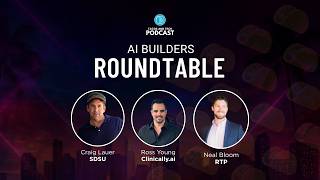
Neal Bloom hosts a roundtable on AI's shift from toys to operating systems. Craig built LaunchMate, a conversational agent for startup mentorship that remembers founder interactions and automates status updates. Ross Young's Clinically AI uses Claude as an internal OS, ingesting transcripts and automating weekly reviews and task lists.
Chapters
Startups get the party. Startups get the party started. Startups get the party. Startups get the party started. You want tech and tacos, Tacos and tech? You know, we got it.
Hey.
Startups get the party. Startups get the party started. Startups get the party. Startups get the party started. Startups get the party. Startups get the party started. You want tech and tacos, tacos in tech, you know, we got it.
Hey.
Yeah, I, I, I think, I mean, if this is an auspicious day for an AI podcast, because I, I really do think this day will be memorable. Yes.
February 5th, the day of infamy.
The day soft. I mean, so from what I gather, anthropic releases 4, 6 scores on top of the benchmark for codeine for 30 minutes, and then Sam Altman releases codex 5. What is it, 53 now or something? I forgot what it's on. And that trumps the latest release from Anthropic. I mean, but, but both of which signal the end of a software engineer not using coding tool. I mean, it's. So this is so obvious, the case right now. Like, it's over.
So that's, yeah, well, the, the war is interesting, right? If you saw, you know, Anthropic just released their super bowl ads, you know, with comedy about adding, you know, paid ads inside of AI and, and influencing people in an incorrect way. Right. I think the guy was having a bad relationship with his mother and asking his therapist, which was OpenAI about, you know, what he can do to improve it. And it said, sign up for goldengirls.com to meet older women. Should I create a profile for you?
They were funny, you have to admit.
Yeah, but the war, the trillion dollar war on an AI, right? I mean, it's model after model. And the interesting thing about it is you think about application layer companies like us that design software to align with workflow and then being able to plug the different intelligence in as it comes out after you've vetted it and traced it and done all of those things. So what was interesting is early on, when you're building software and creating features and using these models, is that they work kind of okay out of the box. You tune them, you get them better, you train them, you get them better. But then for that particular use case, they're pretty decent. But then the new model comes out and it's even better. So you get the upgrade from modifying the model, you know, tuning it and testing it and putting it in, and your product gets that much better because of the war. That's going on in AI, so it's really interesting building an application layer.
Fascinating.
Before we go too deep down the road, let's do a quick round of intros just for our listeners here who are listening on the AI Builders Roundtable. I just named it that. We'll see if GPT has a better name for that soon. And I just thought I'd get us together to talk about what's happening today, literally because tomorrow will be a whole new podcast. Honestly. I'm Neil with Horizon Type Partners. I'm both investing in new technology and I'm using technology to build my VC operating system layer. And so I'm hoping to pull in some things around that. Craig, why don't you go next?
Great. Hi Neil. Great to be on your podcast. I'm so glad we did intros because last night my girlfriend's daughter Delilah workshopped my opening with me. She was like Craig, you have to have a good opening. And I don't think we ever got there. But I'm glad we started with intro. So she was, I wanted to go with hey, hey, hey. But she, she nixed it. She was like, you can't do that. So of course I, I, I work with you sponsoring a, advising a class at San Diego State where we are helping some of our brightest future facilities founders and entrepreneurs learn about how to build businesses from zero to one. And so we've built some curriculum around that and workshops, it's more like workshops rather than curriculum. So we help people grow their, their ideas into something. I am prototyping a new program around AI to called Live in the Future. So maybe we can talk about that today. I think it applies directly but just happy to be here and share the, share the time with Ross.
Love it.
Hey, one heck of an intro you did use. Hey, hey, hey. So that was, that was excellent. No. Hi everyone, my name is Ross Young. I'm the co founder and CEO at Clinically AI and we do ambient listening, chart and chart auditing for Medicaid providers in the behavioral health space. So super subjective documentation. Helping out folks with severe substance use disorder, intellectual disabilities such as adult level schizophrenia and down syndrome, and really federally funded organizations that are really safety net of our society with Medicaid audits and things that coming out, they have a lot of challenges. We're doing that complex documentation for them. We're out of San Diego and this is my third time being on a podcast with Neil. I was on Tacos and Tech when I was a VP at another company, but excited to be Here and talk about, you know, what AI is doing both for a product perspective, but also how it's affecting internal operation. So thanks for having me, Neil and always Greg. Great to be with you. I have been a guest at one of those workshops helping the zero to one businesses. So it's always fun. Love what you guys are doing for the community.
Thanks.
Yeah, maybe we should start there a little bit and then we'll talk a little bit about launchmate and then we'll talk about some other projects here I think will be poignant. Craig and I have been involved at Santa State's zip Launchpad for I think two plus years now, maybe two and a half. And I talk about it as like my living laboratory. For me it's understanding, you know, the potential of entrepreneurship and the potential of people really is what we, we tie, try to test, I would say. And so we brought in this idea of a boot camp which really the idea originally was like, why do what we do in a semester when we can do it in a day? Why do in a day what we can do in seven hours? And then we kept saying like, what's the shortest period of time to go from problem worth solving to solving that problem and getting paid to do it? And so we just, just coming off of a week ago with 75 or so students where we sent them out into the world to go find a problem worth solving. Really it was find a person so that you can personalize and be like, what problem is that they have? That is the most red hot severe. But since we've been doing this, Craig has been also building the technology part as like a co pilot alongside the scene. Do you want to give us that piece?
Sure. So we, you know, we recognize that the, there's a ton of communication that happens between the founders in the class and the mentors. And San Diego State's done a great job of assembling all of these resources and mentors and the communication between all of these people was really bottlenecked by time. You know, people would text the mentor or you wouldn't hear the as a mentor, you wouldn't hear from your founders. And so until you had a one on one. So we asked ourselves the question of sort of living in the future. We asked ourselves the question, what if we had agents that sat between all of this communication and helped us all maintain continuity and progress in their journey? And that was sort of the inception point of this project was can AIs helping behind the scenes to mediate communication and facilitate the goal, which is Founders want to move faster, they want to have momentum. They don't want to sort of stall. That's the. That's the worst thing that, you know, it's the old shark swimming, right? It's. It's the worst thing that a founder could do is just stall. And so we looked at how we could build AI into a platform around communication so that founders could move faster. Mentors can be more effective in nudging them in certain directions. And it's been a real learning. I mean, that's the only way to say is not intuitive and obvious how a very inexpensive super intelligence can be applied to any problem. You just have to jump in and start tinkering and building and exploring in order to really appreciate how fundamentally different this is. So it's been great.
It has been great. Maybe we have. You pull up and share a screen of a recent work case on that, while I share a little bit about the iteration part too. So when Ross came to the last boot camp, we would use GPT as almost like a sounding board or voice of customer. Right? Remember that, Ross? We would, you know, we would have people put ideas up on the wall, create teams around it, and then go to a first pass of customer development with GPT. And once we had LaunchMate going as like, kind of like your. Your sounding board slash communication partner for running a company, we're like, wait, why can't anything we're doing in GPT also live in LaunchMate too? Right? And then we just kept being like, what else is there that we can be doing in LaunchMate that has an LLM and has kind of this contextual memory about everything you put into it? And then there's also the mentor piece. So we as mentors have a role in our own instance. And what we realized was one part is the visualization of context. So it's been pretty cool, I think. Craig, hopefully you'll show maybe a tidbit and maybe also what LaunchMate looks like. I don't. Ross, I don't think you've seen launchmate yet.
Right? I haven't. I'm excited to see it.
Okay.
But I think that's really the next phase, you know, where when I was, you know, at San Diego State helping out with that workshop. You're right. It was a sounding board and how AI has really been as a chat function, Right. You talk to it, it gives you a response. You talk to it, it gives you response. Hopefully it can potentially remember some level of consolidated view of previous chats. But I'm excited to See what Launcher Main is doing, because the next phase is really your AI operating system as a business that can hold on to the different context, understand all the work that you've done previously within the context window to then actually start operating and doing things for you, which really helps from a staffing perspective as well. Right. People can come and go, and then you lose some of that knowledge. And how do you capture some of that? Get it in the markdown or the right format for the AI to understand so you can continue, you know, speed up onboarding and then operate with the context of that department within your business. So I think you know what you're doing, especially even, you know, these launch events is. Is great, but in reality, you know, once you're beyond your first, you know, six months or year or two years down the line, where does all that go? So how do you capture that? So I think it's super interesting and I'm excited to see it.
All right, should we show off a bit? Craig, you want to share screen? I can get to this room. This one?
Okay. Why don't you do it? Yeah, why don't you?
Where do I go?
But which one am I?
So. So I'm in zip. Launchpad. Why don't you do that one?
Okay, there we go.
So this. What we learned about launchmate and in the development of this, is that the really the most valuable thing that a founder wants is they want a partner that knows everything about what they're doing. And so the real key is not a lot of sophisticated web app development that has, you know, all sorts of feedback features. The key thing is, we asked to our founders, they want a familiar chat interface, and they want an agent that is super well trained on exactly what their problem is, what their domain is, what their challenges are, and more importantly than anything, they want memory. So the agents are super well trained on the problem domain and the nature of the program that we're creating, Neil. And secondarily, it has an ongoing memory of every conversation you have. Much better than sort of contextually relevant than what we've seen from chat in their general conversations. So. So in this, you just want to treat it like a. Like a partner. So you say, hey, I'm going on a. I'm going on a podcast in 30 minutes. Can you give me some talking points that I can speak to about what I'm involved with? And you just start treating that as a kind of. Kind of that partner where you can unload everything that's in your mind. And of course, it is very well suited to the business domain that you're focused on. So it's, it's a tremendously strong sounding board for what to do and what not to do when you're trying to find product market fit for your idea. But it's as simple as just saying, hey, I need to craft an email that will get somebody in interest in talking to me or I'm going on a podcast so can just very quickly remind me what I should be talking about.
Okay. So that in that part. GPT Ish. Right. In terms of that. But I think the piece that has been really important and you're doing this this semester is feeding in a bunch of context so that it has that right. And so I think you learned a little bit of this for me where I just feed full transcripts of conversations with one on ones I have with students so that we have memory. I'm guessing I'm going to. My instance is on the advisor side, so I don't know if I'll be.
Able to show that.
But should I type in like how, how a company is recently doing?
Yeah, so, So as a, so you can imagine every, every agent has an awareness of all the other agents in the c. In the platform. So your ability to get insight into what others are doing and leveraging is all there. But you, you really did highlight Neil. The key is, yeah, we gotta, we gotta make sure we're not divulging any secrets here from some of the, some of the, some of the other participants with LaunchMate. But you hit on the main thing which is your, your training is only as good as your context. And so you got to just be filling up your context over and over and over again with new information. Whether that's transcripts from your phone calls, whether that is, you know, meetings with customers, whether it is advice from your mentor. And so all of this gets fed into your agent behind the scenes so that your agent grows with you. I will tell you anecdotally something wonderful is you spoke of the boot camp Neil that we were at. One of our founders that is in our program was running has a LaunchMate agent. And when we told them to create a new agent for boot camp, he raised his hand and he said he had kind of a panicked look on his face. And so I went out to him, said, what's your concern? He said, if I create a new launch made agent, will I lose my agent that I've been, I've been training in, in flight? And we're like, no, no, no, absolutely not. You'll keep that. And he's like, oh, thank goodness. And I, and I, I couldn't tell you how happy I was when I heard that reaction, because as any founder knows, the best feedback you can get from a user is, if I took this thing away from you, how would you feel? And most of the time people are like, eh, I'd make do. But to see somebody have pain and suffering around giving up that trained agent that is personalized to him, that was a good signal to us that maybe we're on the right track. But here you go, here you go. One quick. Your agent went out, it talked to the other agents, it gave you a brief kind of synthesized view of how each, each team is doing. You could of course talk to this agent, ask for anything more, drill down. We really do feel that natural language is the way into metrics. So this is a great example of synthesizing across the whole cohort how they're doing and letting you know who, where you need to attend to. Neil?
Yeah, this has been great to have for the last few months and now to be able to see them go back in there and make updates. The piece that I'll. Let's just do a quick. I'll share the tidbits from, from. I have got them up from the boot camp, which is the next level, which is another layer of, you know, visualization, if you will. Right?
Yeah. And so let me frame, let me frame this feature. So what we noticed was the one thing that people enjoy doing with launch made is they enjoy talking to the agent. But we're human beings and what we don't like doing is things we're supposed to do. Like, hey, you need to send an update to your mentor or to your team members, letting them know what you've been up to. And it's like, oh God, the minute you hear that, you just kind of like, oh, that feels like work. Right? So we asked ourselves, is there a way to share without sharing? And so what you're going to see is a tidbit is a feature that one of our developers hacked up and it turned out to be wildly successful, which is that if you just continue to talk to your agent, that we can have another agent that knows how to kind of storytell and appreciate what's important in your dialogue, that that agent could go reach out to your partner and extract all the necessary information and create something really nice to show so maybe you can bring up a tidbit. And so for free, for free, our agents will go out and showcase. So what was This, I don't think. Do you really want to show that one? I don't think you want to show that one, Neil.
No. All right.
I don't know. Do you. You want to reveal real people and their.
Their progress? This was just a boot camp. It was done in hours.
Okay. It was done in hours. So the idea is that we can. We can essentially create status updates, not so much about what you're doing. I mean, that's easy enough to list what. But the why. What is their thinking? What is their mindset? How are they progressing? Are they breaking through barriers? Are they changing directions as they go through the journey? All of this is captured very well by an AI. And AI is very good at determining sort of the why and the mindset of users. And so crafting stories based on your conversations is very easy for an AI to do. And of course, we format it in a way that's very easy to consume on a phone. And so this is an example of that. I'll send you another one that's maybe more traditional.
Cool.
Ross.
Wouldn't this been to be able to get these updates, in a sense, during the boot camp? Yes. You're walking around talking to founders, and then you're like, someone just made some progress. That's kind of our goal. And. Or someone's getting off progress. Let's go intervene. Right. It's like you're talking to this group, but, hey, let's go over here and within minutes be like, help them get back to path. That's kind of our thinking here. So. And eventually take us out of loop on that. We won't need to be part of that. It'll just be launch bait doing these pieces. Okay, I'll share. You shared one with me.
Yeah, I'm gonna. I'm gonna send it to you right now. So we have email. I'll text it to you. So we have a wonderful. Neil. So we have a. We have a wonderful, wonderful founder who is in the process of iterating. Iterating. Iterating on the. On the journey to product marketing. Fit with their. With their. And this is, you know, this is a tidbit of her progress, which was automatically created for her. She didn't have to do any work. It's a way of creating continuity between stakeholders, including me, her mentor in what she's doing. And it allows me to, like, I read this before our one on one. I just get this in my text messages, and it's like, all right, what you been doing? Oh, my God. She's contacted 50 restaurants. Wow, she's killing it. Right on. Okay. And it's a way of removing from our one on one calls all the updates where you spend, you know, 20 minutes of a 30 minute update just getting updated on what she's done. And so as you scroll through it kind of gives her journey through the week. Right. And it sort of tells the story of Kavindi is making a wonderful company where she's creating Instagram compelling Instagram videos of mom and pop restaurants with outstanding food to try and drive traffic to those local restaurants and offer all sorts of incentives for people to populate these restaurants. It's a way of championing the the independent restaurant owners around. So she's in the journey of trying to figure out how to build a business around that. And just by interacting with LaunchMate we get this wonderful capsule of her progress. So it's actually been really, really effective.
It's a really cool thing that the you and the LaunchMate, which is the team, which is the zip Launchpad design team design lab put together and you can tell the team building this where we are the startup for them or the customer. Man, they love it. It's so fun to see how much they get engagement and they joined our, some of them even joined our hackathon or boot camp just to like be on the other side to be, you know, customer hungry. So cool. Awesome. Yeah. Sharing that. Ross, why don't we turn over? I want to see something that you're building. What are you, what's your current stack like? What are you using? What do you tinker in?
Yeah, well, I mean there's quite a few of them. Right. I mean a couple of things, you know, that we're doing internally, you know, this AI operating system we've really been focused on and with the launch of Claude coworkers, it's really enabled and unlocked a lot for our team. So because of the power of it, I've been a Windows user since I was in second grade and I switched over to a Mac recently to take advantage the power of cloud cowork within our organization. So we've gone through and basically recorded every part of our business, every sales call, every support call, every implementation call, tickets, et cetera. And then we went through and summarized all of that context together and put that in markdown format and then included that the AI can read it MD and then included that inside of cloud projects and also had the AI go through an interview each particular department head of our company for the tribal knowledge, the things, you know, the whispers of how we do things in a company when it's not fully corporate and processed. And then we took all that context and we've put it inside of these projects connected with other tools such as HubSpot, such as Canva, such as our support system. And now you can go to coworkers, some of these particular projects and ask questions about what's going on with the business.
Right.
You know, I created a skill inside of Claude where Sunday night I'll run it, I'll say review last week and look at this upcoming week and build my to do list for tomorrow morning for each particular thing. And it knows to go through and check all of those meetings and the transcripts associated with those meetings. And then it has context at the departments that I'm looking for as a CEO. So it builds me a really nice rapport. We really use it a lot for sales management, content generation, etc. So now we are really exponentially creating a lot of value with keeping a high, you know, revenue per full time employee. And our onboarding for new staff requires that they go through this Claude type, cowork type training.
Right.
So I think it's really a new way to work and it's recently been unlocked. So yeah, I'm happy to share a couple of our projects and you know, show some of those, you know, really as well so I can share my screen real quick. But I don't know if you have any questions or thoughts on that concept.








