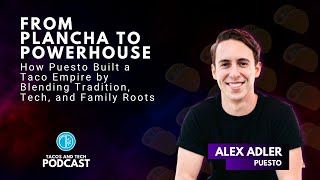
Alex Adler, co-founder of San Diego's Puesto, talks about growing a family taco business from La Jolla into a multi-location operation. He covers the operational systems that let them scale, how Toast and DoorDash fit into the model, and menu hits like plancha tacos and filet mignon. Expansion plans include out-of-state locations and new restaurant brands.
Startups get the party. Startups get the party started. Startups get the party. Startups get the party started.
You want tech and tacos, Tacos and tech, you know, we got it.
Hey.
Startups get the party. Startups get the party started. Startups get the party. Startups get the party started. Startups get the party. Startups get the party started.
You want tech and tacos, tacos in tech, you know, we got it. Hey.
And welcome back to the Tacos and Tech podcast. I'm your host, Neal Bloom, and I am thrilled to have on one of the taco kings of San Diego. We're gonna flip this episode on its head, Alex Adler, co founder of Questo. Hey, Alex, thanks for being on the pod.
Well, thanks for having me. Yeah, yeah, it's. This seems like a natural podcast for us. We may. May not be as much tech as usual, but definitely, I think the taco part, we're probably. Probably a perfect fit. So I'm excited to be here.
We've been talking about this for a bit. I feel like. I feel like we met Preco when maybe it was only three locations in questo and we actually talked a little bit, like what tech was going into questo. But, man, I feel like you really come into your own as a business. Really grown up in a. To a certain regard. Right. Had like a second or third generation as a business sound, right?
Yeah, yeah. I mean, it's. It's funny because we talked pre covered and then, you know, it's like everything was going in the right direction. You were starting to think about how SEO and everything affects restaurants, which, you know, it's usually a little dated for restaurants where we're laggers when it comes to technology, but we were, you know, trying to be ahead of it. Then Covid hits and it's like pause on everything because all our doors are closed. We can't serve anybody in California. And then we come out of it and now we're just picking up everything that's going on, you know, getting back into the marketing, getting back into how we present ourselves with our guests. And then now we get hit with AI and we're like, oh, wow, how's that going to affect our business? So it's exciting times. Oh, all right.
We got a lot to talk about. And we've been doing events here at. We are live at the Mission Valley Cuesta. We've been doing. For whatever reason, we've done a bunch of fintech founder gatherings here, both at the outside patio and one of the private rooms. It's been awesome. I think we have another one coming up that we're booking here. This seems to be a good spot because FinTech, apparently there's north county and there's downtown. So it's a good meeting spot in between. But let's take it all the way back. Like where does this all begin? Do you have restaurants in your family? Like how did you come into this part of the world of business?
No. So I think it was probably the last, the last sort of industry that our family was thinking we would get into. Our family was in real estate. Prior to that they were in, in Mexico, they, they worked in consumer products, more on the electronic side, radios, things like that, alarms that business ends. They moved to San Diego talking 40 plus years ago and create, you know, something that's a little more, you know, stable with the real estate and go from one unit, build it up and get, you know, get to where they, they got. And I think for us, we loved it and we were passionate about it, but we also had this other calling of, you know, working with people doing something that, that can, you know, create memories and create something that's lasting and, and to us the vision came through hospitality. I think it was again something that we, we never imagined. Zero restaurant background getting into it. But now we're almost on year 14 so it's been a journey and it.
Sounds like it's a family, family affair, family business.
It is family, 100%, myself, brothers, cousins. So it really is strictly a family business. And we joke. A lot of people that work with us, you know, they're part, I guess it's not a joke. They are part of the family. And sometimes we're in meetings, they're like, are you guys brothers? And we're like, yeah. And he's also our long lost brother as well because yeah, it's just a lot of family.
Yeah, well there's a lot learned in business with doing business with people and if you already have a relationship with them, it goes a long way too circular, that's for sure. Actually my family multi generational in the restaurant business ended up in LA in the hamburger business. Actually. My grandpa had a butcher shop, then started a hamburger stand and then my dad took it over and I was working in it as a kid and then they got into real estate because they started buying the land that their burger joints were on. So I understand a little bit of that growing up and I ended up going down a different path. But take us through, like what was the spark like when did you actually thank Puesta.
I mean, I think pue really came through just the. Really, the. The meals we would have at home, being Mexican American, first generation, our family from Monterrey and Guadalajara, and really this feeling that everything done outside of our home was done poorly. Bad ingredients, bad quality. You know, for us, the taco, if. If the tortilla is bad and isn't made in the moment, you're just doing it a disservice. It's literally like burger or sandwich, if it doesn't have the right patty or. Or bread, like you already lost, which I think a lot of people miss. And we had this feeling that just, it was, you know, the taco in 2011, when we started coming up with the idea, was done poorly in San Diego, which is 15 minutes from the border. Like, this should be the pinnacle of the United States. And then it also came through our chef and partner who was doing these events that were literally just based on the taco and making that the hero of everything. Every, you know, the chefs were in white chef's coats. You know, they're wearing the hats that you would imagine from, like, from ratatouille or, like, and white tablecloth. And just everything was done very elegantly and something that tacos had never experienced. But I do know during that time, these events were pretty much 300 plus of them. He was doing a year. It was kind of like the talk of the town, and you were excited if you got an invite. If you didn't get one, you were looking at how you could join those events or just sneak your way in, because the only way to get them was there. So for us, we had, you know, the passion. It hit us seeing it in person, and it was just that drive of, how do we put it in a brick and mortar and give, you know, give people what they want every day rather than through that. And as the story goes, I mean, our chef also was a. Was a hairstylist. And, you know, my mom and my oldest brother Eric went to meet him at his salon and pitch him there. And that's. That's where it really began and gave us, you know, the, I guess, proof of concept that there was a hole in the market for something like this. And was the start. Wow.
Was there, like a validation test kitchen test with an audience? Or did you go straight to first full kitchen, first full whole restaurant and everything?
It was a stand in our house that he came and just cooked. But at the end of the day, you know, we had seen it so many times in events and being that success that People would literally go back eight times to get tacos during an event and just keep going and going because, you know, the reality is the tacit taco, when it's coming off the plancha with the, you know, the crispy melted cheese, which was again in Mexico, Costa, or. Or however you want to call it, was. Was a thing. But in San Diego, I mean, I would argue we were probably first to bring it here and it's became our signature and what we were known for. So we had a good feeling, I would say. Yeah.
Interesting. So where was first location?
La Hoya.
Ah, okay. Right there in the Village.
Yeah, La Jolla. On Wall Street. And funny enough, you know, you look at it now and you're like, well, that's, it's the pinnacle of La Jolla. It's got Burger Lounge, Maurici's there now, which is ours as well. There's, you know, great Sushi concepts, Himitsu's there, Marketplace. There's just a lot of food going around in that area. But back when we opened, I mean, our space was a mortgage bank. Burger Lounge was just getting started, so there really wasn't a lot going on. But the drive was, you know, it's somewhere that we feel has a lot of opportunity, has a lot of, you know, tourism that can bolster the business. But then also we can just be hands on because at the beginning it was literally us working the business every day.
Really. What was your role? What was the first or what did you not do? Probably honestly, Right?
No, we, we joke. My brother Alan was on the plancha. He was great with the cheese rolls I was on pretty much. They would pass it to me, garnish, cold station everything to complete it and then pass it to the, the POS or the payment where my brother Eric was. And now, you know, we have full bar. Margaritas are a thing. Back then we would sell one sculpin and start ringing, almost like ringing a bell. Like, sell the seven dollar sculpin. And we were ecstatic. So it's come a long way.
Yeah, it's come a long way.
Wow.
What's, what is. Like, how did you, how did you know you were onto something and you're ready to scale and grow? Like, what are those things that go through your head around that?
I think, you know, you get a lot of confirmation from people and just seeing the lines and, you know, I think we took a leap of faith because we, we realized, you know, one location is never going to be, you know, the money maker, like at the end of the day you can have sales and you can look busy and everyone from the outside is going to think that you're doing great. But we're a big family so it was going to take more than one. And really I think it was betting on ourselves, the concept and the reality that we were fortunate. From day one we had, we had a following and people are excited about it and, and that carried us into, you know, just having the, the courage to follow the passion and open up our large, you know, a very large location at the time, which was Puesto downtown at the headquarters. And even crazier was get involved with the landlord's request to, you know, that they really would like to see full service too. And us think, well we'll operate both at the same time with full bar, see where it goes. Which was actually I guess the first pivot in the company history. Which you know, that's, you know, you talk about businesses 14 years in and all these pivots that are monumental. That was it because now we're a full service all around.
So headquarters was second location. Then Mission Valley.
No. So we went to headquarters. Then we actually went to Orange County. We opened up a couple there. Then we went to Santa Clara. All the way in the bay open there. Then in Covid, we ended up opening up another two which was Mission Valley and Anaheim at the same time. So they were. It was a weird timing where everything's closed but you're already under construction, fully committed and you just keep going and pushing ahead.
Totally along the way. Not just scaling, growing. You're kind of writing playbooks, right? Do you kind of remember some of that of just like the operational excellence. I'm guessing they're still there today. But like what do you remember? Streamlining.
It's still there today. I mean I think it's. What's interesting is that it never. I think your values, your mission, things like that, your culture carry. But in regards to playbooks just constantly being reinvented every day. It's just we, we went from a company that was, you know, us working the line, having our first as you call it, like lead coming from Panera across the street. And you know, we were super happy and excited when we got to hire her to now this place where we have, you know, there's over 800 team members. We have these multi locations, the environment constantly changing for better or worse and we, you know, we just have to roll with it. And again like the culture is, is the key because we, we stick to that and it's still the same principles from the beginning but playbook is every day's an. Every day is a school day here. So it's great.
What related that like innovation wise, like what have you seen the industry change obviously point of sale and some of that from 14 years ago didn't exist. Right. The toasts and the olos and all those. But what else, what have you seen come in to kind of help you guys?
Yeah, I mean I think you touched on. Probably the largest one for us is Toast. I mean Toast was. We were part of, you know the, the old days where everyone bring in aloha or micros and you know, pay hundreds of thousands to put the systems in. You had this pretty much these bricks that you couldn't sell to anybody for anything and you ran with them. You wanted tablets. There were thousands and thousands per tablet. So it wasn't really viable. They also weren't made by them. So it never synced properly to this world where everything is connected now through Toast and to us it's probably, you know, it's the number one thing we use in regards to all payments go through there, loyalty goes through there. It's synced through Door Dash or any delivery service you want to use. Open Table just it's. I think that's what's come the furthest is that now you have all these tools that are all synced and actually working together to benefit you to the point where we have all this information. That's great. But we're like, wow, how do we use this? Because there's a lot coming our way in the best way possible.
Yeah. Along the way also the experience for the customer with doordash and I mean obviously Covid like accelerated that. What's that been like to. In terms of how do you scale the experience when you're outside the physical walls of this place?
I think you, you know, we're, we're a unique example because we're, you know, we're full service but we still offer the delivery experience. You know you have the challenge of you're operating the business. Usually it's not like orders will come in when it's convenient for you. They're going to come in at the same time as diners for the most part. So you're juggling both but we just have to do is put in all the fail safes you can packaging, testing your packaging, testing your SOPs for how, how it's going down from when the order comes in to who's. Who's putting it together to where it's Going how it's getting picked up, getting it as fast as possible to the door dasher and. And then once it's in their hands, pretty much just pray. But you know I, I think it's. You had to just Covid kind of made you adopt it and then coming out of it you had to decide if you're going to keep going with it. And for us, you know, I heard this line actually from the CEO of DoorDash was literally they asked him if he was scared that after coming out of COVID was he going to see the decline like some of the zooms or things like that. Like Zoom today is no back to hangouts or teams or whatever it may be. But he answered perfect. So convenience only goes one way. So when you hear that you're like yeah, he's right. Like at the end of the day, you know they're big believers that people are going to dine out still and they're going to enjoy their time because they do want that interaction and excitement. But there's always going to be that time and place where you just I'm home, I want to relax, I had a long day or whatever it may be and I'm going to order in. And they're fine with that. Yeah.
Interesting. It's interesting. You talk about toast kind of being maybe the one winner there for you guys but the delivery services, I feel like it's everywhere. Uber breeze, doordash or maybe it's just the two. I don't know. Like is there that side kind of settled in to a winner.
It's. I mean in our opinion, I mean we went strictly doordash. I think our business is again since we focus on full service as well, we wanted to streamline it to whoever we thought was dominant which for us it's doordash in our market specifically. I think there's more money to be made if we open it up but it's not worth the risk of having to sacrifice on the experience here. I think they all won. But from our side I guess just the most pivotal is just toast because it's literally the brain for everything and everything's sinking through there. I don't even have a doordash tablet here. It's all going through my toast.
Got it. The other innovation I think about is food and drink. Like what's maybe just personal preference, what's changed? But sometimes it's the innovators bringing it to them like plant based protein or even now the rise of non alcoholic drinking. Right. And these adaptogen based Drinks like how have you ridden the wave of, you know, the food, the menu and the drink to around consumer preference?
It's. Yeah, no, there's been a lot, a lot of changes and I think it's. The thing about it is you have to play, you know, the fine line of the hits and not moving too fast or too far, but also innovating because you're. Some guests want that, some don't. Some want the, you know, the filet mignon taco, which is our number one. So we've been really just treading the, you know, the line of things we really think are here to stay and are excited about. Example non alcoholic. We, we think that's here to stay. So we really leaned into that. But before doing it, I think if it's going to be done, it has to be done done to the same level as our margaritas or any of our cocktails. So that was, that's kind of the, the balance we play. Like we're not just going to throw, you know, juice in a cup and charge you 14. Like we're gonna literally here we even, we tried every non alcoholic tequila brand on the market and hated them all to the point we actually created our own blend that tastes as close to tequila as we can using our own products. I mean it's got some crazy things that are our VP of bar and spirits created. I mean down to like using our esquite and different teas and different things like that that he combined. And when you try a non alcoholic margarita, you're like oh, that's pretty close. It's not alcohol, but it's pretty close. That's awesome.
Really interesting. What about, okay, let's talk like tacos for a second. We got it for a while because people got preference. And in San Diego there's like all these different subcultures of tacos, right? Fish tacos one whole area, birria tacos, another whole area. Then you've got the classic California burritos, so potatoes in your Mexican food. How do you look at all these little sub subculture clusters under a taco banner?
I mean I think what happens is when it comes to full service and tacos, there's not a lot of players in our world. And you have all these other amazing taco concepts doing, you know, like you said, specializing. They're the best for birria, they're the best for seafood, whatever it may be. And so our job is just to, to pretty much stick to the, what's going on in the market and what are Like, Beeria had its moment. So when that happens, like, we have to have the best version of birria that we can produce and we're really proud of on our menu. But again, our, our goal is with our 12 tacos that we always have there, we're going to hit all those segments. So instead of being just dedicated to that area, like, we want to pretty much hit the segments that are trending while keeping six to price. Yeah. Half of the tacos staying consistent to what people come for and love.
So the El Paso in another area. Right.
And that, that was from the beginning. So for us, funny enough, our Alpa sourced chicken, which everyone's always like, why did that happen? Well, it happened because a lot of the events were predominantly Jewish. They couldn't do pork. So this chef, you know, he's not Jewish, but right away he said, you know what, I'm just gonna make a chicken alba store. We came to love it from the beginning. And that. That's a staple from literally the start.
That's interesting. I actually was just at Tacos La Gordo. They don't have a chicken. They only have pork and beef. They have a lot of weird beef, by the way. Beef head, beef brain. Anyway.
Yeah. Which is another. I mean, I love it like a tongue language. I'm down with it. But it's. It's also the fine line that we, we have to play of. We, we. We're authentic. You know, our chef is from Mexico City. He's been with us since the beginning. Like, everything we follow is true to. To Mexico, but we also have to realize what the guest in our markets wants and not go too far. Yeah. Like, we've done it before. We put, you know, examples, things like langua and, you know, just didn't get the sales. So.
Interesting. So, yeah, some of the non. Like the vegetarian ones, I know the mushroom. I feel like there's been some other ones that have come through too. Right. You've tried vegetarian squash blossom. Right. What else has kind of come through innovation wise for you guys for that?
I'm trying to think of. Of the, the plus and minuses, but really what the best avenue we always had for this was Taco the month, which we just recently brought back. It was another Covid casualty that, that is back now, but that, you know, I think in a couple months I'll give you some more headlines, but pretty much everything that hits the menu was tested there.
Okay.
And that would give us. That gave us the. The confidence based on movement and excitement. And so when I Hit the menu. We're pretty sure.
Yeah. You mentioned Birya had its moment. Like what. What's the next taco trend that you're seeing?
The next taco trend? Well, the current one right now is kind of just like a steak. Like it's either. It's either a trumpo or. Or it kind of just, you know, skirts there. Whatever steak you want to use where it's just like flat and it's just. I think Mexican food is heading to this, to a stage where you just want to like highlight great ingredients, which is kind of what we stood for from the beginning. So if you look in Mexico City, it's literally just, you know, it's a great tortilla, a great piece of meat. Your salsas, maybe escaveche on top or whatever you want, but it's pretty simple. So it's almost like taking the classic, which was just like carne asada with onions and cilantro. And this new version, it's more refined and delicate. I guess that's something. That's the trend we've been seeing a lot coming out of Mexico. We added to our menu on the last menu change, actually. So it's our ribeye taco. We actually call it the CDMX because based on Mexico City.
Delicious.
I've had it so good.
I actually go back and forth to filet mignon and the ribeye for sure. And isn't there a short rib? There's a short rib one too, right?
Biria?
Ah, right.
Yeah, yeah, still there. Meat tacos for sure.
Where else. Where. Where are you guys headed over? I mean, I know expansion. You guys have definitely looked at other places. Where, where else are you headed that can give us a glimpse into.
Yeah, we're, you know, as a group, it's an interesting time because we have Puesto, we have Maurici, we have Roman Norte, which is our bar concept downtown. So this year we have three. Three projects slated. The highlight, I guess they're all highlights, but puesta wise, we have one that's going to be opening up next to the padel courts and the Alexandria property, which we're really excited about. It's got to be great. Sereno Valley, they're great partners. It's going to be kind of a. An homage to the, to the past of more of a fast, casual version of PUE. 3000 square FT and bring us back to the roots. So it's going to be fun. Pesto out of state is kind of the headline. You know, we're. We're signed well, we'll be releasing a little more on that, but we'll be doing our first out of state this year and then we have another fine dining concept being created in the San Diego market coming summer of next year. So again, it's an interesting time because we're looking at it as a group now and there's just a lot going on.
Yeah, that's interesting. Are you finding is this. Well, obviously you've written playbooks, right? And you know how to expand and now you know how to try other foods which could be other brands. Right. Everything about opening in Mexico, is that a thing? Is that on the, on the list?
We always joke that we want to go back to the homeland, take p there and, and see, you know, and see what happens. Cuz at the end of the day, I think our concept is unique even for Mexico City. Like nobody's doing. There's amazing taco shops but nobody's doing, you know, the fine casual taco. Being the hero of the menu but still giving you that experience that, that we want to give that, you know, we often, you know, if we're going to get ding sometimes it's price but we stand by using, you know, masienda tortillas, which is the same as Enrique Oliveira. Like our produce and products and everything that's coming in is farms we're proud of and we can actually talk about. So it is what it is. And working in California. So yeah, I think Mexico City would be a great fit. Hopefully. I'd love to. That would be awesome.
Definitely. I mean it's such a culinary destination, right? And you guys are a destination too. Can we ask your favorite taco? Is that like asking your favorite baby or is it off limits?
No, you can ask. And unfortunately it's not going to be as fun as everyone hope. But it's really the filet mignon. I mean for me that's the most. It's filet mignon. And a taco is one of those things that everyone's like, there's no way you're going to do that. Like, are you really going to do that? Are you sure you want to do that? So after all, once you get past that, it's just, you know, it's incredible. It's, it's super non fatty. Great meat. The lemon wrapped in crispy melted cheese topped with our pistachio serrano salsa. I mean, which again, pistachio, like what the. Like, who thought of that? That was from the beginning. Like it was something, you know, the chef had in his, in his Tool belt. And we fell in love with it and it stuck to the this day. And as honestly, it's the sleeper. And like when I go to puesta, I eat the pistachio salsa just. And I order a side of it and I'm literally pouring it on everything. So I mean that. That's my number one still to this day.
Amazing. Do the different taco restaurant owners. Is there a gathering. Do people like break bread and share notes of the taco scene?
No, I really. I wish there was. I recently found out that the sushi scenes has that all the sushi chefs, like Ken from Kensushi, goes with the Himitsu team and they're. I'm sure Ota joins in and they go golf together. So I was like, that's pretty cool.
You gotta come in, you gotta call the count. The taco council together.
Yeah. I was inspired. I was very inspired. But no, not, not to this day.
Let's get the Lola 55 and a few of those others together who really are, you know, elevating this great food and bringing it to everyone. And I think, I know, I mean, like really has elevated food to that regard. We've seen that people eat at 3am Right to, you know, super nice. Like you said, white linen tables.
It's pretty cool. Yeah.
To be pushing that way. So congrats.
Thank you.
And thanks for being on.
Thank you.
Appreciate it. Thank you.
Startups get the party Startups get the party started.
You want tech and tacos, Tacos in tech you, you know we got tacos in techies on smash for the green guacamole keeper Countins counting beans Contador Quentan frijoles Founders trying to raise some queso la vida San Diego school of rappy rapping fire tortillas round jalapenos in these modern times a craft beer and coffee My coding yoga posse fold the body origami we be surfing Coronado eating tacos el go the tacos stand in puesto lucha libre and sombrero Gotta shout out to cost angels by the ocean Watch the sunset La Jolla shores Entrepreneurs trying to get funded When San Diego Startup Week is popping in the summer Oceanside, the Tijuana esti be full of hustlers from couch surfing to penthouses right on the beach Tech leaders who believe stars are within reach we interviewing founders who be shooting for the Money Moon hashtag SD TechOS with your host, Neil Bloom. Come on.
Startups get the party Startups get the party started Startups get the party Startups get the party started? Startups get the party Startups get the party started.
You want tech in tacos, tacos in tech, you know we got it, hey.
Startups get the party Startups get the party started? Startups get the party start up get the party started? Startups get the party Startups get the party started?
You want tech and tacos, tacos in tech, you know we got it, hey.








