How SDSU Became a Startup Connector
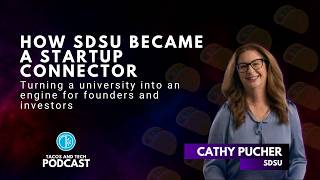
Kathy Poucher, Executive Director of Entrepreneurship Initiatives at SDSU, built the university's incubator and now runs the San Diego Angel Conference Fund 8, a two-and-a-half-month program that trains accredited investors and culminates in a demo day for six startups. She came to SDSU after launching San Diego's first free incubator at EvoNexus, and spent eight years at Texas Instruments investing in early-stage wireless companies.
Chapters
Startups get the party. Startups get the party started. Startups get the party. Startups get the party started. You want tech and tacos, Tacos and tech, you know we got it.
Hey.
Startups get the party. Startups get the party started. Startups get the party. Startups get the party started. Startups get the party. Startups get the party started. You want tech and tacos, tacos in tech, you know we got it.
Hey.
And welcome back to the Tacos and Tech podcast. I'm your host, Neil Bloom, and I am so thrilled to have on my friend, your community leader, Kathy Poucher, the executive director of entrepreneurship initiatives at San Diego State University. Hey, Kathy.
Hi, Neil. Thank you for allowing me to be on this wonderful podcast with you.
Thanks for accepting my invitation. I'm thrilled to have you on. We get to see each other a lot these days, which is so fun. We're working on a lot of things together, and the more the merrier for I. For all I say, because I just enjoy working with you, but also just seeing everything you do, it just. I mean, you're just taking a step for the community first, which is exactly where I sit. And we can tell the community is benefiting from it. So that's for sure. So thank you and thanks for.
Thank you. That is very, very kind of you to say.
Well, it's true. And it all actually comes back to how we met. I don't know if you remember how the first official time that we met was on a panel at Rotary International San Diego Chapter about the San Diego startup community. You, me, and Brittany mailing the. At the time, I think she was the Union Tribune or business journal startup reporter, one of those two. Remember that?
Well, I was wondering whether you remembered that because we haven't talked about that, but yes. And I was shocked that I was just meeting you after having heard about you for many, many years. So that was a happy moment.
It was. And same. I heard about you, obviously, because I had gone through EVO Nexus and you had previously been in EVO Nexus. So anyway, let's take it back. Let's. We got our history here that we'll talk about sprinkled throughout. But I want to hear your history because your history is deep in the roots of the history of tech within San Diego, specifically the hardware community. Both there's local connections and national and global. And I want to hear that how that connection powered you into going so deep into the San Diego startup community, which is helping startups, but now helping a whole new generation of investors who are Investing in startups with San Diego Angel Conference. So can you take us all back? Where does it all start? For Kathy.
For Kathy. I studied electrical engineering at ucsd. I grew up in LA and coming to San Diego for university was very exciting to me. Very passionate about math and chose electrical engineering. I was recruited by Texas Instruments and went to Dallas and five other cities doing semiconductor sales for eight years. So six cities in eight years before I came back to San Diego. When I came back to San Diego, there were some really amazing things happening. One of them is Qualcomm had spread its wings and there was starting to be a lot of spin offs as well as startups. So spin offs of Qualcomm that were startups, but also just companies coming here to be part of the wireless technology community that was starting in San Diego. So at the time there were a lot of Asian companies, I'll use Denso as an example where they were traditionally automotive and other electronics and they wanted to get into the cell phone wireless market and so many other companies just like that. And then there were these startups that were supporting the wireless infrastructure that was being created by Qualcomm. And I'll give another example, widcom, who basically did the protocol that's necessary for Bluetooth when it's implemented between the cell phone and whatever device it's talking to. So there was so much happening here and I came to start and to head up San Diego sales market for Texas Instruments. What we noticed was this incredible creation of a wireless ecosystem really blossoming because of Qualcomm's success. And Texas Instruments wanted to not only have a sales relationship with the community, cause at the time we were the leaders in the wireless cell phone from a semiconductor standpoint, but we also wanted to improve our position in the wireless market. So my team and I were empowered to find companies that not only obviously we could sell semiconductors to, but we could also potentially acquire, license or partner with. And so my entry into San Diego and the startup ecosystem was that first we found widcom and Texas Instruments for our Bluetooth chip needed the software. You had to have the software. You can't have the hardware without the software and our customer couldn't have done anything with it. And so we licensed from Woodcom and we also made an investment. And I was the board member for Texas Instruments for widcom. Hip Fawn was the CEO, actually a neighbor of mine as well. And then the next one was Packet Video was the first to put video on a cell phone. And again we licensed we did sales, you know, partnered in sales with them, but we also invested and I was also that board member for Packet Video. And third, we found a company by the name of Dot Wireless headed up by Rick Kornfel, and that led to an acquisition. So we acquired just under 50 people for quite a bit of money. And that was our entrance into TI's interest into CDMA and then what was known as WCDMA. So that's when I really fell in love with it. We also had at Texas Instruments a venture group, and that venture group was also looking at companies for other reasons. And I would also help with the due diligence and scouting for them as well.
Wow, what an experience.
It was incredible experience.
Yeah. What was. Okay, of all the cities before coming to San Diego, what was the, what was the favorite?
Chicago. Chicago.
Awesome, I get it. And then startup wise, what. What was the first, you know, obviously like, what was the first piece that was kind of attractive about it? Was it the agency aspect or was it trying something new and pushing boundaries or what. What do you remember originally?
That's a great question. I think it was the energy, the dynamic. How dynamic and energized and how quickly they were able to move, particularly if like the take the Bluetooth. That market was evolving so quickly and competition was occurring. But the way that I watched that Hip and his team could maneuver through it, I hadn't seen before because at that point I had been at ti more than 10 years. It's the only company I had worked at since graduating and I had never seen a company move that quickly. And I just was fascinated by it.
I love it. What was your take on San Diego startup community? Was it, you know, how did that compare? Were you able. Were you seeing other cities and communities as well, or you really just seeing kind of San Diego's because you're living here.
So being in semiconductor sales, all roads lead to. To where? Silicon Valley. So I was in Silicon Valley at one point and the thing that is so weird that I found about Silicon Valley is I was warned when you're at the gym or the restaurant, like, not to talk about work or if you talk about work, to be really careful because everyone's in the business and they might use what they hear as a competitive advantage. And it. And it was really. And I worked with the world's largest hard disk drive company and the deals that we were working on were, were really, really significant and took years, you know, to, to secure and, and it just made me like super paranoid everywhere I went. And it made me think before I spoke in any social setting. And that was just very fatiguing. And when I got to San Diego, it was. I know we don't. Back then in May and now we still don't have the density. But I would never think twice about how I speak at a social that that something I'd say could be used against me and the company I represent. I would never. It just feels so. It feels like I work as hard here, but the atmosphere is very. It doesn't have all this noise and static in it.
Interesting. You know, I. We may have come full circle on that or we just still there. I just used that analogy on a podcast recently where you may have a neighbor who you actually never talk about your work with and you just know them as, you know, Tom, my kid's softball coach, only to find out one day accidentally that they're, you know, head of global innovation for Nvidia. But they live in Carmel Valley and they're your next door neighbor. Right. And that's a detriment and a positive. I think in San Diego. Right. It's that I think we put lifestyle and work on exact same pedestal. One is not before the other. Both are equal in the importance.
And so that's such a good way of saying it because if I was in Silicon Valley, there's no way I wouldn't know what they did. Because you just would.
Right before you even shook hands, you're saying, what do you do?
Yeah. And it would be important somehow to the dynamic of that discussion. You're right. You're absolutely right.
Yeah. It's interesting. I don't just found that. I don't know if it's. It's a hypothesis I'm testing right now, but it does feel like I know people's work lifestyle stuff and never enter into work world. It's almost like, oh, you're asking me about work. Odd. Okay. But. Okay, so what was the official jump like? You were getting all this, you know, startup interest, but doing it for big tech, if you will. When did you finally rip off the band aid and say, I'm ready, I'm ready to take the leap?
Right. So my responsibilities grew to across Northern California and I got a taste of other startups in. Across the country that were working on wireless. And so the interest just grew. It wasn't just a San Diego thing and I wanted worldwide responsibility. So I had North America, I wanted worldwide. And the opportunity to stay at TI and do worldwide would require going back to Dallas and my husband and I Did not want to do that. And so I had a very close relationship with the CEO from Packet Video and who. And I knew quite a bit about it. So at that time, I was with TI for 17 years. I knew a lot about Packet Video because I was on the board. I had done business deals with them and they needed a worldwide executive vice president of sales and marketing. And I jumped, I jumped and it was incredibly dynamic. They were actually in their second phase. So they had gone through the dot com bust. They had separated one part of the company from the other. They had moved back into their original dwelling. So they are originally on the GA campus, General Atomic's campus. Then they moved to this gorgeous facility that MP3 had occupied and then moved back and they had downsized significantly and their business model, there were a lot of adjustments. So I was in second phase of their journey and. And I was all in.
Amazing. Never look back. Once you see startups, it's hard to. Hard to go back, right?
Yes.
What ended up happening in Packet Video? Tell us the ending story there.
Well, for me, I was traveling. I was very addicted to my work. I had two young kids, husband, two dogs, traveling, 70% international. I was never home and it just wasn't sustainable. It was very addictive. The, the companies that I was able to work with, employing people all around the world, the kind of deals that we were working on, was intoxicating. But I was never home. And when I was home, all I wanted to do was sleep. And so I eventually quit in not a very elegant way, but needed to pull the band aid.
It happens. It happens. There's no easy way. And the time, yes. Even post, you know, dot com bust, there was actually like a vibrant VC scene in San Diego. Right. You had Mission Ventures and, and, and many others. Did you feel like you were part of a, an ecosystem when you were in that.
Oh, yeah, yeah, yeah, definitely. And at that, when I was at TI in San Diego, I had also joined. So when I was at TI in San Diego, I realized that I wanted to do more and be part of the startup ecosystem in a bigger way than just the role I played at ti. So I joined. At the time it was called San Diego Telecom Council. It now has become comnexus and now referred to as Evo Nexus. And that's when I first started doing the community work because I felt like I wanted a bigger mission than just, well, I'm always on the sales side. So, okay, I'm, I'm always selling something. Let's be honest. That's what a salesperson does. But I wanted to. To grow the ecosystem and contribute in a community way. So that's when I saw the VCs. That's when I. That's when I really saw the service providers. That was something I didn't. I mean huge vibrant service providers and yeah the VCs, angels, everything back then. Tech Coast Angels.
Amazing. Well and I'm guessing in true San Diego fashion, it felt very, you know, like you're part of something and everyone's very welcoming I would imagine just as it's. It's been for the longest time. Give before you get feels like it's always been a San Diego ethos but eventually you got into let's not just build the one the startup that I'm on and contribute to the community, but actually help build the community to make it more, even more hospitable for startups. When did you, you know, kind of feel to go all in on ecosystem?
Well, I, after I left Packet Video just by chance. A couple of very good friends were starting a company and want a startup and wanted me to come over and we were working on it and then I wasn't directly involved with comnexus at the time, but it was rumored that they were going to start an incubator and obviously I knew the organization really well so I went to go talk to them about it for our startup to apply and Rory said well you should interview and, and you'd be great to be our executive director and then you can bring the startup along. So fast forward just in a matter of months, I became the executive director, the first executive director for EVO Nexus when it was just the concept that we would have a free incubator to help the original concept to help serial entrepreneurs cross the chasm which, which is the point that's most difficult in San Diego because of our funding sources and that it would be free and we would support a business model around that, I. E. You know, sponsors and things of that nature. And that was just a concept and I made it as the executive director but the startup didn't keep going.
Interesting. Okay. And I believe if I remember Eco ATM is. Are they known as one of the first startups to have gone through then? Were they involved when you were there?
Yeah. So the ones that you might know that were in the first one or two batch of acceptances. Eco atm, I think it was called Micropower if you remember them, John Cyan and then IO Semiconductor, which is not talked a lot but they have gone on to be hugely successful. But not of public knowledge. And then who was one of the other ones? But there was a series, the guys who did Crazy. Crazy.
Oh yeah, medical. Yeah, yep, I remember them.
It was a, it was a really nice bunch of startups that, that so our. So just so most people don't know this, so we had no space. So a company had a couple months left on a lease and let us move into their space. And, and that's where you would have seen some of the companies that I.
Said that was the Cricket Wireless space.
No, it was before Cricket. I think the guy's name is, it's Bill Unruh, I believe is his name. And his company was a cybersecurity company.
Yeah, I remember him. He's got a insuretech company now. He's done a few startups since. Yep, for sure.
And then Cricket Wireless gave us the entire building with about just under a year on the lease. And then Roy was able to build the relationship with the Irvine company and then Irvine company moved us into the UTC area was the original home. So I left right before the downtown expansion.
Got it. Oh wow. Really interesting. Well there was the birthplace of so many companies and so many startup ecosystem movements even if you will, right? When you put enough founders in a room, founders are going to found, that's for sure. And so a lot happened there and it's pretty cool to have founded the founder movement, if you will, as part of that. So thank you because that obviously helped bring me to San Diego in 2013. A few years later, as soon as I stepped into that downtown space, I literally put my two week notice in my aerospace job and said yep, this is home and moved back to San Diego.
So I wish I didn't have anything to do with the downtown space, but that was genius the whole way it, the energy that it could create and foster true was just, it's insane.
But it was iterative, right? I mean in true startup fashion, it was, you know, your guys's first space which was, you know, a sublease of a sublease probably. And it iterated as there was density of more demand for more space and more founders around each other. So you, you did contribute to that. You kickstarted the domino and honestly, you know, till Covid downtown suddenly became the, the, the center of gravity for startups for a good period of time, which was pretty cool to have in that regard. Simultaneously you went to sdsu, right? That was what, that was what brought you to SDSU from there?
No, so I had helped someone get placed as the CEO of a startup that had come out of TI and the. I don't want to go into the whole premise, but the premise was an incredible. We saw it, he and I, as just a really amazing right place, right time, opportunity. What it really had to do with the smart energy space. And there was a protocol that. That allows for anything in the home that's plugged into the grid to be connected. And I'm not going to go into the details of it, but it was. You know, we had both been part of the smartphone industry from day one and it. We had saw what happens when an industry can really be exponential and we recognize that we might be on the verge of that, but for a lot of reasons it didn't pan out the way that its potential. There's a. There's. Yeah. Well, while it's wonderful that everything could be connected, there's a lot of people that don't necessarily want an open. An open way for anyone to connect within the home. There's a lot of business models that don't want. They want a private connection, not a public connection. So anyway, there was a lot of reasons, good business reasons, why the vision wasn't able to move forward. But as the head of sales there, that was a very tough position to be in. And, and then from there, that's when my very, very, very guardian angel, Martha Dennis called and said they were in need, desperate need, because someone had suddenly left at SDSU that was running the incubator and that there was only one person that could do it, and that was Kathy Poucher. And I needed to get on over to sdsu and I had never been in that part of the city before. Everything was new to me. But that's when the journey at SDSU started.
Amazing. What was SDSU's connection to the startup community at that point?
So what, I'll just use Martha's word. Martha said they needed me because one, the work that I had done at Evo Nexus, but two, I needed to connect them from their island to the startup ecosystem of the rest of San Diego. Now I alone have not done that. There's many people and many reasons why I feel like SDSU is in the heart of it. But at that time 14 years ago, we were on an island and there was a lot of work to be done to foster closer relationships.
I think SDSU was being a typical university is what it sounds like. Most universities are islands and also little fiefdoms of their own that expects everyone to come to them. So it was just doing what it does what universities naturally do yet been around 100 years, I think at that. Maybe 100 plus 1897, right? I guess so 100 and some odd years. So why would they change things that regard. But someone who's seen startups and technology, you're going to certainly change things. So where. What were some of the things that, what were things that you kicked off that now we can see that have kind of brought an SDSU into the community and vice versa.
So first of all, the number one thing I did coming from this sales background was to make sure it was easy to visit sdsu because we are not where people necessarily drive by every day going to and from their, their daily life. So very first thing I did was make sure people understood that they could get on campus, park, get to where they needed to be. They would have someone that would escort, would walk them, whatever we needed to do to make it really easy and make sure that anyone that came would want to come back. I learned that because when I was working in San Diego at Texas Instruments, we had a special rate with La Bearge in Del Mar and so we would get our colleagues from Dallas and Houston to come see our customers in San Diego and we'd have them stay at L BE in Del Mar and with a very good rate and they would say when can we come back? We want to help you with your customers. So anyway, that was one of the first things I did. I couldn't offer them La Be but I could offer them an easy on ramp and off ramp on campus building. The advisory board was really the first thing that I did was to get people from the startup ecosystem to really commit with their time and their donation to working with us on a systematic, regular basis to really think about how we could advance the work that we do and how we could provide the best support to our campus entrepreneurs.
Then that's for sure. We've seen that from speakers, but we also, we've also seen, you know, a lot of prominent, I would say consumer businesses. So it seems like feels like you've seen over the at least a 10 year period. Is that what it feels like? That like a lot of consumer minded kind of startups come from student startups or how do you look at the startup community at SDSU versus, you know, where startups go afterwards.
So you're just starting now to see the blossoming of the research startups coming out of sdsu and those are a different nature. But for the first decade at least in the zip launchpad we saw a lot of student Startups and still continue to see that. And the most successful have literally all come from a student solving a problem 10ft in front of them. An example, shred lights. I fall when I'm skateboarding. Course key. I want a connection with the students that are in my classroom and I'm going to help the professor take attendance when I walk into the class. Same thing so much which is a really great social impact one. I'm at a restaurant, I see that's a sustained sustainability restaurant and I see this grain or rice being thrown out every night. How do I turn that into something that can benefit somebody in some important way? So.
Or blenders. I want better eyewear when I'm surfing or better. Or pura vita. I want better, you know, expression for.
When I'm also surfing, also serving or shake smart when I go in or out at the gym. I want access quickly to my pre and post protein workout. So and then I then yes, it tends to be from a consumer perspective. I don't know if that's a, that's because of the age of the entrepreneur or, or what but that's definitely the trend.
Interesting. Yeah. And I think now from now that we run you know, help run startup programs at the zip launchpad we see a lot of consumer but also a lot of B2B but always around helping something right in front of them. I want to solve the parking problem. I want to solve helping students get the right classes at the right time. You know it's, it's true, it's. I mean I think they're looking for a founder market fit which is this is their world and this is the world that they can solve in which I think we like, we want founders to have founder market fit solve. Why you. Right. Well this is what I know. So I think that's a good sign. That's a great sign that you have founder market fit with. With the founders that are related to that. What have you seen in terms of the needs of the community versus the community? SDSU supporting the community in that regard and helping founders find that.
I think San sdsu. So from in the very beginning when I came to the incubator and it was one year long, the incubator had been established for one year and I came on, I was often asked what do we need to do for these startups when they leave the incubator at sdsu? What should our strategy be? There was often talk of an accelerator or some kind of program that you could tag on to what we were doing at the Incubator but what I observed and the advisory board observed is San Diego is incredibly lucky in terms of the startup support that we have in our ecosystem. And some of it is very broad, like Connect. San Diego has some very broad offerings, but there's also niche or very concentrated offerings like cleantech. San Diego has its own resources for incubating or accelerating. We have Evo Nexus, we have as part of Scripps UC San Diego, there is a BlueTech, something very specific just to. To. Is it called BlueTech?
There's the Blue Tech incubator at the Port of San Diego.
Right, okay. And then I believe Scripps has one also.
Yeah, Start our blue.
Yeah. Amazing. There's, there's Ad Astra, which is. Had historically been specifically for female founders. Just like these incredible resources. What we do, at least at sdsu, is as the companies are nearing, the startups are nearing their exit from our program, we start to introduce and identify the programs that could continue to advance and support them. You don't know this, but we had four companies leave at one time and we rented them space at WeWorks.
That's awesome.
SDSU did so. Or as zip launchpad at SDSU so that they could continue to be together.
So that's conviction and people, you know, it's investing in people for sure, in its own regard, 100% and that was.
The right solution for them. We've had Corski went to Evo Nexus, we've had other companies participate in Ad Astra or be part of Stella and the work that that is done there.
So yeah, yeah, I think it's very much sdsu and I think honestly you're not gonna, you're not going to say it, but I will. I mean, you're super pragmatic at looking at where the gaps and fill in them, you know, in that regard. And that's, that's not typical for most education, you know, and it shows. And I think from a founder's perspective who first got here and you know, had to raise capital within a year. The kind of last frontier, I think that we all ever, a lot of people started working on is local capital. Right. And at one point it was just tech goes angels that you could, you know, could, could go to, but then still really no local capital beyond that. After you got your angel, you know, kind of investment, which is what Sano Venture Group started tackling, right. Bringing investors from outside in, you know, a few times a year, but to actually build a local domestic capital community that, you know, invests local and then recycles into itself. That was kind of unheard of for, for a while. And I would say Misty Rusk, really, I would say, you know, set the, the flag up there. Eight years ago from Sano Angel Conference at USD. What was your take when you, I mean you've seen local capital community, you've seen a few waves of local capital, where were you starting to see and pick up on the gaps that were happening there?
Well, I can just say when I met Misty Rusk about eight years ago and she told me what USD was doing, I was just so happy. I'm like, this is needed, this is so smart. So what is it they're doing? They're training and activating angel investors, investors to be part of this early stage investment community. And I just, I had never heard of a program like that and I was just so glad that it was in San Diego. And we became, we, SDSU became sponsors. We looked for different ways that we could get involved and have our students benefit from it any way that we could. But I was just so happy to hear that program was going to happen in San Diego and be additive to our startup ecosystem. I've been a member of New Fund which came from Tech Coast Angels for about five years. I think that organization is incredible. So if you want to tell people what New Fund is. But I think San Diego Angel Conference, starting with USD as the host and now SDSU is a huge compliment and pipeline really to New Fund.
Yeah, absolutely. So, so Tech Ghost Angels became New Fund. They kind of broke off from the franchise model of different chapters of Tech Ghost Angels in different chapters, which is where I got my first funding back in 2014 for portfolio. And we got I think four, four of the five TCA chapters someone participated, including the group that became Seed San Diego, which then became AD Astra. Really. So Alison Long, Eric Gasser, that whole crew were TechOS Angels members and they were brand new members who said we are a different breed of angel investor. We want to do things and try things. And they pushed TCA in good ways to say let's invest in areas where we have, you know, we know we can be additive to some part of the process because it's hard to get funding for startups for sure. It's hard for startups to even get to even know where to find funding, let alone get attention of an investor because as soon as the world knows your investor, you get inundated with startups. And so just that whole pipeline as you mentioned, is really important for a startup to know that a pipeline Exists and they don't have to fly a few times a year to go get it. They can actually on a daily basis just try to network into it. And so techos Angels really, you know, was great at that of having hundreds of members in the community. Then New Fund, which is. I joined right that time too, as well as a member when they formed the first fund, ACE1, I think it was with. And really it was a shock. I push, I. I blame ASHOK in a good way of attracting a new way of funding startups, an annual fund, as opposed to just, you know, everyone write their own checks. And I think that really pushed TCA to be New Fund, which is a new style of funding startups at the earliest of stages. But like you said, you kind of already have to know to be an angel investor to even know how to join that sometimes, or you need to know a few things. You need to know some of the lingo. I mean, New Fund is very, very approachable and very much helps you learn. And they, they even tell you, hey, take a year before you even write a check. Right? So very much accessible in that regard, but still to even have an even friendlier place up, up funnel, if you will, to learn what is even all of this, what is a startup, what is fundable versus not. I think Angel Conference has rightly taken that place as kind of the front door of someone who could even be, let's call them, angel investor curious. Someone who says, well, I don't even know what that world is, but I think I'm interested in learning to even determine if it's right for me. And that seems to be. Angel Conference has very much become an education series to where you learn by doing, not just take a course online, but you learn by writing the check eventually. And did it from year one, honestly. So I also applaud Misty for doing that. And even with COVID which, you know, did it in a virtual way, still survived and has grown and put, you know, eight, seven years of funds to work now. And this will be year eight, which is pretty cool to have had eight years consistently of writing checks into multiple startups. Take us through a little bit about, you know, history of SDAC and how it's gotten its way to sdsu.
Yeah, let me do that. But let me just make sure this is when I learned about San Diego Angel Conference. The nomenclature is a little confusing. So let's say we're talking about this year. The program itself, the overarching program is SDSU 2026 SDAC, which stands for San Diego Angel Conference. The conference itself is the finale. So if you start with the end in mind, the finale is where after about two and a half months of effort, the decision of how the investment is going to be made is announced and then the top six finalists are showcased. So now you go back two and a half months and what is happening? So there's actually a fund that exists outside of SDSU with this incredible fund manager this year. Who's the fund manager? It's a member managed fund led by the fund manager. And who is that incredible person?
I am happy and honored to have taken that mantle this year as SDAC Fund 8 fund manager.
And that fund manager will facilitate a series of meetings starting in early March all the way through to end of May where you're learning as you're going of evaluating a series of startups, over 100 seeking funding all the way down to the due diligence and the actual decision by the members of how they're going to invest. And prior to that two and a half month period since July we've been getting together monthly over beverages and dinner in a social environment to network and hear different facets of education related to early stage investing. The whole program itself is networking with like minded people, learning about what early stage investment is, collaborating and then actually participating in this fund that exists outside of sdsu. So it's learning by doing. It's really incredible. So we are executing it by USD's playbook. Misty Rusk brought the program to San Diego specifically to USD where she worked about probably more than eight years ago. So let's say the first one was eight years ago, so sometime before that and ran it for six years. And then SDSU last year had the opportunity for 2025 to run it and be the host. So USD handed off being the host to SDSU last year, we ran it and this is our second year. We love the fact, we SDSU loves the fact that it's experiential learning. So everything that is under my umbrella in, well SDSU is in a very experience based learning campus in general. And then the programs that I am associated with for entrepreneurship are all experience based learning, learning almost entirely for campus. And so SDAC San Diego Angel Conference gives us an opportunity to extend the experiential learning into this early stage investor community. And then for reasons that Neil talked about, we're creating more people that are going to potentially help support the blossoming and early days of the startups in San Diego. So it's just, it's just all wonderful. And amazing. And it really fits into my passion for community and SDSU's vision for community. So we're really pleased to be part of it. It's a big list but we're pleased to be part of it.
Totally. It's a huge effort and I think SDAC members know that and feel that though there's such a tight knit community, I would say not tight knit, people love the experience so much that they come back year after year even though they also have learned and have actually gone on to join new fund Interlock Capital Rising partners, their own funds, their own syndicates. They become writing checks just on deals on the side. I've seen ESTAC members go off to many other demo days now like Techstar San Diego and UCSD's med device. You know, demo day like eight years later, the funnel is working, people are learning, deploying capital and continue to. Right. They're not just saying, well check the box on that experience once. Like I think we can really actually see a genetic, you know, chain of new money being put into new startups now. Sure we haven't had exits yet, but that's not startup bill. Startup exits are 10 to 15 years these days. But also the other part that's super interesting is the kinds of deals that are getting funded are broader than you would in a traditional like venture capital firm only. Who might say I only look at, you know, seed hardware only. Well, we've had biotech, hardware, consumer packaged goods, food, tech, you name it, has come through SDAC in eight years now, which is awesome, right? To have had a broad enough mandate to fund great companies. That's it, right? And enable these companies to go off and grow sales, grow jobs and make an impact in their own way. So I can say, already say it's had a huge impact and uh, I feel, you know, honored to be kind of hand, have that baton to say let's, let's keep amping it up this year. Don't, don't not do anything. In fact, what can we do more of? How can we put more money to work? How can we let more startups into the funnel? How do we train more angels? That's what I feel compelled to do because of what's already happened for seven years. So I'm excited about it, that's for sure.
And this year I'm super excited for all the reasons you said, but also because I've been able to hire about. I think it's nine interns, students from SDSU that are just fascinated by this startup investment world and Want to learn more somehow we're going to immerse them alongside the participants in SDSU San Diego Angel Conference and learn and hopefully add value. Hopefully be able to do some of the market research or whatever makes sense. But I just. The fact that there's a student lens to this as well, I'm really excited about. And maybe over time we can amplify that because the learning, the experiential learning that these investors are gaining from week to week, it's really incredible.
It is, yeah. The fact that there's so many, so much happening so quickly is the opportunity to compound that learning so fast. Right. If you were just a student and just, you know, shadowing an investor, I don't think you'd learn nearly as fast as seeing the process of going from hundreds of companies down to six within a matter of weeks. So it's awesome to be given that exposure. I know. Luckily, I think SDSU mastered that internship program during the techstars SDSU program, which I've also seen a lot of success from seeing a lot of zip students have the ability to just help immediately day one help a startup. So I love that. Thanks for doing that. I'm excited to have more of their brain power as well. We've already had it on them helping with the application process. We've been actually been design, redesigning the application based on feedback from past years, both startups and stack members of saying here's info that was nice to have versus this is must have and just kind of prioritizing that. So shout out to the interns who have already been helping on that and then the which which by the way, applications open this week. This podcast is going out this week, putting ourselves on notice. Startups, you can start applying now pretty much. By the time you hear this by going to the link in the show notes here, just click which you obviously found this podcast, you can click the link there and start the process. It is through gust and you probably can't do it in your first sitting. In fact, I know you can't. So go look at it and then go set aside time to, you know, write out your answers, use GPT to help you write the perfect application, record a great video because we in the sense in the end we're investing in you and we want to know you. So make sure that you, the startup founder team is shining through in your application because that's the most important part. Anything else you want to add there?
Yeah, just that applicants can be startup applicants seeking funding can be anywhere from the United states there is a requirement at some point that you are in person, but that information is available at the site that is given and but much of the participation can be done remotely in the beginning at least. It just depends how far you advance. And then if you're interested in being part of the program as an early stage investor, we do have an Angel Academy which is on March 6th and that is a great way to get a sense for the group and to also learn about different facets of early stage investing. And Neil will be the MC as well as delivering some of the content. So and we get to network at the end with applicants. So when you apply, if you're able to come to the reception, you are invited on March 6 as an applicant to the reception to have the opportunity to meet with some of the potential participants for SDAC 2026. Let me think what else people might want to know.
Info Sessions so throughout the month we are doing informational sessions on Zoom. You can come to the Neil and Kathy show live and in person and or watch a recording after where we will talk through what is San Diego Angel Conference. And then we also do a separate one where I walk through the documents and the terms and what does it actually mean to be San A san Evangel Conference Fund 8 member because you are signing terms, you are, you know, making a risky investment. And so we walk through all of that together and we've got a number of those coming up. Those links will be in the show notes as well too. But we want to give you as many reasons to at least get the info to think about joining as well as meet the people. That is you are going to spend a lot of time around other people. And so we've got an event coming up on February 10th, a knowledge learning event at C3 bank where we will be doing a learning session together. So that will be one that I'll be helping lead. We call it an SDAC Investor Meeting, but it is open to the community.
So that's investor. That's Investor Knowledge and Network. Sorry, Investor Knowledge 2026 SDAC Investor Knowledge and Network on February 10th.
Thank you, thank you. We are happy to have you there. To be involved in San Angel Commerce as an investor, you do need to be an accredited investor. And so I would go look that up if you haven't heard that term before. There are just a few qualifications put out by the US sec. And so we always ask that first because we have to be mindful that we have the right audience in the room and we can't you know, we got to be following all the legalities of that. So if you don't know your answer and if you have questions about it, you can reach out to us and we can, you know, point you to ways that you can learn if you are accredited investor or not. So that's one of the areas come to Angel Academy. We will probably discuss that as a deep topic that day as well too. Angel Academy is one of my favorite days where it's like all day learning together, learning by doing, by the way, from practitioners of every part of the investment journey, from stories of how founders got their first funding to lawyers talking about pitfalls that they commonly see to other investors talking about what they're interested in learning and seeing in companies coming their way too. So will be a fun day. Keep all those, like I said, we'll have all them in the show notes, all the dates coming up. Oh, and then capital wise, what do we actually. What kind of, what kind of money are we talking about here on the line? Well, good about. We're talking hundreds of thousands at a minimum. That goes into a number of companies. I think on average over the years, SDAC has invested between two to four invested in two to four companies. It's kind of what it's averaged out. It all comes from one fund. So it's a pooled fund that all investors invest into and then collectively as a group of members decide what to invest in. And so a minimum of $200,000, but is capped at $2 million. And so we'd love to hit that cap this year on the high end and put a lot of money to work in two great companies. So this is, you know, meaningful money at the angel stage. Hundreds of thousands is what we're talking about in two companies. So companies should be applying if that's the kind of capital that you need to take it to the next level, your company and for investors as well too, you have the ability to participate in those kinds of investments, yet not have to write that kind of check, which is really important. Right. You get to have the gravity of making that decision, but not have to write that check directly into one company. You get to write it into a bit of a basket, a portfolio of companies, and you're invested in all of them, which is important because you learn a lot about yourself as an angel. You learn a lot about startups very quickly because you're paying attention to them because it's your money that you're paying attention to. And so I think that's the best part about the learn by doing angel investor style is that you were, you were in. You have the right incentive to pay attention to how did I do as an investor into companies. So it's a great way. Really highly recommend people come out for it. And Kathy, we are going to close up here about San angel conference by talking about food because that is the binder of San Diego is that we all have tacos in our life. That's for sure. Do you have a favorite taco or.
I do want to say in the last many years, I recently had the best taco ever. And it. I was visiting Arcsis Nexus in Tijuana and somebody walked us down the street. Excuse me. To a local vendor, their favorite taco spot. And I don't remember the name of it, but it was best taco I've ever eaten. Now here locally doesn't compare with just the intensity of flavor that I experienced in a few bites in tj. But I am a huge fan of the street taco from Rubio's. It's very simple, it's very flavorful. It's getting very difficult to find at some of the Rubio's that I go to on the menu. But that is, that is a very good, you know, go back and get another one kind of taco for me. But I still have a memory of the first bite of the taco I had in TJ that was pretty phenomenal.
Was that a, was that a pop up stand on the street? Was it a birria stand or. No, it was an actual retail spot.
It was a retail spot. We walked maybe three blocks and there were three of them right in a row that were doing the exact same thing. But we went to the one that was on the end and had seating on the roof, which is where we sat. And I don't often eat pork. I'm just not a huge fan of pork. It was pork and it was delicious and it was simple. Very simple.
Amazing. Love it.
Very. Yes. But the spices and the freshness of the tortilla and the, the citrus of the lime. Delicious.
Yeah. Well, it was Arcus who also brought me to my first street beas spot. Also walking distance to their place too. So they are, they are helping expand our taco horizons. But so. But I would imagine that your answer is the right answer from sdsu, by the way. Ralph Rubio, an SDSU Aztec alum who brought the. I think it's the Baja fish taco was really what he wanted to bring to United States. And he did it still San Diego based company, which is pretty cool and still something I eat every Friday because you bring it for me. So thank you.
My pleasure. And I'm just lucky to get to work with you in so many different capacities, so.
Likewise. Same here as well too. Well, glad to add Rubio's and that random spot in tj, we'll just. That's what we'll put into the taco database. Great. Random spot with rooftop spot. Three in a row. I'm sure if I we mention it, we can get the answer from Dyra and in hell. But Kathy, thanks for being on. Thanks for leading by doing in the community, truly and continuing to do you know what's best for the startup community and the tech community in San Diego. So thank you.
Thank you. And thank you, Neil.
Of course. All right, see you later, everyone. Cheers.
Tacos in techies on smash border Green guacamole quinta countins counting beans Contador quentan frijoles Founders trying to raise some queso la vida San Diego school of rappy rapping fire tortillas round jalapenos in these modern times a craft beer and coffee My coding yoga posse fold the body origami we be surfing coronado eating tacos and el gordo the taco stand in puesto lucha libre and sombrero Got a shout out to cost angels by the ocean watch the sunset La hoya shores Entrepreneurs trying to get funded When San Diego startup week is popping in the summer Oceanside Tijuana esti be full of hustlers from couch surfing to penthouses right on the beach Tech leaders who believe stars are with within reach we interview and founders who be shooting for the moon Hashtag st Tacos with your host Neil Bloom Come on. Startups get the party Startups get the party started Startups get the party Startups get the party started? Startups get the party Startups get the party started? You want tech in tacos? Tacos in tech, you know we got it hey. Startups get the party Startups get the get the party started? Startups get the party Startups get the party started? Startups get the party Startups get the party started? You want tech and tacos Tacos in tech, you know we got it, hey.
It.








