Living in Your Greatness: Building Empires Through Relationships with Jeff Fenster
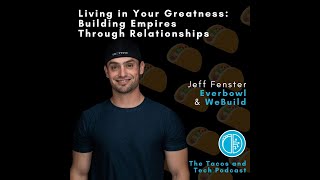
Podcast episode of Tacos and Tech (host Neal Bloom) featuring Jeff Fenster (serial entrepreneur and Everbowl CEO). The conversation traces Fenster’s path from law school through sales at ADP to founding payroll and HR firms, then moving into tech, digital marketing, and consumer food retail with Everbowl. Major themes: the value of relationship capital; problem-driven entrepreneurship; vertical integration (WeBuild construction, in-house sourcing/Unevolved products) to lower costs and scale; lessons on choosing investors and hiring the right talent; and a founder’s mindset for iterating product/operations. The tone is informal, anecdotal, and advice-oriented.
Startups get the party. Startups get the party started. Startups get the party start ups get the party started.
You want tech and tacos, Tacos and tech, you know we got tacos and tech is on smash border green guacamole keep accountants counting beans Contador quentan frijoles Founders trying to raise some queso la vida San Diego school of rappy rapping fire tortillas round jalapenos in these modern times of craft beer and coffee coding yoga posse fold the body origami we be surfing coronado eating tacos El gordo, the taco standing puesto lucha libre and sombrero Got a shout out to cost angels by the ocean watch the sunset La Hoya shows entrepreneurs trying to get funded When San Diego Startup Week is popping in the summer Oceanside, the Tijuana St. Be full of hustlers from couch surfing to penthouses right on the beach. Tech leaders who believe stars are within reach. Interviewing founders who be shooting for the Moon SD TechOS with your host, Neil Bloom. Come on.
Startups get the party. Startups get the party started. Startups get the party. Startups get the party started. Startups get the party. Startups get the party started.
You want tech in tacos, tacos in tech, you know we got it.
Hey.
Startups get the party. Startups get the party started. Startups get the party. Startups get the party started. Startups get the party. Startups get the party started.
You want tech and tacos, tacos in tech, you know we got it.
Hey.
Welcome back to the Tacos and Tech podcast. I'm your host, Neal Bloom, and I am thrilled to be joined here by Jeff Fenster, serial entrepreneur, founder, author, speaker, investor, and most recently CEO of Everbowl. Hey, thanks for being on the pod with us.
Thank you for having me. Super excited and I love the intro. Thank you. Now I need to eat a taco.
Right? Well, we shall do that soon.
Yes.
It's really great to have you on the podcast. Both of us being on both sides of the mic here, which is pretty fun. We've gotten to know each other just recently over a few events and joining our networks a little bit, which we love here in San Diego. So thanks again for being on.
Well, thank you for what you do. Being a San Diego born and raised, local, you know, we're the largest small city in America and it's nice to see that our community is doing more and we're building it and you're leading the charge and what you're doing. So thank You?
No, but it's really, it's confined effort of all of us. We easily could just like, put our blinders on and build our company.
Right.
And you've all done that at times and you need to. But at some point you also say, you know what, someone helped pull me along. I should reach back and do that too. And I know you do that with students, which we're going to talk about in a second as well.
Sure.
But where did it all get started for you? Like, do you come from an entrepreneurial family? Is that where you just expected this would end up for you?
No. Dad was a doctor, mom was a teacher. Jewish family. And I was told growing up, you can do whatever you want as long as it's a doctor or lawyer. Pick. So, went to high school, went to college, went to law school, went to law school to be a sports agent. Thought that was my path. And my third year of law school ended up meaning the woman who's my wife. And we, we have a daughter. And when I graduated law school at 24 with a kid and a fiance, I decided I didn't want to pursue sports agency. Even though I had a job with Lee Steinberg Sports Agency and I didn't want to travel around representing grownups. It's a full time commitment. You're gone a ton of the time and you're building someone else's life, and I just didn't want to pursue it. So six figures of law school loans and no idea what I wanted to do.
Oh, man.
Yes.
But I'm guessing if you want to be a sports agent, you must have been a lover of sports.
Huge, huge lover.
And was this one way to just be around pro athletes? Was that a piece of it or what was the original inkling to be?
Yeah, I wanted to be a pro athlete.
Okay.
And I was good, not great. And I don't have. I'm 5 9, £175, so I'm not this amazing stature either. I was fast, but not big enough. And so I couldn't play. And so I felt like, okay, if I can't play, maybe I'll coach, maybe I'll be an agent. And I didn't really have an in with coaching. I had an in through being a sports agent. I love Jerry Maguire. I love the idea. Drew Rosenhaus, his book A Shark Never Sleeps was one I read in college. And it, it just, I love the story. I just love the idea of being a sports agent. And you get to go to all the games for free.
Yeah.
You get to Be around the athletes.
You're.
You're part of it. And you're trading in the currency of athletes and helping them expand their wealth. And I thought that was a fun way to use this law degree and still be part of the sports and match my interest and passion with my career. And so it just seemed like the natural place for me. When I graduated college at 21, which was a year I graduated in three years.
Yeah.
I wasn't sure I was gonna get into law school because law school likes older, older kids. Mid 20s, established. And so the average age of admittance to law school is like 25, 26.
Yeah.
I'm 21.
Yeah.
So I applied to law school and actually enlisted in the Marine Corps at the same time.
Whoa. Yeah.
And my job was going to be special police, and I was going to stay in the United States. And I figured if I can't. And I was thinking a few good men, like, if I can't get, you know, they'll pay my law school and I'll. I'll get to the Marine Corps. Because that was the other way to get into law school. And I told the Marines if I got accepted to law school, I was going to law school.
And I did.
I got accepted to two law schools out of the five I applied to Barry Law School in Orlando and Miami and went to Miami. Was there one year. 21 in Miami alone was a waste. Lonely. Well, I, you know, I didn't even go out that much because I didn't have many friends because all my peers were much older than me and I was homesick and I didn't like it. I liked Miami, but I didn't like being the dog. Days of law school is tough.
Yeah.
And what's really hard about law school is you're competing against your peers. Everything's graded on a curve. So if there's a multiple choice exam and there's 10 questions and there's 20 kids in our class and 18 of them get nine out of 10 and I get eight out of 10. I don't get a B, I get an F. Yeah.
Wow. Yeah.
Which makes it hard to have too close of friendships.
Right.
But I was also just turned 21, so I'm not even in the same mindset as they are. And I was, I'm a young looking guy, so I looked even younger. I look like I was 17 when I went to, when I went to law school. And so I was like, I'll come home and do it in San Diego where I have my social circle, my Peer group. So I transferred. I finished top 10% of my class year one and transferred back to San Diego.
Okay.
But then eventually realized, you know, you're taking your. Your skills to a different beach.
Yes.
Not South Beach.
Yes.
Where?
Where?
I mean, how'd you. So you immediately realized at some point, legal is not for me? Was that. How'd you feel? Well, you feel like you failed? Or did you feel like I just got a new lease on life?
Actually, it's kind of weird. I always had this. I call it. I have it coined now as entrepreneurial add. But I never could see myself doing one thing the rest of my life. And back in, you know, the 90s, when I was in high school, that was a death sentence. Like, professionally, everyone's like, you got to find something, Jeff. Like, yeah, I was. You know, I had like 11 jobs in high school. Oh, I'll do this. I went to college, and my first major was business. I switched to another major. I finished with regional development, which was real estate. I was like, I'll do real estate now. I'm going to law school. I'm going go to Marines. Like, I couldn't identify it. And my third year of law school, I knew I was going to be a sports agent, but I was still a certified intern at the public defender's office, and I was representing people for misdemeanor crimes. And I knew then I didn't want to do that job, but I did it for a year. So I got a taste, and I just came out and I was like, you know, I have a law degree, which is kind of the same as an MBA. You look at the majority of CEOs and politicians, they either have an MBA or a law degree. So I knew I had options. Like, I wasn't like, if I don't go to law, if I don't practice law, I'm a failure. I didn't feel like I had a new grasp on life either, because I had no idea what I was going to do. And a friend of mine, Tracy, she was a sales rep at adp, selling payroll. And I was always good in sales. And she's like, hey, you got to start making some money while you're figuring out your life, come work at ADP and make some money. So I did. I got a job, and I was there six months. That was the 10 year of my career. And first six months, though I made President's Club, was the number one sales rep in the country out of 2,000 sales reps. Worked two and a half days a Week, played golf, raised my daughter, built, bought a house, my first house in Miramasa. And I was 24 and I thought, hey, I'll work here forever. This is great. This is easy. And I had earned a $17,000 base pay increase. I was making 38,000 a salary plus commission. Not a lot of money, but if I sold this amount, they were going to bump me up to 54,000 base. So in January of 08, I went to my boss and I said, listen, I hit the goals. Give me the base increase. And they said, you have to wait to the end of the fiscal year. I was like, okay, six months later, yeah, fiscal ended in June. I'd get it in July. I'm like, why do I need to wait?
Yeah.
And they're like, well, it's an annual goal, and we're built on an annual, you know, fiscal calendar, and we give you a new contract every year and you got to wait. And I'm like, well, that doesn't make sense to me.
Yeah.
And I'm not a rule breaker and I'm not anti establishment, but I am anti if you tell me something or I believe it, like, and I do it, give me what I deserve.
Yeah.
So I went home and I just. Then I felt like a prisoner. I felt like the rest of my life I was just going to be arbitrarily waiting for some date in the future when somebody tells me I get to have what I earned.
Yeah.
And that's like the biggest demoralizer for me personally. And so I told my fiance we had just moved in our house two and a half months earlier. And I said, I want to quit my job, I want to sell the house, and I want to move in with my mom and dad and start my own payroll company. She's like, well, you don't know anything about payroll, about running a company. Back then, entrepreneurship wasn't a word.
Right.
This was more business owner days. You're a business owner or you were an employee? I said, well, yeah, but I know how to sell it. Look how good I am. And she's like, well, I support you if that's what you want to do. So I went to work the next day and I said, if you guys don't give me my money, I'm going to quit. Truth is, I tell this story and it sounds that simple. I thought for sure they were going to give me the money, so I had her support. But, like, I even told her, I'm like, there's no way they're going to let me quit over 17 grand.
Yeah.
I mean, they paid me a quarter of a million dollars in six months based on my commission. So you know how much money I brought in?
Right.
We're talking 17,000 spread out over 12 months.
Right.
To ADP, one of the biggest companies in the world, I'm the number one rep. No chance. They looked at me and they said, there's the door.
Let you walk.
They let me walk.
Wow.
Which was an ego. Smashed my ego.
Yeah.
And I went home and I was like, well, we're selling the house and we're moving in with mom and dad. So I did, and I started my first payroll company out of my mom's kitchen with a buddy called I Checks. And the whole premise was go back and do exactly what I just sold. Sell small businesses, payroll and HR services. And that was how I got into entrepreneurship. Was really over $17,000.
So in a sense, you got paid to learn sales a little bit at adp.
Right.
So you got paid to learn.
Yep.
As opposed to the college where you're paying to learn, kind of. So, you know, it's kind of a cool learning experience. It's just like getting paid to learn new skill sets.
Yeah.
And then saying, all right, I've mastered that skill set. I'm going to take it, put it in my pocket, and go forward.
They do teach. I mean, for all the things I'll say bad about adp, they are great organization and they're a great training platform. And if you need sales reps, go poach them out of adp, because they are a feeder for that. And those reps go on to be incredible. They teach models like 55 and 2, which is make 50 calls a week, set five appointments, close two deals. It's math.
Yeah.
It's simple. Like, you can start to understand how formulaic success can be in sales if you follow the script. What you learn is most people just don't make the 50 calls.
Right.
So all you have to do is make the 50 calls. And that really bodes well for all of my future sales. And I was able to, more importantly, and as it works through my later career, I also get to meet business owners. Like selling payroll is. I'm meeting business owners.
Yeah.
It's a reason to get in the door.
It's a reason to get in the door.
Yeah.
And it also is a reason for me to be touching them every two weeks.
Yeah.
And that's really cool when you're trying to build relationships with business owners. And it served my later companies. And it's Kind of like weird how if you plot individually, you don't see a connection, but when you connect all my companies, you start to realize, oh, that makes sense. It's like a picture of how I've used all the different experiences to do the next thing.
Absolutely, yeah. I mean, why relearn everything from scratch? You know for sure you got like, you're building up this cheat code pamphlet.
Yes, for sure.
As soon as you started your first company, were you hooked? Were like, I was meant to do this. Could you tell or was it. Dang, this is hard.
It was dang. This was hard. I'll tell you a funny story. So me and my partner, we, we had quickly sold a bunch of clients. So I think we had 20 clients out the gates just from my. All the sales we had. So it's the very first payday and this was pre YouTube days. Like, this was 08. So, like, there wasn't this lot. I mean, YouTube might have been around, but it wasn't filled with the library of information. And using the Internet to learn wasn't programmed in us yet.
Right.
So wasn't a verb to go Google it.
Correct.
Yeah.
And we printed more paychecks than we did direct deposit. So you can think about how banking was done. And we have all these employees that are gonna get paid. We bought our printer. I borrowed 20,000 from my mom and dad. They were our first investors. And we print out all these checks, we deliver them. We're sitting in our office, we're high fiving, like, mission accomplished, first payday. And then the first phone call comes in. Hey, Jeff, this is Debbie. Johnny is at the bank saying there's a problem with his check. Like, it's weird looking up on our side. And then the next phone call, the next phone call, the next phone call. What we didn't know was that banks use a kind of ink called micro ink, and there's a magnetic stuff in the ink. So people like us don't just print paychecks at home. So we gave everybody fake fraudulent pieces of paper and told them to go cash them at banks. And that's not a good thing when you're a payroll company, when the employees aren't getting paid.
No, this is your business. You should be owning this.
Yes. So that was our first foray into entrepreneurship, was we gave a couple hundred fake checks to people and blew up our very first payday. So we solved it by going to the bank and making cash deposits in everyone's account and getting their account numbers, which fortunately we were able to reverse engineer through a lot of time and pain and we saved the day and learned something very important which is Micro Inc. Yeah. So we bought MICR Inc. But from there it was what I what I attribute entrepreneurship to truly is problem solving. I think of it as completely just the amount of problems you have to solve. And if you keep solving them, you build great companies. And once you've done that, you're extremely successful. And I love problem solving. I like the challenge of what are we going to do and how are we going to figure it out. I like the stress which is weird but I actually do. I like the sucker punches. I don't like when it's optimized. That's actually why when I said entrepreneurial add the reason I can't be a lifer is because companies grow to a size where you're now playing in the margins. It's about optimization. You're not trying to break things. You're not trying to innovate and disrupt. You're actually trying to just scale and optimize because that little optimization could be hundreds of millions of dollars.
Totally.
Like Google is not going to reinvent how the search engine works today. They're just fine tuning it and the behavior that's at that point there's a different skill set. That's not me. I'm a startup guy.
Yeah.
I'm a. You and me are sitting here. We want to figure something out. Let's go. And from here to scale where all the real problems are just compounding.
Yeah.
That's there I have that's music to me that that chaos is where I find joy.
Totally agree.
Yeah.
You're trying to optimize your own like processes of problem solving. Right. So eventually you're writing the playbook. Once the playbook's been written pass it off. Not for you anymore as well.
Correct. I still like to be involved for sure. But I'm not also what I've come to realize and I mean this for all entrepreneurs. You have to do a inventory of your own skills.
Yeah.
I'm not the best person anymore. So at Everbowl we recently hired a brand president Trevor since he's come on we've grown exponentially because I took us as far as my but I as I could and be the best at it. Yeah but I'm not the best president for a company of ever both size anymore. And lose the ego about that. It's not doesn't make me less than yeah. It makes me clear on where I'm great. And if you can Live in your greatness. Success is guaranteed.
Totally.
It's when we try to be what we're not. And I understand, like, if this is your baby and you want to see it through, I had that. I had a company that I was in charge too long and I cost the company, my shareholders, a ton of money. And so it was through learning where now it's like, no, I want to grow and scale and through vertical integration and other things, I get to continue to do that in my own companies so I don't have to leave and go do something else. But bringing in that talent around me is also the fun part. I get to recruit and build culture. I get to watch other people take an idea that I might have started and see where they take it.
Totally.
And they take it places I couldn't even imagine.
Yeah.
And that's just inspiring.
Yeah.
You're a talent scout too.
Yes.
As founder, CEO, you're always looking for the great talent to replace you.
Right.
And then you apply your value to the next place, next problem that needs to be solved.
Correct. My goal is to build the company to a point where I don't have to be there and it doesn't break.
Totally.
Then I've done my job.
So where you were starting this first company, you said you're a business owner selling other business owners. Were you tapping into the brain power of other business owners would be like, hey, I'm like, you like what? Tell me what you've learned.
Yes. So I. That was part of my solution. Based selling is how I sold and I sold by making friends and understanding your problem. And so once I had all my clients, I started my company In January of 08, right before the Great Recession. So my timing was impeccable. But I used to go talk to my customers and I used to say, what are your biggest I. Every time I'd meet with one of my business owners and I'd meet with them once or twice a year, I try to, and I'd say, you know, hey, Neil, what are one of the two biggest challenges you're facing right now as an organization? And I asked because I want to understand, is there commonalities? What can my company do to evolve, adapt, and make sure that we are staying sticky?
Right.
And what I kept hearing in 08, 09 and 10 is we can't hire people. The unemployment pool is so big that sorting through those resumes is a full time job. Recruiting agencies are expensive and no one's leaving jobs right now. Because if you had a job during the Great Recession and unemployment was so high, people were scared to change jobs.
Yeah.
So I was like, okay, well, we had just hired. At this point, we had switched from ICHS to Canopy hr and we changed our business model from payroll to building a single database. App driven HRAS platform using technology, bringing technology to an antiquated ecosystem where things were still in the filing cabinets and HR managers had paper applications. And if you changed your job, it didn't update in the four different systems and no one knew what the real information was. We did, we used technology and tried to bridge that. Well, I'm not a coder. And so it was, you know, where can I focus? And so I started a recruiting agency and my job was if you joined with Canopy hr, we did your recruiting for free. You have to pay us. And what was cool for us was now I wasn't. Oh, well, you're happy with your payroll company. Well, who's doing your recruiting?
Yeah.
You're paying 20% of their annual fee. What if I do it for you for free and I vertically integrate my people that I'm paying anyway and they get to do it for all my companies, My clients, We had thousands of clients. So it didn't cost me much per client, if you think about it. Amortized.
Yeah.
And I don't have to make money doing it, but it made it much harder to leave. And if we screwed up your payroll. But I got you an incredible coo, you're not leaving.
Right.
You're happy still, like, we'll figure out how to solve that.
Yeah.
And so during that process and through asking those questions. Yes. That's how a whole nother company that I was able to exit from was formed. And that taught me the importance of always talking to your customers. They're the ones who will tell you what you need.
Right.
I don't know what you need.
Right.
I really don't. I do. Well, I say that one of my favorite quotes is Henry Ford. So if I asked them what they wanted, they would have said faster horses. He is not talking about clients, he's talking about customers.
Yeah.
The customers don't always meaning the customer who's buying a widget, not the client that you're providing a service to. So if I'm disrupting like iPhone. Yes. You have to create that for me because I can't see the vision. But for businesses, if I'm providing you a regular service, I need to serve you. To serve you. I need to know your problems. That's why I need to understand I might come up with A new innovative way to do it, which you're unfamiliar with, but that's why we ask. The question is, what are the problems and how can I help? And as an entrepreneur, if you stop thinking of yourself as this person who has to have every answer and start thinking of yourself as a problem solver. Yeah, the map is there for you.
Huge. Yeah, well, we'll get to that. On investing a little bit. Like the people who have just built something and haven't figured out customer yet versus the other right people who are just in search of what the problems are. For sure. What a way though, for someone who has professional add, as I do as well too, to go and see what a whole bunch of other businesses are doing right on the wall a little bit and be like, oh, wow, your business does this, your business does this. And then to vertically and horizontally build services for them to one get to spend more time with them, but also solve their needs. That must have been really fulfilling.
It was. It's extremely fulfilling for me and it gave me my purpose, which is I turned what could have been my greatest weakness, my lack of ability to stay committed to something for that long, into my greatest strength, which is my ability to create startups and vertically integrate multiple startups and have multiple businesses. Yeah, it was lucky that I was able to connect those dots. And I say lucky because a lot of times people are afraid of our weaknesses, so we put them under the rug and we only focus on our strengths. I do the opposite. My strengths are my strengths for a reason. I don't need to hone those. I want to work on my weaknesses. I'm not embarrassed, I'm vulnerable. I understand that I'm not the, the best at a lot of things. I'm not scared to admit it and I'm good with it because I just want to get 1% better every day. And if I work on them and I say, you know my weaknesses, I can't stick to anything. Well, where can I turn that into a strength? How can I make that what is currently a negative into a positive? And as an entrepreneur, if you're entrepreneurs or your founders, my strength is I know how to start companies, I know how to take that risk, I know how to scale, I know how to do those things. That's my strength. So turn the weakness of Jeff, you've been at the business for five years and it's outgrown you and you don't want to stay there into how can I help grow my main business with another business? Yeah, how can I help My main thing. It's still my main thing. The recruiting agency was to help my main thing. I just wasn't running the main thing anymore. I was running the ancillary. And oh and behold, both sold.
Yeah.
That's fun.
Yeah.
Was it a whole level of complexity when you started making a tech business?
Yes.
Okay.
Oh, yeah.
Because building product versus just kind of selling a service, Whole different thing.
Equity. We had two private equity firms behind us, Innovate Partners and Claritas Capital. And luckily they had a lot of resources in that sector, in that space and relationships. And we were able to partner with companies and white label certain components and start using Bolt on technologies and combine them into our own ecosystem so we didn't have to code everything from scratch. Yeah. And that's something that I recommend everyone also think about, which is you don't always have to build from scratch. You can use Bolt on technology and say, hey, they're really good at this. And companies do this all the time. I mean, you think about Chase Bank.
Yeah.
Wells Fargo. I mean, Plaid is a. Is a company that simply integrates with existing banks to bring your money and prove that your bank account's there for a third party application. So the third party application doesn't have to build Plaid, they just use Plaid.
Right, right.
Totally.
And then when you start to do that, it's less scary.
Yeah.
It's less intimidating.
Yeah. Well.
And smart of you to have, you know, a capital provider who had that kind of resources too, who could connect you with that.
Correct.
It could have just been dumb money. Right. As we say, which is just a check and disappeared. And hey, come back around when you've made us a 5X. No, they're a partner and they helped you out.
The hardest thing I did as an entrepreneur is I turned down the first check I was ever offered. I love the gentleman. Craig Georgi. He since has passed away, but he was one of the founders of Polk Audio.
Oh, wow.
And I flew to St. George to. Not St. George, to salt Lake City. And we drove to Park City, Utah to meet him and he offered us our full ask of our payroll business. And we went home and I had another meeting the next day with. With Innovate Partners, which ended up being our private equity firm. And they offered us a worse valuation and less money than we were asking for. And we took that one. And we took that one because me and my partner were sitting there talking and we're like, okay, we're going to get money from either of them. Which one is going to help us the most. Because the money is money, meaning it's physical, I need it, I need to use it. But it doesn't come with instructions on the money itself. It doesn't tell you how to spend it. Correct. So the professional money. Well, I loved Craig. He didn't have the time. He said, look, I'll write you guys a check and just send me updates when you can. Like, it was that easy. And to a lot of young entrepreneurs, that's like, oh, that's great.
Yeah.
No oversight, no big fault, no big mom or dad overlooking my shoulder. Like, give me money, let me go.
Yeah.
But with Innovated was like, we have an entire ecosystem. We have a financial department, we have an HR department, we have a legal department. We have a portfolio of companies that you'll be able to sell into and lean on and learn from. And at first we're like, well, that seems like a lot of oversight. And it's a little unnerving for 24 year old entrepreneurs that we don't want to be told what to do. But at the same time, it was also the secret. It was a recipe, it was a roadmap. And they're now invested in our success. And yeah, I think we made the right choice.
Yeah, I mean, they're doing all the things that aren't unique to you, you know, and what you bring. And they just take a lot of the headache out and, and come with probably wisdom because they've done this before as well too.
100. I mean, look, there's teeth in those deals.
Yeah.
And we got bit. And there are things I learned that I didn't like. And they took more of the company over the years because they were smart and sophisticated. And I got my MBA through the school of a little bit of hard knocks going through professional money for the first time. And you can't get mad at sharks for being sharks. A shark's gonna bite. It's a shark. That's okay. I mean, Shark Tank is Shark Tank. You can't expect them to give you their, you know, they're. It's a tough deal you're gonna give.
Yeah.
It's a business relationship. There's a negotiation. You know, you're not.
Yeah.
You're on other sides of the table sometimes.
Correct.
Yeah.
But it was still worth it. I wouldn't go back and change any of it.
Did you have a mentality that I'm building to sell at some point?
Always.
Okay.
Especially when you took money. I guess now you thought you had to return money to someone too of course.
And I always did.
Yeah.
I was never in love with payroll.
Right.
That was never like, I just had an, that was just opportunity. It was just, I know how to sell this. And I have, you know, hundreds of clients from ADP and I can systematically go back to every single one of them because I don't sell adp, I sell myself.
Right.
And that's true when you're raising money.
Yeah.
If I was going to sell you, it was always like, hey, Neil, I'm Jeff. I'm going to provide services and solutions to help you. If what I have doesn't work, I'm going to make sure you're taken care of and I'll walk you back to a competitor. I know them all. I understand the system. I assure you that if you do business with me, you will end positive whether or not I'm the one who's actually doing the work or not. And I lived it, I meant it. And I made friends with them. And what I did would, I think others need to understand is I started to build community. So my peers in adp, everyone says, how are you so successful so fast? Because everyone else was selling one to one, they were calling business owners, hey Neil, we'd love to do your payroll, you know, at your, at one of your companies. And I was like, well, that's a lot of work. So I started to pull together what is like minded services. And I realized every business has a bank banker, every business has a CPA or a bookkeeper, and every business needs insurance. So we partnered with bank of America. I went to the new business banker in all the different communities and I said, here's the deal. When I go to a new company that is starting up and they come to me for payroll and they don't have a bank, I'm going to introduce them to you, Mr. And Mrs. Banker. And I went to the bookkeepers and the CPAs in those territories and I said, when I have a client in La Jolla, I'm going to bring them to you. If they don't have an account or a CPA from Mr. And Mrs. Insurance Agent, when they don't have workers comp and general liability and all of the different insurances they need, I'm going to bring them to you. And in each community they were the person I went to. So if you had a business in La Jolla, I brought you to my La Jolla business banker, my La Jolla CPA and my La Jolla insurance Agent. And I started spending my time saying, if I can get One customer. I can get four. Four people clients. And I always would lead with, listen, I recommend you use Jose at the bank of America in La Jolla. I recommend you use Sally at this CPA firm. I recommend you meet Johnny at this insurance agency because we work so well together. It's going to be seamless for you.
Yeah.
And I'll even save you a little bit of money because it's integrated.
Super smart.
Smart.
Yeah.
So what do they do in turn? I'm the only one bringing them business. So everyone who went in to open a new business checking account who didn't have pair, who do you pair with? Nobody. Talk to Jeff at adp.
Course.
Talk to Jeff at adp.
Yeah.
Talk to Jeff at adp.
Yeah.
So really quickly I got all this business and I had four sales reps working for me and I didn't have to pay them.
Right.
And that's why I was able to do it really quickly. So I did the same thing at a bigger scale once it became my own business. And that's why I was like, well, I can do this.
Yeah, super smart. And then you went on to other areas. You went into marketing.
Yep. So sold in 2011 and 2012. Tried two companies in 2012 that were my bigger, bigger failures. One was the equity circle. We talked about offline, but it was to legalize equity based crowdfunding and build a marketplace for it. We helped legalize, but the marketplace, we were unsuccessful in it and lost a bunch of money, which was okay. And then I had a company called J Capital where I actually worked with entrepreneurs to help introduce them to money as a business. As a business. Yeah. I mean, it was all about crowdfunding because I. I had a little distaste from private equity for a little while. And it's. It was a little bit of immaturity on my part. But the short answer was our revenue was growing and in parallel, our expenses were growing. And we kept making capital investments into more people and more processes, and so they grew simultaneously in parallel. So we kept running out of money. And our private equity firm would say, well, listen, we love the business. We're growing. We'll put in the money. Do you have your share to put it? Nope. We'll have to dilute you. And I just kept getting diluted a little bit and a little bit and a little bit until I lost more of the company I wanted to. And when we sold, I didn't have as much as I wish I did.
Yeah.
And I used to think I got taken advantage of. I Didn't I got an mba. It was great. I made money, I built a company, I had an exit and I learned a lot. Yeah, what else can you ask for?
And then you want to be on the other side and be like, well, now I could make. I could be the capital provider and.
I can help them. Yeah, right. And so my J Capital was to help navigate that and help them raise money. So that was a. It was good business.
It.
When I say fail, it just didn't amount to what I thought it was when I started it. And that's when I use the word failure.
But it's also a tough environment. Just there's so much regulations that just really put barriers up for new ideas for capital.
And I was young still. I mean, I was only 28 and 28 years old again. Young looking. 28 year old. I mean, I barely could grow a mustache or a beard. And I just didn't have the right mindset at the time. I started a few other little businesses. One was a sports investing business called Sports Investing Systems with algorithms. And we built a community online. And then I realized my youngest was born and I said, hey, I want to work from a computer. So I started a digital marketing agency and that was my next successful business. I ended up partnering with Neil Patel and we helped a lot of, you know, some of the biggest websites on the planet. It was really fun. Got to use a lot of the technologies that he built or co founded kissmetrics. Hello, bar Crazy Egg. We really got to go and dive into how people interact with websites. I don't know much about computers, but I knew enough to be able to do the sales side. And when I mentioned it all works. If you go back to what my past was with my payroll and my recruiting, I knew thousands of business owners around the country at a time in 2012 when businesses were still migrating from offline to online. And really quickly, it was, it was just evident that there are so many companies that don't know how the Internet works. Yeah, they don't know how to transition offline sales from catalogs to online sales. And we, Neil, had all the tools so we could really get into the behaviors and the habits and how people interact with the websites. And with minor tweaks, conversion rate optimization and basic SEO tactics and ppc. Once we figured out the funnels and the role and how the website would work and even the colors, you know, because Crazy Egg, which is one of his technologies, is heat mapping technology. And heat mapping is where you, your eyes go, the mouse goes and we would really quickly see where people's eyes were navigating on the website and put call to actions there.
Right.
It's amazing what that does to revenue over scale.
Yeah.
And so we were able to make immediate impacts, and we generated a ton of money, had a lot of fun. And then in 2015, the Internet was becoming much more prevalent. And what's fun about the Internet is the younger you are, the more sophisticated you tend to be. And we got a little lazy and older, and Neil was speaking a lot, and I was doing a lot more speaking myself. And he wanted to spin up Neil Patel Digital, and I wanted to get into something else, and it became too optimized for me. And so he went off and spun up Neil Patel Digital with Mike Camo and a few others. And I took some time and spent some time with my family, and I was driving my wife and kids crazy, and they said, go do something. You're driving us crazy. So I started my. My passion project, my hobby, which was ever bowl. And it was just a mission. I'm big into health and wellness, and I thought I could help solve the crisis in America of why we're killing ourselves. And you look at heart disease, stroke, obesity, cancer, diabetes, hypertension. 80% of them are delayable or preventable with lifestyle change. It's science. The medical research is out there. So 20% are gonna happen. But 80% can be delayed or prevented with lifestyle change. And those are killing us.
Yeah.
So I'm like, well, okay, lifestyle change. What does that mean? Move your body and eat real food. All right? I can't make everyone.
You.
You can't outwork a bad diet. And we eat every day. And I can't get everyone to exercise because people are busy.
Yeah.
But I can change the fact that the average American eats fast food 3.2 times a week. I can say, why is that happening? And so I did. And I did some. You know, you did some research, and I started asking customers and doing kind of what you did with. With your company and started saying, okay, why do you. Why do you. I went to McDonald's. Why do you eat McDonald's? Why don't you eat soup Plantation.
Right.
Healthy eating doesn't taste good, doesn't fill me up. Can't get it. Cost too much money. Those are the. Basically, those four excuses summed up 95% of the results. Okay, so Everbowl was built to be affordable, filling, delicious, and accessible. There was my roadmap.
Yeah.
Make healthy food. That solves those four things. And I can get People to eat healthy more often, and I can do my good part. And so that was the birth of Everbowl. And I knew nothing about restaurants. Oh, man.
You just built a whole. You built multiple businesses around serving. The business owner learned every aspect of that and, you know, yeah, why not go solve a new problem?
Yes.
Which is the general consumer. Which is a whole nother thing being B2C.
Well, it's funny, right? Because I'll never forget the dinner. I'm with my mom, my dad, my two kids, and my wife, and I tell them I'm going to start a restaurant. And my mom goes, are you nuts? You don't know how to cook. My dad goes, are you nuts? Nine out of ten restaurants fail. And my wife piled on and just said, all you do in the kitchen is eat and make a mess. And I was like, you're all right. But why do nine out of 10 restaurants fail? And this is so paramount. Like, this is the number one thing. If you remember anything that we talk about this episode. 9 out of 10 restaurants fail because they're started by chefs. And think about that. They're not business owners or entrepreneurs. They're chefs, which means they're. They're tacticians. Plumbers start plumbing companies, dentists start dental practices, lawyers start legal practices, painters start painting companies. Business is the same regardless if it's a restaurant, a payroll company, a digital marketing agency, it doesn't matter. There's. You have to make more money than you spend. You have to control cost. You have to build culture, you have to hire. You have to identify a target market. You have to figure out what product or service to give them. That's the same. So my quote is, experience is the most overrated prerequisite to starting a company or being successful. Because I don't need a chef to start a restaurant. I need someone who understands business. If you get both, that's wonderful. So chefs should go learn business or partner with someone who does. And business people who want to start restaurants should hire a chef or partner with a chef.
Right.
Makes total sense. Yeah, but I can be successful in business, in any industry, without that requisite tactical experience. I didn't know how to use a computer when I started a digital marketing agency. Neil did. I know how to sell and grow, and together we built it. Yeah, right? Co founders is great. That's the beauty of it. With the restaurant, I just knew, like, I could hire a chef, I could figure out the food once I understand what prime cost means in restaurants. You know, food and labor has to be 60% or less. Great. That's a formula. So my food costs and my labor has to be less than 60% and I can make money in restaurants. It's a golden rule. So now when I built the menu and we were doing menu ideation, they said ideally you want to keep it under 30%. So cool. If we're going to charge $10 for a bowl, $3 is the most we can spend. What can we put in it? And we just went backwards and we built it. And you'd always adjust and pivot and change and adapt. But that's what is exciting to me, is why I like new industries. You know, I have a construction company. I don't know how to build stuff. I have a product manufacturing, importing company. I have a studio. I'm not an engineer. I mean, Eric Hanson designed our studio. And all that stuff is fun for me because it's brand new startups, brand new problem solving. And I get to learn new industries. I get to be around smart people and partner and use my relationship capital to surround us with cool people.
Yeah.
And vertically integrate them into whatever the main thing is.
Okay, we got a lot to unpack there, so.
Sorry.
No, it's great. Just so many learnings there. But I want to do a softball question.
The.
Has the food ever changed from Everbowl? Was it. Has it pivoted big time just from learning from the customer?
Oh, yes, yes, we've changed dramatically. I mean, our first, first iteration v1 is not what we sell today.
Okay.
Yeah, but that's just the nature of entrepreneur. Everything's iteration. Correct. Relationship capital is the first time you actually formally said it. But it is like it is your aura. When did you start realizing you had you were you? I mean, how did you package it all up and realize? And when did that come to be that you knew this was a thing and that you identified it Very early.
In life I had mentors. You know, I was fortunate enough. David Meltzer was my first mentor. We were lifelong friends. His mom and my mom were best friends. So When I was 4, he was in high school and we were close. He used to babysit me. I used to go watch him play football. I got to intern in all of his companies. And I always remember people always saying things like, oh, that person got that job because they're so and so's brother or so and so's friend or so and so's sister. And you realize nepotism is real and it's not what you know, it's who you know. And so understanding that makes me realize, like, oh, the popular kids get all the popular things in school. You saw it. The popular actors and actresses make the most money. Well, popularity can mean many things, but in the business sector, having a bunch of champions of you is paramount. And when I went to ADP and I did that same model, I made friends with a business banker and an insurance agent and a CPA and a bookkeeper. They were doing my business for me. And when I had my own payroll company, through just life and being a solution based selling means I got to make friends. And everyone could be a business owner or knows one, so they're all potential customers. So I was always interested in learning and meeting new people. My biggest client I got at my can at my own company, Ichecks, before we became Canopy was from the checkout clerk at an Albertsons. It's in my neighborhood in San Alejo. And she'd be there and you know, once or twice a week I would see her, we'd have cordial conversation like she knew I had a payroll business. She knew I was trying my first company. Like she knew I had a kid and I knew about her and her son. And one day she says, hey, you have a payroll company. My brother's having an issue. Do you mind if I give you your number? I'm thinking it's like a two employee taco shop, you know, like a very small little deal. But yes, the answer is yes, I will help. He calls me. He had over a thousand employees. It was my first mid sized client. Yeah, it was a six figure a year contract because I made friends with the checkout clerk at Albertsons. And then I had that epiphany which was everybody is someone's brother, sister, cousin, aunt, uncle. And if I lead with value and I help enough people and I make enough deposits into enough individuals and I help everyone be a better version of themselves. And I don't worry about what's in it for me today. They're gonna go around the world thinking positively about me. And all that means is six months from now, somebody who I did something good for might be walking down the street, see a meet somebody and go, you should talk to Jeff. Because. And if that happens, that could be a million dollar deal. That could be a dollar deal. That could be an opportunity that sends me to the moon. I want that opportunity. Yeah, I want more people out there building the sphere of luck. You know, my friends always say, oh yeah, fenced your luck. It's because of what I put my attention and intention to Ends up being that luck.
Yeah.
And I want more luck.
Yeah.
So I stack the odds.
It's currency. It's your currency.
It's my currency.
Correct.
And currency is in circulation and it.
Comes back around and it's free to do. Because you might say, well, I don't have the knowledge or resources. You have your time.
Yeah.
If you're moving, I can come help you move. If you're painting your house, I can come help you paint.
Yeah.
You want to go eat some tacos? I know a great taco shop. Let's go have a taco. Like, there's. It's not just about business. It's about life. And as I tell my kids, there's 8 billion people on this planet. Most of us know a few hundred. Most of us are really close with about 30, which means there's 30 people out of 8 billion that actually give a shit about you or me. Sorry if I wasn't supposed to swear. That's a small number. That's a scary number. The more people that have your back in this world and think positive of you is a good thing.
Totally.
And so why not build that?
Yeah.
And it's also fun and it's interesting. And you get ideation happens and inspiration happens and motivation happens. And it makes the whole act of life better.
Totally.
So relationship capital to me just became everything. And I realized my core values are very clear. I live and die by them. Every rule at my company is based off of the first two is make friends and have fun. You ask anyone who works with me. It's make friends and have fun. And if we do those two things, success just follows.
Yeah, that's awesome. And it fuses every business whatsoever. Doesn't matter what you do, Say whatever, and you're having fun while working. So you've built a bit of a business empire. Now, I feel like with ever bull and you've realized around ever bull to build, you know, businesses that can scale off that.
Yep.
Take us through that a little bit. Just like when you realized you didn't have to stop something and start something new, you realized you could run a bunch at the same time.
Well, it's problem solving. So I opened my first restaurant in 2016, October. It cost me almost 300, just under $300,000. And I was going to self I wanted to go build 100 because the four things were affordable, filling, delicious, and accessible. Accessible means McDonald's are on every street corner, which means people know the brand, go to the brand, and that's it. Well, $300,000 to build is one of the reasons why restaurants are scary propositions. Because it's a big capital upfront expense. It takes a while. And most restaurants have a cash on cash return successful ones of about four years. So it's going to take a while to scale. So most people in this situation, they go, okay, restaurants cost, expense too much, and they're expensive. What do I do? Let's go raise money. Easy answer. Most entrepreneurs and founders say raise money. I've learned about a new exercise I do, which is I write my problem down and I step back and I go, what can I do to make this problem not a problem? Well, why? So I start asking, why are restaurants so expensive? And I start to break down one of those components. General contractors, all these trades, they often make their money. Margin, margin, margin, margin, margin. Okay, well, I'm gonna build a hundred of them. It's a repeatable problem for myself. It's a problem that I don't want to have. And I can control the outcome. And I don't have to make money doing it. I'm gonna start my own construction company just to build Everbles.
Seems reasonable.
Seems reasonable, right? I don't know how to do it yet. But the bottom line is, more importantly, I don't need to make money doing it. It's not my main business. It's a vertically integrated component. It's gonna make building ever both cheaper. So it's helping my main thing. And so I went to Jake, who was a buddy of my friend of mine's son, who helped build the first ever bowl. And I said, do you want to come work for me and build Everbles? You already know how to do it. You've done it once. He said yes. And he started and became the head of We Build and We Build was born to build Ever Bulls. And We Build ended up building 28 Ever Bulls before we started franchising. Webull has now built 60/ Ever Bulls in 17 states. It's a huge revenue generator. When Covid happened, guess what else I had? I had a construction company. And so here's a fun story. So I'm trying to get Shaquille o' Neal to open Ever Bulls. He's interested, but it ended up he started his own concept called Big Chicken. And the powers that be that involved in his brand and it's not just him, decided it was a bad time for him to invest into a new franchise when he's launching his own. And the franchisees that bought into the Shaq. Big Chicken should not see Shaq doing ever both seems reasonable. I still want to work with Shaq. So I said hey Shaq. He learned about Webuild during and he did say to me that's cool. Maybe you can help big chicken. So I used that as an opportunity. I said we want to work with you. Gave us the specs. We ended up closing the deal. We now build big chickens. So we build is now doing third party companies and we build big chicken. We're building stretch zone for Drew Brees. We're building Lash Lounge and Sugaring LA and Capriotti's and Wing Zone and any emerging concept retail or restaurant that is repeatable and scaling we have a model to do it. Because I can open an inevitable in three days.
That's huge.
Yes. And I can do it for he was 300,000 and now it's close to 100,000. All in my competitors. If you go try to build one of my competitors and I air quote the word competitor because I don't mean real competitor. I just mean like similar product Acai bowl chain. It'll cost you 250 grand to build. I'll build you an ever bowl for 100 grand. So let's build two for the price of one. So it expeditiously increased our ability to open stores when we franchise. Now our franchisees buy more units because we can build them cheaper. I still don't have to make money doing it because I make money went through the Everbull brand and it grows my main thing faster. It also gave me another business and that's true on all the components of the same thing. With sourcing superfoods I went down to Brazil, started sourcing my own Acai importing our own Pattaya manufacturing our own base flavors. Cut out the middleman and middlewoman companies as it because it's a repeatable problem. I have to bring my cost down. I have to control my supply chain. During COVID supply chain was was hell. I didn't have a problem because I imported my own superfoods. So I was not at the back of the line from Jamba Juice which is bigger than me buying up all of the Acai didn't have that issue. So I had protection. I had a moat around my company. And again, I don't need to make money doing it. I need to bring my cost down.
Yeah.
Which allows you to build a different kind of business.
Yeah.
Oh, by the way, when Covid happened that business allowed us to pivot and turn into a revenue generator and we started a direct to consumer arm. We partnered with QVC. I've been on QVC 17 times. We've sold out 17 times. And we were plant based product of the year in 2021. And for my shareholders and my investors, they love it because now we have three revenue generators from one business. Everbl unevolved products. And we build. We build. And uneven products make everable stronger, more profitable and better. But the other two are now huge revenue generators.
Yeah.
And now I have three businesses for the price of one. And me, the entrepreneurial add guy, got to start three companies.
Yeah.
And I get to focus on where we're focusing.
And you're. And you're focusing on is still in the business too. It's not like, oh, maybe I could do another thing.
Correct.
Right.
It's still building value on your.
But it is a completely different thing.
For sure. It's just the next problem, though.
The next problem.
Yeah.
And I think that if we as entrepreneurs start to write down our problems and start to think before we immediately go and rush to solve it in the same way everyone else does, there's opportunities for us to vertically integrate big companies. I mean, McDonald's is the largest toy distributor in the world.
Wow.
Just from the Happy Meal.
Yeah.
Their chicken farms are enormous. They're a hamburger place.
Yeah.
You know, they're also one of the largest real estate owners in the world. And you can start to learn from that. And the last hack I'll give on that side, if you're not sure in your own industry is public companies do public quarterly reports. If you're not listening to those in your neck in your sector, you're missing out on free information in intel. Like when Covid happened, I was listening to Domino's. I was listening to Chipotle. I was listening to McDonald's. They all three said the same thing. We are investing in technology and apps. The consumer behavior is changing. So what do you think we did? I'm not their size. I don't have the resources. But we focused on our app for sure. Third party delivery.
Yeah.
They're smart, they're sophisticated.
Yeah.
And they're giving me the roadmap.
Totally learn from what They've already spent.
On 100% for sure. And so we all can do that. That's the negative of a public company, is they're public.
Yeah.
When you're a small company, you know, I get asked this a ton. What are the strengths of a startup? Speed and agility. We are a speed, a little motorboat. The big companies, they're cruise ships or aircraft Carriers, they'll run you over if you get in front of them. But hard to turn. So if you know what direction they're going, get there first. Take the beach, get in, try things, move it. You can use speed, agility, your to your advantage. And that's what we try to do. And I have fun doing it.
Yeah.
Super smart. And reinvesting in yourself and the business in a sense.
Right.
By going figuring out expenses to cancel out.
Correct. And it grows, it grows your enterprise value which if you're taking money from investors, you're increasing the value of that investment. And as a result we have incredible investors. We've had liquidity option opportunities for a lot of my earlier investors. We continuously have new investors that want to come in and they're giving opportunities for our investors to trade out if they want to. If they want to take some chips off the table or move on to another venture. And that's my job. I mean that's the last bit which I learned early on is the day I took money. I. I actually work for my investors.
Yeah.
And I take that so seriously. I don't work for Everbowl. Ever Bull is meant to deliver a return for my investors and my job is to make sure that happens. And my team is supposed to work for Ever Bull and collectively we do that. But I'm a CEO.
Yeah.
And I am the steward of their capital and I want to make sure that I'm thinking about the enterprise at the top level and grow enterprise value every day in a responsible way towards our common goal. And entrepreneurs sometimes lose sight of that. And that's the advice I would give just as an investor. I've noticed that's like once I give you my money, you now you're not indebted to me but you owe it to me to be the steward of it and be thinking about the business. And yeah. You might have another idea. But if it doesn't integrate into the main business. Wait.
Yeah, totally.
Or sell.
Yeah.
But focus on your main business. And so I'm able to do that with still handling my entrepreneurial ADD because I find ways to vertically integrate other companies that help my main thing be still be my main thing even if I'm working in the ancillaries.
Yeah.
Because like I said, I'm not involved day to day in everybody as much anymore. But I'm heavily involved in. We built heavily involved in unevolved products. And that's just the fun part of it.
Yeah.
The crowdfunding world caught up. Crowdfunding is popular. Do you ever think of going back and doing a crowdfund for Everbowl?
I mean, I don't need. We don't need money.
Yeah.
But the accessibility.
Yes.
The wider audience.
I do like the idea. Yeah, I do. I do. I mean, I have considered it for sure, but it's also.
It's someone else's platform. One that you didn't build.
That doesn't bother me. That doesn't bother. I don't have an ego. Like I said, I like to be the dumbest guy in the room. I'm totally good. Trading on someone else's brilliance. It'd be fun, you know, it would definitely be fun. I think that I will do something with crowdfunding at some point. I'm an investor in crowdfunding.
Yeah.
You know, as I mentioned, you know, I'm trying to invest with you in Interlock Capital and that's kind of probably how I'll participate more. I'll be a investor.
Yeah.
Because I like investing, I like business, I like startups, and I have relationship capital to bring with my money. And I have my own creativity, which is. That's. How can we vertically integrate this? How can we improve this? What can we do here? And I like that stuff.
Okay. So people listening can come find you to look for investment.
Yes.
Any other parameters that they should know?
I always bet on the jockey, not the horse. Don't come to me with the most brilliant idea, come to me with the most brilliant team. And that might just be you. And you're a solopreneur today. That's fine. If I'm not inspired, I'm not going to invest. I don't care if it's the next Facebook. I just know business in my world has been about the people, the people, the people. And I need people who are humble. I want my investor or my founders to. To understand that they don't know everything. I don't like big egos. I had one when I was young and I. I ran out talent and I lost a lot of money and there's no reason for it. Like. And I want them to have a clear. I'm very clear on my core values. I need to know what those are. If you're not clear on your mission and what you stand for, I can't invest because tomorrow is going to happen. My and my five core values are make friends, have fun, take immediate, decisive action. Kaizen to get 1% better every day and be change ready. And I know those five by back of my hand. I repeat them daily. So every Decision I make gets pinned against one of those five or all those five. And I know how to handle a storm because I'm just going to lean into that change ready means I'm going to change my business if I have to. When Covid happens, I'm not going to become blockbuster. Right. And that's the scary thing for me. If you don't know yourself, your business and you can't articulate it, I'm probably not going to invest, but I'm happy to still help. That's the parameter.
Amazing, amazing awareness of that. And to now be teaching that to others, but also be investing in others who are starting to have that awareness as well too. Because, you know, that's kind of the greatness principle for sure. Another thing to look for in investing is people. Someone you can sit down and have a taco with. Do you have a favorite taco spot?
I do, yeah. I actually have a few. But Cassero Taqueria, which is in Brusty Ranch, they have incredible tacos. They really do. And they have these special tacos come out once a week and I eat there all the time.
What's, what's the order every?
Well, I change it up every time. I usually get one of the specials. They're all pastors, really good. Their shrimp is really good. But sometimes they come up with like this one with like beef and potato. Like they just have fun flavors there. And I don't know if you do the same. I judge not fast food taco places, but most. I judge a lot of them by their chips. The tortilla chips.
No, that's not the one for me.
Okay, okay.
But I judge the restaurant by the chip because if they put love and quality into the chip and the salsa, I know that the taco and everything's going to be great.
Obviously, I will now start paying attention to that.
For sure. You'll notice, you'll notice that like, oh, weak chip. Probably a weak taco.
Yeah, yeah.
Fast food taco shops aside, because they have their place.
Yeah, for sure.
There's a right place in time for every taco spot.
Correct?
For sure.
What's your favorite taco spot?
Oh, man, that's like asking, you know, what's your favorite, baby?
I know.
You know, I actually lately, just recently, city tacos has become a favorite. I really like how wide their menu is. So I'm just trying to order everything off eventually just to see what I like. Like I like to try order something new every time.
Yeah.
Which is sometimes you do that and sometimes you have the same order you at the same spot. You know, many places. It's just the California burrito.
Sure. Which is a standard go to in California.
Absolutely. But no, it's city tacos, which I've been working across the street from one so I'm working with.
Oh, really?
Well, yeah.
In downtown Encinitas.
Very cool.
Yeah. Yeah.
Well, Jeff, sounds like we need to get tacos.
Yes, we do. I'm actually starving for tacos now.
Yeah, same. Thank you so much for being on the podcast, sharing so much knowledge, letting us into your beautiful new studio, and for opening up to your network, which we really appreciate. So thank you.
Well, thank you for having me. It's been an absolute pleasure. I'm a huge fan of you, your show and everything. You guys are going. So thank you.
Thanks, Jeff.
Cheers.
Tacos in tech, you know we got tacos and tech is on smash border green guacamole keep accountants counting beans Contador quentan frijoles founders trying to raise some queso let's la vida San Diego school of rappy rapping fire tortillas, round jalapenos in these modern times a craft beer and coffee my coding yoga posse older body origami we be surfing Coronado eating tacos El gordo, the taco stand in puesto lucha libre and sombrero Got a shout out to cost angels by the ocean watch the sunset La Hoya shows entrepreneurs trying to get funded When San Diego startup week is popping in the summer Oceanside, the Tijuana St. Be full of hustlers from couch surfing to penthouses right on the beach Tech leaders who believe stars are within reach we interviewing founders who be shooting for the Moon SD TechOS with your host, Neil Bloom.
Come on.
Startups get the party. Startups get the party started. Startups get the party. Startups get the party started. Startups get the party. Startups get the party started.
You want tech in tacos, Tacos in tech, you know we got it.
Hey.
Startups get the party Startups get the party started. Startups get the party. Startups get the party started. Startups get the party. Startups get the party started.
You want tech and tacos? Tacos in tech, you know we got it.
A ra.








