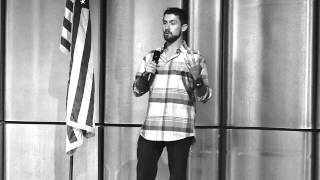
Neal Bloom went from building rockets at UC San Diego to founding Portfolium, a platform where students and young professionals show off projects instead of just resumes. He credits the San Diego startup community for helping him build the company and find early users among freshmen, high schoolers, and recent grads.
Why you came here to San Diego. Hey, everyone. Thanks, Greg. I'll talk a little about starting businesses, but really about communities. So I came to San Diego for the community. So first communities for me that I learned about were while I was a student at UC San Diego. I was a mechanical engineer student there, really wanted to create something. I thought that's what engineering was all about. I thought that was right for me. I went off to go actually build rockets. So I moved up to LA because that was the only job I could find that I was at that time passionate about in engineering. And I built rockets for five years, launching the space shuttle and other satellites for defense and commercial in a very cool community that had been around since the late 1940s, which was the space era. And that really was a huge deal in the 60s and 70s and then again in the 90s, but has recently started to show off. And so it was interesting for me to explain as my first job being kind of on the very, very mature age of a community, which was the space business. And what's interesting about it is it's something that you got amazingly smart people involved in, but not innovating. They've been doing the same thing for 30 to 40 years. As crazy as it is to be launching people into space, it actually does get redundant. And so I eventually left that. And before leaving, though, I started, I had an idea. I came back to my experience as a student and saw what it was like to get a job. Say I got a job back in 2008, which was probably the hardest year to get a job. Most recently, there wasn't many companies hiring and so I had to figure out a way to stand out. What I was doing was printing out all of my papers and projects, just bringing in a hard portfolio, paper portfolio, into all of my jobs and showing off. And instead of conversations happening down on paper, they were happening up here, eyes to eyes, showing my projects right there, saying, this is what I did and this is what I learned from it. And it made for a really dynamic experience. And that stuck with me. So I landed a really cool job. The company must have seen something to me because they put me on the road to go hire our next generation of talent consultants. So I was going off to these universities and I was looking at resumes, hundreds of them coming after each career fair and really not remembering anyone I talked to. I mean, you can change the format all you want, but there really isn't anything different compared to italic or bold. It's not your personality. And so that was kind of when I thought of the portfolio idea with my co founder, the idea of that showing, not telling is how you make a better conversation and show off who you are. Now Facebook had done this for the social life. I grew up in the very first Facebook era. It started in 04 to 08. Those were my four years of college and I had a perfect social record, four years of it all online for an employer to really make a great first impression. It wasn't what I wanted to show off. When you typed me into Google, there wasn't anything else there to show ch off besides Facebook, an old MySpace and maybe an old Friendster account. And so my co founder and I, who met at our job, created the portfolium.com which is a professional social network like LinkedIn but built all around a visual portfolio. You can upload any kind of media file, papers, pictures, projects and use that in an interview on a smartphone or a tablet, use your own custom URL, write on a resume or job application and show off who you actually are in person. So this immediately brought the college space into our startup. And we found that because we're a UCSD alum, no better place to try this out than San Diego. And so we apply it to the Evo Nexus incubator, which was a pretty rigorous process getting in. But we were really stoked to get in and immediately joined a whole new community, the San Diego startup community downtown. And it was amazing. It's been amazing. We got in just last summer and we've been testing out our system, our portfolio at the universities here in San Diego first, which happens to be quite a few different university systems, which helps us really well from public to private, large and small tech like Colemans and Nationals to, you know, the UCSD's and San Diego states. And we've had amazing traction. We realized that we've actually created an online community for people to identify with. We originally built this really for seniors in college ready to make that transition to getting their first job. What we found is that there's so much content being uploaded onto the site that now freshmen first are now saying I can now figure out what major I want to be or I can talk to people who just got a job in my major and it's actually been gone down into the high school area now and graduated alone. So we've now created this whole online community from 9th grade to young professionals that are all interacting online based on content that you've actually been creating. And that's been really fulfilling for us, especially seeing it at, you know, the level where we're a startup, we're actually involved. We were recently called grad students. And actually I moved here not really knowing much about being a professional at San Diego, only being a student. So I've actually networked with people based on a platform I actually built. It's really cool. I happen to be an ultra marathon runner, which just means I run crazy distances beyond marathons. And I found people in San Diego who actually also creates. So that's been very, very cool to build and fulfill your own professional wants, but also those for others. So our success stories, we've gotten back from people across the country saying, I got a job because I stood out at an interview, even though I had a lower GPA than they were, can allow for this position. I showed that I stood out. And that's what's really important to the feelings that I've found outside of the online space. There's like the previous speaker, talk about passions. No one really knows what usually the passions are unless you stand up and talk about it, where you stand up and do something about it. And the community here in San Diego, I mean, especially that we've seen this week for Startup Week, people stepping away from laptops, willing to come out of their offices and go to other people's offices and celebrate, has been amazing. And I think that's something that San Diego is going to be riding this way for quite a while, and I am completely stoked to be a part of it. So thank you very much. Thanks for coming. Thanks for.








