New Podcast Interview: Augment, Don’t Replace
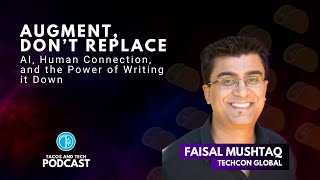
Faisal Mushtaq, a 20+ year tech veteran, discusses why AI should augment human work rather than replace it. He shares frameworks for scaling organizations, building communities through TechCon conferences, and his three books on X-Ops, AI in healthcare, and low-code development.
Questions this video answers
CTO of Sleep Number Corporation (described in transcript as a $2 billion company).
May 22–23, 2026 (Memorial Day weekend).
February 12–13, 2026 in Austin (called TechCon Southwest).
Three books: a framework on X-Ops in the age of Data & AI; a book on AI in healthcare; and a book on low-code / AI-assisted ('wipe coding') software development.
Startups get the party. Startups get the party started. Startups get the party. Startups get the party started. You want tech and tacos, Tacos and tech, you know we got it.
Hey.
Startups get the party. Startups get the party started. Startups get the party. Startups get the party started. Startups get the party. Startups get the party started. You want tech and tacos, tacos in tech, you know we got it.
Hey.
Hello and welcome back to the Tacos and Tech podcast. I'm your host, Neil Bloom, and I'm so thrilled to have on one of my tech besties here in town, longtime friend Faisal Mushtaq, who is a serial builder, an author, a founder, an investor, and most recently, you probably would have seen him leading the effort at techcon Global, a multi city technology conference that I have been honored to be part of over the last few years. Faisal, thanks for being on the pod.
Thank you, Neil, for the kind introduction. Always a pleasure. I mean, known you for a very, very long time and it's always a pleasure to be in part of this amazing podcast.
I appreciate it. It's great to have you on. But even more I would say, than on the podcast, it's great to be building in the community with you. There are not a lot of people who roll up their sleeves and say, I want to build community for the sake of the community, for the sake of really of founders and for the sake of technology advancement. And I just thank you right up front for doing that and taking the lead and coming back post Covid after, you know, starting TechCon room within a month of COVID and then saying, we're not done yet, we got a lot to do. So thank you for building.
Well, thank you so much and thank you for being part of it since like 2009, late 2019, early 2020, when we started this. But yeah, I think you are my role model in this. So I always try to, you know, do things and, you know, you're my North Star, so I keep pushing myself there.
No, likewise and same. I mean, you put on a big summit and you bring great thought leadership, which also is huge for the region that we. And we're going to talk about that, we're going to talk about kind of the genesis of that, what keeps you going there. But I want to know where it all started. How did you find yourself down into the tech world as a little Faisal?
Oh, yeah, I think it's a great question. So I think I always had aptitude for technology when I was Growing up. So my favorite subjects were obviously math, physics and then computer science. And so I think that's how I kind of, you know, grew up. My education, also my undergrad, my graduate studies were all in computer engineering, computer science. So that's how kind of I knew that's the domain or area, you know, where I feel I can contribute. And after my finished my graduate studies I started my career in Bay Area. And I've been in, I'll say some shape and form of tech companies for 20 plus years. But the interesting aspect is that I've done, if you look at my career, it's almost half and half. So one half of my career have been larger leading being senior leadership roles or C level roles in larger public companies or private companies. So most recently many people know me. I was CTO of sleep number corporation, $2 billion smart bet company based in US where I was responsible for the global product development, engineering, research, technology, pretty much everything that's there in the product. Before that I started my career in Cisco. I was also part of a company that became part of Hitachi. So those are larger organizations, like thousands of people, different functions and also running large teams and I've kind of led teams all the way from seven to thousand people also. So pretty large organizations. And it spread across multiple time zones. So that's one side, the other side have been startups. So if you look at almost half my career is in startups. I was fortunate enough to be part of three startups. One was almost like three guys in a room with no windows, great dreams, slogging 100 hours and you know, that was our first. And then in other two cases I came in at series A as a VP of Engineering or cto, slash svp, different roles, trying to scale the products, scale the technology and scale the team. So that had been kind of my forte. Then I realized this is my sweet spot. Like I, you know, scaling and taking, you know, once you have a product market fit and you have kind of like an MVP and some initial. How do you scale the, the team, how do you scale the product, how do you scale the, the customer base? So I think that have been my kind of forte and I've been fortunate enough that all the startups that I was part of were acquired in some shape or form. So I went through different kind. I mean MNA is also a very interesting experience. You know, from investment banker to you know, unsolicited offer, coming from an acquirer and diligence process and all that. So we, I've seen All of that site also. So, so I kind of, I feel fortunate that you know, I can be in a team of three people and do great things and I can be in a team of 3,000 people and do great things. At the bottom line is it has to be that are you creating a value? Whichever you're doing, are you creating value? Are you creating for your customer, for your company, for your, for the industry, for the ecosystem. But whatever you do it, you have to think in that perspective and, and are you learning? I mean that's also a factor that you know when a lot of people like they do the same thing with nothing against it. But I think I feel like as humans like the best thing is that somebody tells me this cannot be done and that triggers me that okay, you know, if they're not be done then you know, I love to, you know, I'll show how it's done. All the companies I mentioned around six or seven of them, they're all in different domains, you know, different verticals. Some were enterprise, some were telco, some were sleep Number was a consumer company completely. Right. And then Cisco was a completely infrastructure company. So it's also you know, different kind of domain expertise and the work I was doing was also different, you know from you know, backend cloud work to embedded to you know, AI to mobile. So, so yeah I think that's have been my journey in, in career. I around seven so I came down to San Diego around 12 years ago and love the city. So this became the home and will always be the home. So I been involved with the ecosystem I think met you I think around 10 years ago Neil. I think I've been known you at least for that long. Been an angel investor also with the new fund with, with your interlock and and many other great, you know, organizations that are doing good and yeah I think and been an author also. So you know, you know, when I'm not doing anything I'm writing blogs or books. But yeah, I think that's kind of my journey again. Always a nerdy and techie I would say.
Yeah, I love it. Uh, well that's all of us but often we don't get to talk too deeply around some of the learnings something you know, you've been startup three person, you've been big org. I feel like a lot of times it's easy to look at. The grass is always greener. Like startups are like I can't wait to be big, can't wait to grow. And then big orgs are like I Can't wait to be have nimbleness again and flexibility and creativity. Does it feel that way or is there a time and place for kind of being both?
Yeah, it's a great question. I think. So first of all, I mean startups I think is an amazing place for creativity, for getting things done and people say cannot be done right, so you know you can. And with very small teams or small resources, amount of resources. I do remember the first startup when we were making a plan and we said that, you know, we're going to build this product and it's a, it's a telco grade product and we said we need nine people and we're going to. And we were three people. Initially I said, how is that? In my mind I was being part of that process, but in my heart was like, how's that possible? I'm, I'm leading a team of 30 people in Cisco and doing only one feature. How can it be that three people can do so much or nine people can? And then when you go through this whole grind then you realize that really amazing things can do. So if you get smart, good, amazing, driven people with the goal and ambition, amazing things can happen. So that's part of, is on the startup like move fast, iterate, learn, fail all those things that you can. That's the learning from there. In larger companies, I think it's more about scaling. People think scaling is easy. Like you do something and then you put 100 more people, it will scale by 100x. It's not like that. So how do you scale organizations, how do you scale companies and products and customer base? And I think that's a different level of discipline that comes in, like processes start creeping in because you have many functions. And so I think the key would be where you draw a line. Like a lot of these larger companies that are very innovative are able to balance this like innovation, but with structure and discipline. Right? So how do you give space for creativity while making sure that we have discipline? Because when you have hundreds of customers, I mean the dates, deliverables, everything is very important, right? So I think it's a balancing act and I think if you do both, it will give you both skills. Because a lot of entrepreneurs, I've seen that they incubate, they do, but then when scaling start, they bring a new CEO, they hand it over because they're not able to take it all the way. But great entrepreneurs take it all the way, like Mark Zuckerberg. So I think it's, it's, I think if you get exposure to both either earlier in the career or later. This will give you, I think it's learning on both sides and then it's up to you to pick the best of both learnings and, and implement in your life.
That's really smart. Really, really smart feedback. There's a lot of people who talk like I'm just good at the zero to one. Right? Yeah, but, but there's been so much data that shows founder led public tech companies are some of the performing companies. Right. And those are people who've been there from 0 to 10,000 people and 100 billion in market cap or more. Right. Market multi trillion. Right. So but how do you go. So for some of the younger founders, how do you go get that experience? Is it go work at every size company before you start your own or what do you think?
So I think it depends on what path your life is taking. So I just was, I mean yesterday I was in San Francisco and I was, it was a closed session arranged by one of our investor. And so this guy just walked in and Neil, he was a 26 year old and I didn't know he was. And then when he started talking, he has built up $8 billion company in last like 18 months. Right. And when he started talking and also. But so you know, you realize there's something special about this guy, you know and you know, the cognition. I think you can look him up, I think, you know. Oh yeah, yeah. So I think so I think there are really great people that have that something in it. So if you're one of those, right. That so I mean then you are gifted and you have to like, you know, just believe in yourself and take it all the way and do it. I mean cursor and all these are young guys, all the CEO, they're not like, you know, you know, fresh, I mean from mit. But I'm pointing like there are these special genre of entrepreneurs. If you're in that category, you know, bless you, that's, I mean amazing. Not everyone is in that category. So then, then in that case what you do is you, you decide. I mean you can start say you know, you start a company and then that get acquired and then you become part of a larger company instead of immediately leaving. You know, I know it's very painful when you are in that mode and then you go to a bigger company and the thing, everything slows down. I think it's a good learning for you to see why. You know, when you're doing something at 10 billion and revenue or 5 billion what things are done differently, what is, you know, and those skills are always important and maybe go back and start your second one and then take it all the way and not, you know, go ipo. So I think it depends on the journey and it depends on your own personal drive and capabilities. And not everyone is different. So you just evaluate. Some people start out of college in a big company for a few years and then they jump in. So they already have some idea about that. So I think it's helpful, but it's not a must. There are tons of, you mentioned tons of entrepreneur that out of mit, Stanford, and they took it all the way and you know, they're better than many, you know, really educated and big executive. They've done better job than that. So I think there are all kinds of people but just evaluate yourself where you stand in that spectrum and then take steps to take it, you know, push yourself towards it.
It's a great point. I think I like the point that you make around learning to learn. Right?
Yeah.
Very subjective to yourself. So one, know yourself and know how you learn and then go and learn every way you can. But, but you have to have that awareness first for sure. And then I love the part you talk about like learn as much as you can and then go do it again with those learnings. Hopefully next time will be easier or different because of the things you've learned. It's pretty insightful, I would say. And something else that a lot of people do, obviously they go work and build tech, start it or grow it and scale it. But then sharing it is a whole other thing, right? Sharing your learnings, sharing with a community, mentoring, it's almost like an afterthought for people or an add on. But for you it feels like it actually goes hand in hand. Working and learning and sharing are hand in hand. Meaning you're writing your community building, it's a. Just as much a high priority for you as a value for your customers mentality. Where do you think that came from and how do you, when did that start?
Yeah, I think so. I think first of all, thank you for your kind words. But yeah, I think that something that I feel also I think this point in my career, I feel like, you know, it's, I should be giving more. So and I, I, you know, I love Brad Feld's book about give first but I think a lot of people are takers. Like, you know, I mean I, I always classify people when I meet somebody. I, nothing against anybody but I, I classify as like neutral taker or giver. So if it's a giver, because giver has the biggest respect in my mind. Right. You give. And in all my life, if I give something without asking for a return, I get some other benefit through other means that, you know, much X times that much. So I think that's my belief. Right. So my point is like whether you are, say you know, entrepreneur, whether you are an investor, whether you are a community builder, I think community builders are the great givers. You are a great example of that. So what I'm saying is that, you know, that's what my mindset was always obviously sometimes you're busy. So like when you're in startup and you're running out of funding, you know, time is a constraint. But whenever I get time like you know, I mean between different, you know, I move to the next, you know, project in my life, you know, I feel like, you know, it can give it. So writing as something that I started in the last three years because it's always I was doing internal within the company but not public. So you know, started writing blog and because it's also giving, because you know, it's just you go read and if you learn something from it, you know, so be it. But also mentoring is important and so my, you know that again you need to know what your strengths are. So for me my sweet spot is scaling. So somebody comes to me and say, no, I've raised these seed round, I've built this, I think I have a product market fit here. Now how do I scale my team? How do I scale my, you know, how do I go to series A and beyond. So I think that's what I think it's, it's of point for me. So, so I think again, know yourself where you can the best at giving, you know, because you know, then you should be able. But I think it's, it's always everyone should be giver. I will say, even entrepreneurs. I will say that if, if you are still looking for funding, still you can be a giver because you are, you know, there are people that might benefit from your experiences and sharing that always helps. And it's never been that I shared something even techcon. I started with that ambition that I felt that something was missing and I'll come to that later. But so I think it's just natural. I think it's whatever you do that you enjoy, you don't have to force yourself to do it right. So if you are enjoying something, you will naturally do it more and build more fashion. Than if it's just a job or like, wow, I feel that, I think all of us should be doing that, should be giving, helping people and wherever it can be. But also I will say relationship comes first. So what I mean is that for entrepreneurs, I always advise. I think you also mentioned, I think I heard you also mention it, that you should build relationships and you should network when you don't need it. Because a lot of people happen when they have a need, they start networking and then they turn off and they, you know, say you're looking for a job, you'll see them and then I think that's not the right thing. I mean, you, you should be involved in giving. And I know there's some. When you're busy, you have less time. That's fair. But my point is like, you, you know, you should not own, not only, you know, go and say, I'm looking for this. You can say, you know, I, I have this expertise, this is where I can help. And sometimes what happens is you'll get involved and you might get a job through that. If you're looking for a job and you say, I'm good at AI modeling and there's some project and you're helping, and suddenly you might get a job through that perspective, right? So again, I feel that everyone should make sure that they keep an allocation. Whatever the allocation, they feel comfortable of giving that whatever expertise they have, knowledge they have, connections they have, and they should help people. There's no harm in that. It always amplifies and comes back.
I love that. I mean, it's super important to hear now and internalize. I feel like some people already know it, but they probably haven't put words down to it. But the give first actually is so succinct from tech stars. It really is how the world works. And, you know, people just, are it or not? It's a really. I like your filter for that. Your filter.
Test.
One. And it does really come back around. I mean, it really, you know, like, if you aren't expecting a transactional thing, somehow it's a multifold return back to you. When you get, when you want, when you do a transactional thing, you get the transactional thing back to you. Tell me about the, the blogging. How when did that start? Like, writing is not, you know, usually you don't think a lot of people, especially on the technical side, us engineers, not writers, we shy away from that. When did that start and how did you get it going and what did it turn into?
Yeah, it was always, I Think within a lot of specs and documents you have to write internally, right? I mean and I always was good at. So like the things that excites me the most I think are one is the organization. I noticed like seeing all these organizations and different roles and. But there is a whole area that I think I've written several blogs on that you know, how with the world changing with AI and data, how the organization should evolve. And it was, you know, I did consulting for two and a half years and that's what our thing. We go and see this Fortune 500 companies and see where there's bottlenecks and 90% of the time the bottlenecks were in the organization structure or you know, those kind of things rather than, you know, technology. Obviously they had very old stacks and all that, which is always the case. But so I think that's where you know, it was there. But I think not publicly because when you are, you know, especially when you are in companies, I think there are. And in a senior position there are also rules and you know, what you can write and publicly and all that. So. But now I think I, I feel like that, you know, last few years I started more and so that's one area. The other part is technology which is the whole spectrum of IoT AI software. I think that excites me. I think that's, that's also, you know, very important. And then leadership. I think there are, you know, funny story. So the. I think the two. The previous to previous blog that I wrote was things that I used. I'm telling my sons I have a 11 year old and a 7 year old. I'm taking them to school and give them like lessons like these kind of. More I like models. I say these are four pillars and these are so to make them easy for them to understand. When I was doing it, I said why can't I just write it and share? You know that doesn't mean you have to agree to it because there are hundreds of models of leadership. But at least this is my model. So I can say that this is, you know, how I think things if I'm a model guy. So I'd like to break things into, you know, models and frameworks that it helps me comprehend better. So I was just telling my son like, you know, this is the success has these pillars. And yeah, I said these are very. My goal was to make it simple so a 5 year old, sorry, a 7 year old, 11 year old can comprehend. And then I said it's pretty deep, you know, it's not as, you know, simple. So maybe let me put it so I would say it. It's not easy, but if you have the concept first, you need to know what you write. You have to be passionate about what you're. You know, if you say, right, you know, if you want me to write a blog on art, I can't write it because I'm not into art, right? So my point is that, you know, it has to be something that comes natively to you and, and something you create, a value, something new has to be there. Like, you think differently of, you know, you have done experience differently that you are sharing or you believe differently, right? So I think if you can do that. Otherwise, if you just take something that's available, like you said, this is how AI works. The whole world knows how AI works, right? I mean, everything is so. I think it's more about the. So what? Like, what is the application? What is the impact? You know, so that's. I think that's more exciting than the technology. Even in Techcon, you've noticed that we don't have PowerPoint slides and deep, like technical. Because I. We feel that this is available, this material is available publicly. You can go and learn anything online these days, right? It's more about the experience. Like women. In TechCon, what we do is focus on people's experiences and wisdom and all because. Which is the hard thing to get. You know, somebody scaled a company from zero to say, 100 million. The lessons and the roadblock that he or she failed are unique to him or her. But there might be lessons that are valuable for more. More than him, right? So I think once he or she shares. So that's where I think my interest is. Like I was telling you, or maybe like I showed you that day, right? I went to this conference and I just took notes and you know, the key takeaway words, you know, and that to me is like more valuable that those are like wisdom summarized in one sentence, right? And that I think, very exciting to me. So, yeah, I think that's how it started. I think I was always doing internally, but I think at that time, you know, I didn't do so much public writing, but I think last two years, I've been doing two and a half, three years maybe.
That's great. I mean, does it feel like. What's funny is that AI now has made it so easy to consume content and write content and so it'd be a really easy time to be like, this is the time to not write. Because everyone can ask every Question that's ever been wondered into GPT yet actually now that because of that humans input, your input, your unique feedback might actually be even more valuable right now because of the availability and access, which I think is kind of what I heard you say, even what you get from like a conference as well too, right?
Yeah, yeah, I think that's, that's a good point. I think that's why I, I feel like eventually the way the world is going, Neil, I don't know. I mean, I love AI, but I'm scared of AI also. I mean the speed does, the sheer speed where things are changing. So in our lifetime, I don't know what else will, you know, within. I mean, I'm talking about next 10, 15, 20 years. I mean, what amazing things that it can do and which is already doing. So that's true. And I think yesterday also we were discussing that like just take wipe coding, for example, right? So there's a dilemma right now that for, for people who are starting like say first semester in computer science or computer engineering, should they be learning wipe coding or should be learning what you and I learned? Right? The data structures and C. Right. So the foundation. And there's a, I mean, because there's a, there's a thought process that if you use those tools, the part of the brain that you create, you know, that stimulates and that creates that, I think you will stop using it. And then it, you know, so, so I mean, that's where the dilemma. The tools are great, but if you become too much dependent, then original thinking and creativity goes away. So I mean, it's a philosophical discussion. I agree, but the point is that I use it as a tool, right? I mean, I use ChatGPT a lot as a tool like proofreading and you know, replying to emails. Like, you know, I don't think that much because that's not, not much creativity there. Right. I mean, the point is like it has to be grammatically correct and simple. But. But what you're saying that, okay, how the business should be scaling now. There are a hundred things out there. But I think if, unless it comes from your heart, right. Your experiences, then it's unique. Otherwise it's, you know, there's a lot of stuff out there. You can make up a lot of stuff also.
True, true. What do you think? Same with the content ingestion. You know, there's so many ways to now just have an AI note taker, mail in a meeting for you or listen and summarize a conference and all that pieces Is too. How do you think those actual tools can be used to enhance our ingestion of content in the way that the writer or originator wanted us to. To want it? Like, how do you think through that now?
I think very highly of those tools. I think for me, that's the stuff I was never doing. So my point is like, you know, I, you know, I have meetings and all the minutes are in my mind. Sometimes I, you know, jot down on my diary, like few, you know, broken sentences. That was my note taking right now it's like very detailed note taking with all action items and points. So I think it makes us more productive if you use that. And then what you can do is you can obviously say one of the goal is to make our meetings. One of the goals that I was trying to do in my team was making meetings efficient. But now, you know what was discussed, the summary of the meeting. And then you can use that to identify areas of improvement that, you know, if you are discussing things in a status meeting and you're converting into a design meeting and just going into the details and it just runs over time. A lot of these inefficiencies. As long as there's an efficiency gain, I feel this is an amazing tool. I mean, I don't think anybody should take hand notes these days. Why? I mean, just like I don't remember my even daughter's phone number because it's on my iPhone. I'll say, call my daughter and it will be calling, right? But when I was growing up, Anil, you know, I didn't have, I mean, this. I used to remember at least 50 to 70 phone numbers. Even my aunt, uncle's cousin. I had the number in my mind because, I mean, there's no other source. If I have to call him, where will I look up, right? So it's always. But we didn't use that part of the brain. I forget things now, numbers and all, because everything is easy. So there will be some destruction. But I think it makes us more productive around we do more things than I was doing 30, 40 years ago. But as long as we are careful, what's the right use of the tool and what is the area that, you know, it's the augmentation. I'm a big fan. Like, you do something and use it to augment, make it faster, better, efficient, productive. I'm with it. Replacement. I. I'm not a big fan. Like, you know, if you say like it replaces, it means that you're not putting an effort in and you're just you know, compliantly using it then I think it's not the right use and I think it's very destructive.
Yeah, I agree. I mean I think there's this kind of what you said around learning coding like our, our brains can be better used for other things now, right? Because other tools can save numbers for us. That's not a best use of our brain. There's better uses of our brain which is, you know, actually connecting with someone or whatever else it is. So I agree the augmentation is big. Soon that'll be self driving cars and all those pieces too. But I don't think like connecting with humans will ever change. Like we will always need one on one connection and our own way to learn from someone else's what they have learned. Right. Do you think then therefore the way you are writing, the way you're designing conferences, even writing books, do you think about the new ways to use AI tools to enhance those experiences or to get the learnings out or do you think those, those tools haven't existed yet to like get the learnings better distilled from a conference experience or a blog or something like that?
That's a great point. So let me touch upon that. Before that I think you mentioned about self driving and I can say like 15 years from now, Neil, like every, we have like level 5 autonomy and all of that. So then maybe I'll call Hey Neil, like you know, let's go on a Sunday, like like you do hiking, let's go in like there's a drive. There's an area in LA where they let you drive the car. Then we're going to go and drive that like humans used to do. It's not far off, I'm telling you. Like why, why do you have to waste time? Like do you like sitting on five and then just you know, sitting on the or I mean you can do a lot of work while the car is taking you, right? There is a productivity gains. I'm a big proponent of self driving. I hate driving because that's a waste of time for me. I'm not gaining anything and my IQ is not going up. Sitting one and a half hour on five basically. Right. So, so that part I think then I think my feeling is especially and I think you can add to it Covid initially people thought that you know, human connection is no longer needed. Everything can be done virtually zoom and right. And we lived through it for two years or two and a half years. Right. And now everyone knows like just a shake hand hug or you know, looking in the eye and saying that is can't replace a one hour zoom meeting on, you know, that you're doing. Right. And that's a human connection. I think that will never go away. Like, you know, and yesterday I went there because I wanted to meet three guys. We just talked for five minutes, hugged and you know, and shake hand. But there's a connection that was established, will never be done if I have not gone there. Right. So I think that's where the human part, the community part will become more important. I think that's where it is. And then to your point, I mean, I wish that they could. Like techcon for example. There's so much great ideas and things are shared and then what we are trying to do is record it in the video, right? So many sessions were recorded, they're available on YouTube. But also as humans, we're becoming little impatient. So we want information at our fingertips yesterday, right? Not even today. So maybe we can ingest that, all that content into AI and then summarize it and then keep findings and nuggets because they are all scattered through two days of conferences. So maybe that can be a next wave that we. I'm thinking about some of those tools that can we take all the material and then create connections also like I think many people are doing that if I'm and you are going and we have similar interest. I think we should be introduced to each other that okay, hey, you know, Neil is a early stage investor vessel. You should meet him for coffee, right? But that has to be high quality. You know, AI has to be high quality that when I look at Neil, I say, yes, I want to talk to him. Right. A lot of people are trying that, but the matches they sent me are not that great, frankly. So I think that part I think will create. I think AI can be used to augment human connections. And conferences can be the platform that where you connect with people and then conference should be. It's not the journey, it's not the end, it's the beginning of an end. Because if you meet person and then you take carry on the relationship through different modalities afterwards. So I think they need to have the whole journey there. And I think that will become more important in this day because people are craving for great intellectual discourse and great connections.
I totally agree, man. We could unbundle the whole experience of a conference of all the areas to enhance using tools. I mean, you look at the pre consumption, consumption and post consumption model. What could people be doing to prepare themselves better for the conference. Well, how could they maximize their time during and how do they actually have follow up with the people they met for a long term relationship? All of those pieces could be better, but I think you actually nailed it. It's. We need better contextual matchmaking. I think the problem I find is just out in the community every day, people don't even know what they want. Right. You say how can I help you? Oftentimes they don't even know what they need help with. Right. And so that is a step one is either we have to reverse engineer what help looks like and then say, hey, here's your menu item listing what area touches on makes a good connection for you. Because I think most people can't even conceptualize it. Then design the right connection using structured data. Right. Okay, this person has these things, that person has these things match. But then there's probably also the train and teach people what to do after match has been made. What is the long term potential of two people meeting? Uh, and how do you train to map success? Right. If someone met at a techcon, wouldn't you love to know if they became co founders one day or one hired the other person or you know, all those things? How do you track success of connecting people as well too? So yeah, there's a lot, there's a lot here.
And I'll give you a very, very genuine example. You know, Neil, still, you know, after TechCon, like I was just having a lunch with one of the investors, Steve, and he said, you know, festival the, you know, the. I did a, I led the investment in one of the founder who was at a panel with me and I say Steve, you know, can you, can you just, are you open to come on like just a short interview and share that experience? Because to me that was a red, you know, like light bulb warmed up that there are so many such connections. And what happens is that first of all I'm glad this is happening, but I think if we can make it like post conference connections can be made it more easy to do that and then follow through and help. I think that will help and also help people how to prepare for it. People just show up at a conference. For me, you have to do a lot of homework. You need to read the bios of all the speakers, what they have done, all the key attendees. Then you have to say that these are the five people. Like whatever you're looking for, these are the five people. And make an effort to go and at least build the human level first interaction and then follow up nicely and then carry it forward. So I think that's an area that I think can be really revolutionized. I agree with you. Because human connections, unless we become like completely dormant, sitting in our home with the VR glasses and you know, everything is virtual in our life, maybe, I don't know. But if we are living as humans, normal humans, we need connections.
Yeah, I think, I think Hollywood has given us a lot of negative pessimist. They call it techno pessimism. Right. There's a lot of that. But man, like once you experience other people in person, it completely flips your mentality being like, oh my God, like so much faith in humanity and tools will hopefully only enable more of that. Right. Connection to happen. Right. So we just need people to come out more. We need people to show up in person more because usually spirals more. And then teach people how to use AI tools to not have to stress their brains out on the things that keep them at home. Right. They're like, oh, I gotta sit home all day and be on Zoom. It's like, hey, did you know you could do lots of other things that would actually be more powerful and better of your time? These are the kinds of things we need to share more.
Yeah, it's again, the augmentation and replacement. Like Zoom was a replacement because it replaces the human connection. Right. But what we are thinking is we do have human connection, but AI can augment that connection to make it more productive, more useful pre post and during the conference or events. I think that will be really valuable because it enhances what you're trying to accomplish.
Agree. Well, take me through. I mean you went from short form writing blog to big conference style, kind of content, thought leadership to writing your own book. How did that come to be? And tell me about the books.
Yeah, yeah. So thank you so much for. I can pitch my books now. So there are three books. The first one was when I was asleep number and we with. We started implementing data AI. They have different functions and we were following, you know, whatever the standards were, like DevOps, SecOps and you know, I started implementing all that and then I realized that with this new age, it's a very different thinking of how the different functions reside. And I think the term X ops was the term, which is not very commonly. I mean if you're really nerdy you will know. But it's about like all these functions, the Data Ops and FinOps and everything combined. And that I think is the key because when you say you're implementing a cloud infrastructure and you have to implement it, which is typically the cloud team. Then you have DevOps team that's kind of deploying it and then there is a SRE team that's monitoring it. But then the bill comes high. It's like I used to get like these AWS large bills as a cto I have to like you know, from a budget I have to sign. I said who's taking care of these? Like who's making sure that the cost is being monitored? So you know there was like oh, fingers are pointed. And there was no, there's a thing called finops. And so I said like why are these all fragmented? Right? Why can't we just like, you know then AI is different team so they are managing own pipeline. Why is that? Right. You know the DevOps. So that then I started implementing that unified framework in subshaper form and then when I started thinking about it I started writing that. So I think that was the first book, it was two years ago called X Opt in the Age of Data and AI. All the books are on Amazon. You can look up my name. It basically lays the framework of all these things like how these DevOps evolved SRE and, and now how do you put it in one framework? If you're, especially if you're a larger, a mid sized to larger organization, you have to have it, otherwise you have the time you're wasting and your productivity and all that. So that's the first one. The second one is AI in healthcare. And again it started three years ago when I started thinking about it because I myself, I don't know whether we have done written several papers on we could detect Covid through the, the data that we had from sleeping sensors in the bed. I think one was just published. I was very happy because it took us four years to get it published and all that. But I think the idea was our healthcare system has its own challenges. But the point was that what are the different domains that is it transforming from diagnosis to back office work, especially for entrepreneurs. It's a very good guideline because some things are fda, some things are, you know, you need domain expertise. So if you're doing AI based drug discovery then you, it's just AI is not sufficient. You need to have a co founder or your own background in that domain. But if you're automating the back office work in, you know, in hospital through AI automation and document or note taking, that does not require that. Right. So that also gives those areas to play for entrepreneurs where AI can. But the book was about all the different Elements that impact AI will impact. And it's all. It wasn't for the, our, I'll say, very complicated health ecosystem and all the other constraints that we have put in. And then the payer and provider and then we have kind of like the few larger companies managing most of the EMR and ehr. So those are the nonsense. It was like if it was like an Internet, like an open system, like ietf, like standard protocols, that would have been much faster. But now change is coming, how they'll diagnose and all again, augmentation versus replacement. So like people said, will you ever go to a doctor into a, like a, like a virtual doctor or like a humanoid and they look at your scan and say you have this disease. I mean you will like human. At least in our lifetime. I feel like we will still need a human to do it. But if that human is using AI. So there's a very nice, you know, I think you must have seen it in San Francisco, San Jose, there's a board that, you know, AI will not take your job, but someone who's using AI will take your job. Right. So what I'm saying is that AI you have to use, right? So as an augmentation tool to help you. So I think, you know, from image scanning, from, you know, MRI scanning to, you know, drug discovery, like, you know, there are many great companies that are doing that, you know, much more, you know, faster. And so that book was more about that, that what are the different facets of healthcare ecosystem and where AI plays and how. But also I'm a very. So since even I was growing up, I always liked history because when we are at this point, I say, how did we get here? So I always cover the whole history because a lot of people don't look at history that I'll just pass. Who cares? In my mind, history is a projection of future. There's enough learnings in the history that you can use to forecast the future. And I think I use that as the thing. So some of the things in AI, I mean, to be fair, we can't just go to ChatGPT in 20, 19, 20 and say this is the AI moment. They were really big, big AI moments and it took 50, 70 years. It was just unfortunate that there was less compute and less GPU, compute power and memory and storage in the 70s and 80s that we have right now. Otherwise we could have done some of the foundations, but laid early on. My point was it was a historical perspective that don't think that it's a revolution you know, it's 50 years in the making. And a lot of these things like in the book I highlight, like some things were done in the 70s and 80s that was way ahead of his time, you know, using AI and you know, so the people should at least appreciate. I mean it's because a lot of people started looking at AI in the last four years, but I think this have been there and, and so, so that was the second book. It was more about laying the health landscape and how AI can play in each function from different functions of the healthcare ecosystem. And then that might give entrepreneurs also a playbook that they want. Like, okay, this is the right space for me where I'm good at AI. I have this team, I can take and fix this problem. This problem can be solved with AI. The third book is about what we all are talking about, like wipe coding, right. So this is again sdlc, like software development lifecycle and how light coding is again I like history. So I mean, you know, when Agile came in, everyone hated Agile or. Right. And this was waterfall. Even in some of the companies I was in there was like Waterfall, Globe and Agile. I'm not talking 500 years ago, like even like seven years ago, eight years ago. So that was a revision. So now. But what's happening is now with wipe coding it's really coming, you know, very fast. And where do you define the guardrails and how do you define. So this book talk about the journey, like how these big, you know, to me waterfall to Agile was a big transition and then, you know, there were many other transitions along the way and then the wipe coding now is the next big one that's coming in now. Use it as a tool, not a replacement. Use it as a tool to improve accuracy, productivity and throughput of the team while defining the right processes and guardrails. I mean whatever software development life cycle you're using within your company, how do you implement this part into it? So that's what the book is about. It's not like replacement, throw everything and go to like replit and you know, and cursor. So, and so I think that's the challenge there is. The world is evolving at a speed of light right now. So you can't forecast things because it might be wrong. So I try to give frameworks there like, you know, this is how you should think about it when you implement an organization because each organization is different. So those are the three books.
I love it. Where can people find it?
Yeah, if you go to Amazon.com and you, you know, you can, you can say slash author slash F mushtaq or you can put my name. The books will pop up.
Cool. I love the frameworks piece because it is back to again. It's just humans going through change, which we've always gone through over millennia. So we're going through change now. It's going to be hard and people are going to process differently and learn in their own way. And you offer your own framework of how at least what works for you. It's got to, it's going to work for others as well too. And kind of the human lens of how to go through and navigate this change that is AI which man, I can't wait for us to find other words to use for this. But that is the word we use everywhere right now. Those two letters.
Yeah.
And okay, so these books. Are you doing a book tour? Book signing. Can people come and come have you sign a copy of the book?
Yes, yes. That means I haven't promoted it. But, but I think if you know, anybody would love to be an honor. So we can maybe do a book signing and maybe some one of your future events. I think I can bring some books. There is a, I'm part of this called Ties. They are having an event where I will be also doing a, you know, book signing, but maybe at petcon also. I, I, I mean I'm not a, I'm a very quite shy guys. I don't promote much, but I think I will be more than happy to bring the books and, and sign. If somebody has it, I will do it. And if maybe we can arrange something in the coming months and weeks.
Okay, we'll do it. This episode will have already gone out after Startup Week, but you will hopefully be a part of the, have been a part of the author room that Cheryl Goodman set up. This will be her second year where she actually has local or relevant tech authors together to share their books. So I'll make sure that that happens, that you're connected to that. But yeah, I would love to do a book signing event together. So let's do that.
Wonderful, wonderful.
Yeah. Take us through a little bit of TechCon here where you're going through some, some growth because of the successful consistency I would say you've had. Where can we expect to see TechCon in 2026?
Yeah. So I think first of all, thank you for being part of it from day one. So techcon we have announced two events. Our flagship event will always be San Diego. So it's Techcon SoCal 2026. It will be on May 22nd, 23rd next year it will be the Memorial Day weekend. We look forward to seeing everyone there. We're going to be bigger and better with a lot more new speaker that we are bringing across the country. And the second one which will happen is in Austin I think which will be earlier than this. It will be in February 12th, 13th and it will be in Austin. I think it's called TechCon Southwest and would love to have people from San Diego attended. I think there are different set of speakers, it's not the same. So you will get to expose to a different set of founders and speakers. We are also planning, we haven't announced it yet. We are doing TechCon Silicon Valley forum. It's not a conference but it's a meetup and a few talks and a networking event. It will be in April, we're going to announce soon and the goal is to create the people awareness about TechCon and hopefully highlight San Diego event which is in end of May kind of. So we'll have, you know, we'll start promoting that there. So those are the ones that are, you know, we have announced yet. I'll tell you a little bit about the TechCon what we are trying to accomplish and, and, and the mission behind it. I think so. So techcom Global I think the mission is obviously we want to create a thought leadership event where we bring the best minds together. And also we want to make sure that it's a platform where you can build relationships and get inspired from each other and learn from each other. So that was the mindset around techcon. What we felt was that there are different kind of conferences. There are really large shows where you go and thousands of people but very hard to build really deeper connections there. And also the quality of speakers. I think there are few but not like a large number. The second one is private events where we really meet at a deeper level. But those are either like invite only or private events. So the idea was that to build that bridge between the two like a conference that is where you can still meet people, build connections, learn from each other and also you know, connect with people. So the second part is also a lot of conferences are verticalized. Either they are geographically verticalized or whether they are like topic wise verticalized. And we feel that the technology and the investment ecosystem is broad. So we cover around 8 track from deep tech, fintech, AI because things are over, let's say somebody, some entrepreneur is starting a medtech company that has hardware in it and building a chip for it and Writing software that is AI so that technically. And it will have a SaaS service that will use that machine, that SaaS. It's hardware, it's medtech. So the technology and things are overlapping these days. And I think that we wanted to create a platform where collaboration can happen and those kind of topics can be discussed. The idea is to focus on regions that have a great up and coming system. And San Diego was the first one I think and we try to bring around 60% of the speakers are from rest of the country and then 30 to 40% are from the region. And I think the idea is to build those connections. So like if an investor from New York invest in a company in San Diego, I think that connection will establish and that's what we are trying to do. The other region, the second region that we're going to launch is Austin next year. And also we're trying to create a bridge between the regions like I know you are going to Austin, I'm going to Austin. Many people from San Diego will be in Austin and we will have many people from Austin coming to San Diego. So I think that also creates that collaboration. Learning and investors are looking for good deals, good entrepreneur looking for investors. CXOs are looking for good products to implement in their system or buying great companies that they can integrate. So it's a win win for everyone. And we're trying to build that ecosystem there. One thing we do is we make sure that around 10 to 15% of our attendees are bootstrap entrepreneurs and students. For that we have partnered with all the great schools from UCSD to sdsu. We partnered with nonprofit like John G. Watson foundation that they sponsor 50 students to attend for free. Because we want, because a lot of these conferences we notice that great learnings and great insights but we don't have this future generation in the in the room then the would be or the new entrepreneur in the room to learn and get inspired. And we're trying to make sure that those guys have access and a seat at the table.
I think that's super important that like make sure the future leaders are learning from the current leaders piece. That's a really big legacy item that I think we've missed out on a lot. I look around in a variety of ways of giving. It's skipping a few generations right now. You know there's still kind of the octogenarians, 80s and 90 year olds who are still kind of expected to give and they're not passing the baton on saying it's your turn. Right. And I think the same from learnings of how to build same. I don't know if they're being passed on and I love that you are taking an effort to do that. It seems like you're doing in a variety of ways, right. Like you're writing and sharing your own learnings and frameworks. You're then convening people to do that and then you're being insightful in who is in the room to make sure that we're not missing some gaps. So thanks for taking a holistic and whole view and lens approach to that. Excited to get out to Austin. I'll be there with this month to build some relationships ahead of being out there for tech on Austin. So I'm looking forward to meeting more of our Austin friends. Yeehaw.
Yeah, yeah. Really exciting I think and it's going to be fun. And then the Austin event would be in a Bullock Museum. So it's a very nice bright on the Congress Avenue, very nice venue. Everyone is going to have fun. So look forward to having many people I think. And if you are an entrepreneur looking for investors, I will say look up the list of. We already have speakers listed on both conference pages so you can see and depending on your domain, depending on the stage that you're looking to raise, start doing research that which will be the right investor for you if you're an entrepreneur. If you are looking for a job, for example, that There are great CXOs coming, they're looking always have jobs and so there's always a win win. I mean I would say meeting people and great people. I think it's always a win when you always. There's nothing to lose against it. I think you will always benefit in the long run.
Totally. Well, something else that San Diego and Austin have in common are our taco scene. Now Austin is known for breakfast tacos. Okay. It's. That's just what they hang their hat on. San Diego is known for tacos at all times of the day. What kind of tacos do you prefer, Faisal?
I'm not a big taco guy, but you'll be really, you know, that will be the worst kind of answer for me. But I think the only tacos I normally eat is like there's a chain called California Fish Griddle. So I, you know, eat like shrimp tacos from there.
Yeah, those are good for sure. Yeah. I mean I think, I think we've traveling the world, you've seen a lot of cultures that maybe they call it something different, right. Some sort of bread product or carb with some meat in it and, and rice and beans. I mean, I think that you can find that in actually a lot of the world's cultures, that's for sure. So it's just one name. That tacos happens to be San Diego's thing because of its proximity to Mexico and Austin because of that. But we like good food. That's kind of what it says when you travel the world. That's for sure.
That's true. That's true. Yeah. I think it's, I think we are, we are very nicely located, I think with the proximity to Mexico, I think for manufacturing, I know many companies taking advantage of that and, you know, I think we can do more. I feel like we should be able to take more advantage of the cross border entrepreneurship and collaboration. So I think a lot more to do.
We do have a lot more to do. I know I have run into you in Tijuana at Arcus Nexus's office before which Santa Star Week is doing again. So I look forward to seeing you on both sides of the border during that. We're seeing you in multiple states now. But Faisal, overall, just thank you. Thank you for, for sharing, for sharing your learnings and inspiring more to stand up and lead and give and for continuing to build. So I look forward to do more together, more investing together and more building together. So thanks, Faisal, for being on the podcast.
Thank you. Yeah, thank you so much, Neil. And look forward to, you know, continuing to build together. Yeah, take care.
Thank you.
Tacos in tech is on smash border green guacamole Keep accountants counting beans Contador quentan frijoles Founders trying to raise some queso la vida San Diego school of rappy rapping Fire tortillas round jalapenos in these modern times A craft beer and coffee My coding yoga posse fold the body origami we be surfing Coronado eating tacos El gordo the taco stand in puesto Lucha libre and sombrero Got a shout out to cost angels by the ocean Watch the sunset La Jolla shows entrepreneurs trying to get funded When San Diego Startup Week is popping in the summer Oceanside to Tijuana SD be full of hustle Hustlers from couch surfing to penthouses right on the beach Tech leaders who believe stars are within reach we interview and founders who be shooting for the Moon SD TechOS with your host, Neil Bloom Startups get the party Startups get the party started Startups get the party Startups get the party started Startups get the party Startups get the party started? You want tech and tacos? Tacos and tech, you know we got it?
Hey.
Startups get the party Startups get the party started? Startups get the party Startups get the party started? Startups get the party Startups get the party started? You want tech and tacos, tacos in tech, you know we got it.
Hey, sa.








