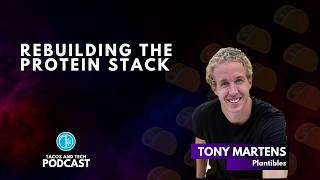
Tony Martins, co-founder of Plantable, extracts Rubisco protein from duckweed to make sustainable food ingredients. He moved from commodity trading to building a facility on a 20,000-acre West Texas ranch, raising $500k to scale from grams to kilograms. The protein now goes into products at Sprouts and Gelson's.
Chapters
Ah! Startups get party started— startups start up to have fun— you want tech or tacos? Tacos Tech—you know we got it hey!! Startup gets your body starting startup's getting their bodies running-startup starts off at 4 AM—we gotta do something about this shit!!! You wanna take some taco-taco-tech? We'll show ya how much fucking money I'm making on my business right now... haha ha! Hey guys what going down?! This video was directed by me myself so if there were any errors please forgive them for that reason only because they're not professionals like yours truly whoa yo yeahhaha uh huh ah hahaha hehehaahaa hello everyone welcome back again today let us talk more of our favorite topic which would be "Tech" but before all those nerds freak out click subscribe button below okay thank y'all bye-bye see u next week!
And welcome back to the Tacos and Tech podcast. I'm your host, Neal Bloom. I'm thrilled to have on my friend Tony Martins, co-founder of Plantable. Hey Tony, thanks for being on the pod.
Hey Neal, thanks for having me.
Oh man, it's so good to have you on. Long time coming. And I'm stoked to, you know, hear again the Plantable story, which is just incredible, is just such a cool growth story. It's a cool story of convergences of industries from ag, agriculture, technology, food, science, like all the pieces that I think make a really good San Diego story, but really a good story of food, like where food is headed these days. So without further ado, tell us what's Plantable.
Yeah, so Plantable in a nutshell is we grow novel plants and from these novel plants we extract high value ingredients that improve nutrition, taste, and texture across industries like food, personal care, and animal feed. Amazing.
Okay, we're gonna talk about all the ways that that is applied to the food system, but we gotta know, how did Tony get applied to the food system? Where did Tony start and how did you end up here?
Yes, that's a good question. Super random. But, you know, I'm originally from Amsterdam, the Netherlands, and I started my career in agricultural commodity trading, you know, focused more on traditional commodities like corn, soy, wheat, rice. Basically, no fertilizers, more and more, let's say, actual like food components, the output of fertilizer, but the output of fertilizer. And, you know, I think doing that for a couple of years was super insightful, right? Because there's a couple of things that you learn. First and foremost, like how fragile our food system is and has become. And secondly, how overly centralized it has become, right? I think a lot of people realize, okay, obviously, you know, climate change is affecting, let's say, the yield and quality of crops around the world. We're seeing natural resource scarcity in the form of arable land or fresh water resources. But I think a lot of people don't realize also the geopolitical risks that come with our agricultural supply chain, where it's basically dominated by 2 or 3 regions in the world, whereas let's say 65% of our global calorific intake is coming from 4 crops. And I think as climate change becomes let's say, more prevalent, and let's say geopolitical risks increase, which is something that we obviously have been seeing over the past couple of years, I think our food supply chain is genuinely threatened and at risk of falling apart. And I think right now we're living in a Western society where those effects are felt less than elsewhere in the world. But I think the risk of it starting to materially affect Western societies is upon us. You know, and so I think with that in mind, you know, small problem at hand, we were like, hey, you know, what can we do? And then you start looking into, let's say, the fundamentals of our agricultural supply chain and realizing that we haven't really updated our supply chain for over 3,000 years, right? So the crops and animals that we grow today are the exact same animals and crops we grew 3,000 years ago. And, you know, for whatever reason, every other industry from transportation to, let's say, communication. We've all advanced from, let's say, a horse and carriage to now having reusable space rockets. But, but food is still the same as it was, right? And there has to be, let's say, an understanding that with today's know-how, today's understanding of what's good or better for the human body, we should be able to grow better organisms and, and convert those into higher value, better tasting products for consumers. And so with that in mind, we started Plantable about 8 years ago, looking into like, hey, you know, first of all, like, you have to pick, you have to pick your fight somewhere. And so we're like, okay, like, what are like the critical components of a diet? Now, obviously, protein is one of the most critical components of our food system where nutritionally it's the building block of the human body, but then also functionally it creates the textures of products that we love to eat. And so we're like, okay, great. Now let's look at our protein stack. You know, you have soy, you have dairy, you have eggs and, and, and, and beef or meat. These are all, let's say, ancient proteins, right? We've been consuming them for thousands of years. It's hard to, it's hard, it's hard to say that these are the best proteins we can produce for the human body because, you know, these are the only ones that we have produced. And so what if we start to look elsewhere in the protein landscape? And that led us to a protein known as ribosome. Ribisco, which funnily enough is one of the most abundant proteins on our planet because it's in every leafy green. So every time you eat kale or lettuce or spinach, you eat a little bit of ribisco. But for the past 80 to 90 years, this has been considered the holy grail of proteins. And because of its nutritional and functional superiority to animal and plant protein sources. And so we're like, oh great, so if this is so great, why has nobody succeeded? And which then led us to the whole biology and supply chain aspect of producing Rubisco, which then led us to like this little aquatic plant known as lemna, but also known by its less appetizing name, duckweed, which is the most Rubisco-efficient plant our planet has to offer. And so we're like, hey, great, let's connect one and let's connect two. And we, me and my co-founder, we quit our jobs and jumped on a plane and moved to San Diego to start this adventure. Yeah. Amazing.
Well, I mean, you were sitting observing, you were seeing the food system. How did you know you had to do this? I'm sure there was a lot of opportunities that you're like, let's go in on. Why? Why this one?
Yeah, it's a good question. I mean, like, it comes back, right? So I think, like, I've always contemplated— me and my co-founder, we had always contemplated starting a business together. And initially it was like, you know, maybe do somewhere tech or software or whatever. And they were like, well, you know, Maybe we want to do something that leaves the world in a better place, you know. And we started to look at renewable energy, but I think like, you know, renewable energy, you know, it's a race to the bottom, I think, at the moment where you have a lot of, let's say, horses in the race. And I don't think we would have been able to create a competitive advantage for ourselves. And then we're like, because of my background, we started to look in food. And in the food industry, you know, once again, you see all of these issues, uh, where, you know, you know, it's like one of the most outdated ancient industries industries that we have. And I think it's one of also one of the biggest and largest industries that has some serious macro and micro threats going at it. And so we're like, okay, you know, but sometimes ignorance is a blessing. So I think that's, yeah, we're like, okay, let's just go, let's just go. And, uh, you know, 8 years later, um, you know, we're still alive, so it's good.
Yeah. Uh, at least— well, okay, hopping on a plane, you could have ended up anywhere. You could have stayed in Amsterdam How did you end up in San Marcos, California to do this as a kickoff?
Yeah, it's a good question. So, you know, we came up with this idea, we quit our jobs and we were in the attic of my, my ex-girlfriend's father and we were, you know, looking at like, okay, where are we going to do this? Right. So obviously we started in the Netherlands, worked with a couple of research institutes in the Netherlands, but we soon figured that like, okay, you can work with these research organizations and they're very smart, but they don't have the same agency and urgency as a founder or as a startup, right? So there's, there's just a major disconnect. And they were like, okay, cool. But also let's look at the regulatory landscape and let's look at financial landscape and like regulatory-wise. And back in those days, financially, the United States made the most sense. And we then were like, okay, where in the United States are we going? And then through like one of our friends and family investors, we got in touch with this water recycling company out of Chicago that had built like this greenhouse facility for aquatic organisms in San Marcos, and they were trying to get rid of it. And, you know, we Dutch people were genetically frugal, so we asked them like, hey, can we, can we get this facility for free? And they said like, well, if you take over the land lease, you can get all of the assets for free. And so we're like, right. So, you know, we jumped on a plane and found ourselves in Southern California. You know, this facility could have been anywhere. So, you know, we were quite lucky. We were quite lucky.
Well, what have you learned? What other assets have you found at your disposal for where you ended up? And how did it go? And I've seen the facility now, right? Yeah. The campus, if you will, plus RVs. How did it turn from, you know, a facility to science to actual food production?
Yeah, I mean, that's, that's a journey in itself, right? So I think, you know, we got there and, you know, to put it, put it mildly, the facility didn't look in its greatest shape. But it's really been, you know, it wasn't treated well for the years by the— in the years prior. Anyway, we got there and, you know, the way we went about it is like, first of all, we got to the United States, we got to the facility, we realized like how expensive California is. They were like, oh, okay, what are we going to do, right? So we were like, what are we going to do? Like we saw our money, our bank accounts, our personal savings evaporating. So we're like, okay, what are we going to do? We created a list on LinkedIn of a variety of like angel investors in this space. And started to send them like messages on LinkedIn. And as you can imagine, the relative response rate of people to, hey, we're a couple of Dutch guys growing duckweed in a greenhouse, you know, was fairly low. I would say it was fairly low. Fortunately, a couple of guys responded and they put us in touch with a pre-seed fund out of San Francisco called Unshackled. And, you know, one of the partners came down to our facility in San Marcos, checked it out, like, you know, whatever, like these guys have a crazy story, uh, and let me, let me, let me give them a chance. So they're like a fund solely focused on immigrant founders. So they gave us like $500K and, uh, we were off to the races, right? And so we had a little facility, we started to refurbish, uh, let's say some of these greenhouses, started to grow, uh, uh, some, some plant biomass material. And also in our little Breaking Bad trailer that was on site, we started to experiment with extracting the protein, And well, soon enough, we produced a couple of grams and started to send those to prospective customers. Those prospective customers then all came back like, wow, how can we get more of this stuff? We're like, oh, we might be on to something, you know what I mean? And so that was then in 2020, and we raised our seed round, you know, and like with 2020, like everybody remembers, we raised our seed round. And 3 weeks later, Governor Newsom announced the lockdown. So we were like, oh, you know, what are we going to do now? You know, we have this money in our bank account. We need to move. Yeah, time is ticking. And so we basically bought a couple of RVs that same night on Craigslist and then lived with our team, back then 5 people in total, on our farm for like 9 months to go from like our little Breaking Bad trailer to having like a full-fledged pilot facility up and running. And, you know, here we are, like, you know, that allowed us to go from the gram to the kilogram scale. And so we were able to produce a couple of kilograms. And then once again, these customers stayed super excited. So one of them actually accelerated into commercial, a multimillion-dollar commercial agreement. So we're like, oh, then we need to fill this commercial agreement. We need to build out a commercial facility. So then in 2022, we actually started to build out our first large-scale commercial facility. Now this time not in California, a little bit too expensive, but then through one of our investors we got in touch with a landowner in West Texas who had a beautiful ranch, a 20,000-acre ranch, that he wanted to convert into, let's say, new forms of sustainable agriculture. And so this is where we landed in late 2022. And then in Q3 of 2023, we had our first couple of greenhouses up and running and produced our first commercial quantities of our hibisco powder. And fast forward, we now have a full-fledged manufacturing plant in West Texas that we're, that we're expanding.
Yeah. Amazing. Wow. That— I didn't realize the timeline was so quick on that from 2020 to 2022 like that. Take me through the product iteration a little bit. Like, what was the original premise and idea that you knew with Rubisco, the protein derived from Rubisco? Who were the first customers? Like, what were their use cases versus what are you scaling up for? Like, take us through.
Yeah, yeah. Like, obviously the food industry has changed a lot, right, over the past 5 years. And I mean mostly from a tech perspective. So obviously, you know, even though I have a vendetta against the word, but like, you know, a couple of years ago, you had the whole alternative protein boom, right? So there was a huge demand coming from a lot of like these plant-based meat companies and whatsoever to improve their ingredient stack. Because as you can imagine, coming back to what I said earlier, I think this is also like one of the reasons why the products are the way they are. But yeah, like these companies had to deal with like ancient ingredients, like an ancient ingredient stack and had to make the best of it, right? And so yeah, you're like, okay, I've got some soy, I got some pea and let's see what I can do with these things. But you know, it would've been a miracle if let's say 3,000 years ago we predicted that one day soybeans were going to, were going to replace or outcompete meat, right? Anyway, long story short, so a lot in the beginning, a lot of those companies wanted to buy our product and so that's— Protein companies were looking for, yeah, so they use all of like these synthetic emulsifiers and binders. So if you think about the Rubisco protein, so it's nutritionally very, very well put together, it's more bioavailable or digestible than any of the animal and plant proteins. It's a complete protein. It has the highest quality protein of all commercially available proteins at the moment, but it's also very functional. So it can create a foam, a gel, emulsion, whatsoever. And so a lot of these companies wanted it to replace a lot of the synthetic ingredients that they have on their label and swap them out for protein. And so that's what we were mostly targeting in the beginning and what we're seeing, let's say, most of the demand coming from. Now that was just that, that, that, that boom at that point in time, and that catalyzed some of the initial growth. But in parallel, other industries— so think about like egg reduction or egg replacement, dairy reduction or dairy replacement— were also, let's say, equally interested along that journey. And so I think what's interesting about those two markets is that it's much more of a supply chain and allergenicity play. So like if you think about eggs, we all remember, let's say, the avian flu outbreak from last year where, you know, like a dozen of eggs that cost like $15 at one point in retail, you know, and if you're a food manufacturer and you buy that as a raw material for your products, you can't really deal with like a 40% price volatility on an annual basis. Right. And so that's where our little Ruby protein also plays a critical role in actually replacing or reducing the amount of eggs that these food companies need. And creating a more supply, a more stable supply chain along the, along the way as well. And so that's where we see most of our growth today, whereas, you know, you can imagine that, you know, the demand from the plant-based meat industry has, you know, been a little bit stagnant. Yeah, it's flattened a little bit.
But I think, I think it was a necessary step for humans to finally question what are we putting in our bodies and how is it made, right? So Right. I mean, I think continuously, as at least Americans right now, on a journey of questioning the entire system. Is that what it feels like?
Yeah. I mean, I think, like, you know, I think the industry is not created equal. Right. And so I think somebody once explained to me this great, like, the way they look at it, which I think makes a lot of sense. Like, you can put whatever you want into a cow or chicken or a pig. And the only thing you have to label on the ingredient label is beef, chicken, or pork, right? If you put that same stuff into a machine, suddenly you have to label everything that you put into that machine, right? And, uh, then suddenly people say like, oh my God, this is like so many ingredients. Uh, it's not clean label, whereas like, you know, um, there's, there's just regulations around, like, you have to list, right? And I, I think fundamentally Yeah, I think there is an opportunity for the industry to, to take a close look and to your point, reassess what we're putting in our bodies. How does it make us feel? Is it— maybe it was great for the past 3,000 years, but is it still the best for the next 1,000, 2,000, 3,000 years if we want to further evolve as a human species, right? If we want to focus on longevity, health, quality of life. You know, I think food— I think a lot of people have forgotten that, you know, as what's this, Hippocrates once said, like, let food be thy medicine. And I think as a society we've drifted away from that, although now consumers are becoming more conscious, right? And there's more focus on what do we put in our bodies and like, uh, what is actually good for us, you know. And I think that, to your point, You know, we're at an interesting time that that's becoming actually reassessed and reevaluated.
Yeah, well, good time to be scaling up and offering this en masse. What have you learned about scaling from where you had your plant to where you were able to produce now?
Yeah, it's actually— I recently was asked that same question. I think, you know, I think what it really comes down to scaling is like I like, I recently read this book like How to Build Big Things. It's awesome. I think it's all about modularity, right? I think the problem that we've seen in the climate tech space, or let's say also food tech space, is that people went from like $0 million to $100 million CapEx projects and built like huge capacity where demand was yet to be proven. And obviously, once you build like a large factory, it becomes like this cookie monster that wants to consume cash every day. Right? Cash, cash, cash. And so I think, and it's really hard to turn that around, right? And so I think what have we learned is like, hey, how can you create these incremental steps where obviously you can go from lab to pilot to demo to commercial scale, but even when you're a demo or commercial scale, what is the smallest module that you are, let's say, modular unit that you can operate at, and how can you gradually build that out instead of like, okay, I just go big and massive, uh, and then you have to fill that capacity, right? Because specifically in food, I think the sales cycles are slightly different than, for example, in energy projects where In energy projects, you produce an electron, you can sell that to the grid, and there's a price for that, right? Yeah. In food, that's not necessarily how it works, right? You produce a component, and then that has to be— in the B2B space at least— you produce a component, and that has to be formulated into a consumer product, right? Or let's say if you have produced a consumer product, you know, that needs to go on a shelf, a consumer needs to buy it, you know what I mean? There's no guaranteed offtake from the beginning. Right. And I think therefore, you know, if you get ahead of your skis, you know, you build this large cookie monster, they just, it just starts to consume cash and it just starts to consume all the bandwidth that you have in your company. And so I think modularity and being able to be very skill and cost conscious, I think is the biggest learning, you know, to be gained.
That's really interesting. Just because, and, and kind of back to your commodity mentality. You know, food is a commodity. You know how tiny those margins are and what that stacks along the way for sure. Yeah. Where, when did you realize like this was not just, this was food grade in a sense, right? When did you know besides the customer saying we want more, when was the real, I don't know, use case that you're like, oh, this can scale, especially with your commodity mentality.
Yeah, you know, I think, yeah, I think like, yeah, there's obviously like everybody can do everything in the lab, right? So I think like when you can do stuff in the lab, that's great. People can perform everything and then you go like, okay, lab to pilot. And I think pilot is a loosely used term generally, right? So I once spoke to an investor who said that they were talking to the startup. It's like, oh, we built out a pilot facility and they had pictures in their deck and then it was just basically a wide angle camera that they used to make it look very big, but it was actually still like a benchtop scale-up situation. Yeah. Anyway, but so I think once we went to pilot, once we went to pilot and really proved that we can use industrial-scale machinery and equipment, be it the smallest size, right, be the smallest size, but still industrial, industrial equipment. Showcase that we can still hit, let's say, the specifications from a quality. So think about, let's say, taste, functionality, nutrition, but also from a food safety perspective. And that, that actually converted some of these people that were excited. Hey, when we produced the grams, they were like, hey, well, we want to buy— now that we've tested the kilograms, we want to buy metric tons of your product. I was like, wow, okay, we might be really like— this is quite serious now, right? So the next step is really to build out a commercial-sized operation. But I think that first multimillion-dollar commercial agreement from like a multinational food company, I think for me was like truly the validation, like, hey, there might be something here versus, you know, you can have like a restaurant or a small company, nothing against a restaurant or a small company, but they might just want to differentiate, right? Whereas if like you have a multinational company, you know, they just want to optimize their own operations and business models, you know.
So yeah. And it means you're making an impact on the food system, right? Yeah, exactly. Are you able to— I know you're an ingredient in many food products. You able to share where we could be eating Plantable foods right now?
You know, we're actually like, we've launched with some customers across Sprouts, Gelson's. We're now going into some other large national retailers. Through a couple of friends. I've been told that I cannot disclose it, but it's pretty exciting, I would say. And so, yeah, I think we're making it like right now our biggest distribution is in the bakery aisle where we're replacing whole eggs, egg whites across a wide range of various products.
Yeah. Okay. And I know there's sauces and other things that you'll be able to share at some point.
Yeah, yeah, yeah, yeah. No, it's exciting.
Yeah, it's very exciting. Congrats, man. Man, what a, what a, what a good feeling it feels. But also it feels like, well, now the bar is here and we got to go do the next thing. Do you, do you feel that way?
Yeah. I mean, you know, I think, like, we're still not there, right? I mean, like, it's good. I mean, like, I think as a founder, sometimes you forget to look back and enjoy what you've accomplished. And you're just like, oh my God, just consumed by the problem of today, you know, like, but I think overall we're on the right track. Our next step is like, like I said, I think like right now we're focusing on like this plant, we're focusing on these ingredients that we can sell to companies. But like what we're doing in the backend is we're basically trying to develop a whole new form of agriculture, right? Where you build, let's say, these large greenhouses with these, let's say, ponds inside of them, which then opens the door to evaluate other aquatic organisms beyond, let's say, the Lemnara duckweed that we're growing today, right? And so If you think about it, there doesn't really exist any aquatic supply, aquatic plant supply chain at the moment. They're all very microscale. So if we can standardize, let's say, the formula and the platform, to use a cheesy word, we can basically hopefully duplicate that same platform over and over and over again, whether that's locally in Texas, but also eventually internationally in Europe. Asia, Southern America, etc.
Got it. And so when you're successful doing that, scaling your own plants, what do you think the food system looks like differently in 5+ years because of this? Yeah, drastically.
No, I think, you know, like, I think in the food system, um, I think in the food system there's no one, like, there's no silver bullet, right? I think there is an element of like, how can we relieve pressure of our existing supply chains, right? I think, how can we relieve pressure of our existing supply chains? That's going to be super important, right? Because if you look at agriculture as a whole, it's the largest consumer of fresh water, it's the largest consumer of land. You know, it's one of the, if not the single largest emitter of greenhouse gases, you know, like, there's a lot of things that are not working in agriculture's favor these days. And Yeah. And so I think we have to really think about, hey, how can we diversify our supply chains, but also how can we upgrade our supply chains by gradually phasing in newer, better performing toolkits that, you know, alleviate the natural resource pressure, but also improve the health and quality of the food products that we consume. Right. And I think You know, hopefully 5 years from now, Plantable has been able to play a critical role where on the one hand, you know, where we've deployed multiple of these manufacturing modules around the world that don't require arable land, that use a fraction of the water that our existing supply chains use, and they're producing greens that are better for consumers around the world. Um, and you know, that's, that's, that's what, what I hope to achieve, you know. And I think like hopefully it also creates, let's say, an opportunity for other companies around the world to, to innovate and improve, let's say, the, the ingredient stack in the food system. Yeah, amazing.
Well, it's, I mean, it's right place, right time right now where we as a nation are starting to realize some of the national security aspects to owning our own supply chain, right? Also, the changing landscape of labor is going through a big ringer right now, right? Where we're realizing we need hard trades and blue-collar work again, and manufacturing jobs need to be retaught on new modern things. So what a, what a tailwind to ride on of, you know, changing also the way that we're going to scale, grow, and eat. Pretty cool. Yeah.
Big part of. Yeah, I think, I think it's cool. I think like, you know, I think like the problem with farming is, right? And I think that's like a, like even like a double whammy. I would say is that I think the problem with farmers in the United States, but also globally, I think as a profession, it has amongst the highest suicide rates. And the issue is that, you know, if you look at like, consumer products are adjusted for inflation, right? Agricultural crops aren't necessarily adjusted for inflation, right? And so you can see how farmers are getting squeezed where they buy products on the shelf, they have to pay a higher price every year, but their income doesn't necessarily increase year by year. On top of that, the issue that they're running into is that because of industrial agriculture, the lands that they grow their crops on are becoming less and less fertile. So overall yields might go down, or if they want to maintain the same yields, they need to increase the amount of fertilizer and inputs that they use in order to grow those crops. And so their costs increase., right? But still, let's say, with a relative ceiling as to like what they can sell their products for. And so I think, how can you, how can you develop once again new agricultural systems that allow farmers around the world to actually improve the ROI on the lands they operate, right? Uh, and how can you help them create a more stable, gradually higher income for themselves? And what we've done is we've gone to like West Texas, we're in a relatively rural part, where historically they were producing a lot of, let's say, cotton and wool. But because of, let's say, changing, let's say, natural resources and weather patterns, actually those industries have died down quite a bit. Obviously, they had oil and gas in West Texas, but that's a boom and bust industry as a whole, and it's been gradually decreasing over the past years as wells start to dry up. That being said, so you have like a lot of these towns that I've realized in the United States that still have people living there, but where there's just simply not a lot of economic opportunity. And so ever since we landed in West Texas, in El Dorado, uh, and I wouldn't say that this is all because of Plantable, but having been there for 3 years and having seen the relative economic activity in the area, you know, the median household income in this small rural county increased by 62%, right? Because we're coming there, we're creating better paying jobs. Educating these people about, let's say, new forms of farming, new forms of food production, and overall are able to increase the overall living wage for these rural communities, which is, I think, super exciting. And I really hope that we can use that as proof to validate our model where it not only produces better ingredients, but it can also lift rural economies out of poverty and give them work to be proud of.
100%. Wow. So from a commodity trading idea in Amsterdam to a crazy lab in San Marcos to scaled manufacturing and a whole new workforce development in West Texas, like, what a story that you're impacting. And yet at the end of the day, we all got to eat. And some of us and many of us here are eating tacos is the way we're doing it. People got to know, one, your favorite taco, and two, does it have rubisco in it? And I should—
yeah, well, it might have a little bit of rubisco in it because of the leafy greens that are in there, right? But my favorite taco spot is the Taco Stand. You know, it might be a cheesy answer, but I think it's my favorite. It's in— the one that I go to is in Encinitas. Oh, yeah. Shout out Taco Stand. Please give me a discount. Always. Yeah, we'll get in line. Yeah, the line are like Yeah.
And I like the movie's Order Ahead so that you just pick up and you can eat there.
Yeah, it does. That works because I've tried it so many times and then it's like, it's unavailable. Oh, I heard about this.
Yeah, we shared it on the show too many times. I guess the secret's out. That's it. That's it.
Anyway, I love their fish taco. I love their fish taco. I think it's amazing. Yeah.
So Taco Stand. It has been the most mentioned spot on the pod, so you're in good company. Most of all founders, founders love Taco Stand, so you're in good company, you know, that's good. That's the right answer there for sure. Uh, the one down the street from there is City Tacos. That's our third most mentioned, and they have about 40 or 50 different kinds of tacos on their menu. And so when you're like, too long of a line, you head to City Tacos, you try a different kind of taco there. Like, they have a cactus taco, a zucchini taco, a mushroom taco. So that's a lot though. They got some plant, plant-based tacos. They got some plant options.
Okay, that's good. Yeah, yeah, yeah, for sure. Like, here in Austin, Texas, there's this place called Veracruz. Oh yeah, in the hotel also, right? Yeah, yeah, in the Line Hotel there's one. Yeah, correct. Yeah, but They have some really good, really good tacos as well.
Oh, they do. But Austin, Texas is known for the breakfast taco, right? Isn't that the way? Yeah, yeah, that's right.
Yeah, yeah, they love it.
Yeah, yeah. Love a good breakfast taco with some eggs in it, you know?
Oh, for sure. For sure. Yeah.
And then if you can— is there queso? Is also the big thing, right? The Tex-Mex. Yeah, I have like—
I like queso or something as a European that still needs to grow on me, you know? But yeah, yeah, yeah. But Tex-Mex, yes, for sure. Yeah.
And then obviously barbecue, anything brisket, ribs, right? Yes.
A lot of, a lot of barbecue. A lot of barbecue for sure. Yeah. I mean, like, you know, the food scene is, you know, it's, it's, it's, it's good in Texas, I would say.
What about agtech in Texas? I mean, are you meeting other founders doing interesting things in agriculture technology? I would say agtech.
There are actually quite a lot, a lot of large food manufacturing companies in Texas. Right? So they have some manufacturing facilities here. I do think there are some greenhouse operators. I have, you know, like, there's a lot of defense tech, I feel, in Texas. I like overall, and actually Austin, at least there's a lot of, let's say, CPG innovation, right? So there's a lot of, let's say, CPG brands that are like Chieté and whatnot. They all— I think Poppy, Poppy was also out of Austin. So on the CPG side, AgTech, I think I haven't, I haven't come across that many AgTech founders out there.
You have to lead the charge in, uh, yeah, once the robot, once they start having like the robots come to your facility to see, hey, how can we help you?
Oh, that's right.
Yeah, yeah. Your manufacturing, right? Optimus is going to be built just down the street, you know?
I hope so. I'm excited to see. I'm excited to see what that's going to look like.
And same back in Escondido now where we're building. We finally got the keys and are building out our AgX Food Hub Innovation Center where we definitely are looking forward to having you back to kind of see what's— so much. Yeah. When that's on the ground and going. So that's awesome, man. Tony, thanks so much for the time, but even more, thanks for making a global impact on something that we do every day.
Eat step by step. Yeah.
Thanks, Neal Bloom. Thank you. Cheers. Hustlers from couch surfing to penthouses right on the beach. Tech leaders who believe stars are within reach. We interviewin' founders who be shootin' for the moon. #SDTechos with your host Neal Bloom. Startups get the party, startups get the party started. Startups get the party, startups get the party started. Startups get the party, startups get the started! You want tech n tacos? Tacos N Tech— you know we got it, ay! Startups get the party started! Start-ups get the party started! Start ups get the party... start up to get this party started! Startup skip that part of startups gets the parties started! You wanna take 'em tacos?! Tacos N Tech— y'know we gotta day!!!








