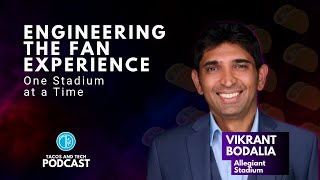
Vikrant Bodalia, VP of Technology at ASM Global, manages tech for major Las Vegas venues like T-Mobile Arena and Allegiant Stadium. He reverse-engineers fan journeys to design better experiences, handles massive events like the Super Bowl and Stanley Cup, and treats cybersecurity as a cultural program rather than just IT policy.
Startups get the party. Startups get the party started. Startups get the party. Startups get the party started.
You want tech and tacos, Tacos and tech, you know we got it.
Hey.
Startups get the party. Startups get the party started. Startups get the party. Startups get the party started. Startups get the party. Startups get the party started.
You want tech and tacos, tacos and tech, you know we got it. Hey.
And welcome back to the Tacos and Tech podcast. I'm your host, Neil Bloom and I'm thrilled to have on Vikrant Bodalia, vice president of technology from ASM Global. Hey, Vikrant, thanks for being on the pod.
Hey Neil, how are you?
I'm doing great. It is good to have you on here, good to spend some time with you and good to get to know a little bit of your story which really is the story of where sports hospitality and technology come together. Which anyone who, you know, majority of our listeners who are sports fans and technologists, we've all seen it apparent that what has happened to the viewership and what's it like to experience sport over the last 20, 30 years, but you've been on the back end enabling a lot of different experiences to change through multiple sports. We're talking basketball, hockey, football and all the, all the stuff about it. So I'm excited for this conversation. Do you want to give us a quick high level of what ASM Global is and then we'll dive into it?
Absolutely. So I currently work for a company named ASM Global Legends. We are a major venue management operator company. We have many, many venues all across the world that we manage day to day operations from finance, security, guest experience, technology. And that's where my role comes into play for Allegiance Stadium. Specifically where we oversee and manage all technical operations for the stadium. That falls under my purview is the background of my company and what we do at Collision Stadium.
Amazing. Well, we'll dive into that because obviously it's one of the newest stadiums. So therefore we're going to want to know, you know, all the cool tech that goes into it. But I want to dive way back into this. How did you actually find yourself into this field? I would imagine a bit ago technology wasn't as prevalent or maybe it was and therefore was the big pull the need there. Like take us back to a young Vikram.
No, I started my career early back in 2006, seven, eight time frame, where I used to be a help desk technician, remote desk technician working for a bunch of pharmaceutical companies. Back in New Jersey and I was going between jobs and whatnot and ended up getting a position with NBA the league office in Secaucus, New Jersey to be an in game technician. Little did I know when I accepted the position what the job entailed or anything around it. And as I got into it I my mind was blown because you're dealing with a fast paced basketball technology operations while the games are happening live. And as I got more and more involved into it, we had great people, smart people, learned a lot in the process. But that's what attracted me in a way to this hospitality entertainment industry is that you have a high stress, high pressure, but also high reward environment, creating an experience for fans and whatnot. So that's where I kind of got started being on the creative side, being on the innovative side. Again, the leagues have to constantly evolve themselves to create the fan base, to maintain the fan base, to keep the games exciting, let it be whatever league, the basketball, hockey, football and on the league side learned a lot in the process and which has kind of shaped my career over the last 10 years in the sports and entertainment industry.
Amazing. Well, take us through a little bit of like what you saw as a change even. Let's take, we can start at basketball.
Just because you spent a good amount.
Of time there, like did you. First of all, the audience wants to know like, are certain sports earlier adopters to tech than other sports and league versus teams? A little bit, you know, like how does technology actually come into sport? Like the, you know, a, the A level, pro level of sports? Like and how does it come to you at your desk?
It's funny because now that I have had experience with basketball, hockey and football, the leagues compete not only to get the viewers and fan base, but in the technology evolution as well in creating an engaging fan base. So they're always neck to neck is when one league is implementing a certain technology or advancing the other leagues are trying to either mimic or one up each other and whatnot. So that was a good balancing act is like hey, we're watching other sports as well. And that's what creates the innovation. And again the fan base is what's demanding when you want player stats, player tracking, our real time data, how you make the game more engaging and things of that nature. So you're always on that innovative side. So all leagues in my opinion are kind of neck to neck when it comes to technology evolution. But they're also trying to create more engagement, create more social media interactions, but at the same time not lose the value of fan watching the game in the stadiums, in the arenas, because it kind of goes in hand in hand. And the leagues have to make a balancing act on how a fan can enjoy the game in the venue versus at the same time watch it on their 90 inch screen in their own home. Right. And it's a balancing act on how we deliver those experiences on both sides of the world.
Interesting. And so having worked in a bunch of leagues and sports, you've got a lot of peers, maybe you know, some mentors, mentees that you're able to share and say, oh, what's working here? Try it. To us, how does that work? Do you rely on your network in that regard of sharing?
110%. We wouldn't be anywhere without our peers, our network, we always joke. So we built our own network every time I was at a league office. So when I was working at the NBA league office, all the NBA teams, we kind of joke about saying our teams compete on the court, but we collaborate off the court. And we used to do meetings, sessions, brainstorming sessions, how we can do better. But we rely on each other on making things better. As I fast forward into the hockey league, it's the same concept. And now that I am into the football league, it's a similar concept where our peers are our best advisors, if you will. And then having the senior management that constantly challenges us to look outside, think outside the box, look around the horizon and see what we can do. And every venue is doing some level of innovation and creativity every time a new stadium goes up. We are currently, as you mentioned, we are fairly new. We are about five years old now. But as new arenas and stadiums are coming up, they're constantly evolving. And how we can stay competitive to ensure that fans are getting the most experience out of the entire setup is how we focus. But again, it's a collaborative, sharing, communicative approach instead of, hey, this is my little ball, I'm gonna go play in my own court. Like, we don't really approach things that way. And I'm very thankful for the support mechanism we have in the industry. Oh, I'm sure.
And now having pretty much not just new stadiums, new expansions, I mean, we're talking Las Vegas as a city, which is the capital of entertainment, but now is the capital of sports, and that's really new. So you're kind of getting to be at the ground level of designing the sports technology entertainment experience from scratch. Like, what's that like? Take us through when you get a blank slate like that and a Magic wand.
Yeah. No, it's interesting. Again, in my journey, I moved to Las Vegas back in 2015, part of the construction and opening of T Mobile arena where which was one of the first main pro sports arena coming up in Vegas market. Again an opportunity was to open in a new arena in entertainment capital of the world and sort of shape the landscape of how Vegas was gonna grow into this sports and entertainment capital of the world. And we created lots of experiences between different events and whatnot. The first year we didn't have the pro sports team assigned to us, it was 2017 when the Golden Knights became official residents of the T Mobile arena. And then the first season they went to the Stanley cup finals and things of that nature. So it's kind of shaped the landscape of our Vegas city. And then the minor league arenas have in. We actually acquired a women's basketball team now that we have Allegiance Stadium and the Raiders and the UNLV play football there. So the sports landscape and in some shape or form. I had a level of involvement in helping the Mandalay Bay Event Center Michelob arena now in ensuring the technologies got put implemented the way they needed to. Because of my prior experiences with the wnba. Same thing with the hockey arena. The Golden Knights team operate and manage it. And I was kind of helping them and kind of advising in some areas. So I had some engagement there. Same thing with the illusion stadium. So I'm very blessed to be able to part of be part of the sports and entertainment landscape of Vegas market that I have had the involvement in shaping it. So super thankful and super blessed to be in the right place at the right time, I guess totally.
But also then having some of the top technology at your disposal that you get to put in from scratch, not necessarily having to do like after the fact. So I don't know, take us a little bit about transforming that. How do you go about and now be customer pulled like you talked about. But it's from the design phase to a certain guard, right?
Yeah, absolutely. And again it starts with creating the vision, creating the journey. The two favorite words I live by is reverse engineering. Right when we get engaged. When I first got into T Mobile arena during the construction phase, a lot of stuff was already in progress and we didn't really have a lot of changes that we could make. But post construction we went into like, hey, what's the end goal? We want the ticketing to work the way it needs to. We need fans to be able to get in, buy food and beverage the experience elements. What does that look like? And let's design it from technology perspective so it's an abler enabler, not a blocker or burden in a way. And then fast forward to Allegiant Stadium. I was very blessed to be partnered up with the Raiders ownership and we created a vision we executed with the technology as a backbone and had a business partnership. It was not just a technology is going to do its thing. We align our verticals in security, guest experience, ticketing, food and beverage and built our infrastructure in a way that allowed us to support and manage and meet the expectations of the fans. So it was more reverse engineer. What are we trying to accomplish? How can we make it seamless for folks to be able to get in and enjoy the experience versus be cumbersome on how you even get into the venue? Right. So that's been my approach in from design is what's the end goal and how can we make sure the technology is supporting it in any way we can?
And is there a difference in experience for a hockey game and hockey crowd versus football now that you've been, you know and that compare contrast a little bit, 100%.
I think Vegas is a unique market. The fan base we experience a lot of out of towners, visitors, the journey from fan and both sides. If I compare T Mobile and Allegiant, everyone wants a very seamless, easy experience. They want to be able to get into the venue so that they can enjoy an experience in the fans. Football fans are just more rowdy and more engaging versus hockey. But I think our hockey crowd that we see it, they get more engaging, they're technical savvy. The football side I see a little bit more tax savvy crowd than the hockey side. But no, the fan base, they all want the same thing and we actually are taking the crown in the industry is the fan experience and the game presentation experience that with the way we did it at T Mobile arena and it's the top in the hockey league and the way we do it at Allegiant Stadium, the halftime shows, the pre game shows, things of that nature, it again puts us at the top on the on the football league side. So fan actually enjoy that experience on the board side.
Well and I think you've been rewarded because of that. Whether it's being able to host the super bowl, right. Which is literally the biggest of the biggest shows or the team doing well and getting in the Stanley cup itself and getting to host the Stanley cup because of that's how hockey works. Right. So whether it's you know, front office or back office to a certain regard, you've been able to step up not just being in the pro leagues, but actually being at the top, top your game there. Like, what's that like? Is that a whole nother level of pressure to perform when you're, you know, playing in the championships in all areas?
I won't say it's. And we couldn't do. Yes, it's a lot of pressure. You have to be constantly on your guard. But you couldn't do a lot of these things without your team and things of that nature. Right. And in my past experiences, I have done NBA Finals, I've done Stanley Cup Final, I've done now Super Bowl. So again, being able to draw from experiences in different places. All the plan and prep starts before you. Like the minute you get announced, like, hey, we're getting super bowl, that's when the clock starts. In my opinion, from technology perspective, if you are two months, three months out and you're ready, getting ready for the event, it's already too late and, and being able to have good partnerships again. When we were in the first place playoff rounds in Golden Knights for the Stanley cup run, when we met and said, hey, now we're in the playoffs, a lot of folks, Vegas Golden Knights has not gone to playoffs before. This was the first season. A lot of the folks at T Mobile arena didn't really have a Stanley cup hockey finals experience in a way. So it's like, so we actually started prepping for finals more than playoffs and sort of again, back to the reverse engineering style and we partnered up with the league office and say, hey, what are your requirements? What are your mandates? How can we get ahead so we can build this out? We got this two months Runway or month Runway in playoffs. How can we maximize our efforts? Same thing with Super Bowl. We, we start our conversation a year prior. One of the things that NFL does extremely well and I'm appreciative and the good part on the NFL side is you have a venue that you already picked. So with the NBA and the hockey league, you don't really have a choice. Whatever team goes to the finals, that's where you're going to play. So you can't really proactively plan for football. You know which venue you're going to go to. So what hockey, what football league does is they invite the technology team for the next year to the current year and kind of give an overview and landscape on what the super bowl entails. And it's a huge blessing because you get to see the Setup, you get to see the involvement. So we went to Arizona where Super bowl was getting hosted in the previous year. And as soon as I came back next day we drew a draft out our plan. We had documentation ready for approvals from our CFO and saying, hey, we need to do infrastructure upgrades, grids, we need to start putting things in parking lots. So we went to work right away saying this is what it's going to take to do a Super bowl as seamlessly as we can. And, and so yeah, you start doing a lot of this work well in advance, just like in any other technology implementations you would do. Sorry, a long winded way of saying it.
I know it's great. I mean it's, it's, it's totally true, right? Every year, whether it's totally dependent on how your team's going to do. Except in football, when you, you're regardless of how your team can do, you're hosting, right? If you're tapped to be on. So it's kind of interesting, kind of the flip around that so related that like what take us maybe use it super bowl or other ways like what are some interesting systems or innovations that kind of go into that knowing you've got kind of the consistency year in, year out around that.
So from super bowl perspective there are a few. I learned this from one of my mentors in the early on, when you look at any major event back in NBA Finals in my career, control the consistent items, right? Like we know certain things are going to be required, so let's make them best. So when we talked about super bowl, we knew that every super bowl that's hosted you break records. When it comes to WI Fi, when it comes to network, when it comes to bandwidth, when it comes to viewerships, you are going to break records. So we knew that we had a target on our back in a way or we had a goal saying we got to beat last year's numbers, whatever venue it was previously. So we went into enhancing our digital network footprint from WI fi to bandwidth to fiber infrastructure so we can manage it appropriately and create a robust experience for the fan. NFL also helps messaging, the apps that they put out so that fans can do a journey and what that looks like. So it's a handshake. But we start creating a robust infrastructure because we know that there's going to be a beat down on technology that's going to come. So let's power it up in a way where we can take the beating. When we have 75,000 fans coming into the building, we can sustain that beating and set the record. So that's the mindset I brought into the mix, is like, all right, let's enhance our infrastructure so that we can sustain whatever comes our way.
Got it? Yeah. I mean, it's some of the largest audiences in crowds right on record together. And we know with crowds and a lot of users come. I don't know, cybersecurity endpoint issues or just right. Like vulnerabilities, let's call it right. How do you plan all of that into the. The protection and cyber piece?
Cyber is one of my favorite topics. I'll give you a quick story. When we were in construction phase 2020, and we had a turnover from construction into operations, and we're feeling, like, really good. And we're like, hey, we're going to have one of the best technologies and everything is working the way it is. And then I think it was 2021. I think it was 2021 where NFL did a cybersecurity audit on us. And they go through every league, every venue, and it's a standard process. And I'm expecting, like, great results. And I'm like, hey, we're going to be great. But when we looked at the results, it was bad. Like, it was really bad. Like, we. And again, a lot of the construction button up didn't happen. So it was a huge ego crusher. It crushed me in many ways. But then I took the entire audit and I studied it like nobody's business and started. I mean, you got to fail miserably to succeed at something, right? And that's the story. I lived and as I went through. Took us good two years to get a program in place. From a cybersecurity perspective, that gives us the robustness that we need today. We had to itemize every vertical, every application, every network in a way, and say, hey, how do we make this better? And as we were doing it, I learned two or three things very quickly. Cybersecurity is not a system. It is not a cliche word. It's a culture. You have to live it, breathe it. And not just you. I can be the cybersecurity superhero, if you will. But if my departments, my peers, are not living, breathing in the same way, then it doesn't work. You can have systems that will help you secure your posture, but it's also driven by the process. If systems and process don't come together, then you're not going to have a very good solution. So to answer your question, to get ready for the Super Bowls or any other Major event. It's not a day off or month off or whatnot. It's a culture we have embedded into folks new hires training program, our folks training program. So it's a culture that we live day in, day out instead of hey, we're just going to make sure that nothing gets hacked. And again having tabletop exercises and training folks how you can get phished. And we do of government agencies offer program to test your robustness from your cybersecurity program. And we sort of let I let it loose. I'm like come in here, break us. Because there is no better reality check than a third party coming in and try to penetrate your network and things of that nature. And the people that do get victimized, they also learn in the process. So we play a game a little bit of shame as well as training to ensure that, that it's a cultural thing. And we all are going in the same direction when it comes to cyber security. Cybersecurity is my favorite topic. So sorry again, long winded way of.
Saying it but no, no but you're, you're right in the culture side like it, you can't just, you know, can't just be a buzzword otherwise that's every vulnerability is left open there if people aren't vigilant about it. And so it's year round just like you said. You know, you're planning for events year out and year round. So is there really an off season and a during season or are you just always on like 12 months?
We are always. It's like any athlete or anything. Again, it's like if you were to run a marathon but you just wake up one day and it's like, hey, I'm going to run a marathon today. That's not how it works. You train and train and train and then go run a marathon. It's the same mindset that we have when we do have off season or off time if you will. We are doing maintenances, we're doing vulnerability patches, we're doing training, we're making sure our defenses and systems are at running top notch. So when it comes time to event mode or game mode, we are ready to just rock it. Like that's the mindset we do. So yeah, to your point, there is no off season or off time. We are always trying to get ready to ensure that we're setting the benchmark in the industry. Awesome.
Well, I know because of that, you know you were honored recently at the Las Vegas Top Tech Awards and congratulations. Well deserved.
Thank you, thank you.
This Is a unique. I find it unique honoring where you know your peers are recognizing each other from technical excellence. What did it mean to you? Take me through that a little bit.
Again. I got a little story on the Top Tech Award as well. I watched Top Tech awards for last six years of my career. When we went through T Mobile arena it was hosted and presented there. We would do all the work in the background, the music for the nominees, doing the award presentation ceremony, the lights, the music. We did it on the ice of few times as well. So I used to always watch and we were working the event of course. So I used to watch and I'm like what would it take for people like us to get recognized and whatnot and never really found the window. Fast forward we opened Elysian Stadium and the Top Tech Award was hosted at Allegiance Stadium for last few years as well. And then last year or the year before when I got nominated again, super thankful for my peers for nominating me. I thought it was a spam email when I got the nomination. I'm like what is what, what? And then the entire journey was just, just unbelievable. Super thankful. They made it super easy from photo shoots to things of that nature and then actually getting the award. I'll be honest, as the board presentations were happening, a lot of folks had speech written and whatnot and I'm not expecting anything so I'm like you, I'm just gonna show up. So I didn't have a speech ready and whatnot. But going through the entire process it was very refreshing and encouraging the journey that people go through. And again a lot of the times technology folks are just sitting in the background. We're making sure things are working, things are safe and having this platform, getting recognition articles in newspapers and media and things of that nature, it's very refreshing for the next generation to come. Or the peers is like hey, okay, this is something now I need to shoot for and how can I continue to drive that? Excellent. Not saying nobody else is doing a better job. I think everybody's. We're also technology people. We are IT people, we are introverts. We like to hide under the rock. Bother me, I don't want to talk to any. We are antisocial. Right? So this is a great platform for the like minded folks, the like personalities to mingle and be a little comfortable in this situations. Right. So it's an amazing experience. Again, hats off to Cox in putting this program together and yeah. And for the new generations to come. It's, it's a. And the, the city Just keeps growing on these sports and entertainment sites. So it was a, it was, it was an unbelievable experience.
Yeah, well, you know, you've worked with Sarah Brown. She, she doesn't, she doesn't joke around, around this. That wasn't spam, that was the real deal. And you know that. So you know, now, you know, shout out to Sarah. We, we love working with her as well too. So let's talk about, you know, broad, broad industry trends. Like what do you see coming as kind of the next in venue tech that you're excited about?
Looks scary to be honest. The reason I say that is the demands keep growing again. When we first opened a venue here, a 10 gig Internet circuit was plenty. Now 40 gig circuits are not enough and 100 gig circuits are not enough and things of that nature. So as you watch the new generation, new landscape of the entire entertainment industry, the content is getting richer. The immersive experiences, the fan presentation like again, sphere is a great example of how immersive the fans want to be. Like if you just have few scoreboards and people are watching game, you have multiple TVs, people have video walls in their own houses now to watch games and things of that nature. Right. So in the technological evolution, how is that fan experience and journey getting shaped and how are we making it seamless? It's more like how you give a competition to in home experience. Right. The surround sound systems, folks have stuff that they have on the phones, things of that nature. So that's what we got to compete with. So it's going to get richer, it's going to get more engaging. And then on the other side is the magical or most used word, two letter words these days is AI. How are we using the AI in creating the fan journey and experience again in the new landscape? Your face is your ticket, your face is your credit card, your face is your entry to the places and how you evolve that and implement that at a venue level. And again, when you're looking at it in a small landscape, it works great. But when you do it for 70,000 fans, 65,000 fans, how can technology be abler but at the same time from the fan engagement perspective? So again, a lot of moving pieces, it's scary, but that's what excites me is, is it's a daunting task that's ahead of us and we gotta get ready for it. So yeah, totally, yeah.
And I think you kind of said it in a few times. What has been behind the scenes is becoming, you know, front and center to that expectation of 24. 7 connectivity. Right. But now the actual experience of tracking face and everything, does that change your role you think going forward then in terms of how you integrate and look for new technology to reverse engineer into the experience.
110% we are no longer it, we're no longer technology. We are business and technology leadership. That's the way I see it. And what I mean by that is every vertical, name it, security, finance, guest experience, events management, technology, apps, systems is the driver behind everything. Right. So we have to now take a step back saying I can't look at it from just ones and zeros perspective. It's a business operation and a business decision. At the end of the day. A lot of the other departments and again I pick on security and few others, they're also a little bit more technological savvy. People want to build different integrations and whatnot. So now you have to sort of elevate your landscape and how you manage a business as an operation instead of just technology as an operation. So I think I've seen our roles evolve into a business operations instead of just a technology because it's just one piece of it. But we're not driving the entire organization and its technological culture.
No, but when you reverse engineer the fan experience to feel like you are part of that even more and enhancing not just the experience, but you know, unlocking opportunity to now have the funds to put more into technology and to go out and seek technology from your peers and your partners who are doing it in another league and say look, this is working there. I know how to integrate it here. That's going to feel really empowering. And so I'm excited for, for what you are going to lead us to at our next experience here and our next super bowl hopefully also I'm sure will come around pretty quickly since you're one of the newest venues around no.
100. We have the entire deck stacked for the events on upcoming at Elysian Stadium. We have some again, I don't even know what the announcements are but we got final football, college football, final four, some fights and things of that nature. So we're gonna set the benchmark in how to execute some, some insane, crazy events. Again going through WrestleMania earlier this year, it was an insane experience and it was, it was phenomenal just continuing to set the benchmark. And the other part which I didn't even, we didn't even talk about, but not only we reverse engineer the way I reverse engineering things of that nature, but I also partner up with the leagues, with the promoters with the clients. So WrestleManias and NFL's and look at it from their lens saying what are they expecting and how can I make their journey a lot faster, easier, convenient when they want to come into my building so that when they want to come back again, they are, dick is over there, we don't have to worry about it. Right? And when I hear those lines, that's a compliment to me. And my team is like they now feel comfortable in what we have put in place. So understanding it from the other lens on what the partners, what the events, what the clients want and how we can design it appropriately. It's a feather in our cap for many aspects. That's a great point.
You're kind of always winning and always on display to show that come back because we can do it next time will be even easier if you did it. All the work up front too, all the brain power there is too closing out here. You know, Las Vegas being the city of, of sin of entertainment and now of sport, also city of food. And this being the tacos insect podcast we got to know. So enlighten us. Do you have a go to favorite spot that you go to for, for tacos locally?
Yeah, no, I, I, I won't say it's a dedicated taco spot, but my favorite go to place is Casa Don Juan. I love, love, love that that place. Their tacos are amazing. Their enchiladas are amazing. Their, their food is just, just beyond amazing. I love that place. Every time I have either friends or family or clients visiting, I'm like, we're doing lunch or dinner at Casa down one and the one on the main street. I think it's one of the original ones. They have a few branches now, but I tried to like to go to the original one. I love that place. Absolutely love it, love it.
What's the, what's your go to order there? Do you have like the one thing or you always try new stuff?
I try new different things now. I'm blanking on it.
All good.
Dang it.
We'll link to it. All good. Don't even worry about it. We love to add it to our taco database, which we do keep up and have a visual aspect to it. So we'll put both them in there. The one both on Main street and on Buffalo Drive, I think. But this is awesome. Vikrant, this is so great to spend some time with you. Thank you for leading the way of showing the proper way to enjoy sport in person and just excited for what we will experience next.
No Absolutely. And the one thing I always encourage my team and I do it as well when we go through difficult or hard, I don't want to say difficult. The hard, long planned event, WrestleManias, Super Bowls and a lot of effort goes from everyone. I do encourage our teams to go out there. You have worked your butt off on putting this event on. But go out there, enjoy the event for five minutes and watch the fans around you. And even saying this, I get goosebumps because just seeing the fan having a moment and enjoying themselves, there is no better feeling then. And I tried to do that at least a few times in major events that we host to just go out there and watch the fans having time of their life. It's the best experience. And it feels very. Again, you're not getting pat on the back when nobody's congratulating. But what you feel so rewarding in creating an experience in the journey for fans that have saved up their money and they are now coming to your venue to enjoy that experience. And seeing them smile and feel excited excites me. So that's what keeps driving me in many ways.
Yeah, it's the super fulfilling. It's kind of your own version of currency of why you're doing it in that regard, to see the customer delighted. That's what we're all after, right? Is solving a bit of a problem in a really elegant solution with some taste behind it, you know. And we'll congratulate you for doing it on the largest stage. So thanks again, Vikrant. Appreciate it and all the best.
Thank you.
Tacos in tech is on smash for the green guacamole keeper Countins counting beans Contador Quentan Frijoles found us trying to raise some queso la vida San Diego school of rappy rapping Fire tortillas round jalapenos in these modern times A craft beer and coffee my coding yoga posi fold the body origami we be surfing Coronado eating tacos el gordo the taco stand in presto Lucha libre and sombrero gotta shout out to cost Angels by the ocean Watch the sunset La Jolla shores Entrepreneurs trying to get funded When San Diego startup week is popping in the summer Oceanside the Tijuana esti be full of hustlers from couch surfing to penthouses right on the beach Tech leaders who believe stars are within reach we interview and founders who be shooting for the Moon SD TechOS with your host.
Neil Bloom Startups get the party Startups get the party started Startups get the party Startups get the party started. Startups get the party Startups get the party started.
You want tech in tacos, tacos in tech, you know we got it.
Hey.
Startups get the party start. Ups get the party started. Startups get the party, Startups get the party started. Startups get the party Startups get the party started.
You want decking, tacos, tacos in tech, you know we got it. Hey.








