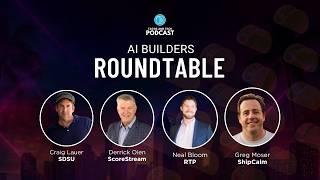
Founders discuss how agentic AI tools like Claude and Cursor are reshaping product development. Craig built LaunchMate, a cloud-based AI co-founder platform. Derek Oehn of ScoreStream demos rapid feature builds and a blockchain prototype that tokenizes API access, while Greg Moser describes turning ShipCom into an AI-native organization.
Chapters
All right, welcome back to the AI Builders Roundtable, Episode 3, uh, with more besties around the table, people I go back 10, 15 years with now. Man, uh, this is pretty fun. Well, This AI Builders Roundtable has gotten some legs. So now it's a table with legs and everyone's building something both here on the— we're going to do some demos, but we're also, you know, people are building in public everywhere. So what was OpenClaw a few weeks ago, now there's derivatives of that. Why don't we do a quick round of intros and then we'll dive right into it. Craig, why don't you go first? Then Greg, then—
All right, well, I'm back. This is now— this is now our third instantiation of this. This is great. Hope people are enjoying it. I sure am. It's a good way for me to kind of clock. So, uh, I'm, uh, currently a longtime San Diego person, had— was— spent 20 years at Qualcomm, uh, in the very early days. So early days Qualcomm, then angel investing after that, and subsequently now working alongside Neal Bloom at San Diego State doing a workshop for students, uh, called Launchpad. So we're, we're kind of front and center with helping students launch businesses.
So, and using AI bots to do it and help them, of course. Yes, which is featured in episode 1, so you can go back and watch episode 1 of what Craig has been building called Launchmate to help you, uh, have an AI co-founder, if you will.
Uh, Greg Moser, Yeah, I'm Greg Moser, co-founder and CEO of a company called ShipCom. We partner with emerging consumer brands to help them grow their operations and run their operations effectively. And I also refer to myself as a recovering software engineer. I spent probably, you know, 15 years of my life as a software engineer. And now I've been sort of self- tasked with reinventing our company as an AI-native business, which is in some ways more challenging than starting a new company from scratch as an AI-native company. Sort of how do you convert a 100-person organization into being AI-native and AI-centric? And so that's what we've been up to at ShipCom, and I got back into building because of it. And so thanks for having me again this week, Neal. This is a lot of fun.
You got it. Now, it was fun to have you on last week. You can— everyone can— we'll put in the show notes what—
where the—
where the— where Marvin was at last week. And well, I'm sure we'll hear a little bit of where is it one week later when— especially after we see what Derek's using. Uh, and so before further ado, Derek Oehn from ScoreStream.
I'm Derek Oehn. I'm on my safe box, which is agent dev. So, um, yeah, I, I'm the CEO and co-founder of a company called ScoreStream. We're a crowdsourcing platform for, um, high school and local sports. Um, and I've been doing startups in San Diego for about 25 years. Um, a bunch of different stuff. And so yeah, super excited. The last, I don't know, last 5, 6 months have been insane, especially the last 2 months. So happy to, uh, share some of the stuff that we're working on.
Yes, lots to do there. Why don't we take us through your lens before we do demos? Like where everyone kind of has their red pill moment. When When, what, when was it that suddenly you said 2 months ago, I'm trying to picture what came out then that pulls you in. Was it Claude, Cowork, and, uh, and that being like, oh, I can build.
No, no, no. Um, so I started doing some stuff for a bit in August of the, in the fall. Um, playing with Claude, uh, Cursor primarily at the beginning. And, um, I built a tool that was like a, you know, we're a small team and so we have sort of our core infrastructure, which, um,, you know, my co-founders who are technical need to spend time on, but we have a lot of user requests for different small things. And so one of them is like photographers. We make people upload one photo at a time, which is not a good experience for photographers. So I used Cursor to build a photo uploading tool. Um, and it was, it was pretty, I, I did it as a, um, a showcase to my co-founders who are technical. I said, they're like, oh my God, this is amazing. This looks great. I'm like, cool, roll it out. And so we pushed it into production. It's very lightly used. But then the 2 months ago was Opus 4.6. And that was like, holy crap. And so I did another project. We have a bunch of users who want to— we also make them schedule games one at a time. So I created a batch uploading tool using Cloud Code. And then the larger project I've been working on for a while, which I'll share, is— we've, there's a whole bunch of stuff going on in around SEO and things like that. And we score right now at this time of year, we score about 15,000 to 20,000 games a week and we license our API to third parties. And we have a lot of people who want to get, you know, more regional or local markets. And so when we give them access to the API, they get access to everything. And so then, you know, for several hundred dollars a month, I have to make sure they're not stealing all the data. And so we've been looking at some opportunities around some blockchain things.. And so I've just completed a prototype of publishing to the base blockchain and then creating the side part where consumers can purchase à la carte score data and schedule data. So that's been, and that's crazy because it's like technology, Solidity and other things I would, you know, like way far away from anything I would ever learn. So it's been that. And then OpenClaw, you started creating like bots, you know, mostly for experimental basis to stick into games and have them chat with users and whatnot. And It's hilarious just to send your bot off into a game and it just does its own thing without any instruction. And so it does dumb things, which I'll share in a second. But yeah, it's been really— I had told a friend, I was in Georgia last week, I was telling Neal Bloom before the call, you know, to me this is very similar to that time when I was using the internet before browsers. So it was like FTP and Usenet and IRC. And then when the browser came, I was like, holy crap, this is a whole new world. And the agentic coding stuff feels the same way. It's like this is just a whole different world and super excited about it.
Yeah, it's— it is a whole new world for sure. And I feel like people are jumping off the sidelines who have not been building in a while from a code perspective. I mean, Derek, I don't know if you— for the entire— I've known you, I haven't known you to write a line of code per se, even though you've been building software companies. So seeing you and others jump off right here is pretty fun.
Yeah, 2 to 3 years I learned Python before Yeah, before that had been probably 20+ years of C++ and Java and stuff like that. So yeah, it's, it's a— thankfully I understand infrastructure, because I think that's— for people who don't know any coding or infrastructure, I think if you understand some infrastructure, then you can do this stuff pretty easily.
I gotta ask, Derek, like when you got, uh, like when you, um, or, uh, used Cursor to code up the new photo upload feature and then you showed your technical founders the thing and we're like, let's go push it into production or whatever. Talk to me about that experience just for one second because I've been around a lot of these experiences recently where it's like the non-typical technical guy shows up and it's like, look, I built this thing, like just deploy it into production. And the technical people are like, I don't know what's in there. And what you like, how did that, was it okay for you and your organization or was it problematic?
We do like what we call war room at the beginning of the football season because high school football is our biggest time of year. And so we were all together because we're usually virtual and we were all together. I was like, hey, check out this tool I built. And they were like, kind of to your point, they were drawn back at first. They're like, this looks pretty good. And so then I was like, okay, well, I hardcoded my sort of user login and I had it, I had it, I used Cloudinary for it. So basically did the whole thing parallel to what we would do. And they're like, this is really good. You probably use this. I go, great. Well, let's migrate. And they're like, okay. And it is a small use case, I think. Everything I'm doing is sort of non-core production stuff. I think with, with Opus 4.6, I think you could start to do— I'd feel more comfortable doing production stuff now. Yeah. But I think back, yeah, back in August, September, I was not. I was like, these are interesting little tools for a very small subset of our users. That's not going to bring things down. Yeah, they've been supportive. Yeah. I haven't shown the blockchain stuff yet. That's going to blow their minds, I think. But it's pretty funny.
That's cool. A little tease there. Oh, I didn't have that on my bingo card. Blockchain, right?
That's good. Yeah. Well, the blockchain stuff's interesting. I think the, you know, so the key piece is that I could do à la carte API licensing. So I can like, you know, someone pay a very small amount of ETH and they can get a whole bunch of scores. And so it keeps it very— I don't have to babysit them. They can take whatever they want. I don't care. That's one piece. And the other part is while we do a lot of high school stuff, we think we originally started this with looking at creating our own token because we are users. It's crowdsourcing. So our users score games for Magic Internet Points and levels and badges. And so I was like, well, let's make a token. And so the regulatory landscape around tokens is brutal. I spent 6 to 9 months trying to figure out how to do this without getting sued, and I'm still not comfortable. That's not possible yet. So, you know, there's like SEC declined to prosecute letters so far., but publishing to blockchain makes sense, I think, especially the prediction market stuff. So if you look at like Kalshi and Polymarket and even Robinhood and Crypto.com, they're doing a lot of stuff specifically around sports. And so we thought there's some interesting things to do downstream, potentially giving tokens out for score data. And I think a lot of these, even with the agent stuff, right, the idea that an agent could have a wallet that could purchase score data and process it in the background without having to go through a normal direct API integration, right? They can just grab it. Get some JSON and off you go. Very cool. I'm so—
I'm like, so I so don't understand this at all. Sorry, this is my naivete, Derek, but maybe, maybe somebody else who's listening won't understand either. Why is blockchain necessary to sell access to the API? Like, why are— why is that a good, like, use case for blockchain? Like, how does it enable, you know, giving access to your API data Let me demo it for you. Yeah, okay, cool. All right, there you go. Segway demo. Is that okay, Neal? Are we allowed to demo Segway right now?
We can do that. I was gonna go a little more macro, but that's fine.
Oh, all right, all right. Sorry, I get us off the rails too fast.
No, all good. We'll come back around, maybe, uh, talk about where like OpenClaws turned to Ironclaw to turn to everything else once we see what Derek's running, which claw.
Sorry, me, uh, I just put Zoom on my dev box, so give me a second to, uh, my permission set up.
What is your box? You have asked OpenClaw. You didn't ask OpenClaw to install it for you? I would have had it all set up.
Um, oh no, I have to quit and reopen. Leah, I think I have to let back in.
Sorry.
All right, all good.
We can go back to macro then. So Neal, I, I think, so to me, I mean, so one of the, one of the fascinating It's more of an architecture question, but for those of us that have been around, right, we used to build applications, install them on computers in the '90s, and then the 2000s came around and we realized, wow, it'd be great to architect solutions and put them in the cloud. But now, so much of the value of these large language models have to do with the harness, right, that essentially is the interface for you to leverage tools and resources, that so much of the value is marrying tools and resources to the model that we're actually reversing course again. And for those people that are bold enough to put software back onto your local machines instead of in the cloud, you, you potentially have so much more opportunity. And so we actually architected LaunchMate to run in the cloud, and we found ourselves almost limited because we don't have access to the kinds of tools and resources we could have if we were running locally. But again, the world is not set up to have a bunch of people running things locally. So it's, it's a brand new world. I mean, I think it's really an exciting place to innovate because as that shift happens, I think we're going to have to rewrite and reinvent a whole infrastructure of software to make that safe, scalable archive, you know, sort of So this is going to be a fun time. I mean, that's kind of what's been on my mind since the last—
Craig, I'd strongly agree on this one.
Strongly agree, right?
Like I think that, you know, we went through a period of time where it was like, oh, can your software run in the cloud or can it run at AWS or can it— when it was all moving from on-prem to like, well, we kind of want this thing to run in the cloud so we don't have to manage servers or whatever it is. I think we're going to go through a similar thing, which is like, oh, this tool is all cool, but can it run on the edge? You know, can it run on my new— because there's there's definitely gonna be more prolific laptops that are built with kind of GPUs and things like that to be able to make edge compute of AI much more cost-effective and all sorts of things, right? And so I'm sort of strong agree that I think we're gonna go through that cycle again, but in the opposite direction.
Yeah, and I mean, just today, Quinn, a new model was released that can run locally on a Mac. That's every bit as powerful as we're seeing from the large labs. So once you add a harness with scheduled cron jobs that can fire up agents and run locally, and duration starts extending out hours, days, weeks for agents, and a locally grown model that can run superintelligence on your, computers. I mean, we're, I mean, overnight we're looking at a brand new landscape of software architecture.
So very, it's interesting to, I'll just to pull it back to the macro, you know, there's a lot of belief system that, you know, these massive data centers are going to be required for all the AI compute. But actually, if you look at leveraging the volume of edge processing power there is, it's like, wait a minute, actually, maybe we don't. Maybe this isn't actually going to be run all in massive data centers, right? Like, actually, maybe that is some of the solution is by decentralizing a lot of the actual compute to do this stuff. So it'll be interesting to see what happens over the next 12 months, right, as, as these solutions get more baked.
Well, I— question from different architecture standpoint, and this will be a good transition back to Derek if you're ready, is just like every week I want to start and I'm like, but I don't, I don't know how to start architecting because I feel like next week I'm going to have to scrap it.
Great.
It's like, give you the great advice. He gave you the great advice on our first episode. It's true. Cloud, cloud co-work is the perfect hybrid right now. Yeah. True. Not as, not as, let me recap. It's not as a bleeding edge frontier. Oh, scary that OpenClaw is. And it is not as harnessed and restrictive as cloud agent architectures are in the cloud. I think Claude, and if anybody on the, you know, the Zoom is interested, I think Claude Cowork is the perfect starting place for this new agentic universe.
Not to mention that its CEO doesn't think our government should have Terminators, which I think is like a good thing, you know? I can align with that. I could be like, yeah, Terminator seems bad to me too.
Yeah, it was okay for Venezuela but not okay for Iran is what you're saying.
Got it. Okay, I have a couple of defense tech companies, so I may be, uh, I may be, uh, too much skin in the game.
You're very Terminator on is what I'm hearing, Craig.
You're very pro-Terminator.
Nuance there.
There's nuance. Derek, why don't you take us through how it started for you?
Yeah, for sure. So, um, so I'm gonna go right to like what Greg— the question Greg asked. So, um, quickly, see my screen? Okay, the right screen. Can you see settlement layer? Okay, cool. So yeah, so this was— I did the photo upload thing where you could go in the game and do stuff, and it's pretty rudimentary. And then a scheduling tool, which was pretty fun. That was like, we have a lot of users say, I put my schedules on MaxPreps and I want to put them into what we're doing. So I built this, this like took half a day. And so basically, it hits our API and it goes through, reads the PF. Demo fail. I think my railway died. So anyway, we'll go back to that later. I will go back to work on that. But this is the piece that we've built out that really speaks more to the blockchain piece. And so we score, as I mentioned, like 15,000 to 20,000 games a week. And so I can go in and say I want to look at Pennsylvania. And this would be conceptually down the road, this would be all automated, not manually pushing this. And also we'd allow third parties to publish. So if I look in Pennsylvania last Friday night, There are 22 games there in the playoffs at this point, and we have our own internal methodology for how we rate games for verification across the crowdsourcing piece with user history and cross-referencing with other parties. So I'm going to look at these games. I want to publish them to the blockchain. I have to connect my wallet here. And so I'll publish these scores. And from a publisher, it's a small amount, but so that'll publish very quickly. And so the reason for— it's been published successfully. The reason why we would do this instead of an API is that a third party can come in. So this is a user just coming in a consumer portal, then connect their wallet. Refresh on that first. So connect the wallet, I can buy some credits, and if I want to go in and look at Pennsylvania same day, I see a bunch of games that are locked. I can buy credits. I'll buy 10 credits. Now it's done. I can say which games I want, or it could be a batch, whatever. I can unlock those. Sorry. And now you have the scores. You can actually go down and download the JSON. So I think the key part, Greg, for me is that I don't have to talk to third parties. They don't have to get an API key. I don't have to monitor them. You can set up a metered system. And I think just it sort of becomes a decentralized distribution of this data. And part of this, some of the thought around this was a lot of the SEO stuff, a lot of the AI agents are just basically scraping our data and repurposing it into the models. And so how do we isolate this stuff off?
And so that's kind of the background for it. And when you went to add the scores, sorry, I don't know the platform super well yet, but when you went to add the scores on the other side, you mentioned sort of crowdsourcing of this data. So is the way your tool works like parents are sitting in the stands and they upload data or whoever can kind of upload data to your guys' platform anyway? So you're getting the data from a distributed sort of a crowdsourced modality?
Yeah, absolutely. So if we go in, so we have a whole framework. So if I look at, I can show you stats, top games last Friday night, that same night. These were games from last week, that same Friday. So if I look at this game and look at the backend, these 3 different people were scoring the games. But during the football season, we have 50, sometimes 100 people scoring a game. And so we have a whole algorithm on the back end that does that and out of that creates a confidence grade. So this has a confidence grade of 99, which is, it's not 99% confidence, anything, but anything above a 30% confidence, we publish like to live television. We currently have like 75 TV stations that we do real-time score data that we send out. But those numbers correspond with these, the different confidence levels that we have here. And so from a syndication perspective, if we have a low, like provisional someone could go in and look at that and verify that score and upgrade the score, the confidence level. But these other pieces were confident. And one of our partners is the Associated Press. So basically the Associated Press verifies all of our scores depending on the season, depending on the sport.
Got it. But this blockchain, does that give any— it doesn't give any compensation to the people who put in the scores the first time. It just gives compensation to you guys, right?
No, we want to do that. And the reason we want to do that is like, so here's a user from a game today. He's been in 160,000 games since 2020. And so they've scored these games each year, they do stuff. And so we want to create like a token to give them some sort of value for that. And those tokens could be things that also could be used to redeem score access to third parties and create liquidity. Makes sense. Yeah. And so we've also been doing a bot thing. So that's more of the OpenClaw. And so I had a game today where my user Drobot was in here saying good game, whatever, just chatting. Basically, I said, go talk in this game and chat with people. And some of the things I think in OpenClaw, he's saying, yes, Cubs 9-17 while you're down. You're losing. And at the end he's like, this is awesome. I'm like, why would you say that? And he is like, oh my God, you're right. And so then goes in and updates its, you know, its different frameworks. So, oh, in the future I'm gonna do this, I'm not gonna say that, whatever. So that's been, it's been hilarious. I think the, the cool part about OpenClaw for me is that, that, you know, perpetual learning piece that's really interesting where you can, you know, every day my bot at midnight takes whatever learnings it has and feeds that in. Although, you know, these things do break and they're brittle at times still, but But it's been really fun to play with it.
Is this the SOL file or the SKILL file or outside that where it's being—
you're adding? It's a combination tool. A lot of the tool— it migrated my stuff to tools recently. It used to be in sort of the larger file, but not SOL. But yeah, I have those all running on a Mac Mini separate from everything. Never, you know, just none of my main accounts on it because I'm terrified of what it can do. I was telling my wife, I was like, she's like, well, why weren't you running it on your computer? And I said, well, you could tell it to build something. If I ran out of disk space, it would delete all my files because it needs it for the, for the job it's doing.
So, so Derek, I, I, I've been talking to a lot of startup founders and, and, and everybody sort of has top of mind like, okay, AI, the surface area of AI is so large. How do we focus on how it affects our business? So it's, I'm sort of hearing two stories. I hear some stories from founders that are like, hey, let's figure out how to get some low-hanging fruit, big wins, extend our value proposition. I have other founders who will say, uh, boy, AI is actually very threatening to us if somebody were to attack our secret sauce. So we need to do that ourselves and go and kind of refashion how we think about things. Where do you sit on that spectrum? Like how, how do you decide what to focus your team or yourself and your team on?
Yeah, I mean, I think we've been very successful on SEO and so SEO is certainly under attack from an AI perspective. And so that's something, you know, there's a lot of thought like how can you still provide data to third parties without the AI company stealing all your data and your perplexity was the worst about that. So I think that's at the one side. On the other side, it's like, How do these systems change over time? And so a lot of our partnerships have been with, you know, our investors are like Sinclair Broadcasting, iHeart, Associated Press. So we work with a lot of media companies. And right now we see things like the Pittsburgh Post-Gazette is done in May. Pittsburgh will not have a paper in May at all. Nothing. The Washington Post got rid of sports, you know, 4 weeks ago. No sports in the Washington Post. You know, the D.C. market's a classic high school sports market. And so for us, it's like trying to figure out where's the action moving. It's moving away from media companies and into things like the prediction markets. And so, you know, I think some of these things around creating distributed score distribution and actually the ability for third parties to even contribute to that starts to set up new frameworks, I think. And so I think net-net, it's a big opportunity. But I think if you're just sitting here and waiting to see what happens, I think that's bad. I think you have to wade into it. Made some mistakes along the way, but I think that, that is really a big positive. Yeah.
Do you think that like right now, do you get most of your new— so it feels like the, the like lifeblood of your business is the network, right? It's the fact like you guys do have a bit of a moat around the fact that it would be like I couldn't just start an AI company tomorrow that rips off ScoreStream and be like, oh, hey, look here, it's now and it's free or something because I did it cheaper or whatever. It's like I got to go through a whole education thing to convince a bunch of moms and dads across the country to give me their kids' score data, I think. Right. So like you guys have a bit of a network moat around it.
Is that fair to say? We have annually, we have about 10 to 11 million users and then we have about almost 200 TV stations we work with as well as Associated Press. So that's taken many years to build up. And right. And I think we also focus on very specific things. So like our biggest competitor is MaxPreps, which is a it's more of a media company. We're all about real-time scoring. And so it's a different animal. It would be really hard to replicate what we do at this point. Right.
Yeah, that's what I think. And mostly just because of the network effect of like how many people are signed up for it and like you're the kind of the incumbent now that's, that's doing this thing. So that's, I feel like that's one of the more defensible positions right now given, you know, software at large.
So that's really cool. Yeah, I think features and stuff like that are not. I mean, and I'm sure we, some of the, I have a call tomorrow with some people talking about accessing some of the blockchain stuff conceptually. And that there's a lot, a big learning curve for people on that too. I mean, this is not, that integration is not easy, but the alternative is a very expensive API licensing model. So it'd be a lot more expensive.
So I'm curious, I mean, not to go too deep on the Squarescreen, but so are you looking to become kind of the trusted source for prediction markets?
I think that we were able to grow in the United States through our media partnerships. And if you look at the rest of the world, we had some success before COVID internationally in niche sports like American football in Germany, like the GFL and the British American Football League and stuff like that. But the reality is they've gone well past local media and those markets are all gambling, they're all wagering. And so for us, we're like, if we could introduce a token, create a framework, then we could go in, crowdsource, Like in the UK, there's like 25 tables of European football, right? You hear Premier League and Champions League, but there's like the Isthmus League and then whatever. And so we think the same model we've done with ScoreStream around crowdsourcing could be used to get like 10th or 12th table. And if you had a token that had some sort of compensation, then we could set up a framework for distribution using blockchain to prediction markets.
Interesting. I think, you know, I think one of the things that you touched on is really important about, you know, how a company can't just ignore this stuff is happening and has to sort of evolve and do whatever. You know, one of the things that, that we really talked about a lot is the importance around the speed of the feedback loop. So one of the things that you described with— I talked to some photographers, some photographers needed to upload photos in bulk and not one by one. And so like there was this feature request need. And I would say, you know, for myself personally, you know, I buy a lot of software for our business, all sorts of different software providers. And there's a big difference between a software provider where if there's an issue, they're like, hey, we'll get that into next sprint or we'll get that into two sprints from now. And I'm like, okay, this is going to get kind of solved in the next month, month and a half.
That's great.
And then I have some software vendors where it's like, Thank you so much for giving us that information. And like maybe once a year, there's a feature release with some bug fixes or something like that in it, right? And you can just kind of tell the difference between sort of a more antiquated software development modality and a more agile new. And I think that that's going to get, that expectation is going to get accelerated here in like, I think that consumers and users of software are going to start expecting companies to take it from user pain, I have an issue, to that's solved and it's in the core product in like 48 hours, right? And that there's gonna be this lack of, and so your point about utilizing tools like Cursor is such an important thing for a company like yours to be doing so that you can kind of give them that sense of immediate feedback loop. And otherwise, then all of a sudden the network really will move somewhere else if you guys can't innovate fast enough, right? But as long as you're using the new tools, you can.
Which is, which is important. Yeah, and I think it enables, uh, I think that, you know, anybody's backlog, you have, you know, 100 things in your backlog, and a lot of them, like for us, the photographers was ever a priority because our users come to games in real time, and a photographer will come in on Saturday morning and upload 50 pictures. And our thesis has always been that our users are mostly going to be there Friday night at 10 PM. And so it's really not very interesting necessarily because there's not a lot of traffic on Saturday when you upload your 50 photos. But if you don't keep the photographers happy, they won't interact with you. And so, so a lot of this, I think, allows you to hit stuff deeper on your backlog that you wouldn't necessarily spend your core development resources on.
I so love that. Yes, I agree on that. And also, you know, I was talking about this with some friends over the week. I was in Colorado with a bunch of very successful business leaders and we were talking about this, the same subject. I think there might actually end up being a whole lot of products and a whole lot of features that maybe didn't make sense to build before because the economics didn't make sense to build. You're like, why would I build this crazy robust feature for these 3, for the only 3 users on my platform that are never actually going to drive enough revenue? And you're like, well, when that feature used to take, you know, $10,000 or $20,000 worth of investment, no. But now if that feature is going to take $100 worth worth of investment, maybe, right? You know what I mean? And so I think there's a whole lot of like zoom out as like a VC or something, right? Be like, what are all the markets or all the things that we couldn't build before because the economics didn't quite make sense to throw that many engineering resources at it? And I think that'll be really interesting. Like new problems will get solved in different ways, which will be, which will be fun to watch.
Yeah, for sure. And I think some of these things too, like there are features that you probably think aren't very interesting, but sometimes sometimes they're a big deal. So when I had a company, Intercasting, with Sean Conahan and some other friends, we built this product, we sent it, it was full, you know, traditional 100-page spec, built in India. And when we launched, our most important feature was on the fourth screen in the app. And so you're like, oh my God, now we have to redo the whole app. And it's just after 6 months of development, it was horrible. And so I think being able to roll out these things that you have a thesis around and test them, and if you get traction, then Maybe you incorporate in the core product, but I think that's cool. I think that's a whole different way of thinking about development. Somebody I heard say was, it's like development has now turned into Agile Waterfall. Yeah. I was like, that's funny. I hadn't thought of it that way.
Yeah, I think that's right.
I think that's right. What, what else has Open Cloud changed your mind about? I mean, you saw, like, are you using it internally for as much as you are chatting with, with fans in that regard, or like, where else are you taking it?
No, I mean, I think I'm using it for some research. I think right now it's still configuration for me. So I started using Opus 4.6 to start, and I burned through like $100 in a day. And so I migrated to KIMI K2.5, and then now I've got multiple models. So if I have a hard problem, I'll run Opus 4.6, and then just the generic chatting and stuff, I'll run the Chinese model. So it's fun to see that. I think now I'm trying to figure out are there ways to integrate that into some core workflow stuff where I haven't introduced any of those things onto my development box yet because I'm terrified of what could happen. But now I'm starting to get, okay, we can do some stuff. You know, I think there's some interesting things to do with Slack and some other tools we use that we haven't touched yet. But definitely been cognizant of the risks. I know some people aren't and I'm like, I think that's insane.
But Derek, I've been evangelizing. We were a big OpenOpus 4.6 user, but yeah, it burns. It's expensive. GLM 5.0, Chinese model, is unbelievable at tool calling, and it's free.
It's incredible. It blows you away. Nice.
I'll check it out. Better luck than that than Kimi. Kimi was hit and miss a little bit, but the tool calling, in general chat personality of GLM 5.0 is, it's crazy.
So, but I think you guys run, so I felt bad. I bought a Mac mini with a decent amount of RAM and then I'm like, I want to run local on it. It's like, I have not been able to get a good model local yet. I tried Qwen and I was just like, this was really slow.
Hey, did you see what was released today? No, the new Quen is supposed to— yeah, just came out today. So, oh cool. Try the new Quen. See, I haven't tried it yet, but that was that. They said this was the breakthrough moment for Quen locally.
Awesome.
Yeah, it's good to hear. I mean, every day we need Neal Bloom. We can't do this every week.
We got to do this.
Yeah, seriously.
And we'll just become TVPN and talk for 3 hours on Uh, what the latest thing is. We got stuff to build. Well, I guess soon we'll have OpenClaw to build for us, and we can just— and then we'll just have a life of abundance of talking, right? That's what we've been promised, apparently. Um, well, that's what I'm excited about, is to take the stuff off the table that we have to manually do so we can get back to this, the human-to-human interaction. That's for sure. Uh, I had Claude help me reconcile books over the weekend and do prepare my taxes, which was great. So, you know, stuff like that.
Did you, did you use like a, like a special tool, like a specialized tool for that, or just like out of the gate, just Claude chat interface?
Co-work or something? Yeah, just with co-work specifically. Yeah, cool. Um, and now tonight is next thing is now I'm gonna have to create a whole new kind of business line and chart of accounts and everything. And I'm like, all right, let's see if we can start from scratch and have it, you know, kick it up by itself. So we shall see. Uh, not a fun demo to do, by the way. I'm— so I do not plan to do QuickBooks counting books and bookkeeping here on this podcast ever, but that is where I'm finding give me back my time, that's for sure.
Yeah, for sure. It's really, um, that same group that I was talking to over the weekend, um, You know, I had an interesting conversation specifically about QuickBooks. One of the guys' wives runs a single-person org, and he's like, you know, hearing about all this cool AI stuff that we're doing and yada yada. And he goes, hey, will all that AI work for like my wife in her small business? She's a designer, you know, can this like, none of us like doing anything with finance. Can it just do all those things or whatever? And I think there is like this impetus for people to use AI for everything, but I'm like, I'm like, you know, I don't know, maybe just $90 a month with QuickBooks and like their outsourced bookkeeping. Like they're going to turn it into an AI, you know, more and more of their service offering will get more and more AI native. And so the cost will continue to come down. I'm like, you know, this idea of continuing, just because an AI tool might be able to do everything for you, the idea of continuing to spend money with an organization that has all of the mental model knowledge service abilities, you know, and human components when you need to, you know, really more like, let's just rely on those specialized service offerings to keep doing what they're doing. Just hopefully it gets cheaper, or somebody else will come up with a cheaper version of it. It probably makes more sense to do that than to spend, you know, a day or two with Cursor to try and build your own, you know, QuickBooks app or something like that. You know, like, don't do that. That probably feels like a bad idea. To me. So I think there's this interesting decision-making, especially for the solopreneurs out there. And Neal, you're very much sort of like in a solopreneurish way right now, right? You're like using the tools for how can this help me with my fund and what I'm doing?
Yeah, manage 20 SPVs for me from soup to nuts and automate, right?
For sure.
But that sounds pretty good though. Like the big— yeah, you see kind of— it's interesting to watch the legacy SaaS companies like a TurboTax and even in Airtable, you see when their features like TurboTax, I feel like just got, you know, a chatbot in there now. And same with Airtable, it's like chat prompting, you know, it's only a few months old and yet the founder just released Super Agent, right? And he's like, all right, now we've gone from chat to do the work, right? And Airtable, some of that. Are you guys tracking some of that and seeing how legacy SaaS is trying to catch up versus net new, just say from scratch build?
Well, I, so there's two. Yeah. So there's, there's the spectrum, right? Where you have something like Notion who's introduced a new agent platform that sort of looks like OpenClaw in the cloud working with Notion databases. And it definitely feels like an extension and it's impressive, but it doesn't feel native. I don't, you know, in the same way that Facebook in the old days, like we had this, when we invented Facebook, we said, let's do ads. And we kind of mimicked them like newspapers. And it took a while for us to realize, no, ads really belong in a feed. There's a native internet format for ads and it belongs in a feed. Like it took us a while to figure that out. And I feel like we're in that phase with AI. And then I look at companies like the most interesting instance of this today where I think it really is the future is a company called Polsia. Have you guys heard about this? P-O-L-S-I-A. It's literally a— you give it a budget and it creates a company for you and runs it for you. Okay. And it's a platform to do that. And as a result of it being pretty good at this, it also allows you to upload your own company to it and it'll do all the things that it's learned to do to help its companies to help your company. And you realize, so literally the first page is create a new company from scratch. That's the opening button. And it runs it. You give it a budget and it just invents a company, a digital company, and it starts marketing and it starts doing things and it just, you let the AI go. And that to me feels like a true like that is ads in the newsfeed for AI, right? Like this is what AI should be doing to, you know, the digital world and knowledge. And you take everything Derek just spoke about, about how now, boy, if we just had a way for commerce to happen, you know, frictionless in a low, low, you know, like expedited way and low volumes, I mean, low dollar amounts, like Oh yeah, there's a whole blockchain infrastructure for this kind of stuff. It's, you know, so that to me is, you know, a lot of the SaaS companies are trying to bolt on stuff, but I look at that and go, hot, that feels AI native. And I think that's the future.
Yeah, that's really interesting, Craig. This is cool. I'm going to have to play with this. I'm going to have to start another business now.
Thanks. Thanks. Appreciate it.
Yeah, exactly.
I'll fall asleep.
But it'll be, it'll be really interesting because like, I think that that will reinvent all companies with something like this, right? It's like, uh, I don't know, it's almost like there are certain businesses that didn't exist before e-commerce came around, and then there was like a whole sphere of, you know, interesting sort of e-com offshoots that were e-com native and all of these sorts of things with business models that were unique, but it was kind of a market that got created that wasn't there before. I think there's definitely going to be these kinds of AI-native tools, but I don't know that somebody who starts this company is going to take over like the steel industry or something like that. It'd be interesting to see what business models an AI-native tool is good for. It's like, oh, there's a whole new slew of business models that we weren't even thinking about before that are all just now new business models and they're all dependent upon being AI native, right? But there's still a bunch of other business models and somewhere in that Venn diagram is old business models that got supplanted with this one, right? You know, so it'd be interesting to see.
You see how this is going to play out though. Like you and Derek were talking about, how do you ask you, how do you sort of manage user expectation for new features, right? Right. But Derek may realize, wow, my company is really the most valuable resource. My company is this network. The one asset we have nobody else has is this crowdsourced network of data. And I need to offer a, a Gentic AI into this data with a fee so that when Polsia starts a new company, it can see my API feed as a potential source of ideas for a new company. Like, who knows what the new company will be? But Derek's got to make his API available and monetize that so that the Polsias of the world can start using— oh God, I got all this. You know what, I'm going to create betting markets using high school baseball.
And, you know, like, no, no, this is— sorry, sorry, but, but I'm not doing that.
My point is, is the future of demand may come from agents.
Agents.
Yeah.
No, it's all—
oh yeah, go ahead, Derek, you got it.
Yeah, I mean, that, that— I think the thought for us is like right now a person can go in and say I want to build the whole, you know, the smart contract interface to access the data from ScoreStream. But the reality is someone's OpenClaw agent is going to do that with a wallet that's funded with a small amount of tokens and just do it automatically and not even worry about the API integration. Yeah.
So this is for sure, I think, this interesting world like you were talking about SEO earlier, right? It's like, okay, SEO has been a big channel for us too, right? You know, we got a lot of our— so we've invested heavily in SEO over the year. It's been a great thing. And then, you know, ChatGPT ChatGPT comes along and all of a sudden it's like, oh wow, I'm getting a lot of leads from ChatGPT searches. But those are still humans entering search criteria into ChatGPT and then going and making a business decision the way that they normally would. I think there is a whole optimization that is how are you optimized for agentic loops to sort of pick up your service and recommend it and wire it up and bake it. I mean, like, you know, it's doing that. It's sort of doing that now. If you say, hey, make a phone call, it's like, well, I'm going to go use Twilio for that because like I know it, it's documented well, it's easier for me to do. Like it's a, it's a de facto standard. And so you're like, well, where are there going to be these moments right now where if you can be the de facto agent-centric tunnel plumbing, whatever it is for that thing, you could all of a sudden get like millions of users overnight because agents are who you're marketing to, not humans anymore. Right. And that's interesting marketing to agents. You know, that's an interesting concept. What makes an agent tick?
You know, what are their buying decisions and all of that kind of stuff, right?
Yeah. I had a friend today who was talking to me. He was like, should I hire this SEO guy? He wants like a really obscene amount of money. I'm like, I don't know if they're not thinking about things in a new way. I wouldn't even talk to them because it is a whole different thing. And I think how you optimize for dealing with the LLMs is one thing, but then also, you know, how do you get in front of the agents? How do you get to a place where you're recognized as a source of truth for something, whatever that is, or a source of value.
Yeah, that's right.
Fascinating.
Derek, you want—
go ahead. I say there's some opportunities there.
I know, no, there's some alpha. There's some alpha.
He just released some alpha. Well, guys, it's been Really great. Uh, I love where the conversation's gone. I've got a whole new company running right now on Polysia called IntroForge that I'm gonna be demoing on the next call here, uh, to pay to have— get introduced to the perfect, most curated contextual match that you can. Uh, and thanks, Craig. That's all up and running now. Derek, is there one last area that you want to, want to take us or leave us with of where you're headed and thinking?
Brainwashed. I think where this conversation went towards the end is right. I mean, I think we started with this sort of blockchain thing really as a way to how do we hit that smaller à la carte API access model. And this was all like 6, 7 months ago trying to get through all the specific pieces. And now I do think it becomes more of an agent sort of framework as well. And so excited about to see where it goes. You know, let's see where we're at in 4 weeks, right? It just keeps changing so fast.
What strikes me, if we have one more minute, I'll just— what strikes me as crazy is, you know, I think all of us, right, sort of grew up in this generation of internet and then mobile, right, and whatnot. But if you start from the AI, you go, God, how did the AI get so smart? Well, first step one is we need humanity to put all their knowledge in a digital format and easily easily available, right? And so we did that, right? As humans, we did that. Step 2, I mean, how do we really enable? We really need a way for commerce to happen frictionlessly. That digital really wasn't for humans to send a tenth of a Bitcoin to another human. We need to invent this thing so that actually if agents start communicating, they have a way to do it completely digitally. Initially. Check. We just did that, right? We've done that for the last 10 years. And then it bootstraps itself into existence. And now it's like, what is going to happen? I do not know. But it sure seems like everything was building towards this moment with human collaboration, making it enabling. So, yeah, it's— I mean, that's the part I love is like I talk to everybody, young or old, and we're all equally pumped. By what this could possibly become.
So for sure.
That's awesome.
Well, yeah, yeah.
I'm like now realizing I'm like, I need my agent to know what my monthly budget is and I just need to turn my— I'd still be way better at it than I am, you know, like, I don't know, I'll leave it up to me. I won't be able to make my mortgage payment. Thank God the agent is watching out. You know, he's got me on the right budget and, you know, getting me my microtransactions.
Don't worry, soon enough we will rebuild the cloud too as well, guys, so, so that our agents can talk to each other and API keys are valuable again until we redesign Twitter and turn the Twitter API off again. So, uh, we're headed— we're rebuilding everything from scratch. Derek, I'm excited to have you back on in 4 weeks and see where you're at building-wise.
Yeah, for sure.
Yeah. Good to see you, Gary.
Thanks everyone for joining us for another episode here of the AI Builders Roundtable. Thanks everyone. Reach out and let us know what you're building as well too.
Cheers. Thanks everybody.
La Jolla shores, entrepreneurs trying to get funded when San Diego Startup Week is popping in the summer. Oceanside to Tijuana, SD be full of hustlers. From couch surfing to penthouses right on the beach, tech leaders who believe stars are within reach. We interviewing founders who be shooting for the moon. #SDTechos with your host Neal Bloom. Neal Bloom.
Come on!
Startups get the party, startups get the party started. Startups get the party, startups get the party started. Startups get the party, startups get the party started. You want tech in tacos, tacos in tech, you know we got it. Startups get the party, startups get the party started. Startups get the party, startups get the party started. Startups get the party, startups get the party started. You want tech and tacos, tacos and tech, you know we got it.
Hey!








