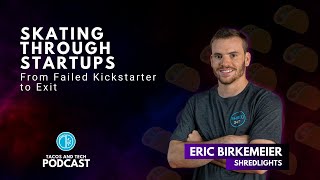
Eric Berkmeyer founded Shred Lights at San Diego State to light up skateboards. His first Kickstarter flopped targeting street skaters, so he pivoted to electric-skateboard riders and scaled through 3D printing then China manufacturing. In spring 2025, Meepo Electric Skateboards acquired Shred Lights, and Berkmeyer joined the company.
Startups get the party. Startups get the party started. Startups get the party. Startups get the party started.
You want tech and tacos, Tacos and tech, you know we got it.
Hey.
Startups get the party. Startups get the party started. Startups get the party. Startups get the party started. Startups get the party. Startups get the party started.
You want tech and tacos, tacos in tech, you know we got it.
Hey, foreign.
Welcome back to the Tacos in Tech podcast. I'm your host, Neil Bloom. I'm so thrilled to have on Eric Berkmeyer from Shred Lights and now Meepo Electric Skateboard. We've got an interesting story to tell you, a very San Diego story from a San Diego entrepreneur who I think I first met at San Diego State. It's possible that you were there in the program. Startup programs there and I think from afar, been watching your journey, which has been pretty cool. Had some big, big news recently. I don't want to spoil the news there. So, Eric, welcome to the pod.
Thanks. Yeah, excited to be here.
Give us a high level. Just like, high level what? Shred Lights and what's Meepo Electric skateboard now.
Yeah. So Shredlights is action sports lighting company that we started at San Diego State over 10 years ago as kind of a challenge to see if we could engineer a product that didn't break. And turned out that problem was a lot harder to solve than we thought and we were kind of right place, right time with the micromobility industry taking off. Micromobility is electric bikes, electric scooters, electric skateboards, any sort of light portable devices, device that operates on a battery. And we were right place, right time. So that was kind of our niche. And now in 2025, Shred Lights was just acquired by Nebo Electric Skateboards, where I'll be working now. And yeah, really excited for the next steps, but also excited to kind of look back today and share some of the cool moments of the journey to get here.
Oh, congrats. That's huge.
Man.
What a journey. We need, like, some, like, confetti to pop off here because I know, you know, it always feels like that's what's going to happen and you cross the finish line, but the path to the finish line is tough. And then there usually is like, oh, and by the way, you got to keep working for the next two years or something as well too. So talk about that. But congrats either way to just, just have a new, you know, an inflection point, a milestone is a big deal, but take us back. Like, are you, you know, where did this all come from? You come from a family of entrepreneurs. You always want to start a skateboard where.
Yeah, yeah, I, I love building things ever since I was a kid. I have three older brothers. And so we would go in our basement and, you know, empty out all the Legos, the connects. We're always into the toys that were kind of like diy, make your own adventure. So I think that was, you know, from a young age, I just loved taking a box of, you know, a bunch of bricks of Legos and then envisioning what you could turn into and bringing it to life. And like in, you know, those third, fourth grade art projects where it asks like, what do you want to be when you grow up? I always said I wanted to be an inventor and I would like take my LEGO projects to school and try and sell them. So I think early on I was like trying to be an entrepreneur. I didn't know what the name was, so I called it an inventor. Yeah. And then I grew up in Minnesota and I was always really into skateboarding and snowboarding and all the action sports there, which I didn't really fit in. Most of my friends play hockey up in Minnesota. So I always kind of saw all these skate videos and snowboarding videos of California. And having not been out here, it just seemed like this, like, magical dream place where, you know, it's always good weather and you can surf, snowboard, skate. And it really kind of, yeah, drew me in. And in high school, I think kind of one inflection point for me in my life and my entrepreneurship journey was my first part time job. I was making pizzas and I was making like, I think it was like $7 an hour at the time, in like 2011, 2012, in high school. And I would go to the thrift stores after work and look for stuff to buy and resell online. And the niche I found ended up being like Air Jordan basketball shoes. So I would go work this shift for like five hours, you know, make like $50 before taxes. And then right after my shift, I would drive to the thrift store and sometimes I'd find a pair of shoes where the profit from those would be, you know, $100. So I think at 16 years old, it really kind of like rewired the way I think about earning money. And it taught me that it's not really about how, how hard I work or how long I work. It's about how much value can you provide to other People. And so that direct, like, trade off really had a big influence on me. And at that time, my older brothers were just graduating college and getting into their careers. And it was a tough time. It was right after the 2009 financial collapse of my oldest brother. I was having a hard time finding a job. So I think all those experiences at the age of 16 kind of culminated and planted that seed of like, I want to own a company, I want to start a business, I want to, you know, I want to control how much value I'm putting into the world and do it my own way. So I think that was kind of like the initial seed of entrepreneurship.
Amazing.
And then from there. Yeah.
What brought you to San Jose State?
Yeah, exactly. I came out one time and saw the campus and I was like, I will die before I don't come to school here. It was like so clear. Like, you know, you get those feelings. And I was on campus during the tour and within 20 minutes I was like, this is the place for me. I'll do whatever it takes. I'll sell a kidney. I'm coming to the school. So when I got home, I lied to my parents and told them that I applied to all these schools in Minnesota, which I never did. And I only got into three schools in San Diego. Ucsd, STSU and USD. I only wanted to go to sdsu, but I applied to the other ones just for safety. So end of senior year, high school comes around. My parents are like, all right, which college are you going to? And I said, well, I have to move to San Diego because I didn't apply to any other schools. So your options are I don't go to college this year or I get to move to San Diego. They were like, you little shit. But they respected it because I made it so there was no possible way I couldn't come to San Diego. So I think, yeah, that was kind of how I looked at it, was like I understood the stakes. So I was like, I'm not gonna leave this up to my parents or, you know, leave any wiggle room other than like getting what I need to get. Yeah. And I moved out to SDSU right away in month one. I think my mom recommended that I join the entrepreneurship club because she was trying to help me get involved and stuff. And went in there, tried to start a business for my Air Jordan shoe business. And it was fun because it got me in there and I got to meet like minded people and it really opened my eyes to the entrepreneurship community at sdsu, which was awesome. And Meeting all these other like minded students, it was. It was amazing. So I was in there and literally one day I was kind of giving up on my. My idea and I was in the zone. That one was called the Steve Depot. And it was essentially like going to be ebay, but niche down to streetwear. So anyone could list, you know, shoes or secondhand, like, high fashion kind of clothing. And my site would verify if it was real or fake and you could resell. But it was a much, much bigger undertaking than I would have thought to, you know, develop this whole website that could do all that. So I was kind of understanding that after a couple months, like, maybe this one is too big to chew off right now. And two, I'm not super passionate about air Jordans. This is really just a business. So, you know, I could kind of feel that, like, the passion is not here to go the distance for the work. You know, to climb the mountain that I need to climb to do this. I don't think I have passion for this idea, and I can kind of tell that. So as I was feeling that, I walked out of the Zaun Innovation center and literally, I'm not joking, there's a giant poster on the wall for Shruglights. And I'm like, huh? And so I started, like, looking at it and it's headlights for skateboards. And I had my skateboard. That was the main way I got around campus for all four years I was at sdsu. So I was constantly skating in the dark. And I was always parking off campus because I wanted to park for free. So on campus was nice. There's plenty of lights and everything, and everything's good to go. But then as soon as I got off campus for that last half mile or mile to my car, you know, it'd be completely dark and there's cars coming. So I had already kind of experienced the problem firsthand of skating in the dark and wanting to be seen by cars. And so when I saw the poster, I was like, it kind of just clicked right away. Like, that makes sense. That's a good idea. And my first thought was, I want some of this. Like, I just want some headlights for my skateboard. So I took a picture of the poster, and then I emailed the founder at the time and said, hey, can I buy some shred lights? And he was like, oh, no, they're not ready yet. We're still working on it. And I was like, okay, well, I'm in there. I'm in the Zahn center, my own business. Do you guys need Any help? And he said, well, no, but we need a website. Do you know anyone that can make us a website? And over the last three months, I just learned how to make my first website with my first idea. So I was like, totally, like, not feeling like I could, but I was like, I just knew I had to say yes. So I was like, yeah, I can do this. And my brother had actually built, like, a lot of my first website with me. So I got the deal to make this red lights website. I think it was for like, $50. And I basically called up my brother and had my brother build like a ton of the website. And I think I paid him like a hundred dollars. So I lost money on it, on how to deliver this website. And it was kind of a good lesson of, like, just saying, yeah, if I had said no to Drew, oh, no, I can't make this website, my life would have been on a completely different trajectory because I couldn't really build a website. But I just knew I could figure out how to get a website built even if I wasn't the one to do it. So I think that, like, was a good lesson. And, yeah. And that's how I originally got involved in Shredlights. Wow.
So it was. It was another student who had it going, is what you're saying, and someone else was. Was. So let's talk about that. Like, what was the relationship of joining and where did it go from there? Because obviously the journey of finding. I don't know if you ended up becoming co founders or how did that whole kind of journey go together on that?
Totally. Yeah. Yeah. At that time, it was definitely his idea. He was a really good street skater growing up, so he wanted to sell to. Street skating just means, like, doing tricks. So for example, if you see someone skating down a set of stairs or doing like a handrail, more tricks and that type of crowd, and that was who you wanted to sell to. So that was kind of our initial target market. And we had Kyle, who's going to be the engineer. And I was kind of just the fringe kid. And I kind of saw in the first few months, like, there isn't much I can. There's not much value I can add yet, but it's important that I don't get in the way. And I just keep showing up. So for the first, like, three months, I'd literally just show up to all these meetings in the notebook and not really say anything and just sit there and, like, take notes or just, like, just help make their lives a tiny bit easier. But really try and stay out of the way and just kind of soak it in and just. And I think after a few months they were like, all right, this Eric kid, we don't really know how we're going to use him yet, but he keeps showing up. Like, we got to have some place for him. So that was kind of how it started. They were like, you can join the team. We don't really know what you're going to do, but we like your dedication. We can tell you understand the problem and solution. So I just kind of got on the team by just consistently showing up and yeah, not trying to do too much right away, I guess. And then over the next few years we were just 3D printing and trying to design something I didn't break, which is very, very difficult. And in parallel kind of trying to validate, like, do people actually want this product? Like, if we make the perfect headlight that doesn't break, does anyone actually want that? So we're kind of in parallel developing these two things, like developing the actual product, but also trying to develop the demand. And see, once we have the product ready, will the demand be there? And so we were, you know, going to different events, posting on social media. The early days of shred lights, we used to buy these like pre built flashlights from Alibaba. And then I would take shoelaces and wrap them around the skateboard. So when the video is on and because it's a light and you're in the dark, you could never really see the actual light. All you could see was like the LED cast. So when we take videos, it looked like two headlights on the board and you couldn't tell what the actual light was. And these lights would break after literally five minutes. I would buy sets of like 50 lights and bring all these lights with me. And we'd have to keep swapping them like every five minutes because they would break super quick. So we'd have to like put them on the board, get a couple shots, they'd break. And that was just in the effort of like validating. Yeah. The demand and the idea.
What a classic entrepreneurial thing to, to build it, then go find like, hey, do people want this thing? You know, a hammer nail? Like we have all been there for sure.
Yeah.
It used to be more on a helmet. Is that what you said? And then it became on the skateboard. Is that what I heard you talk?
No, it always, it always started on skateboard. Yeah. And that was kind of like, that's how we found our, our blue Ocean was like, one, no one else cares about making a light durable enough for a skateboard because it's a small market. And two, it's just really hard. Like, there is like a skateboard takes so much abuse, but there really is nothing out there that can withstand it. So it was kind of good for us because it was such a hard problem to solve that that's what kind of created our IP and our moat is. Once we were able to solve that, it really did differentiate us in the marketplace. And once business started growing later, that was a key feature that kind of really helped us grow.
So, yeah, talk about growth a bit. Like, where did you talk? How did you figure out how. Supply chain. Like, what was, I guess, was there a moment where like, this is working.
We gotta scale well first? Yeah, the first big failure. I can kind of get to that first. So in 2016, we launched Kickstarter. And that was super fun because it, you know, we'd kind of been like, we've been building all these prototypes, testing and stuff. We hadn't really had like a clear, like roadmap of to go to market. So once we started planning Kickstarter and going for that, I felt like, okay, this is real now. Now, like, the launch is coming. We all need to like, commit to schedules, divvying up the work. And like, we got to hit this deadline. So we worked super hard on that. I did like a random email to ABC News and they sent an anchor out to SDSU to interview us. And it was literally the day our Kickstarter launched. So we launched this Kickstarter. We have, you know, a news special coming that day. And so I'm like, super excited. And our goal for the Kickstarter was like 40 grand. And so I'm thinking, oh my God, we're going to air on the news. We're going to hit the goal right away. This is, you know, in San Diego. So I'm living with seven, seven other guys in this house. And 6pm News comes on and we're watching me on the news, pitch red lights, and it's like so exciting. And I'm just thinking, like in my head, like, counting the dollars, coming in, so excited. And then, you know, the two minute, three minute segment airs and it's done. And I'm sitting there like, refreshing my phone, like, all right, where are the orders at? And it's just like nothing. And then like two days go by and we just got stuck at like 3 or 4000 and it was just like a slap in the face. Of reality that we had zero product market fit. And we tried running ads, we tried going to skate parks, we tried doing all the guerrilla marketing tactics. And over and over, we just kept getting told point blank, like, I don't want these lights on my board. Street skaters do not care about safety. And actually, when you're doing certain tricks, the way the board can flip and spin, the lights would actually blind them. Because when you're doing a trick, you're looking down at your board, and so when the board's flipping around, the lights can blind you. So it was just like a horrible product market fit. And we rode that assumption all the way to the Kickstarter. And I think we were in kind of denial that we wanted to have a company in the street skating space so bad that we ignored all the other signs that this was not actually a good business model. And it all kind of came to a culmination at the Kickstarter, where, like, I met one of the most legendary pro skaters ever, Jamie Thomas. He was in, like, all the Tony hawk video games, like, super famous pro skater. And I gave him some shred lights, and he was just straight to my face, like, what? This is such a gimmick. I don't want these. Why are you talking to me? But it was important for you to have that experience. I mean, he wasn't like that rude, and I was kind of soliciting him. So I understood that. I didn't take it personally, but it was like, all right, it doesn't get more obvious than that. Were barking up their own tree here. So after that, Drew, the original founder, really kind of lost faith. And he was like, look, I don't want to do this anymore. He had just graduated college, and he was like, 26, whereas I was only, like, 20 or 19 at the time. And he was like, hey, I need to make some real money. I need to, you know, get my life started. I just graduated, so it was totally understandable. And he was like, I don't think I want to go with this anymore. So then he left, and Kyle and I decided to take over. And so this was like, 2017 now, and we were fresh off our failed Kickstarter. We had some 3D printed designs that still broke pretty often. And we were like, hey, we put this much work in. Let's give it six more months, and let's see if we can't sell. I think our goal was, like, 200 sets of lights or something. In six months, we're giving up. And Kyle and I had that agreement. So the first thing we did, this is probably like the biggest inflection point in the Shred Light story is Kyle and I sat down. We're like, okay, we both agree that street skaters aren't the market, but who is, you know, and is there a market? So we're like, all right, we have like 70 customers, so let's just shoot them a survey and let's ask them, you know, who they are, and see if we can get some information there. So the first question of the survey was, what board do you ride? And it was like a penny board, a skateboard, or a longboard. And that was our bias because those were the only boards we rode. And then, thank God, I put an option for other. So there's the three options that we assumed that they would answer and other. And then out of the 70 respondents, you know, probably 70, 60, 70% of them filled out other and either wrote in electric skateboard or boosted board. And that was literally how we even ever heard of electric skateboarding. So then we were like, all right, what the heck is a boosted board? So we like, Google it and we see they just did a Kickstarter and they got funded for like a couple million, and their project just ended. And it's a $1500 electric skateboard that goes 20 miles an hour, and it's more for commuting. And everyone in their videos is wearing helmets and knee pads and safety gear. So me and Kyle are like, dude, I think this is it. Like, this customer has the money. They care about safety. It's totally different than longboarding. So it was like, now we had our sights set on a better target, and we were still like, we had no idea if it would work, but at least we were like, okay, this is someone that is voluntarily telling us they want the product. So then I reached out to anyone I knew at sdsu, said, hey, do you know anyone with an electric skateboard? And through, like, three different friends, I found some random guy that had an electric skateboard, and I asked him if I could borrow it. And we put our prototypes on that and basically went around SCSU and I shot all new photos and basically just completely pivoted the website to go from street skating to all new content with electric skateboarding. And it was just like, it felt like the next 12 months were like out of the movie. It was like the classic entrepreneur dream where it was just like sales were growing by like 2 or 300% every month, and we weren't doing any marketing. So, like, those first couple years were insane. We did our first million in revenue with 00 ad spend. We didn't have any Facebook ads set up. Like, we weren't doing anything. We were just like, what the heck's going on? And honestly, all of our time was spent building lights and just trying to keep up with demand. And later we figured out that we were like going viral on Reddit and it was all word of mouth and we were like the only ones, and we were just right place, right time, the only ones. With this product, there is a growing population of electric skateboard owners that needed lights, and so that we were just kind of riding that wave and we had no idea what was really happening for like a year. Wow.
Amazing. What a turnaround. I mean, think about all everything that happened to a failed Kickstarter and the founder leaving. You know, like, it would be very easy for you to be like, not my thing, not what I signed up for. But you, you guys stepped up and you're like, no, let's get to know the customer. Let's get to know what the real problem that we're solving here. And you did the work, you know, like, you went and actually did the real customer development and then turned around such a cool story. And so orders are coming in. Like, are you now having a change as a business? Like you're having to actually make these fulfill orders, like even know how to set up supply chain and you know, kind of the E commerce and the whole thing around that to scale it up?
Yeah, I mean, we had no idea it was just completely winging it. So we made a lot of mistakes. We had a lot of quality issues with the product. I mean, making one or two is. Is one thing, but to make hundreds is really tough. So I would go to the Zahn center every eight hours and start a new print. So, like, I'd be out partying Friday night and It'd be like 11:30 at night and my alarm would go off and I'd skate from the party over to the Zahn center, swipe in and take the prints off, start a new print, and then skate back to the party. Wow.
And then Kathy Poucher, who I'm sure saw you being walked out like eight times a day on the logs or something, man.
Yeah, yeah, yeah, yeah. She knew what I was doing, but she was a huge supporter early on, so that was awesome. Yeah. And then I started hiring my roommates to build them. So at that time, you know, we started doing everything in the US so 3D printing the housings, we were ordering the circuit boards locally. But no matter what, we're always ordering the batteries from China. And obviously we knew China was the end game to manufacture. We just didn't know how to get there. So we started just literally going on Alibaba completely from scratch. And we went through so many different suppliers in a two or three year period. You know, just every batch had something wrong with it. It was late, it cost too much, anything that could have happened pretty much did. But we had to just like keep forging ahead. And luckily at that time, because the market was growing and we were the only ones with this product, the market kind of dealt with a lot of our early issues. So, like, a lot of our first lights, you know, had a huge failure rate, like 30%. But people just kept buying another pair and another pair because there was nothing else out there that was better. So even though ours wasn't that great, it was still way better than any other option for like mounting a bike light or anything else. I think that really allowed us a little more leeway and a little more space to fail and not lose our position in the market. I think had we been in more of a competitive market, we probably would have, you know, gotten out, innovated a lot sooner. So being the only one here and kind of having this blue ocean market gave us a lot more space to fail and figure it out because it was our first business. And then I would say the next kind of key inflection point was our first time going to China in 2019. That was like, I think looking back, that's probably the biggest regret I have with Shred Lights was not going to China sooner. I think we didn't really realize, like we were, you know, replacing POS. They weren't huge. Let's say, you know, we're spending 50 to 100,000 a year maybe, which isn't that much, you know, for this stuff. But in hindsight, I should have at the time been like, hey, we're spending this much. We should totally spend 2 or 3,000 to go out there and meet them. You know, it's not that, you know, it's expensive, but like, I don't know, it just didn't click that, like spending a couple thousand dollars to go to China was going to have exponential returns. And I just never thought about it like that until we were there. And then when we were there, we were meeting with all of our suppliers and it was like we'd meet in the morning and they'd show us a sample and we'd be like, okay, here's all the changes we need. And they'd be like, okay, I'll be back in two hours. Two hours later they got the next version. Okay, here's the next changes. Okay, I'll be back in two hours. So now it's like we had three versions of a part in one day. So me and Kyle were just like having so much fun there because it was like we're getting so much done so quick. I mean, not only the work aspect, but like just really cool people. Everyone is super welcoming, super nice. Just everything about that first trip went really, really well and it was super eye opening to us to like, okay, if we're going to have a consumer product, good company, especially an electronic one, we got to have close ties to our supply chain in China and we really need to make this a core pillar of our operations and not just, you know, a manufacturer on Alibaba. Like we really need to own our supply chain here. So about a year after that trip, we hired a full time employee in China to fully manage our supply chain, which ended up being super lucky because we hired him in like November 2019 or January 2020 and we were trying to come out with a new product at the time. And then obviously Covid hit and so had we not had him during that two year period when we couldn't go to China and everything was going crazy with supply chain, we definitely would have gotten out of business. But having him there like was so valuable during that time. Wow.
Incredible. I mean you couldn't have planned that whatsoever. And a lot of other China foreshadowing comes to here, which, which kind of also just wonder, you know, us American entrepreneurs hear a lot about IP stealing and copycat. Was that a worry or, or once you got into China you learned a lot about what that really is.
Yeah, yeah, no, it was absolutely a worry. And yeah, it's funny, I mean we, we did get totally copied. Like two or three years ago, someone, one of our suppliers, you know, decided to make their own version. And honestly for us in our market and our circumstances, it wasn't that big a deal. Because we had the trusted brand name, we always had the best after sales support. Like we had so many intangible things outside of the product that the whole market didn't really want to choose this other product. It actually wasn't really any cheaper or better in any way either. But that was an interesting lesson because it's like, okay, we got knocked off and the best thing to do is not do anything. So I think that kind of changed my perspective on ip. And again, this is purely just my circumstance. I'm not saying ip, you know, isn't worthwhile, but in our situation it wasn't worth suing them and they fizzled out pretty quick. So I think that experience ease our concerns. Even though like someone, you know, had broken our trust there, the actual reality of how that played out wasn't that big a deal. So it was a. Yeah, it was a good lesson of kind of the actual damage that something like that would cause.
Yeah. So take us going forward now, obviously, and I'm going to fast forward us if you'd like, like all the way to do tariffs. Right. Which is the next giant headwind or maybe there's even more. Just like.
Yeah, there's. There's one in between.
I mean, there's logistics craziness of getting stuff from China to, you know, America and then everything else. Like, you know, I just, man, I feel for you already of just headwinds that come from a hardware product from China to America, like totally. Where is that what has powered you through in a sense to this exit here?
Yeah, yeah. And I mean, I think the last two years have been by far the most challenging, personally. So after Covid, the outdoor consumer product, good space just blew up. So like 2021, 2022 were our biggest years ever and learned a lot about cash flow, managing inventory. And so it was like we had our biggest years ever, but we were still struggling to pay for pos. And with a product like ours, you know, basically we have to put down 50%. It takes 12 weeks before we get the product, but at eight weeks we have to pay the other 50%. So it's like this money is. It takes super long to get a return on our money based on the lead times and stuff. And we didn't really understand how to forecast this. So it was a huge learning curve there. And so it was like, you know, we're doing over a million a year and we were still not really making money and we were still having to get outside financing. So that was when we made a major change and we made Kyle the CEO. And he did a really excellent job at leaning out our costs and setting the right prices and developing some really detailed and useful spreadsheets that were allow us to have a much clearer idea of what would happen in the next six to 12 months based on different scenarios. So it felt like Kyle really helped take us from kind of this like accidental success to like a real operation that was going to be scalable and repeatable. So that was kind of a huge point in 2022. And we were doing super well. So, you know, we just had these big years. We were expanding into electric bikes and other markets and everything was going well. And I felt like, okay, like we had our big growth moment and we've made all these mistakes, but now we've been in business for four or five years. Like, now we know what to do. It's just a matter of putting a plan in place. So you started implementing this plan, and we had our first profitable year. We had like almost a 10 net margin, which is really solid for a consumer product, good company. And this is all without any sort of outside investment, Basically just loans. So everything was going well. And then we started developing a smartphone app so you would be able to control all your lights via Bluetooth. So Kyle went out and found a couple really talented engineers that were able to essentially work on the product for royalties or payment later. So he understood, like, hey, we can't invest later. Like, it would have been like 100 grand to get this developed. So we need to find partners that are willing to build now and kind of get paid later. So you set all this up and it was like, cool. We're moving. Like, we got. Our operations are online. Cash flow is getting better. We're developing really high tech stuff. You know, we're kind of punching out of our league almost with Bluetooth lights. Like, this is way more advanced than we've ever done before. Everything was like, all right, in the next two years, you know, we're going to be on track for like 5 million a year. And it was super exciting. And that's kind of when everything came crashing down. So Kyle got married in May 2022 to his wife Diana, who I'm also friends with, Very successful creator on YouTube. Physics girl. Definitely check out her channel. Really cool educational physics videos. So it's super fun. Wedding was, you know, super happy for Kyle as a friend and a business partner, you know, really happy for him at the wedding. And then went to Scotland for two months and Diana got Covid in Scotland and got back. It turned into long Covid and it just affected her really, really strongly so slowly throughout that fall. And I don't mean to spare the details on Diana's story, It is really sad, but trying to keep it in relation to shred lights.
And she's been really public about it. I've been following her on Twitter if.
You'Re interested in her and more. Yeah. And she's on the other.
Which is pretty awesome.
So. Right. I'm Doing great now. Yeah.
Yes, totally.
Yeah. Super good news there. Yeah. So that fall, Kyle slowly started taking more time off to spend with her. And Kyle and I have always really had a strong connection. He's like an older brother to me. He's the same age as my oldest brother. There's always been that, like, hey, we can usually make business first, but we do care about each other and we're friends and he's like family. We spent so much time together. We've been through so much. So I just wanted to be there to support him and Diana. And I was always. My mindset was like, if the business fails, it's fine. Like, he needs to be there for her. So I slowly started taking on some of his responsibilities. And then in January, she started doing a lot worse. And so he said, hey, I need to fully step away. I need to be a full time caretaker for Diana. Like, that's, that's my only party in life right now. So I was like, okay, I understand. I agree. That's what you should do. And basically, you know, this was like a matter of weeks where he made the decision and left. And then I was left to, you know, take over full, full time product manager of the Bluetooth line. We were still deep in R D there, so I had to get up to speed on all the Bluetooth project, a lot of the details there, all of the testing features, you know, everything with that, plus all the financial forecasting while still doing all the marketing and ads and everything. And so that was the last two years. And meanwhile, while internally all that was happening, the market really slowed down. So in 2022, we kind of had an artificial boom. And it was not real. The demand was so much higher than it should have been. And so it wasn't necessarily that the market shrank. It was just like, okay, the artificial demand's gone now you got to use to it. So we're adapting to lower sales. So I was constantly having to figure out how to keep lowering our operating costs while we're trying to develop this new product line. And I feel like in the last two years, I actually feel like I'm an entrepreneur now. I think before that, because Kyle and I had divided the workload so much. So I always kind of felt this sense of imposter syndrome, like telling people I was an entrepreneur because I'm like, well, I just make cool videos and, you know, I give Kyle feedback on the product, but he does the, you know, he designs it and all this stuff. But the last two years, now it's like, I'm going to China. I'm doing like all I'm talking with banks to get financing. Like, so I feel like that experience for me really kind of made me earn my stripes. And I'm like, all right, now I'm like running the whole business myself now. I feel like I can actually confidently say I'm an entrepreneur. What an experience, though.
What a relationship for the two of you to have, though. Two. One, switch roles at some point, which not a lot of partners actually survive, by the way. There's like so much go to stuff. Even when you're co, founder or even, you know, like owner, right. Of a business, swapping CEO roles can sometimes be devastating. Someone's like, adequate, right? And you're like, oh, I couldn't do the job or something. But one kudos to the partnership and friendship that you two had, right? Like, that's the kind of partnership we talk about with, with partners is it's a second marriage, right? And totally. Oh, yeah, obviously you guys had that, right, that deep trust to say, you know what? I'm not rocking this skill set. And I think you have it. You try it and, and I'll support you. And then two steps say, look like life comes first and go do life while I, you know, take this to the next level. I don't know, it's just like, really, really hit me just say, like, what a great partner you had, the two of you in each other, which is absolutely.
And I think our relationship dynamic was like a key ingredient in success. You gotta be able to make it through that stuff. You gotta have fun. I think that's how we always saw it. Like, we would have, like, you know, a shipment lost or like a thousand parts would show up and it'd be the wrong part and we would just like, laugh because it was like, you know, we're making skateboard lights. And we always kind of had that, like, it's not that serious, but we were able to like, laugh at ourselves when really bad stuff would happen. We deal with it. But at least we were like, light hearted. Like, we've never yelled at each other or gotten like in a heated thing. Like, anytime that would potentially happen. It was a very calm, like, hey, let's circle back tomorrow. Let's not do this. Let's circle back. So I think our communication and emotional intelligence towards each other helped so, so, so much. And it just made it fun. And when something's fun, you're gonna be able to succeed so much more. You know, when you're not having Fun. It's hard to put the effort in, so just, yeah, keeping it fun between us was huge.
Did you meet every day in person or was there a lot of working virtually through the years together.
A lot in person. And for the, you know, from like 2017 to 2019, when the business was first starting to take off, he was working full time at the Zahn center. And then we got him to go half time. And then finally in 2019, he left his full time job there. And that's our nickname for him was Full Time Kyle. Because it was like, oh my God, we finally have Kyle full time at Shredlights. You know, because up to that point I had only had like a couple of days a week or, you know, to your answer your question, I had very limited access to him up until he went full time. So that was, yeah, that was super exciting. And then we got an office space, sports arena, and then we were in the office every day. We had like seven 3D printers. And yeah, it'd be awesome. I'd come into work and he would 3D print a new design. I would go test it, I'd come in, we'd see what went wrong, he would design another one, come in the next day. And for like a couple years, that's what we do. Just printing and testing different stacks. It was super fun. Wow. Wow.
Really cool. So where, where did it take you? Like where, you know, like where did, when did the idea of selling actually come to, to mind?
Yeah, I mean, I think from the very beginning I always wanted to sell the business and that was kind of a big part of starting a business. So I was always the back of my mind. But the last two years, yeah, like I said, the, the market slowing down and me getting a lot better at the financial forecasting and cash flow made me see the bigger picture. And so I could kind of see like, okay, this is realistically where this business is going to go. You know, it's. There's no way we're going to just double profit overnight or, you know, different things. So I was building these financial forecasts for like, okay, let's say we get into the bike market, we come out with a killer product. Okay, what does that actually mean? Are we going to sell 500,000 units a year? No, probably not. Maybe we'll sell 5 or 10,000. Okay, what's our margin? What's our price? And I plug in these different scenarios of like, best case, worst case, and it really helped me kind of see these different features. And I think even in the Best case, it was really clear that the ceiling was low. So I think as an entrepreneur, I'm like, okay, I have all these skill sets now that I can apply to anything. Is this the best thing for me to apply it to for five more years, or do I want to apply this to something else? And I think once I started asking that question and seeing the best case scenarios that were going to be, you know, the best case scenarios would have taken a ton of risk, sacrifice, and hard work for me to achieve. And then I was seeing like, okay, here's how much I could make getting there. It wasn't necessarily about the money. It was more just like, do I want to do this? So that's where, yeah, selling came about. And about a year and a half ago is when I kind of really decided to go after it. So started splitting my time between working on the business and trying to sell it. Started reaching out to other entrepreneurs in San Diego. Found a guy named Riley who is the founder of Loom Cube. I was another light company, and he's in Norris county, so that with him. And he kind of just became my mentor last summer. And he had just exited his business, and he was five years farther along. He's five years older, and he was just, you know, just got married, about to have his first kid, and kind of had these things that I want in five years. So he's a really great mentor and asked a lot of the tough questions. And, you know, and it was. He was asking Eric the questions, not shred lights. You know, what do you want? Where do you want to be in a few years? And he got me to really kind of separate my own goals and stuff from the business. And that's where he kind of helped me decide, okay, I want to sell the business for sure. And that's where it kind of really became concrete. So I started, you know, creating pitch decks, use chat GPT a ton, and just kind of trying to figure out, like, how do you sell a business? This seems like an extremely daunting thing, and how do I actually do this? And just like anything of entrepreneurship, it's like, just take a baby step. Don't worry about all the things you need to do and all the things you don't know yet. Just start taking steps, right? And that's what I did over the last year is just kind of like meeting with anyone I could, meeting with anyone that had sold a business, trying to just soak up as much information as I could. And then last fall, started reaching out to some companies in our space and very quickly found that all the other companies have also had declining sales in the last two years. And no one was really, you know, thinking about growth right now. And all the other companies know Shred Lights. They know we have a great customer base, a great product. And it wasn't that they were like, weren't interested in buying Shred Lights. They just weren't interested in investing in growth right now because they were really trying to cut their costs and maybe had already laid off some team members. So it just wasn't a right time to make this play. So Q4 last year, everyone was too busy, and we were also busy. Q4 is our biggest time of year, just like any e commerce company. So I kind of had to put it on the back burner for Q4, started working hard, but it really started kind of eating away at me. And that's what got really tough. I think I was going through a breakup at the time as well, and I think that was one of the real low points for me with Shred Lights was like, we. Yeah, we're. I had so much work to do that had to get done. I was the only way I could do it. But meanwhile, I was kind of like, really at this low point mentally of like, feeling like a failure, feeling like, okay, I can't just shut down the business. So I felt very trapped. We had some debt that was to the business, but me and colleague co signed on. So if I wanted to dissolve the business, I would have had to assume that personally, which I didn't want to do, it was a lot more debt than I'd be interested in. So I felt very, very trapped. And that, you know, some days were really, really tough. And that was when I kind of, like, asked myself, like, all right, like, you got yourself in this situation. What are you going to do about it? You know, are you going to complain and blame other people? Are you going to roll up your sleeves and, like, figure out how to do it? So that was. That was really challenging time, though, to, like, wake up every day and be able to, like, keep making steps when I didn't know if it was the right direction. I didn't know if it was going to work. Like, I had no idea if I'd be able to keep making rent in six months. Like, it was. It was a really tough time. But I think what got me through it was just like the. I don't know, just kind of the. The belief in myself that, like, I could learn how to do any of this stuff. And as long As I gave my best effort, if no one bought the business and it was a complete failure, I can live with that. But if I gave up now, I couldn't live with that. And I knew that. So I'm like, all right, I owe it to my future self. Like, I at least have to try. And if it doesn't work, I can live with that. But, yeah. So fast forward to the spring. I kind of got back on. The outreach campaign, was reaching out to more companies, getting a little more interest. And throughout those six months, I spent a ton of time understanding how to pitch a business to understanding all the key risk factors that the buyer would look for, different financial projections of scenarios of worst case. Best case, here's how you make your money back. I'm asking for X amount of money, and here's how I'm going to back that up. So just understanding how to learn everything. So once it came down to the negotiation, I knew what I was talking about. And that took a lot of time to learn all that. And so in April, I met one of the electric skateboard company owners in Vegas. And I had known him for a while, but we saw each other there. And two years ago, I pitched the idea of him buying my business kind of loosely. And he was like, yeah, sure. But at that time, I wasn't ready. I didn't. I just had no. I wasn't ready to do it, but now I was. So we met in Vegas and went to his hotel, and I brought up the pitch deck, and I. I had everything ready. And I could tell on his face, like, he saw that I was much, much more serious this time, and I had everything to back it up. And I'd been, you know, getting all this ready. And he starts talking about prices and stuff. And it was the first time someone had, like, actually validated that they might want to buy the business. So it was super exciting. And it was like, holy crap. Okay, this is it. So the next day, I went to Zion national park and was just hiking from by myself for the day, and I'm, like, driving out there and I'm thinking, like, I'm so excited. I'm like, oh, my God. Like, this is it. But I'm not trying to get too excited because it's still early. So he goes back to China, and then communication essentially fell off in April. So the Chinese culture, at least the. The companies I've worked with, they don't really do Zoom or video meetings nearly as much. It's all like WeChat messages or emails, and they're not really used to scheduling, like, hey, let's meet at 7. We're both going to come with agenda and get something done that's like very American. They don't really do that there. So I was kind of struggling to be like, how do I keep this deal going while we're like barely talking to each other? So in April, it really felt like it was like a do or die moment where I was like, okay, here's my window right now and if I don't close this, you know, in the next month, like it's going to go away and then I'm going to have to shut down the business and take this debt. So I like felt this intense pressure and I was just like one night it was really stressing me out and so I was like journaling. And then I was thinking like, what can I do about this? What is in my control? And I'm like, well, I can go to China. I can buy a ticket right now to go to China and then we'll see. And once I kind of thought about that, I'm like, yeah, I totally need to do this. So that night I just booked a trip to China for like three weeks out. And I messaged him and was like, hey, are you around? Can I come these dates? He was like, yeah, that's good. And that was all we had. So, like, there was no understanding that we were going to like try and close the deal. It was just like I told him, I was like, oh, I'll be there for another reason. We might as well meet. And I like made this up and then went to China and I had like 10 day trip planned in May and I had no agenda. So my goal was to, you know, sell the business and close the deal. But we had no plan, like, no. No agenda. So I'm on the plane, like three hours from landing, and he messages me and he's like, hey, do you want to come to my house for the weekend and we can talk some business and we can swim and hang out and stuff. And I think it was his way of wanting to get to know me better because a big part of this deal was going to be me working for him with his electric skateboard company. So I felt like it was a way for him to get to know me better. And yeah, so did that. And basically the whole rest of the trip just like everything lined up and I think I got there on Wednesday and By Monday at 5pm we'd sign the deal. And it was like at the hotel, I was just Thinking like, this is so insane that, like, I thought it would take two weeks to maybe get an offer. And it was like the third day the deal signed. Wow.
All because you showed up.
Exactly. Yeah. And he said that he was like, yeah, you coming here showed me that you were serious about it. So I think that was like my biggest takeaway from this was like, you got to understand, like, when you got to, you don't need 100% certainty. You need to, like, just take the risk and just go for it. And had I gone to China and come home empty handed, I could have lived with that because at least I went for it, you know?
Yep.
Wow.
So you came home, company sold, but now you're working for that company. Is that true to this day, you're still now working kind of from here in San Diego helping build the company?
Yep. So, yeah. The new company is called Nepo Electric Skateboards. And so it's kind of been two main things. June was really busy with transitioning Trend Lights to them, and it's been a really cool learning experience to like, actually see how an asset sale goes. So I'm always curious, like, how do you start a business? How do you sell a business? Well, now I'm going to answer, like, how do you actually merge a business? So that's been really fun. And then Meepo is one of the biggest electric skateboard companies, but they have no one in the United States right now, so their branding and marketing has a lot of room for improvement. So it's been super exciting for me to take a lot of the skills and relationships that I built with Shredlights and then now be able to immediately apply them to Meepo and immediately make an impact. So I think back to what I was saying earlier of kind of feeling like the ceiling was too low at Shred Lights. The last couple months have been super exciting for me to, you know, be able to do a lot of the same stuff, but everything is just a bigger result now with a bigger brand.
Wow, that's really cool to now to take all those years of experience in different phases of the company, but now also to kind of represent a bigger brand, if you will, in the space that you already know. That's pretty cool. Yeah, it's pretty cool, I would say and all that.
Yeah. Super fun.
But wow, what a journey and introspective of you. I don't know. I mean, like, this all happened really recently. A lot of this.
Yeah. Yeah. I'm definitely still getting used to it.
Totally. But still to just. I Don't know. Put yourself in the moment. April wasn't that long ago. It was like four months ago. You just like hopped on a plane. You're like, I gotta do this. So kudos to you, Eric. I think your story is very much still being written. Very excited for where the journey is head. Where can people find? So are Shred Lights now Meepo Lights or did they get rebranded? Renamed or.
No, no. Shred Lights brand will live on. Everything with Shred Lights will remain the same, which is super cool because in a lot of scenarios Shred Lights would have gone out of business and died. So it's cool that this was the best situation for Shred Lights. You know, we spent 10 years building this brand and we have a lot of evangelists out there. So it's super cool to be able to feel like Shred Lights is in a good home and also have some control over it to help however I can and make sure, yeah, it stays the same brand as much as possible. And then, yeah, I'll be working at Veepo and yeah, kind of excited to. It's kind of nice to have a job right away so I can keep moving because I think, I don't know, I can't relax for too long, but I think maybe in a year or something, once I'm farther from this transition, we'll see then you know what I want to do and how I'm feeling. But I think right now it's been exciting to just dive right into the next thing.
Well, we really appreciate you sharing the story and like I said, your story's still being written. So excited for what you continue to do next because all that learnings and energy is definitely going to go somewhere for sure.
Definitely. Yeah.
And hopefully we're just getting started. Totally. Exactly. So hopefully and especially in San Diego, there's so many good people to collaborate with. You mentioned Riley, who's gone on to start Cadre AI. Right. So mentor viewers in a second life, starting an AI agency, you know, who previously built a hardware company. So yeah, it's. It's pretty cool to see the founder, entrepreneurial community that you're a part of here as well. And like I said, like I, like you mentioned, deep rooted in sds, you zip and Zon sender, which is pretty cool as well too. Where I spend pretty much every Friday these days just mentoring student entrepreneurs like that as well. So pretty cool story.
Yeah, thanks. Of course.
But the audience has to know on, on its way out, you travel in China, you're traveling all over you're treading locally now in north county and seeing this. Where is your go to spot for tacos?
I would say Los Tacos off Emptiness Boulevard. Kind of El Camino Rail. Yeah, they got a. They got a spicy shrimp surf and turf. Burrito is so good. I just had on this weekend. Yeah, Los Los Tacos is my favorite.
Good little hidden gem back there. I. I pick it up as well. Right in that. Pete's shopping center. Pete's the habit right there. Tucked away next to, I think, like, a mochi donut spot that seems to, like, rotate through different brand names of donut places. But Los Tacos has held steady since. Yeah, I think they opened during COVID And yeah, I've been. Yeah, I get their taco bowls.
My hot take, though, I gotta say, after living in south county for so long, I think I got better taco shops down south.
Okay.
So let's talk. Is my favorite up here. But I felt like, yeah, there's a lot down south I like a lot.
All right, then maybe drop some. Some south county ones.
I'd say La Perla. La Perla is my favorite. Probably in pb, they got the best California burrito ever. Oscar's Fish Tacos. Oscars, you know, you know, like, in and out. You show up to someone and they're like, oh, it's just a burger. And I'm like, well, yeah, you know, you can't totally buy the hype. Oscars is one of those places where I feel like it totally lives up to the hype, where you could say it's the best talk you've ever had, and someone would be like, yep, I. I could believe that.
Oscar Sa.
Oh, yeah. So good.
By the way, Oscars had a spot in the same. In the. In the Trader Joe's park center. Just tacos. And it closed during COVID So poor one out. Oscar. Oscar. They tried north county for a hot minute.
Okay. Have you been to Pablo's Tacos? I've heard of them, but I haven't been yet.
Pablo's? No. Where's that?
Pavlos. Pav. It's. It's right near Los Tacos. It's by, like, Sprouts and Whole Foods or Sprouts and LA Fitness and stuff. Okay. I haven't tried it yet, but I've heard it's really good. So maybe that'll make the list.
Okay, then maybe they'll make the list and that, you know, within one block, we're talking NCS Boulevard and El Camino Real. Like that.
It's like right there.
Yeah, there's a bunch that we're talking about. All right there. And I just got. There's probably another one across the street that needs to be tried right there too. I think it's Tacos viejas. Is it across the street? Literally. So looks like we. We need to do a little.
Yes.
Together maybe now.
I'm hungry. Skateboard.
We should skate.
Yeah.
And see if we can do a taco crawl with a few.
Yeah. Do you skate?
A little bit.
A little bit.
I wouldn't tell people. I would just in case I.
All right, well, there you go. You just signed up for a Eastgate demo. I have. I have nine electric skateboards in my garage, so we can meet up there's. They're super easy to ride.
All right, we're doing that. We're doing a skate and then we're going L Tacos to. Oh, it's Mexico Viejo. And then Pablo's tacos. All three. Put it on the calendar. Eric, this is awesome. What a journey. So pumped for just the learnings, but also where you're headed as well too. So thank you for sharing your story. Shout out to the rest of the team too, Kyle. And original founder Drew, you know who.
Yep.
Sparked this inspiration with you. And Eric, thanks so much, and I'll see you on electric skateboard very soon.
Sounds good. Thanks for having me, Neil. Thanks. Cheers.
The party started.
You want tech and tacos? Tacos and tech, you know we got tacos and tech is on smash for the green guacamole keeper Counting, counting beans Contador Quentan frijoles found us trying to raise some queso la vida San Diego school of rappy rapping Fire tortillas round jalapenos in these modern times of craft beer and coffee My coating yoga posse fold the body origami we be surfing Coronado eating tacos el gordo the tacos stand in puesto lucha libre and sombrero Gotta shout out to angels by the ocean Watch the sunset La Jolla shores Entrepreneurs trying to get funded When San Diego Startup Week is popping in the summer Oceanside to Tijuana St. Be full of hustlers from couch surfing to pants houses right on the beach Tech leaders who believe stars are within reach we interview and founders who be shooting for the Moon hashtag SD TechOS with your host, Neil Bloom.
Come on.
Startups get the party. Startups, get the party started. Startups get the party. Startups, get the party started. Startups, get the party. Startups, get the party started.
You want taking tacos, tacos, holes in tech, you know we got it?
Startups get the party Startups get the party started? Startups get the party Startups get the party started? Startups get the party Startups get the party started?
You want tech and tacos, tacos in tech, you know we got it.
Hey, sa.








