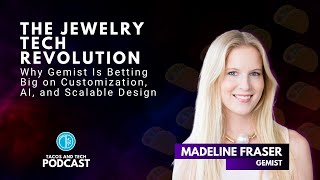
Madeline Frazier, CEO of Gemmas, built AI software that lets jewelry brands show photorealistic renders of custom pieces. The company started as a direct-to-consumer prototype, then pivoted to white-label SaaS. Online jewelry sales jumped from 10% before COVID to 35% now, with custom pieces driving most revenue.
Startups get the party. Startups get the party started. Startups get the party. Startups get the party started.
You want tech and tacos, Tacos and tech, you know, we got it.
Hey.
Startups get the party. Startups get the party started. Startups get the party. Startups get the party started. Startups get the party. Startups get the party started.
You want tech and tacos, tacos in tech, you know, we got it.
Hey.
And welcome back to the Tacos and Tech podcast. I'm your host, Neil Bloom, and I am so thrilled to have on the podcast today co founder and CEO of Gemmas, Madeline Frazier. Hey, Madeline. Welcome to the podcast.
Hey, Neil, thanks for having me. I'm excited to chat.
Me too. What's cool about this is that we met on the set of a podcast, and here we are recording our own. We met two years ago, I think, on the set of the pitch in San Diego. I think you were visiting and I remember. And we'll link it in the show, notes our episode together. What do you remember from that day?
Yeah. Oh, my God. Well, that was like my first pitch podcast. You know, podcasts are so chill. It's like conversational, and you're chatting and it's like this, right? So I was surprised when I came in that it wasn't just like sitting around a roundtable chatting, right. It was like, oh, you stand up and. And, like, do this whole thing. But I do think, you know, I definitely was nervous when I got there because I. To be super honest, I don't think I was incredibly prepared. Just kind of was like, oh, I'm going to do this thing. It'll be super fun. Let's go. And. Yeah, no, it was. It was a legit pitch, and we raised a lot of money in a short amount of time. It was pretty cool.
Yeah, it was the only I saw. So for me, we had six pitches that day, I think, and they wouldn't tell us anything they wanted. Like the cold experience of, you know, person walks through the door, first time seeing them, and everything is caught on camera, which was cool. And Jemis was the only deal I. I made an investment offer on, and ultimately, obviously invested. So it was pretty cool in that regard as well, too. Yeah. Passed on five and super stoked that we got involved with you from that. And I think mark from 11 tribes also committed during the episode as well, too. Another good guy in the VC world. Yeah.
Yeah, that was a lucky day for us. It was just all good people all around. It was totally the right fit, you know. Love you, Love Mark. So, yeah, it was all very much meant to be.
Yeah. Awesome. Well, let's take it. Give us a high level so that the audience knows what gems is before we get too deep in the. Into the. So here's where you get to do the pitch real quick and then want to take it back and get to know your background real quick.
Yeah, yeah, of course. So Gemis is a B2B vertical SaaS and AI company. We primarily focus on the jewelry industry. We essentially help this industry get online, see growth and run more efficiently through really beautiful user experiences for their customers to shop for jewelry. So, like our main offerings are customization of jewelry, stacking and styling, stone marketplaces, and then we have gorgeous, best in class photorealistic renderings. So we kind of do all the things when it comes to shopping for jewelry, but we're on the B2B side. So we work with. It's fun. We get to work with all these incredible brands, retailers, manufacturers, help them create really gorgeous experiences for their jewelry. And the results have been amazing. We're seeing just like huge increases in conversion rates and engagement, more loyal customers. And on the back end, we actually scale the custom side of these jewelry businesses. Custom is really normal in jewelry. It's actually really accounts for over 60% of the total revenue in this industry because so the customer wants, you know, people don't really want just the thing that everybody else has. They want something that's unique to them. We see that in every other industry. Jewelry is made for this. It's probably the most personal thing you could buy and the most personalizable things, this thing that you could do. Right. If you think about it. But the process of making that happen before Gemmas was 100% manual for the company on the back end, and then very slow and kind of tedious and not visual for the customer. And so that's really what we change and what we help scale. So you can see your pieces come to life beautifully, understand what they're going to look like, understand pricing. Right. Very. A lot of clarity for the end consumer and then full scalability for the brand or the retailer.
Awesome. Well, we're obviously going to dive deep into where the original idea came from, which I think, if I remember right, is coming from a lot of deep personal experience from building complementary businesses and being a, you know, in the industry itself. But where does it all really start from? I know of you as like my friend in Ojai, but. But where does physically it all start from you. And how did you get down into this tech world.
Oh, yeah, man. Started for me. I started my first company when I was a junior in college. So I've been, you know, I've been doing this for 13 years now. And you know, I. It's funny, I never would have thought that this would be what I would be doing, to be super honest with you. It's not like I didn't go to business school. I never, like, went to college and was like, I'm going to an entrepreneur. I'm a very creative person. So I went to college for interior architecture and fine art and I just kind of always thought I would be an artist in life. But you know, my parents were very entrepreneurial, both television producers and built a lot of things from the ground up. Very creative individuals. Big visions and actually executed a lot in their lifetimes. And so I think that's kind of just in my blood, right? Like. Like I kind of get bored just doing a sculpture or a painting, right? I. I need more. I need. I need a bigger vision, something to, to build on top of that. And I learned that in college, I guess, you know, and so we, we were two. My. I started my first company with my two friends in college. This is when you're so young and naive that you don't know anything. And so, like, starting a company is like, why not? Of course we can start a company. Let's do it. Right? It's just like, you don't really think too about it, which is kind of lovely. It's kind of a cool thing. You just dive in head first. And that's what we did. We were interior architecture students. We saw a need in the industry for affordable online interior design. And we felt like it made a lot of sense for young working professionals and college students. And that's what we did. We started the first online interior design company. It was called Zoom Interiors. And yeah, we, like, we. We hacked it together, man. Like, it was totally scrappy. We didn't. I didn't even know what fundraising was at that point in my life. I had no idea that I didn't. If you asked me what venture capital was, I'd be like, sorry, what? Like, it was, it was. Just. Didn't know, you know, it was. It was really an organic kind of fun way to build a company because we just learned along the way. So everything was bootstrapped. We had like, friends of friends build the website. You know, we. We got freshman interns and it was like we just built this thing and we started getting customers and doing their rooms and it was really about college kids. So it worked because we were on, we were in college, right? So it, it was kind of a word of mouth growth thing. And we started doing it and then I was like, well, how do we get more people to know about this? You know, again, we didn't have funding. We didn't, we didn't have anything. We were just putting all the money back into the company. And I was sitting in the cafeteria one night and I. On the TV was Shark Tank. It was one of the Shark Tank episodes and there was a college. There were two college guys pitching a company for like moving. It was a moving company for college kids. It's called like College Boxes. It was like hot girls who like pack your apartment up and then move your stuff. And I just thought it was hilarious. And I thought to myself, oh, well, if college kids are on Shark Tank, we're college kids. We have a good idea. We should be on Shark Tank too. And so, you know, I got all excited and I told my co founders that I was going to get us on Shark Tank. And they were like, I'm sorry, no, you can't do that. You can't just get us on Shark Tank. Everyone was like, you can't do that. That's insane. And I love it when you tell me I can't do something because then I do it. And so that's what we did. We got on Shark Tank and that kind of blew up the. That company. And that was the start. That was the start of me understanding how to grow things. And I've never stopped.
Amazing Storage Scholars. Was that the moving one, do you remember? That's the one comes to mind for me, maybe. All right, well, we're gonna find your.
We gotta find it.
Yeah, we'll find yours. Of your Shark Tank episode said for sure. So we'll link that in the show notes here as well too. That and obviously you on the pitch. Just apparently now I understand this is, this is a thing. It started a spark of pitching to a live audience is what you like to do to live investors and getting offers on the spot. Did you get an offer on the Shark Tank?
Yeah, yeah, we got an offer from Barbara Corcoran.
Nice. Awesome.
Yeah, it was cool.
Was this in LA you were working? Was the company based in LA where you were?
No, we were. We were. We started in D.C. and then we ended up moving into Philadelphia, various reasons with my co founders. And then, yeah, once Shark Tank aired, the company kind of blew up and we were kind of freaking out. Cause we again like, remember, guys, like, we were, like, early twenties just figuring things out, and we kind of bit off more than we could chew a little bit. Like, we were. It was. It kind of grew fast, and we needed mentorship. We needed guidance. The whole thing with Shark Tank, that's interesting is it's not really a place to get that. It's a great place to get publicity. But it's. It's. These are investors that are very, very busy. And so I didn't have the experience I had with the pitch where you guys really like set, or you were an investment, you actually did and now are working together, and yay, yay, yay. With Shark Tank, you have a handshake deal. You don't sign anything. It's just, okay, we're going to commit to doing this and talk about it on the show. And actually, one in nine deals that are committed to on the show do not, you know, only one in nine go through. So it's a high percentage don't actually go through. And that's, again, because these people are big, busy people, right? And so Barbara was lovely. Her team was amazing. But, like, I just point blank asked her, so can you actually help me? Can you actually help us or not? Right? You know, are you gonna. You're a busy woman. Are you really gonna give us time? Cause I said, we don't really need the money. We need mentorship. We need someone to guide us and mold us into amazing executives and teach us how to do things, because we don't know what we don't know. And she was lovely, but she just said, that's an excellent question, and you're right, I don't have the time. And so we very amicably parted ways. But then one door closes, another opens. I get a Facebook message from Sean Rad, the founder of Tinder, and he saw the episode, wanted to meet us, and he ended up becoming our first investor and advisor of our board for our second company, Hutch. So there's so many things in the world that lead you and guide you in different directions, and. And I think it's really just being open to them, right? And. And realizing that nothing's ever as good or as bad as you think it's going to be. Right. And just kind of enjoying the journey and going with the flow is definitely what I've learned over the last 13 years of doing this kind of a job.
Yeah, yeah, you can. I mean, you got to show up, so you got to manifest it. But then walking in the room, you know, all sorts of Things. And that's kind of. People talk about luck in entrepreneurship, but it's. It's luck plus showing up. Because if you. You just sit at home and didn't go on tv, whether. Whatever happened to the company, either way, stuff happens. Right? So I think that's a big thing for you is the showing up part. And then the. And then everything that. That rolls downhill from that. So kudos to you. You teased the next company. So what happened? Like, how'd you. How did you bridge the gap to go start another one after going through the craziness of a first?
Yeah, well, we needed, like, we needed to scale technology. We needed. We needed a lot of things. So we didn't have. And that's really what came out of. Out of Hutch. So we wanted to build tech. We knew we needed funding for that. And then Sean came into the picture and so that. And that was his whole world. Right. So it was. This is how you fundraise. We're moving the. You guys have to move to la. It happened very, very quickly. And so we. We ended up taking all of the data and everything that we had built and learned and understood from our customer base at Zoom and applied all of that into Hutch and created a tech platform more than anything. So it was, you know, one of the main things we. It really overlaps with gems, actually. One of the main things we were getting feedback from our customers was that they wanted to design on their own. They didn't really want to work with anybody. Right. It's that idea of just diy, Right. And so cool. What an awesome idea to be able to drag and drop and build your room and buy furniture from actual companies and all these things. And so that's what we wanted to build. But again, we didn't have the. The capital to do that. And so we knew there was a need, and that's what we leverage with Hutch. So Hutch was a do, do it on your own. Design your own space platform where, yeah, customers could come in, build, design their pieces. We did a lot with 3D technology and rendering. We did a lot with partnerships, furniture partnerships with all the big companies, so that it ended up actually becoming a place where you could also purchase that furniture. So it was really cool. It was a lot of fun to build it. But that was like. I would call. Hutch was like my business school in a lot of ways. Right. I think all of us would have. Would say that we learned a hell of a lot what to do, what not to do, and in a lot of ways it was, it kind of just, it just shoved me into this world of, of fast paced growth startup life. Right. Which, which was definitely overwhelming in the beginning, but we, we dove in. Yeah.
Outside capital can do that. It's kind of what you're signing up for. Right. You're like rocket ship fuel. Okay, let's go.
Here we go. We're ready.
Yeah, totally. So what ended up, what ultimately happened with Hutch?
Hutch exited to the video game space. So it turned out that like, I actually didn't know this, you know, really much about video games, but women are the number one demographic, I guess. Like there's a huge amount of women playing video games and what we had built was super interactive and a lot of fun and it lent itself to that world. So that's what ended up happening. And so, you know, it's, it's one of those things where this idea of creating meaningful experience for customers. Right. Is something that I'm so interested in and helping them create things that make them feel a part of something bigger. Right. Allow them to visualize something. And that is a lot of that product mind and that I grew right through, through these companies is what I've applied to Gemist with everything that we're doing with jewelry, which is one of the hardest things to visualize and render and deal with, you know.
Yeah.
So I, I feel like the, it's interesting. It's like when I just think about like the trajectory of my career, I feel like everything was like leading me here. Right. Which is, is very interesting. And there's so many lessons that I learned along the way that are making me a better founder now. Decisions that I'm making today, I never would have made if I didn't have my past. Right. And all the learnings and lessons that I had learned from my last two companies. And so it's just, it's been interesting. I've been reflecting a lot on that last couple, actually.
I mean it stacks for sure. I think I saw some stats somewhere that like the average Silicon Valley founder who's like rocket ship or whatever is in their 40s or whatever because it's, it takes a bunch of just try by trial by fire, you know, failing and you get.
Yes. And you get a thicker skin, you have more wisdom, you're more level headed. Yeah. It's one of those things like our, My mantra has always been fail fast, fix fast, learn fast. And that I always come back to that. Right. And it's because the whole point of this is that there's no rulebook. There's no guideline. Right. Every single company you're going to create and build is going to be unique and probably one of the first of its kind. And so, you know, the whole point is you have to move quickly and you have to fail. There's no way around it. You're going to fail a lot. Right? That's the whole point. And for me, as long as we're not failing the same way twice, we're good. And that's how we move, adapt. Right? Have kind of agility in what we're doing.
Yeah, totally. And the motivation to keep going when you fail. You mentioned the chip on the shoulder piece is real. Like, you really need your own internal motivators as an entrepreneur because, you know, you're pitching a big picture, big vision of things that are going to come to fruition that you got to manifest. You got to wake up every day and be like, I'm running through that wall, right? And some of these chips, like someone saying no is the motivator, right? Or someone. You know, all these different things are completely reasons to keep running through that wall because you got to do it every day. So. So you. You had the. The Hutch exit. What made you want to go do something, Something new? And next?
For me, the. The biggest thing that I had learned through that experience was that I really wanted to be CEO. And. And I was not CEO of my last. I mean, the first company, I don't think we had titles. I mean, it was just, get your shit done, who can do what, right? But for me, it was very important that I was able to sit in that seat and. And. And lead without any blurred lines. And so I also decided to start Jemist without a co founder. I have one now, but I just. I did make that decision. So there were certain things that, as I reflected in terms of starting another company, I was like, I'm gonna be CEO. I don't need a co founder, but I'm gonna find one, right? And I'm gonna be able to take all that I've learned, all that I've gathered, and build something really, really special that becomes profitable. That was another thing for me is really making sure that we build a smart company that is revenue driven. And again, there's never a perfect path to anything, especially startup, right? You learn a lot along the way. And that was kind of the beginning for me with Jemis. Now, I obviously, I had an idea too. I was actually going through the process of getting engaged in my personal life, and I went, you know, to think about designing a ring and I really thought I could just do it online. Like that's in my head. I just assumed that Gemmis existed, I guess, right? So I, I go online, I'm starting to Google design jewelry, you know, Visualize jewelry, whatever it is. And God, it was just like one terrible tech experience after another was coming my way. And I just couldn't believe how clunky and outdated and overwhelming and bizarre the user experiences were. And that was like, that was kind of for me like a little bit of the eye opening moment. And then I, when I, when I grab onto something that I'm interested in, I start kind of obsessing over it. And so then I started like asking everyone I knew, like, what did you do? And hey, did you try this? And starting kind of like serving the people in my life. And I realized that like, mostly like people weren't really buying jewelry online or custom jewelry. It was really like they were going to like jewelers, right? And it was just this very manual process. And I'm in la, so like everyone has a guy, right? Like, that's what was happening. And so like, I got a guy, I've got a guy, I've got a guy. I'm like, what? Okay, so I get like a few phone numbers. The first one who calls me back, I'm like, where are you? He's in downtown la. I'll be there tomorrow, you know, And I went to this guy's like tiny little shoebox office, you know, drew a ring on a piece of paper and told him what to make me. And like, that's because I'm an artist, right? I'm a very creative person. So for me to do that was not a big deal for most people. That's like way over their head, right? So I leap of faith, am asking this person to create this piece of jewelry that I'm supposed to wear forever. You know, it was just, it was, it was bizarre to me that this is what was happening and I had, didn't have, really have clarity in exactly what it was going to look like. It was a kind of, kind of a crapshoot that ended up working out. And I ended, this is the ring that I ended up designing. And I love it. But you know, it was one of those things where I couldn't grasp onto anything. And I was stressed out about it because I, obviously I'm type A. I'm like, I want, I wanted to control over the process and I wanted to know what I was going to get. But I Didn't. But then when I finally got the ring, I realized the magic of jewelry, Right. Which is that really, you can make anything, and it can be unique to you. And this idea of custom jewelry is so special and so unique to this industry, and I wanted to bottle that feeling, and I wanted to figure out how to scale that feeling. And so that was the beginning of Jemist.
Amazing. How did you know where to start? I mean, it was obviously you knew where part of the problem was, which was the design experience. But how do you actually, like, take action on that? I mean, I know you had. Well, one, you'd done a few of these complimentary interiors and others before, but, like, what was the first thing to be like, all right, this is what I got to do, and this is how I know when to go all in on it.
Yeah. So the. The first thing that I knew I needed to do was user test the hell out of it. Because my hypothesis was that everything that I had seen on other websites wasn't being user tested. I felt like jewelry people were just building mediocre technology and then just putting it on a website. And I'm pretty sure that's what has been happening. And so I wanted to make sure that whatever we did made sense to the normal person, not to the jeweler. That was step one most important. And so, because I have the background, I do, product is very interesting to me. Right. So I basically came up with a solution. I was like, let's create customized experiences where consumers can build their jewelry, see it come to life, and then let's make sure that we can actually enable this idea of scalability and visualization on model. I wanted to make sure that customers could see this product and not just see it, but actually it has to look real. Right. Like, to me, the thing that can be so disappointing about what's happening online today, not for Jemis, is that you look at something online and then you go to see it in the store, it comes to your house, and it doesn't look the same. Right. And you're spending a lot of money. This isn't like you're spending $10, $100, you're spending thousands of dollars on these things. And so for me, it was like, how could anyone actually click checkout if they don't understand what this thing is going to look like and they don't understand the scale of that product? We dealt a lot with that with Hutch. With furniture. How do you see furniture in your space before making a purchase? Right. Like, how do you make sure the textures and the quality of the renders are good enough. Right? So you really understand what these things look like. Same concept, right. I would argue this is even more important because it's something that you physically wear on your body, right? That is, that is an heirloom, right? That is this. These are things that can be in your life forever, that you're going to pass down through generations, right? These are very, very important purchases that need care and education behind them. And that just wasn't really happening in the industry. So, number one, we needed to user test and number two, we had to prototype something to show investors, right? And so for me, and we even do this today, like we don't build one piece of code until we prototype and test. And that's really important, right, because like, you don't want to spend money and time and energy on something that doesn't actually make sense. So, you know, at the time we used Envision, I don't think that's around anymore. Now you can do it on figma, but I highly recommend this to anyone who's building anything, right? You know, you don't know what you don't know. Please, please don't go off of your gut. Especially on things like user experience. You got to learn from the data. So we built prototype of the experience based off of like my V1. We started kind of doing tests in terms of what this was all going to look like. We did a little bit of user testing, got some early data, again just through prototypes. Nothing was coded at all. And then I just started fundraising and I showed the need, I showed the market value. I, I just literally was fundraising on a clickable Envision prototype. That's it.
Wow. Wow. Pre generative AI world. So it still took a bit to build that prototype compared to today, which would have been one sentence.
Well, exactly. Oh, yeah, no, we, we, we built it out like fully and made it look really beautiful and then again made it clickable so that it was something that felt real. And yeah, so that's how we started. And then, yeah, I think I raised like a million or something in the pre seed. And once we did that, then we actually started, you know, I started building stuff and really again leaned into user testing and it took us like, we actually had like an interesting evolution with the company because we started, I really wanted to understand like everything for jewelry, right? I wanted to understand not just how the user experienced shopping for jewelry, but also what was the back end. What were the back end pain points that jewelers were facing on a day to day basis. Right? That's getting online, that's inventory management, stone sourcing, manufacturing. Right. I was really curious about like the entire A to Z funnel. If we were going to be building tech to help these people, I needed to understand that. And so we actually, to get all the user tests through and to get all the users through, we launched Gemist first as a D2C company. The goal was always to be SaaS. But again, I wasn't going to just launch a half assed SaaS company. I needed it to be because I didn't think anyone would take us seriously. I was like, this has to be proven and this has to be good enough to make sense to customers. That's where we started. And it was cool because we were able to bring users through, we were able to actually sell the jewelry. So I was able to do everything from understanding the back end management systems, the manufacturing systems, the stone sourcing systems. A lot of that technology, a lot of our technology today on the back end helps with all of those things. Right? Go figure. Right? But it was all these things that we were building to help make these things more scalable. And then once we had a solid platform, it was working, we were making sales, we were bringing in a ton of users. We could basically say, hey, compared to industry standards, this is where the rest of the industry is. And with what we're doing at Gems C2C, this is what we're doing. How about we now license this to the industry? And so that's when we shifted and we just white labeled and licensed it. And that's what we've been doing for the last two years.
Amazing. I was going to ask how different was that prototype to now? Well, that obviously is a big difference in that regard. But take us through to now, like functionality and everything. Like how are customers using today's product?
Yeah. So our biggest solution right now is customization. So this idea of scaling the custom side of your business, really, really critical for this industry. And so what we do is we work with a brand, we build out a customization experience around one or multiple categories of their jewelry. They have CAD models of that, of that, of those jewelry pieces. And then we basically take all the variants. Right. So like if you have one ring, that ring could come in seven stone shapes, 10 stone types, five metal types, three bandwidths, 10 settings. Right. Like it actually becomes exponential if you think about it like we're managing usually with our customers, tens of thousands of variants and SKUs, sometimes in the hundreds of thousands. So our backend system is unbelievably complex in terms of what we do and how we manage it. And then we have this gorgeous front end experience that aids in all of that. But yeah, we basically do all of it. So the pricing is done, the renders are done. There's no, it's a no inventory model. Our customers, meaning the brands, they don't have to hold inventory when they want to launch new styles. They don't have to make one thing, they can just launch their new lines based off of the data, right? We always come back to data and then we've, since then we've learned from our customers and there's been other pain points that have kind of come to our attention. Like a lot of companies spend an incredible amount of time with customers asking them like, what does this product look like? With this product, I want to know what this looks like with this on Instagram DM or on email. And that means you have to have physical inventory of those pieces. You have to be able to put them together, photograph them and then send them to a customer. Time consuming, expensive, et cetera. And so that was where our stacking tool came into play, right? So being able to mix and match and see different pieces come to life again with any category. And then we also put, now have a stone marketplace. So what if you want to select an actual stone, right? Not just a calibrated option. What if I want to decide between a light blue, a medium blue and a dark blue blue sapphire, right? What if I want to decide between a lab grown and natural diamond? So our technology there brings in API feeds from any stone vendor that our brands work with and then we filter that and curate that for a beautiful, easy to understand experience for the customer. So it's all made to work as this really gorgeous funnel to basically create engagement, loyalty from the customer and ultimately higher conversion rates. And then all of our solutions can basically be a la carte too, right? So if they just want the stone marketplace, we can put it on their product page. If they want stacking, we can put it on their product pages, right? So it's one of those things where it's like, what do you need, what do you need to execute? What are your biggest pain points, how do we help you and how do we do it quickly? And then of course all of this is paired with our render, with our renders. So we do all of this through digital renders, both white background and on model, so that again, there's no inventory, which is a huge deal for this industry where you could launch an entire jewelry company with Gemist without making one piece of inventory.
How many people just need one piece versus really end up needing the whole stack?
You mean the company or the customer?
The comp. Yeah, the companies themselves.
The. Yeah, the. The companies need a lot. You need. You need a ton of jewelry to launch a jewelry company. Right. So that's.
Oh, yeah, yeah. Sorry. I mean, like, like the jewelry stores. How much of the. Of the Gemis product do they. Do they end up, like, actually utilizing? I'm guessing they really think, like, I can do this piece myself, but then end up growing into the full stack. Is that. Is that kind of typical?
Yeah, we do more full stack than anything. People are like, sold on the whole thing. Like, they. They're just kind of like, let's. Let's dive in and do everything. That's what we do, like, probably 80% of the time.
Got it.
Yeah.
Really cool. And what's trending with jewelry stores nowadays? And I'm sure they've been sold and tried to sell pieces of this in different forms. Right. Like, and they're doing point of sale and they have to, like, take on technology in a variety of ways. Right. So where are they trending that you're seeing kind of the industry that's. That's changed over time as well, too.
Well, I think, you know, before COVID the industry was only 10% online.
Whoa.
Crazy. Right now it's like 35% online. So there's still a huge amount of this industry that's. That's brick and mortar only. However, it's, you know, almost 4x in the last few years. And so I think in general, like, what I see a lot of is companies trying to get online and they're just like, picking the wrong partners. You know, it's. Listen, like, just get a Shopify website. You know what I mean? Like, I just. There's just certain things where I'm like, you don't need this, like, crazy complicated situation. And so, you know, it is one of those things where I can just. I can. I'm glad that the industry is starting to understand and adapt digital. It's great for our company, it's great for us, but I definitely still see people using, like, very outdated tech platforms that they shouldn't be using. And then that's. For me, it's a headache because I'm like, I don't want to integrate with that. You know what I mean? Like, there's just certain things where that stuff comes up sometimes. But I would say I'm seeing more of the trend of companies that are really starting to use like more on the standard tech partners. Which is, which is great. And I, that's changed a lot in the last, I'd say like year and a half. And, and yeah, and there's just, I think there's a big disconnect between online and in store sales. It's a, it's a problem. And so I think when you don't have smart tech partners or when you're using a different POS system and a different website, it's like, why, you know, just like streamline stuff. Like the data has to be consistent, it has to make sense. Like the last thing you want to be doing is not understanding your data and bang your head against the wall because you have like, you know, data that's not talking to each other. So you know, for us, we really try to just integrate into whatever they're using today. And then we try to sort of say, hey, here, here's kind of best practices.
Got it. Okay. And, and jewelry stores all over the country, has it been kind of a regional, like who, who are the kinds of, what's the prototypical customer, especially if some are maybe listening here, that we should put them in touch.
Sure. So we've primarily worked with brands and we primarily have been working with larger scale companies. However, we are actually right now launching easier integrations with Jemist for smaller companies and for retailers. So that's something that we're focusing on now. It's kind of like, you know, we, we, we shop. We went for the stars right into the moon. We, we built the hardest things first and the most complex, biggest solutions first. And now we're kind of saying, okay, this is kind of the big Gemist umbrella. Now here are the things that you can integrate in a more simple way if you don't want to do everything with us. Right. And so that's kind of what we're doing now. But pretty much if you're a jewelry company, we should be able to work with you.
Nice. Love it. Well, awesome. Well, it's super exciting where you guys have been growing. I know you took on some recent, some more capital, which helps grow and fuel that as well too, which also gives more connections towards, you know, customers and the next round. So congrats on getting that part where, where, you know, big, big picture, like where. How do you think five years from now, let's say the person who is shopping for their first engagement ring, what's the dream experience you think that we'll all be living and we'll completely forget when we had to actually scribble something on a piece of paper.
Yeah, yeah, exactly. Well, they'll be using GEM as technology for sure. Yeah. I mean, I think our goal is the thing that's cool about what we do. Yes, we are a SaaS company, but we do really curate our experiences and very much brand our experiences to the customers that we work with. And so gemist experiences do not look the same across the board, which is really cool, I think, and important for this industry because of that. It allows us to work with an incredible amount of companies and I like a diverse number of companies. So I don't think there's any reason in the future that, you know, any company shouldn't be working with Jemis. Right. And I think as we continue to scale and solve more problems and more pain points for the industry, there should be a Jemis solution for your company as we continue to grow. And you know, I think as. As we've been thinking about future funding rounds and getting to profitability and really what's next for us as well, we can have our technology apply to other industries, which is kind of cool. That's something we've also been thinking a lot about and are considering beta testing. The first one is watches that we're going to start expanding into, which makes a lot of sense. I think that's another thing just on our mind in the next five years or so as we continue to grow, is how can we help more companies enable scalability through visualization is what we're thinking about.
Very cool. So we're just going to see watchest.com soon.
There you go.
Cool. Love it.
Love it.
Well, I know you're going to be in the Senegal region for a big gem conference because, like, the GIA is kind of like the center of the gem universe. Happens to be in Carlsbad kind of, I feel like randomly, I'm sure you know the history behind it all there. So yeah, what's the dates that you're. Do you remember, like, early September.
You're in north early September. Yeah, I think I'm there like the 7th through the 10th or 11th. So yeah, so we'll be around and we'd love to see you and catch up in person and all that fun stuff. So, yeah, so yeah, it'll be a beautiful time of year also.
Oh yeah, totally. It'll be great. I think the last time I saw you was in Santa Barbara, by the way, so that's a while ago in person at least. So be great to see in Person, we'll have to have some tacos, because that's what we do here. Which means we got to know, what are your favorite tacos? Where do you go? You need them.
Yeah. So I am an LA girl, but I do live in Ojai now. If you guys know where Ojai is, if you know California. It's not Ohio. Just fun fact, Ojai, we're right above Ventura in the mountains. It's an energy vortex. So I highly recommend good vibes all around. Seriously, it's been very helpful to my mental health being a founder, living in Ojai. It's a nice balance, to be honest with you.
It's like a very ag community. Right? There's, like, wine and farms and.
Yeah. Excellent restaurants, excellent hiking, and my husband and I own a farm. So, yeah, we have the farm life. We have a vineyard, and we have goats and chickens and beehives, and we grow about 2 acres of fruits and vegetables. That's what he does. Yeah.
So, yeah, Sam from Visor and I keep saying we want to come see the farm, so we need to make that happen. I'm putting that out there. Sam, I know you're listening. We will make a trip up to the farm, because that would be awesome. But we'll also make sure we, the three of us, get together in Carlsbad when you're here too.
Yeah, totally. I would love that. Okay, so tacos. So if you can get your butt to Ojai, there is a little hole in the wall taco place that I feel like people should know about this. It's the Ojai Tortilla house. Now, a few things to know about it. It's open. Not all. It's like, it has a line. It's not open all the time. Every time it's open. Huge line. So try to get there closer to when they open is my recommendation. And it's cash only, and I swear to God, it's like a little grandma in the back making handmade tortillas and stuff. Like, it is so, so, so good. It's excellent. They have amazing tacos and burritos and, like, the whole thing, so you really can't go wrong. You just can get stuck in, like, the line situation, which does kind of suck, but I think that also means it's good.
That totally means it's good. That plus grandma hand making, pressing the tortillas. Done. So now even further. I just sent a photo of you and me recording to Sam from Visor to make sure this happens. Great. Well, I'M excited to see you. I'm excited for you. Obviously, we've been, you know, at Interlock, big fans, obviously, and hopefully now the community too, can jump on board and understand what you guys are building and how you're changing. Everyone's bejeweled everything. Not just, not just hands and neck, but now wrist coming to you soon.
So.
I love it. Well, Madeline, thanks so much for being on the pod and good to see you, and we'll see you again soon.
Awesome. Thanks, Neil. Appreciate it.
Of course.
Tacos in tech is on smash for the green guacamole keeper? Counting, counting beans Contador Quinton free holies trying to raise some queso la vida? San Diego school of rappy rapping Fire tortillas round jalapenos in these modern times? A craft beer and coffee my coating yoga posse fold the body origami? We be surfing coronado eating tacos el gordo the taco stand in puesto lucha libre and sombrero? Gotta shout out to cost angels by the ocean? Watch the sunset La Jolla shores? Entrepreneurs trying to get funded when San Diego Startup Week is popping in the summer? Oceanside, the Tijuana sd be full of hustlers from couch surfing to penthouses right on the beach? Tech leaders who believe stars are within reach? We interview and founders who be shooting for The Moon? Hashtag SD TechOS with your host, Neil P. Come on.
Startups get the party? Startups get the party started? Startups get the party? Startups get the party started? Startups get the party? Startups get the party started?
You want tech in tacos, Tacos in tech, you know we got it?
Startups get the party? Startups get the party started? Startups get the party? Startups get the party started? Startups get the party? Startups get the party?
You want tech and tacos? Tacos in tech, you know we got it?
Hey.








