The Tech World with "Mr. San Diego" Part 1 of 2
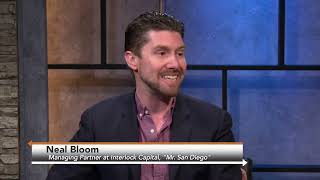
A TV interview on America Trends (May 4, 2023) where host Mary Burt Godwin interviews Neal Bloom — managing partner and co-founder of Interlock Capital — about his transition from aerospace engineer (space shuttle program) to tech entrepreneur (founder of Portfolium; involvement with Hired.com), and now venture investor focused on community-driven, operator-led investments in San Diego. The discussion covers Portfolium’s visual student portfolio product, Interlock’s community/operator investor model (including support for women founders), San Diego’s growing tech ecosystem, startup importance for job creation, and effects of recent shocks like SVB on startups.
Foreign.
You're watching America Trends. I'm Mary Burt Godwin. And you know, here in San Diego, we're known for a lot of things. Military, we're getting to be known for beer and food. But I think also the next big thing that we're going to be known for is tech. And I have Mr. Tech San Diego sitting right here in studio with me. Neil Bloom, managing partner and co founder of Interlock Capital, Washington. Welcome to America Trends.
Thanks for having me.
I was looking at your resume and you have all these businesses and all this tech stuff. You even have a podcast that I did, a little deep dive. We'll talk about that later. But so tell me about how you started your first foray into the tech world.
Yeah, I started as an aerospace engineer working on the space shuttle program.
Really?
And had a big pivot and started a software company that was LinkedIn for students is what it eventually became. We thought it'd be for engineers, but as entrepreneurs learn, you pivot where you find where your customers are.
So that was your first Portfolium, Is that what it's called?
Exactly.
Okay, and so when was that? Was that when you were in college or when did you do that?
No, five years after college. So 2012, 2013 time frame. Right. As they were retiring. The space shuttle program was kind of my transition into the entrepreneur and software world.
Okay, and where did you grow up?
I grew up in la, so not far, just up the road. Yeah. But I went to college in San Diego, so. So I. Ucsc. Yeah. I felt like I'd be back afterwards. And an incubator locally in San Diego really recruited our company to move to San Diego. And they surrounded us with so many resources and helpful mentors that we just fell in love with the community. And I've been here ever since.
It's a pretty nice place to be, you gotta say. It is. And I mean, so was I right in saying that the tech. I don't think San Diego has been known in the past as a tech hub. It's more up the road in Silicon Valley, up the coast, I should say. But do you see it as developing more and more?
Absolutely. We've had actually a very mature biotech scene, so a lot of drug development companies here that are really turning to the software world to help them advance. And so this community of software builders in San Diego are finding new applications in healthcare and in ag tech and in water and infrastructure and even in military. So we're finding that we're kind of having this convergence of technology to smart Software builders, applying it to other areas that we already have deep roots in the San Diego community.
Okay, so you went from aerospace engineering to tech startup.
Yeah.
And then you developed this platform. You were saying it's like a social media.
Yeah, it's like a visual resume for students. So people who have not had work experience yet are usually kind of shy to build a LinkedIn because it looks empty.
Yeah.
So we've developed kind of like Instagram meets Dropbox. We can ingest any kind of file or. But show it off in a really visual, stimulating way so that when you're in an interview, you can have people looking at the projects you're doing and saying, oh, I know how to use you. I'll hire you. So that was the basis.
Genius.
So we sold into universities and eventually we were acquired by a university software company called Instructure.
Okay, cool. So then you moved on to what was your next venture?
I really wanted to help build more platforms to get jobs. That was actually the original premise of Portfolium was help students get jobs. And so I helped build a company called Hired.com, which was like a marketplace for tech talent. And that got me to learn how tech talent is hired at scale. And during that time frame realized it's all about where whoever has the capital is kind of like companies who are raising capital, they have to go raise a ton of people. And I wanted to get more involved on the capital side. And so I started investing into companies that I had been watching for a while, just personally impressed by, by the founders. And that took me down the investment road.
So now that leads you to Interlock Capital.
Yeah.
How long when did you found Interlock Capital?
Only about two and a half years ago. So it was during COVID I had already been an angel Investor in probably 20 or 25 companies already. Just my own personal money. Investing in people, really. That's kind of what angel investing is.
Yeah. We were talking before the show started that we have a mutual friend, Sylvia Ma, who's been on the show.
Love Sylvia.
She's incredible and invests in so many. Mostly I would say female entrepreneurs is her niche. But she's incredible and her angel investing is pretty amazing.
And Sylvia and I are so simpatico in that regard. And half our portfolio are women led companies. So truly believe that that's the way it should be going.
Yeah, well, there hasn't been a lot of money in the past put towards that, so it's nice to kind of catch up.
It's like less than 1% go to women founders. So the fact that we're 50% in our portfolio, I think not necessarily exclusive by design, I think it means it's because of the kinds of people who are investors in us, help bring the right deals forward and the right people.
To invest in and they're attracted to what you guys have to offer. So it's a community driven investment firm. Talk about what kind of makes it different.
Sure. So we, everyone in our group are entrepreneurs. Current. Once you're an entrepreneur, you always are for life. You mentioned I've got a bunch of companies. It's because you can't not be running businesses or addicted in your blood.
Yes, yes.
You just really get addicted to solving people's problems is what it is. That's what entrepreneurship is. And so we've created this community of we call operators, people who have run businesses or running businesses and potentially successfully run businesses. That's who we want in our group. Looking at deals, diligencing them, writing the check, and then continuing to help these companies. Because it's really not the capital that really helps the company, it's the cheat codes that you already know that you give the founder. Right. I've already spent 10 years running businesses. I could distill down my learnings into 15 minutes to a company. Right?
Yes.
That would really go a long way further than whatever check I'm going to write them. So we want to attract as many business operators to our group as investors because we know that we can tap into any of them to help our founders with the hard things, what they're.
Going through and like you said, make a cheat code and kind of give them that extra leg up. Because you're right, it's money, but it's also connections, probably.
And yes, connections to talent, connections to potential partners, to customers, to other board members, to other investors. That relationship capital is really important and.
Kind of maybe answering questions, being that phone call, oh, I'm stuck here. What's the best next move?
Absolutely.
Yeah.
Right.
Okay, so what makes it different, do you think?
One, I think it's having the ability to have all this expertise around.
Okay.
It also means that we can be more of generalists in the things that we invest in because we've got 5, 10, 20 experts in every field from medical device to software to online marketplaces and E commerce to even hardware. So I think for us we're able to look at a lot of different businesses and look inward and say, hey, has anyone done this before? Yes. Help us assess if this is a.
Good investment and where do you find these folks, I mean, do you. You're active, you are so enmeshed in the community and you probably go out and meet people and go to meetups and that kind of thing. But, you know, where's your. Where do you go and look for all this talent?
Yeah, so we've been in the community for 10 plus years, kind of building the community. So we kind of feel like we are seeing companies from start to finish already, whether it's events we're putting on, like founder hikes, we do monthly. Or the founder hike.
Is it literally just go.
We go do TORY PINES HIKE 6:30 First Wednesday of each month. Right. Get 30, 40 people out. We do dinners. We do. And then I have the podcast where I'm interviewing people and their guard is kind of off, which is great. I get to really know people and they're not just pitching for money. So there's that aspect. Then I mentioned there's hundreds of investor operators in our group. I consider all them scouts. So they should be looking for companies that are interesting to them for us to assess as well. And so 50% of the companies we've invested in so far all came from our investment group, our referral network in that regard. So we should get into the best deals in San Diego. But our investors are all over the world. And so we still see companies all over the world that we look forward to investing in.
Did you see. Started two and a half years ago. So that was just after Covid.
During. Yeah, during. Yeah, exactly.
Nice. And okay, so startups, how important are they to the economy?
Hugely important. I think there's a common phrase from economists that all net new job creation comes from net new company creation, meaning all existing companies are gonna hire and fire at the same rate. So if we're gonna create more jobs, it has to come from creating more companies, new companies. So that's step one. That's super important in that regard. We're also entering this time frame since COVID where we've realized how much technology is gonna advance a lot of things, like whether it's the virtual aspect or how old our infrastructure and our supply chain network was. So we're realizing we really need to adopt technology faster, fast in that regard.
It's changing. So ra and everything's changing.
Right.
And I was just having this conversation recently. I was listening to a podcast about ChatGPT and how Bing was using it to change Google or change search engines, and I thought, oh my gosh, all of the SEO optimization companies, all of the marketing advertisers all of a sudden our business has just shifted. I mean, it's changing and now it's like people have to change and probably new companies need to come into existence that now have this talent.
Right. It's even in building the software people are talking about. GBT is going to write software for you. These are people who with really high paying jobs are going to have to figure out their relevance and importance as well too.
Yes.
And now what matters is the relationships. You have to get your product into the customer's hands in that regard too.
Which is why something like your business, because you have all these relationships and you have little hikes. You can say, how do we pivot together?
Yeah, exactly. I mean, it's people matter. Relationships really matter in the end.
Now, the fallout of svb, how did that affect, how is that currently affecting startups and the economy for startups?
So over the last year we had, okay, let's take it. Since COVID we realized, wow, we really need tech and we need to embrace tech. But then over the last year, we've had all these fallouts in tech, whether it's the stock market crashing, we've had cryptocurrency crashes and then svb, which was this run on a bank by the startup community. So you've had a lot of negatives in a sense of a risky community of startups where big industry says, whoa, this is a risky industry. Should we be putting our, should we be going there? Yeah. And at the same time, startups realized it's really important to have a good banking relationship. Right. Because I need to call someone to move money around to stay relevant right now.
Yeah. I've got to go to a commercial and I just asked a big question. So we're going to put a pin in that right there and just take a quick commercial break because this is a really important topic. You're watching America Trends. I'm Mary Burgardin with Neal Bloom. We'll be right back right after this break.








