The Top Tech Awards at Snapdragon Stadium!
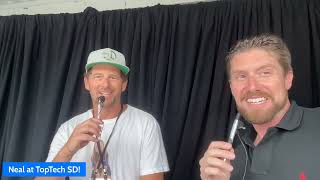
Neal Bloom hosts live interviews at Snapdragon Stadium with San Diego tech leaders, founders, and students. Topics range from AI in schools and student internships at UCSD and Cal State San Marcos to nearshoring, cybersecurity, and hardware innovation. Local tacos get recommendations too.
Chapters
Startups get the party. Startups get the party started. Startups get the party. Startups get the party started. You want tech and tacos, Tacos and tech, you know we got it. Hey. Startups get the party. Startups get the party started. Startups get the party. Startups get the party started. Startups get the party. Startups get the party started. You want tech and tacos, tacos in tech, you know we got it. Hey. Coming to you live from Top Tech San Diego, the Top Tech awards at Snapdragon Stadium. If you're watching this, it means you're not here at the party. The party is going off. J + saxophone. Maybe you hear him in the background. It will get him on the mic. It's really cool that I see actually a lot of couples, a lot of people here with their spouses, which means they get a little night out. I'm going to interview people. You guys want to come on the mic? Come around this way. We're actually going to do it live in studio here. This is the Top Tech awards. Oh, sweet. Podcast. Come on into the.
Oh, yeah.
Hey, I'm Neil Blue.
Hi, I'm Jennifer Oliveira.
Hey, nice to meet you.
Nice to meet you too. Let me see. Oh, let's take those off. Yeah.
Your first soft tech.
No, this is my third nomination.
Amazing.
Yeah, go. Third time's a term. Why not? Sure. I work at the South Bay Union School District in Southern San Diego.
Amazing. Yeah.
I'm the director of technology for South Bay.
All right. Yeah, that's a full time job and a half.
Yeah, Yeah. I was hired in 2019 right before COVID So that was death by trial by fire. And yeah, I've been learning a lot ever since.
Yeah. What's new post Covid? Like, obviously. Yeah, okay. But what's actually new in your world from a learning perspective? Meeting.
You know, it's interesting because I think what Covid did was really disrupt every education, which was phenomenal. And I think unfortunately we've kind of rubber banded back to some old strategies, which is expected. We. I'm in elementary school, so we don't talk a lot about AI unless it's productivity for teachers. So I think, you know, we're just trying to get kids to create more, you know, and understand more about how their content matters rather than consume content. Because we, I think in education have a. We are susceptible to just consuming applications and not really creating or producing anything.
So, example, what's the creation?
So, I mean, you know, I was working in K6 schools a long time, you know, A while ago, and, you know, I was doing podcasting with kids, fourth graders. They can do it. We don't.
We don't.
We haven't been doing a lot of that. So part of my job is to make sure teachers know how and that they can do that. But, you know, just basic technology is a tool, not as the thing. And I think a lot of folks, especially veteran teachers, tend to be a little bit nervous about breaking something.
Yeah, yeah, yeah, yeah. So. So is it just as much teaching you them? Yeah, yeah.
It's like training your dog. Right. It's really about the human.
Yeah.
It's not to equate children to dogs, but, you know, or teachers to dogs, or. Yeah, but I think, you know. Yeah. We have a responsibility to help teachers help kids. And, you know, kids are going to get it. They're not afraid. They're going to create and they're going to make stuff. Stuff without a teacher. So why not guide them a little bit more about what that should look like?
Have you ever gotten ideas from boys or fifth graders?
They're full of. I. You know, I think we see that all the time. Right. I mean, they love to build content. YouTube. Every kid you ask, 50% of the kids you ask want to be a YouTuber. So, like, how do we. How do we organize that in a. In a way that's a little bit more productive for kids? Yeah, yeah, yeah.
Next. Mr. Beast is coming from South Bay.
Why not?
Yeah. That's awesome.
Yeah.
Well, thank you so much.
Well, thanks for having me. I appreciate it.
Thanks for being on here with us.
All right, well, where's this going? Where am I going to see it?
This is called the Tacos and Tech podcast.
Tacos and Tech. Okay.
One to two episodes per week for the last five, six years.
All right, awesome.
San Diego focused. Really putting a spotlight on the tech community.
San Diego. All right.
It's live on LinkedIn live right now.
All right.
And we will make sure we get you a recording of this later.
There's my boss and my boss and my boss.
Love it.
All right, thanks. All right, awesome. Thank you. My name is Erica Schmidt. I'm from Ring Central. And I'm Natalie Claus. And I'm also from Ringcentral.
Amazing. Are you guys local or where are you guys in from?
She's from Dallas. I'm from San Jose, California.
Welcome.
Yeah, thank you.
You guys just get in today?
Yesterday.
Okay. So you got a little rain?
Yes. And now we're getting a lot of sweat. I know.
Thank you for being here. And thanks for being a part of Comtech this year. Give us a. Tell us a little about RingCentral.
Absolutely. So we partnered with Cox and they have a great base community. You know, they, they're basically their product supports our product and we complement each other. We're a full UCAAS solution. So when you think of unified communication, you're thinking of phone, video, instant messaging, sms and so that's what customers are looking for nowadays.
Completely wireless and native agnostic to every platform.
Absolutely, yes. Like I literally work from anywhere with any device being able to communicate and it's just like I'm working from the office and customers don't know that.
Totally.
Yeah.
We're right now using on the roof of this. This is my Starlink and we're able to connect through all the things as long as we got connectivity somewhere. Right. Everything else can happen to that take us through some of the customers that you work with and some of your unique needs that you've seen come through. Anything from like unique customers of using a breed central.
So we actually work with really any vertical customers, you know, especially when the pandemic hit. Right. Everyone kind of was like, how are we going to communicate? So we were successful before that and we're successful now. But type of customers is really any vertical. There's really not one vertical. I think of that. We do not work well with that. And on top of it, any size as well. So you can have a company with two employees or you can have a company with 2,500 employees.
We support it all. Really cool. What's San Diego a big hub for you guys Because Cox is in San Diego.
Exactly. Yeah. So like my territory is San Diego, Las Vegas and Phoenix. The hottest markets out there.
Hottest physically and like most populated.
I'm populated.
Miracle. What, what do you see on the horizon? Kind of new technology you think that'll kind of get implemented in or that you're excited to see your customers using.
I think the hot word right now is AI. Everyone's talking about it. So that is happening right now. And so I'm really excited about all that, you know, function feature now. Function and features. Like I joke around with her, but Chat GPT is my best friend.
Totally. Yeah.
And with Crocs Business Connect we come out with new features every quarter. So the product is really one that constantly updates and sees new features and that is all available to the customers automatically. Right. So they are with us, they get to immediately enjoy all those new features. Got a lot on the horizon, so stay tuned for that. But it's really amazing. Yeah, really. The innovation is key. You know, we are a company that's consistently innovating with new features, functionality. So just every quarter is getting better.
Totally. I can see some specifically, you said gbt. The way I'm using, it's kind of having to record literally every conversation for context.
Yeah.
Which means you want, anywhere you're communicating, you need to grab all of that information to plug into GPT or whatever your LLM, just so it knows more and more context. Right. And so pull from your chats, pull from your texts, pull from your emails, pull from your. And you guys are powering a lot of that. Like the in between layer. I can see somehow at some point you're going to be like pulling data.
Well, actually it already does that. So I love hosting videos when we're talking to clients because not only does it record the meeting so I can go back to keywords, but it also transcribes that call. So it's really cool technology. Like, you know, I like to focus when the customer's talking, so I'm not into writing notes anymore. So just the fact that I can go back to that and go to keywords like sales or, you know, phone, and it goes right to that conversation. And it's all available on the same platform.
Right.
So there's no switching between different apps. It's all available on the same app and you can go from your laptop to your phone to your tablet, whatever you're using. So it's super fun if you're about. We laugh about it all the time.
Right.
Because we're both moms, we work and so sometimes we switch our meeting from the computer to the phone. You know, going to go grab our kid or do whatever we need to do and nobody knows on the other end. So it's really a seamless platform. And I just say a funny joke, but it's actually, it's true. There was a time when I was taking a video meeting with one of my customers from my home office with my MacBook and I looked at the time and I was late to pick up my daughter. So what I did is I opened up my Cox Business Connect application and there's literally a banner that comes and it says switch meeting to this device. So I switched it seamlessly and I jumped in the car, I went to go pick up my daughter and that customer never knew what just happened.
Yep.
Yeah, totally. What's happening more and more, I mean, I don't forget my daughter that much.
Switching devices. Okay. This being the tacos tech podcast. Do you guys have any Entering some taco hot spots. Do you have favorite taco spots that you go to often?
Man, I'm in Dallas. We actually do have quite some tacos there. We have some holes in the wall that I love, but it's so just little holes in the wall that are fantastic. Yeah. But we did have some tacos today here in San Diego. Recomm. Absolutely.
All right. Right near the stadium. Like post. Post event. If you depends on how much you drink tonight at the event. If good for sit down Puesto tacos.
I heard about that. I heard about that sit down taco spot.
And it's like five minutes from here, maybe two minutes.
I love that.
So, you know, maybe go there tonight or tomorrow morning. Tomorrow for lunch if you're here. If you have a great time tonight, then you're going to want a whole on wall spot. Say D are the best.
Yes.
One that's also nearby here and near and dear to my heart is Sombrero's tacos. Okay. Their California burrito is like the top also huge but very close. So questo down there that way or sombrero down the road that way.
Don't you guys have El Gordo too?
Tacos al gordo is amazing.
That's what I heard. I want to try that.
There's different lines for different tacos. Their El Paso has its own line just for the questo taco because it is the number one.
Wow, that must be fun.
You can get El pasta pasta pastor and any virgin taco quesadilla burrito. But like the El Pastor line is your line for sure. There's one down in Chula Vista. I love it. I think there's one downtown in San Diego as well too.
Love it.
We're gonna try it.
We're getting all the intel. Thank you very much. My stomach. My stomach thanks you.
Thanks, guys.
Thanks for on the pod. Thank you so much. Thank you one more time again.
Just we have it on the pod.
I'm Natalie Claus. And I'm Erica Schmidt.
Hey, welcome back to the Tacos in Tech podcast at the Top Tech Awards. Got a long time friend here, Mr. John Stern, who is a longtime builder in the tech community. Good to see you. You too. Bringing dad around to the Top Tech Awards. Yeah, he just moved here to San Diego, so I want to introduce him to you and anyone else we could over here. I love it. Well, what are you working on now? How are things going? Things are going well. Still working on Ringpin and building here in the San Diego community. So it's a platform that helps companies connect to more users from more places. So some of our most recent projects are putting QR codes that geo locate the users and then serve a personalized page based on where they scan from. So it helps them kind of automate the process and get to the right people at the right time. Regency Centers is a big real estate company that uses it and the VF Corporation, who's North Face Timberlands vans, we're doing a big project for them now. So just ways to kind of automate take steps out of the process to make it easier for everyone. Very cool. Yeah. What's exciting tech wise? Obviously AI tools, auto prompt to build kind of stuff. Where are you seeing that intersect in your world? One of the things we were talking about is for recruiting. They're having a hard time finding seasonal help in a lot of their retail stores. So we're going to geolocate the users that scan the QR codes, tell them which stores are closest to them that they can get jobs at, and then have AI Automate looking at their LinkedIn profile, see what type of experience they have and get it to the right person as quickly as possible so they can skip some steps in the hiring process. Yeah, retail's hurting for sure, right? Exactly. We're even doing old school postcards for them because. Yeah, because they're just trying everything they can to get as many quality people and quality candidates. What about San Diego? Like what's on your radar here in town? Are you seeing any interesting other companies or you just been heads down building? You know, haven't been getting out too much recently, but there is some cool stuff going on here. Obviously, you know, in biotech. I have a lot of friends working there and AI is coming here as well. So I'm most interested right now, I think in robotics futures and that's kind of what I've been interested in. And medical solutions, all San Diego hotspots and they're all kind of converging together. You know, I applied to bio, AI applied to robotics and all those things I think will be a San Diego winner. Yeah, I think there'll be a bunch coming out of here too. Plus it's just such a nice place with a lot of talent. So people don't leave here, that's for sure. Work on things that you like working on and that change the world. Right. I came here 25 years ago and even though my family, my dad's sitting over here now, we're still back in Michigan. I never was able to leave. Really? Yeah. What brought you here? Originally it was just weather. It was the weather. I was from Michigan. I always wanted to live somewhere warm. And as soon as I graduated school, this was the first place I came and settled in and built a great life here. Love it. Well, you've been to top tech awards before? Yeah, many times. Yeah. Yeah. So this will be a fun night here at Snapdragon. Should be fun. Yeah, absolutely. It's good to see you and some familiar faces also. Well, thanks for being on, Jack. Good to see you. Thanks for having me. I'm Bill Smith with Chrome Roads and we have this intelligent ID badge platform. It's biometrically secure, it operates on your Bluetooth, on your Wi Fi, etc. And so forth. It's positioned in between a smartphone and an RFID badge. Right, so it's a B2B product. Absolutely. For sure Enterprises. Any company that's got the need for a chief security officer is going to understand the need for this device. There's a lot of security based apps that don't belong on smartphones and a lot of smartphones become dangerous distractions in the workplace. So if you still want corporate messaging, you can have that. Give me a very specific use case. Well, it would be great if we could get into Amazon, but they haven't called us yet. How would Amazon use it? Amazon would use it. I have a friend that I've interviewed, he manages warehouses, seafood warehouses back on the Eastern shore of Maryland. And people are always dealing with problems. There's a panic button on here, right? So if you come around the corner and there's 500 lobsters running around the floor and you need some help, you push the panic button. Okay. And your, your nearest colleague is going to come in with hopefully with a big pot of boiling water. Yeah, interesting. So what about like security, you know, walking your car or late at night? Absolutely. So, good thing you brought that up. We have a pilot program getting started at CSUSM and their senior experience program that's going to happen here in a month. So we're putting together a minimum viable product for those guys to use. Real world. Hopefully we'll get a lot of learning out of that. Such that when we deliver a pilot to our very first paying customers, which are more than ready, that we will have made as many. That's my phone making obnoxious noises. Sorry about that. You're good. How does the device. Sorry, sorry. Very first. Yeah, that's the rooster noise it makes. So anyway, yeah, one of the Functions for them will be, oh, there's our CEO walking by right now. One of the functions is going to be that panic button. Okay, Here, let me put this down. Two seconds. Sorry. Yeah, so we're working out. You know, it's not exactly designed for college students, but devices out there. Right. There'd be like tens of thousands of people with cards. I mean, you'd love that. We don't mind that at all. Of course, we believe that, that there's billions of RFID cards out there in circulation. Why not replace each and every one of those? So for college students, they're always logging in, logging out. Other industries like hospitals, doctors can spend up to 45 minutes a day authenticating in and out of different Systems. This is Fido 2 compatible. Okay. So they'll be able to walk up. The students will be able to walk up to their various computers around campus, just tap the fingerprint sensor and be logged in. Really helpful. Yeah. So there's a good. Each and every industry's got a different way to use it. Hardware is hot again. In the world of AI, somehow AI software side has made hardware interesting again. Do you feel that too? Is hardware hot again? Hardware is. I do both software and hardware in my career and hardware is harder. I mean, for sure. But I feel like the. So software enabling the hardware has gotten easier, which has made the hardware maybe a little bit more impactful. The actual coding of the software. You know, if you're hinting at artificial intelligence. Artificial intelligence is also shrinking design times for electronic circuits too. So. And maybe, maybe that's even a bigger gain than what you get out of software development. And it's probably better at mapping manufacturing than humans could that. Yeah, I wouldn't be able to comment on that because that's not. That's not my angle. We're mostly MVPs in my company, but Chrome Roads is definitely working on. They're working with a manufacturer over in Oceanside High Tem. I don't know if you know those guys, but they, they've got a really exhaustive testing lab over there. So that's, I think, the primary reason why we chose to go with those guys. Got it. Really cool. Well, I know, I mean, we go way back. I've seen a lot of varied stuff that you worked on. Yeah, you're a great networker, from agriculture technology stuff to theme park stuff. And now very cool to see the cybersecurity authentication area. Yeah, well, it's an interesting project, right, Because I've been in a lot of social networking and Just to be involved in a project where you really have to be talking, where you go to a trade show that is only about identity. And every last person at that trade show spends all day, every day working with ID badges or passwords or whatever. It's. It's very, very, very different. So really. Well, awesome to do a deep dive into that and find the real problems with solving. Right. Yeah. Where the rubber hits the road. Yeah, absolutely. Tacos from tech. We gotta talk tacos. Got a favorite taco spot? Well, I live in Escondido, so it's TJ Tacos, of course. All day. Huh? What's the order there? Yes. Yeah, Nailed it. I think we. We definitely had it mentioned on the podcast before. I don't know if I've ever asked people what they order, but that's probably what everyone orders first. At least that. At least in Autovado. Well, and. And my kid does the loaded fries, which I kind of think those were invented in Escondido. You think so? That was the first place I saw. Oh, that's a big claim. So loaded fries. Yeah. Yeah. Okay. All right. Great to see you. Thanks for. Michael, have a great time tonight. It's been fun chatting. Who do we have on? Introduce yourselves.
My name is Montserrat Hara. I'm from Cal State San Marcos. I started. Sorry. I studied software engineering. I study software engineering. I hope to go into AI, hopefully learn more about it and stay here in the area. In San Diego.
You got it. Us. My name is Calvary Fisher. I am also from Cal State San Marcos and I graduated with my degree in Computer Information Systems last spring. And I'm hoping to go into IT or software development. And we both love San Diego, so we're hoping to stay here if we can. We would love to have you here too. Well, thank you. Congratulations. Just graduated. Oh, yeah, yeah, you said this coming up this year.
Yeah, coming up in May.
Ah, amazing. And you have the same major? Sound like or. No, different major. Slightly different. Software. Cis, Computer information systems. Tell us a little bit about. You're coming into the workforce in, like the golden AI gold rush. Right. Does it feel like the things you learned even a few years ago compared to what they're asking you to do, to work on? Has there been a change just in the last year or two of the stuff you're working on, how you're using them? I think it's been interesting to see how applying to internships when I was in college versus applying to jobs now. They're actually asking for AI tools, whereas as an intern, they, a few years ago, they weren't asking for those. I think I've had to definitely be off social media more because everyone's like saying a bazillion different things about AI and so I kind of just have to keep my head down and keep applying and not worry about what people are saying about AI to help you apply. Yes, I am, I am. I use it a lot to revise or be like, let me rephrase this, what's the past tense of troubleshoot? Things like that. Right, right. My gv Just for this job. Yes, yes. It's so helpful for tailoring everything. Pass it over here real quick. So you're currently in school. Are you finding even teaching methods are changing? Are professors teaching differently and are you feel like learning and doing stuff differently? Just the age of AI now, I.
Think there's still a little bit of fear of AI in classrooms, but I'm definitely curious on how AI will be used as a tool in the. Not even the future now already I'm working on my Capstone project. It seems to be that there's going to be some AI features. So I'm really excited to work with that, see how that can really help me. It's supposed to be a robot that can do speech recognition, can track the user and stuff like that. So I think that'll be really, really helpful. And you know what, create to the project.
Yeah, in technology you want to work on like hardware, software, enable hardware or any kind of industries.
I've just started taking embedded systems, so I'm really interested in hardware at the moment. And next semester I'll be taking intro to AI. So we'll see where that takes me. But definitely interested in both.
Yeah, we have a lot of it. San Diego is like the nexus of hardware and software combined. Embedded systems are huge here. We pretty much almost invented, you know, some of the, some of the uses of chips in places, right. Like Qualcomm still is inventing, finding new places to put chips and stuff like cars and then in drones and then other places around that too. So I think, you know, you'll find a lot, you'll meet a lot of people here who are building some of those things into there, but with AI as a co pilot, as a friendly, powered way ahead into people who are, you know, still saying, well, I've been building this way, how I've always done it. Whereas you will be coming out, both of you saying like, no, no, no. This is like a superpower. Right. What are the industries you're seeing that are interesting right now hiring and you know, tell me about that a little bit. Kind of being on the the hiring roadshow right now. Yeah, I'm seeing a lot of just it jobs. I think software has been harder to find like, like specifically like software engineering. It's harder to find entry level stuff right now but everybody needs it. So that's the main thing I'm looking for. Wanting to be as flexible as I can with that. Well, I think what's interesting about you know anything in it which is technology, every role is going to be superpowered with AI all the way down to quality assurance and help desk. You know, having AI as a as not thinking of it's replacing the job. But actually you plus the AI makes you a superpower. So I think you bringing that right in and being native to it to be a really big deal. So I'm excited to hear that you're already being asked that and seen that on the job interviews. Any specific industries that you're looking to jump into? Oh man. I feel like honestly there's so much innovation like everywhere that it's really exciting. But I know for me I'm really excited whenever I see medical tech just because of the way that it can be so transformative for people's lives. Which thing like a device healthcare system. What do you think? Kind of a mix of both. Like I've seen great stuff. I just today I was reading something about like an AI tool that helps doctors do less paperwork so they can actually like spend more time with patients. But I've also seen really cool stuff just with like medical tech for like reducing how invasive surgeries are and stuff like that. So there's some really awesome stuff like that. Literally the interview we had just before here by the way with Bill Smith has a identity identity identity tool where it's for doctors is one use case that they can identify finger on there so that they don't have to like log into every computer in every room. They said they're doing a capstone at Cal State San Marcos this year. Oh dang. May be able to like close the loop on that. That's awesome. Now in real time on helping doctors just identity identity management. They're not supposed to be experts at logging in. I went to medical school for right? Yeah, yeah, yeah. So yeah we might be able to solve that right here in Northern County. That's awesome. Yeah. Well guys, this has been awesome to have you on the last question we always got asked favorite taco spot. This being the taco podcast Go first. Okay. A Cal State San Marcos One is Mr. Taco. It's across the street from, from Cal State San Marcos, the special breakfast burrito. If you order it before 10am you get a discount. All right.
How about you in the Encinitas area? Taco stand I believe. Oh yeah, they've got a lot of options. Yes, I'm a vegetarian so I personally really love their mushroom and cactus tacos. So delicious.
Have you been also down the street City tacos.
No, I haven't.
Check that out. I definitely taco options. Three times the vegetarian options. City tacos. Too long of a line at taco stand.
Walk down tacos.
Well guys, thank you so much for being on. Can't wait to have your expertise and skills in the workforce and have fun tonight.
Thank you.
My name is Anthony Soza.
Hi, I'm Christy Kyogi, University talent director for Tech San Diego.
Hey, I'm Ori Chasen, incoming student at UC San Diego studying computer science and we got there.
Yeah, yeah, there we go. Your name and your major? I'm Ruby and I'm a student at San Diego State University. I'm in my fourth year and I'm a management information systems major.
Amazing. I love it. Give us a little background on the, on the program itself before we dive into each student background.
So I run the Jacob's Talent Initiative and what we're doing is trying to keep our San Diego talent in San Diego. So they're here at ucsd, Cal State, San Marco, San Diego State and we are making sure that our talent, they're being educated here in these wonderful universities. So we've got to keep them here right in the region. They're learning from world class professors and so having students like Orey, Ruby, Anthony and you met earlier, Calvary and Monty, they're networking, they're making connections, they're building their confidence here making San Diego a career destination. So that's what we do at Texas San Diego.
And you are physically on campuses, right? Like are you there on campus kind of being that bridge on campus, off campus.
Correct. I'm over at the College of Engineering at ucsd. I'm over at the MIS department at San Diego State. I'm at the Women's Resource center looking at the women in tech to help them look at themselves in the tech industry. So being on campus is fun. And lots of free food too.
Oh right. So I'm gonna get students at something. So there's always free food around.
Yes.
Why don't you take us through, give us a little Bit of your background, what are you studying and what are you interested in getting into? I'm currently studying electrical engineering. When I transferred to UCSD one year ago and I feel like my background's been a little bit all over the place. I kind of follow what I'm interested in. I was in a rocketry club at UCSD called seds. We kind of developed rockets. I went out to the Mojave Desert and we launched them. This summer I interned as a cyber security intern. So already I'm kind of diverging from aerospace to cyber and I learned a lot. It was for a pharmaceutical company called Acadia. So that was really fun. And then now I'm starting something else for I believe it's our school. It's a co op internship with the Department of Defense. So it's kind of like entrepreneurship there. So I've just kind of been following whatever interests me right now. Gotta try everything now it's time. Before you get locked into something for three years, then another three years. Like that's great. I'm E60 alum, a mechanical engineer transfer student. Oh, awesome. I love seeing your journey and you know, I think you'll be, you'll go pretty far any. So you're trying every industry right now as electrical engine. You're trying a bunch of clubs. Yeah. Trying a bunch of internships, which is awesome. What do you know about San Diego's kind of ecosystem industries that you would want to jump into one day? I think San Diego is a really good hotspot for everything. I. I realize that San Diego is a really good hotspot for all biotech companies. That's what I was exposed to this summer. As far as defense. They're very powerful. They have a lot of bases already around this area and now for tech. So now I'm exploring tech now and there's a bunch of tech. So it's just a hot zone for everything. I think all industries in general. Let's pass the mic over. Take us through. What are you studying and what have you been working on so far? And make sure it's real close to your mouth.
So I'm studying information systems management Information systems at sdsu. And so I also transferred. I transferred from Southwestern Community College where I got an associates in just General Business Administration. And in my fourth year at sdsu, I've been connecting a lot with the school community. I'm actually a part of the school marching band and the school pep band. So I got a lot of that Aztec pride, you know.
And other than that, what do you play?
I play trumpet. Yeah. So we actually perform here at Snapdragon sometimes, which is pretty fun. And more tech related. I'm also currently interning at the San Diego Police Department. I started about a month ago and it's been really fun. I've been learning a lot of different things. Currently they have me learning a lot about inventorying in the office and it's just, it's a great experience and I'm so grateful to be able to learn so much about. And I'm also interested in getting into cyber security, which is something I more so have to study on the side. But I definitely want to look more into the field of IT and just, you know, learn more about tech overall.
Yeah, I love it. Well, I. On Fridays I teach at the San Diego State SIP launch pad, which is the entrepreneurship incubator. You should come over every Friday 1 to 3pm We've got 20 to 30 startups who are building stuff out, talking to customers and then iterating and building more stuff. So if you want to sit in, come join us. You know, we're building things within minutes, running out the door, talking to and finding a customer and then being like, all right, this is how they use it. Let's rebuild. Yeah, love to have your expertise in that.
No, that would be. That sounds great. I would love to just. If you could write me some information down about that after this, that would be great. And I would definitely like to stop by when I get the chance.
Microphone over here. Corey, give us a little bit of what you're studying, what your background is and what are you excited for to work on next? Well, first of all, thank you for having me on. It's super exciting. So I'm actually from Los Angeles. I just moved out here to La Hoya about a few weeks ago. My background from there I was in community college, studying computer science. And what's your community college? Moore Park College, transfer to uc. Awesome. Love to see. Meant to be. All right, we'll talk about that later. But so out there I was also teaching robotics and computer programming and yeah, so that's kind of where I formed my foundation and now I'm transferring to UC San Diego as a computer, Computer engineering, computer science major. But what I really do enjoy is I heard someone saying earlier, but bridging software and hardware, so that's kind of where I found my zone. I really like understanding from the circuit to the software and from, from the ground up what's happening. It's just super interesting. So I want to take that either into a field of like, embedded systems and either like autonomous navigation, UAVs, cars, or into aerospace, so kind of wherever the road takes me in terms of that. But I'm really excited for UC San Diego. I think it's an amazing school, amazing programs. Professors are awesome. That I already met so far, so. And thanks to Christy and Tech San Diego for having us here. And I'm really excited. We're excited for you to network in further here tonight. But we got to know. This is the Tacos in Tech podcast. You got to eat. We got to know. What's your favorite taco spot? My favorite taco spot. It doesn't have to be in San Diego. Yeah, what's it called? 19 something tacos. Like 1988 tacos, nuts. I don't know. It's. It's a taco store in Sherman Oaks. I always go to it. It's a little hole in the wall. You know what I'm talking about? Yeah, that one. I'm not a huge taco guy, but that's where I go if I get tacos. Yeah. We'll introduce you to the San Diego scene. Yeah, please. I. I know you guys have great taco seafood out here, so. Yeah, throw the mic over. We'll jump over here. Favorite taco spot.
Favorite taco spot. A popular one among San Diego locals, but tacos. El Gordo. Yeah, I know. That's a popular one. Really good. I highly recommend that you guys try it if you haven't got a separate.
Line just for the El Pastor.
Yes.
How popular it is?
Crazy popular.
Good one. And you mentioned taco stand has got to be the best tacos I've ever had. I think it's not the meat, but it's the sauce on that they have. Yeah. It's just the burritos are really good. Whether it's the Cali burritos or the loaded fries. Taco sand is like amazing and it shows. There's never. Not a line. Yeah. You know for sure the move is order ahead and then from the app and then run up and get it from the window. Go pick it up. Yeah. No, they're amazing. Well, guys, it's so great to have you not just here tonight, but here in town and the community and getting Internet worked in. So thank you to Tech San Diego for being part of this out. Have a great time tonight. Thank you. Thank you for having us. I'm Joe earle. I'm with C3 Insurance. I'm a cyber insurance broker. Happy to be nominated here and good luck. To all the contestants. Yeah. Right. It's a fun. Have you been to this? I haven't, no. Oh, first time? Yeah. Oh, amazing. Oh, it's such a fun party. I think it's year 17 or 18. Wow. It's been going on. Where have I been this whole time? I mean, it's, it's a pretty under the radar because it's mostly for like your CTOs and your CIOs, which, you know, don't out, don't go out and boast like, hey, I'm going to this big party, right? They go, they come, they celebrate. A lot of bringing their spouse and their partners, which is pretty cool. Have kind of a tech night out with your partner. Take us through a little bit what your role looks like in terms of the cyber security sector. Sure, sure. So my job is to help businesses choose what cyber insurance to buy. I help them figure out how much insurance they need, basically, like how much risk they're transferring. And then I help them through claims. If they do get hacked, the insurance company will pay for, you know, their. Pay them back for whatever fraudulent transfer they accidentally do or pay the incident response people to get them back online as long. Along with the breach attorneys. And then my side job, I also have a podcast. Yeah. It's called Ransomware Rewind. Yeah. Oh, thanks, man. Yeah, so we just talk about, you know, we. It's very casual, very, it's non technical. We just talk about like current events, deep fix, AI, all that fun stuff. Cyber security is one of these things. It feels like it's all very reactive. It's like you didn't cover yourself and then something happened and you're like, damn it, I got one. Fix that. And then I don't let that happen again. Is that, is that what it feels like? It kind of is, yeah. I think there's, I think there's the companies that are investing in cyber security and they're taking it seriously. They have a cybersecurity budget. And then there's the people that are like, it'll never happen to me and it happens to them, you know, but I feel like the companies that are investing, it happens to them maybe at a prior company. Yes, yes, yes. So a lot of times CISOs have to work with their hands tied behind their back because they're like second class C level person where like they're not invited to the corporate meetings or they're not in the boardroom. And I would just tell them, you know, you gotta find a position where you're invited into the Boardroom and that you can help make the decisions for the company because you don't want to have to figure out security after the fact. You want that built into the decisions of the company. I'm gonna throw you a personal use case. Something happened to me recently. What? Talk through it of how I should have covered myself. My Twitter got hacked and I can't get back in and I'm pretty much stuck out of it. And they've been posting on it. Changed my. Changed my. Obviously my profile and my email and my email and the cell phone and everything. And they've just been posting crypto. You know, buy my crypto. Oh no. So. And Twitter won't respond. They're like, we can't verify that there's an email there. Is this that our personal social handles like something that people are covering themselves with? Is that something that people are overlooking that piece? I obviously did. Right. I think at a certain level people need to think about that, you know, if they are an influencer like yourself, you know. But what I would say to you is, you know, find every. Anybody you're connected to at Twitter, on LinkedIn and message everybody until somebody, you know, starts listening to your case. Even tweet at Elon if you want. Really? That's the level we have to do to get back into our accounts. Crazy. But that's. Yeah. Well, I had a client that he got hacked by Kira Ransomware Group and he got his money because he didn't have a Coinbase account to pay this guy. And he got his money locked into Coinbase and that's how he got his money out was he had to find people on LinkedIn. He was connected to send instant messages on LinkedIn to see like, hey, can I get my money out of here? I need it to pay this hacker. That is crazy. So on top of getting hacked, then your money gets hacked in a sense or locked. Yeah, it gets locked because know your customer rules, right? Yeah. You can't just like move money through Coinbase that fast. Where does the tech go to eventually stop us and help us and help companies really? Not don't say my case, but where. Where's the technology going, you know, to make this actually one more top of mind cyber security so that people aren't doing a reactionary and it won't ever happen to me. What do you see coming down the pipe around that? Well, a lot of new products are around AI. So I think you have to fight AI with AI. And there's some interesting products out there like cyber crucible who's like, stop automating the processes. Stopping the processes that, that go like, you know, like when they start like hacking you, it's automatically. And then there's really interesting, like cyber awareness programs that are mimicking like deep fakes. They're mimicking like spear phishing emails, things like that to get, you know, because you're only as good as your weakest link. So you got to train your people. Right. And you know, it's short sighted not to train your people, even though it can be expensive and you have to buy some software. But it's much more expensive when, you know, the lady from accounting gets tricked into sending, you know, 250K to some hacker. Right? Totally. Yeah. That's the part of AI that just feels like it will never exchange is the human element is, are the front lines. Yeah. I mean, even the, the CEO of the CFO of Ferrari got depicted. And the way he found out I was a deep faker was he asked him, you know, because he thought the guy was posing as a CEO, you know, and he deep faked the Italian accent and everything. And he asked him, what book did you recommend to me last summer? So you gotta like take the, the human, put the human back in there so that you can figure out like if that's the right person or not. It's all about identity now. Totally. Really interesting. We've had a number of identity technology conversations here which has been interesting to hear a repeated theme around that. So, Joe, appreciate it. Thanks for being on. Of course. Good luck tonight. Have fun. Thank you. Thanks. I'm Ed Peterson, the Citron Koopman. And I'm Jason Krueger, also a Citron Cooperman. Guys, thanks for being here at the Top Tech Awards. You're already having fun. Fantastic. So far so good. Yeah, we got, we're the caricature guys. You haven't gotten yours yet. Let's show it off to the camera. Yeah, Caricature. It looks pretty good. It looks like you. Yeah, I love it. I'll go get one for sure. Take us through a little bit with Citroen stuff too. Yeah. We're a full service CPA firm, so everything from your basic tax and audit support, but what we really do, especially in our San Diego market, is what we call digital services. So we support Netsuite, Microsoft products, Salesforce, you name it. And I'll let this guy right here finish it off. Yeah. So it's funny because I'm the guy responsible for digital services. He's on our fractional accounting support team. We have a large fractional accounting support team. So a lot of organizations, Neil, that are growing, you know, it's, you need a certain type of cfo, slash controller, slash accounting support. When you're a certain size, you need a different kind of person when you're a different size and a different stage of your business. And sometimes it's very hard to hire the person that can do it all. In fact, very seldom can you do it all. So sometimes it's better to just get an expert in for a short period of time on a fractional basis and then, you know, get someone different. When you get to the point when you're trying to raise capital or whatever you're trying to do. Our entire company, 4,000 of us, I mean we're very good at swinging the axe, you know, and you know we can make any system work, but the digital services team does is we sharpen the axe. Like they'll come to us and say, listen guys, you know, it's taking you three weeks to close the books. Your systems are antiquated. They don't talk to each other. There's alternatives for you out there in the market. And we do it all. We do Microsoft, we do Salesforce, we do NetSuite, we do a lot of different ERP systems. And then we can come in and consult and say hey, like this is a good way direction to move. That's really smart. What do you. Obviously a ton of new tools coming out, replacing a lot of other tools. What are you seeing as an. And a human plus tool is kind of a superpower we're finding these days. Absolutely. Replacing a human. But like one plus one equals three. Like what are. Give me an example of like how you're seeing a new tool plus someone on the consulting side there that's just like different night and day from a year or two ago. Well, you just look at a tool like Ramp, for example, a modern, you know, you know, ar, AP sort of solution where you can of run everything through credit cards and virtual credit cards and just really integrate it all to your erp. It sort of, it brings AI to bear within your standard ERP and it just creates such efficiencies. Like my gut tells me that these big SaaS solutions will get under pressure, but not for a while. Like the investment that these big organizations have made is so intense and they're doubling down on AI. I mean no one spends as much money as Microsoft. No one spends. I mean Salesforce is all in on Agent Force. You know, Netsuite, Oracle, you've seen that massive pop in Oracle stock. Larry's all in on, on AI. So I mean, I just think that we're going to see the biggest impact with the biggest providers now. We'll have smaller emerging, you know, solutions that come and compete, but they got a big road to hoe to get to, to where NetSuite is, you know, a SaaS solution since 1994. I mean, back in the dial up days. Yeah. I mean, just to top it off, I think we want to create as much efficiency as we can leveraging technology and then have the human aspect, you know, be able to understand and go through that information to be able to help make decisions.
Right.
To achieve the goals that our clients have. And so we're all about, as, you know, creating the, as the maximum amount of efficiencies we can, so we can focus on the good stuff with our clients versus having them pay for the, you know, the lower level, less efficient areas that to be honest, clients don't even know about or care about. Right. So no client, the business owner just needs the job. Just solve my problem. Exactly, exactly. I got other things to work on. Just do the thing. Right. And if you can be more efficient at it with a tool plus human. Yeah, because the human knows the strategy, the reason to do it, the context. Yep. Tool does the thing. Right. Anything come to mind within your kind of vertical of tools that are helping you on the back end? Yeah, I mean, so we work within a lot of ERP systems. So as Ed mentioned, even Salesforce, those systems are continuing to integrate different aspects of what we call AI. Right. Which everybody thinks AI is something different right now, but. Different. Yeah, exactly. Different efficiencies within those systems. So the goal is to, is to leverage Ed's team to create those efficiencies within the system and then our team then would work within that system to really drive the value that our clients looking for from the types of reporting they need to make business decisions, financial reporting side of things, all of those types of really it comes down to reporting how can we get the right information to our clients to be able to make the right decisions? And, and the data.
Yeah.
And how do you organize that data in the right place? And so, you know, we're, we're seeing that with the different systems. And our firm is a big Microsoft user and, and implementer as well. When it comes to copilot. I know we've done a lot of things with Copilot. That's just, you know, the starting, starting point for AI for companies is Understanding how do I leverage copilot to create efficiencies. So, yeah, and Neil, the other thing is that, you know, Citroen Koopman was acquired by Black Blackstone. So I mean, the biggest private equity firm in the world, and they're all in on AI. I mean, they're massive, massive investments in data centers and everything they're doing. So we're as a firm are being driven to be very cutting edge in terms of AI and thinking about how it's going to affect everything that we do. Like a sandbox for them really, to try things that probably they want to pull out and use in other parts of their portfolio. Absolutely. And things that they're seeing in the market that they, they know is going to have a big impact. And if we can be at the cutting edge of that, I think we have value to offer to clients, you know, small and large. I mean, you know, I know you deal with a lot of sort of incubator and startup firms and people that are raising capital here, you know, in the Southern California market. And that's critically important. My, my pitch to people oftentimes is like, get on the right tool early. I mean, trying to drive the race car around the track while changing the tiles is different is really difficult. So the smaller you are, the quicker we can implement the loss, the more cost effective it will be. But then you're also leveraging the right tool where you don't have to worry about it when you're $200 million and now you've got a huge, big upheaval to go through because, you know, it's, you know, any kind of ERP implementation is like having Tommy John surgery. It's painful. There's going to be a recovery, but, man, you're going to be able to fish at 100 miles an hour once it's done. True. You know, but if you're only pitching at 40, you need to pitch at 100 if you want to compete in the big leagues. Yeah. I mean, that's just the reality. So get on the right tool early. Yeah. And try tools. Be even willing to try a tool. Especially now. The tools are getting better. Yes. Right, absolutely. And be willing to also, you know, say that, yes, something is better than what I have. Yeah. Because a lot of people are not willing to cut off an existing arm. Yeah. Because it's like, well, I have a process and a system. It's like, yeah, but you're not going to grow any faster. This tool might make you 100% faster. Your, your, your product that was developed in 1984 on a client service solution up there that's been upgraded and patched and whatnot. Still running.net is. Is not going to compete with some of these modern, you know, rapidly evolving solutions that are being written by AI for. For all intensive purposes. Yeah, I mean, that's exactly what I was going to say. What got you here. What got you here isn't going to get you that next. That next step. Right. And so, you know, how can we position our clients to be able to take advantage of what's happening in the future versus always that slog of, oh, man, you know, my systems aren't quite right, but I'll deal with it now and, you know, figure it out later. Well, later is now in a lot of cases. And so how do we help them take that next step? Yeah, I love it. Well, being in San Diego, obviously we are taco town. When we're not here doing tech, we're having tacos. You guys have a favorite taco spot that you'd like to. To go to? Venture to El Pueblo of. El Pueblo of Birmingham, 24 hours a day, $29 fish tacos, baby. Hard to beat. You can feed an entire family for 10 bucks. Love it. And they're not bad. They're actually pretty damn good. I've got two. Yeah, I got two teenage boys that probably consume more calories from there than anywhere else. Yeah. Yeah. Is that the one in Cardiff? Yeah. So right there. Yeah. Yeah. So that, that seems to be the spot. Yeah, that's right by your house. You can probably walk it from the house. It's close. Yeah. Amazing. Well, guys, thank you so much for being here. Thanks for being a part of Top Tech. This is a really fun night where, you know, the tech community actually comes out to have some fun and recognize each other for our. The advances that we're doing in the community. So really appreciate you being a part of it. Yeah. And I look forward to doing more with you in the future. Absolutely. Yeah. Appreciate it. And nice to finally meet you. Yeah, likewise. Been listening to Tuckers and tech for. For years and years and years. Now you're on it, you know.
Well, that's.
That's a highlight for me. So you've made my day. Thank you, Neil. And we are back live here at the Top Tech Awards San Diego. Got Jeff Clanton on the pod, another podcast host here in town. Jeff, introduce yourself. Another San Diego podcaster. Yes. The podcast is Conscious Curiosity sd. We interview local San Diego business leaders that lead beyond profit. So we're talking about conscious capitalism, the B corp guys bring them in, tell their story, how they're managing, how they're leading, why they do it. Yeah, lot of I'm in the tech world. A lot of B corp meets tech in that regard. From the flock freights the trust in wills. There's a huge B corp San Diego movement here. Right. Working on with Abraham Chen. Yes. Yeah. Tell us a little bit about how you, when and where did the movement start in San Diego? Like how. Where did you see it industry wise and how has it spread? Well, I first got on board with conscious capitalism probably about seven, eight years ago. That's what began this whole thing. And going out of post Covid, I was like going. We were interviewing people from outside the area. So how come we're not talking to local San Diego business leaders? Right. We're right here, people I can meet. So I went to the conscious capital and focused today I want to start a podcast. And that led me to the BBB where I actually do the podcast. I attended their torture awards and said, wow, these guys are like conscious capital companies. Right. Then I led to the B corp guys. Then I've been involved with cause San Diego, which conferences coming up on October 9th. Right around the corner. Yep. Business for good. And yeah, amazing. Are you seeing it? Specific industries adopt quicker than others. In San Diego seems like smaller companies seem to have more of that mindset than the big companies, which just seems to be the challenge. Yeah, we need, we need the bigger companies get on board. Totally. Well, change takes a while and usually with a B corp it's like an employee movement and employee feeling. Right. That kind of bright side up. Is that what you see as well? Yeah. Right. I mean it's really about something beyond just a job. Right, Right. So for me, probably why I'm involved is because I really believe that, you know, people should go to work. It's a thing you spend the majority of your life doing. It should be something you're excited about and you find meaningful. Unfortunately, statistically like 80% of people don't. So that's what we need to change. I can't quite understand why leaders don't get that when you had a bunch of employees that were engaged and excited to be here. That's a good business model. It's true. Well, I think, well, there's two worlds. There's the just, just a bunch of talk about, hey, the impact we're having, everything. But with B corp you gotta be. You gotta prove it. You gotta prove it. Yeah. So that's why it's like really easy to just have lip service until they're overrated the road. And now you're actually measured on your impact, right? Yeah. So I think it's gonna be slow, but the ones who are there are real adopters, are making real impact. Well, the other thing is kind of exciting. Here at Conscious Capitalism we have a social innovation internship program we're doing with USD and we're on year three. Started out as a little small prototype with three students. We did 11 students last year and this coming year I'll be doing 26. We're launching that as we speak. So it's really amazing. Internships, engineering, business. Across the board it's about bringing an intern in. We're actually supported by the. Oh, what's the group grant Oliphants group. The Previs foundation actually funded the program. So it's actually. They're covering the cost of the student so it's actually free to the company. It's almost like a apprenticeship almost in a sense getting paid to learn to a certain regard. Yeah. And only at B. Only at B Corpse. No, no, across the board. Across the board. Definitely some B Corpse are in the pile. But yeah, send us through your podcast itself. So one I need to get out to the BBB to see their podcast studio because most people have mentioned it. Always looking for a good spot to record at. Take me through your podcast, how you started it and how it's evolved over time. Yeah, like I said, I started kind of post Covid when I wanted to say we should be interviewing local, local leaders. And then that actually introduced me to all the other organizations. So really I tried to become the hub for all these kind of purposeful organizations like the B Corp movement and Cause San Diego and those kinds of folks. So how do we bring these people together? My big thing is we're not collaborating. Right. So I interview like these wonderful business leaders are doing some amazing thing, but they're just kind of doing within their business. It's kind of true of the organizations as well. B Corp guys are doing B Corp stuff. Conscious capitalists doing conscious capitalism. So how do we all collaborate? I think that's going to make the difference. We all actually have one plus one equals three. What did you do in prior life that like kind of led you to be all in on this movement? Well, I'm kind of like the unconscious capitalist. Right. I always kind of led from the idea of purpose. It was kind of self serving that if I can enroll you bigger into what I'm trying to get done, then that'd be good for me. And along the way, just noticed how people just weren't that engaged at work, and that became kind of a driver. So I actually wrote a book about 15 years ago called Jailbreak Leadership, which was all about what's your. What's your personal purpose and how does that show up in your work that you do? So how do you bring purpose into work? And so for me, from a business leader's perspective, the work becomes a platform where you actually can bring your purpose alive so you don't have to go looking around. It's actually the thing you want to bring above and beyond just making the money and making the products that you do. So. Yeah. Amazing. Why do you think that plays so well in San Diego? I mean, obviously, I know we choose to live here in a place where people, you know, know, vacation. So we put quality of life over everything else. Right. Does that kind of have the. The roots for also working on the things that matter and the things that drive us in purpose wise? Well, you know, we're that small, big town. Right. So everybody kind of knows each other. We're like a community. We got an ocean on one side, we got a international border on the other side, we got a desert, and we got a marine base. Right. So we got our own little island here. So it's a great opportunity for us to actually be the spearhead of actually doing this sort of activity and being the example for other cities around the. Around the country. Yeah. It's a good way to put it. I do call. I hadn't thought about the island that way, but I do consider north of Camp Pendleton. Northern California. Exactly. So you're. You're spot on there. You've obviously been doing business in a long time. Where we work is also where we eat. We love to eat tacos in San Diego. Do you have a favorite taco spot? I do not, no. I made some awesome carnitas the other day, though. Yeah. Where do you get. I live in pb. Okay. And we've had a little bit of a fly issue, and we've been battling the flies, and we're kind of gone. I made this carnitas, and all of a sudden the fly showed up. My wife said, it's because of your carnitas. I said, they're good, but they're not that good. After the flies come the yellow jackets. If they're really good, you know, that's how you know you've made the. You've really made the best for sure. Okay. I'll be looking out for those. Jeff, it's been a pleasure. Have you on. Awesome. Thank you for the impact you're having on the community. Well, thank you, Neil. Appreciate it. All righty. Thank you. Thanks. And I'm here with longtime friend START community leader Marco from Arcus Nexus. Hey, how are you? I'm doing great, Neil. Thanks for. I didn't realize you were hiding in this container. And now. Now I know why. So this is the live booth. We got signs up on the outside. I got Starlink on the roof powering my Internet. And we're talking tech here at the. The favorite top tech awards where we're celebrating our technical leaders, which I know you've been a part of for a long time. What year is this for you? You know, you remember I was chatting to somebody about it. I think it's probably my 9th or 10th year attending. Amazing. It's gone up a little bit, you know. Yeah, we've had some years. We've been at the. We've been on Petco park field. We've been in the Del Brow paddock. But I think ever since they found Snap. Yeah, yeah, I remember Petco. That was a fun one. The Jumbotron. You could post your picture online and they would put it up right up there. So that was your 10, by the way. So that was pre Covid, for sure. Oh, yeah. Oh, yeah, yeah. Long time ago. We're getting old, Neil. We're coming right into our sweet spot is what we're really saying. That's where technology and experience gets superpowered, which is what you guys do at Arch Nexus. Using a whole bunch of human talent to power the tech community for tech companies. Can you give us a little bit of background on Archus Nexus for our. For our listeners? Yeah, sure. So we are a near shoring software development firm. We're one of the pioneers in near shoring, as a matter of fact. Been around for 22 years. Started here in San Diego, Tijuana region. Locally, we have supported mostly tech startups in the SoCal tech scene. And basically what we do is we find talent for them and build teams so that they are able to develop faster, better, cheaper, and they can ship that product out, get more users on their platform, reinvest that capital, grow even more, and then ultimately get acquired. We've been part of 11 successful acquisitions. I guess somebody won an award. Let's go. That's exactly how we feel when one of our clients get acquired. Yeah. So we've been part of 11 of those processes, mostly customers Companies here locally in San Diego. And yeah, we're very proud of what we do. We're longtime supporters of the tech scene here locally. I'm personally a big supporter of the borderless innovation community movement. I've been around organizations like SD Connect, I support startups, San Diego's like binational efforts and I, I don't know, I'm a true believer that we are in a unique part of the world and our company is just one of many examples of how that's a reality and but yeah, that's, that's what we do. I mean ARCUS Nexus, the story of ARCUS Nexus is the story of the San Diego startup community. I mean they both have grown up together and you can tell from I think it was year two of Santa Startup Week 2014 or 15 when we hosted our first opening night at Arcus Nexus when it was just the containers. Yeah. Then the, the tall building and now the, the third building to complete, you know the Arkus Nexus compound down in Tijuana which is where night two is it Night two of Startup Week is going to be I believe. So it's Tuesday. It's not even just night, it's like the whole afternoon. It's a full day packed of. Yeah. Talks, lightning talks, networking, the traditional tacos of course. And yeah, and we ring a bus for people to get on at the border. It's, it's very casual. You basically get yourself down to the San Ysidro port of entry into Mexico. You walk across, there's a bus there and people waiting to greet you and we get everybody over to our office which should be like a five or eight minute drive from there. But it's, it's very casual. We've done this, I think it's our seventh year in a row now. That's amazing. But yeah, no, we really enjoy having guests over and showcasing kind of the art of the possible south of the border. And yeah, we've been, we've been around for a while so we, we know a lot of, we have a lot of connections and fortunately those are adventurous and are okay crossing the border and you know, checking out what's going on south of and yeah, so we're very happy to be hosting that of course again October 7th, night two of Startup Week coming up really soon here. So make sure you check out sanderstartupweek.com or startupsd.org I'll be there. It's been a bit since I've been down to your guys place. I used to come down a Lot more. And I know Dyrah would be right there waiting to pick me up and drive me the five minutes to the office. Office. So you get the. You get the carte blanche, man. You get the pickup at the border treatment. So, yeah, you guys are so accommodating. But. But you've been both, like you said, long time. You've been running the OC CTO tech talk community for a long time and then kind of expanded that almost down to San Diego, and now the monthly CTO talks all over Southern California. I've seen them all over the country at times. Right, You've tested in Colorado and Texas and Florida. Take us through a little bit of the CTO talk series that you guys have championed. Yeah, hold a little closer, Mouth. Sorry. Yeah, no problem. So I don't know, Neil, Ever since I grew up, I've been part of a community and I've always felt like I've contributed, but also I've taken a lot just by connections or just by, you know, people like yourself introducing me to other professionals. And I feel that's been an integral part in my career personally, but also in organization. So in 2017, I knew I was going to be moving to Orange county, so I said, I. I love ETN's group in San Diego, and I used to hang out with those guys a lot, but. And I love. Exactly. And I love Tony's group up in la, the Lacto Forum, But I'm right in between the two. I'm like, I don't want to be driving up and down all the time. So I, I said, okay, sure, let's start one here locally in Irvine and actually got great support from people here in San Diego as well to kind of, you know, baby step that out of the. Out of the corral. Yes. And against. Will sometimes drive to Northern California, in Orange county to make the move. Yeah, yeah. Or take the Amtrak too, which is quite fun, actually. Yeah. But, yeah, we started that, ran it, you know, monthly, started growing 2020 came and we didn't really know what to do. So we did exactly what you're doing and we did the podcasts, we did the digital version of it. Some folks really, you know, bought into it and were volunteering to be my, like, my guests. And I would do the same as you're doing, just do interviews and, you know, tell us how you're navigating Covid. And that began to kind of become popular in 21. We had to stop every ARCUS business, really picked up like many other companies in 21. And I, I just had. No, not a lot of energy to run though. So 22, we brought it back, but with a nice plus one. We actually added San Diego. So you mentioned Daira and the rest of the community team kind of bootstrapped it in San Diego as well. So I kept on doing the Orange county group. We probably have a couple hundred members there. And then we currently have. We're actually having our coming October. I'm confused between the 1st and the 22nd because we're having both in the same month. But yeah, yeah, we have a lot of folks following that group. And the CTO Talks is basically a platform for tech execs to converge and share insights and share kind of that knowledge and mind share amongst each others. It's been a great platform. We just had our private dinner last night at Javier's at utc. You know, folks from Illumina, from Drata show up and it's great for them to be able to also connect with their peers while they kind of share their stories with the rest of the community. So it's so important. The CTO community, I feel like is is unfortunately overlooked because CEOs get so much emphasis and love, you know, and the CTOs often who are co founders. Right. So they are just as entrepreneurial and having to code and lead and manage teams and grow them all the way up. And so one tonight obviously is a, is a showcase of that where technical leaders actually gather. But you're doing that all year round because you realize obviously that's the community that needs, that needs, you know, the support, because they're under support. So it's been awesome to see and we start partnering. I think it was two and a half, three years ago on doing, taking. You know, every once in a while we'll do kind of a larger panel version of a CTO talk. So most CTO talks, you know, a solo talk. Yeah. And then we'll add in every once in a while a panel, you know, for cross conversation around that too, which is a really fun partnership to have. Yeah, it has really. And one of our most successful additions is when we partner with great communities like yours and, you know, it's all about driving the conversations. Right. When we started the group, the premise was, chances are there's people stuck in one building working eight hours a day. If they're a CTO of a tech company in Southern California, chances are you're trying to solve the same as the guy in the next office. Right. However, you're probably not going to talk to that person. Unless you get stuck in the elevator or something. Right. So that's why we started it. And sure enough, it's been a good platform for enabling that. And yeah, yeah, joining forces has certainly been key to expanding, to getting new faces. Believe it or not, the talks are not extremely deeply technical. They're more of culture. They're. Some of them are navigating with the CEO conversations but all around, you know, people driving the technology agenda for companies from all different shapes and sizes in San Diego and Orange county. And yeah, love to do it, love to see it continue to flourish and let's continue to partner with you. So thanks for being such a huge community builder here and I'm looking forward to being down at the archives hub here coming up in Startup Week. Yeah, my pleasure, man. Always good catching up with you and I love this new, you know, format. So, yeah, it's great. Join the office anytime. So thanks, Marco. Appreciate it. Cool. Yeah. Like this, man. Yeah.
Hi, everybody, I'm Sharon Alipana with Premier Property Partners and I'm here joined with.
Hi, my name is Ron Nealix and I'm the executive director of the Escondido YMCA Campus for Community. Well, being amazing, amazing community Communities, obviously amazing night where we're celebrating technical leaders and the community that we build our companies in, our companies and our organizations in. I know you're up for an award tonight, so fingers crossed. This should be a really fun, you know, awards nights to celebrate. Either way. Just give us a little background on, on your background before we kind of dive into Rom's area.
Well, this is actually my third or fourth year here, the top tech award and it's amazing. I love this venue by the way. It's. It's one of my most favorite places to be and so my background, so my background is in technology. I've been in tech executive for 20 years and I've also dabbled in a lot of real estate investment and all of that stuff. Now I have my own real estate company. Over 25 partners, we call them partners in my team. And we are growing, but growing a business, it's not really what it's all about. I know we all in this business to make living right, to feed our family, but making an impact in community is what we are all after. My passion is about the community, what I can give back to community because that's ultimately that's what gives back to me. Right? And the community that I, I picked to serve is YMCA of Escondida. And that's why I'm so proud to have Ron with me, the executive director of YMC and Escondido who's always supportive. Thank you so much Ron for showing up here and just helping. Like it's, it's all about really how we can help and support each other. Right. That's the name of the game. Whether it's in tech, whether it is in the community work, whatever that we do. It's all about how we can come together to make each other's like better 100%.
Take us through a little bit of the, the YMCA especially up in north county where what's been the, the iteration because obviously YMCA has been around for a while and very while a global brand hyperlocal to the community that it serves. Take us through a little bit about the uniqueness of ymca. Well I, I think what's great is I've been in the, the YMCA of San Diego county for 29 years. So I, I've seen a lot of growth with the YMCA of San Diego County. What's so special about the Escondido YMCA is the campus has actually been closed down since the beginning of Pandemic and was on the verge of being sold. We had a great visionary come in, Todd Tibbetts, our CEO and worked with a couple of key partners within the community, National University, Neighborhood Health Care and especially the Escondido Union School District. And we formed this partnership on the campus and we went from what we used to be called the Palomar Family YMCA to the Escondido YMCA campus for community well being. Because it's all about the community. It's how can we serve the community and what they actually need. Higher education, secondary education, better healthcare services and activating the youth most importantly. So one of the key partnerships that we're really launching in the next week is a swim program to teach the kids the important life saving skill of swimming. And we're partnering with the Escondido Union School District. They're going to be bused over and we're going to have 80 kids each day coming over learning that life saving skill and it's going to be an amazing, amazing transformation of that property. Feel like there's a lot of ways people initially interact the YMCA it's usually either through a child program. Yes. Or a gym for themselves. Yes. There's so much more involved. Take us through, I don't know, kind of the breath of Misa that people kind of engage throughout. Well, I think what's so interesting about the YMCA is most people look at the YMCA almost like a Gym and swim. But it's so much more than that. We have, we're a multi generational facility where you can have newborns all the way to people that are 103 years old and they're all in the same place celebrating life together. It is an amazing process. But not only that, but we have all these services that we offer through our community support services that are transitioning housing for our foster kids that are aging out of the system. A lot of them go end up homeless because they don't transition well into adulthood. Well, the YMCA has many apartment complexes that they can go, they get wraparound services, they get them into school, learn life skills and be able to trans transition them into adult into being a, a young productive adult in society. They also have people counseling, respite care, extended learning program where it's an enrichment program through all of the schools where they go and they teach them well. In Escondido alone, we're in 18 of the elementary school, all the elementary schools in Escondido. So the why is so much more than just the fitness area and the, and the pool. Something that's also been really interesting to see is that it's a place that people usually come like recreation. But then actually you see a lot of people start to work there and transition as well too and learn actually leadership skills and employment, which has been pretty cool as just a training ground for future leaders. I think one of the, the things that really get me excited about the YMCA is the fact that I've been with it for 29 years. So I have taught kids that were 3 years old in a sports program when I first started with the ymca. And now they're coming back and they're working in our camp programs and they remember who you are and they talk about their lives and how positive and productive that they're on their lives. So I've always had this statement that if you can change one life, that person can go on to change two people's lives. And it's like a domino effect that goes through it. And that's how you change a community through the future. Totally. Which is game changer in my book. So it is so good to like see what you've done just by giving somebody in a positive experience and that that's what the Y does for the community. Yeah. How, when did you get involved in the why?
Well, why did I get involved? It's, it's less than a year. I, I, it's because I live in Escondido. My main business In North County. Right. And. And I get involved. I. I'm passionate about education, students, especially youth and child education. I have an 8 year old, so I'm trying to figure out better ways to teach him life skills. Right. And then as I work through my business and I talk to families with kids, everybody's after the same thing. It's like we want more. We want to teach our kids how to deal with like real life challenges. Right. Some things that you can learn, schools are amazing. Some things you can learn school, but some things that you need to learn as you experience go totally through them. Right. And then I came across ymca. I met Ron. We chat, we had a quick chat and I'm like, we kind of aligned because our visions, like we talked a little bit about what we really want for our community, our immediate community, especially that we live there. Right. And that was the start of that thing. And I'm like, oh, this is like it doesn't. Is like a given. I'm like this just alliance. I know, I know your mission. I know. What I want is like, it's. It's just like marriage maiden. Yeah.
Makes sense.
Yeah.
I think also from a technical standpoint, being tech leaders.
Yeah.
We also want our kids and us to actually get a little bit away from a screen. And that's Right. Diverse experiences, which also sounds like can obviously happen on a campus environment from a variety of ages, generations and backgrounds. Maybe talk about the.
I want to talk about the gymnasium, actually. What gymnasium? So the first. So he gave me a tour of Escana ymca. And that was one of the conversation that we had. And we. And I'm like, I want my son to get away from screen because it's. It is addictive. We all know it, but as parents, we are struggling with it. Right. What do you want to replace that with? Great. Because you can't just take away things without replacing with something. I walked into gymnasium in ymca. It is huge. And I met this amazing lady who's been there forever, who teaches us and gymnastics program, gymnastic program. And she was like, just bring him and we're gonna know. I'm like, oh my God, this feels like home to me. Right. And then we started talking a little bit more about what we can do at a bigger scale. Scale for kids. And we did come up with ideas we working through. Son, you want to talk about that?
I think, I think what's right is she brings a whole different perspective. She's actually one of our newest board members, which is exciting because she brings so much energy to our board. And on top of that, one of the programs that we're trying to design together is called the Wise Entrepreneur, where kids learn how to create an idea or a product. They learn everything. How to build a business case, how to market, how to be able to sell, how to be able to interact people. It's so many skill sets wrapped into one where kids can get out of this shell. They can learn how to socialize, how to just be able to be in.
The community like a legend. Like financial literacy is the biggest thing thing. Right. Like how to teach kids how they can actually think about ideas, start a business, grow that business and learn how to manage the money. That's the, that's a program that we're working on to bring to that community.
Yeah.
Which is like, not only it's my personal passion, but it's like, it's just like it's our vision and it aligns with what I'm saying. Right. And there's a tech component, there's financial component, and there's a community component to that. Yeah, Yeah.
I think what's so nice is especially with our foundational partner, Escondido Union School District. They're so progressive on what they do in their school system. They're so innovative. They really want their kids to succeed. They want to be able to do huge enrichment to give them opportunities that they've never been able to experience. And sometimes you only get to experience what's in front of you, but if you have somebody from the outside say, hey, look in this direction, it's a whole new world for them. So we're really excited about that. And so speaking of exponential growth and affecting the community, the theme song of the ymca, which I'm sure we will hear at some point tonight, it's been like a 50 year generational marketing for it. Yes. How often does it get played actually there or is it played out? In my head it gets played about 30 times a day. But that. We have that, that song always comes on and we. And we still celebrate it every time it comes on. So yeah. It has legs. Every new generation. It's like the presidential theme song also over the last year, last, last three years. Marketing is good marketing. Absolutely. Thank you for what you guys are doing. For stepping up and being on boards is a really big deal. As a business leader, it's really easy to sit on, on sit at your business behind a screen and just focus on that and then go home to your kids. But you're doing the work of stepping up and, and helping another Organization. So I thank you for that as well. Thank you.
Thank you for having us here, giving us the opportunity to share our story and message. Really appreciate that. Thank you.
Yeah, thank you. Thank you very much. We really appreciate it for affecting, you know, billions of people. Good luck tonight. Have fun either way. Appreciate it. See you out in the community here as well soon too. Excellent. Thank you. Thank you. Thanks for being on the podcast here at the Top Tech Awards San Diego. We are thrilled to be here on the Talk podcast. Thank you. Thanks Neil, for being there for us for the tech community and San Diego as a whole. You bet. Thanks for leading in your community and your company and here tonight. It's inspiring to see leaders who put in the time and energy and get well deserved recognition for it. Thank you. Thank you. Appreciate your thoughts. Give us a quick little background on what you're working on. So I've been in the tech industry for over 36 years. Right, okay. So you name any of the core technologies. Right? Okay. Yeah, since birth, I guess. Right. Okay. You are probably not born at that time. Right. So we've been dabbling into multiple areas of technology. You name any high tech company that that's there in the tech industry. Right? Okay. I've done a lot of work for Samsung, Nokia, Motorola, Cisco, Ericsson and the likes. Always in the forefront of technology because of which, okay, I have a way of looking at innovation from a different perspective, from a user experience perspective to a technology perspective, to how you build a bridge gap between technology to products. Right. So at any point in time every year we are building about two to three technology products and we are probably killing a few of them as well. Right. Okay. So some of those technologies pick up and then, okay, we are there and then sometimes, okay, we just stop it and commercialize them. Yeah, we do everything. Everything. Right. So for example, I can give you a simple example. We started dabbling in AI in 2017 and then, okay, we couldn't get there because the technology was there, but then the industry wasn't there. Right. So then we went down and then, okay, then we got picked it up after post Covid and then, okay, we have a beautiful product around AI. Right. AI now has obviously become a buzzword where it was an actual, you know, kind of whole big cluster of many sub technologies like natural language and machine learning. Correct. But has it, have the new tools killed a lot of your past tools itself? See, as a technologist, what happens is, okay, what I've always thought thrived on is letting go of the past, looking towards the Future, as I told you, right? Yeah, as I told you, right? Okay. So you create products. You don't fall in love with the products, rather basically. Okay, make sure that you are doing it right. And if it picks up, it picks up. If it doesn't, okay, kill it and move on. So that way, yes, AI and newer technologies have come forward faster. So you got to let go of the past and move on towards the future. Totally. And Morgan is companies themselves. These are set for a small company where your entire focus is new technology development. Yeah, companies who are building businesses where technology is just a tool for them because they don't want to cut off an arm to grow a new arm. Got it. How do you see that going forward, especially right now in the kind of AI gold rush? So what we've done is, okay, we've done a. We have a very unique business bottle. What we do is we build a product, seed it into the B2C market. Okay. So get a lot of input around it. Okay. And then, okay, we perfect the solution and then we sell it into B2B. Okay. So B2B has much more money to shell. So we take that money in and then, okay, go and build another. Another set of B2C products. Okay. Anything you can share recently that you've built that we can find out there. So we have a. We have a fall detection solution where, okay, so if you see it right, okay, about 73% of the elderly people die because of a fall. Okay, so we have a fall detection solution that we have put on Android where, okay, it can be put on any device and if people fall, it immediately calls 911 or their loved ones. Right, That's. I'm a big proponent of tech for good, because of which what we have done is making sure that we are creating any of the products for good. Okay, so that is one product that I can talk about. Another product is an EMM enterprise mobility management solution where let's assume it's a school, kids get into school, but then, okay, you don't want the kids to be using YouTube or Instagram and all that stuff inside the school. So what we've done is, okay, we have geofenced the school. So when people bringing their devices, what happens is, okay, we stop it and then, okay, we allow the users to use only certain applications. When they go back outside the school, they can use their app, things like that. Where do the ideas come from? Ideas come from multiple reading, multiple things that are happening out there in the industry, multiple marriage of technologies. For me, right, innovation is a marriage of technologies. Okay. You take AI and you take mobility. You take human behavior, put together a product. Right. Okay. So things like that. Right. Okay. So ideas are germinated based on my reading, my writing skills, books. Okay. One on leadership and other on innovation. Right. Okay. So I. I am a kind of. I. I like to be very innovative and nimble. Right. Failures happen. So you take on the failures and go towards success. I love it. I love that you have your own little lab to always be iterating and testing. Yeah. And let the market tell you what is worth building. Exactly, exactly. Exactly. Life is cool in the sense that, okay, you are dabbling with newer technologies, newer products, and then. Okay, you can pivot easily as well. Right. Okay. So you're working on. So for example, maybe eight years ago, we worked on a small product for kiosk mode, which locks the Android device into one certain state. Right. That we expanded into enterprise mobility. Right. Okay. So we keep expanding on the existing solutions, existing products, whatever small things we do, we learn from that and we move on. Exactly. Right. Expanding use cases as well and seeing how people interact with your technology. People always use technology different than what we plan. Got it. That's for sure. It's cool that you can see both on the consumer side and individual. And then in a, in a business environment, how do they use it differently, how to get around it, how do they jailbreak it, you know, all those things. It can be anything. Right? Okay. It can be IoT. It can be AI, it can be video validations. In Ken, are you finding with the new generative AI tools, ideation is. Is different or easier or any other way that you're kind of, you know, bringing products to market. Innovation is different, but unfortunately what has happened is with the tools like chat, GPT and all that. Right. Okay. The. The creativity in people have slowed down a little bit. I feel that. Okay, that is, that's. So when things are available for easy. Right. Okay. A lot of people go and say, okay, hey, give me 10 product ideas. People get those product ideas and then they try to iterate on it. In a way it is good. But then, okay, the original thinking is going, going on. Okay, that's. That's something that I'm seeing right now. But life is limited. But that's why we've also always said ideas are mostly not novel. It's the people execute the idea. Correct. Correct. Correct. Correct. I would say ideas are diameters and execution is the key. And I'm more about taking an idea towards execution and then deciding Whether this is going to be right for the market or not and then move on. Can you spin up an idea though into a product quicker now with generative AI tools? Yes, yes, yes. Correct, correct. Right. Okay. So if you can. So in the past, about, about four years ago, if you have to create a mobile app, for example. Right. Okay. So if you. It took about six months to 12 months for us to perfect the app. Right. Right. Now maybe we can iterate faster. Two, two months. Right.
Okay.
We can get done and. Okay, we need to validate it and move on. Right. There's a figma AI tool. Correct. The user interface. Correct. And then code generation. Code generation. Right. Okay. I, I read a. Recently I read a report. 83% of the Fang Fang company code is generated by AI. Right. Okay. So code generation is getting easier and things are good. Totally. We need to have you over at Center State so I help run the incubator there. Every beginning of every quarter we do a four hour from brand new ideas to sales boot camp and everyone has to have sales and ideas that did not exist four hours before. Good, we can have you. Good, good. Good. Friday, we kind of try to see how much further can we push it in two hours. Good, good. Find the idea. If I go talking to a customer and iterating, throw away last week's code, throw away last week's product rebuild, go back to the customer and be like, did you. Could you solve my problem better? Good, good, good. Two things when you're saying that. Right. Two things I could think of. I do speak in a lot of these universities. I've gone to sdsu, I've gone to ucsd. I've gone to Cal State, San Marcos as well. I do speak at these colleges to go teach students. The second thing I can say is okay. I recently wrote a book called Innovate or Fade. Okay. That's all about innovation. Since you spoke about innovation, stuff like that. Right. Right after this, if you can send me, I'll send you an email and if you can me send, send me an address, I'll ship you a book, bring it into the school. We love to have you. Sure. Congrats again tonight. Thank you. Thank you for. I know you'll make many more products from here as well too. And thanks for the impact. Thank you. Thank you, Neil. Appreciate your help. Thank you. Bye bye. Hey, y' all live for two hours.
Okay.
I haven't stopped talking, so I won't do much of it. But we are back live with one of my favorite friends here in town.
Yeah, that's a high compliment.
Oh, no, it's compliment to have you here in the studio in the Top Tech podcast lounge as well, which I think is the hottest part of Top Tech.
Like literally, physically, physically. It's a little warm. It's Hawaii in here. Aloha, baby.
Yeah, exactly. Well, thank you for being on. So you've got your own podcast, too.
That's true. And I got to get you on this pod.
Okay.
Yeah, yeah. So it's Mind the Machine podcast today. We just dropped a show on Marcos Rivera, who is pricing IO Epic. Right. Like, he is so amazing, isn't he? So, you know, and you know, I've been doing this for about a year now, and I'd say at the end of the day, Mind the Machine is really about the human element of AI. So it was never like just an AI show. It's like our human response to that. And so how are people thinking about it? So some good interviews, but when you're on, brother, it's going to skyrocket. So I can't wait for that to happen.
We'll cross post on this part as well, too. Just watching the saxophonist come by, get him in here and do a little.
Solo live on Bring in the brass, baby.
Yeah. So this. So we've got. We go back, I think, at least your Qualcomm days before Sony. Right. So you've been in technology a long time.
That's right.
I missed the mp3.com days.
Yes.
Where you changed the music industry alongside our friend Michael Roberts.
Ah, yes. And lock arm with Michael Robertson. Definitely one of the, I think under celebrated leaders in terms of disruption. And, you know, I learned a lot from him and I. So I have him a huge gratitude for him for what he taught me in my early days. Yeah.
Scene tech change, not just locally, but globally. And then decided jump right in and write a book.
Right.
And you know, take us through a little bit of that. Yeah, as well, too.
Yeah. So mp3 from mp3.com Lindos OS, which was, you know, Microsoft trademark lawsuit on that, naming Windows Windows you. So that was great.
You love lawsuit. Heavy stuff.
Yeah, Well, I think it's a little guerrilla, you know, marketing guerrilla pr. But at the end of the day, you serve people. So if we're serving a real problem and you're breaking down like unnecessary bulk and software and open source, hey, if the people win, then you win.
Right.
And I. I think of it like this. An analogy is like a tree doesn't eat its own fruit. Right. You know, you have to produce that fruit for others. And I think that's been the theme in my career is we've tangibly provided things to people. So after Lindo's Linux went to Qualcomm for 10 years, display tech and then the last part of that was Qualcomm Labs, which was phenomenal. A lot of great people came out of Qualcomm Labs, including, including Roland Leichtenberg, House call pro Ian Height. Yes. So many good people. Navrina Singh with Credo AI, which is killing it was on Bloomberg yesterday. So you know, it was a what a time. Such a time as this. Right. It's like I only wish I knew it was the good old days when I was in the good old days and then maybe I would have appreciated it more. But I do reflect upon on it and say these were all formative experiences to predict as much as one can, the pattern recognition of the future. So when I wrote the book it was really, let's really get out how technology diffuses from the point of inception to patent filing to it's in your kids hands. And it's actually quite a long journey. So we're going through the same thing now except that these timelines are shrunk. There's an emotional component that we can't, you know, really resolve. And so the book started from there. But you know, books are, you know, they're traditional technology. So I'm like this has got to be a live podcast. This has got to be. And so that's what I've done.
Can you imagine how much things have changed since you put the book out?
Like a year and a half ago? Yeah, yeah, a year and a half ago. And. And when I did that I knew it was like the second the ink hints, the page, it's like dries and it's old. So I tried to write it as time timeless as possible. So it's still a great reference books. But at the end of the day it is. We've got to be in conversation every day about what this means because a lot of people are freaked out. And now the ROI is being questioned and I believe that there are still mega winners that are going to win in this next season. Like let's not give up just because there's complexity or there's naysayers. I don't believe it's an AI bubble. I don't think the right information is getting out, hence the podcast.
Okay, so. But a year and a half ago, think back on that. Where people were with AI. Yeah. Which I think was it was more of like a toy. Totally. We're just like, I can do image generation.
Look how sexy I am. I've just created my own, you know, synthesia video.
You think a year and a half later. Are we totally past that?
Absolutely. Well, I don't think the consumers are industry. So this week I've been at a family office conference and I know you are also very involved in family office and friend Jeremiah. I did not. Different group, but net net there. And we, man, you and I got to catch up because we got some good stuff cooking. But bottom line is, is they're. They're still talking about generative AI in that last mile of. Oh yeah, the kids are using it for the email and whatever. And I'm like, we're kind of missing the point here, you know, the point is that the infrastructure at C scale, like Autom automizing at scale using generative AI. Yes. Agents. Not every industry is going to come along faster due to complexity. Like we all know this. But there are some great things happening out there. I'm super excited. Companies like Cadre AI, what Grayson and Chad and Riley are doing, these guys are killing it. And so my message to the community is don't give up on AI because you know, you just got to dig deeper and you got to at the emotional side apart, like, yeah, jobs are going to change. Accept it, baby. Ain't nothing we can do about that except stay smart, lean in and get the knowledge. Totally.
And the humans empowered with the right tools are like a whole nother level. Totally. I mean, they really are like. So people talk about jobs replacing people. No, no. Jobs are going to be replaced by people who have embraced technology.
Yeah, that's true.
Which is kind of what it's always happened.
Yeah, it has always happened. And I think the diff. The only difference this time is the speed. And in many ways. And you'll see Michael, and maybe Michael's out there listening. Follow Michael Robertson on LinkedIn. He's posting constantly about the things that. How does this smacks of 1997, 98, when you know, digital rights management and music copyright infringement, words that are being pulled from some source and then redistributed in a different form, have so much copyright, you know, struggling to find the word. But you know what I'm saying about.
Him yesterday actually, because he's been building webinar tv.
That's right. Yes.
And I thought, oh my God, for however many years now, think of how much thought leadership he has captured that he could put into an AI engine and distill out some incredible thought leadership.
I think that's amazing.
You know, I was like literally being like, I would love to query the entire data database and web TV from just like a, you know. Yeah, from an LLM itself.
Yeah, yeah, that's a great idea.
Right, so shout out to Michael, let's, let's talk about your data.
Go, mister. Yeah, I love it. But one thing I'm also doing is I, I now I'm hosting international startups with the American Council. So I have two startups here, one from Belgium and the other one from Greece. And we are knee deep getting ready to not only get ready for Startup San Diego, which is, you know, coming up October 6th through the 10th here.
All the way through then.
Yeah, no, they're helping on the back end and, and you know, next year we gotta align it so we can get them out here with the hard part. Yeah.
You know you used to run the American Diplomacy Council here. Yeah, we hosted, we hosted people for like a month, usually from all over the world. And in fact I hosted someone from Malaysia in 2019, and then I was supposed to go to Malaysia for two, three weeks to go tour the Malaysian startup community.
Oh man, that's. Oh yeah, absolutely. And, and this is why I was in Uzbekistan in November, you know, 10 days with the Ministry of Justice doing AI education training, Westminster University and Tashkent. So it's amazing. And, and I think Heidi has now stepped away and she's at SDSU now. Yeah. Hey, all the cool kids are over there too. No, no shade to UCSD though. But yeah, so we just got it in line for next year to make sure that Startup San Diego Week happens at the same time. They're doing it because they're hitting LA Tech Week, they hit Boston Startup Week. And so it's like slightly painful that they're not able to do that. But the Net Net is, they're, they're great startups. They represent really the best of what is what we believe. And you believe San Diego is global, right? We are a global entity. And some folks may think we're surfing parochial military people maybe a little bit, but the net Net is, is like, if you're really paying attention, like Neil Bloom, then you know that we are, we're intergalactic, actually.
Right past those people.
That's right. Water in their face. That's right, that's right. So don't underestimate San Diego.
And we've had a few people now. We had Marco from Marcus Nexus talk to take Us through day two of Tijuana Day of the Startup Week. Right. We've got day one up in Carlsbad, day three at SDSU, day four at.
UCSD, day five at UCSD, the tenth and I'll be leading that. And we have 500 billion dollar companies on the power panel, so I can't wait to promote that. I will also be announcing a family office, so stay tuned for that. That's why I got to get to you before then. Yes.
Yeah, we can share all those things. But Friday morning I want you to come out for one of my hike. Oh yes, I saw that.
6:30 in the morning. I'm like, he's trying to kill me. If you get a baby stroller, I'm in. Just push me on the beach.
I've added an alternative to the hike.
Okay.
So if you don't want to hike, stay at the top because as people come back, we're doing a sunrise DJ session. Oh, I love that DJ sunrise. It's called the Church of Music. Lean and Gordon. She'll be spinning as we come back up and we have a coffee truck there.
Oh, I love it.
So a morning dance party. I love it. Right? Yeah.
And then you can just roll straight to ucsd, catch Andy White Buyback Ventures kicking us off I think at 8:00'.
Clock. Yeah.
And then I. We roll into authorpreneurs. Marcos Rivera is going to be on that too. So I have three author, four authors. Yeah. Oh yeah, that would be great. Oh my gosh, Frank Gleason. That was hitting the home run, man.
Yeah.
So I'd love to get, you know, David Goggins. I don't know anybody. Anybody know David Goggins? Yeah, that's right. That's true. Or Jocko Willinick. I'm reading right now that book. So yeah, I mean, come on, jump in. Or anyone who's written a book or has an aspiration to write a book. We're breaking it down.
This book just came out. Oh, did it?
Oh yeah, I saw that.
Should be a good one. Who else got a book that's out recently anyway, Love it.
Bazal Scott. I think now a second book maybe, but SoCal.
Yeah, a book in Time. I'm gonna put a book out before then.
Okay. Awesome, awesome, awesome. Well, I'm happy to do to be your pre read if you need a pre reader. So a lot.
My agent. Talk to your agent these days. My GBT agent. We'll talk to your gbt.
We'll talk to your bot. It's kind of like the hr when you apply for a job and you know, and then the HR bot hit, you know, they're all fighting the bots. But anyway, so, so should we bring in our startups to say how. Okay, startups, come over here. Hey, come on, we got Blend.
All right.
Constantino Samuel, please. Yeah, I'll stay on. Yeah, yeah. Oh, no, no, you. Oh, do you need a break?
If you want.
Okay. All right. Hi, I'm Neil Bloom. My name is no Bloom. You can send all your checks to. No, I'm just kidding. All right, take a seat. So we are live, ladies and gentlemen. Go ahead and have a seat. And this is a microphone. So I'm going to introduce you to Lorena. Lorena. Say your last name. Billy. That's right. And of fort her, which is the community of women in Web3 and AI. Yes, yes. Okay. And you are from Belgium. Yes. Right, From Brussels, Belgium.
Yes.
And then we have Konstantino Samuel from Cyprus. Yeah.
And I'm the founder of Blend, an employee scheduling and team management app for small and medium sized businesses. Yes.
Let's start with big on AI. When I when taking a step back American Council with the ytli maybe we talk a little bit about that the program. So if you want to start there, you start. So it's a program that is sponsored by the Department of State and it's for 50 entrepreneurs from Europe going transatlantic in the US to learn about how to network and expand spend in the U.S. excellent. So as part of that program with the American Councils and the San Diego diplomacy as Neil was talking about earlier, this is why they're visiting. They're also supporting Startup San Diego against Startup San Diego week. And then so now let's go to you Constantino. Let's talk a little bit about when. Very cool. By the way. He's already, he's already getting investors.
So yes, buildings. So basically what we build is an app that helps more businesses manage their employees. So imagine a small restaurant, bar or cafe. So anything that has to do with shift management, assigning shifts to your employees, assigning tasks, monitoring the progress and also anything that has to with communication can be done through our app. So yeah, we're basically anything that has to do before payroll can be done through plan. Yes.
And so I, I'll just say this and then I'm gonna hand it over to you officially. So we are co working down at anear who is hosting. Thank you. Being Wayne co chair of the tech day for Startup San Diego. And we're also today we're down at Downtown work. So really big shout out to anyone that helps support these entrepreneurs as they're really getting their feet on what it means to do business in America.
How long, how long have you guys been in town now? So we came on Saturday and we're staying for three weeks basically and then we're going to Washington. Ah, amazing. All right, what do you, what have you learned so far already about this? It's a bit too early to be honest. So we only been here for like three days. Apparently from the people we've been talking about the event, there's actually saying there's a upcoming and it's one of the markets in the next few years that's going to really pick up. Are you guys working on the same thing or different things?
No, we work on different things.
Yeah. Take us through what you're working on.
Yes. So I have the woman community in Web3 and AI and I'm also doing talent management in AI. So I consult companies and I advise them on the best talents that they need for the AI implementation and upskilling.
Ah, so what's. You're at the cutting edge right there. What is the what a business is saying that they need versus what they actually need?
Well, they really want to know about the trends but they don't know what is best for them. So it's really about getting to know about what's going on and then implementing the right thing.
We got to get you to come spend a day at Cadre. You guys should co work from Cadre for a day. They would love to host you guys for sure.
I think Chad owes me a call, so.
All right, we'll make it happen for sure. Shout out to the team there. All right.
Yes, Good stuff.
Yeah, we're take us through a little bit. Just, you know, have it. I love the outside perspective. I know it's a little early because you haven't seen San yet, but what in your mind, how do you like map a startup community? Like what, what are the pieces that you want to learn and see to be able to compare back to what you know back at home. So yeah, basically how many of you see a community from the outside? Definitely has to have startup to start with. You have to have mentor who basically it could be business people with a couple of years of experience. Then you always need the sponsors which are usually the big companies sponsoring and powering everything. And then you need the super networkers like Shirley here that basically connect the dots and make things work.
And you also need accountability. You really need like an Ecosystem that who you can. Yeah, for startups like a schedule. You know, we were talking a lot about accelerator and how accelerators are fantastic but sometimes they give the startup too much homework. Right. And then they can't work on their own thing. And so when they drop them out of that program, they are, they feel naked. They feel like they don't have that infrastructure, they have to run the business. So I know you know a lot about this because of what happens with tech stars, so forth. So we're really looking at how can we make sure everyone is successful once they leave an accelerator, how can they persevere in their pursuit of learning and you know, producing that fruit as we talked about, like the fruit for the consumer, be the tree that bears fruit.
Right. So such a good visual storytelling that. Yeah, it is.
It's little old Testament, but hey, timeless trees, baby. I'm all about timeless truth. It's true. You know, trends come and go.
It's true. I constantly think about, you know, some of the startup community stuff that we do. Are they crutches, right? Are we like in that same kind of mentality? It's like how much should the founder have to be accountable to themselves to do and show versus how much do they need, you know, to be able to show hey, I'm making progress or not? I don't know. Where does that come through in your mind for where you see in other communities just from a accountability to themselves versus needing programs to do it.
I think it's very challenging to have accountability for yourself because you need external opinions in order to make sure that you explore the best direction and that you don't lose time. Because when you are on your own, you can go in one direction when it may not be the best one. So if you have someone else with whom you can be accountable on the. The different steps that moves you forward, it really helps to save you time and also to save you some struggles.
Totally.
It's really about self accountability. It's one thing on, on your daily basis on how you check your tasks, but if you want to improve your journey as an entrepreneur, it's good to have an external accountability.
I really think like this you have something to add? No, I think Lauren explained it perfectly. So I mean, yeah, all entrepreneurs basically are super driven in day to day, but again getting the feedback from mentors or from anyone basically to make sure that on the right track it's always important.
I think it's that bias thing too. It's like I know in my own there are things I Love to do. And there are things I hate to do. The things I hate to do pile up and I lose, you know, you lose opportunities if you don't make yourself do the hard thing. And I actually just heard this, this concept, it's, you know, mentally, it's just like a muscle. So if you really get used to doing hard things, that's why I want to talk to David Goggins. When you're you over, develop that super muscle in your mind about doing hard things. I think that's what's missing in the startup journey in the ecosystem. Like, dude, file that or whatever, that administrative thing that's critical to get that brand or whatever, do it right. Like, don't do the podcast, Cheryl. I mean, what. Anyway.
Totally true.
Yeah.
Well, you guys are, I know, new to town, which we love having you here. What you also need to engage in, besides our tech community is our taco community. This being the tacos and tech podcast, can't reach on the spot and ask you your favorite taco spot. Yes. Do they have it? Oh, let's go, let's go. All right. Do you guys have a favorite taco spot yet?
We have the best podcast here. So it's Mind Machine. So you all have to go and listen to this podcast. It's hosted by Cheryl and she interview, like the very good minds around business and AI. So it's very interesting. The last one is about writing strategy, so you need to go and listen to it. Yes. And then on the campus front, these guys are down downtown. I believe they had El Gordo. So I'm trying to get him to the. You know me, I like the greasy deep fried taco. I'm all rigor burdens, baby. Aldeberta. That's me. I'm sorry, I just like, I'm a cheap date. What can I say after this?
Yeah, I'm sure there's one within the rock throwing distance. Yeah, if not that, then puesto is another.
You know, I love, love me some questo. It's a little fancy, a little bit too much stuff in there. I'm like, dude, just deep fry it in that really old, old oil. That'll probably kill me. And I just want to have fun. Live dangerously, baby. Eat a deep fried beef taco.
Well, guys, thanks so much for being on the pod. Thank you for being here in town and showing up. I mean, it's a big deal to show up into a community and we appreciate, we'd love your feedback on. On the exit of what, what you saw, what you Heard and where we can improve. And then we'd love to come visit you in your communities as well too, right?
That's right. Because Neil has also traveled abroad with the programming. I would just say this, thank you. Neil Bloom, you are amazing. I mean, I am honestly, I would say you are critical to people's journey. And I remember when your, your walk, you know, the postco era when there were only a handful of people and now you're like Moses, man.
I'm waiting for tablets to break because.
You have like this crew of people. It's community is defined as a place where people grow and you're growing well.
Thank you. Sticking with the, the biblical journeys, we need the 12 tribes now though, so that we can go off in our separate paths and not be, be bottlenecks. Because that's what's, you know, starting to happen, I would say in our community is that, you know, we've got the conveners and influencers using the language that techstars uses and they need to each kind of iterate and scale and grow community because I think our events are back, our event leaders are back, so our conveners are there now. We need to continue to iterate the community for the founders who are growing as well too. So that's what I want to work on next. I know we'll talk all about that offline, but thank you guys for being on the pod. And we need to find a light for this booth.
Yeah, I know it's kind of.
Thanks for staying with us, everyone. We're still here live at the Top Tech Awards. Yeah. Hey, we got friends left and right. This is the start of our, of our Cox and Friends segment of the hour here at the Top Tech Awards San Diego.
I'm, I'm signing autographs actually.
Yeah, yeah.
Please sign an autograph. I'm ready.
Yeah. Please come through and have your Top Tech Awards signed. Introduce yourself please to the audience here.
Hi, everybody. I am Rebecca Rosen and I run content marketing for Cox Business.
Amazing. You, I mean, more than that, you run a lot of community for Southern California within the innovation, telecom and tech community as well too. I know I've traveled with you up and down the coast up to Santa Barbara at times showcasing relevant local technology. So thank you for being here and being a part of this and likewise.
Thank you very much.
No, it's super fun. What do you think of tonight? You having a fun time?
You know what, this is just the best evening to celebrate the innovation behind tech.
You know what? I.
This is so funny and I was thinking about it actually today. I think TV is magical.
This is the most bizarre thing.
The fact that. And I guess it's even happening here.
Live stream.
The fact that you see me as I think I look, but just imagine me a little bit skinnier and you hear my voice, the way that it sounds. Even if I might think it's a little bit crazy to my own ear.
No.
And that's all happening across some sort of digital communication line.
Yeah.
With zeros and ones.
Yeah.
And then it goes from here to whatever screen somebody else is, mobile device, desktop, whatever it is, and they see it like this. I still think that's magical.








