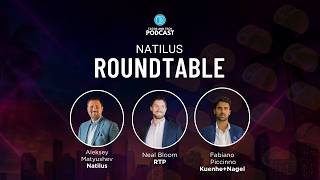
Natilus CEO Alexei and Kuehne+Nagel's Fabiano Piscino discuss how a blended wing-body aircraft design cuts drag by 30 percent and cargo costs by up to 50 percent. Natilus plans first flight of its regional freighter within 20-24 months, with broader market entry in the early 2030s. The partnership will test routes where the new design replaces trucks in congested markets like India.
Chapters
[NOISE] <LYRICS>Startups get them party started— startups! Startups get 'em party starting... You want tech n tacos? Tacos?!
Tech—you know we got it hey!</LYRICS> And welcome back to the Tacos and Tech podcast. I'm your host, Neal Bloom, and I am thrilled to have here aerospace experts from the industry to lead a great conversation about what's happening today and what's happening in the future with us. Let's say, ma chev. From Natilus, and Fabiano Piscino, Global Head of Sustainability for Air Logistics from Kuehne+Nagel. Guys, thanks for being here.
Thank you for having me.
We are here at Natilus HQ in downtown San Diego on a beautiful May day. Great to have you here in town joining us. Love a good in-person conversation. Do you wanna start? Give us a little bit of your background, kind of area that you focus on, and then we'll dive into a deeper conversation.
Sure, yeah. I'm globally responsible for all sustainability topics within the air logistics at Kühne Nagel, a global freight forwarder, asset light actually, and trying to— going from the relations to the carriers, reducing the emissions in the transportation for the customers, for the shippers, and also looking at how can we implement new solutions to make this transition faster.
Amazing. We're going to talk deeply about how you got into that and what's the current state of that space today, for sure. But I'd say, you want to give us a little bit of background and area focus of leading Natilus? Second time on the pod, first time—
Second time on the pod, yeah. But my name is Alexei, the CEO, one of two founders here at the company. Before starting the company, I had about 18 years in aviation and defense, uh, typically leading engineering teams through aircraft design programs, everything from commercial to military aviation.
Well, we had a great conversation maybe about 6 months ago. We'll get some updates on where the company is from now, from when that last episode airs, and where the industry as well too. And why don't we start with that a little bit? Like, what's happening in aerospace these days? What's top of mind for you?
Well, I think aviation is very cyclical. Right now it seems like we're in the defense phase of aviation in general. So of course with this new administration, there's a huge focus on military applications, dual-use technologies, of course, and Nautilus has been taking a lot of advantage of that. Here in the United States, that's a very strong backbone of aviation in general. So folks like Boeing and others really use those government dollars and those government contracts to help aid the commercial side of the business. So the company is still very much focused on sustainability, operational efficiency, of course, which is how we got in touch with Korninegel and of course Fabiano. to have this conversation. But at the same time, there seems to be a renewed interest, of course, for Department of War applications.
And did that come from a logistics angle because of the amount of logistics we're seeing that needs to get moved? Is that kind of where it comes from?
I think there's a lot of renewed interest on many levels. Logistics is certainly part of it. You know, I think there has been a lot of focus on the Pacific region in general. Specifically, that has got a lot of logistical challenges being such a theater that the United States hasn't really been in in a very long time. And so Strategic Lift came capability, of course, sustainability from the focus of extending the range of certain airplanes and platforms has kind of really gotten renewed interest.
Yeah. Oh, and great to be able to prove out the need, the desperate, urgent need though, for movement of goods, unfortunately in times of war, but in general, just of movement of needs is definitely super important piece right now.
Absolutely. Yeah. So we had, we as a company have never lost sight of the sustainability focus for our commercially-minded customers, but Yeah, there's definitely a renewed interest in how do you also take some of those thinking and ideas and bring them over to the Department of War.
Yeah. Well, and I think also defense and time of war has kind of also put up this critical piece of fuel volatility, right? And the need for sustainability in the place of when, uh, the price of fuel is actually so volatile. Is that something that comes into play in kind of your area?
So yeah, since the beginning of this War, we've seen a huge spike in the prices and that has affected a lot also the logistics part of it and the cost for, at the end, for our customers, the shipper of the goods. Also had a big impact on the capacity because big hubs through the Middle East like Dubai or Qatar have lost a lot of capacity. But the fuel price is what has really had an impact. And for me, it's a lost opportunity actually that we could have they had with sustainable aviation fuel. Sustainable aviation fuel is a renewable fuel today, mainly produced out of waste vegetable materials such as used cooking oil or even from the meat production tallow to produce a more renewable source for aviation fuel that can be put into today's aircraft. And it's happening already all over, all over the world. So it creates an independence also beside the sustainability effect, so independence from the energy perspective. That is not tied to the fossil prices. However, all the contracts, most of the contracts that are today in place have been tied to the index of the fossil fuel. So, they increased also with this price spike, which is really a lost opportunity to show that investment into sustainability solutions is not just about saving the world. Yes, it's important, but also it's a question of energy security, business continuity, and gives access and not to, to new opportunities and decentralization of this dependency of this few locations in the world that are tied today to the fossil fuel. We can, we can reduce that impact, but there was a lost opportunity and hopefully moving forward now we do as an industry a better job in, in, in that.
Okay. What sets the state? Oh, go ahead.
Yeah, I was gonna ask the idea, do you know what the current price of Jet A is? Is, is double right now than what it was right before the war? I think it almost doubled overnight and it's really interesting too because airlines are a really low profit margin business, typically 3 to 4% and all of it is tied to fuel. And so nobody's making any money right now, it seems like on the carrier side.
Venture? I don't know their numbers exactly, but yeah, roughly 30 to 40% of their spend is the fuel price. So if that increases by that much, I think that's—
A little wipeout.
Yeah, you need to take out airlines already, right? And so, right, so it's real.
That's for sure. I flew in here, right? I'm based in Switzerland, so I flew in here through Chicago, and on the flight here, the economy class was practically empty. Maybe 30% or even less.
Wow.
Filled. And that is also to do with higher prices, also insecurity because they don't know, they've heard about certain airlines being grounded because there's not enough fuel that they're saying some don't want to take the risk of them just being, you know, stranded and not being able to go to fly back. This, that is something we are hearing in Europe at least as a real source concern that, yeah, that people are having. I don't know how much that had an impact, but it was, it was impressive. I've never seen a transatlantic flight this, this empty.
Wow. Well, it sets, that certainly sets the stage for where we are right now. Why don't we talk a little bit about your businesses related to that? So within Canon, like, take us through a little bit of like, what's the daily, amount of cargo being carried and what's the footprint that you guys operate in within the globe? Like, give us a little background on KNX.
Yeah, so as I mentioned at the beginning, we are an asset-light company. We do all modes of transportation, actually. We are pure freight forwarder in the air freight sector, meaning that we don't own any aircraft. So we work with carriers, with basically all the big airlines that you might think of, whether it's passenger airlines or pure cargo airlines that only have cargo aircraft. Roughly, globally, it's 50-50 how much is transported in the belly of a passenger aircraft or in a pure cargo aircraft. And we do the transportation globally. So we are a Switzerland-based company, but we operate globally. So the US, for example, is a big market, right? And Asia is one of the biggest from export point of view, going into Europe, going into into the, the US and North America overall. And so through the asset-light business, we try to find the capacity and do a door-to-door service for the customers to pick it up at their location, bring it normally via truck to an airport or to a port for, for if, if it goes via sea. And then at the airport where it comes, do the entire part on the inbound part for the customs and everything, and then bring it to the end location if needed to the customer's facilities. So that's why we connect really door-to-door. We have the warehouse also in between where we do, of course, all the warehousing-related stuff, even some fulfillment centers. And from a sustainability perspective, I mean, transportation has a huge impact. It's depending on If it's just the freight transportation without the passenger, depending on which source you're looking at, it's maybe 8%, 7-8%. You hear a bit different numbers. I mean, what the impact is in terms of CO2 emissions, but it's for sure clear that it's really high, and it's also something that's only increasing, right? We are seeing an increase. I mean, aviation, all the forecast you see, it's going to increase, especially in countries, for example, that are developing, like in India. Where the demand is clearly not at this saturation. Maybe over here in Europe it's more at that point, but I mean, it's only going to increase. So, if we are not able then to reduce the environmental impact of it, although, you know, the aviation part today, the numbers are small depending again, percentage-wise, how you measure it, as other sectors are going to decrease their emissions through new technologies, the aviation is the one that's probably— Increasing. One of the few that's projected to increase its environmental impact because of the growth, together with just being a hard-to-abate sector with the slow implementation of new technologies that reduce the emissions by a factor that's higher than its growth. And what the projections today are, it's the opposite. So we are trying to reduce that. I mean, on the air, that's my responsibility, the air logistics part. Mm-hmm. To reduce that through different kinds of solutions that can be implemented today, but also looking how can we implement for the future.
Got it. Yeah, and as we've talked already, it's, you know, some of these were a maybe less business imperative and becoming more and more a business imperative too because of the volatility of prices and just demand for air cargo in general, right? Like demand for it. Why don't you take us through a little bit about where you've seen sustainability piece be within Mattelis, right? It's at times you've heard different things from different airlines. Maybe kind of give us the perspective of the imperative piece that you hear from your customers.
I think, you know, if you look at a global level, most airlines today have sustainability goals in some way, shape, or form. I think the date is 2050 for most of them right now. There's some more ambitious ones, but it's at the forefront of everybody's I would say mind. I think even for the first time, there's chief sustainability officers now within these large carriers and airlines. But really, not only the conversation is really about sustainability, of course, CO2 emissions, and as Fabiana mentioned, like, it's a very hard to abate sector. There's really not a lot of things that you can do. We're still very heavily dependent on kerosene-based fuels. And of course, you mentioned sustainable aviation fuel, SAF, as being one of the pillars of how you actually get there. But the problem with SAF is it's the supply and the demand curves of it, right? So sustainable aviation fuel, there's really not a lot of supply right now, and the cost of it is about almost double the cost of Jet A. So, you know, Jet A prices, just say it increased by double, then that means that SAF doubled as well. And so right now I can't imagine a lot, unless they have pre-purchase contracts, a lot of these airline carriers would not be flying SAF because it's just too expensive. But yeah, the problem with SAF is just the low rate of production, and then also the amount of energy is actually needed to create SAF. 'cause it's still synthesized with kerosene-based fuels. It's kind of like what you see with ethanol at the pump here for normal cars. So there's still a long ways to go on that. But from these airlines' perspective, sustainability is all about, of course, the emissions side of it, but also the operational efficiency of it, right? So how can you reduce the cost of the operational side of the airplane, which is of course where Nautilus comes in? So we're able to reduce per-passenger seat-mile cost by 50% using our blended wing body technology using existing engines right now. And of course on the cargo side as well. So we work both with cargo carriers and passenger carriers as well. But I think the promised land for everybody is hydrogen within aviation. It's been talked about for such a long time. And of course, we're partnering with ZeroAvia to really think through it. But hydrogen itself has got a lot of, I would say, technological challenges and supply and demand challenges as well. So it feels like we're in the early days of both, you know, sustainability within aviation, and there doesn't seem to be just a catch-all solution that we'll probably see for the next 20 to 30 years. So I think behind closed doors, most of the carriers would say like SAF is the only thing that logically makes sense, but we have to get the supply and demand curves fixed. And so there's still a lot to do there. And I feel, I feel like there should be more startups, more technologies really focusing on that in some way, shape, or form.
But let's dive deeper into the Blend Wing Body just to kind of double-click on that. Like where did that From the beginning, with that in mind, you found a way to focus on design of the fuselage and not the propulsion. Take us through that, that kind of iterative towards sustainability piece.
Well, for us, it was called operational efficiency at that point, how we reduce the operational cost for the airline carriers, but then it kind of evolved into sustainability because sustainability, it was just labeled that way then. And so, yeah, the unique shape of the airplane is what allows the 30% reduction in drag. And it's just due to the airflow shape of the fuselage. It's pretty much straightforward and been documented quite a bit in academia. On top of that, we also carry more goods or people. And so for cargo especially, it's very important because a lot of air cargo is very volume-centric. It's not really weight-centric. And so with the blended wing body, you're able to introduce a lot more volume capacity or cubic feet into the fuselage, which is, of course, why carriers really love the design and the approach that Nautilus is taking. Mm-hmm.
Where are you seeing innovation from just carrying a cargo around that? I mean, you mentioned SAF, but where else?
Yes.
Within Atlas and others.
To build also on his point, what's extremely exciting and interesting for us there is also because SAF is more expensive and it's going to be projected to be more expensive for at least a certain amount of time, right? Until we bring the maybe certain technologies down or Also when, when there is less subsidies for fossil fuels, not something I think that's gonna happen anytime soon, but the fact that it's more expensive, it's limited to who is willing to pay today to that it's actually implemented, right? Because the supply is not going up is if there is not enough demand. Also there needs to, of course, all the facilities need to be built and it needs to be scaling in time, but if they need to have a clear demand, to be sure that they can scale and build those plants and that they get those final investment decisions as well. So the interesting part here is really the fuel, through the fuel reduction, the more higher efficiency, you need less fuel, so it's less cost.
Mm-hmm.
Right. And whenever, you know, sustainability and economics go the same way, then it's easy. It makes absolutely sense. There's no reason not to do it. When it's the opposite way, by just using the SAF, then it's more difficult because how do you, you know, how do you value those two things against each other? And there's some companies who are willing to invest and invest a lot, but still it's a minority. And the scalability is probably limited because there's, to those who are rather high margin sectors, like in high tech, in pharma, in the luxury brands, and those are the ones that we see also invest in this, and this is where we talk from the cargo side of view, in these technologies or solutions. Yeah. But what about those with the lower margin, like perishables, flowers or fresh fruit, salmon that's shipped around there where the margins are much lower? So the willingness or even ability to pay there is much more difficult unless the end customer's willing to do it. So what makes the Nautilus very appealing is that through this price reduction, now you have— I mean, to this fuel efficiency gain, you have reduction in the emissions already directly, plus the cost reduction. Now, through this cost reduction, theoretically, you can also use it and add more SAF into it, and you're still at the lower price or at price parity. And now you didn't just decrease the emissions by the 30%, that's the fuel efficiency, but even the additional SAF. So that's what we're trying to do also in our analysis. Maybe it's 50 or 60%, we need to find out. What those numbers are at the same price. And that's something that's scalable. That's something that then a lot come, yes. I mean, if I pay the same and it's lower, much lower emissions, it's cleaner, right? And of course, I mean, no one is like, would not, no one to do that, right?
And then Fabian, I, correct me if I'm wrong, but isn't in Europe, there's like an, now an emissions tax on just passenger tickets in general and possibly even airfreights?
So there is, there's a couple things. There's on the one hand, there's a mandate since 2025 that all the European airports of certain size on average, the so-called union airports, need to have 2% SAF blend. At the moment in the UK, it's even already, it is at 3.6%, I think, or somewhere around that, and it increases every year. While in Europe, I mean the rest of Europe, European Union plus Switzerland, some countries, it's every 5 years where it increases, there's a jump. And that creates, however, on the supply side, or a clear demand, right? There's clear quantity that what needs to be blended in, and then it's basically it's a higher fuel price that you're paying because you add something that, that has a higher cost. That's one thing. The other part is the, there's the EU ETS, the emission trading scheme that basically per the sector there is a capping of emissions and that you have to buy allowances, so-called allowances, which is basically a right to emit. So whatever you emit, you need to buy them. There are currently, I've not sure what the exact price is, but somewhere around €90 to €100, a bit more in dollars per ton of CO2. So meaning that the less you emit, the less you need to pay for that. And that has an impact, of course, that, that is some sort of a tax at the end, is a carbon tax, but it depends a lot on where the price is of these allowances on the one hand. And it's also just limited today to the intra-European flights, so from Europe to Europe and not on intercontinental flights. So limited, basically the biggest part of the emissions comes from the intercontinental flights. So it's limited, but yes, there is, and those can already be used to reduce the price gap of the sustainable aviation fuel. So that helps in this development. It's always the question how much, you know, stick versus carrot. In the US, we see more the carrot, especially in California or in Illinois, that there is a lot of subsidies or tax benefits for the use of production of those fuels. And in Europe, it's a bit of both, right? It's a stick because the mandate you have to, and otherwise the carbon tax, bottom tax or the UETS, but also helping with some allowances to reduce the price gap. It helps, you know, for free market, always it's difficult to say, hey, no, we should, we should regulate everything, but it helps to create a clear demand and scaling it up there for sure. However, also they receive, from what I hear, is that the fuel suppliers take advantage of that because, you know, they have to pay the 2%, so they, they blow up the price. Yeah. Higher to what it's supposed, or what it could be, let's put it that way, because the demand side is there. Basically, there is a market clear. And they also include now from 2030 synthetic fuels. So CO2 or so-called power-to-liquids where you create an aviation fuel using renewable energy plus CO2. They can be from the atmosphere, from a point source, and basically do a chemical reaction Very simply put, to create an equivalent of a jet fuel that can go into today's aircraft.
Interesting. Really interesting. Few areas. There's also something you said about the age of the fleet, right? As planes get older, become less efficient, or they just have older engines and other pieces to that. What is that something that is, comes into the calculation sustainability-wise, or just like the planes that are being used now and the backlog of new planes?
That, that has a big impact actually, because Historically, we are seeing overall on average 1 to 2%, you know, fuel efficiency gains, I think, on the worldwide fleet. But every new generation of aircraft is much higher. I'm not sure now if you're talking about 20% or something like that. You hear also there different numbers and I don't know exactly the number, to be honest. But so the newer the aircraft, the engine, also the maintenance and everything behind it, the higher the fuel efficiency, the lower the emission. So that has a big impact and that's what we also see So while passenger aircraft on average are younger, I've heard also numbers there, 10 to 12 years, the cargo aircraft are normally older, maybe former passenger aircraft, they're 25 years or older. So they have much higher environmental impact and fuel consumption than the newer aircraft. And that's a bit the question. Of course, there's a lot of capital, you know, in there. Yeah. So just getting rid of it and putting always a new one is difficult. Plus, I mean, even if you want a new one today, you don't get it right away, right? There is a backlog in the production there to get them in time. So all those things, they play together, right? And it's normally from a lifecycle assessment or circular economy point of view, it'd say, hey, let's extend the life of a product as much as possible to reduce the emission, the environmental impact. And aircraft's probably one of the of the cases where it's not, where it's not true because the impact of the production of the material, everything that comes with it, and maybe disposal of it is lower than what it's on in its use phase. So you can recuperate much more during the, during the use phase of it.
Interesting. I think you can speak to the shortage of planes a little bit in terms of what you hear from airlines as well.
Yeah, so right now I heard that the latest backlog is 12 years. So if you were to place an order today with Airbus or Boeing for a narrowbody, that's just for a passenger brand new airplane or even cargo. It'll be, it'll be 12 years before you receive the airplane. And then just to also, you know, like the perspective of old versus new. So most airplanes will have a lifecycle or lifespan of about 30 years. And Fabiana is absolutely right. So like the airlines will have the airplane for about 15 to 20 years and then the airplane will be, you know, if it's useful, be converted to a freighter. And so usually the freighters only operators tend to have really old airplanes, which are less efficient. Easier for them to acquire these assets, but then also the operational cost and of course the efficiency gains that they gain from it is a lot lower. There's only a handful of, we call them large integrators or large cargo airlines across the world that actually can't even afford a brand new airplane right off the production line. And those will be like the Cargoluxes of the world, the Atlas Airs of the world, the UPSs and the FedExes. Most everybody else will buy secondhand airplanes in the used market and then convert it into a freighter.
Hmm.
So how is this going to play out with a shortage? I mean, at some point backlog will be 30 years, right?
Yeah. Well, yeah. So like the, the amount of airplanes that need to be produced is almost doubling over the next 20 years. And so it's become like a huge problem on the airline side. And so this is of course where Nautilus comes in is, you know, manufacturing capacity is something that is a huge concern to a lot of these airlines. They can't even grow their businesses. They're limited by the production rates of of all these airplanes. And so there kind of seems to be at least enough market demand for a third large OEM to be put here in the United States or somewhere abroad. And of course, that's really where Nautilus' ambition is. Not only are we going to be more efficient, but also provide that manufacturing capacity so like the global economy can actually grow with the demand that is actually projected.
And Nautilus is coming to market with a cargo plane first and then a passenger next. Or passenger and cargo. That's single aisle kind of size plane. Take us through a little bit of that, you know, strategy with that.
So the first product is the kind of regional freighter, freight only, easier to certify, faster to get to markets, really great at regional routes. So like think about, oh, actually here in San Diego, yeah, I'm actually the worst route in the world for FedEx. It's quite comical, but there's a Tijuana International Airport is right here. Not a lot of people know, but the fact that there's actually an airplane that flies, it's an ATR 72 turboprop, so like a 60-seat passenger airplane. It flies 10 minutes every single day from Tijuana International Airport, which is what, like 20 miles away from here, directly to San Diego, which is, you know, 5 minutes by car. It's like a 10-minute flight every single night for FedEx.
For just repositioning a plane?
No.
Or is carrying cargo?
Carrying cargo from Tijuana over to—
Just to custom, uh, the Western Territory lines on the—
Yeah, so they could truck it, but they actually fly an airplane 10 minutes every single day. It's one of the shortest flights that I've ever seen in my life. But anyway, FedEx and how they built their networks is very interesting. But yeah, all that to say is like, there's a lot of inefficiency sometimes like that. Obviously there's a demand curve for it, which is why the airplane flies. But yeah, it's like, there's a lot of things like that that are just, you sometimes just wonder what's going on, so.
As well as just, the way that our cargo world has evolved? I mean, we don't necessarily, we have different kind of cargo at different shapes these days as well too. So how does the blended wing body really kind of affect that?
I think for us, it's the cargo bay section's more rectangular. And so when you think about stuffing, you know, rectangular boxes into a circular fuselage section, there's a lot of inefficiencies and a lot of dead space. And so with our airplanes too, the way it loads up naturally seems to be a little bit easier. And so, you know, the cubic feet that we're able to offer as well as, you know, the containers that we're able to do are more prone to what the actual box is going through the networks actually physically look like. And so of course that creates certain operational efficiency gains as well.
Amazing. Well, why don't we talk a little bit about the partnership? And you want to share a little bit of the partnership between Nautilus and KNN? Tell us how you guys first came to meet and what it looks like today.
Well, actually I got, let me think back, someone within the company has basically introduced me to Nautilus. I'm not sure if we even had to talk to you, But, you know, when I saw that, I went digging a bit deeper into it to understand, right, what it's about. And then it sounded really interesting because also, you know, for me, I'm trying sustainability topic to see, okay, where are innovations possible? And it's maybe a little bit limited, or if you're— it's easy not to look a bit beyond to, you know, where we are already with, with the aircraft that have been looking more or less the same for, for quite a while. And so for me, it was always what innovations can we bring in to actually, you know, advance and have this disruptive technology advancement. And so when I, when I saw that, it seemed really interesting. And so I reached out to understand more. And then the more I knew about it, the more it, it felt like it makes sense because there is, on the one hand, this sustainability topic is first. For my personal personal motivation and also my role within the company, but then also the aspect, you know, that it can have cost advantages makes it always easier, as I said. And the further it has operational advantages, for example, like when you can fit more cargo or bulkier cargo in there, I think that because sometimes we get to limitations even. So that helps in all the areas and then it makes it easier, I think. And one part that's interesting for me is also I always like to show that sustainability is not about you cannot, you should not, right? Because if you hear, it's like, use less energy, use your car less, which makes sense because everything we are doing today, the way we're doing it is creating a negative externality and environmental impact. So for me, it's always how can we do things differently so that we can keep on doing the things that, you know, the world is not gonna move on without flying, without aviation. So that's out of the picture. Of course, there is certain limitation how much we should. That's not my area now where I want to, you know, define because almost philosophical question. But here's like showing, hey, it's about the topic, is about technology, it's about innovation, it's about doing things differently, gets people excited. Also, when I talk to customers, it gets them excited about the topic because you need to create something that creates attention, right? Yeah. And so with that, it helps, and I think it's a perfect example for that. And then I'll leave you with a forward trend.
Yeah, of course. I mean, Kuehane Nego is one of the world's largest freight forwarders, and so the amount of goods that they seize that comes through their network, whether it could be, and also intermodal, which is very interesting too, where, you know, you have everything from trains, I'm sure you guys use, you have ocean freights, you have trucking, of course, and then air freight is just another piece of the puzzle for you.
Trains, very limited. Very limited. Yeah, a lot of trucks, but we are number one in sea freight and still in air freight, um, last year at least according to last year's numbers in terms of volume moved. So yeah.
Yeah, it's quite interesting. And as we started the company too, what really got me interested in air freight in general was actually we got connected to a freight forwarder, which became Quantinagle. You guys acquired them out of Los Angeles eventually. So, but salmon was the story of Salmon. So they brought me into the warehouse and I literally saw like salmon boxes, like in styrofoam boxes coming in from Chile on ice and like the, it's like something broke and like, it was just like wrapped in with like aluminum foil or something like that to keep the heat there or like the coolness there. But like the casing broke and there was just like salmon everywhere. Like that was just all over this warehouse. And like, I was just complaining. It's just, they have to throw away everything because like, it's like perishables, cold chain, all this stuff is so complex that people just don't realize it. But— became very interested in Aerofit. And of course, when Kwane Nagle approached us, I really wanted to understand like how they view— because they have one of the single, I guess, pieces for sustainability and operational efficiency across the entire global level. And that is a dataset that I just, you know, when you start applying sustainability and fuel efficiency to that, it's such a compelling story. And so that's what really I think with Kwane Nagle and us that we really got excited about working on is just trying to understand what carbon wing body technology or more sustainable aviation could do on a global scale to you know, for Juan Diego's customers and of course, on carriers as a whole. So that's, that's such an important part of the story that we just never would have been able to tell.
Mm. And I believe you were undergoing like a technical feasibility study together, right? To evaluate the impact of integrating Blend Wingbody into operations. Is there anything preliminarily you can share?
I think it's still early days for us, but it's something that we want to get to quickly.
Okay. Anything from a feasibility study you're hoping to get preliminarily?
Yeah, I mean, We're looking at various different things. So, selecting which routes and where it could make sense, right? Either it's supplementing or replacing existing transportation modes, because I think we can look at it holistically because it opens up more, more opportunities. And for me, again, first show what can be the environmental impact if we scale it. And with all the, starting with the Kona, with the small one, but also with the bigger ones that are planned, even the ones that are not that far ahead yet, but as pure cargo, a large one, you know, that would be the one with probably the biggest impact for us. So to see where it makes sense also to use it, because again, the smaller the corner could be— I see it more as replacing a truck based on the payload and the range and everything. But in certain locations, it's actually complementary where there is regional, geographical, or topographical limitations for a truck, or even what we're— what one idea is like to look into is in very, you know, a lot of congestion and crowded, like in India, where it could be very interesting to use it even for shorter distances. So I think there's a lot of applications that we can look at that are extremely, extremely interesting and see how we can complement the business and how we can move it forward. And from an operational perspective, also that we're able to give feedback to to Alexei and his team, so that he knows what would make sense, what would help us in making more attractive. And so I'm really excited to see what's coming out of there. See actually what, you know, to put some numbers behind it.
Ah, yeah.
To see what the overall impact is to give an idea. And there's even some customers already that have shown a lot of interest to know more, to even maybe, hey, can you use our routes? Can we look into those and how we can complement that? Because they also want to be associated with something that's more you know, how can they move technology ahead? So it's, it's, it's really exciting. And I think it's, again, it goes, it goes against that boring narrative maybe sometimes that you cannot, you should not. And, uh, you know, we should all live in, in the woods to be more sustainable, which yes, it would be true, but no one wants to live like that.
Yeah. You gotta, you gotta do big things, you know, you gotta change not just the narrative, but the way things are actually done., and it takes businesses to actually lean into that. So it's a big deal that you're actually looking into that kind of aviation, not the 1% incremental, the stepwise function change, which it sounds like can get from, from a blood-to-end body. What do you think is timeline for full getting data out to see that this is feasible in some kind of this global and from a product perspective too?
Well, I mean, to the data, hopefully soon is what I will say. But from a product perspective, we'll have first flight of our Konae in the next 20, 24 months. That's what the company's laser-focused on doing. And really show it to the world what a blended wing body could be and could do. And so we're really excited for that. And then on the horizon, I mean, it's still early days, but it's hopefully in the early 2030s for market entry.
And that's going to have a potential to be cargo as well too?
Yeah, it's still used cargo. It's definitely been a focus on that airplane as well. And yeah, we'll see how much we can push it, but passenger first and the cargo second on the Conqueror.
We're going to get a lot of data from the study as well, just seeing the needs of the kinds of planes, the size of plane for the different routes. I mean, you mentioned the Tijuana to San Diego, could it do more or less with a different size plane, right? I think you've also talked about kind of the San Diego to Imperial Valley route is another— Days of independence. Right, so lots of studies to come while you get a plane up in the air, which is exciting. Anything else, Blast leaving, that's exciting to you kind of aviation today besides its blended wing body as a design change?
So there's, There is a lot of enthusiasm around it, even though, you know, maybe that's not so public at the moment. But when you talk to the experts, you know, within the different companies, you see that it's tough, it's difficult, right, to move forward. So that's why it does such a— new ideas can, you know, really help to propel it fast and create the excitement. We need excitement as well, right? And we need the success stories. So we are looking in various kinds of things, also different Sustainable aviation fuels, as I mentioned, that goes, we can combine it with that. We have an offtake agreement with a new production plant that uses concentrated sunlight, right, together with mostly CO2 and methane from biogenic sources to create a power-to-liquid that can be used to propel that. And then we've had some discussions even with hydrogen and also you mentioned it before, right? Hydrogen can be, is what a lot see as the future for aviation, while a couple of years back, actually, it was even for trucking, say, long distance will be hydrogen and short distance will be electric. However, now you see everyone is betting on the electric in the trucking. I don't see it for aviation, but I see for aviation really hydrogen. This makes more sense. But the thing is that the targets are 2050, as we heard. Until 2050, because also those cycle times of the aircraft are so long. Even if we had the technology today for hydrogen aircraft, it would take 25 to 30 years probably until we would have like really a lot of hydrogen aircraft in there. So, and of course this technology is nowhere near being deployed. So until 2050, sustainable aviation fuel together with more efficient flying is extremely important. Yeah. And that's why I think it did— this collaboration makes a lot of sense and For us, it's also, you know, we have a global name, we have a global reach. We work with basically any company you can imagine. We work with them probably in any way into transportation because most of them do. Even if you think, you know, like some more software-heavy companies, they have a lot of data centers, right? They have a lot of material that they need to ship as well. And, or any, in any industry you can imagine, or most of the industries. So they're customers. So we have a reach also there. That we can discuss it and make it more visible and show and see if the technologies make sense, right?
Yeah.
But I really love the aspect that we can accompany that and that we can use our name in creating, even though we are asset light, right? It might be counterintuitive. They can still help that, that getting the name out there and getting the technology and see what comes after the study with the results. I think that's when we can really start planning the next steps. Whatever's ahead, whatever comes out from there.
Yeah, very exciting. Well, we're excited for the data, but congrats on the partnership here together. Sounds like kind of just the beginning. This being the Tacos and Tech podcast, we gotta end on food, which by the way, food has moved globally, obviously every day, fresh products, manufactured products. On our last pod, we talked about bicoastal taco favorites? Is Rocco's still the favorite?
Rocco's still the guy. I was just there a couple weeks ago and it's still, it's still got it, man.
All right, so I gotta accompany you on a Florida trip. We all gotta go see if that's the best tacos on the horizon. Uh-huh. Where do you, do you have a go-to taco spot somewhere in the world?
I wouldn't say the go-to because I mean, I don't always go there, but the best I've been to was in actually Mexico City. Maybe a lot of your audience might not like that, so I Fully, I'm fully plant-based. No, that's what I'm trying to say though. That's one that has everything plant-based. I don't remember the name to be honest, but it was in Mexico City. It was even incredibly cheap and we ate so much and were all like, like really good options there, which normally, you know, when you have the plant-based ones, they're sometimes a bit boring. There, that was not the case. So I'm there and always spicy. Always spicy.
Has anybody said Taco Bell yet on the podcast?
People said Taco Bell. There's a time at 2:00 AM in the morning when Taco Bell is the best option, you know?
Sorrel sexy.
The only, you know, for sure. We have some phenomenal non-meat options, you know, whether it's a mushroom-based taco or a cauliflower taco, you know, that some here, even in San Diego, they do really well at. So love the alternative meat and plant-based options there too. You know, there's no wrong— you can put anything in a tortilla, that's for sure. Well guys, thank you so much for this conversation. Really appreciate it. And excited to check in again as we continue to, I mean, honestly, based on the beginning of our conversation, which was such a macro necessity, the world is changing. We need these changes now. And you guys are focused on that. It's coming into view that the stuff you're working on needs to happen as soon as possible. So thank you for working on those.
Cheers. Cheers. Woo!
Startups get the party started. Startups get the party started. You want tech and tacos, tacos and tech. You know we got it. Tacos and tech is on smash for the green. Guacamole, keeper, accountants counting beans. Contador cuentan frijoles. Founders trying to raise some queso. La vida San Diego. School of Rappi rapping fire. Tortillas, Juan, jalapeños in these modern times. A craft beer and coffee. My coding yoga posse fold the body origami. We be surfing Coronado, eating tacos El Gordo. The tacos standing puesto, lucha libre and sombrero. Gotta shout out Tech Coast Angels by the ocean, watch the sunset. The Hoya Shores entrepreneurs trying to get funded when San Diego Startup Week is popping in the summer. Oceanside to Tijuana, SD be full of hustlers, from couch surfing to penthouses right on the beach. Tech leaders who believe stars are within reach. We interviewin' founders who be shootin' for the moon. #SDTechos with your host Neal Bloom. Startups get the party, startups get the party started. Startups get the party, startups get the party started. Startups get the —Startups get the party started! You want tech 'n tacos? Tacos n' tech?! Yuh know we got it hey!!! Startups get the party... startups get the party started!! —Hey!!!! Startupz git da paartyee startupzz gittt thaa paaaartiiiiee starttttedddd yuuu wanna tekkin taacooooos?? Taacccooooss nn tehccch??? You knoooowwwe gooot iiiit heyyyyy!!!!!








