"Will This Smart Home Automation Pitch Impress Venture Capitalists?"
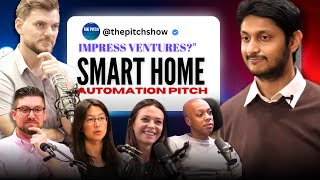
Duvall pitches Lotus, a wearable ring that controls smart home devices through infrared, targeting people with limited mobility. Venture capitalists including Neal Bloom and Elizabeth Yin grill the founder on product details, market size, and pilot commitments.
Pitch three, day one Hardware.
It's notoriously, well, hard. It's expensive to get started. You've got to build all these prototypes. It takes longer than you think to get to market. And when it's time to scale, well, that's hard, too. A lot of investors flat out won't invest in hardware, which is why we've been hesitant to bring those companies on the show. But then I met Duvall, a founder who wants to turn every home into a smart home without using any smart tech, making it so easy, even great grandpa can do it. It's the Moonshot hardware company I've been looking for. Hey, Alexa, Will Duvall get money on this pitch?
Sorry, Josh, you will have to listen to find out.
Alexa, you're worthless. I'm Josh Muccio, and this is the pitch where real entrepreneurs pitch real investors for real money.
Hi, I'm Paige Vendorti, founding partner behind Genius Ventures, and welcome to San Diego.
Hey, I'm Neil Bloom, managing partner at Interlock Capital.
Hi, I'm Elizabeth Yin, general partner at Hustle Fund.
I'm Mark Phillips, founder of eleven Tribes Ventures.
Hi, I'm Charles Hudson, managing partner of Precursor Ventures.
The pitch for Lotus is coming up after this.
All right. Hi. Deval. Nice to meet you. Pleasure. Nice to meet you.
Hey, Duval. Elizabeth. Nice to meet you.
Hi, Deval. I'm Mark.
Nice to meet you. Mark.
Nice to meet you, too.
Hey, Charles. Nice to meet you. Deval.
Pleasure. So the story starts with me. I was born with twisted knees, and over the years, I've been on and off crutches. Now, one night a few years ago, I got into bed, having left the hallway lights on, but I was too tired to get out of bed, hop onto my crutches, hobble 10ft, turn off the light, hobble back 10ft, and get back into bed. So I slept with the lights on the entire night and woke up in the morning thinking, if someone like me, an engineer, having managed a division at Apple with 37 patents, if I don't even have smart home tech, who does? 91% of US homes were built before smart homes. Even getting an Alexa means rewiring every wall switch to connect to the Internet and pairing every switch one by one, through another app. And this disproportionately affects the 27 million people with limited mobility. Soldiers, older adults, disabled persons. So at Lotus, we've built this nice a patented wearable ring that controls objects at home by pointing. No apps, no rewiring, no Internet. Infrared eliminates the need for apps, smartphones, even Internet. Today, we can control anything. A wall switch controls lights, fans, appliances. This is a $335 billion market that's been over 80% untapped, even after a decade. And with Lotus, you can go from home to smart home in seconds. And that combination is really resonating with people. We've got 14 pilots in just 30 days. We're here to raise 2 million to go from prototype to product and production, to build a future where there will be a universe of ring controllable objects, where any person, younger or older, disabled or not disabled, can stay at home with autonomy and dignity. This is Lotus.
Very cool. So how do you install the sensors? Yeah, please.
And so these are the rings. This is an existing wall switch. You can attach a switch cover like this magnetically.
Yeah.
So step one, you put on the ring, there's a little button up here. And so all you do is that.
That's super cool.
Step two, snap on. Step three, point and click. And that's it. I'll pass this on.
Clever.
Do you have to charge the ring?
Yeah. So the nice thing about this technology is, as opposed to Internet of Things, you have to be connected to the network all the time, which is why it draws power all the time. With infrared, it's like your TV remote. It's only drawing power for the 50 milliseconds that you push the button. And so instead of charging it every day, like an Apple watch, where every three days, like an OURA ring, you only need to charge once every 90 days.
So one ring to remove. Yeah, exactly. So the ring will be connected to all the devices like this, which can be connected to the television or to the light switch or to, I mean, you name it. The fan. Correct. And so a house would have this all throughout any room that they want. And it's simply a point and click. It's going to adjust each other.
So in our pack, we're planning on giving one ring and four switches.
Okay.
For the same price that you get an Amazon Echo show today in your.
User interviews, what's the perspective on wearing the ring constantly versus making it something that's kind of like a television remote?
Yeah, we actually, to level with you, I originally thought this was a stupid idea. The bar at Apple is, does your device deserve to exist? So we interviewed people for nine months. These are detailed interviews. Nine hours long, over three days. And we didn't tell them about the idea until the very last hour. And so in the first eight hours, we would ask them, what types of devices do you use today? And Constantly. There were three pieces of feedback we got. One, we don't tend to wear watches and we certainly don't wear it at night either because we have to charge it or we take it out out of habit or, and this is true, it gets caught in my significant other's hair. It's a real, real comment. And so people don't wear it at night, which is a problem because you're in this catch 22 at night. So in a typical situation, either you have to turn off the light switch and then in the dark you're walking to your bed, or vice versa, where if you get up in the middle of the night to go to the bathroom, you're looking for the light switch in the dark. And for older adults, one third of all faults happen in that situation. So if all the ring did was only do lights and nothing else, we would still eliminate one third of falls in 33% of older adults. Which is why one of our B2B segments is actually senior living. Because if anyone falls in the facility, they get fined by the state, they get sued by the family, and they get dinged on their star rating by cms, by Medicare and Medicaid, so their reimbursement rates drop. So it's a big problem for them.
So on the B2B side, you're targeting retirement homes and the value prop to them is, hey, we'll install this ring in all of your rooms, thereby reducing your risk of falling and failure by some dramatic percentage.
Yeah, I remember when I was a kid watching tv, there was this advert, you know, clap on, clap on. But I never knew anybody who had it.
Yeah.
What do you think is wrong with that product?
Too many false positives is the shortest answer, which is any noise would set it off. Oh, any noise.
I actually bought one once. Oh, you can lie to you. Yeah, I totally bought one. It didn't, it just didn't work well. And then you would try to, you would clap and it wouldn't hear it. It's not good.
It just like doesn't work.
It just did not. It doesn't work well.
The other problem is it's only for plug in appliances. But the most important, the biggest problem with the H tech category as products is the end user doesn't want them. Nobody wants to use diapers, nobody wants to wear a life alert. They do it out of need, but nobody wants to. The benefit here is, and we've been told this directly from our end users, they just like it. It gives them more agency, more autonomy, more independence. Which is really dignity is all they want.
What can be learned from a company like Aura, Right. That has tried this form factor. They've done all right. I think it maybe has tapered off a little bit. No one here is wearing an Oura R. Lessons learned from a company like that.
Two or three. Do you have an Aura? No, just a tidbit, a couple of lessons. One, I think the hardest problem that Aura's had is that it's a little bit of a vitamin and not a painkiller per se, because it's preventive health. The second, their price point is really high. And part of the reason for that is going direct to consumer is very, very difficult. There were about 30 other companies that tried doing something similar or as the only survivor, because all of them tried to go direct to consumer. And so that's why B2, B2C is great. It's a one stop shop that ends.
Up with a lot of consumers coming from Apple. The big question in a lot of these other spaces is but why couldn't Apple just do this from the watch and the Aura killer or the Fitbit killer. Same with Apple with Smart Home. Why aren't they getting into this space?
Yeah, there's sort of three moats if you will. Lowest hanging fruit. I'll say table stakes is just patents. The second is the first mover advantage. You actually want to move into the space early because those people do not. Even when new products come out, they don't change. And the third is the secret sauce where it's not trivial to figure out the infrared beam intensity that is strong enough to get long range but not so strong that you get false reflections in the same room. It's not an impossible task, but it's not trivial.
Yeah. Especially if you're in a room where maybe you have multiple switches.
Oh yeah. Which is everywhere.
I mean, that would be an interesting test in this room.
One way to test it is to basically point in other directions and if there were reflections, it would actually turn.
It, turn it on, Right?
Yeah. And can you talk a little bit about your 14 pilots? What is the nature of them? Are they paying you?
So the bulk of them are paid. The largest one is Veterans Affairs. The second is the state of New York. They actually want 10,000 units, but we have 10. And so we're really early stage. They're planning on paying for somewhere between 50 and 100 pilot devices. And then they want to put a Pre order for 110,000 units. And then the remaining ones are a combination of disability organizations. All throughout the country and senior living organizations all throughout the country.
Those are the 14, but it sounds like they are not yet signed or where are you in that process?
So we have one signed customer, actually. They've even given us a 50% deposit. And so we have some booked revenue, but primarily we're pre product, pre revenue.
I see. How much was that for this particular.
Customer that I'm talking about was 20 units, $300 a pack. So six grand. And so they paid us 50% upfront. So three grand.
Elizabeth, I feel like we're trying to understand where are they really right now. Like, in terms of pilots, I feel like the answer is zero current pilots.
Yeah, we haven't started any pilots yet. Like I said, we have 10 units.
Okay, so zero deployed, zero pilots. But I feel like at times you're talking about like it already is happening.
No. So, yeah, I should say they've given us verbal commitments for these, but the clear answer is no, pilots have begun. In fact, we don't want them to start for another two months until we have done testing, finished test all of these 10 devices.
And as sort of a piece of feedback for you, when you came in, you said you had 14 pilots. I think the nuance, I would say, is we have 14 verbal commitments on pilots.
Oh, got it.
Or just 14 in our pipeline.
Got it. Okay, thank you.
Because I think verbal commitments are something.
Yeah.
But it's not time. They haven't sent you the money and you're not working with them.
Yeah, yeah, yeah, got it. Thank you. I appreciate that feedback. My apologies.
Oh, good.
We've invested in three different connected hardware companies. I think, like, one of the challenges that we've seen across them is like, manufacturing and supply chain. I'd be curious to understand more about how you're thinking about going from 10 to 10,000 to 100,000 devices.
Yeah, actually, that's the part that concerns me least. That's actually all I did at Apple. And so we have consistent supply chains both here locally. So the plan is if we're building less than a thousand, we'll do here locally. Then we plan to do either Mexico or Philippines. And then for 10,000 units or more, we do China. So that's actually our supply chain right now. Timing is about a month and a half.
So it's a month and a half to build a full unit?
No, no. To go from complete design on paper to end units in hand.
That's pretty fast.
Yeah, it's relatively small.
Yeah.
What's the cost profile?
So one unit and four switches. We think we're going to retail for 270. At that price point, if we only built 1,000 units, our gross margin is 64%. And if we build 10,000 units, which is actually what the State of New York wants, it's 75%. And the higher you go, the more economies of scale you get, essentially because we're using old technology in a new way and we joke about this all the time. It's pretty inexpensive, small and power efficient.
Can you unpack for a moment the nature of the round? So, $2 million you're raising valuation and then what are the milestones you want to accomplish?
Yeah, basically we want to go from prototype to product in market. So the biggest thing that's holding back right now, all these customers usually assume that it's ready and available and they want to buy in bulk, which I can't do. And so the 2 million split breaks down into 1.2 for salaries for 24 months, 0.5 for the actual builds, meaning the hardware cycles and then a little bit buffer, just time in case something else happens.
Do you have any of that committed already or are you opening the round now?
Yeah, the total we've raised to date is 425. In this specific round, in just the past couple of weeks, we raised 225k. That money was an offer that we got. So it's been a couple of angels and one institutional that came in at a 14 million post money valuation cap. Having said that, I'm flexible on terms. That's great.
So I'm really impressed with your control of this business. I really like it. It's going to be too early for us. We want to see a little bit more progress on the product. I really want to stay in touch. So it's a no for us today. I think when you do go to market, this could catch on like wildfire. And when there's another round that might be interesting for us, but for today, it's going to be a pass.
Thank.
You.
So that's one pass. No surprise there. Hardware is say it with me hard. When we come back, Duvall tries to ring the rest of them. Welcome back to the Moonshot Pitch. Here's Paige with a zinger, or in this case, a ringer.
What keeps you up at night as a founder?
Yeah, it's part of the reason I'm here. It's actually all the skills you have that I don't have. And I mean that in a very real way. I actually keep waking up in the middle of the night for that reason. One, I know the engineering really well and so yeah sure, everything's not perfectly figured out, but these are all solvable problems and I've done that for over a decade. The engineering doesn't keep me up. It's where I would say I don't have expertise. So I'm not sort of gifted in sales like you Charles, or with marketing like you Paige, in the hardware and software with given your own background, Elizabeth. But those are the skills that I don't have and I would love to not just get capital, but intellectual capital so I know how to deploy the capital well most efficiently. And so that's the stuff that keeps me up at night. That and the actual capital where, you know, we've been working together for close to a year. Not doing right by my team does keep me up at right at some point if any one of them gets sick, no one's getting paid right now and so I want to make sure they can keep their lights on.
Can you talk more about what you did at Apple and your other co founding team?
Yeah, yeah, I worked on everything from the trackpads on the laptops to 3D Touch on the phones to then finally managing an organization for wireless charging for iPhone, watch, AirPods and some special projects. So my specialty I would say is sensing haptics and power.
Do you have co founders?
No, so it's just me right now, but the founding team, the first engineer, ex Amazon, ex BlackBerry, he's a PD engineer, mechanical engineer. Our head of disability, she is deafblind herself. So sales. This person used to actually do Bizdev for the New Yorker magazine for marketing. We actually have a person, Natalie, she's actually a copywriter by trade and so she's been helping with the marketing. We doubled our team size since we got into Techstars, so now we're seven full time people, 12 total.
Is there any way to get to meaningful revenue on the 2 million without a big lumpy contract like NYC, a.
Lot of senior living. So then it would be a trench strategy which is basically you go to each one of the organizations. Like right now we're working with, one of the partners is United Church Homes. There's the second largest senior living organization in the country. And so you pilot with one, then they actually want it everywhere in their own facilities. In fact, for United Church Home specifically, they want me to come down, live there in person and actually run the pilot with them in person, which is great.
I'm impressed by you. Technically I'm seeing a complete lack of the other side of kind of the founding team who knows how to sell government, sell to Medicare. These are big complex things that I think it behoove you to have not just a hire who's done sales at a magazine but someone big level who has done this before. But I haven't seen that you've even tried to attract that talent yet from any level. So for now I'm out without more experience relevant to the space.
Got it. Thank you.
So I really think this is super clever. I love your hustle and strategy also in who to go after. I think you're spot on about thinking about no D2C and even within your B2B contracts, which ones are interesting and which ones are not. I think the valuation is a bit pricey. I think the 14 is too frothy for this business model and where you are. It's also not software which is out of our thesis, but theses often make exceptions. I'd be willing to go in at 50k but I think we're looking at like 6mil post on a safe.
Got it.
Just to piggyback on what Elizabeth said, we do a lot of hardware and I don't know why it always seems to take $7 million to get to a commercial product. We have a next gen Walker company that it seems. I don't know why it seems to take $7 million. And it always seems. And sometimes it's technology complexity and sometimes it's actually the go to market piece just takes longer and figuring out who's going to pay and how much. So I always assume that there's going to be at a minimum two seed rounds for a hardware company to actually get to a place where there's meaningful traction. And like Elizabeth, the 14 million number doesn't work for me with the expectation that there will be another seed round and there has to be some room between the today price and the future price. So I'm out on the current terms. But I would be open to revisiting it at some point in the future if the terms are lower and I have a better sense of the pipeline.
Just out of curiosity, if we took away that hurdle and we went with Elizabeth's, would you be open?
The thing I'd want to have a bit more clarity on just in a world where New York City doesn't come through, how much legwork is required to go through these other channels And I don't think I have enough clarity on that today.
Got it. Thank you.
I agree with both what Elizabeth and Charles have said. I've had experience investing in hardware companies and I feel like they're often some of my favorite companies to invest in. I think some of the things that are interesting in this is it's a painkiller, it's not a vitamin. And I think that what I've seen work well is painkiller hardware. I'd be interested in putting in 150 at a 6 mil post with Elizabeth.
Got it. Thank you. If I can respectfully counter, when we came into Stack Stars, we came in at 6. Would it be okay if I asked for 8? The big changes that happened in the past three months, we basically doubled our team size, we built our first prototypes and we got at least verbal commitments.
Yeah. I think your initial pricing was a little frothy. So I understand you've obviously progressed a lot over the last few months or so. But I would be out at 8. Yeah.
Got it.
I think it would for me make sense at 8 if you had 14 pilots. But I don't think it makes sense for me at 8 with the verbal commitments. So for that reason, I'm out.
Well, for me it was. The valuation cap was never as important. It was always more important to help the people and do it faster with the right intellectuals. So I'm happy to accept. With the six.
Yeah.
Cool.
Sad to do this.
Thank you.
Can I shake your hand?
Awesome.
Thank you. Thank you.
Awesome.
Thank you so much. Thank you so much. Thank you. Well done.
Yes.
I have.
I have a ring as well. Yeah.
We've all got hardware to get back to.
There's only 10 of them.
Thank you.
That's great. Congrats.
Yeah. First deal.
You guys are in the ring business now.
Let's go.
That's great.
All right.
Were you surprised that he took it at 6?
No. No.
Not 30 days after Techstars. I feel like you're still on that round. You should take all the money you can right now as a hardware company.
Yeah.
Did we just get you to make an off thesis investment?
Yes.
Nice.
Yes.
Do you feel good about that? Does that make you feel nervous?
No, it doesn't make me feel nervous. I think there are real gems in these areas where people categorically pass.
Yeah.
Like this category no one will love for a whole variety of reasons. That's hardware. It's very early.
It's old technology.
It's old technology. There's no wi fi, not even Bluetooth. And the thing that's going for him is his background. So he knows how to ship a product. They've done a lot of form Factor user testing. And then they seem to have had some hustle and conversations and, you know, having people try this. That's where it is.
Yeah, yeah, yeah, I think so, too. Well, I feel like I think about investing, like, specifically in founders on, like, three different axes. So the first is like, are they good? Storyteller. He was really great storyteller. He came in, had super crisp pitch. The second is, like, a strong mission, and then the third is execution velocity, which is like, how thoughtfully can they set direction, then how quickly can they execute on it? And I think he had those, like, 14 pilot conversations in the last 30 days, which was really impressive.
Something I don't know if I heard him say in the pitch. He said, like, when you design for people with disabilities, you end up designing things that are super easy for anyone to use. That's his whole mission. He's like, we're gonna design for these people first, but we think it's gonna be something that everyone will want to use just because it's so simple.
Yeah.
Well, that was awesome. I mean, that was one. I was like, oh, man, this is risky. It's hardware. But I felt like there was something there.
He was super impressive.
Yeah, he was.
He did great.
All right, cool. That's a wrap.
Are we on a break, or are we back at it?
Against all odds, Duvall raised 200,000 on the pitch show. But did these commitments actually turn into cold, hard cash for some cold, hard wear? Listen to episode 117 of the Pitch podcast to hear my conversation with Duvall. I'll see you next week on the pitch show.
Sam.








