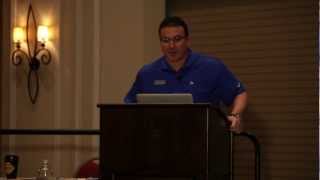
Nelson Cicchitto, Avatier CEO, presents at Helpdesk International 2011 Conference

Matthew Cummingford describes his company's shift from paper-based user provisioning to Avatier's automated system. His team manages 150 applications and faces yearly audits from six regulatory groups. Avatier's shopping-cart interface and automated workflows replaced manual approval processes.
Questions this video answers
7:15 AM
Six
150 applications
Chapters
Good morning. How's everybody doing today? I want to thank you all for coming out this early. I know being in Vegas, this is quite early at 7:15 in the morning. My name is Matthew Cummingford and I am here today to talk to you a little bit about user provisioning. Some of you may know it as identity access management. First off, we're going to talk a little bit about the nightmare that my company struggled with with our original user provisioning process. Then we'll take a look at our first attempt at an automated solution that didn' really go so well. After that we find Avatr and we work with them and we'll tell you where they've taken us today. Then I'll turn the presentation over to Nelson who will kind of give you a look at the product and show you what Avatr has to offer. After that we'll have a short Q and A session and I can answer any questions that you may have related to my personal experiences with the product or for Nelson from the product itself. If you're not familiar with the financial industry, which some of you may be. We get audited. We get audited a lot. In the span of a typical year we get audited by six different external regulatory and compliance groups. As we become a larger and larger bank, the intensity and frequency of these audits increases. Then we also have our internal audit to deal with. Typically the auditors will select a random sampling of individuals and ask to see all of those paper forms that are related to the access that was requested. We would then run to the filing cabinet and attempt to locate each of the pieces of paper for that individual. Oftentimes we couldn't find some of them. We would then go through every paper in the filing cabinet attempting to determine if something had been misfiled. We would spend several hours getting this information together for the auditors each time. Then when the auditors had that information, they would compare the information to on the paper to what actually matched in the system. From the process I'm described, I'm sure you can tell that we fell short a few times in this process. I will be honest, we fell short on about every audit related to user provisioning. At this point we were confident that continuing to build was not our best solution. We were so frustrated with developed and lack of formal support that we also began researching off the shelf products. We looked to the well known analysts and publications and looked at the product reviews. We saw that since our original research, several new companies had come into the picture. We began the process of evaluating Them all one by one to determine which one was the best fit for our company. Most of them were extremely complicated systems to use. Again, not quite what we needed. Others were very industry specific. Both of these types were eliminated very quickly. In the process, it came down to only two products, one by a company called avatr and one by another. We liked the fact that avatr supported only one build and did not have unique configurations per company. The product was flexible enough that you could turn features on and off as you desired them to make them fit your industry's need. We also like the fact that if an enhancement was made to the product that all of their customers benefited from it instead of just one particular customer that paid for that enhancement in their unique build. In the end, we selected Avatr as our user provisioning system. So where has Avatr taken us today? Where do I start? Now before you start thinking that I'm working for avatr, I am not. I am a customer of theirs and I work with this application on a daily basis within my environment. My departments also support the back end of this system. Remember those 150 applications that I mentioned earlier? This is actually one of the easiest to work with and support in our environment. This application is simple to install and when updates are available, it can be upgraded within minutes. Sound too good to be true? I agree. It sounds like a white paper that you might read on a software vendor's website talking about how their product will fix all of your issues and solve world peace at the same time. While Avatr may not be able to take care of all of the issues of the world, I guarantee they can help you with your user provisioning nightmare by creating a shopping cart system. Users can request applications and access at the click of a button. All of the workflows are handled automatically and routed through the system and audit information is collected to do research within the system. It is very easy. This is actually an example of our actual main screen. When users go in to request items. You can see that we've got some buckets for applications, assets, mobile device synchronization and telecom add on features. Diving down into one of those containers, this is our telecom add on features. Users can come in and they can request external call forwarding, international dialing, or a conference account if they need to be able to set up bridges. Now I almost forgot. Remember the audit issue that we had? Now that we have started using this product, it has taken care of all of our audit issues. Now I've been hogging the stage long enough. I'm sure you might want to hear a little bit more about the product and what Avatr has to offer for you at this time. I will turn over the presentation to Nelson, the CEO of avatr.
Thank you very much. I appreciate that.
Wow.
Matthew, thank you. I actually received a demonstration. I remember Matthew's boss, the director of it, giving us a call, saying, nelson, I want to show you what we've done. And it was then that we realized we were onto something here with the way we were using the business service catalog to drive account provisioning, deprovisioning. And it gave us a lot of ideas. And you're going to see where we took the technology. They were running kind of the second or third generation. We're now moving on to the fourth generation of a shopping cart, combining technologies that you would see in the Apple App store and maybe Amazon.com into one UI and one interface for you to manage your IT department. So with that, this is an example of the new user interface, and we're looking at a larger icon view with a description and hyperlinks, et cetera. This might be a store, a main store that you would go into where you can look at your laptops and your mobile devices. You can switch this to a small icon view where it looks just like the App Store, where it's just a bunch of icons and, and descriptions and the ability to drive down or drill down into specific items. Notice also that we cleaned up the tree. The tree is no longer displayed. You can turn that on or off. But we're trying to make this very simple, very easy, giving users the experience of logging into an Amazon.com or the Apple, Microsoft, Apple App Store. Go ahead. And the next slide here we drill down into the actual BlackBerry or mobile devices, and you can see we've added pricing to the different devices and budgeting. So what we call avatier is calling identity accounting, where you can give your employees a stipend, let's say $2,000, and they can go shopping for assets throughout your organization. And we actually have a budget calculator on the shopping cart, so they can see what they've spent and they can drill down into the actual assets and see what those assets are that they've purchased. After they exceed their limit, they can no longer shop from the shopping cart for additional assets. Identity Analyzer, who has access to what? You guys have all this legacy data out there. You have all these systems across your AS 400, your Oracle, your PeopleSoft, whatever systems you guys have. Identity Analyzer goes out there and it analyzes all of your accounts across all those systems. It tells you how many accounts have been abandoned and not logged on and how many accounts are disabled or in a state that's not functional. So this is a product we showed off to The Air Force, one of our newest customers, 1,020,000 users worldwide. And they're very interested in this technology to help solve all of their Active directory accounts that exist out there that need to be cleaned up and determine what's going on throughout their environment. It also will produce group memberships across all your groups, not just across Active Directory, but SAP, Unix, LDAP databases, et cetera. So even internal applications, once you add our connectors, our connectors tie into the whole suite. And we can analyze all of your custom internal apps that you have, your database applications, and determine which accounts haven't logged in for a while, which, which accounts belong to admin, security groups, et cetera. So Identity Analyzer is a wonderful way to really look at what your environment looks like in this particular request. This is the privilege request. You can see actual pictures of the items that people are requesting. Active Directory permissions down here, US Remote desktop to a zoom, an iPad from Carlos Santana. So you can click on these different items. The items that we're looking at right now is write checks, which is an active directory group. Or it could be a SAP role, or it could be a Oracle financial responsibility. So again, this integrates with all of your applications that you have, including cloud applications. This integrates with Salesforce.com and Google Apps, if you guys are moving into that direction. We're working to integrate with more and more cloud applications. And so what we're looking at here is this is an action to add write checks. It's going to Aaron Rodgers. The justification was spend money. He needs to spend money. You can see as the administrator that's logged in, you can approve or deny this. You can skip an approver, and this shows you the next approvers. Here's Nelson sitting down here. I received this on March 30th. I haven't responded. I've been too busy at these shows, so I could obviously be skipped. They could cancel the request. They could send a reminder to me to go ahead and approve this. But you can do all this from your phone or from your iPad and eventually your droid and Windows 7 device. And maybe we'll do BlackBerries. We'll see. BlackBerries are a little bit more cumbersome, but we'll get there. Okay. And again, I thank you all for being here so early in the morning. I know we were out, what, until 10:30 or so? Very late night for Vegas, huh? So let me.
More from Nelson


2013 HDI Conference Breakfast Briefing -- Avatier Identity Management Megatrends Driving the Future
Nelson Cicchitto, Avatier CEO, Returning Identity and Access Management (IAM) to the User HDI 2012